Maverick Transportation joins Blockchain in Transport Alliance
Maverick Transportation LLC, is excited to announce it has joined the Blockchain in Transport Alliance (BiTA).
Ultimately, the winner of the e-commerce battle, whether groceries or the greater retail one, will come down to which company better understands human behavior.
The success of electric vehicles lies in the cost efficiency and scalability of its batteries. The supply of lithium and cobalt over the next decade would end up defining the extent of that success.
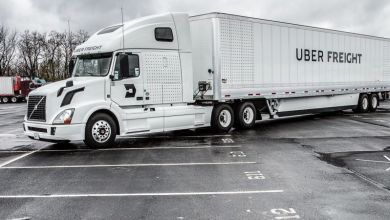
Following the announcement of the end of Uber’s self-driving truck program, Uber reached out to FreightWaves for an opportunity to discuss Uber Freight and to check the pulse on the self-driving industry.
UPS today announced a collaboration with Thor Trucks to develop and test a fully-electric class 6 delivery truck in Los Angeles.
Hapag-Lloyd believes that data standardization would help various stakeholders to collaborate together and improve the supply chain efficiency in the maritime industry.
The former head of innovation for Bridgestone has been appointed as Managing Director of Freight.Tech, an engagement platform built for companies that want to navigate the waters of innovation and market disrpution.
Without self-driving trucks, what is the point of Uber Freight?
Uber Freight is poised to rise quickly in the fragmented freight brokerage business, but there are some factors that could hinder its growth: limited market penetration of digital apps, the Uber Freight app’s weak intelligence into routes and hours of service, and incumbents’ tech investments.
ShipChain, a South Carolina-based blockchain logistics startup, successfully resolved a dispute with the Securities Division of the South Carolina Attorney General’s office. A cease and desist order entered in May was vacated yesterday.
COSCO shipping came under a cyber attack this week, which reinforces the need for comprehensive cybersecurity regulations within the maritime industry as the future moves towards port automation and autonomous shipping.
Amazon spent $21.7 billion in shipping last year – a number which could be reduced if the company took control of its supply chain instead of partnering with 3PLs.
Used truck prices in June were changed little month-over-month, but posted a 15% increase over June 2017, according to ACT Research.
According to CB Insights, “the maritime shipping industry accounts for 90% of global trade and is only now beginning to leverage technology. This shift could have far-reaching impact on retailers, consumer goods companies, manufacturers, and more.” With this important industry in mind, CB Insights hosted a July 24 webinar to “explore how shipping companies and global ports are utilizing automation and blockchain technology to revolutionize the shipping industry,” taking a look at various aspects of the supply chain along the way.
Among today’s highlights: a drop in spot rates, Werner comments on driver availability, Rhode Island collects more than expected
Hyperloop Transportation Technologies (HTT) has inked a deal with the province of Guizhou for creating China’s first commercial hyperloop track.
Leaders from several different safety advocacy groups came together to ask the U.S. Senate to add safeguards to the AV START Act (S. 1885), a bill that addresses autonomous vehicles.
Aside from providing track and trace solutions, Loginext uses machine learning to provide organized logistics and field service management solutions in the most cost-optimized way.
Chainyard, North Carolina’s largest blockchain specialist, announces its alliance with Blockchain in Transport Alliance (BiTA).
Panelists from Redwood Logistics, Slync, the Trusted IoT Alliance, and Flux Protocol discussed the difficulties of pushing adoption of blockchain-powered IoT devices, despite the technology’s obvious potential.