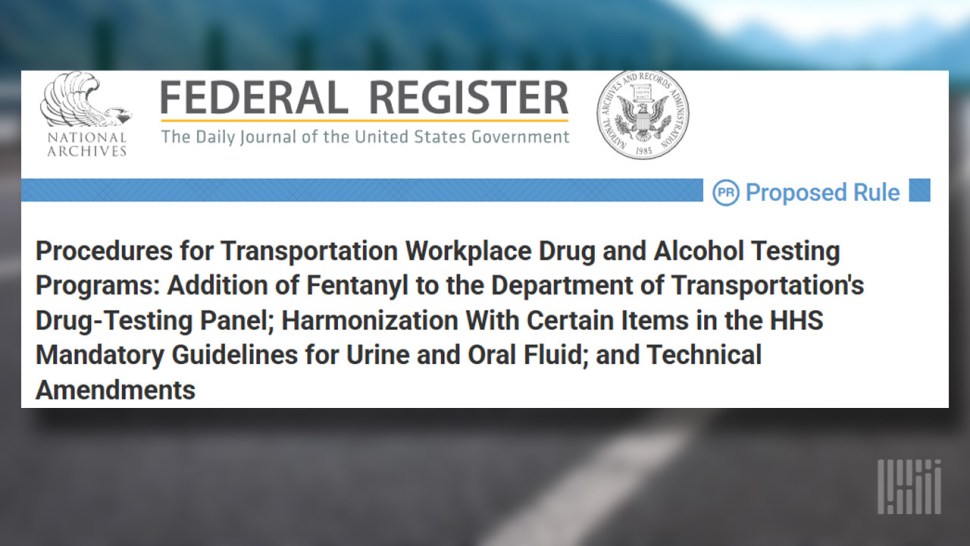
The Department of Transportation announced this week it wants to add fentanyl testing to its mandatory drug screening program for commercial drivers, marking the first major expansion of federal drug testing requirements since amphetamines were added in 2017.
The Sept. 2 proposal would require safety-sensitive transportation workers to be tested for fentanyl and its metabolite norfentanyl, targeting a synthetic opioid that kills roughly 150 Americans every day and represents 70% of all overdose deaths nationwide. But the announcement has triggered familiar eye-rolling from industry veterans who’ve watched DOT struggle for years to implement basic safety technologies that already exist and work.
Fentanyl drives approximately 70% of U.S. overdose deaths, with over 150 daily fatalities from synthetic opioids alone. The drug is 50 times more potent than heroin and 100 times stronger than morphine, making even tiny amounts potentially lethal. Drug overdose death rates involving fentanyl surged 279% between 2016 and 2021, according to federal data.
The substance ranked fourth among drugs identified in forensic laboratories as of 2021, driving home its widespread presence in illegal drug markets.
“Fentanyl accounts for a large proportion of overdose deaths in the United States and is therefore an important public safety concern,” Health and Human Services stated in supporting DOT’s proposal.
What’s Changing
The proposed rule goes beyond simply adding one drug to existing testing panels. DOT is proposing:
New Testing Requirements:
- Fentanyl screening for both urine and oral fluid samples at 1 ng/mL cutoffs
- Norfentanyl testing for urine specimens only, also at 1 ng/mL
- Updated laboratory reporting standards for both substances
Modified Existing Procedures:
- Morphine confirmation thresholds raised from 2,000 ng/mL to 4,000 ng/mL for urine
- Elimination of clinical examinations for certain codeine/morphine results
- Authorization for biomarker testing once approved by HHS
Administrative Updates:
- Marijuana testing terminology standardized (THCA becomes Δ9THCC for urine, THC becomes Δ9THC for oral fluid)
- New “fatal flaw” criteria for oral fluid collections
- Mandatory 30-day completion windows for collector training
- Revised chain of custody requirements
Cost and Concerns
DOT estimates the changes will cost approximately $18.4 million annually across the industry, broken down as:
- $18 million for screening 6.9 million specimens annually
- $216,315 for confirmation testing on an estimated 13,110 positive screens
- $143,156 in Medical Review Officer costs for reviewing confirmed positives
- $356,400 in savings from eliminating clinical exam requirements
The agency argues preventing a single serious accident would justify the entire cost.
Industry groups have generally supported adding fentanyl to testing panels but support for the concept doesn’t translate to confidence in execution. Historical agency fumbles like that of the oral fluid, hair testing and other notable chronicles of failure emphasize why we have skeptics.
Regulatory Dysfunction
DOT’s track record on drug testing implementations has been, charitably speaking, abysmal. The agency has consistently demonstrated an ability to take sensible safety ideas and transform them into bureaucratic disasters through incompetent execution. This isn’t exclusive ot drug testing, ELDT is a good example.
Congress mandated hair follicle testing research in 2012. The technology works, carriers want it, and it catches chronic drug users that urine tests routinely miss. Yet after 13 years of studies, pilot programs, and regulatory reviews, commercial drivers still urinate into cups under supervision like it’s the Carter administration.
HHS has delayed hair testing guidelines until May 2025, the third postponement after missed deadlines in June 2023, November 2023, and October 2024. Each delay comes with vague explanations about needing more “research and stakeholder engagement.”
DOT authorized oral fluid testing as an alternative to urine collection in May 2023, eliminating privacy concerns while providing more accurate recent-use detection. Yet 30 months later, the testing method remains virtually unused because DOT failed to ensure adequate laboratory infrastructure before implementation. According to the latest certified laboratory list published in September 2025, HHS hasn’t certified a single lab to conduct oral fluid testing. The agency needs at least two certified facilities, one primary and one split-specimen laboratory, before the collection method can be used.
The medical certification National Registry represents DOT’s most spectacular regulatory failure. The agency had 10 full years to develop a system that essentially uploads PDF documents to a database. When the November 2024 implementation date arrived, 14 states, nearly one-third of the country, weren’t prepared to handle the system. DOT’s solution? Create waivers excusing states that couldn’t meet a deadline they’d known about for a decade.
Implementation Risks
The fentanyl testing rule faces similar execution challenges that have plagued other DOT initiatives:
- All HHS-certified laboratories must develop capability to test for fentanyl and norfentanyl at the proposed cutoff levels. Smaller laboratories may struggle to meet certification requirements, potentially creating testing capacity constraints.
- Medical Review Officers need training on new verification procedures for fentanyl results and updated opioid protocols. The rule assumes existing MRO certification organizations will handle this training but provides no enforcement mechanism or timeline.
- The rule requires updates to laboratory information systems, chain of custody procedures, and reporting protocols. Given DOT’s technology implementation record, system integration failures and data reporting errors seem inevitable.
- While $18.4 million may sound manageable industry-wide, it represents another regulatory cost layer for small trucking operations already drowning in compliance overhead.
The Bigger Picture
The fentanyl proposal exemplifies systemic problems with federal trucking regulation:
- DOT can spend years debating regulatory minutiae while basic safety technologies that already work sit on the shelf awaiting implementation.
- The agency prioritizes regulatory processes – comment periods, stakeholder meetings, advisory committees – over measurable safety improvements.
- Good policy ideas consistently get mangled by poor execution, creating compliance nightmares rather than safety improvements.
- Rules get passed but enforcement varies dramatically between regions and inspectors, creating arbitrary compliance environments.
Whats Next
DOT is accepting public comments through Oct. 17 via the Federal eRulemaking Portal at regulations.gov under docket number DOT-OST-2025-0049. Given the regulatory track record, expect extensive comments focusing less on whether to test for fentanyl (obviously necessary) and more on implementation concerns and demands for accountability measures.
The proposal will likely become final rule within 12-18 months, assuming DOT doesn’t get distracted by other regulatory priorities or encounter unexpected implementation complications.
Testing commercial drivers for fentanyl represents obvious, overdue public safety policy. The synthetic opioid crisis demands aggressive federal action, and transportation workers operating 80,000-pound vehicles should absolutely be screened for substances that impair judgment and reaction time.
The real question isn’t whether the DOT should test for fentanyl, it should. The question is whether the agency can implement fentanyl testing without creating another regulatory train wreck like hair testing, oral fluid testing, or the National Registry.
Based on DOT’s consistent pattern of regulatory incompetence, the American public may get fentanyl testing rules but not functional fentanyl testing programs. The agency’s ability to transform sensible safety policies into bureaucratic disasters remains unmatched in the federal and even State government.
Commercial drivers and motor carriers deserve both effective fentanyl testing and a federal agency capable of implementing such testing competently. History suggests we’ll get one but not the other.
Brokerage Compliance Symposium
The day before F3. Every compliance issue you face - fraud exposure, carrier liability, FMCSA rules, cargo theft, insurance gaps - navigated by attorneys and operators defining best practices in a changing industry.
F3 Awards Dinner
The night before F3. FreightTech100 companies honored. FreightTech 25 and Shipper of Choice winners revealed live. Cocktail reception into dinner and live music - 300 industry leaders in one purpose-built room.
F3: Future of Freight Festival
Industry-defining keynotes, rapid-fire technology demos, and industry leaders networking in experiences across Chattanooga - plus the inaugural F3 Awards Dinner featuring the FreightTech and Shipper of Choice reveals.
The day before F3. Every compliance issue you face - fraud exposure, carrier liability, FMCSA rules, cargo theft, insurance gaps - navigated by attorneys and operators defining best practices in a changing industry.
The Signal at Chattanooga Choo Choo • Chattanooga, TN Register NowThe night before F3. FreightTech100 companies honored. FreightTech 25 and Shipper of Choice winners revealed live. Cocktail reception into dinner and live music - 300 industry leaders in one purpose-built room.
The Signal at Chattanooga Choo Choo • Chattanooga, TN Register NowIndustry-defining keynotes, rapid-fire technology demos, and industry leaders networking in experiences across Chattanooga - plus the inaugural F3 Awards Dinner featuring the FreightTech and Shipper of Choice reveals.
The Signal at Chattanooga Choo Choo • Chattanooga, TN Register Now