




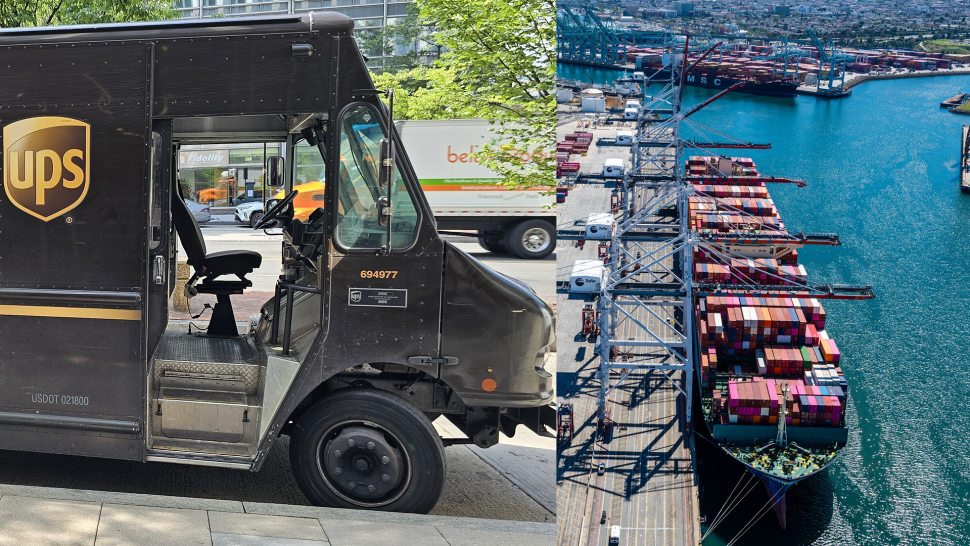
The stakes are always high during labor negotiations between West Coast dockworkers and port operators because so much of the nation’s international trade flows through the coastal gateways. And the threat of a potential labor disruption always puts parcel and freight shippers on edge when collective bargaining between United Parcel Service and the Teamsters union goes to the wire.
Combine those major labor events in the same year, just as peak shipping season ramps up for the holidays, and the ramifications for the U.S. economy and shippers will be extremely magnified.
That’s what is scheduled to occur in 2028.
The contract between the International Longshore and Warehouse union and the Pacific Maritime Association is set to expire on July 1, 2028. One month later, the five-year master contract that governs benefits and work conditions for UPS (NYSE: UPS) drivers and parcel handlers will end.
While the business community seems completely unaware of the intersecting talks, the unions already expect their combined economic impact will give them greater leverage over the employers.
“The ILWU has the same expiration date as a UPS contract. So imagine this. Imagine us shutting down the largest logistics company in the country and also the ports on the West Coast. I can’t think of a better bad idea than to do that,” said Teamsters President Sean O’Brien on the Aug. 5 episode of his “Better Bad Ideas” podcast.
There’s more. 2028 is also a presidential election year, with candidates being asked to pick sides and the White House under pressure to simultaneously intervene or stay out if talks falter.
That’s a scary proposition for the logistics sector and businesses of all kinds that ship goods internationally and domestically.
“The implications are significant if there is any connection between any slowdowns or disruption, if they coincide. You could have huge backlogs at ports and with parcel shipments. You won’t be able to get products on time,” said a retail industry official who was made aware of the overlapping labor talks and asked not to be identified because of the topic’s combustible nature.
A potential mitigating factor is that large shippers might import goods earlier and keep them in warehouses, as they have done in recent years when anticipating harmful situations, if talks appear to be stalled by the spring of 2028.
“The challenge on the UPS side is you can’t move up parcel shipping, it’s more real-time, so there are fewer options,” the source said. Experts say businesses are likely to shift to FedEx and other carriers, but they will be limited in how much extra volume they can ingest without slowing their own operations.
West Coast ports, anchored by the massive Los Angeles-Long Beach complex, handle 37.2% of U.S. containerized import tonnage, and 9% of U.S. GDP, according to the Pacific Maritime Association. The region’s share of import volumes has declined in recent years as shippers have diversified supply chain networks, but still represents a huge share of economic activity.
UPS delivers more than 17 million packages per day, about 18.6% of total domestic volume, according to ShipMatrix, and the total amount of parcel freight moving through its system represents an estimated 5% to 6% of U.S. GDP.
As previously reported by FreightWaves, the Teamsters president is already publicly telegraphing that a strike is inevitable unless UPS accedes to new demands for the most highly compensated parcel workforce in the United States. Analysts say the current contract puts UPS at a significant competitive disadvantage compared to Amazon, FedEx and dozens of independent last-mile delivery couriers. Some argue that UPS needs to claw back some concessions from the union to even the playing field, which would increase the chance for a strike if management took that position.
Meanwhile, the stevedoring union and the container terminal operators have a rocky history.
The ILWU has a reputation for hard bargaining. In 2002, management locked out the longshoremen for 10 days after a costly work slowdown, triggering a backlog of container ships that wasn’t resolved until President George W. Bush invoked the Taft-Hartley Act and ordered ports to reopen. Negotiations were less troublesome in 2008. The ILWU agreed to automation, but with many conditions that gave it power over projects.
In 2014, negotiations started a month before the deadline and lasted 10 months. Port conditions deteriorated as longshoremen called in sick or didn’t show for assignments. The number of crane moves fell from about 25 to 27 per hour to eight. By early 2015, there was a queue of 40 vessels outside the Southern California ports. Once there was an agreement, it took six months to unclog ports and restore fluid operations.
The 2023 contract approval took more than 13 months of negotiations to achieve and involved numerous port disputes and closures, as well as fears of a strike that could have snarled supply chains.
West Coast longshoremen are among the highest paid industrial workers in the world.
Why It Matters: Shippers will need to plan for the possibility of potential strikes at West Coast ports and at UPS in 2028, which could severely disrupt their business operations.
Click here for more FreightWaves/American Shipper stories by Eric Kulisch.
Write to Eric Kulisch at ekulisch@freightwaves.com.
RELATED STORIES:
Teamsters president throws down gauntlet to UPS: Strike coming in 2028
Analyst: UPS-Teamsters 2028 showdown will unleash parcel industry tsunami
Brokerage Compliance Symposium
The day before F3. Every compliance issue you face - fraud exposure, carrier liability, FMCSA rules, cargo theft, insurance gaps - navigated by attorneys and operators defining best practices in a changing industry.
F3 Awards Dinner
The night before F3. FreightTech100 companies honored. FreightTech 25 and Shipper of Choice winners revealed live. Cocktail reception into dinner and live music - 300 industry leaders in one purpose-built room.
F3: Future of Freight Festival
Industry-defining keynotes, rapid-fire technology demos, and industry leaders networking in experiences across Chattanooga - plus the inaugural F3 Awards Dinner featuring the FreightTech and Shipper of Choice reveals.
The day before F3. Every compliance issue you face - fraud exposure, carrier liability, FMCSA rules, cargo theft, insurance gaps - navigated by attorneys and operators defining best practices in a changing industry.
The Signal at Chattanooga Choo Choo • Chattanooga, TN Register NowThe night before F3. FreightTech100 companies honored. FreightTech 25 and Shipper of Choice winners revealed live. Cocktail reception into dinner and live music - 300 industry leaders in one purpose-built room.
The Signal at Chattanooga Choo Choo • Chattanooga, TN Register NowIndustry-defining keynotes, rapid-fire technology demos, and industry leaders networking in experiences across Chattanooga - plus the inaugural F3 Awards Dinner featuring the FreightTech and Shipper of Choice reveals.
The Signal at Chattanooga Choo Choo • Chattanooga, TN Register Now