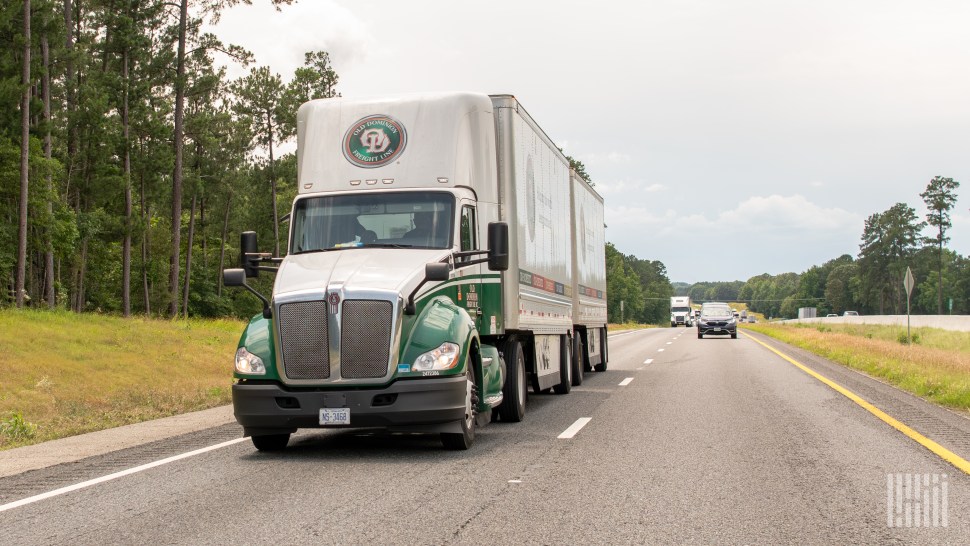
Management at LTL carrier Old Dominion Freight Lines has said frequently that their goal is to get the company back to a sub-70% operating ratio (OR), where it was for a couple of quarters in 2022.
It almost got there in the second quarter of 2026, helped by a boost from real estate transactions that management on the company’s quarterly earnings call with analysts said are not likely to be repeated.
Adam Satterfield, the company’s CFO, said on the call that removing the real estate impact from the company’s third quarter OR would likely increase it 150 to 200 basis points from the second quarter figure of 70.1%. That was a big improvement from 74.6% a year earlier.
But the sub-70 OR continues to be the magic number for Old Dominion (NASDAQ: ODFL). It is putting more money into that push with an increase in its capital expenditure budget.
In the release of its second quarter earnings, Old Dominion said it expects total capital expenditures to reach $380 million for the year. That would be after a first half in which total capex spending was about $140 million, $77 million of that coming in the second quarter.
That means to reach that goal, Old Dominion will need to spend $240 million in the second half of the year, sharply higher than the first half spending.
The breakdown of that $380 million in spending, according to the company, will be $180 million for real estate and service center expansion; $155 million for tractors and trailers; and $45 million for what it called information technology and other assets.
Well below the 2022 spending level
For perspective, Old Dominion had capital spending in the banner year of 2022 that totaled $775.1 million. It spent $415 million last year. But in its first quarter earnings report, Old Dominion said it expected to spend $265 million this year, so the current plan marks a significant upgrade.
Satterfield said even if the impact of the real estate gain was backed out, “that was one of the strongest operating quarters that we’ve ever had.”
One of the quarters where the company did post a sub-70 OR was the second quarter of 2022. Satterfield said the second quarter of this year had direct operating costs as a percent of revenue that was about 200 to 250 basis points less than that quarter in 2022. “There’s a tremendous amount of leverage that can not only take us down into the 60’s or just hitting it right there at a 69 operating ratio,” Satterfield said. “It’s going to be able to allow us to drive it even much lower.”
Advancing 2027 plans
Satterfield said some of the increased spending on equipment “would have been allocated to 2027, so we’re kind of pulling some of those purchases into the fourth quarter of this year.”
“Our operations team felt like it would be better to go ahead and pull some of the equipment into this year,” Satterfield added.
The freight market is presenting itself with other opportunities, Sattefeidl said. “From a real estate standpoint, you’ve also got some projects that you know we’ve continued to spend on our network because of the confidence we have in our long-term market share opportunities,” he said. Some of those opportunities, Satterfield said, are “unique…where it could be something that fits in the long-term plan in a market where it’s hard to find real estate.” He added that he would not discuss those opportunities in detail.
Satterfield rattled off the company’s areas of improvement compared to the second quarter of 2025, which came even as tonnage numbers were down.
But he also cited sequential improvements: revenue per day was up 14.6%. LTL tons per day was up 4%. Shipments per day were up 3.2%. Satterfield then provided as a point of reference the average 10-year sequential change in those metrics,showing that the gains are not all improvements over historical trends: revenue per day usually averages a 7.1% increase between the first and second quarters, tons per day is usually up 4.4% and shipments per day are usually up 5.2%.
But the market improved as the quarter went on. For example, tons per day were down 2.8% sequentially in April relative to March. But May was up 3% from April and June was up 0.9% from May.
July isn’t in the quarterly report, but Satterfield said revenue per day is up 7.5% to 8% this year compared to July 2025.
Where’s the volume?
The transportation research team at TD Cowen, in a post-earnings call analysis, highlighted the positive–improved metrics in issues like revenue per hundredweight–but also noted the negative: weak volume.
“Volume strength has yet to be seen in (the second half) and (are) below expectations when accounting for six consecutive positive manufacturing ISM reads,” the analysts wrote.”Most carriers expected to see the ISM inflection reflected in shipments trends that have yet to show up in results.”
“Despite commentary on low inventory/sales ratio on the call, we do not expect any outsized re-stock that will surprise shipments to the upside in (the second half),” TD Cowen added.
Spillover freight not always welcome
When trucking markets get tight, LTL carriers often face a double-edged sword: shippers that can’t find truckload capacity turn to LTL carriers. And the LTL carriers don’t like it.
Dropping truckload freight into an LTL market can create a host of problems, as it can disrupt tightly scripted markets created to go in and out of the LTL carriers’ warehouses. The problem is creeping up again.
In reaction to an analyst question, Satterfield said that trend “is in the early innings,” but that he has heard from some customers that they were turning to Old Dominion because of tight capacity in truckload.
“I expect that will continue as the truckload rate environment continues to be really strong,” Satterfield said. But he did not sound an alarm: “Overall for us, demand continues to improve,” Satterfield said. “We’re happy with the trends that we’re seeing.”
CEO Marty Freeman, addressing the same issue, said driver availability may be a factor in the trend of freight spilling over from truckload to LTL.
“We are hearing some talk about some of our competitors having problems picking up at the end of the month,” Freeman said (and the company in its earnings announcement touted a 99% on-time rate). “We have seen some of that freight move over temporarily, and if we get a major inflection in the economy, I think we’ll see it daily.”
Why it’s important: The plans to increase capital spending show that Old Dominion, which did better financially in the quarter but not on the basis of any significant growth in volume, is still optimistic for the rest of the year.
More articles by John Kingston
Trump promise on military CDLs sounds similar to existing programs
Briefs in as sides gets read to rumble over non-domiciled CDLs
Werner CEO Leathers: just the 3rd inning in driver attrition
Brokerage Compliance Symposium
The day before F3. Every compliance issue you face - fraud exposure, carrier liability, FMCSA rules, cargo theft, insurance gaps - navigated by attorneys and operators defining best practices in a changing industry.
F3 Awards Dinner
The night before F3. FreightTech100 companies honored. FreightTech 25 and Shipper of Choice winners revealed live. Cocktail reception into dinner and live music - 300 industry leaders in one purpose-built room.
F3: Future of Freight Festival
Industry-defining keynotes, rapid-fire technology demos, and industry leaders networking in experiences across Chattanooga - plus the inaugural F3 Awards Dinner featuring the FreightTech and Shipper of Choice reveals.
The day before F3. Every compliance issue you face - fraud exposure, carrier liability, FMCSA rules, cargo theft, insurance gaps - navigated by attorneys and operators defining best practices in a changing industry.
The Signal at Chattanooga Choo Choo • Chattanooga, TN Register NowThe night before F3. FreightTech100 companies honored. FreightTech 25 and Shipper of Choice winners revealed live. Cocktail reception into dinner and live music - 300 industry leaders in one purpose-built room.
The Signal at Chattanooga Choo Choo • Chattanooga, TN Register NowIndustry-defining keynotes, rapid-fire technology demos, and industry leaders networking in experiences across Chattanooga - plus the inaugural F3 Awards Dinner featuring the FreightTech and Shipper of Choice reveals.
The Signal at Chattanooga Choo Choo • Chattanooga, TN Register Now