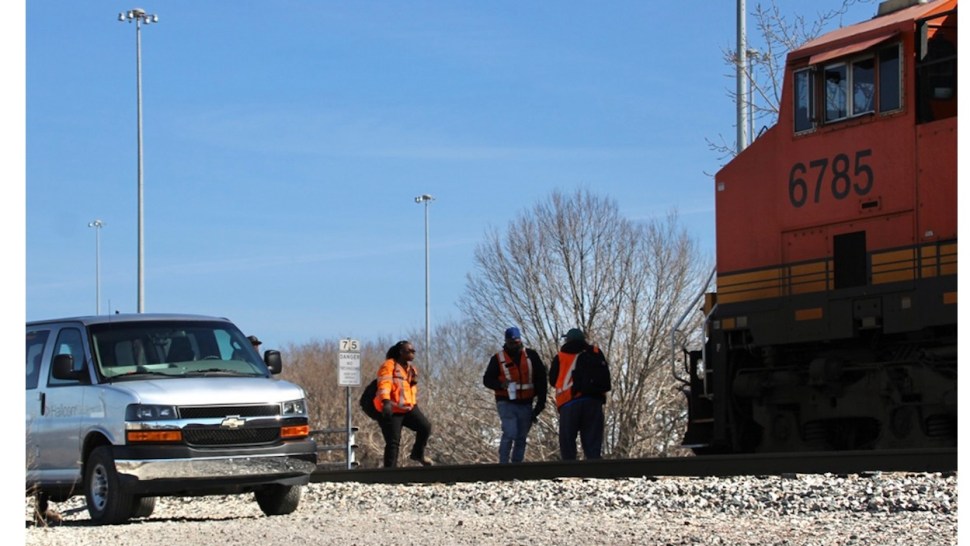
A federal appeals court on Tuesday upheld the two-person crew requirement established by the Federal Railroad Administration, turning down industry arguments that the rule adopted in 2024 was arbitrary and capricious and represented regulatory overreach.
In a 93-page, 2-1 decision, the U.S. Court of Appeals for the 11th Circuit turned down the challenge by the Association of American Railroads, American Short Line and Regional Railroad Association, and six railroads, saying “none of the railroads’ arguments have merit.”
The International Association of Sheet Metal, Air, Rail and Transportation Workers-Transportation Division – which was granted status to take part in the case – hailed the ruling as “a major victory for railroad safety.”
SMART General President Michael Coleman said, “The court’s decision reinforces what SMART-TD members and rail workers already know: having two qualified workers on a train crew is just common sense. It’s about safety, security and the well-being of workers and communities nationwide.”
The AAR and ASLRRA said they are reviewing the decision and considering their options. The Brotherhood of Locomotive Engineers and Trainmen indicated in a message to Trains that it would have a reaction later today. BNSF (NYSE: BRK-B) and Union Pacific (NYSE: UNP) deferred to the AAR for comment. Trains has also asked the FRA for a comment.
Decision denies seven industry arguments
The decision organized the multiple challenges into two groups of arguments. One set came from challenges by the AAR, BNSF, UP, Florida East Coast Railway, and the Indiana Rail Road, raising five separate objections. The other includes the ASLRRA, Texas & Northern Railway, and Nebraska Central Railroad, and raised two other issues.
The decision, authored by Judge Robin Rosenbaum and supported by Judge Embry Kidd, turned down all of those arguments.
Included in the arguments from the first group, labeled the AAR petitioners:
- The AAR argued the statute authorizing the FRA to make rules “as necessary” requires an action to be “essential” to safety. The court found the rule fell within the FRA’s general rulemaking authority, and the “as necessary” language implies discretion to act.
- The AAR contended the rule was arbitrary and capricious because it reversed a 2019 decision that evidence did not support a two-person crew rule, and because it did not address a National Transportation Safety Board recommendation that would have gathered more data. Noting that the 2019 decision withdrawing a two-person rule was struck down by a lower court, the decision says the court does not see “how a judicially invalidated action leaves anything that constitutes agency policy.” And it says the AAR misread the NTSB recommendation, saying the safety agency “never urged the FRA to refrain from regulating crew size without first collecting more accident data.”
- The AAR also argued the rule was arbitrary and capricious because it did not fully consider the costs of the rule in terms of savings lost by not allowing one-person operation, and noted a different, higher cost estimate for an earlier version of the rule in 2016 than the one adopted in 2024. The court found that the new rule allows for one-person crews through a special approval process, and so “it’s no surprise if that difference shows up as a lower cost estimate.”
- The AAR argued the rule conflicts with the “risk reduction program” of the Rail Safety Improvement Act of 2008, which the court described as a program broad in addressing the aspects of a railroad that impact safety. “Nothing in this statute poses an impediment to the Crew Size Rule,” the court says.
- The AAR group asked that the rule be vacated because the FRA took more than a year to be finalized, citing a congressional directive that rules be disposed of “not … more than 12 months after the date it begins.” The court cited two decisions by the D.C. Circuit that declined to vacate FRA rules for the same reason, under a Supreme Court decision that says that if a statute does not specify a consequence for non-compliance with a time limit, “the federal courts will not in the ordinary course impose their own coercive sanction.”
Regarding arguments raised by the ASLRRA and two shortlines, the decision:
- Says the group forfeited its arguments that the rule was arbitrary and capricious for establishing a two-year threshold for “legacy status” allowing continued use of one-person operation, and that it was “arbitrarily vague” about whether a change in railroad ownership changes that status, by not addressing either point during the rulemaking process. A further argument says the rule is arbitrary and capricious for allowing railroads with that legacy status to handle hazardous materials with a one-person crew, while requiring others to request special approval. But the court found “the FRA considered the relevant factors and reasonably explained its decision – all the APA [Administrative Procedure Act] requires.”
- The rule’s requirement that all locomotives operated by a one-person crew have an alerter, which will stop the train if an engineer is non-responsive, is a change from an earlier rule that only required alerters on locomotives operating above 25 mph. But the court found that the agency had met the requirement to explain such a change, and “provided good reasons” for the policy.
The third member of the three-judge panel, Judge Elizabeth Branch, wrote in a 28-page dissent that she would have struck down the rule as arbitrary and capricious for two reasons. She found it changed a prior position without adequately explaining the change, and did not adequately consider the rule’s cost.
Rosenbaum is a 2014 appointee of President Barack Obama, while Kidd is a 2025 President Joe Biden appointee. Branch is a 2018 appointee of President Donald Trump.
The path to the rule
The FRA issued the 223-page final version of the two-person crew rule in April 2024, providing an exception for operations it said “do not pose significant risks to railroad employees, the public, or the environment.”
“Common sense tells us that large freight trains, some of which can be over 3 miles long, should have at least two crew members on board – and now there’s a federal regulation in place to ensure trains are safely staffed,” then-Transportation Secretary Pete Buttigieg said. The AAR criticized the rule as “unfounded and unnecessary.”
The rule was first proposed in 2016, but was withdrawn in 2019 during the first Trump administration, with Ron Batory, then FRA administrator, saying the rule was unnecessary. While public comment was significantly in support of the rule, Batory said the anecdotal evidence in those comments was outweighed by information supplied by the industry group. He cited a study by consulting firm Oliver Wyman, commissioned by the AAR, that found no concrete evidence that trains with two-person crews were safer than those with just one.
But the rule was revived in 2022, during the Biden administration, with then-FRA Administrator Amit Bose, saying longer trains “require a level of crew size that is proportional to the length of the train.” Train length has increased as railroads adopted the Precision Scheduled Railroading operating model. Bose said “having more than one person … is to the benefit of the community, if safety issues arise.”
Subscribe to FreightWaves’ Rail e-newsletter and get the latest insights on rail freight right in your inbox.
Read more:
BNSF earnings rise on higher volume and revenue
AAR launches freight rail research consortium
Rail merger a failure on first sight, shippers protest
These two industrial categories paced another strong week for rail freight
Brokerage Compliance Symposium
The day before F3. Every compliance issue you face - fraud exposure, carrier liability, FMCSA rules, cargo theft, insurance gaps - navigated by attorneys and operators defining best practices in a changing industry.
F3 Awards Dinner
The night before F3. FreightTech100 companies honored. FreightTech 25 and Shipper of Choice winners revealed live. Cocktail reception into dinner and live music - 300 industry leaders in one purpose-built room.
F3: Future of Freight Festival
Industry-defining keynotes, rapid-fire technology demos, and industry leaders networking in experiences across Chattanooga - plus the inaugural F3 Awards Dinner featuring the FreightTech and Shipper of Choice reveals.
The day before F3. Every compliance issue you face - fraud exposure, carrier liability, FMCSA rules, cargo theft, insurance gaps - navigated by attorneys and operators defining best practices in a changing industry.
The Signal at Chattanooga Choo Choo • Chattanooga, TN Register NowThe night before F3. FreightTech100 companies honored. FreightTech 25 and Shipper of Choice winners revealed live. Cocktail reception into dinner and live music - 300 industry leaders in one purpose-built room.
The Signal at Chattanooga Choo Choo • Chattanooga, TN Register NowIndustry-defining keynotes, rapid-fire technology demos, and industry leaders networking in experiences across Chattanooga - plus the inaugural F3 Awards Dinner featuring the FreightTech and Shipper of Choice reveals.
The Signal at Chattanooga Choo Choo • Chattanooga, TN Register Now