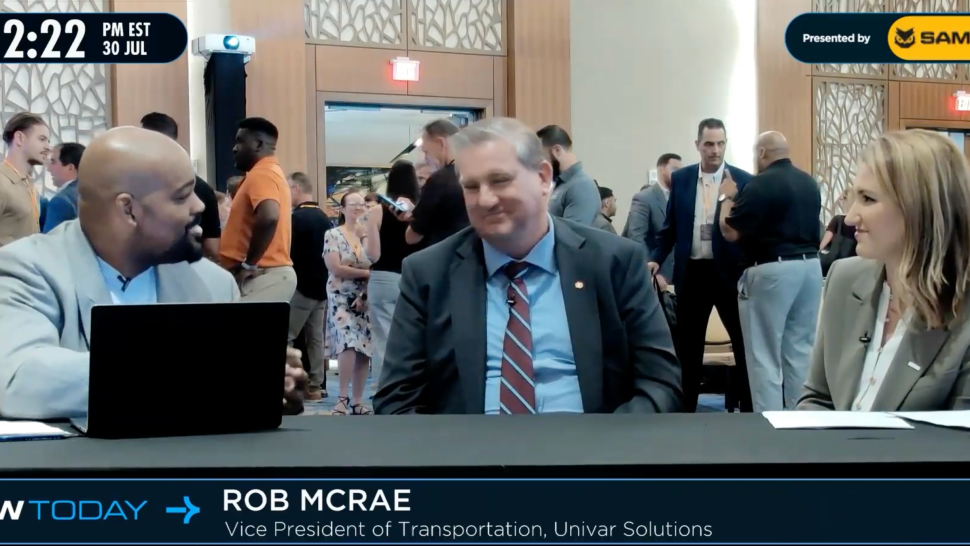

FreightWaves Today broadcast live from the Westin in downtown Chattanooga, Tennessee, for Univar Solutions’ annual Carrier Kickoff event, where roughly 100 transportation providers and more than 200 attendees gathered alongside Univar Solutions’ procurement and operations leadership for a supplier conference built around the fact that relationships, not just rates, win freight when trucks get scarce. The room reflected a cornucopia of modal opportunity, with liquid bulk, truckload, less-than-truckload, rail, air, and parcel providers all represented under one roof.
After a four-year freight recession that hollowed out capacity across the industry, tender rejections are climbing again and insurance costs are spiraling. Soft-market leverage doesn’t last forever, and some shippers are learning that the hard way. FreightWaves’ interviews with carriers and brokers at Univar Solutions’ Carrier Kickoff made clear that the companies which invested in carrier relationships during the downturn are the ones that will keep trucks moving now that the market has turned.
No one made that case more directly than Rob McRae, Vice President of Transportation, North America at Univar Solutions, the host of the event and the executive most responsible for its existence. McRae operates in a uniquely constrained corner of the freight market. Roughly 90% of Univar Solutions’ volume moves in the liquid bulk hazmat space, and that niche dramatically shrinks the pool of qualified carriers before capacity even tightens.
“It’s a very small niche of the registered DOT carriers,” McRae said. “It gets very competitive to get those assets.”
Because of that scarcity, Univar Solutions treats its carrier network as something closer to a fleet of partners than a rotating cast of vendors. About half of Univar Solutions’ freight moves through third-party carriers by design, McRae said, allowing the company to reach customers outside its private fleet’s delivery zones without sacrificing personal familiarity. That way, assets are available when demand spikes.
“For us, being able to know who you’re talking to, for us as well as the carrier, makes it like you’re talking to a friend,” McRae said. “Putting faces to names makes it easier to get that asset when other companies, our competitors, aren’t necessarily investing in the carriers.”
McRae drew a direct comparison to his time in small parcel, pointing to the consistency of a single, familiar face on a delivery route as the model Univar Solutions is chasing at scale. “We view our carrier partners as an extension of our brand,” he said. “We want them to say, ‘Oh yeah, it’s James, he’s with Univar Solutions.’”
The payoff is that Univar Solutions was the first chemical distributor to win FreightWaves’ Shipper of Choice award, and has earned the distinction for the past three consecutive years.
“We did not seek this award whatsoever,” McRae said. “Don’t try to get it; just do the right things and follow the right processes.”
Carriers Say the Model Is Working
While McRae framed the philosophy, the carriers in the room supplied the proof points, and each described a version of the same dynamic. Capacity has genuinely tightened, and the shippers who built relationships before the market turned are the ones getting served first.
Brad Hadley, Vice President of National Accounts at Saia, has watched that shift play out directly in LTL volumes. Saia posted its best tonnage quarter on record in the same period, and Hadley traced it to truckload capacity draining out of the market. “Capacity’s tightened, truckload prices have increased,” Hadley said. “Shipments that might have been half loads that were cheaper for customers to move via truckload have now shifted back to the LTL side.”
The volume shift is colliding with a carrier base that’s trying to recapture margin after years of taking on freight below cost, according to Hadley, who has represented Saia in Univar Solutions’ routing guide for close to 15 years. “We know that we need to get paid for the services that we’re providing,” he said. “It’s not that I like sticking it to the shippers. It’s because there does need to be balance, and we do need carriers to be able to cover their costs and be safe and compliant with quality drivers.”
Ben Caplenor, EVP of Operations at LRT Solutions, made a similar case from the smaller-carrier side of the room, arguing that in a market crowded with comparable service offerings, differentiation has to come from somewhere other than rate. “You’ve got to stick out with customer service,” Caplenor said. “Safety is super important in our world right now. That’s table stakes for everybody. But service is something that we can stand on and stick out with.”
According to Caplenor, there’s pressure building underneath that service pitch. A wave of adverse litigation outcomes are reshaping how carriers operate. “It’s pretty scary,” he said. “We’re going to have to do some things differently and pay more attention to certain things. There are a lot of challenges coming at us right now, so we just have to stay on top of it.”
Brian Reilly, Vice President, National Account Sales at RXO, framed the current environment as an inflection point for how shippers structure their routing guides altogether. Reilly said the traditional waterfall model of locking in contract rates on infrequent lanes months in advance is increasingly unworkable when spot rates are running well above those figures by the time freight needs to move.
“Spot was a slight premium,” Reilly said. “Now, with acceptance being lower, spot is 40%, 50%, 60%, sometimes 70% higher than what you thought your contract rate was going to be, but it’s a paper rate that’s never going to be honored.”
Reilly’s broader argument echoed the idea that shippers who proactively engage with providers, rather than simply issuing rate demands, get better outcomes when capacity is scarce. “If price is the same, and if service metrics are the same, what else is it that you do that separates you to win the tiebreak?” Reilly said.
For customers, these investments translate into reliable capacity, safer transportation and more consistent service, particularly during periods of market disruption when securing qualified transportation assets becomes increasingly challenging.
Where the Market Goes Next
Tyson Wimberly, Senior Vice President of Sales and Revenue Management at Covenant Transport, tied the shift to a mix of regulatory pressure and driver economics that’s been building for years and is now catching up with the industry.
“We are in a much more favorable marketplace than we were the last four years,” Wimberly said, before pivoting to what he sees as the more urgent fix still needed industrywide: driver pay. “Driver pay absolutely has to correct,” Wimberly said. “That is probably the number one criteria in attrition of drivers.”
Wimberly also connected Covenant’s approach to sustainability (including B100 fleet deployments on select dedicated accounts) to the same customer-relationship logic driving the rest of the event. “If it’s something that’s important to you, it’s important to us,” Wimberly said. “We would be customer-led, and we will go through this journey with you.”
All around the industry, various segments all reflect a market in transition. The shippers, carriers and brokers gathered in Chattanooga largely agreed on the diagnosis. Capacity has left and isn’t coming back quickly, insurance and equipment costs are climbing regardless of individual safety records, and driver economics need to catch up with the moment. Univar Solutions continues to invest in the partnerships, operational excellence, and trust required to keep freight moving to deliver on service reliability when the market flips.
That’s what “shipper of choice” looks like when it’s actually tested.
Click here to learn more about Univar Solutions.
Brokerage Compliance Symposium
The day before F3. Every compliance issue you face - fraud exposure, carrier liability, FMCSA rules, cargo theft, insurance gaps - navigated by attorneys and operators defining best practices in a changing industry.
F3 Awards Dinner
The night before F3. FreightTech100 companies honored. FreightTech 25 and Shipper of Choice winners revealed live. Cocktail reception into dinner and live music - 300 industry leaders in one purpose-built room.
F3: Future of Freight Festival
Industry-defining keynotes, rapid-fire technology demos, and industry leaders networking in experiences across Chattanooga - plus the inaugural F3 Awards Dinner featuring the FreightTech and Shipper of Choice reveals.
The day before F3. Every compliance issue you face - fraud exposure, carrier liability, FMCSA rules, cargo theft, insurance gaps - navigated by attorneys and operators defining best practices in a changing industry.
The Signal at Chattanooga Choo Choo • Chattanooga, TN Register NowThe night before F3. FreightTech100 companies honored. FreightTech 25 and Shipper of Choice winners revealed live. Cocktail reception into dinner and live music - 300 industry leaders in one purpose-built room.
The Signal at Chattanooga Choo Choo • Chattanooga, TN Register NowIndustry-defining keynotes, rapid-fire technology demos, and industry leaders networking in experiences across Chattanooga - plus the inaugural F3 Awards Dinner featuring the FreightTech and Shipper of Choice reveals.
The Signal at Chattanooga Choo Choo • Chattanooga, TN Register Now