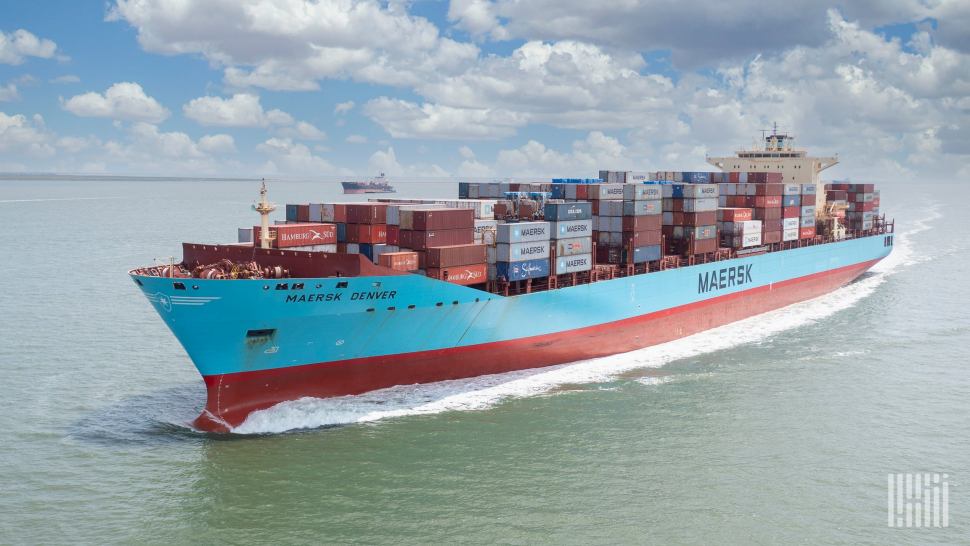
Maersk, the world’s second-largest container shipping company, raised its full-year earnings outlook Friday while simultaneously lowering its forecast for the second half.
The hike in full-year guidance was due to better-than-expected performance in the past — the second quarter — not greater optimism toward the future. Second-quarter upside was driven by lower-than-expected costs (in part due to slow steaming), not freight rates, which were in line with company expectations.
Conference call commentary on the future market was overwhelmingly negative.
“Our expectation right now is that we will see a challenged market for the next couple of years,” said Maersk CEO Vincent Clerc. “It is possible you will have quarters that go into negative territory. Whether they go deep into negative territory is anybody’s guess at this stage.”
Big earnings beat in Q2
The Maersk group (Copenhagen: MAERSK-B) reported net income of $1.49 billion for Q2 2023, down 83% year on year.
Adjusted earnings before interest, taxes, depreciation and amortization came in at $2.92 billion, 27% above the Bloomberg consensus of $2.3 billion. Earnings before interest and taxes (EBIT) was $1.61 billion, double the consensus forecast for $800 million.
Maersk has 68% of its ocean business under long-term contract and 32% in the spot market. Rates (including both contract and spot) averaged $2,444 per forty-foot equivalent unit in Q2 2023. That’s down 51% from boom-inflated rates the year before and down 15% sequentially versus Q1 2023. However, rates were still up 31% from pre-COVID levels in Q2 2019.

Maersk previously projected full-year EBIT of $2 billion-$5 billion. On Friday, it raised its EBIT guidance to $3.5 billion-$5 billion. The range midpoint increased by 21%.
Maersk: Inventory overhang persists
Maersk’s EBIT for the first half of this year was $3.9 billion, so its second-half EBIT outlook ranges from minus-$400 million to plus-$1.2 billion.
Maersk previously expected 2023’s year-on-year change in global container volumes (for the industry as a whole) to be in the range of minus-2.5% to plus-0.5%. It lowered this guidance and now projects a range of minus-4% to minus-1%.
“Inventory destocking continues to be the primary driver of lower volumes,” Clerc said. “We now expect a prolonged period of lower volume driven by continued inventory destocking.”
Maersk CFO Patrik Jany commented, “Looking forward, based on the purchase orders we’re seeing through our 4PL [fourth-party logistics] activities, we do not yet observe a consistent pickup of volumes and therefore expect destocking to continue in the second half.”
The company expects its average freight rate to fall in the third quarter versus the second and in the fourth versus the third, with overall results better in Q3 2023 than Q4 2024.
Clerc does not foresee a big rebound driven by economic activity when destocking does finally end. “The volume is not going to be a double-digit rebound. It’s going to be modest,” he said.
And as these demand-side issues play out, supply-side factors could increase, driven by newbuilding deliveries.
“We have seen significant capacity management discipline across the industry so far. But we’ll have to see how this fleshes out as supply side risks start to weigh more on the market,” said Clerc. “There is a large orderbook that will need to be phased in over the next 12 to 24 months. It is clearly a problem. Whether it’s going to be a big problem or a relatively small problem, we don’t know yet.”

Click for more articles by Greg Miller
Related articles:
- Shipping line ONE’s profits plunge but still top pre-COVID levels
- Container shipping giant CMA CGM still earning over billion a quarter
- Zim downsizing its container ship fleet as demand disappoints
- Trans-Pacific shipping rates rise as carriers make capacity cuts
- Q2 container line earnings could surprise to the upside
- Container shipping stocks outperform despite market gloom
- US containerized imports still outpacing pre-COVID levels
Brokerage Compliance Symposium
The day before F3. Every compliance issue you face - fraud exposure, carrier liability, FMCSA rules, cargo theft, insurance gaps - navigated by attorneys and operators defining best practices in a changing industry.
F3 Awards Dinner
The night before F3. FreightTech100 companies honored. FreightTech 25 and Shipper of Choice winners revealed live. Cocktail reception into dinner and live music - 300 industry leaders in one purpose-built room.
F3: Future of Freight Festival
Industry-defining keynotes, rapid-fire technology demos, and industry leaders networking in experiences across Chattanooga - plus the inaugural F3 Awards Dinner featuring the FreightTech and Shipper of Choice reveals.
The day before F3. Every compliance issue you face - fraud exposure, carrier liability, FMCSA rules, cargo theft, insurance gaps - navigated by attorneys and operators defining best practices in a changing industry.
The Signal at Chattanooga Choo Choo • Chattanooga, TN Register NowThe night before F3. FreightTech100 companies honored. FreightTech 25 and Shipper of Choice winners revealed live. Cocktail reception into dinner and live music - 300 industry leaders in one purpose-built room.
The Signal at Chattanooga Choo Choo • Chattanooga, TN Register NowIndustry-defining keynotes, rapid-fire technology demos, and industry leaders networking in experiences across Chattanooga - plus the inaugural F3 Awards Dinner featuring the FreightTech and Shipper of Choice reveals.
The Signal at Chattanooga Choo Choo • Chattanooga, TN Register Now