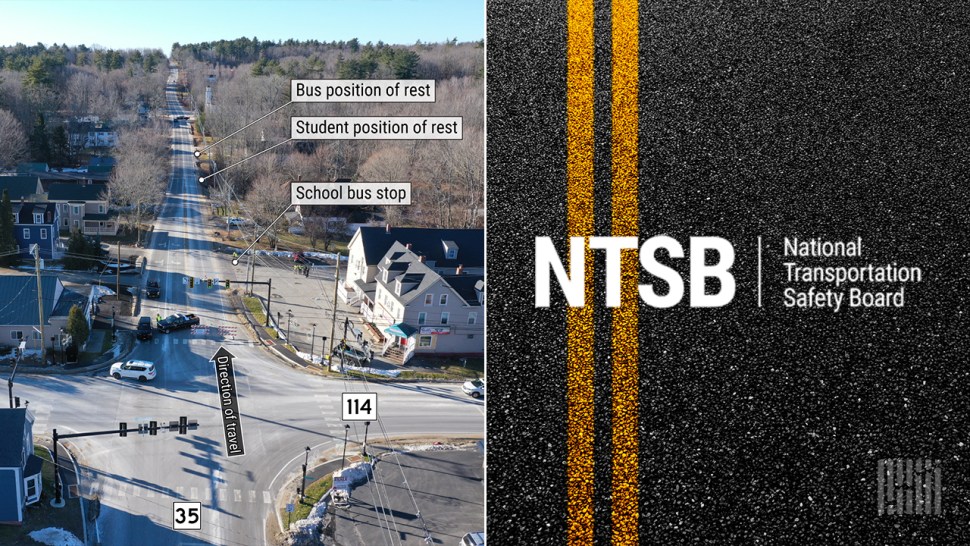
Five-year-old Simon Gonzalez never made it onto his school bus the morning of December 16. The kindergartner approached the 2022 Blue Bird bus from behind as it sat stopped on Route 35, its older half-brother already aboard. As Simon reached the loading doors, they began to close. He extended his left arm between them.
What happened next is the kind of preventable tragedy that has haunted school transportation for more than half a century.
The National Transportation Safety Board released its preliminary findings last week, confirming that Simon’s arm became pinned between the closing doors. The bus then began to pull away, dragging the child approximately 280 feet down the partially wet roadway before he became dislodged, fell to the pavement, and was run over by the same vehicle that was supposed to safely transport him to school.
This was not an anomaly. This was not unforeseeable. This was at least the third student-dragging incident in Maine since 2022.
Every year, approximately 16 children are fatally injured as pedestrians in the loading and unloading zone around school buses, according to the National School Bus Loading and Unloading Survey compiled by the Kansas Department of Education. That number represents a stark improvement from 1975, when 75 students were killed in similar circumstances. But any number above zero represents a system that continues to fail the most vulnerable people it serves.
Since the survey began tracking fatalities in 1970, school buses themselves have been responsible for 714 loading zone deaths. Passing vehicles have killed an additional 499 children. The morning commute to school has proven to be the deadliest time, accounting for the majority of the 812 total fatalities documented over more than five decades of data collection.
The NTSB has designated this investigation as HWY26MH003, a classification that signals the agency’s intent to issue safety recommendations to prevent similar events, but recommendations without regulatory teeth have historically produced mixed results.
On October 30, 2018, in rural Fulton County, Indiana, four siblings were crossing State Route 25 to board their waiting school bus at approximately 7:12 a.m., about an hour before sunrise. The bus had its red warning lights activated and its stop arm extended. A pickup truck traveling in the opposite direction struck all four children.
Nine-year-old Alivia Stahl and her six-year-old twin stepbrothers, Mason and Xzavier Ingle, died at the scene. Eleven-year-old Maverick Lowe survived but required 20 surgeries to recover from multiple broken bones. The driver, a 24-year-old local woman, was later convicted on three felony counts of reckless homicide.
That tragedy forced Indiana to rewrite its school bus safety laws. The state increased penalties for stop-arm violations, authorized school districts to install stop-arm cameras, and mandated that elementary school students be picked up and dropped off on the right-hand side of the roadway whenever safely possible. The day after the Rochester crash, a separate incident claimed another Indiana student’s life when a nine-year-old boy was struck by a pickup while crossing to his bus.
A single-day survey conducted that same year found more than 3,000 Indiana drivers illegally passing stopped school buses. Extrapolated across a 180-day school year, that represents over 540,000 stop-arm violations in one state alone.
Modern sensor systems can detect when a person or object remains in the door swing area and automatically halt or delay door closure before an incident occurs. Transit buses in major metropolitan areas routinely employ such technology. School buses, which transport more than 20 million students to and from school daily, largely do not.
The NTSB has repeatedly recommended that new school buses be equipped with collision avoidance systems and automatic emergency braking technologies. The agency has pushed for connected vehicle technologies that would allow school buses to communicate their position and status to other vehicles on the road. But recommendations are not regulations, and school districts operating on tight budgets often cannot afford optional safety upgrades that federal standards do not require.
In the Maine case, how does a school bus door close on a child’s arm without triggering a sensor that prevents the vehicle from moving? How does a driver not notice a five-year-old being dragged 280 feet before being run over?
How is this still happening in 2025?
According to NHTSA’s National Center for Statistics and Analysis, there were 206 school-age children killed in school transportation-related crashes between 2012 and 2021. Of those, 42 were occupants of school transportation vehicles, 80 were occupants of other vehicles, and 78 were pedestrians struck in or near loading zones. More than half of the school-age pedestrians killed during that period were between five and ten years old.
The 2022-2023 school year recorded three loading zone fatalities, tied for the second-lowest figure since data collection began. The two lowest years, 2019-2020 and 2020-2021, were shortened by the COVID-19 pandemic, which kept millions of students home from school.
When school is in session and buses are running, children will die in the danger zone. Are we doing everything possible to prevent those deaths, or simply accepting them as an inevitable cost of moving 20 million students twice a day?
The Cumberland County Sheriff’s Office, Maine State Police, and Maine Department of Transportation are assisting the NTSB in its investigation of Simon Gonzalez’s death. All aspects of the crash remain under review as investigators work to determine probable cause.
Thoughts and prayers are what we offer when we have nothing else to give. Safety recommendations are what we issue when we lack the political will to mandate change. And every year, approximately 16 more children die in the danger zone while adults debate the cost of prevention.
Simon Gonzalez was five years old. His grandfather told reporters the boy had the most infectious laugh. His half-brother, the seven-year-old who had boarded the bus moments earlier, was physically uninjured. The psychological toll of watching your little brother being dragged down the road and run over by your school bus is not something that appears in the NTSB’s statistical reports.
The school bus remains statistically one of the safest forms of transportation for students. Of the 343,391 fatal motor vehicle crashes that occurred between 2013 and 2022, only 0.28 percent involved school buses. That is cold comfort for the families of the children who fall on the wrong side of that decimal point.
The NTSB will issue its final report and safety recommendations in the coming months. History suggests that some of those recommendations will be adopted, others studied and debated, and a few simply ignored. Somewhere in America, another child will approach a school bus from behind, another door will close at the wrong moment, and another family will learn that the safest form of student transportation was not safe enough for their child.
Brokerage Compliance Symposium
The day before F3. Every compliance issue you face - fraud exposure, carrier liability, FMCSA rules, cargo theft, insurance gaps - navigated by attorneys and operators defining best practices in a changing industry.
F3 Awards Dinner
The night before F3. FreightTech100 companies honored. FreightTech 25 and Shipper of Choice winners revealed live. Cocktail reception into dinner and live music - 300 industry leaders in one purpose-built room.
F3: Future of Freight Festival
Industry-defining keynotes, rapid-fire technology demos, and industry leaders networking in experiences across Chattanooga - plus the inaugural F3 Awards Dinner featuring the FreightTech and Shipper of Choice reveals.
The day before F3. Every compliance issue you face - fraud exposure, carrier liability, FMCSA rules, cargo theft, insurance gaps - navigated by attorneys and operators defining best practices in a changing industry.
The Signal at Chattanooga Choo Choo • Chattanooga, TN Register NowThe night before F3. FreightTech100 companies honored. FreightTech 25 and Shipper of Choice winners revealed live. Cocktail reception into dinner and live music - 300 industry leaders in one purpose-built room.
The Signal at Chattanooga Choo Choo • Chattanooga, TN Register NowIndustry-defining keynotes, rapid-fire technology demos, and industry leaders networking in experiences across Chattanooga - plus the inaugural F3 Awards Dinner featuring the FreightTech and Shipper of Choice reveals.
The Signal at Chattanooga Choo Choo • Chattanooga, TN Register Now