




Old Dominion Freight Line said it’s seeing signs that the market is recovering, noting demand consistently improved throughout the first quarter. However, after five months of volumes performing largely in line with normal seasonality, it flagged a bit of a slowdown in April given customer uncertainty around the geopolitical landscape.
Executives from the company touted recent business wins on a Wednesday quarterly call. Management also said that some less-than-truckload freight lost to a depressed truckload market is returning as TL capacity exits and spot rates surge. It reminded analysts that the carrier typically outgrows the market by 900 to 1,000 basis points during an upswing.
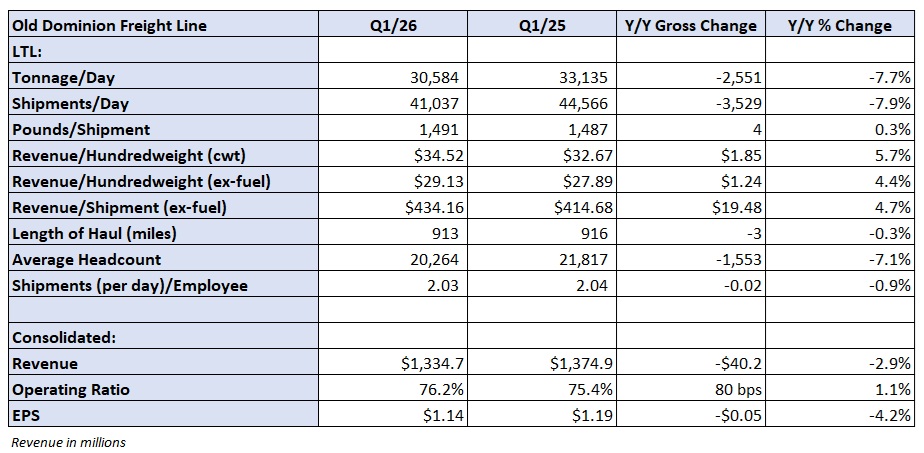
Old Dominion (NASDAQ: ODFL) reported earnings per share of $1.14 for the first quarter. The result was 9 cents better than the consensus estimate, but 5 cents lower year over year.
Revenue declined 3% y/y to $1.33 billion, but came in higher than analysts’ expectations and management’s guidance range of $1.25 billion to $1.3 billion.
Tonnage declined 8% y/y as a similar decline in shipments was only partially offset by a slight increase in weight per shipment. Revenue per hundredweight (yield) increased 6% y/y (4% higher excluding fuel surcharges). Revenue per shipment (excluding fuel) was up 5%.
Revenue per day increased 0.5% from the fourth quarter to the first quarter, bucking a normal sequential decline of 2.8%. Tonnage growth was 210 bps ahead of normal seasonality in the period, with the outperformance occurring in February. However, April volumes are running slightly below normal seasonal patterns, management said.
April revenue per day is approximately 7% higher y/y given higher fuel surcharge revenue. Tonnage in the month is down 6.5% y/y and yield (excluding fuel) is up 4% to 4.5% y/y.
Weight per shipment is up 1% y/y so far in April to roughly 1,490 pounds. Higher shipment weights—a sign of an improving market—drive revenue per shipment and margins higher. Weight per shipment likely troughed in the 2025 third quarter at 1,458 pounds. In stronger markets when manufacturing activity expands, shipment weights average approximately 1,600 pounds. Old Dominion’s last peak occurred in the 2020 second quarter at 1,636 pounds.
April tonnage is down 15.3% on a two-year-stacked comparison. Old Dominion’s tonnage appears to have troughed in October, which was down 20.8% on a two-year comp.
The company reported a 76.2% operating ratio (inverse of operating margin), which was 80 bps worse y/y but 50 bps better than the seasonally stronger fourth quarter. The result was also roughly 200 bps ahead of management’s implied 78.2% guide.
Salaries, wages and benefits (as a percentage of revenue) were approximately flat y/y even as head count was down 7% to 20,264 (2% lower sequentially). Shipments per employee (per day) were off 1% y/y.
Revenue per shipment (including fuel surcharges) was up 5.9% y/y with cost per shipment up 6.6%—a 70-bp negative spread. The company is targeting a positive spread of 100 to 150 bps in a better market.
Old Dominion normally sees 300 to 350 bps of sequential margin improvement in the second quarter. It expects to see a similar result this year. The guide implies a 73% OR at the midpoint (160 bps better y/y) and assumes a typical seasonal uptick in volumes. This would mark the first notable y/y improvement since 2022. (The company reported slight improvement in the 2024 second quarter.)
The company reiterated a $265 million capex budget for 2026, down from $415 million last year. It has invested roughly $2 billion in the network over the past three years. It said it has a little more than 35% excess terminal door capacity to accommodate a volume inflection. It estimates the industry as a whole is relatively capacity-constrained, holding just 5% to 10% excess slack.
The company’s commentary around April’s sub-seasonal volume trends weighed on shares and the sector on Wednesday. The stock was down 5.6% at 1:33 p.m. EDT compared to the S&P 500, which was off 0.2%. However, the LTLs were up more than 45% year-to-date heading into the print due to an improved manufacturing outlook.
Brokerage Compliance Symposium
The day before F3. Every compliance issue you face - fraud exposure, carrier liability, FMCSA rules, cargo theft, insurance gaps - navigated by attorneys and operators defining best practices in a changing industry.
F3 Awards Dinner
The night before F3. FreightTech100 companies honored. FreightTech 25 and Shipper of Choice winners revealed live. Cocktail reception into dinner and live music - 300 industry leaders in one purpose-built room.
F3: Future of Freight Festival
Industry-defining keynotes, rapid-fire technology demos, and industry leaders networking in experiences across Chattanooga - plus the inaugural F3 Awards Dinner featuring the FreightTech and Shipper of Choice reveals.
The day before F3. Every compliance issue you face - fraud exposure, carrier liability, FMCSA rules, cargo theft, insurance gaps - navigated by attorneys and operators defining best practices in a changing industry.
The Signal at Chattanooga Choo Choo • Chattanooga, TN Register NowThe night before F3. FreightTech100 companies honored. FreightTech 25 and Shipper of Choice winners revealed live. Cocktail reception into dinner and live music - 300 industry leaders in one purpose-built room.
The Signal at Chattanooga Choo Choo • Chattanooga, TN Register NowIndustry-defining keynotes, rapid-fire technology demos, and industry leaders networking in experiences across Chattanooga - plus the inaugural F3 Awards Dinner featuring the FreightTech and Shipper of Choice reveals.
The Signal at Chattanooga Choo Choo • Chattanooga, TN Register Now