




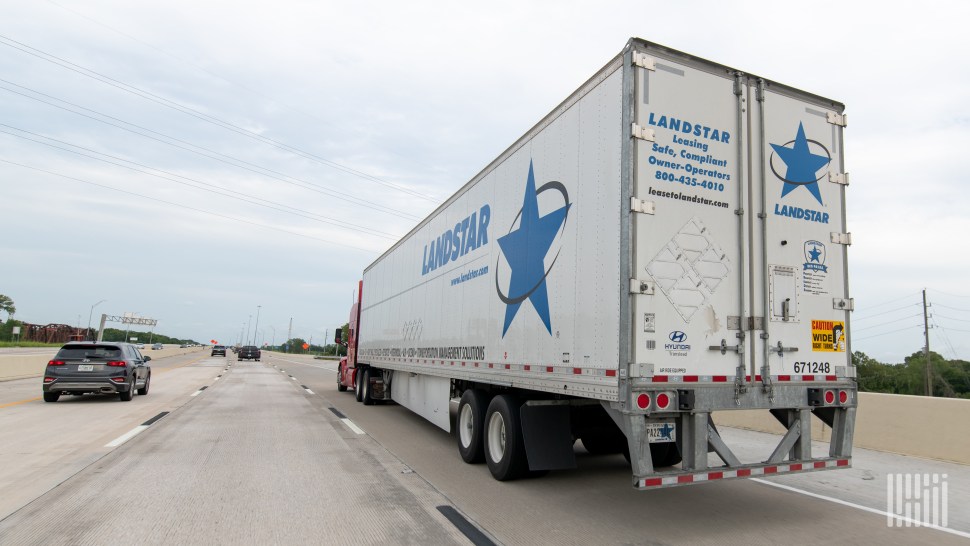
Freight broker Landstar System said Tuesday that the market is in the early stages of an upcycle. It reported notable yield growth during the first quarter, propelling financial results past analysts’ expectations.
Landstar (NASDAQ: LSTR) reported first-quarter earnings per share of $1.16, which was 31 cents higher year over year and 4 cents better than the consensus estimate. (The 2025 first quarter included a 10-cent hit tied to supply chain fraud.)
Consolidated revenue of $1.17 billion was 2% higher y/y and slightly ahead of consensus. Revenue was flat with the fourth quarter, which was well ahead of the typical mid- to high-single-digit seasonal decline.
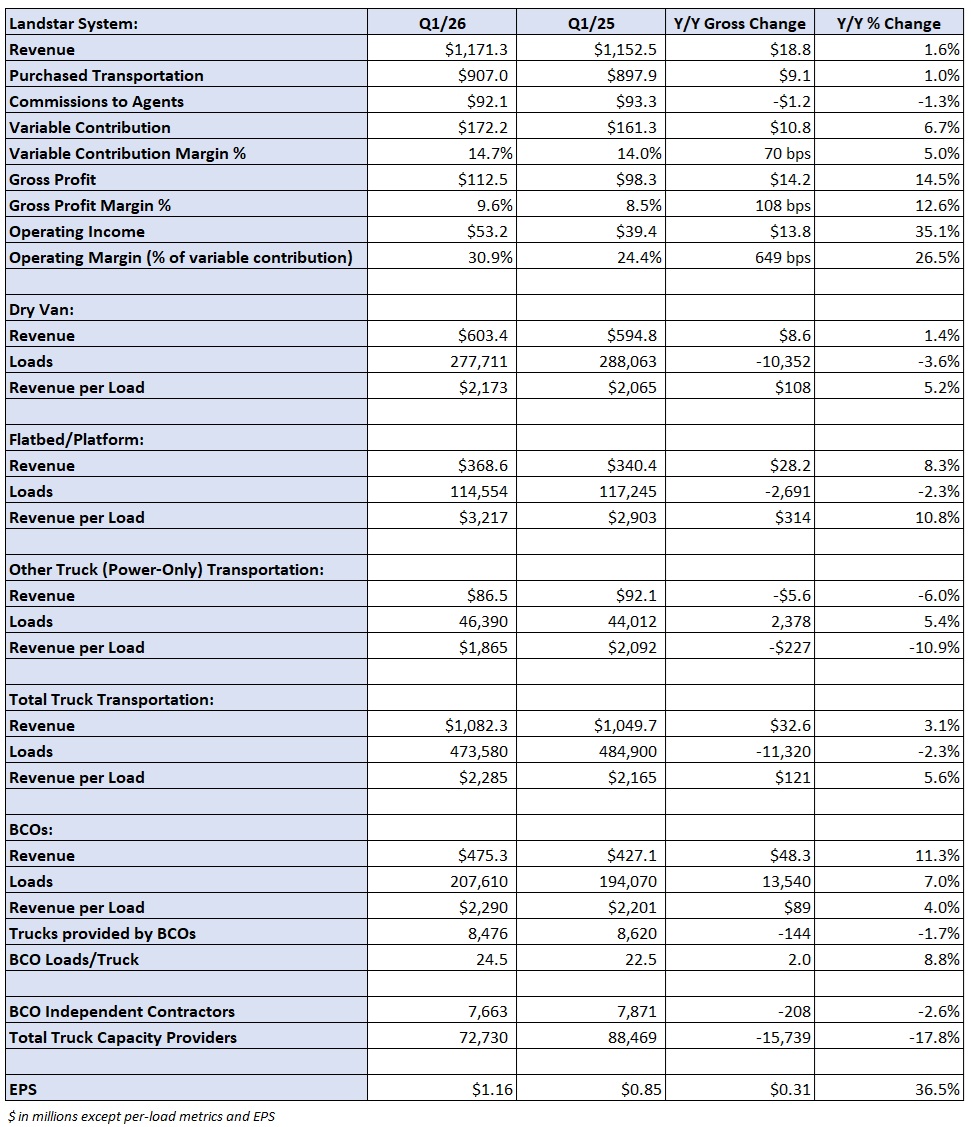
Total truck transportation revenue increased 3% y/y as a 6% increase in revenue per load (yield) was only partially offset by a 2% decline in load count. Dry van loads were off 4% y/y while flatbed loads dipped 2%. However, dry van yield increased 5% while flatbed yield jumped 11%.
The yield trends were ahead of normal seasonality. Total truck yield was up 0.2% sequentially in the first quarter, bucking the normal seasonal trend of a 4% decline.
Landstar said its heavy-haul business (data centers, energy, government, machinery, and aerospace and defense) is seeing very strong demand while standard flatbed (building products and automotive) remains under pressure. Heavy-haul revenue increased 18% y/y in the quarter as loads increased 6% and yield was up 12%. Even with the demand headwinds, standard flatbed yield was 7.3% higher y/y.
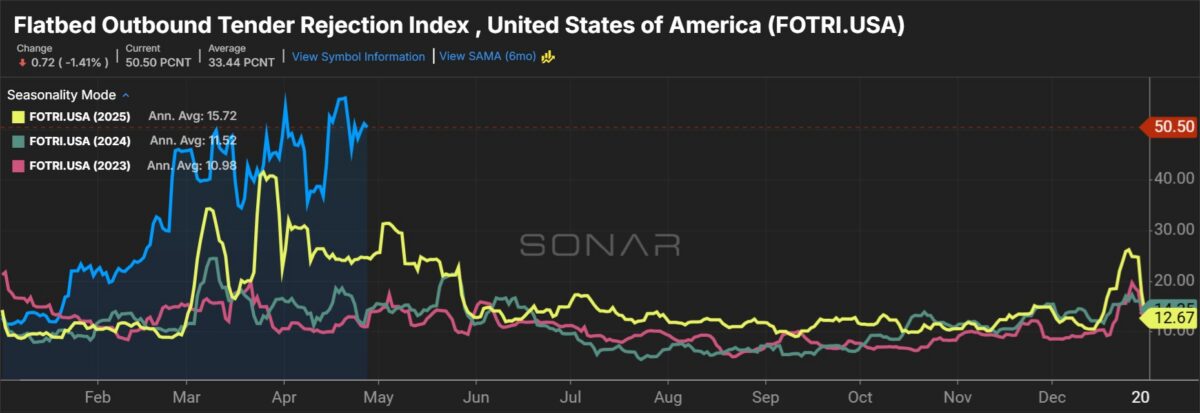
The company didn’t provide second-quarter guidance. It said that prior to the pandemic, truck revenue would usually increase sequentially by a mid- to high-single-digit percentage. Truck loads in April are running flat y/y (in line with normal seasonality), but revenue per load is up 13% y/y (“significantly above” typical seasonal patterns).
The platform has some volume constraints, as truck brokerage carriers declined 19% y/y in the first quarter (up 4% sequentially). Increased vetting to improve safety and prevent fraud drove the y/y decline.
Revenue generated by business capacity owners (BCOs) increased 11% y/y to $475 million as loads increased 7% and yield increased 4%. (Landstar’s BCOs are owner-operators who haul almost exclusively for the company.)
Trucks provided by BCOs declined 2% y/y to 8,476 units. The truck count was down just 38 units from the fourth quarter, which was much better than the average sequential first-quarter decline of 365 trucks over the past three years. Further, truck count through April is level with the end of the first quarter. Retention among the group again improved and truck utilization was 9% higher y/y to nearly 25 loads per truck.
BCO revenue per mile — Landstar’s preferred metric for TL pricing as it excludes fluctuations in diesel fuel prices — was up 3% y/y and 2% y/y on dry van and flatbed shipments, respectively.
Variable contribution, or net revenue, increased 7% y/y to $172 million. That was the first y/y increase since the 2022 third quarter. (The calculation measures revenue remaining after purchased transportation expenses and agent commissions are paid.) A variable contribution margin of 14.7% was 70 basis points higher y/y.
The operating margin (as a percentage of variable contribution) jumped 650 bps y/y to 30.9%. Insurance and claims expenses (as a percentage of BCO revenue) declined 180 bps to 7.5%.
Shares of LSTR were up 3.1% in after-hours trading on Tuesday.
Brokerage Compliance Symposium
The day before F3. Every compliance issue you face - fraud exposure, carrier liability, FMCSA rules, cargo theft, insurance gaps - navigated by attorneys and operators defining best practices in a changing industry.
F3 Awards Dinner
The night before F3. FreightTech100 companies honored. FreightTech 25 and Shipper of Choice winners revealed live. Cocktail reception into dinner and live music - 300 industry leaders in one purpose-built room.
F3: Future of Freight Festival
Industry-defining keynotes, rapid-fire technology demos, and industry leaders networking in experiences across Chattanooga - plus the inaugural F3 Awards Dinner featuring the FreightTech and Shipper of Choice reveals.
The day before F3. Every compliance issue you face - fraud exposure, carrier liability, FMCSA rules, cargo theft, insurance gaps - navigated by attorneys and operators defining best practices in a changing industry.
The Signal at Chattanooga Choo Choo • Chattanooga, TN Register NowThe night before F3. FreightTech100 companies honored. FreightTech 25 and Shipper of Choice winners revealed live. Cocktail reception into dinner and live music - 300 industry leaders in one purpose-built room.
The Signal at Chattanooga Choo Choo • Chattanooga, TN Register NowIndustry-defining keynotes, rapid-fire technology demos, and industry leaders networking in experiences across Chattanooga - plus the inaugural F3 Awards Dinner featuring the FreightTech and Shipper of Choice reveals.
The Signal at Chattanooga Choo Choo • Chattanooga, TN Register Now