Omni Logistics asks court to force Forward Air to closing table

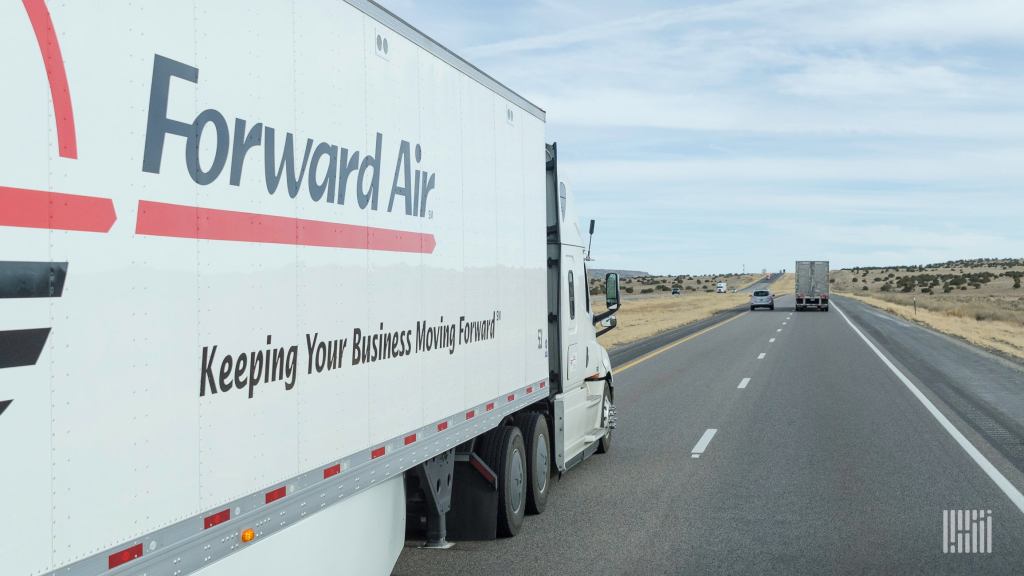
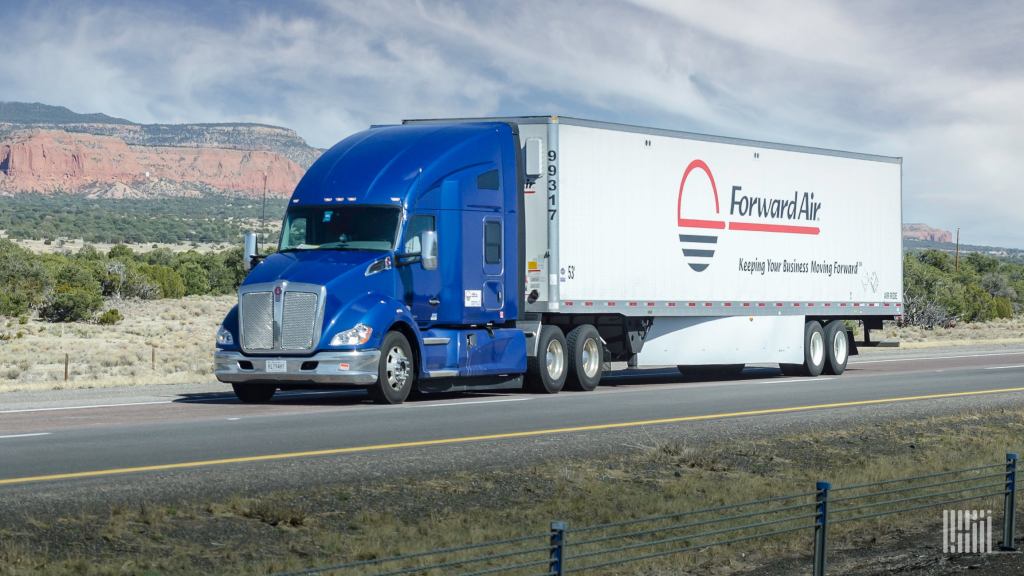
A sleeper cab pulls a white Forward Air trailer on a highway

Editor’s note: This story was updated on Nov. 1 to include new information about Omni’s complaint in a Delaware court.

Omni Logistics filed a lawsuit in a Delaware court Tuesday to require Forward Air to close on a proposed merger between the two companies. The company also asked the court to confirm that it has complied with all obligations required under the merger agreement, a matter that has been contested by Forward.

Omni is seeking a trial in the Delaware Court of Chancery before the merger agreement expires on Feb. 10.

The deal was announced on Aug. 10 at an initial price of $3.2 billion. Both Forward’s shareholders and customers have raised concerns with the transaction. A Tennessee court recently dissolved a temporary restraining order blocking the deal. The injunctive relief was sought by shareholders who claimed their rights were violated when they were not given a vote on the transaction.

Shareholders have questioned numerous aspects of the transaction, including the strategic fit, the deal price, the debt leverage required to fund it and a perceived shift in voting power and control toward Omni’s stakeholders. Forward previously defended against those complaints in court but recently said that it may terminate the transaction as it alleges Omni didn’t meet pre-closing obligations, including a failure to provide timely access to information.

A Tuesday open letter from Omni to Forward’s (NASDAQ: FWRD) shareholders called on the company to “comply with their obligations to complete our previously announced combination.”

Omni said that the negative shareholder reaction to the transaction pressured Forward to make “repeated overtures” to “renegotiate the deal in its favor or cancel it altogether,” according to a Tuesday court filing. Omni said Forward’s solutions included transitioning $400 million to $500 million of the deal price to a contingent earnout or proceeding under a joint venture structure, both of which Omni rejected.

Omni said its CEO, J.J. Schickel, was told by Forward Chairman, President and CEO Tom Schmitt that Forward didn’t intend to close the transaction ahead of an Oct. 25 hearing regarding the temporary restraining order. “The reason Forward would not close, Schmitt explained, is that if the deal were to close, he and his board would be fired,” the filing read.

The alleged breach of the merger agreement stems from Forward’s request for Omni’s fourth-quarter projections, according to the filing. Omni, a private company, said it had questions around how estimated deal synergies should be divided and sought Forward’s guidance in preparing the estimates to no avail.

The filing also said that a recent email from Forward’s CFO to Omni said its financial forecast was “substantially lower than what Omni had reaffirmed at due diligence meetings” with lenders. However, Omni said the numbers used in the forecast were a “what if” scenario modeling “no growth” as communicated to it by Forward and its financial adviser.

Omni defends deal

Omni defended the transaction, saying the market is “evolving towards a more integrated service model for customers” and that the combination would remove “a meaningful layer of cost and complexity” for end customers.

“This is a winning model that will enhance Forward Air’s competitive strength in the logistics space and create an industry innovator with attractive margins and growth prospects,” Schickel stated in the letter.

He said the deal would give Forward access to its 7,000 domestic customers and position the combined entity as a “low unit-cost provider to our customers with direct relationships.”

Omni said its LTL pipeline has increased 480% since the deal’s announcement and pointed to a 14% increase in Forward’s daily volumes with freight forwarders over the same time. That metric was disclosed in Forward’s Monday earnings release.

“We believe shareholders should question what has changed — particularly as our respective customers ramp up their business with us and give positive feedback on the deal,” Schickel stated.

Schickel said Forward largely operates without direct relationships with shippers, which he believes “is not a position for long-term strength.” However, Forward noted on its third-quarter earnings call on Tuesday that it would materially ramp those efforts, potentially increasing the sale force of its direct-selling channel threefold.

“Omni believes Forward Air’s threat to terminate the transaction is unenforceable under our binding contractual agreement — and we are confident that no impediment exists to closing the transaction immediately,” the letter said.

Schmitt said otherwise on the Tuesday call.

“We feel very strongly that we are not under an obligation to close,” Schmitt said. “I’m a big fan of when things get longer, they don’t get better, so we should be getting out of the circus and into our business 100% full time as quickly as possible.”

More FreightWaves articles by Todd Maiden

Truckers push FMCSA to make brokers pay for detention time

Trucks at warehouse

WASHINGTON — If drivers have to be federally regulated by hours-of-service rules, brokers should be required to pay drivers for time lost waiting to pick up freight because it ends up making roads less safe.

That is the argument of a group of owner-operators and small trucking companies as the Federal Motor Carrier Safety Administration plans a new study on the effects of driver detention time on road safety and trucking operations.

While carriers of all sizes have long been concerned about the effects driver detention has on safety and operations, “it affects us differently [than] established trucking companies as they are able to negotiate a maximum wait time and they are given priority when it comes to service,” stated one owner-operator commenting on the information collection request (ICR) for the study, which FMCSA must submit to the Office of Management and Budget for approval.

“Brokers would rather sacrifice the independent owner operators rather than hurt their relationship with the shipper or receivers [because] they would automatically lose their contracts.”

Another commenter to the ICR asserted that although brokers know where and when a truck is heading for a pickup or delivery, “we get there and still have to sit for hours and hours while our clock’s ticking. As soon as we arrive, we should all start being paid on the clock. It will also make these shippers and receivers move faster to send us on a safe journey from pickup to delivery.”

Arctic King Logistics LLC, a trucking dispatch service, said wait time-related pressure to get back on the road to make a delivery or to pick up the next load may lead drivers “to make compromised decisions, potentially endangering themselves and others on the road.”

However, “it’s important to note that not only brokers are responsible,” the company stated. “Certain facilities contribute to the issue, often being ‘short-staffed’ or simply not caring and creating conditions where detention time is almost guaranteed. Regulating and improving these facilities is essential for enhancing overall safety and the welfare of drivers and all participants on the road.”

Several commenters said FMCSA should allow for an industry-accepted two free hours of wait time, after which it should require a $100-per-hour detention time fee be paid by the broker, shipper or receiver.

“Hit them where it hurts: their bottom line,” said one, recommending a $100-per-hour fee go to the driver and $300 per hour to the carrier, “paid immediately by the offending party prior to [the driver’s] departure via an industry accepted payment method. Carriers must pass on full driver share to driver, no exceptions, and carriers cannot, as a condition of employment, compel drivers to sign any portion of their share away.”

Chris Burroughs, vice president of government affairs for the Transportation Intermediaries Association, which represents truck brokers and 3PLs, said that TIA has been investigating the detention time issue for years, pointing out that technology has made it easier to track detention time metrics which in turn improves transparency with customers.

“However, it’s essential to emphasize that sharing accurate data does not automatically guarantee the fair compensation of detention time,” Burroughs told FreightWaves.

“TIA steadfastly views detention time as an industry-wide concern, urging that it should not be the FMCSA’s role to regulate. Instead, the agency should remain dedicated to its core mission of ensuring safety rather than dictating commercial provisions. As brokers, our priority is to nurture fruitful relationships with motor carriers, ensuring that they are justly compensated for any time unnecessarily lost due to detention. It’s our responsibility to advocate for these hardworking professionals.”

The American Trucking Associations, which represents major trucking companies, has also insisted that FMCSA steer clear of attempting to regulate detention time, contending that it is an economic issue and therefore best addressed by carriers and their customers.

“Whether detention time is also a safety issue — and therefore an issue within FMCSA’s statutory authority to address — is another question altogether,” ATA stated in its comments to the ICR.

“While there has been no end of speculation that excessive waiting times provide incentives for unsafe behaviors, numerous studies have failed to substantiate even a statistically rigorous correlation between detention time and crash risk, much less a causal link.”

But the Owner-Operator Independent Drivers Association and truck safety advocates disagree, pointing to a 2018 U.S. Department of Transportation Office of Inspector General report’s conclusion that detention increases the likelihood of truck crashes involving death and serious injury.

“Most of [Truck Safety Coalition] victim volunteers have been forever and irreparably impacted by a fatigued and/or speeding truck driver,” commented the group, which advocates on behalf of crash victims’ families. “It is from a place of tragically somber experience that TSC unapologetically asserts that the proposed [study] is imperative for FMCSA to perform its functions.”

Click for more FreightWaves articles by John Gallagher.

Some shipping lines are still posting 9-figure profits amid downturn

photo of a container shipping vessel

The predicted container shipping wipeout is not here yet. Several container lines are still posting nine-digit quarterly profits, despite a tepid peak season, slumping rates and a tidal wave of new vessel capacity. 

Liner companies Ocean Network Express (ONE) and Matson reported their latest quarterly results on Tuesday and Monday, respectively.

They are totally different companies: ONE is the world’s sixth-largest ocean carrier, with a global footprint. Matson is a niche operator with an expedited China-U.S. service that competes with air freight, plus domestic U.S. Jones Act services.

Both are still solidly in the black. The adjusted share price of Matson (NYSE: MATX) is up almost 40% year to date. As more carriers report results, it appears that steep losses being suffered by Israeli ocean carrier Zim (NYSE: ZIM) are, so far, the exception to the rule.

ONE predicts profits for fiscal year

Singapore-headquartered ONE reported net income of $187 million for July-September (the second quarter of its fiscal year 2023), down 97% from the one-off, boom-inflated results of a year ago, and down 64% sequentially versus April-June.

“Despite the start of the peak season, there was no strong recovery in cargo movement,” said the carrier.

“In North America, cargo movement showed some momentum in August, but lacked sustainability.”

chart of ONE results

Nevertheless, the company’s latest results are better than its pre-pandemic performance. ONE had net income of $121 million during the same period in 2019 and lost $192 million in July-September 2018.

ONE does not report average freight rates. Rather, it publishes an index of average quarterly rates (the combination of spot and contract rates) in comparison to the average for April-June 2018.

This index continues to fall. It’s still above pre-COVID numbers, albeit approaching those levels.

ONE’s Asia-U.S. rates in the most recent quarter were 4% above the average at this time of year in 2019 and 8% above 2018 levels.

ONE’s average Asia-Europe rates in July-September were 15% above the 2019 average and 9% above 2018 levels.

chart of ONE rates
(Chart: FreightWaves based on ONE financial filings)

Three months ago, ONE declined to provide guidance for its fiscal year, stating that market conditions were too uncertain. It belatedly issued that guidance on Tuesday, forecasting net income of $851 million for the 12 months from April 2023-March 2024.

That would be considerably better than pre-COVID returns. It earned only $105 million in FY 2019 and lost $586 million in FY 2018 (when results were impacted by costs from the 2017 merger that created ONE from the fleets of Japan’s NYK, MOL and “K” Line).

A ‘unicorn’ among transportation companies

Meanwhile, Hawaii-based Matson continues to outshine the competition.

“Unicorns do exist — just look at Matson,” wrote Stifel analyst Ben Nolan in a client note.

“While virtually every other segment of [containerized] transportation is struggling, Matson continues to put up surprisingly good results, which are significantly greater than pre-COVID results.”

Matson — with a fleet that’s 1/25th the size of ONE’s — reported net income of $119.9 million for the third quarter of 2023, down 55% from $266 million in Q3 2022 at the tail end of the boom.

chart of Matson results

However, the niche carrier’s latest quarterly profits were up 48% sequentially from Q2 2023 and were more than triple profits in the same period in 2019, pre-pandemic.

“It appears as though the company now has a much broader customer base willing to pay elevated rates for expedited trans-Pacific business that is still far cheaper than air freight,” said Nolan.

During Monday’s conference call, Matson CEO Matt Cox said his company continues to obtain higher China-U.S. rates than the Shanghai Containerized Freight Index. He noted that Matson’s 11-day expedited China-U.S. service is offering “a significant value proposition to air freight customers,” at 10-15% the cost for five to seven days of additional all-in transit time.

“For our China service, we expect continued solid demand,” said Cox.

Inventory overhang issue ‘played itself out’

Cox also commented on U.S. inventory levels — a major issue for shipping lines in the trans-Pacific trade. This topic was also addressed by Matthew Shay, president and CEO of the National Retail Federation (NRF), during a recent Port of Los Angeles press conference.

A year ago, carrier executives at Maersk and Hapag-Lloyd highlighted a potential demand driver from restocking in 2023. The theory was that U.S. companies imported too many goods during the supply chain crisis, leading to bloated inventories. When those inventories finally wound down, importers would have to restock, pushing shipping demand — and rates — back up.

The growing consensus is that restocking rate upside will not happen and that inventories have already normalized, with little effect on rates.

“We are hearing that most of our retailers have worked through those inventories,” said Cox. “There are exceptions — product lines that still have a surplus. But our general feeling is that retailers have done a really good job of working through their overhangs.”

According to Shay, “I think this [inventory issue] has largely played itself out. It’s not something we’re hearing about from our members. It isn’t high on anyone’s list.

“Our assessment is that the inventory-to-sales ratios are back down to pre-pandemic levels and people are pretty comfortable that they’ve got their inventory mix right and they’re in a good place on inventory.

“It’s also our sense that most of the inventory necessary for the holiday season is already in the U.S., in the warehouses or other at points of distribution,” said Shay. “We believe the peak shipping season was probably this summer and specifically in the month of August. Most of the merchandise is already here.”

Click for more articles by Greg Miller 

Forward’s new plan may not include Omni

A white Forward Air trailer being pulled on a highway

Forward Air said Tuesday it will focus on two key components of its less-than-truckload business “full steam” and that it plans to review all strategic options for its noncore operations. The update was part of its third-quarter earnings release and follows a planned merger announcement, which has garnered public criticism from shareholders.

The company plans to further grow its core business, which provides linehaul service to freight forwarders in an airport-to-airport configuration, as well as ramp a newer, direct-selling initiative to shippers that don’t work through forwarders.

Some of Forward’s longtime freight forwarder customers voiced concerns following an announced merger with Omni Logistics, which is a customer of Forward and a competitor to Forward’s customers. Those customers believed Forward was attempting to cut the intermediary, the forwarder, out of the market by aligning with Omni.

Forward (NASDAQ: FWRD) Chairman, President and CEO Tom Schmitt said on a Tuesday call with analysts that wasn’t the intention and that Forward will only work directly with those shippers that do not engage with forwarders. He said doing this will preserve the relationships Forward’s freight forwarder customers have with their shipper clients. It will also allow Forward to solicit the other half of the $15 billion-plus high-value LTL freight market that doesn’t work through intermediaries.

He said recent engagement with forwarders, explaining the change, has resulted in a 14% increase in daily volumes from the group since the transaction was announced on Aug. 10. During the quarter, Forward grew the customer count in its direct-selling channel by more than 33% year over year (y/y).

“Now it’s full force, fair game,” Schmitt said. “That’s the benefit of the Aug. 10 announcement that we became very clear about making sure that we are accessing that other half of the high-value LTL market.”

The company will soon provide details on near- and long-term targets. It will also begin to disclose greater detail on its LTL business, which reports up through its expedited segment currently.

Forward isn’t making large investments to facilitate the changes and said it will cut costs elsewhere to accomplish the plan. That includes a full “strategic portfolio review” of all non-LTL operations, which could be sold.

“Supporting business lines have to be essential to making LTL the main show and when that’s no longer the case and they have served their purpose, then graduation is coming,” Schmitt said.

There’s still a major hurdle for the company — exiting the Omni merger.

A Tennessee court recently lifted a restraining order that was temporarily blocking the deal. The injunctive relief was requested by shareholders, who claimed their rights had been violated when they weren’t given a vote on the transaction. The plaintiffs have asked the court to reconsider its decision.

If the court doesn’t get involved, the deal can proceed. However, Forward believes it has the right to terminate the transaction as it alleges Omni hasn’t met pre-closing requirements, including access to information in a timely manner.

“We feel very strongly that we are not under an obligation to close,” Schmitt said. “I’m a big fan of when things get longer, they don’t get better, so we should be getting out of the circus and into our business 100% full time as quickly as possible.”

Omni’s CEO has disputed those claims.

Omni contends it has “fully complied with all obligations of the merger agreement” and said it intends “to enforce that binding agreement to ensure the successful completion of the transaction,” a Thursday letter from its CEO to customers read.

“We were exploring different tactics, getting to a larger customer and revenue base,” Schmitt explained. “[It] caused a lot of emotional upheaval on multiple fronts. I realize that, I’m sorry for that and I apologize for that because that’s obviously not what we intended to do.” 

Q3 result, Q4 guidance light of expectations

Forward reported adjusted earnings per share of 99 cents for the third quarter, 12 cents below the consensus estimate and 94 cents lower y/y. The result excluded 63 cents per share in due diligence and transaction costs.

The expedited segment reported an 11% y/y revenue decline to $351 million. Tonnage was flat but yield excluding fuel surcharges was down 7%. However, an 8% increase in weight per shipment likely meant the pricing metric was roughly flat.

Tonnage was down 3% y/y in the July-August period before turning positive in September. October tonnage per day is 6% higher y/y.

Compared to the second quarter, tonnage was up 3% and yield increased 1% excluding fuel surcharges. The company said it saw a positive demand inflection following Yellow’s exit but the impact was minimal compared to the sequential changes other carriers reported. Forward more closely serves the time-definite markets than Yellow did. Forward did capture some long-haul and events business through its intermediary relationships, which it expects to be sticky.

The expedited unit posted an 89.7% operating ratio, which was 390 basis points worse y/y. All expense lines increased as a percentage of revenue except for purchased transportation, which benefited from insourcing linehaul miles as well as lower truckload rates. The adjusted OR was 110 bps better sequentially.

The LTL portion of the unit reported an 85% OR in August and September.  

Forward’s 2024 general rate increase (GRI) will be announced in November and is expected to be in line with past GRIs, which have ranged from 5.9% to 7.9%. The company’s annual GRI is effective on the first Monday of February.

Forward’s fourth-quarter guidance was also worse than expected.

The company forecast revenue to decline 7% to 17% y/y, implying $423 million at the midpoint of the range. That was below the consensus estimate of $468 million at the time of the print. Adjusted EPS was forecast to a range of 98 cents to $1.02, which was below a $1.13 consensus estimate.

Shares of FWRD were down 8.4% Tuesday at 3:28 p.m. EDT compared to the S&P 500, which was up 0.6%.

More FreightWaves articles by Todd Maiden

How Voltera is reducing risks to fleet electrification

The popularity of electric vehicles (EVs) has grown so much in recent years that, for the first time, a fully electric automobile was the world’s top-selling car during the first quarter of 2023, just 15 years after the same manufacturer released its first electric vehicle. When it comes to the electrification of commercial fleets, however, real-world examples are just starting to emerge as the path toward implementation becomes clearer.

One of the biggest roadblocks that the industry is tackling right now is charging infrastructure. While personal electric vehicles can be charged by plugging a car into an outlet at home or at a public charging station, commercial electric vehicles need access to more robust charging capabilities. Today, this means businesses must develop and operate their own charging infrastructure for their fleets.

Charging infrastructure comes with its own set of obstacles and considerations, particularly around issues like cost and timeline to implementation. 

While EVs promise less maintenance and lower fuel costs over time, saving the vehicle owner money in the long run, the upfront capital expense and complexity of EV adoption and installing charging infrastructure can deter businesses from taking that next step toward electrification.

“Fleet managers face risk and uncertainty around the financial model of electric vehicles. There are still open questions such as: How long will these vehicles and charging stations last? What risk are you putting into your operations if you go in this direction?” said Scott Fisher, senior vice president at Voltera. 

These questions are valid and companies must answer them if they are to move forward with fleet electrification. This is why Voltera is partnering with fleets to help remove barriers to electrification surrounding charging. It provides the financial upfront resources and experience to help fleets develop and operate fleet charging infrastructure for their organizations and has helped deploy over 1,000 charging sites.

“The Voltera story is really about reducing the risk of fleet providers on the charging side. And, of course, there’s still risk on the vehicle side. But what we’re trying to do is take that charging risk off the table by having purpose-built sites, having uptime guarantee and putting a lot of attention into making those sites exactly what the fleet wants from an operational perspective,” Fisher said.

Voltera doesn’t shy away from the fact that, as the capabilities are today, not all businesses will see a payback from electrification. The number one way that its sites are economically useful to clients is when fleets operate at scale.

“If you’re only driving 20 miles a day and only need to charge a little bit, you won’t get the payback from the fact that electricity costs are lower than diesel,” Fisher explained. “If you can use a site a lot and amortize the upfront cost of building a charging site through utilization, your effective cents per kilowatt hour price is going to be lower.”

Voltera’s equity backing from EQT makes it possible to provide upfront capital to acquire, build, own and operate charging infrastructure to help fleets on their electrification journeys. This allows Voltera to reduce risk for its clients by bearing overrun costs instead of the fleet.

Charging sites built for one company aren’t the only option, though. Voltera is working on creating charging sites for not just one fleet customer but several customers so that no one business has complete responsibility for providing all the utilization needed to make a site economical.

To reduce costs, Voltera is also mindful of the benefits that vary by location, such as California, where there are strong incentives for electrification, and states like Texas and Georgia, where the permitting timeline is shorter and electricity costs are lower.

Long lead times to deployment are another concern for fleets. Fisher said that the timeline for implementation may take up to two years due to the elements at play, such as working with utility companies to coordinate bringing power to the site and receiving proper zoning authority. Voltera offers sites that are already in the development process to offset the number of months fleets will need to wait until implementation. 

“Voltera is focused right now on building sites on time, on budget, that fleets can use to start the scale-up of their electrification program. We’ll always be focused on that. Where the industry is going to go over time as more and more of these charging sites get developed by companies like us and others is increasingly focused on that total cost of ownership and making sure that the cost of electrification is indeed better than an alternative,” Fisher said.

Click here to learn more about Voltera.

Biggest names in freight are headed to Chattanooga

The biggest festival in freight — FreightWaves’ F3: Future of Freight Festival — kicks off in a week, and it promises to be the best one yet.

Set in the heart of Freight Alley in Chattanooga, Tennessee, this year’s event is slated for Nov. 7-9 at the Chattanooga Convention Center.

And we’ve gathered some of the greatest thought leaders in the world and within the freight industry to share insights about factors influencing the market, predict trends and showcase emerging technology.

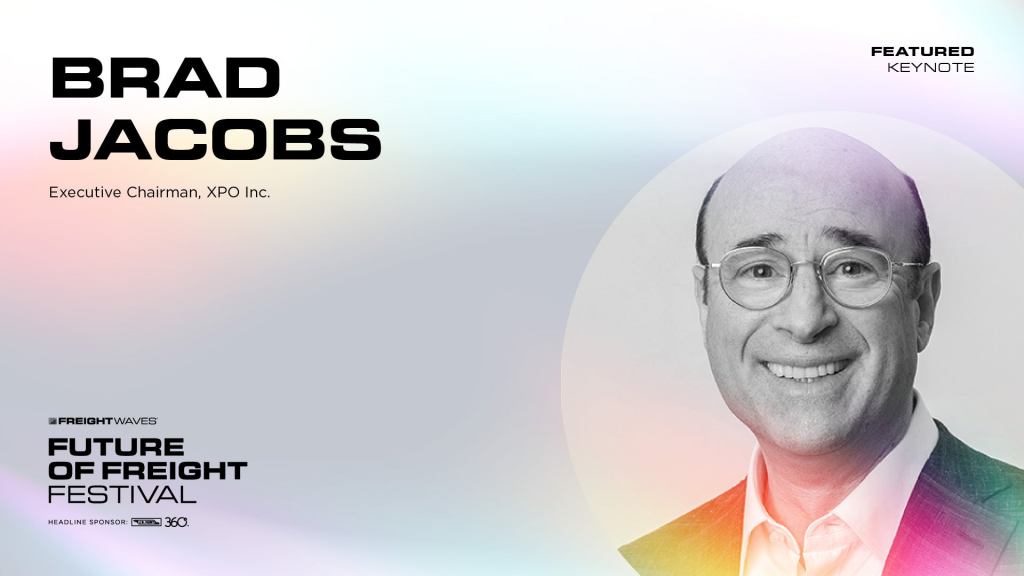
Over three days, attendees will hear from more than 70 freight industry experts, including Brad Jacobs, executive chairman of XPO, who is the featured keynote speaker. He will take the main stage on Nov. 8.

Other keynote speakers include Alex Epstein, Chris Voss, Leland Miller and Michio Kaku.

Who else will be there?

F3 is a great place to connect with companies and network with industry professionals.

Here are some of the companies you can expect to see:

But that’s not all. 

Get ready to rock

It wouldn’t be a true festival without music, and we’ve gathered some of the hottest names to entertain you in the Scenic City.

Here’s our music lineup this year:

  • David Nail is a Grammy-nominated, multiplatinum singer/songwriter who is known as an innovator and creative risk-taker.
  • Kenny Wayne Shepherd Band has sold millions of albums while piling up singles into the Top 10, shining a light on the rich blues of the past and forging ahead with a modern twist on a classic sound that has been featured on “The Tonight Show,” “The Late Show” and “Late Night,” as well as in Rolling Stone, USA Today and more.
  • T.I., labeled “Jay-Z from the South” by Pharrell Williams, has more than 35 million followers on social media, three Grammy Awards and five Top 10 hits.
  • Electric Avenue brings the ’80s to life through its musical performances, working with a variety of top-name musicians ranging from Kid Rock to Pat Benatar to Lionel Richie and many more.
  • DJ Mindub has 32 years of club, tour and private event experience for some of the nation’s top brands and has opened for Carrie Underwood and Hunter Hayes. 

For more information and to purchase your ticket to the hottest freight festival, click here.

Check Call: Spooky season for all

people gathered around a desk of computers. Check Call news and analysis for 3pls and brokers

Welcome to Check Call, our corner of the internet for all things 3PL, freight broker and supply chain. Check Call the podcast comes out every Tuesday at 12:30 p.m. EDT. Catch up on previous episodes here. If this was forwarded to you, sign up for Check Call the newsletter here.

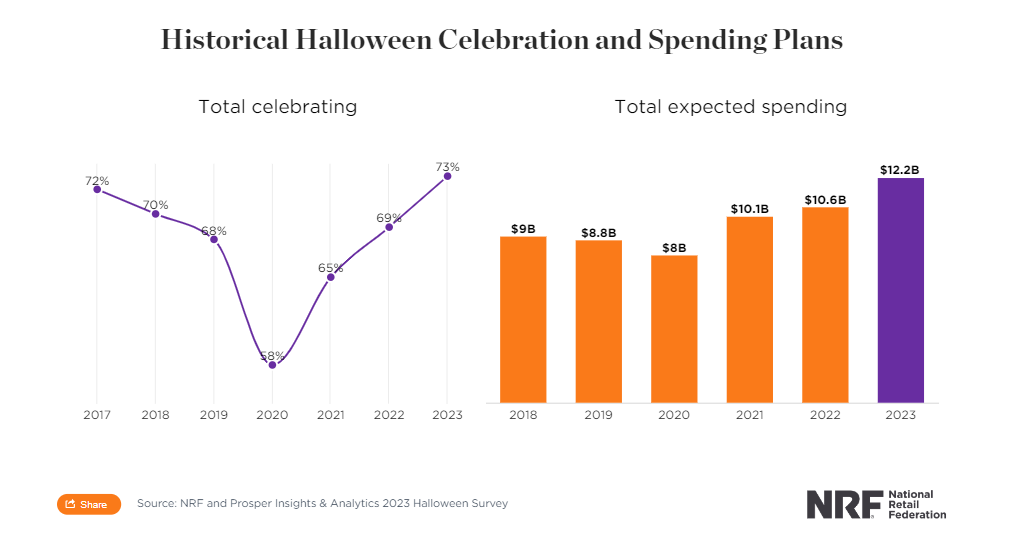
Spooky scary skeletons send shivers down your spine — this year especially as consumer spending for Halloween is expected to hit $12.2 billion, according to to the National Retail Federation. An NRF study found that 73% of Americans will participate in Halloween-related activities. That might explain why stores had back-to-school goods out for about 30 seconds and Halloween goods hit the stores before school started.

The study found that “Like previous years, the top ways consumers are planning to celebrate are handing out candy (68%), decorating their home or yard (53%) or dressing in costume (50%). However, in a return to pre-pandemic norms, more consumers also plan to throw or attend a party (32%) or take their children trick-or-treating (28%).”

Consumers are starting to spend earlier, which means that the traditional rush of seasonal freight is now less of a rush and better planned out for shippers and transportation partners to work with.

However, what should not come as a surprise is that online shopping has risen in popularity, which means the future will no doubt be more direct-to-consumer sales. The impact of stores like Spirit Halloween should not be underestimated as they remain the place to be for all things spooky, taking 39% of the Halloween shopping market.

(GIF: GIPHY)

The United Auto Workers union has come out on top after nearly seven weeks of stand-up walkouts, where different locations joined in should demands not be met instead of the traditional strike where all locations act in unison. The UAW has tentatively agreed to deals with Stellantis and Ford, and just a few days ago GM joined the group.

Terms of the deal with GM haven’t been released, but given how steadfast the union was in its demands it’s likely it got pretty close to what it was looking for. The Ford and Stellantis deals include “An immediate 11% raise in the top hourly wage rate, additional pay hikes totaling another 14% during the four-and-a-half years of the contract, as well as a return of the cost-of-living adjustment (COLA) meant to protect workers from rising prices. When the COLA and guaranteed pay increases are combined together, they could lift members’ pay more than 30% over the life of the contract,” according to CNN.

It is expected that the rank-and-file membership will ratify this agreement, but it’s not unheard of for such a deal to be rejected, as we saw at the beginning of October when the rank-and-file struck down the tentative agreement with Mack Trucks.

Here’s hoping this is the end of it and automotive freight can return to the market. This is not the best time for a substantial amount of freight to be missing in action.

SONAR TRAC Market Dashboard

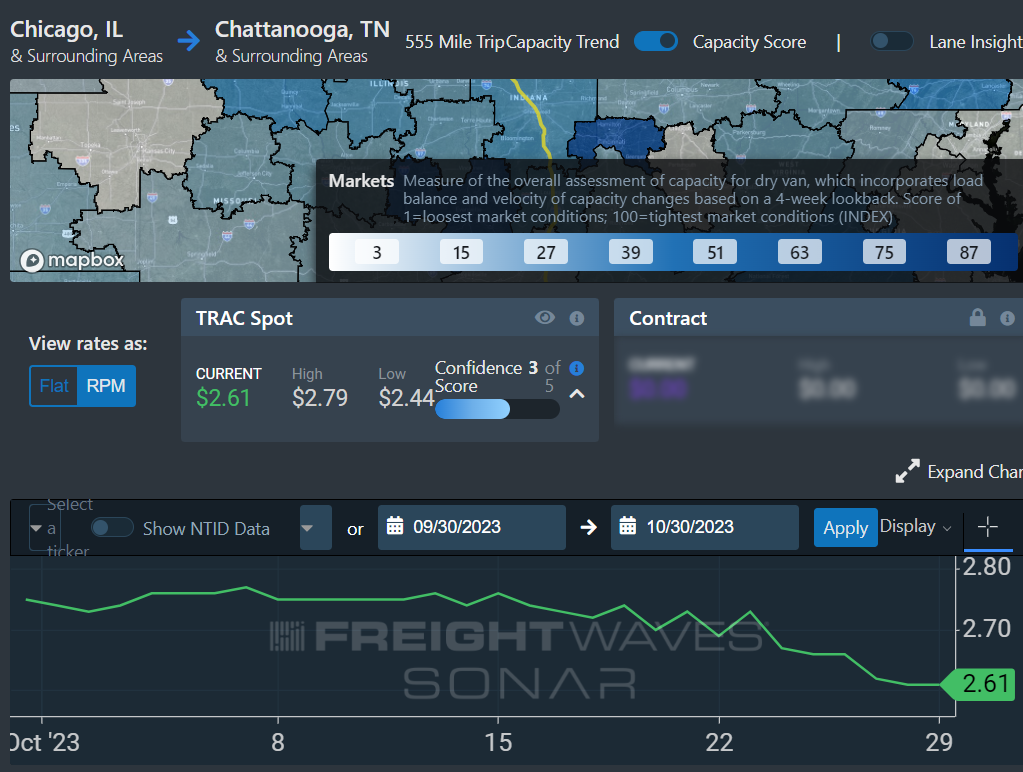
TRAC Thursday. In honor of the Future of Freight Festival taking place in Chattanooga, Tennessee, next week, this week’s Market Dashboard lane is from Chicago to Chattanooga. Unlike anyone flying to Chattanooga on the limited number of nonstop flights, there will be a few stops on this 555-mile journey. The good news for brokers and shippers is that spot rates heading into Chattanooga are trending downward. Outbound tender rejections in Chattanooga are ending the month at 2.67%, and outbound tender rejections are finishing out the month in Chicago at 3.31%. Both markets being below 5% rejections typically indicates that contracted rates will yield more revenue than spot market opportunities.

(GIF: Tenor)

Who’s with whom? It looks like XPO has done quite nicely in the post-Yellow world, with a 0.4% claims ratio, the best in company history, and increased on-time percentage, despite taking on additional freight volumes. The average daily shipment count increased by more than 1,000 in each month to over 54,000 in September.

According to an article by FreightWaves’ Todd Maiden, “Revenue in the company’s LTL segment increased 2% y/y to $1.23 billion. Tonnage per day was up 3% and revenue per hundredweight, or yield, increased 6% excluding fuel surcharges. The yield metric was aided by a 4% decline in weight per shipment. Pricing increased by 9% on contract renewals during the quarter, nearly double the increase booked in the second quarter.”

XPO is expecting to take its general rate increase early next year. Given the success of the third quarter, here’s hoping it’s a reasonable increase.

The more you know

Borderlands: US mulls terminating tomato trade agreement with Mexico

Where did Yellow’s freight go?

East Coast vs. West Coast: More imports shift back to Pacific ports

State of Freight takeaways: From the floor of a very weak trucking market

XPO’s Brad Jacobs will take the stage at next week’s F3

Brad Jacobs, executive chairman of XPO, will serve as the featured keynote speaker at FreightWaves’ second annual F3: Future of Freight Festival, taking place Nov. 7-9 in Chattanooga, Tennessee. 

Jacobs is a career CEO and serial entrepreneur with a unique track record of creating value for shareholders. He has founded seven companies, including five multibillion dollar publicly traded corporations, and delivered tens of billions of dollars of stock appreciation.

He is managing partner of Jacobs Private Equity and executive chairman of XPO (NYSE: XPO), which he founded in 2011. He also serves as nonexecutive chairman of XPO spinoffs GXO (NYSE: GXO) and RXO (NYSE: RXO).

Jacobs will take the stage for a town hall, “How to make a few billions,” on Day 2 of the festival on Nov. 8. 

Located in the heart of Freight Alley, F3 is the largest festival in freight, bringing together experts, entrepreneurs, industry leaders, educators and more to discuss the key factors impacting freight markets and the latest trends pushing the industry forward.

Over three days, attendees will hear from more than 70 freight industry experts, including keynotes from:

  • Alex Epstein, founder and president of the Center for Industrial Progress and author of “Fossil Future: Why Global Human Flourishing Requires More Oil, Coal, and Natural Gas – Not Less,” will discuss what it will take to ensure that living standards improve throughout the world. 
  • Chris Voss is a former international FBI hostage negotiator and The Wall Street Journal bestselling author of “Never Split the Difference: Negotiating As If Your Life Depended On It.” He will share his methodology to build stronger relationships in a shorter period of time, enabling deal negotiations that never seemed possible. Voss applies his years of experience as former lead international kidnapping negotiator for the FBI, his expertise as a hostage negotiation representative for the National Security Council’s Hostage Working Group and his training with Scotland Yard and Harvard Law School to provide proven techniques used successfully in the business world. 
  • Leland Miller, China Beige Book CEO, will provide market-leading insights derived directly from the organization’s nationwide proprietary data on the Chinese economy to help decision-makers stay ahead of critical market-moving trends in the world’s second-largest economy. Miller’s in-depth knowledge of the ongoing impact of geopolitical tensions on global supply chains will provide an interesting conversation and valuable, data-backed insights.
  • Michio Kaku, a theoretical physicist, professor and futurist with five New York Times bestsellers, including his latest, “The God Equation: The Quest for the Theory of Everything,” is one of the most influential physicists in the world. 

For more information on the festival or to register, click here.

Greenscreens.ai launches Capacity On Tap to make load transactions faster

Pricing platform Greenscreens.ai has launched a new feature, Capacity On Tap, to enable its users to access their capacity networks and make efficient and thorough decisions when pairing loads with drivers.

Matthew Silver, Greenscreens.ai’s vice president of strategic partnerships, told FreightWaves the integrations that power Capacity On Tap will help the company’s broker customers make load transactions faster with everything on one page.

“We learned that many capacity providers are not well integrated into the broker’s TMS, brokers toggle between many browser tabs and can forget their logins and it is cumbersome to recall what site to use for certain capacity types or regions. By aggregating the aggregators, as we like to say, brokers get all their capacity sources in a single pane of glass without having to reenter data. The time savings is huge on a per-load basis and helping brokers reduce the friction within the load life cycle is one of our missions,” Silver said.

Greenscreens.ai is currently integrating technologies into its new feature, including from capacity partners like CargoChief, FreightFriend, Yat.ai, Isometric Technologies, Highway and Truckstop. 

“Each of our Capacity On Tap partners has their own secret sauce to validate and rank capacity. We allow them to return results to our platform that is more upstream in the load life cycle from where their tools may have previously been placed. This yields more user activity as well as eliminates mouse clicks and keystrokes for our mutual users,” Silver said.

He went on to explain that since Greenscreens.ai’s focus is helping its customers make smarter pricing choices through business insights and dynamic pricing tools, the aggregating of aggregators into Greenscreens.ai’s platform creates a technology stack that remains neutral in the process of tendering loads to carriers.

“As former brokerage operators, our team understands that brokers need optionality and neutrality in a platform. Bringing multiple sources of capacity is just the beginning for Capacity On Tap,” Silver said. “As we partner with additional providers we will not only add capacity volume but also bring in ratings around on-time metrics and reviews so that our mutual users can select the right driver for the load. We will work with our customer advisory board and partners to understand what pain points brokers have and address those challenges with our partners. We have a belief that we are better together.”

Greenscreens.ai was recently named a FreightWaves’ Freight Tech 100 innovator and nominated for the FreightTech 25, which will be announced at the Future of Freight Festival in Chattanooga, Tennessee, on Nov. 9.


The unsung FreightTech disrupters innovating supply chains

CargoX consortium leads development of Uganda’s trade facilitation platform

Shippers, regulators tap into technology to ferret out illicit imports

Weekly Fuel Report: October 31, 2023


Learn more at SONAR.FreightWaves.com