Railroad signalers union to conduct safety program with Norfolk Southern
The Brotherhood of Railroad Signalmen (BRS) announced two endeavors Thursday involving the two Eastern U.S. Class I railroads: a collaboration with Norfolk Southern for a pilot safety program with Norfolk Southern (NS) and a sick leave agreement with CSX.
BRS’ collaboration with NS (NYSE: NSC) will consist of a one-year pilot program developed with input from the Federal Railroad Administration. The program will look at identifying safety improvements and best practices when sharing information and conducting training and joint inspections, NS said Thursday. The program will be called Signal Safety Collaboration, according to a letter leaders sent to BRS members at NS.
“The first phase includes field visits, team-building sessions, and working meetings to gather input from front-line supervisors and craft employees. To ensure all participants can speak up and provide candid, critical feedback, Norfolk Southern has underscored its commitment that no one will face adverse impacts from input they provide through the program,” said the letter to BTS members. The letter was signed by BRS President Michael Baldwin and Ed Boyle, NS vice president of engineering.
The letter continued, “To ensure the program produces tangible improvements, Norfolk Southern and BRS have mutually committed to work together to implement findings from the program. They have also agreed to advocate together in favor of regulatory changes that emerge as opportunities to enhance safety. Moving forward, BRS and Norfolk Southern will hold quarterly reviews on safety and issue timely updates on the work of the program.”
BRS members ratify sick leave agreement at CSX
Meanwhile, in an unrelated separate announcement, CSX (NASDAQ: CSX) said that a sick leave agreement at the Seaboard Coast Line (SCL) property for BRS has been ratified. The agreement covers nearly 400 employees.
“We value the hard work and dedication of the Brotherhood of Railroad Signalmen and all our employees who keep our operations running smoothly. This agreement reflects our ongoing commitment to improving the employee experience, ensuring our team members have the support they need,” CSX President and CEO Joe Hinrichs said in a release.
SCL General Chairman Gus Demott added, “Our union worked long and hard within the collective bargaining process to secure paid sick leave for our members and to ensure that the benefits are tailored to the needs of signalmen and their particular working conditions.”
It’s Halloween season, so what better time to look at some of the creepiest trucking routes and highways in the United States?
In this week’s episode of Tracks Through Time, Deputy Editor Brielle Jaekel and co-host Mary O’Connell tell some of the scariest legends and stories from America’s highway system.
Convoy failure reflects market conditions that continue to benefit shippers
News of Convoy’s failure dominated FreightWaves’ content this week. While the read-throughs are more pronounced for other brokers than for CPGs/retailers (the intended primary audience for this newsletter), there were still numerous takeaways from our content that are important to shippers.
From Craig Fuller’s article, Freight brokerage bubble bursting as freight markets face long winter:
Freight rates have been very soft all year, and there has been no improvement as bid season (traditionally mid-October through the end of February) gets underway.
We foresee contract rates dropping further as carriers realize “it’s lower for longer.”
Spot rates, currently at levels where carriers lose money on many of the miles they run, are unlikely to fall much further.
FreightWaves has been hearing from sources that a number of other midsize ($50 million-$250 million in revenue) brokers are in financial trouble.
John Kingston’s write-up of Knight-Swift’s earnings suggests that shippers do not have to worry about many loads falling through the routing guide this fall.
The outlook for TL calls for “muted peak season demand with limited non-contract opportunities.” The company expects spot rates to improve slightly, in line with normal seasonal patterns.
In its LTL segment, management expects to see a mid-teen year-over-year (y/y) increase in revenue during the fourth quarter as shipments and yield grow by high-single digits.
JB Hunt’s earnings highlight continued capacity excesses in domestic intermodal.
Intermodal revenue per load declined 14% y/y in Q3, excluding fuel.
The difference between reported trailing equipment at the end of the quarter (117,387 units) and effective trailing equipment usage during the quarter (96,248 units) suggests the equipment was 82% utilized. In that year-ago period it was 96.5%.
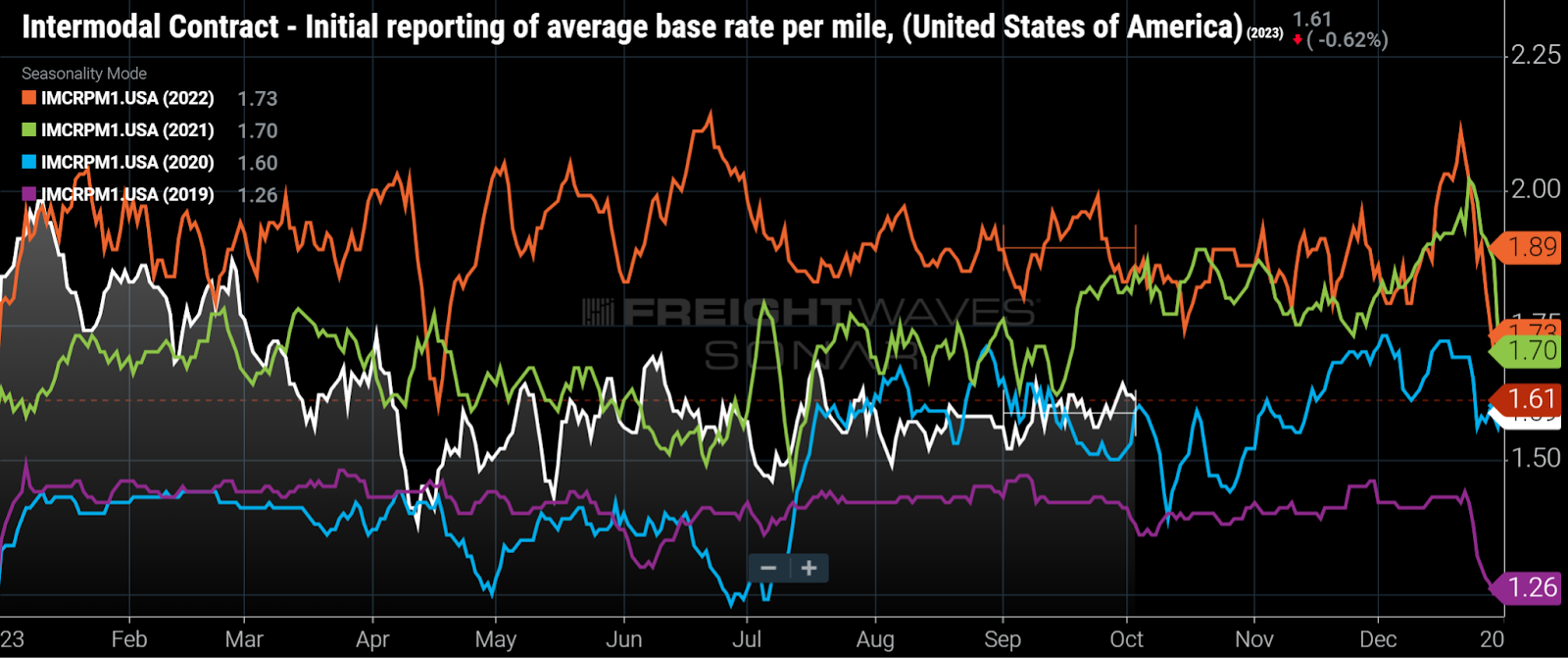
Domestic intermodal contract rates, excluding fuel surcharges, were lower by double-digit percentages in the third quarter. (Chart: FreightWaves SONAR)
Consumer debt continues to mount
(Chart: NewYorkFed.org)
Credit card debt usually peaks seasonally around the holidays, with the biggest credit card bills landing in January. That is part of why total credit card debt rising above $1 trillion, according to the New York Federal Reserve, is concerning and suggests that the average consumer has little dry powder for holiday spending this year. Consumer debt service payments (not including debt service related to mortgages) represented 5.8% of discretionary income at the end of the second quarter, down from 5.9% at the end of the first quarter, but is otherwise the highest percentage since the Great Recession.
Of course, big-ticket discretionary items, such as furniture and televisions, are likely to be most impacted. Still, consumer pressure is also filtering down into CPG unit sales volume. Last year at this time, many CPG companies were still saying that elasticities were “muted,” or less than what history would suggest given the price increases in everyday items. Now, CPG companies are starting to see elasticities that have risen closer to historical norms.
Investors question defensibility of Instacart’s model
(Chart: Barchart.com Inc.)
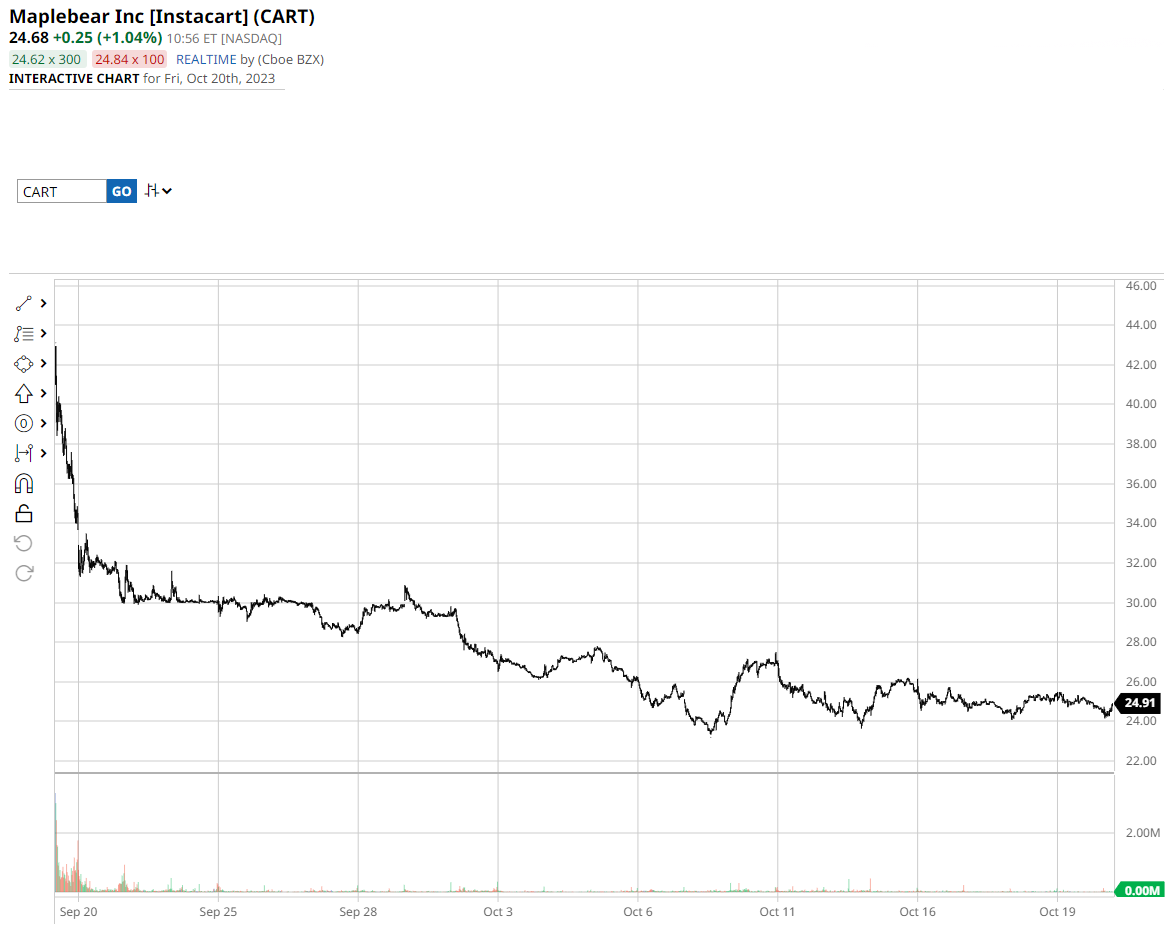
The Instacart IPO hasn’t helped open the floodgates for new public issuances as some had speculated. Aside from pressures on consumers making them more reluctant to hire an Instacart personal shopper, the technology-based delivery service faces numerous other risks. More retailers could cease using Instacart, particularly as the industry consolidates, and as retailers make investments in their own e-commerce platforms. That risk is highlighted by Whole Foods, which had been a significant Instacart partner in 2018 but ceased using the service in May 2019 following its acquisition by Amazon. The risk of further retail departures is significant with its top three retailers representing 43% of Instacart’s gross transaction value. The volume of orders placed on Instacart has slowed, up just 0.4% y/y in the first half of 2023 from the first half of 2022. Higher-margin advertising revenue is more important than revenue related to fulfilling orders and is likely behind the company’s profitability in 2022 and the first half of 2023, but slowing transaction volume may ultimately be a limiting factor on advertising revenue.
To subscribe to The Stockout, FreightWaves’ CPG and retail newsletter, click here.
CSX COO says internal, industry collaboration key to capitalize on opportunities
CSX’s new chief operating officer intends to break down internal information silos and support the railway’s role in a broader industry effort to work collaboratively to gain market share away from trucks.
An emphasis on cross-departmental information sharing can also benefit CSX (NASDAQ: CSX) in discovering any additional ways to cut costs and improve efficiency, COO Mike Cory said during CSX’s Thursday’s earnings call to discuss third-quarter 2023 financial results.
Cory, who assumed the role in early September after the surprise departure of Jamie Boychuk, is a 40-plus-year veteran of the rail industry and served as COO at Canadian railway CN (NYSE: CNI) from 2016 to 2019.
“[I look at the] visibility of waste and getting it and collating that information. … What I do is I try to teach and learn, learn and teach. That’s really what it’s about. We have a good group of people, — many of them younger — who haven’t been experienced in the positions they’re in,” Cory said during the earnings call. “That’s really where I’ve been focusing: first of all, to get a temperature read, but [also] really to start to share with them how to go about getting at that waste. And it’s not easy in a network like this. And it’s something that we will do as a team.”
By going “through the waste exercise,” he said, “it starts to allow you to get into understanding how to devise the network … and keep and even get better service.”
President CEO Joe Hinrichs added that Cory’s appointment was good timing for CSX, which he said has been steadily improving its rail service and will be in a position to take on additional business. CSX’s emphasis on improving company culture, a program called ONE CSX, will also support Cory’s efforts, according to Hinrichs.
“I think the timing of Mike joining us is perfect because we’ve had a year of taking advantage of the operating model that we have, engaging with our employees and doing a lot of things around culture and our ONE CSX,” Hinrichs said. “We’ve made tremendous progress, especially on the service metrics … and we have close industry-leading metrics across the board on the operating side.
“Now we have Mike coming in with his experience, a fresh set of eyes and all the opportunities that can now allow us to now step back and say, ‘OK, we’ve come this far, great work, proud of the team’s work. Now here’s the opportunity that we have to advance even further,’” Hinrichs continued.
Cory said: “What I’m trying to share with them is the availability of data and how to use it. I don’t see that they’ve had enough time. They’ve gone through a pretty tough period here over the last couple of years. They’ve rebounded extremely nicely. And to Joe’s point, this is to get to the next level where they’re self-sufficient. And I know they can be, they know they can be, but I’m here to show them that way.”
This effort to break down internal silos comes at a time when CSX and the broader freight rail industry are seeing more collaboration among Class I railroads to provide new or expanded service offerings.
Announcements this year include CSX’s plans to partner with Canadian Pacific Kansas City (NYSE: CP) to develop a corridor between the U.S. Southeast and Mexico and Texas; an expanded intermodal service among CN, Union Pacific (NYSE: UNP) and Mexican company Grupo México (GMXT); and CN’s partnership with Norfolk Southern (NYSE: NSC) to offer a domestic intermodal service connecting businesses in Canada and the Upper Midwest with the U.S. Southeast.
Many of these announcements occurred after CP and Kansas City Southern formally merged this past spring.
“You have Western Class Is going after the Mexico business. We can participate in that. We’re really happy to work with them. … [There is] a lot of momentum just around us all working together to create opportunities for ourselves, where I think for decades we’ve been pushing volume — quite frankly, off the railroad — onto truck. And now we’re all going to work collectively to really change that trend. And that’s exciting,” said CSX Chief Commercial Officer Kevin Boone.
Hinrichs reiterated that “in order for this industry to see significant growth, we have to work better together to be motivated to serve customers in new and better ways. And we’re starting to have some of those good conversations with other Class I railroads to be able to talk and think differently about how do we serve the customer and how do we get excited about that opportunity.
“So, there are a number of incremental steps we can take to grow the business beyond just getting better and all the work that we’re doing and the cynical nature of our business, which will be some things that should help us going into ’24,” Hinrichs continued.
Q3 2023 financial results
A decline in operating revenues put pressure on CSX’s net profit for the third quarter of 2023, CSX reported late Thursday.
Net earnings for the Eastern U.S. Class I railroad were $1.3 billion, or 42 cents per diluted share, for the third quarter of 2023, compared with $1.1 billion, or 52 cents per diluted share, for the third quarter of 2022.
Revenue totaled $3.57 billion in the third quarter, down 8% year over year (y/y). But expenses fell 2% to $2.28 billion on lower fuel expenses and lower costs for equipment and rents.
Operating income was $1.3 billion, down 18% y/y, while operating ratio — a metric that investors sometimes use to gauge the financial health of a company — rose to 63.8% from 59.5%.
It’s too soon to know whether Hyliion Holdings will be able to make a commercial success of its Hypertruck ERX natural gas-electric powertrain. The dreaded “strategic review” announced Oct. 11 means everything is on the table, including a sale, a shutdown or something in between.
But a second commercial lifeline might exist for Hyliion: the Karno fuel-agnostic generator. Hyliion paid $37 million in cash and stock to acquire the technology from General Electric in August 2022.
Originally touted as a second-generation ERX fuel source, fielding Karno as a stationary power source may generate revenue faster.
The Karno generator Hyliion Holdings purchased from General Electric Aviation in August 2022. (Photo: Alan Adler/FreightWaves)
“We see various market segments. If you think about commercial vehicles, you’re doing EV charging. We also see prime power applications. I like warehouses,” Hyliion founder and CEO Thomas Healy told me this week on the sidelines of the American Trucking Associations’ Management Conference and Exhibition in Austin, Texas.
Healy’s business is just 25 minutes north on Interstate 35 from the Austin Convention Center. Bringing a Peterbilt Model 579-based Hypertruck to give rides to conference attendees was a no-brainer even if the Hypertruck never sees scaled production.
Multiple uses for Hyliion fuel-agnostic Karno generator
Public information sharing guidelines prevent Healy from talking about the future of the Hypertruck. But he can promote the potential of the Karno.
“We see renewable matching so if the wind isn’t blowing or the sun isn’t shining, we could kick on generators to produce electricity,” he said. “We see waste gas opportunities where you would take what would normally be pollution and use that to produce electricity.”
Energy-hungry data centers are often mentioned as a customer for backup power from generators.
“Data centers buy generators that just sit out there ready for emergency use,” Healy said. “What if you could put a generator out there that could be your prime power so you’re running that 24/7 and then if the Karno had an issue, you move back to reliance on the grid? It’s almost like a flip of that model where the primary source is the grid.”
Hyliion: Generators cheaper than grid power
Using generators — Karno specifically — would be cheaper than pulling in grid power, he said.
For electric vehicle charging, bringing Karno generators to a location where utility-installed power is delayed could help match the regulation-driven demand for electric trucks. Karno is a portable power source that operates on up to 20 feedstocks including ammonia, hydrogen and natural gas to name just three.
If there is such great potential for the Karno, why, I asked Healy, did GE agree to part with it?
“GE was in the middle of divestiture at the time. And it was something we were already working with GE on. We were even funding some of the development of the Karno generator even though we were separate entities,” he said. “We approached them. Could we do more? Could we do a JV [or] could we buy it?”
Given Hyliion’s uncertain prospects, it looks like a smart move.
Thomas Healy, founder and CEO of Hyliion Holdings, with the Karno fuel-agnostic generator at the Advanced Clean Transportation Expo in May 2023. (Photo: Alan Adler/FreightWaves)
Hyzon Motors also pursuing stationary power — from fuel cells
Another startup with uncertain prospects is branching into stationary power. Fuel cell powertrain developer Hyzon Motors sees potential in diversifying from a focus on trucking and heavy equipment powertrains.
Hyzon is pushing ahead with a 200-kilowatt single fuel cell for trucking applications. Most competitors use twin stacks for slightly higher power output. Hyzon’s approach saves weight and requires less so-called balance of plant equipment. It is planning a 300kW single stack in a few years.
TechNavio and Fortune Business Insights suggest the total addressable market for stationary fuel cells will exceed $4 billion in the U.S. by 2025 and $35 billion globally, Hyzon CEO Parker Meeks said in an email. Count on charging sites being part of that.
Stiff competition in stationary power
“Charging through stationary fuel cells is part of the solution to provide consistent operations for zero-emission vehicles, particularly where hydrogen refueling is also offered at the same refueling station and with it, hydrogen storage on-site,” Meeks said.
Competition is thick. The cellcentric fuel cell joint venture between Daimler Truck and Volvo Group already works with Rolls-Royce Power Systems. Cummins Inc., a maker of diesel and gasoline-powered generator sets, plans hydrogen options too.
“I’m confident in Hyzon’s leading technology to differentiate itself among the crowd, particularly in those stationary power applications that also benefit from high power density where space can be limited, such as data centers and BEV truck charging in dense urban environments,” Meeks said.
Hyzon Motors fuel cell stacks hold potential for stationary applications. (Photo: Hyzon Motors)
Quick spin: Mack Trucks MD Electric medium-duty
Mack Trucks is bringing its medium-duty electric truck to the Sonoma Motor Speedway in California at the end of the month for a ride-and-drive program.
One of a handful of the trucks built so far in Roanoke, Virginia, made its way to Austin this week. Mack offered literal around-the-block rides for ATA’s’ Management Conference and Exhibition attendees.
As just a chassis cab without a cargo box or other upfit, the MD had significant jounce on the poorly maintained streets around the convention center. But the near-silent electric powertrain provided the conversation-keeping quietness expected in an electric truck.
After Austin, the MD was headed to Guadalajara, Mexico, to gin up business south of the border. The diesel-powered MD, equipped with a Cummins B6.7 engine, cannot be sold in Mexico. But the battery-electric version with a powertrain from Australia’s SEA Electric makes it fair game.
We’ll have more on the MD Electric in November after a longer exposure in California.
Scott Barraclough, Mack Trucks senior product manager of eMobility, inside the Class 6 Mack MD Electric truck. (Photo: Alan Adler/FreightWaves)
Nxu — former Atlis Motors — on the ropes with Nasdaq
Electrification startup Nxu, formerly known as Atlis Motor Vehicles, is on the ropes with the Nasdaq because its stock price and liquidity are too low to keep a seat on the exchange.
The Mesa, Arizona-based company went public in September 2022 following a series of crowdfunded capital raises that brought in about $35 million. It used Regulation A and Regulation Crowdfunding intended for small, entrepreneurial companies, skirting more intensive Securities and Exchange Commission registration rules.
But the cost of developing an electric skateboard chassis and a commercial pickup truck proved unworkable for Atlis, which rebranded itself as Nxu in April.The company pivoted to providing high-speed electric charging.
Nxu on Thursday said it would sell 86 million new shares of stock at 35 cents a share in the hope of raising $3 million. Its stock (NASDAQ: NXU) closed down 35.6% on Thursday at just over 4 cents a share.
Briefly noted …
Cummins and three partners will work together to determine whether concrete mixer trucks are good candidates for zero-carbon, hydrogen-fueled internal combustion engines.
Ree Automotive, the Israeli-based startup developing electric modules placed in four corners of the vehicle, says its order book has grown to $25 million, a 30% increase since August.
Navistar has started production of the S13 integrated powertrain — its last internal combustion engine — at its facility in Huntsville, Alabama.
Clean transportation nonprofit Calstart and utility National Grid will use Department of Energy grants to help turn freight-dense Interstate 95 into a zero-emissions freight corridor.
This week’s episode is “Dispatches from Austin.” Here’s newsletter-exclusive bonus content, an interview with Peter Voorhoeve, president of Volvo Trucks North America.
Daily Infographic: US crude oil exports reached a record high in first half of 2023
To view more FreightWaves infographics, click here
Clever wordsmithing aside, there is an open question today, as there was then, as to how much traction the multistory model will gain. New York City, with its dense urban population, a geography bordered by bodies of water that inherently block land expansion and extremely high real estate values, is the most active market for vertical construction. According to the JLL (NYSE: JLL) report, there are five multistory warehouses standing in New York City, with five more under construction.
Besides the Seattle complex, which is a 590,000-square-foot facility currently fully occupied by a large, unidentified retailer, Prologis (NYSE: PLD) owns and operates a multistory building in Miami.
The next step in the evolution will be in Chicago, a teeming metropolis bordered by one of the Great Lakes and thus land constrained to the north. The two-story facility, located on West Division Street in the city’s downtown, will boast 1.2 million square feet when it is completed sometime in 2024.
The JLL report, while acknowledging the multistory facility trend is still in its infancy, said the segment’s potential remains strong. The macro-factors appear to be in place. The U.S. population continues to grow. More Americans are filling the nation’s urban centers. E-commerce demand relentlessly marches on, pushing businesses to adopt more hyperlocal delivery solutions to rush orders to customers.
Markets like Atlanta, Houston and Dallas/Fort Worth, none of which are particularly land constrained, are candidates for multistory facilities, according to the report, which said other fertile markets include Miami and Seattle.
The multistory concept has been in place for decades in Asia and Europe, continents with countries that have relatively scarce available land. The American model calls for higher clearances than in Asia and Europe in order to handle bigger trucks. U.S. multistory buildings will likely be capped at two to three floors, unlike in Asia, where one facility, in Hong Kong, has 22 floors.
A difference between multistory and traditional mezzanine buildings is that each floor in a multistory facility has loading dock capabilities. Two-story multistory facilities can also do double duty for businesses looking to use one floor for fulfillment and another for distribution.
Though the demographics favor future growth, the economics — which were challenging in 2018 — have likely become even more so today. Relative to traditional one-story, squat warehouses, multistory facilities have higher costs and more challenging designs to execute. According to data published in late 2018 from real estate services firm CBRE Services, a two-story structure could cost about $150 per square foot more than a single-story facility because of higher material and construction costs that come with double decking. CBRE did not respond to a query to update its figures.
That differential was calculated during a period of benign inflation for labor and materials. Today’s gap would likely be much wider given the upward cost spiral during the pandemic and the supply chain bottlenecks that ensued. Although they have moderated over the past year, construction costs remain historically elevated.
The subsegment is also not immune from the spike in borrowing costs that have impacted all areas of real estate, including logistics warehousing, which is managing through a 10-year low in construction starts as investors back away from projects because of projected lower returns on their money.
One post-pandemic element that has yet to play out is to what extent low-rise office buildings, many of which have slack demand due to the work-from-home transition, might be suitable candidates for conversion to multistory warehouses.
Securing land, financing, materials and labor are short- to intermediate-term challenges for multistory projects. “You’re not building these in a month,” said Mehtab Randhawa, global head of industrial research at JLL.
Still, Randhawa remains bullish on the segment given the demographics, even though she acknowledges that multistory projects are “ultra-expensive” to build and not every market will have the profile to support multistory units.
China approves first A321 cargo conversion for Sichuan Airlines
China’s civil aviation authority has approved an American design for modifying a European-made passenger jet so it can carry main-deck cargo, paving the way for Sichuan Airlines to soon operate the narrowbody freighter.
321 Precision Conversions, headquartered near Portland, Oregon, said Thursday that the Civil Aviation Administration of China has validated its Airbus A321-200 conversion design to be operated in China. 321 Precision Conversions is a joint venture between Precision Aircraft Solutions, an engineering firm that designs and makes freighter conversion kits, and cargo-focused Air Transport Services Group.
Sichuan Airlines placed an order for multiple conversion kits last spring.
A handful of airlines this year have pulled back on plans for freighter conversions with the air cargo market in a pronounced downturn and having excess capacity.
The 321 Precision design is the first A321 converted freighter cleared to fly in China. An Airbus affiliate also does A321 conversions.
Sichuan Airlines took the unusual step of essentially installing the conversion kits itself through a maintenance, repair and overhaul (MRO) facility in Chengdu owned by its parent company. Most airlines and leasing companies don’t own their own repair stations and those that do typically don’t do conversions. The conversion process includes plugging the windows and installing a large door for cargo containers.
The Sichuan Aircraft Maintenance Engineering Co., Ltd., which is paid by 321 Precision to do the touch labor using its design, has nearly finished the conversion process and is expected to deliver the reconfigured A321 to Sichuan Airlines in November, according to a news release.
The plane was previously operated in passenger service by Air Macau.
Sichuan Airlines operates more than 180 passenger aircraft but wants to grow its small all-cargo fleet. It operates three factory-built Airbus A330-200 widebody freighters and one converted A330-300 freighter on lease, according to database Planespotters.com
The A321 passenger-to-freighter aircraft from Precision can hold 14 containers on the main deck and 10 small containers on the lower level, although some operators don’t bother using the smaller belly hold or just use it for loose cargo. The design doesn’t have any permanent ballast in the rear, which allows the aircraft to use less fuel than other designs, according to the company. It can support both types of engines used on an A321.
Knight-Swift sees inflection coming, beats lowered Q3 expectations
Management from Knight-Swift Transportation said Thursday that a tipping point for the truckload market is close.
“It feels like the extreme aggressiveness that we have seen out of non-asset-based players has reached a level to where it’s not only unsustainable, but when you add how expensive financing is … it blows up,” President and CEO Dave Jackson told analysts on a conference call.
“You have a lot of small carriers who were dependent on some kind of a model like that, that now are maybe in a little bit of trouble.”
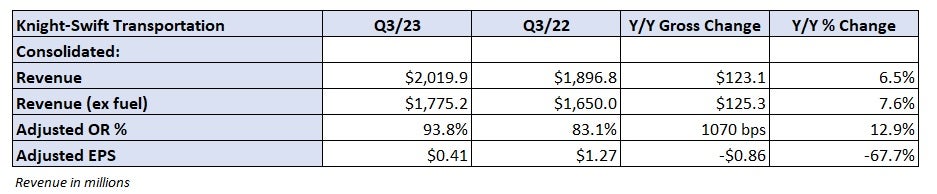
Knight-Swift (NYSE: KNX) reported third-quarter adjusted earnings per share of 41 cents Thursday after the market closed. The result was 5 cents ahead of the consensus estimate but 86 cents lower year over year (y/y). The earnings beat followed multiple negative estimate revisions from analysts in the weeks leading up to the report as freight data points failed to produce a material improvement from the second quarter.
However, as investors feared the worst, management’s outlook for the rest of the year didn’t disappoint.
Knight-Swift only lowered the top end of its full-year guidance range by 10 cents to $2.10 to $2.20. The range was higher than a $2.04 consensus estimate at the time of the print. The better-than-expected result sent shares of KNX 14.1% higher in after-hours trading, reversing a 9% decline logged in the two previous trading sessions.
However, one analyst was quick to level set expectations.
“We’d expect the stock to be up tomorrow, but not nearly as much as what’s currently indicated, given the 3Q EPS reflects more cost action than broader market improvement, and 2024 EPS remains much too high,” Deutsche Bank (NYSE: DB) analyst Amit Mehrotra told clients Thursday evening.
Knight-Swift said the integration of U.S. Xpress is ahead of schedule and it has already achieved an annualized run rate of $100 million in cost and revenue synergies. It expects the unit to produce an operating profit in the first half of 2024 and to be accretive to full-year EPS. However, it is forecast to be a 5-cent drag on the fourth quarter.
The company’s third-quarter adjusted EPS excluded some one-off items associated with the U.S. Xpress acquisition, which closed July 1. The number backed out a 9-cent benefit from tax credits tied to prior net operating losses incurred at U.S. Xpress. Acquisition and severance expenses that equaled 6 cents were also excluded.
The number did include a $15.9 million operating loss in its third-party insurance business, which amounted to 8 cents using a normalized tax rate. Other headwinds included higher interest expense (10 cents) and lower gains on sale (2 cents).
Knight-Swift is looking at strategic opportunities to mitigate losses in its insurance business given a streak of unfavorable claims developments. The company said it may tap into the reinsurance markets to limit the risk.
“It will take some time for these changes in the insurance business to fully materialize in the results, but we are making progress raising premiums and improving the quality of risk as we work to mitigate volatility,” a news release said.
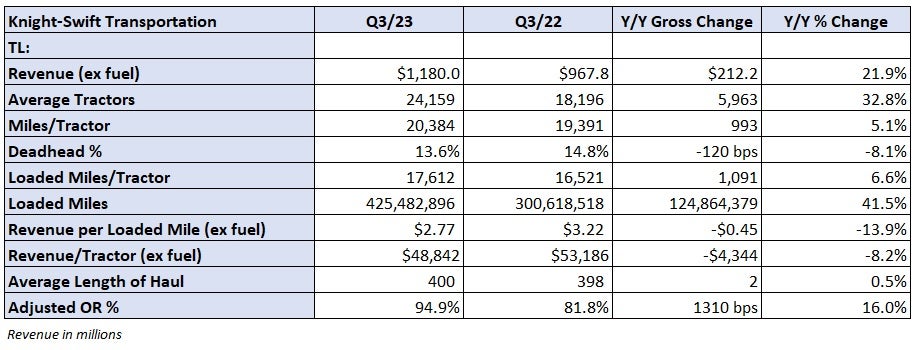
The TL segment reported a 22% y/y increase in revenue to $1.18 billion. The growth was driven by the addition of U.S. Xpress, which pushed average tractors in service 33% higher y/y. Revenue per tractor excluding fuel surcharges fell 8% as loaded miles per tractor increased 7% and revenue per loaded mile (excluding fuel) was down 14%.
The company said pricing in the division was largely reset across the company’s entire book of business and is reflective of a soft but stable TL market. Steady increases in fuel prices during the quarter were a headwind as surcharge programs lagged.
The TL unit posted a 94.9% adjusted operating ratio, which was 1,310 basis points worse y/y. Management said U.S. Xpress’ TL operations were a 340-bp drag on the result. Knight-Swift’s legacy operations saw a modest OR improvement from the second quarter.
The outlook for TL calls for “muted peak season demand with limited non-contract opportunities.” The company expects spot rates to improve slightly, in line with normal seasonal patterns.
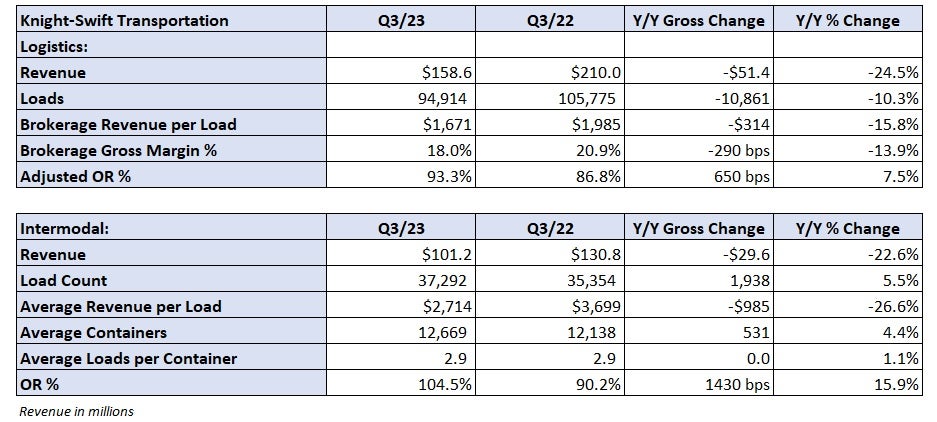
Knight-Swift’s logistics business reported a 25% y/y decline in revenue as loads fell 10% and revenue per load was down 16%. Loads would have been down 30% without the contribution from U.S. Xpress. Brokerage gross margin was down 290 bps to 18%. The segment OR deteriorated 650 bps to 93.3% with U.S. Xpress dragging the result down 90 bps.
The guidance calls for both brokerage volumes and revenue per load to stabilize in the fourth quarter with an OR again in the low-90% range.
Intermodal booked another operating loss in the quarter, posting a 104.5% OR. Revenue fell 23% y/y as a 6% increase in loads was offset by a 27% drop in yield. The unit operated at a breakeven level in September and “modest profitability” is expected in the fourth quarter.
Table: Knight-Swift’s key performance indicators – Logistics and Intermodal
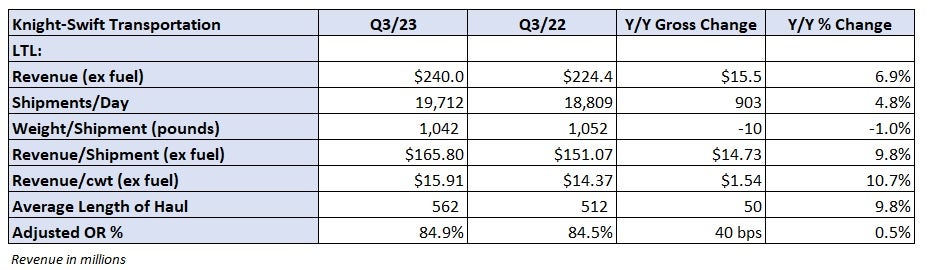
The less-than-truckload unit saw a 7% y/y increase in revenue excluding fuel surcharges. Shipments per day increased 5% and revenue per shipment (excluding fuel) was up 10%. The OR slipped just 40 bps to 84.9%. Annual wage increases and incremental costs incurred taking on more freight were headwinds to the margin.
Management said “volumes built throughout the quarter” due to Yellow’s exit. Looking forward, it expects the unit to see a mid-teen y/y increase in revenue during the fourth quarter as shipments and yield grow by high-single digits.
TriumphPay’s EBITDA loss narrows, volume increases, factoring invoices stay flat
In the quarterly multipage letter to investors from Triumph Financial CEO Aaron Graft, improved financial performance at the company’s open-loop payment network went side by side with weaker numbers in its factoring business that would be expected in the middle of a freight recession.
Triumph (NASDAQ: TFIN) management has said repeatedly that the two most important numbers at TriumphPay were earnings before interest, taxes, depreciation and amortization and the number of transactions on its network, which it defines as TriumphPay clients that use payments, audits or “both products in some capacity in their operations.”
The EBITDA margin at TriumphPay was negative 15% for the third quarter. It was negative 55% in the second quarter and negative 66% in the first quarter. The final quarter of 2022 showed a negative margin of 114%.
“We are closing in on our EBITDA-positive goal which we have committed to achieve on or before the end of 2024,” Graft said in his letter. “It is worth highlighting once again that these positive results at TriumphPay were generated within a freight market that was relatively flat.”
As for volume, TriumphPay processed just over 5 million invoices in the third quarter, up from 4.52 million invoices in the second quarter, a gain of 10.4%.
But that is all invoices processed, which includes the legacy fast pay business that was at the core of TriumphPay’s activities before a vast increase in its scope with the 2021 acquisition of HubTran.
For the network, which is defined as the use of “conforming transactions” that are serviced by all of TriumphPay’s capabilities including audit, network invoice volume soared to 303,300, up from 181,904 one quarter earlier.
“Of all the important metrics, I would call investors attention to network transaction growth,” Graft said. “They are the heart of the network and the most profitable thing we do in TriumphPay.”
The significant increase did not come just from higher volume, Graft said, adding “that was part of it.”
“It was also the result of improving our technology stack to widen the funnel for network transactions,” Graft said. That allowed brokers to use audit-only services at TriumphPay, even if they were not using the payment capabilities of the network.
TriumphPay has frequently noted that growth in getting brokers onto its network is not a quick process. Graft noted in his letter to investors that shifting ownership and broker startups and closures also can give an incomplete picture of TriumphPay’s network penetration, one of the reasons he said volume should be looked at as a top indicator of performance.
But penetration into the largest brokers remains a key metric for TriumphPay. Graft’s letter included graphics that said of the brokers that are “currently live or contracted to go live” on the TriumphPay network, the company has signed up 53 of the top 100 brokers, six of the top 10 and two of the top five. The measurement for those classifications is the amount of freight spend transacted by the companies.
The Graft letter highlighted that it added the brokerage division of Knight-Swift and Bridgeway, a stand-alone 3PL, as new customers to the network during the quarter. Graft said also there will be an as-yet unidentified top 5 broker to be added in the coming quarter.
As for factoring, the original trucking business at Triumph Financial, Graft’s discussion of that unit’s performance combined metrics with his views of where the freight market is headed.
The average transportation invoice size factored by Triumph Financial was $1,772, down $1 from the prior quarter. But as Graft noted in his letter, the figure includes diesel fuel costs. The average Department of Energy/Energy Information Administration weekly retail diesel price was $4.24 in the third quarter and $3.93 in the second, so that the percentage of linehaul costs covered in each invoice would have been less in the third quarter than in the preceding three months.
In the third quarter of 2022, the average transportation invoice factored by Triumph was $2,073. One potential sign of improvement: The average transportation invoice factored by Triumph in October so far rose to $1,828.
But Graft’s forecast on the freight market was not bullish, and it led him to say of the higher October invoice number that “it remains to be seen whether these rates will hold.”
TriumphPay saw an unspecified increase in the number of invoices per client and average daily purchases, but “total active client counts” were lower.
“We believe the market is decreasing in total carrier count with many smaller carriers failing or migrating to larger carriers,” Graft said. “I believe this will continue until we see a sustained turn in the freight market.”
His bearish outlook included these observations: “Without an increase in spot rates, more trucking companies will fail or leave the system. I am surprised that the credit cycle has not advanced more quickly, although headlines in the last few days suggest it may now have arrived,” a possible reference to the shutdown of Convoy Inc.
As “capacity leaves the system,” Graft said, Triumph will face “pressure on revenue versus credit losses.” But given how rapidly invoices enter and leave the factoring system, “the biggest headwinds are lower invoice prices, lower utilization and client attrition.”