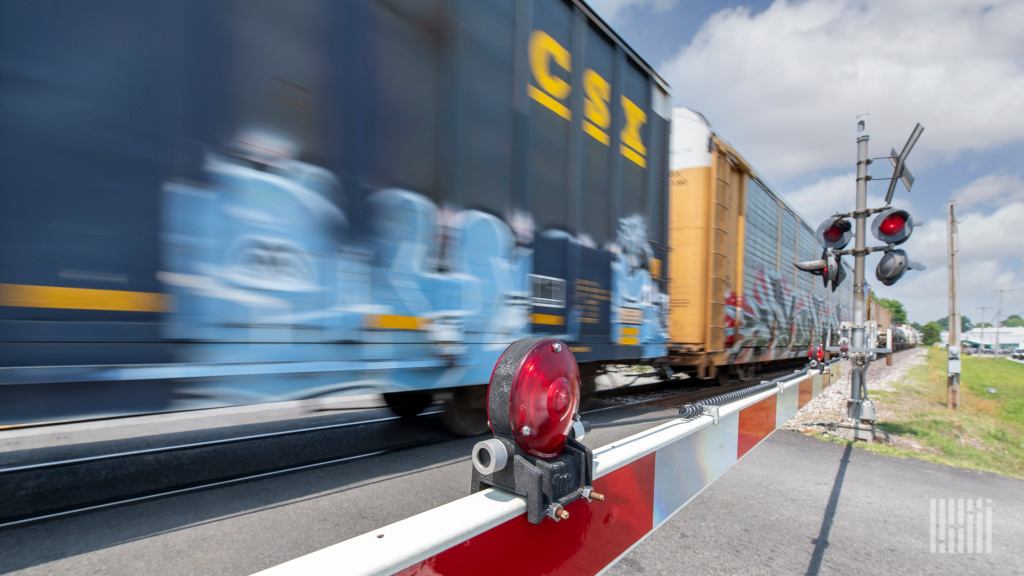
A decline in operating revenues put pressure on CSX’s net profit for the third quarter of 2023.
Net earnings for the eastern U.S. Class I railroad were $1.3 billion, or 42 cents per diluted share, for the third quarter of 2023, compared with $1.1 billion, or 52 cents per diluted share, for the third quarter of 2022.
Revenue totaled $3.57 billion in the third quarter, down 8% year-over-year (y/y). Lower fuel prices, reduced intermodal storage revenue, a decline in export coal benchmark prices and a decrease in export coal benchmark prices contributed to declining revenues and more than offset higher merchandise yields and coal volume growth, CSX said.
But expenses fell 2% to $2.28 billion on lower fuel expenses and lower costs for equipment and rents.
Operating income was $1.3 billion, down 18% y/y, while operating ratio (OR) — a metric that investors sometimes use to gauge the financial health of a company — rose to 63.8% from 59.5%. A lower OR implies improved financial health. CSX (NASDAQ: CSX) said these figures account for “negative impacts of approximately $350 million related to net fuel, storage revenue, and coal prices, partially offset by the favorable impact of $42 million due to out-of-period labor and fringe expenses incurred in the prior year.”
In a Thursday afternoon release, CSX President and CEO Jim Hinrichs said: “Over the third quarter, our efforts centered on delivering the reliable customer service that has allowed us to remain resilient and successfully maneuver through mixed markets. Our merchandise business remained solid, and our coal operations delivered strong volume growth. As we approach year-end, we are proud of the cohesive culture taking shape across our ONE CSX team that is helping to drive positive business results, and we are encouraged to see improving sequential trends in some of our key end markets.”
Looking back at some favorite scary transportation movies
FreightWaves Classics is sponsored by Old Dominion Freight Line — Helping the World Keep Promises. Learn more here.
It’s almost Halloween, and plenty of the FreightWaves staff love to celebrate with a good horror movie. Some of the best horror movies or halloween-adjacent films feature methods of transportation and logistics, which to us makes it that much more intriguing.
FreightWaves Classics polled staffers to get their favorite picks for horror movies featuring trains, planes, automobiles and any other major mode of transport. Here are the Top 10, in no particular order. Watch at your own risk.
‘Duel’
On Nov. 22, 1963, horror and science fiction author Richard Matheson experienced a scary encounter when a truck driver closely tailgated him and a friend, causing them to spin out, he revealed in several interviews. The writer took inspiration from the moment and wrote a short story about a businessman being terrorized by a truck driver that was then turned into a film. The plot of “Duel” follows salesman David Mann driving through the Mojave Desert to meet a client. But along the way, he runs into an ambiguous driver operating a semi-truck.
David gets into an altercation on the highway in the desert with the driver, who you can’t really see for most of the movie. In a seemingly unrelenting fit of road rage — or maybe just for the thrill of it — the driver stalks David for the rest of the film as they travel through the desert.
With a Certified Fresh rating from Rotten Tomatoes at 89%, this classic from 1971 holds up well.
‘The Midnight Meat Train’
“The Midnight Meat Train” is more recent than some of the others on this list, hitting theaters in 2008, but it’s based on a 1984 short story by Clive Baker. The movie brings viewers along with photographer Leon, played by Bradley Cooper, who is trying to find a potential serial killer he discovered while trying to find a new photography project. When detectives and others around him don’t believe his story, he becomes increasingly obsessed with the case. Leon’s obsession leads him to a subway ride from hell — and right into the hands of the killer.
‘Joy Ride’
The late Paul Walker, famous from the “Fast and Furious” franchise, takes the wheel in another fast-paced vehicle-driven action film in “Joy Ride.” The 2001 movie follows brothers Lewis and Fuller, who travel from California to Colorado to pick up Lewis’ childhood crush.
Along the way, they play a prank on a truck driver through a CB radio, convincing the driver that he is speaking to a woman who is romantically interested in him. When the driver, known as “Rusty Nail,” goes to meet up with the fictitious woman, things go awry when he discovers he’s been tricked. In retaliation, Rusty Nail begins to stalk and terrorize the group.
‘Maximum Overdrive’
Aliens and machinery combine in “Maximum Overdrive,” written by Stephen King and starring Emilio Estevez. All machines in the world become murderous after the Earth passes through the tail of a comet. As the world plunges into chaos, one family is terrorized by tow trucks, semis, bulldozers and all kinds of other man-made creations.
While the film’s kills are full of fun campy gore, it also features a score entirely composed by the band AC/DC, which significantly adds to the fun.
‘Terror Train’
If you’re looking for a more traditional slasher movie, “Terror Train” is a 1980 classic that features a New Year’s Eve costume party on a train that leads guests into a hellish night of murder. Similar to other slashers of the time, the motivation is revenge. But there’s one slight twist in the end to keep it fun.
A new version of the film was released on Tubi in 2022, but its Rotten Tomato score has a high of 8% from critics, so we suggest sticking with the original.
‘Train to Busan’
This somewhat newer South Korean film follows a high-speed train traveling between cities as a zombie apocalypse sweeps through the country — and passengers on the train. The story follows a devoted father trying desperately to keep himself and his daughter safe. The ending on this one may leave you shaken, and “campy” is not the right word to describe “Train to Busan.”
Yes, it has subtitles, but that certainly doesn’t take away from the drama. It also has some of the more realistic and frightening zombies I have ever seen. “Train to Busan” gives “The Walking Dead” a run for its money.
‘Snowpiercer’
We included “Snowpiercer” on our last movie listicle, but it’s worth adding here too. The 2013 hit-turned-television-series finds what is left of society surviving on a train that constantly circles the globe during an apocalyptic ice age. A classism divide prompts a kind of civil war to break out on the train, as the lower class fights for better living conditions, since they are forced to sequester at the back on the train where they live off of rats and black protein bars.
Twists and turns keep you guessing throughout the film. And, if the movie leaves you wanting more you can always follow it with a binge of the television series.
‘Christine’
The John Carpenter classic “Christine” is another based off of a book from Stephen King that derives campy fun out of a goofy plot line. A classic car makes for a classic movie when a 1958 Plymouth Fury causes mysterious deaths while its new owner, a nerdy teenager named Arnie, becomes increasingly obsessed with the car. Arnie even grows violent as his obsession becomes more controlling. The film is at its best when Christine the car is in a full murderous rampage and viewers get to watch a car act as a vicious serial killer.
‘Final Destination 2’
I’d be remiss if I didn’t include the film that prevents most millennials from ever driving behind a truck carrying a load of logs — the second in the “Final Destination” series. The film follows a group of friends after they narrowly miss death and destruction when one of them is able to prevent a massive car accident after having a vision.
However, their fates already seem to be sealed as they each start to die one by one in horrific and bizarre accidents.
But the most jarring scene of the film is the vision of the accident, caused by a log falling loose from a flatbed truck.
‘Snakes on a Plane’
The name aptly says it all, but this fan favorite shows Samuel L. Jackson fighting his way to stay alive aboard an airplane filled with deadly snakes sent to murder a witness in a trial. It’s exactly what it says it is.
What is your favorite transportation-related horror movie? Tell us in the comments below.\
Have a topic you want us to cover? Email bjaekel@www.freightwaves.com.
Texas DPS ends truck safety inspections after $1.9B impact
Texas Gov. Greg Abbott may have stopped state-run truck safety inspections at the Mexican border, but business leaders said it could be weeks before cross-border traffic patterns return to normal.
“We hope that in the next three weeks, if we continue without setbacks, there will be good progress in the usual exports, as well as exports that have been waiting,” Manuel Sotelo, vice president of the Juarez chapter of Mexico’s National Chamber of Freight Transport (Canacar), said at a Tuesday news conference in Juarez, Mexico. “In three weeks, the backlog of 24,570 exports should be resolved, possibly not 100%, but it’s a goal we can have.”
Juarez is located just across the border from El Paso, Texas.
Trade across the U.S.-Mexican border has slowed over the past several weeks as U.S. authorities shifted customs personnel to immigration duty as migrants began arriving in large numbers at border ports of entry across the country.
In addition to the migrant surge, Abbott ordered the state’s Department of Public Safety (DPS) to do safety checks at several border crossings beginning Sept. 20 on all cargo trucks, reportedly as a way to deter cartel activity across Texas.
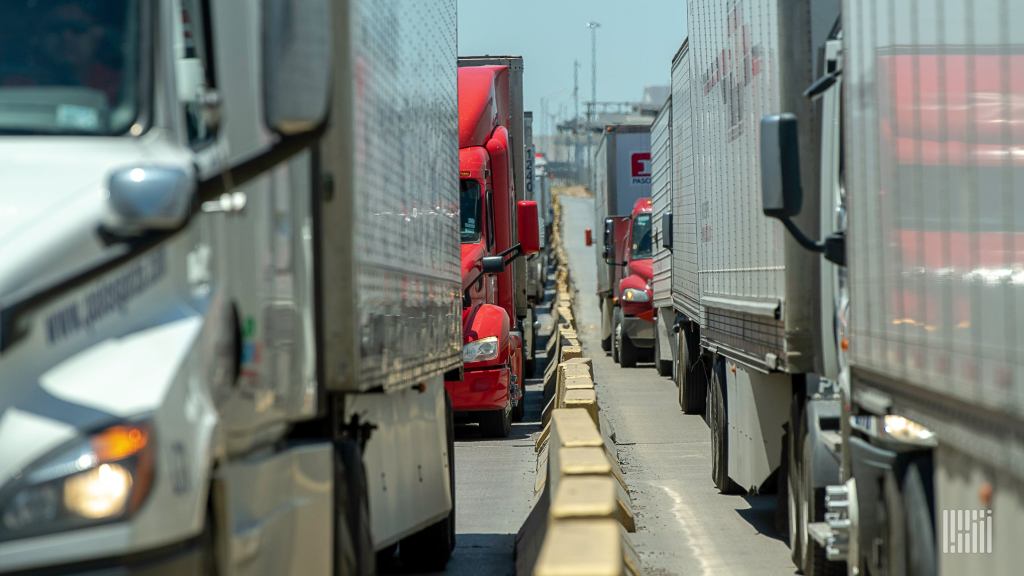
Both the migrant surge and the Texas DPS inspections generated long lines and snarled commercial vehicles at border crossings in Laredo, El Paso, Eagle Pass, Del Rio and Tornillo, Texas.
While the migrant situation began to ease, Abbot kept the Texas DPS inspections going until Monday in El Paso. The DPS inspections ceased at the other locations last week.
Canacar officials said the safety inspections by the Texas DPS stranded 19,000 trucks carrying about $1.9 billion in goods destined for the U.S. at the Mexican border.
The DPS inspections that began in September are at least the fourth time since April 2022 that the agency has implemented the state-run commercial checkpoints. They are in addition to cross-border truck inspections conducted by Mexico customs, U.S. Customs and Border Protection and the Department of Transportation.
U.S. and Mexican officials have criticized the DPS inspections as unnecessary since Texas state troopers do not have the authority to inspect cargo trailers.
Mexican President Andres Manuel Obrador sent a diplomatic note to federal officials in response to the Texas DPS inspections, blaming them for disruptions to international trade.
Sotelo and other trucking and logistics professionals at the Tuesday news conference said they have contacted both U.S. and Mexican authorities about what can be done to make sure the DPS does not implement the safety inspections again.
“On both sides of the border, we have the challenge of correcting the effects that were experienced on Mexican exports and making sure that these situations are not repeated,” Miguel Angel Martinez, Canacar’s national president, said. “We cannot forget the importance that Texas has in the commercial relationship between both countries.”
Homero Balderas, general manager for the city of Eagle Pass International Bridge System, said commercial trade flows are back to normal after several weeks of disruption. Balderas said the Texas DPS inspections were slowing cargo trucks by as much as 40%.
The Port of Eagle Pass usually sees about 850 cargo trucks a day. That number fell to roughly under 400 due to the Texas DPS inspection delays.
“Everything is luckily back to normal regarding inspections and are getting very close to the 800 trucks a day,” Balderas told FreightWaves.
In Arizona, cross-border operators said trade flows are still not back to normal after federal officials removed customs personnel from their inspection posts at the Nogales-Mariposa port of entry to help handle the influx of migrants in the area.
“Nogales-Mariposa is still operating at reduced staff,” Joshua Rubin, vice president of business development at Javid LLC, told FreightWaves.
Javid is a Nogales, Mexico-based shelter company that helps manufacturers set up operations in Mexico. Nogales, Arizona, and Nogales, Mexico, are sister cities along the border.
Rubin said commercial trade and pedestrian crossings at the Nogales-Mariposa port of entry have suffered because of the reduced staffing at the ports and because of the arrival of large groups of migrants in the area.
“This past weekend, lines for people crossing were almost four hours. Normal is an hour. People were waiting in lines half a mile long,” Rubin said. “Migrant crossers are stable, as in they have not gone up or down, but we still have a lot crossing illegally.”
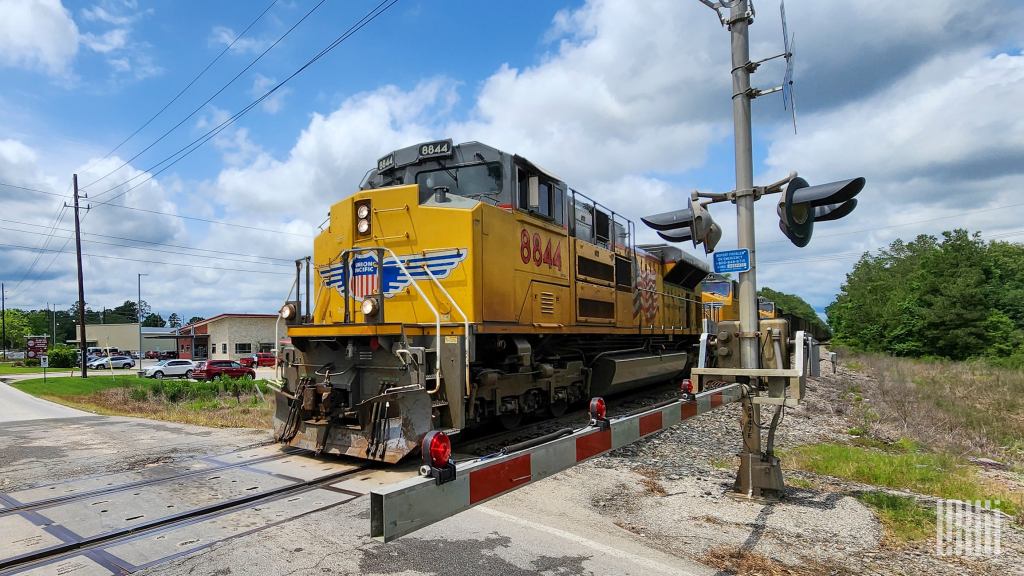
As Union Pacific seeks to climb its way out of 2023’s headwinds of elevated inflation rates and higher labor costs, the ways that the Western U.S. Class I railroad — and newly installed CEO Jim Vena — expect to manage productivity in the near and longer term were of interest to Wall Street investors taking part in UP’s earnings call Thursday to discuss the railway’s third-quarter 2023 financial results.
“I know this railroad, and I understand the opportunity. To win, you need a strong management team, the right culture and a great franchise. And that’s the goal: win and be the best in the industry,” Vena said in prepared remarks.
Vena became UP’s CEO on Aug. 14. He had previously served as the railroad’s chief operating officer in 2019 and 2020.
One way that UP will seek to change is getting more decision-making input from those more attune to the railway’s day-to-day operations, according to Vena, who said that input will help the company improve rail service, use resources and assets more efficiently and keep costs manageable.
“A key early initiative of mine is to drive decision-making lower in the organization. This means reducing layers and simplifying how we work. We need to deliver value with speed. This is a cultural change to empower our people,” Vena said.
That input also includes how to improve productivity at the asset level, Vena continued.
The U.S. Bureau of Labor Statistics defines productivity as “a measure of economic performance that compares the amount of goods and services produced (output) with the amount of inputs used to produce those goods and services.”
In response to an analyst’s question, Vena said, “The way I look at it is, there’s nothing wrong with hump yards, but they have to fit into the fluidity and the touch points of how many times we touch cars and how many cars we actually have to handle.”
He added that UP needs to lower its dwell time at the yards, terminals and intermediate points, which should drive productivity gains.
“You can’t have nine levels — from the CEO to the people who actually do the work — and expect that the message is clear, the decisions are made clear and there isn’t some hiccup. … I want to drive it so that we have way less layers. And that means, with less layers, the people out in the field are empowered to make the right decision: which train to hump, which train to switch. How do we move the cars? What are we doing for customers? What are we doing for scheduling? How are we loading? Is our loading pattern right? [There are] so many things that we can do,” Vena said.
Meanwhile, actions that UP took in the third quarter to grow productivity included storing 300 locomotives, reducing the re-crew rate and growing train length, according to Eric Gehringer, UP executive vice president of operations.
When asked how much Canadian Pacific Kansas City was a threat to UP’s business, Vena cited UP’s network advantage and ability to run at higher speeds, in addition to its partnership with Ferromex, which operates in Mexico and in which UP has a 26% ownership stake.
“There’s nothing wrong with a little competition. I want to win, [CPKC President and CEO Keith Creel] wants to win,” Vena said.
While CPKC might have an advantage in origination and destination pairings, UP’s advantage is that “we’ve got this great network. We go through 23 states. … We have a 70 mile per hour railroad. We’re fast. … CPKC is going to make it difficult and we’re going to make it difficult.
“Now I don’t chase price. This is not a price discussion. It’s about a service and access to markets and how we do it. And I’ll walk away from business if somebody wants to lower their price. Go ahead, take the business, I’ll bring in a business that fits our network that makes sense. So that’s how I think of competitors, and I could have that discussion about all the other railroads.”
UP’s financial results for Q3
UP’s (NYSE: UNP) net profit for the third quarter of 2023 slipped 19% amid a 10% drop in overall revenues, the Western U.S. Class I railroad said Thursday morning.
Third-quarter 2023 net income was $1.53 billion, or $2.51 per diluted share, compared with nearly $1.9 billion, or $3.05 per diluted share, for the third quarter of 2022.
Overall operating revenue was $5.9 billion, down 10% year-over-year (y/y). Of that, freight revenue totaled $5.5 billion, which is a 9% decrease compared with the same period in 2022.
However, UP reduced operating expenses by 4% in the third quarter to $3.76 billion amid a 25% decrease in fuel expenses and a 6% decrease in compensation and benefits.
Operating income was $2.18 billion in the third quarter, down 17% y/y. Operating ratio, a metric that investors sometimes use to gauge the financial health of a company, rose from 59.9% to 63.4% A lower OR can imply improved financial health.
Port of Long Beach CEO: ‘Consumer confidence is on the rise’
The Port of Long Beach reported Thursday that it had achieved its busiest September on record, thanks in large part to consumer demand for holiday-related goods and ratification of the International Longshore and Warehouse Union contract.
The Southern California port moved 829,429 twenty-foot equivalent units in September, up 11.8% from the same month last year and surpassing the previous record set in September 2020, during the COVID-induced e-commerce surge, by 78,849 TEUs.
The port noted that September marked its first monthly year-over-year (y/y) cargo increase in 14 months, suggesting the import drought may be over.
“Consumer confidence is on the rise and shippers can rely on the Port of Choice now that we have a ratified contract in place with our waterfront workforce,” Port of Long Beach CEO Mario Cordero said in Thursday’s news release. “We look forward to a moderate rebound in cargo volume through the end of the year.”
September imports were up 19.3% y/y to 408,926 TEUs, while exports declined 10.3% to 101,248 TEUs. Empty containers moving through the port were up 11.5% y/y to 319,255 TEUs.
Volumes for the first nine months of 2023 were down 20.7% from the same period last year. But the port noted that the 5,822,666 TEUs moved from January through September were in line “with pre-pandemic levels, when the Port of Long Beach moved from 5.7 million TEUs through September 2019.”
The port indicated it is making gains, pointing out that the 2,089,990 TEUs moved during the third quarter was down just 10.5% from Q3 2022.
American Airlines’ cargo revenue shrinks by a third in tough market
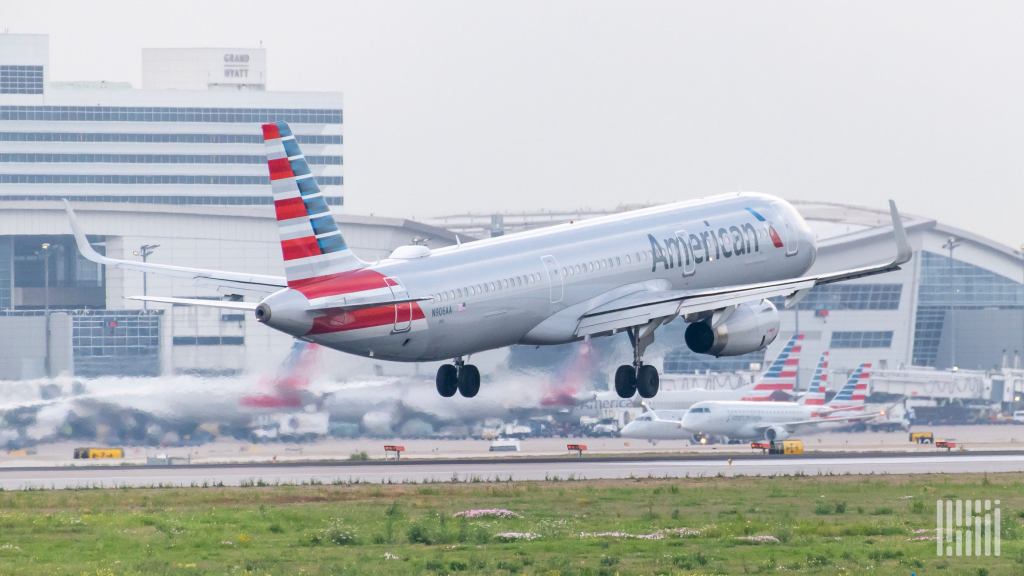
American Airlines said third-quarter cargo revenue fell 31% to $193 million, following a similar trajectory as its U.S. peers that are also dealing with a prolonged contraction in cross-border shipping volumes driven by economic uncertainty and improved ocean shipping reliability.
The downbeat cargo figures came against record corporate revenue of $13.5 billion and adjusted net income of $263 million during the three-month period, in which a nearly $1 billion one-time payout related to a new pilot labor deal was not recognized. The company has posted six consecutive quarters of profits and paid down 70% of its of its total $15 billion in debt coming out of the pandemic.
American Airlines (NASDAQ: AAL) received $613 million in cargo revenue for the nine-month period through September, a drop of 36.8% from a year prior.
United Airlines (NASDAQ: UAL), by comparison, experienced a 33% decrease in cargo revenue year over year to $333 million. Year to date through September, cargo was off nearly 36% at $1.2 billion. At Delta Air Lines (NYSE: DAL), cargo revenue slid 36% in the quarter to $154 million and by a third to $535 million for the first nine months.
The results were expected in an air cargo market that has seen overall volumes fall by 8% to 10% since March 2022, finally hitting bottom in late summer. Airfreight shipping prices have been 40% to 50% lower than last year for most of 2023 and have only recently seen marginal seasonal improvement. Cargo was a rare silver lining for airlines after the pandemic disrupted ocean supply chains and caused carriers to halt passenger flights, resulting in a huge loss of belly capacity.
American’s cargo results lagged 2019 levels of $208 million for the third quarter and $647 million for the first three quarters.
Fewer large jets in the fleet and a smaller Asia-Pacific network have constrained the cargo business and partly explain the difference. The airline retired all of its Boeing 767 medium widebody aircraft at the beginning of the pandemic, as well as its Airbus A330s, and has about 30 fewer widebodies flying today, American Airlines Cargo President Greg Schwendinger said on a recent episode of the “Cargo Masterminds” podcast from STAT Media Group.
American Airlines resumed taking delivery of Boeing 787-8 Dreamliners last year and will begin receiving 787-9s in mid-2024 after Boeing resolved manufacturing issues. As aircraft orders get fulfilled, the fleet will return to its 2019 size in a few years, he noted.
The Fort Worth, Texas-based carrier is not serving markets like Beijing and Hong Kong and has fewer frequencies to Shanghai than prior to the pandemic. Passenger demand has been slower to ramp up in Asia, where strict COVID policies remained in place until late last year, and geopolitical tensions between the U.S. and China have led the governments to limit air service by each country’s respective airlines. As of Aug. 31, the 12 roundtrip operations between the U.S. and China allocated to U.S. carriers were split among American, Delta Air Lines and United Airlines. A new agreement allows the number of bilateral flights to double by the end of October, but the amount of air service between the U.S. and China will still be well below the pre-COVID level.
Schwendinger said that as cargo yields retreat, many large freighters are becoming less economically viable for all-cargo operators, which could push more volume to passenger airlines.
“With yields where they are at this point, serving our forwarder needs on belly space on passenger flights becomes more attractive. The break-even point of putting it on a passenger operated aircraft in the belly as opposed to operating a freighter is starting to change. So to some extent that could serve as somewhat of a yield floor. We’ve heard from some of our customers, particularly those that operate a network of aircraft on their own, that they’re making efforts to potentially put a few aircraft on the ground and move that business onto passenger operations,” he said on the podcast.
AA Cargo has improved the performance of its interline connections, which is drawing more customers, he added.
Cargo system upgrades
In June, American’s cargo division upgraded to the latest version of its iCargo platform from IBS Software. The airline launched the cargo management system in October 2019 but spent a couple of years during the pandemic slowly rolling out the capabilities to make sure the system aligned with the business operation. Rather than adopt new versions when IBS made them available, American waited and jumped forward about eight versions with a single upgrade during the summer, Schwendinger said.
“It was a big effort by our team. We spent seven to eight months preparing and a couple of months after the cutover ensuring that all our processes, systems and reporting that we could generate from iCargo were working,” he said. “We did a major upgrade without any of our customers feeling any kind of impact. In fact, most of them weren’t even aware we were doing anything. We had zero impact on the operations of the airline or our cargo business.”
The smooth IT transition stands in marked contrast to the one experienced at Qantas Freight, which is still digging out from a container logjam caused last month when a switch to a new cloud-based cargo management system went off the rails and data didn’t properly transfer.
The iCargo management system unlocks a trove of data about American’s customers and operations that is now discoverable through various dashboards that make it easier to run the business, the cargo chief said.
American has also established its own software interface that allows its reservation system to connect directly with a couple of large forwarders, which allows them to search for capacity, run price comparisons and book space within their own transportation management systems.
Schwendinger said AA Cargo is also leveraging those programming connections to establish direct communications with ground handling companies at airports, which is expected to improve efficiency at domestic and international destinations.
AA Cargo distributes capacity on the WebCargo and Cargo.one marketplaces, as well as its own website, and recently began to offer dynamic rates where prices adjust on a lane-by-lane basis depending on market factors.
For better retention, focus on what’s controllable — Taking The Hire Road
On this episode of Taking The Hire Road, Jeremy Reymer, founder of DriverReach, is joined by a great industry friend and partner, Max Farrell, co-founder and CEO of WorkHound, a company committed to giving a voice to frontline workers through a real-time anonymous feedback platform.
The trucking industry has dealt with rampant turnover for years. Because of the volatile marketplace, a driver might be “happy in the beginning of the week, get fed up in the middle and quit in the end and have a job somewhere else,” Farrell said.
Historically, though, drivers only have a chance to provide feedback through annual surveys or exit interviews, which are too late or too slow.
WorkHound helps shed light on the issues truck drivers and other frontline workers face in their jobs, which helps companies be proactive instead of reactive in understanding and addressing the problems in their businesses. Workers can provide feedback to their employers anonymously, and companies can take action on those insights to build a stronger business. Last year, WorkHound helped companies retain 12,000 workers.
“That feedback can be really helpful, so it’s not just always about what does it take to hold onto someone, it’s also about what does it take to make them more efficient at what they do so you can do more with less,” Farrell added.
Identifying an organization’s weak spots and leveraging feedback to understand where their organizations create efficiencies can help them to make changes now to allow them to stay competitive in the market. While the market is uncontrollable, companies can look inward at what they can control to make those positive changes. This means looking at what’s hindering their drivers from being productive — whether it’s maintenance issues, specifications of equipment, hold times in communication between driver managers and drivers or something else.
The last thing a company wants is to have blind spots. Hearing directly from drivers, in an anonymous setting, can also help leadership confirm if the problems in their organization mirror the reality being presented by managers.
“What we’ve built is ways companies can do one-way or even two-way anonymous chats back and forth to address the issue with somebody on their team so that they can get to the bottom of something,” Farrell said of WorkHound.
A solid direct feedback loop provides companies with visibility into whether they are doing an adequate job. If they’re not, they can fix it. This is critical because when people don’t feel like a company is doing enough for them, they will either fight and unionize or try to leave, Farrell said.
“I’m all for people having a voice, and if people feel left behind, they need to take care of themselves however they can. Companies do have the ability to do something about this,” Farrell said.
Leveraging WorkHound allows companies to constantly stay on top of their employee satisfaction in real time in an honest environment and help them take action thanks to data-driven insights.
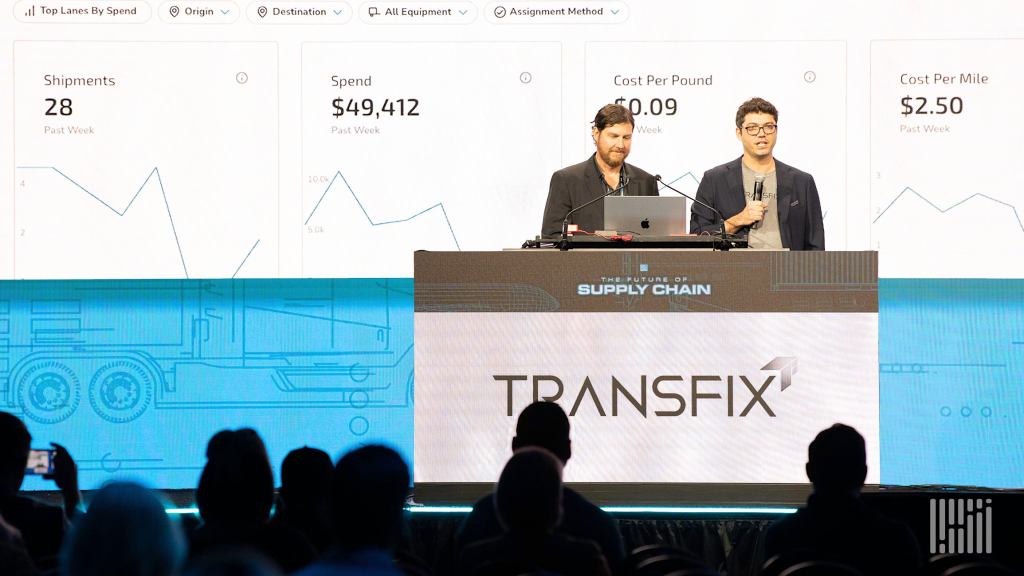
Despite a weak freight market, Transfix announced the closing of a $40 million Series F funding round led by New Enterprise Associates (NEA) and G Squared, with participation from Canvas.
The latest funding strengthens Transfix’s financial position, supports a path to profitability and represents confidence from investors in the company’s approach, Transfix officials said.
New York-based Transfix is a digital freight marketplace connecting shippers and more than 30,000 carriers. The company was founded in 2013 by CEO Jonathan Salama and Chairman and President Drew McElroy.
“Since day one, we have been relentlessly committed to optimizing, improving, and future-proofing our core business: our tech-enabled brokerage and software solutions for shippers and carriers,” Salama said in a news release. “By staying focused, we continue to build momentum despite one of the most challenging markets in freight history.”
Investors said they see continued growth in Tranfix’s business model.
“We believe that Transfix delivers innovative solutions that help companies optimize in today’s freight market, and will provide continued value into the future,” Carmen Chang, partner and head of Asia at NEA, said in a statement. “Our investment represents our ongoing confidence in the company’s strategy and leadership.”
The Series F raise comes a few months after the company saw its valuation fall to $376 million, a nearly 60% reduction from the $940 million the company was valued at in its last funding round in March 2020.
FreightWaves reported late last year that after announcing the company would not go public through a special purpose acquisition company combination with G-Squared, Transfix would be working with NEA and G-Squared on private financing.
The company had hoped to gain a $1.1 billion valuation through the public offering but pointed to market conditions for the change in direction.
FreightWaves has learned that at least two large incumbent logistics providers are actively bidding on Convoy’s tech stack, which would include the engineering and product teams that support the software. Such a play could make sense for any number of 3PLs or asset-based carriers that either want access to the installed base of Convoy’s driver app or some of the most advanced automated matching and pricing engines in the industry.
Convoy employees on Thursday morning were given official notice that the freight brokerage arm of the company was shutting down — loads had been canceled, tenders rejected and freight given back to customers. Salespeople, brokers and operations teams learned they were losing their jobs to a combination of freight market volatility and monetary conditions.
But incumbent logistics companies have long recognized the value in Convoy’s technology: Its driver app has some of the widest adoption of any in the industry, and sophisticated auctioneering algorithms on the back end kept freight moving across the country with a minimum of human intervention. Over the years, Convoy has built software for small fleet dispatchers and transportation management system portals for its customers in order to bring as much of the transaction on-platform as possible so that it can be automated.
It’s unclear exactly how Convoy’s software, which was largely unmonetized, would be valued, but FreightWaves has heard that multiple logistics providers, including Maersk (DXE: MAERB.C.DX) and UPS (NYSE: UPS), have taken a look at the technology platform as a potential strategic asset.
Current parties to the acquisition discussion were not disclosed, but more news is expected over the next week.
Loaded and Rolling: Convoy shuts down
Convoy shuts down
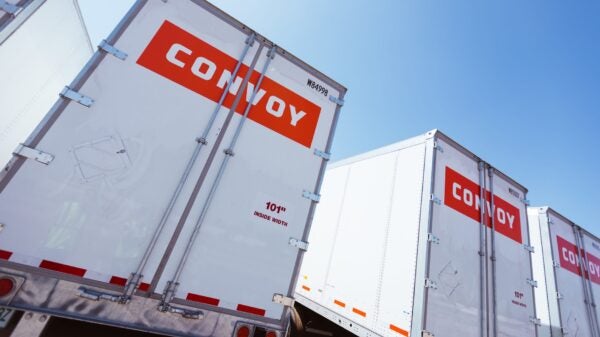
(Photo: Convoy)
Seattle-based digital freight broker Convoy on Wednesday canceled all shipments from its marketplace and company representatives promised more details of a business transition were forthcoming. By Thursday, company employees were told in a meeting that Convoy was “closing down its core business operations.”
FreightWaves’ John Kingston wrote: “In the letter from … CEO and co-founder Dan Lewis that followed a companywide phone call, there was no suggestion that Convoy was about to see its digital brokerage operations snatched up by another suitor, as the rumor mill had churned out several names Wednesday. The company will retain a small team that will not only wind down existing operations but ‘handle … future strategic options.’ Beyond that, every other employee was let go.”
This comes after a Convoy spokeswoman issued a brief statement to FreightWaves, citing potential developments in the next 24 to 48 hours, without elaborating further. As of Thursday afternoon, there had been no bankruptcy filing by Convoy, according to a check of public records by FreightWaves. Convoy’s departure comes after an April 2022 Series E capital raise with $3.8 billion valuation and investment of $260 million.
Freight brokerage bubble bursts
(Photo: Jim Allen/FreightWaves)
Craig Fuller, founder and CEO at FreightWaves, wrote an article Wednesday highlighting how changes in the financial climate paired with an ongoing weak freight market are creating conditions for an increase in freight brokerage failures. One common challenge for freight brokers is managing cash flow. Fuller said that compared to trucking companies that may use factoring companies to handle receivables and speed up cash flows, brokerages were alternate lenders like pledging receivables as collateral against lines of credit.
These asset-based lines of credit, or ABL, were a big factor in brokerage growth, since they cut out the tedious process of collecting from shippers at the expense of a percentage fee paid to the financial institution that gives you the credit.
An ABL itself isn’t a problem until paired with higher interest rates, which caused brokerage lenders to ask for a larger percentage cut of receivables. Fuller wrote, “Freight brokers went out and borrowed against their AR portfolios to fuel growth, racking up debt at cheap rates. When the Fed changed the cost of capital, that debt became more expensive.”
The very capital brokerages were using to fund growth and purchases is now a liability due to the debt that remains. Finance companies, aware of freight volatility, placed covenants on these lines of credit. Fuller added, “As margins compressed, the covenants were violated, and the financiers became nervous. Now some of them are facing a dilemma: continue to fund the line of credit or call it in. In Convoy’s case, it appears the line of credit was called in.”
Market update: Cass September data suggests freight cycle flattening
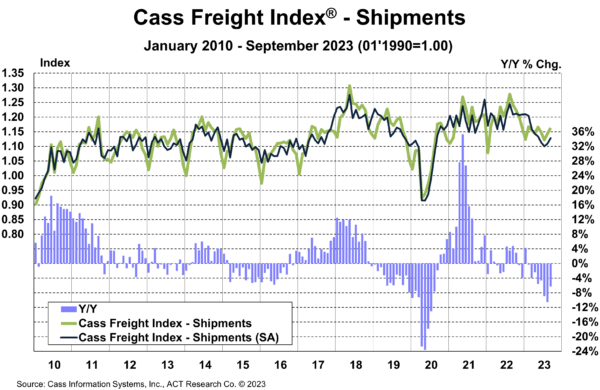
(Source: Cass Information Systems)
Payment provider Cass Information Systems on Wednesday released its September index data showing a slight uptick in freight shipments but lower freight rates and expenditures compared to the previous month. The Cass Shipments Index rose 1.7% month over month to 1.163 points but was down 6.3% year over year. This marks the 14th consecutive decline in monthly freight volumes in the past 21 months, with the report adding this is similar to prior downcycles in length and magnitude, excluding the pandemic.
Linehaul rates had some positive movement. FreightWaves’ Todd Maiden wrote, “Cass’ truckload linehaul index, which excludes fuel and accessorials, ticked up 0.5% sequentially in September, reversing a decline of an equal amount in August. This was the first sequential increase since May 2022.”
Tim Denoyer, vice president and senior analyst at ACT Research, noted, “With both the shipments component of the Cass Freight Index and the Cass Truckload Linehaul Index rising sequentially this month, the freight cycle is at least starting to flatten out, with smaller y/y declines. We continue to expect the freight cycle to turn once capacity tightens, but early signs of 2024 equipment production suggest that may be a while.”
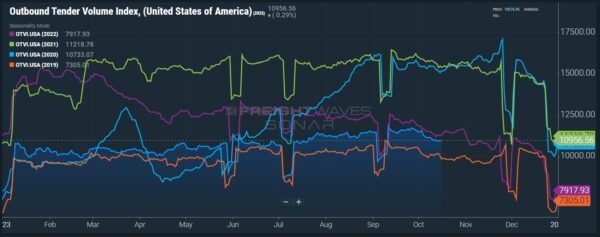
Summary: The beginning of fall typically marks changes in foliage but also declining outbound tender volumes beginning in the last week of September. Revised outbound tender volumes nationwide declined 1.23% or 140.56 points in the past week from 11,097.12 points Oct. 9 to 10,956.56 points. Month-over-month outbound tender volumes fell 3.72% or 423.44 points from 11,380 points on Sept. 17 to 10,956.56 points. In spite of the beginning of Q4 and trucking’s traditional peak season, tender volumes appear to mimic similar declines in October from 2022 and 2019 (highlighted in purple and orange, respectively) with volume increases occurring in the run-up to Christmas Day.
Compared to 2019 and 2022 volume levels, outbound tender rejection rates appear worse for carriers, with the Outbound Tender Reject Index currently at 3.85% nationwide versus 4.8% in 2019 and 4.5% in 2022. For the time being, there remains an abundance of truckload capacity relative to demand. Outbound tender rejection rates typically between 5% and 7% suggest a balanced market between truckload supply and demand, with many shippers requiring a tender compliance level of 95% or more.