FedEx announces holiday shipping deadlines

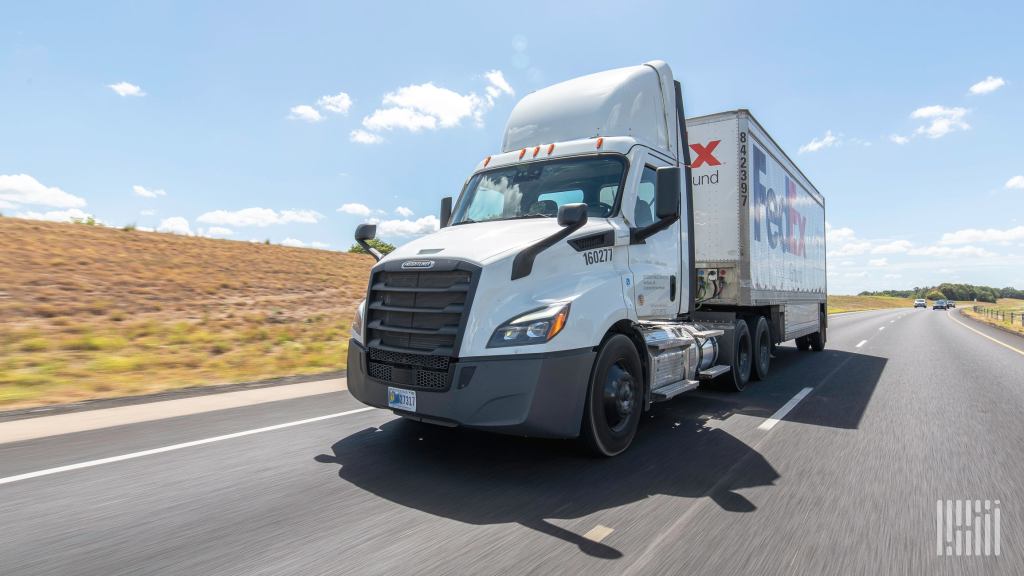
FedEx Corp. (NYSE: FDX) disclosed on Tuesday its holiday shipping deadlines for domestic packages that need to arrive on or before Christmas Eve, which this year falls on Sunday.

Customers using FedEx Ground, the company’s U.S. ground delivery business, will need to ship by Dec. 20 if they choose two-day shipping, the company said. Customers using FedEx Home Delivery, the company’s residential delivery operation, will need to ship by Dec. 21 for two-day shipping. Parcels tendered to FedEx Ground for one-day shipping must ship by Dec. 21. For Home Delivery, the deadline is Dec. 22.

For three-day shipping on FedEx Ground, parcels must be shipped by Dec. 19. On Home Delivery, the deadline is Dec. 20.

For FedEx Ground Economy, which operates under the slowest transit times, parcels must be shipped by Dec. 13, FedEx said.

Shipments tendered to FedEx Express, FedEx’s air and international unit, for next-day delivery must ship by Dec. 21, though parcels can be shipped by Dec. 22 if Saturday delivery is requested. Packages moving in second-day delivery services must ship by Dec. 20, FedEx said.

Packages shipped via FedEx Freight, the company’s LTL unit, must ship by Dec. 21 if the customer requests one-day delivery under FedEx Freight’s priority service, which offers more expedited deliveries than the unit’s Economy service. Customers opting for two-day shipping must ship out their parcels by Dec. 21.

Shippers using the unit’s Economy service must arrange for shipping no later than Dec. 12 to ensure deliveries on or before Christmas Eve.

Last week, the U.S. Postal Service announced that holiday shipments using its Ground Advantage two- to five-day delivery service must ship no later than Dec. 16 to arrive by Christmas Eve. Shipments moving under the Postal Service’s Priority Mail two- to three-day delivery service must ship no later than Dec. 18. Customers using Priority Mail Express, the company’s next-day delivery service, must ship parcels no later than Dec. 20, the Postal Service said.

The schedule applies to shipments moving within the lower 48 states, the Postal Service said.

UPS Inc. (NYSE: UPS) has yet to announce its holiday deadline shipping schedule.

Locomotive engineers’ union calls for limiting freight train lengths

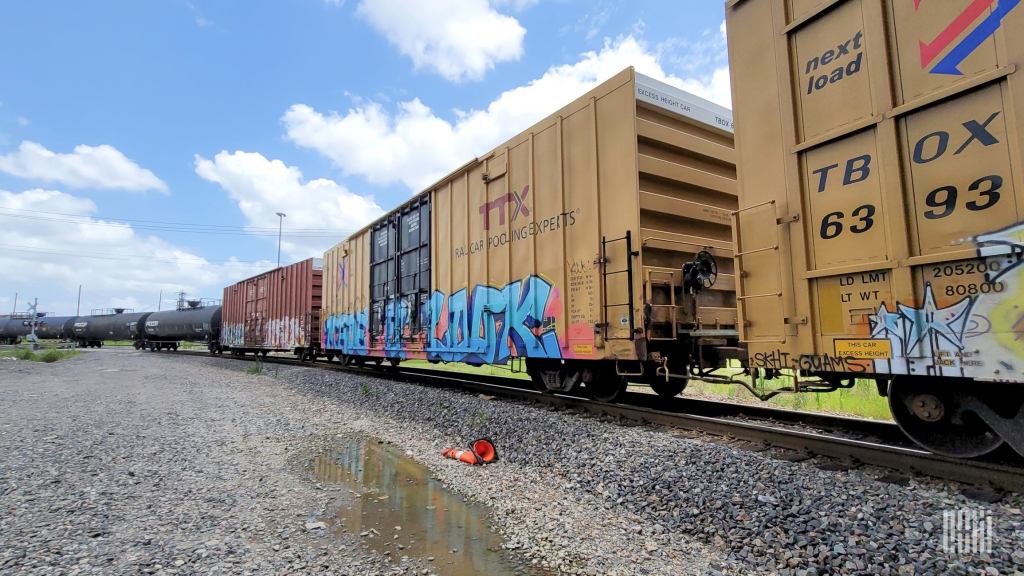
The argument over whether the Class I railroads should deploy longer trains continues, with the Brotherhood of Locomotive Engineers and Trainmen (BLET) recently calling on the Federal Railroad Administration to issue an emergency order that would limit the length of freight trains to 7,500 feet.

The Oct. 9 letter to FRA Administrator Amit Bose and signed by BLET President Eddie Hall says FRA should consider an emergency order because developing and issuing a regulatory standard would “take a very long time.”

The union said setting limits of train lengths is necessary because not all locomotive engineers may be trained or experienced enough to handle longer trains, which could have greater in-train force than shorter trains. The railroads’ infrastructure network also might not always accommodate longer trains.

Hall cited two FRA safety advisories in February and April that highlighted the role that train build and makeup may have had in recent train accidents. 

“With train length continuing to expand, the Carriers have implemented the train length growth without training locomotive engineers to handle these monstrous trains properly. Class I Railroads have failed to consider route infrastructure, e.g. passing sidings, crossings at grade, cross-over switches, and public interactions (such as proximity to schools and hospitals) when building and dispatching very long trains. This was never an issue with trains within the 7,500-foot length,” Hall said. He also said the union had sent copies of its letter to all the Class I railroads to urge them to limit their train lengths in the absence of a regulatory standard.

The union attributed the railroads’ use of longer trains to the deployment of precision scheduled railroading, an operational method that seeks to streamline operations. 

“Now, very long trains are the ‘new normal.’ Best practices do not exist. The railroads have responded by simply adding more distributed power locomotives (“DPU”), but this does not solve any problems of very long trains … . When trains are excessively long, train engineers are unable to adjust their operations to accommodate for terrain, which can mask where in-train forces are occurring throughout the train,” Hall said.

The Association of American Railroads (AAR), which represents the Class I railroads, has said that the industry has developed training and technological tools that address operational issues related to longer trains. The industry’s safety record has also been improving over time, AAR said, with the industry’s mainline accident rate falling by 44% since 2000. Others, meanwhile, have said that regulating train lengths could result in an increase in shorter trains blocking rail crossings at higher rates.

AAR President Ian Jefferies responded to BLET’s request for an emergency order in his own letter to FRA dated last Thursday. “Respectfully, there is no emergency. Railroads have safely operated millions of trains in excess of 7,500 feet over the last eight decades. Experience shows that these trains are safe. As such, there is absolutely no safety justification for the extraordinary step of an emergency order,” Jefferies said.

Meanwhile, regulation looking at freight train lengths is still pending before FRA. The agency recently ended a comment period on whether FRA should collect monthly data from the freight railroads on the lengths and weights of trains.

Subscribe to FreightWaves’ e-newsletters and get the latest insights on freight right in your inbox.

Click here for more FreightWaves articles by Joanna Marsh.

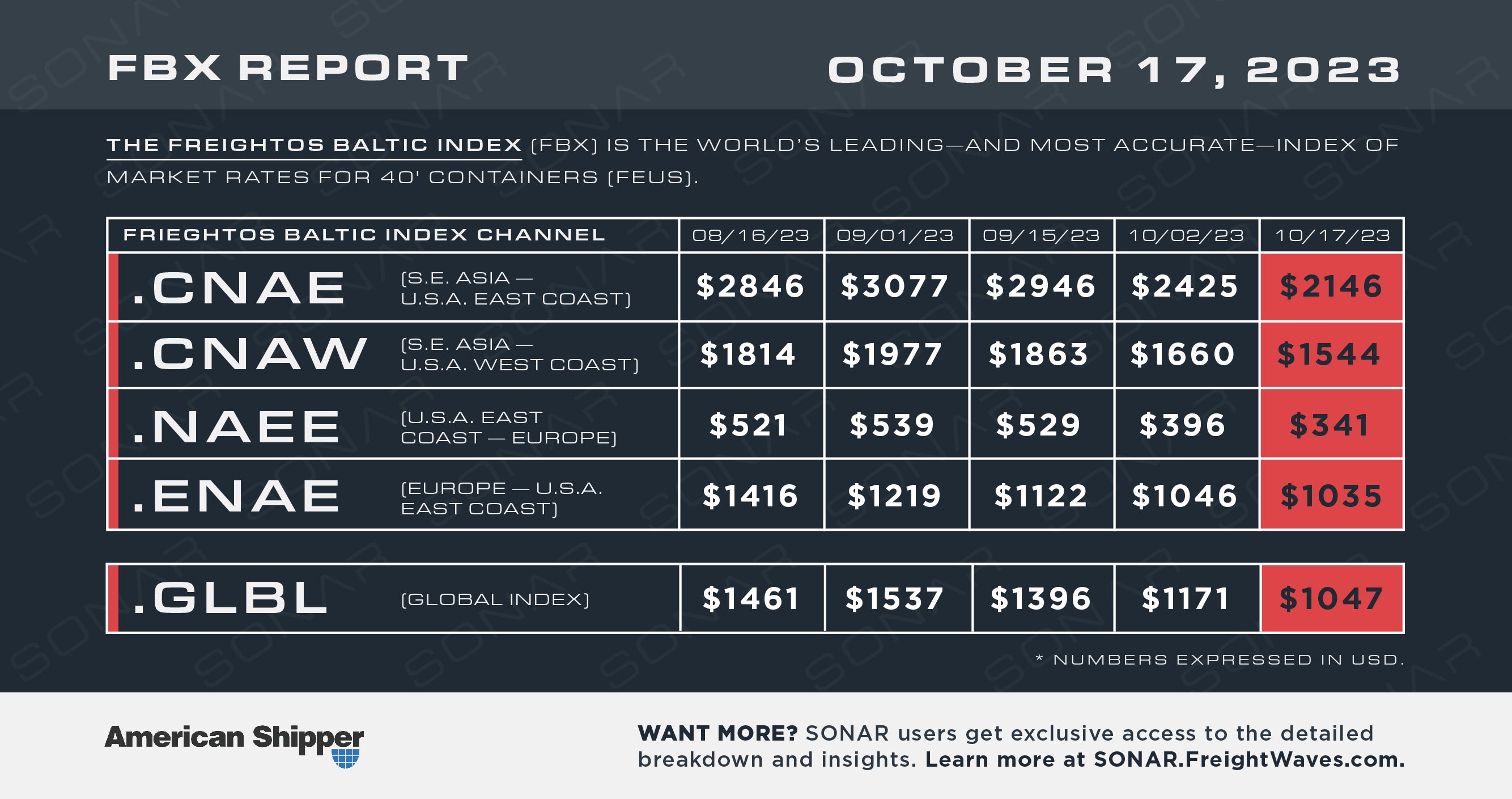
FBX Report: October 17, 2023


To learn more about FreightWaves SONAR, click here.

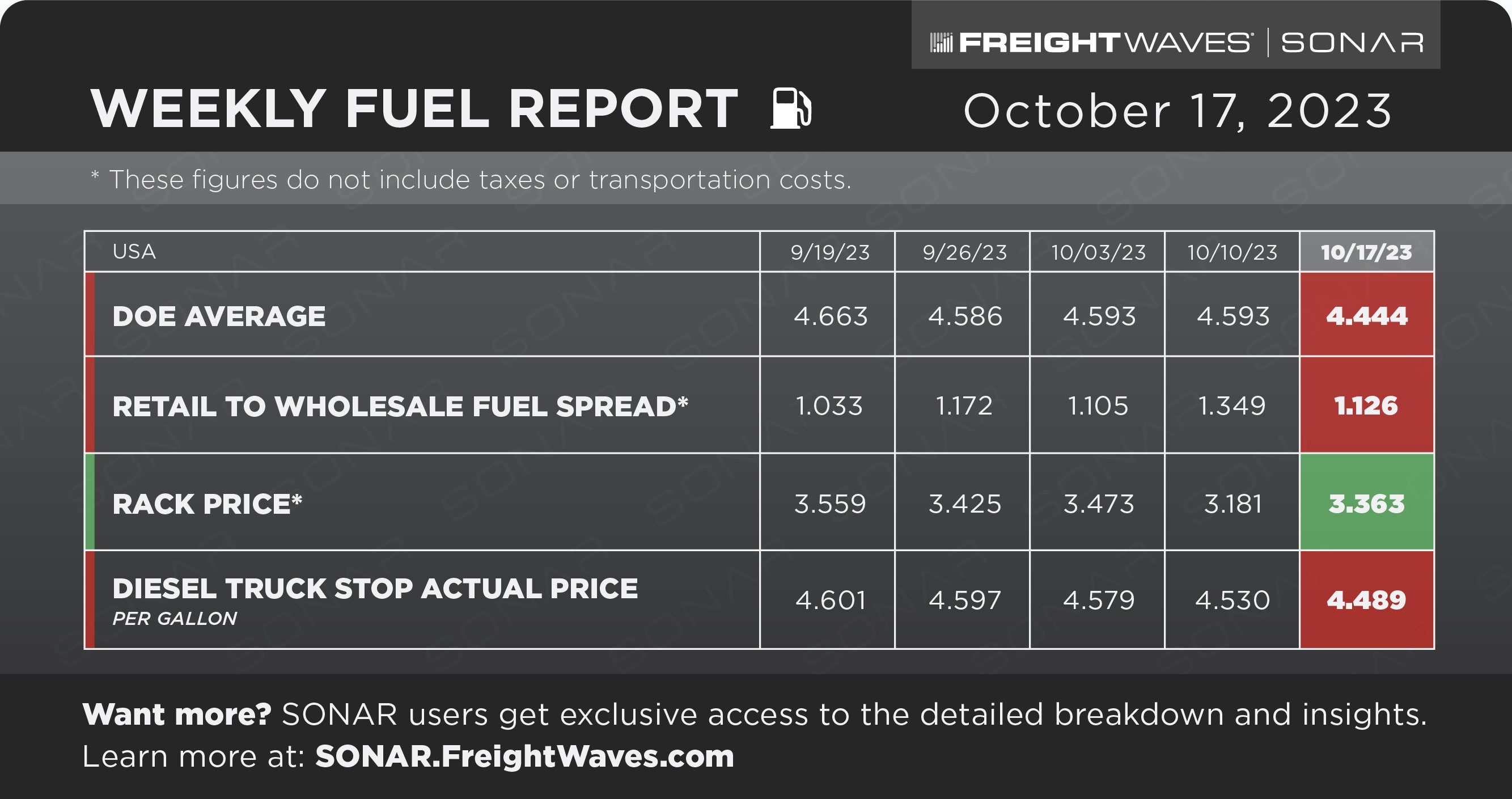
Weekly Fuel Report: October 17, 2023


Learn more at SONAR.FreightWaves.com

CPKC and CSX file plans paving way to Mexico-Southeast corridor

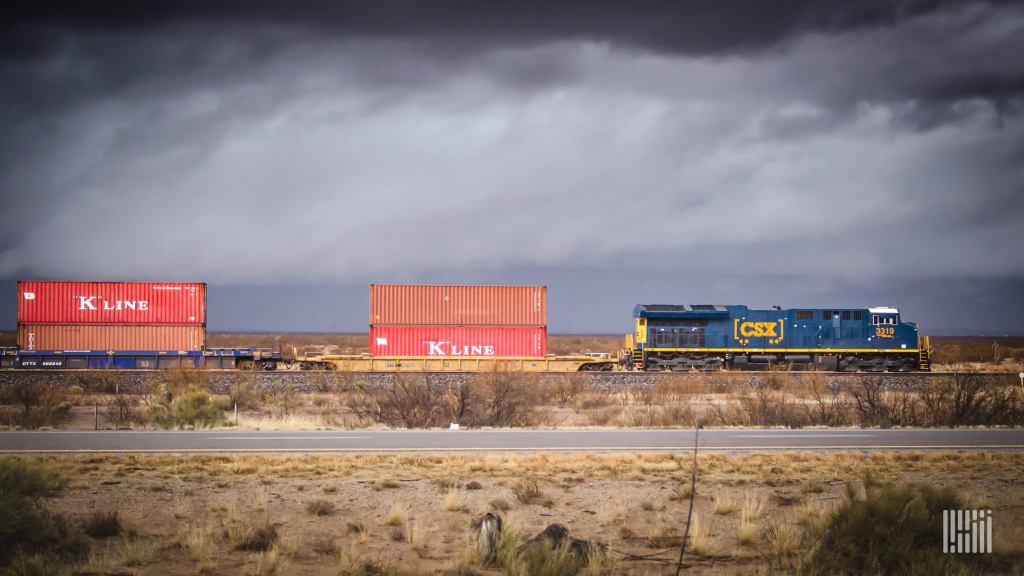
Class I railroads CSX and Canadian Pacific Kansas City (CPKC) have requested Surface Transportation Board approval to acquire portions of a southern U.S. short line in a bid to create more efficient rail freight flows between Mexico, Texas and the southeast U.S.

CSX and CPKC are seeking to acquire portions of the Meridian & Bigbee Railroad, currently a subsidiary of short line operator Genesee & Wyoming.

Their plans come as Georgia Ports Authority said separately last week that shifts in world trade patterns will benefit the Port of Savannah (see below).

Leaders from both CPKC (NYSE: CP) and CSX (NASDAQ: CSX) have expressed interest in creating more efficient transport among those regions and establishing “a new direct connection and corridor linking Mexico, Texas and the U.S. Southeast.” CPKC and CSX announced their intentions in June. In August, CSX CFO Sean Pelkey said at an investor conference that “I haven’t seen a new interchange pop up [in my years at CSX] … that is going to be as significant as this one.”

Mexico and the U.S. Southeast are “two of the fastest-growing regions connecting through a third (Texas),” longtime transportation analyst Tony Hatch told FreightWaves. 

Indeed, their competitors — Norfolk Southern (NYSE: NSC) and Union Pacific (NYSE: UNP) — have also expressed interest in beefing up offerings among those regions. UP is offering intermodal service that originates on Mexican rail carrier Grupo México from both Monterrey in Nuevo Leon and Silao in Guanajuato to cities in the southeastern U.S. 

Meanwhile, NS has a relationship with CPKC in which shippers can utilize the Meridian Speedway to go between Texas and Mexico and the Southeast. NS also has its own service products, including those that involve partners J.B. Hunt and Hub Group, and it recently expanded its intermodal offerings with Florida East Coast Railway.

CSX is seeking to acquire the portion of Meridian & Bigbee Railroad’s 93.7-mile line that runs in Alabama between Burkeville and Myrtlewood, according to an Oct. 6 filing to STB. That same day, CPKC filed a request to STB seeking to acquire the western line of the Meridian & Bigbee line. It consists of approximately 50 miles of track between Meridian, Mississippi, and Myrtlewood.

CSX and CPKC say this arrangement would enable the railroads to create a direct interchange at Myrtlewood. Doing so would eliminate the need for an intermediate carrier on overhead traffic, according to CSX’s filing, and it would allow the railroads to avoid more congestion-prone and weather-sensitive interchanges, such as New Orleans.

“The new, more efficient gateway at Myrtlewood will allow CSXT and CPKC to compete more effectively with other carriers and modes in the region,” CSX said in its filing. 

If CSX and CPKC are able to acquire these assets, then it would allow both railways to create a new freight rail corridor that will expand shipping options for intermodal, automotive and other interline traffic, CPKC said. The Meridian and Bigbee would also retain trackage rights to provide local service, the railway continued.

“CPKC’s investments in track infrastructure [as a result of this acquisition] will enable faster, more efficient, economical, and safe operations on the Western Line,” the railway said in its filing, and it “will create a direct Class I to Class I connection that will provide improvements in the efficient movement of existing and future intermodal, automotive, and other interline traffic between the Southeastern United States and the Southwestern United States and Mexico. Creation of this Class I freight corridor will expand customer market reach, and by converting truck traffic to rail, reduce highway congestion. It will also benefit the environment by reducing fuel consumption.”

The railways also told the board that the acquisitions should be considered “minor” transactions, which means they wouldn’t require as extensive a review process by STB. Minor transactions tend to be those in which anticompetitive concerns don’t appear to be an issue for shippers.

The Meridian & Bigbee, which G&W acquired in 2005, currently has interchanges with Atlantic & Gulf Coast Railway at Linden, Alabama; with CSX at Montgomery, Alabama; with CPKC at Meridian; and with Norfolk Southern at Selma, Alabama, and Meridian.

CSX operated the Meridian & Bigbee prior to G&W’s takeover of the line.

Said Todd Tranausky, vice president of rail and intermodal at FTR: “When you think about the recent announcements in the Southeast, it makes sense from the perspective of the Southeast being a growing region that has additional consumption needs as population shifts increase population in that area and by extension increase the freight demands of that region. It also makes sense from a CPKC perspective because it is a good region to go into and find early volume wins and show a return for their investors in the short term while they make the necessary capital investments along some of their lines in the upper Midwest to fully be able to derive advantage from their reach into Chicago from an intermodal and carload perspective. It will take time, I believe three years is what is in the merger documents about how long they think it will take to get those upgrades complete in the midwest. And the UP is trying to not leave volume on the table as CPKC aggressively looks for volume and rate growth from its acquisition.”

Shifting world trade patterns to benefit Georgia Ports Authority

The filings from CSX and CPKC don’t mention Georgia and the Port of Savannah to STB. But Georgia Ports Authority officials at the Savannah State of the Port event last Thursday noted the manufacturing shift to the Southeast. The region, which GPA says includes Texas, Florida, North Carolina, Georgia, South Carolina and Tennessee, has also grown in population by 9% since 2012. 

CPKC said in its Oct. 6 filing to STB on the request to acquire the western line of the Meridian & Bigbee that its proposed plan with CSX would “position CPKC to compete for the new traffic that will be generated by several new automotive plants that are planned to open in the Southeastern United States in the next few years.”

The trend toward source shifting to Southeast Asia, which consists of adding a Southeast Asian country in addition to China for manufacturing needs, favors U.S. East Coast delivery via the Suez Canal, GPA said. Furthermore, India’s status as a growing economy represents business opportunities for GPA customers, the port authority continued. 

“We need to be ready for future economic cycles. We’re talking to customers and designing a gateway port and inland supply chain that meets their long-term requirements.  We’re all-in on this. The decisions we make will decide who we become as we prepare for the next wave of future cargo,” GPA President and CEO Griff Lynch said in a release. “Savannah’s ocean carrier customers are upsizing their vessels; 80 percent of the container ships entering the port are 11,000 TEU or larger.”

GPA plans to focus on a “mid-American arc” that will stretch from Dallas to Chicago and Cincinnati, and it cited its proximity to Charlotte and Rocky Mount, North Carolina, and Miami, Tampa and Orlando, Florida.

Two new partnerships also have sprouted or are underway: CSX’s Carolina Connector service to Rocky Mount, which GPA says could open up Ohio Valley opportunities, and Norfolk Southern’s slated Blue Ridge Connector service to northeast Georgia, which will open in 2026.

GPA’s Mason Mega Rail is also now fully operational. GPA says the service “provides the greatest on-dock rail capacity of any port in the Western Hemisphere.” The 85-acre intermodal terminal has the capacity to put together and receive six 10,000-foot trains simultaneously, according to GPA’s website

GPA said it handled 5.4 million twenty-foot equivalent units in its 2023 fiscal year, and it forecasts 4%-6% growth in the coming years.

Subscribe to FreightWaves’ e-newsletters and get the latest insights on freight right in your inbox.

Click here for more FreightWaves articles by Joanna Marsh.

Economic losses from UAW strike reach $7.7 billion

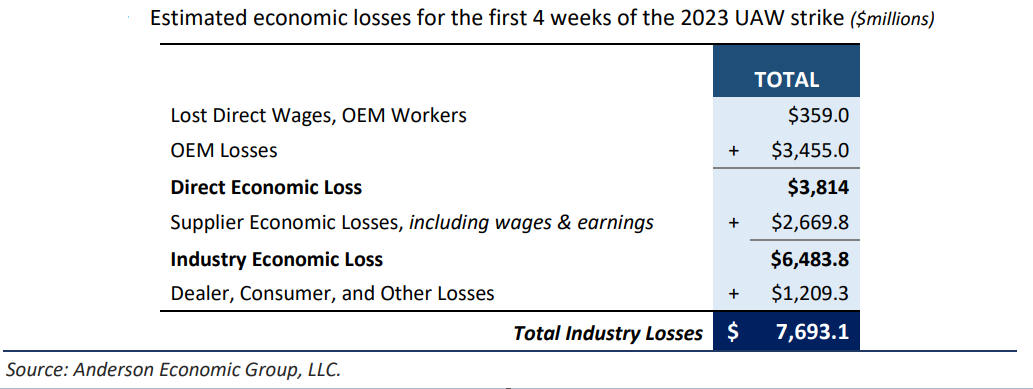
Economic losses from the United Auto Workers strike against Detroit automakers have reached $7.7 billion, according to Anderson Economic Group.

And as the strike enters its fifth week, the Michigan economic consultancy issued a warning.

“We’ve entered the danger zone for many suppliers, and more than one production line,” said Patrick Anderson, CEO of Anderson Economic Group, in a statement. “Without a settlement soon, a plausible restart with higher costs will likely lead to some permanent losses of production, and suppliers that will need financial assistance to return to operation.”

Read more: American manufacturing is coming back. So are strikes. 

Anderson Economic Group has been tracking the losses since the first day of the UAW “Stand Up” strike on Sept. 15.

The breakdown of the cumulative losses is as follows:

Anderson said the impact of the strike and the lost dollars are now being validated in other Michigan economic data.

“We’re already seeing retail sales, airline travel, and income tax collections dropping in the State of Michigan,” Anderson explained. “There are also increasing layoffs among vulnerable suppliers.”

Anderson said most of these costs are not impacting the Detroit Three. “They are being borne by workers and by small- and medium-sized businesses.”

Yellow’s equipment may be sold off by auction houses

Yellow trucks parked at a terminal

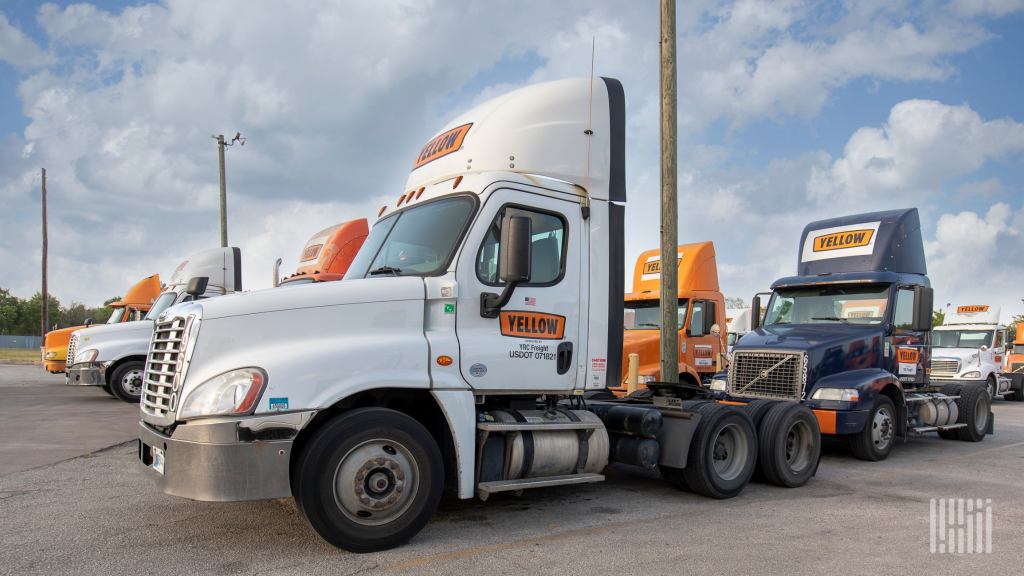
Handlers of Yellow’s estate asked a Delaware bankruptcy court on Tuesday to allow the use of auction houses to facilitate the liquidation of the company’s equipment portfolio.

A motion before the court named Nations Capital, Ritchie Brothers and IronPlanet as the chosen parties to sell the defunct less-than-truckload carrier’s fleet of more than 60,000 units. The portion of the portfolio that Yellow owns includes roughly 12,000 tractors and 35,000 trailers. The agency agreement, inked on Monday, said the auction houses would “act as the Debtors’ exclusive marketer, broker, and auctioneer of the Rolling Stock Assets.”

The filings showed six different liquidators provided proposals.

A Friday filing said that a bid deadline of Oct. 13 and an auction date of Oct. 18 had been extended with new dates yet to be determined.

Restructuring firm and adviser to Yellow, Ducera Partners, said in a filing that retention of a liquidator would be the best avenue for the company to unwind its equipment portfolio. The filing said the auction houses were best suited to remove, refurbish and market the assets.

“The Agent is an industry-leading marketer, auctioneer, and broker of assets of this type with vast industry connections and experience,” Ducera said. “To best maximize the value of the Rolling Stock Assets and the estates, it is, in my opinion, in the Debtors’ best interest to retain the Agent so that the Debtors and their estates can directly benefit from the Agent’s expertise, experience, and market access.”

An Oct. 27 hearing date was set in order to give the U.S. Trustee’s office time to present or work through its objections.

The filings also said the auction houses will provide free storage. The estate would have incurred storage fees to park equipment at the terminals once they exchange hands. Estes Express Lines’ winning $1.525 billion stalking horse bid for Yellow’s 174 owned terminals allowed for 30 days of free storage, which was valued at more than $10 million.

Estes’ bid essentially placed a minimum valuation for the sites. Those properties are expected to be bid on by other suitors as well. The bid deadline for the terminals is Nov. 9, with an auction date of Nov. 28 if needed.

Commissions and terms of the agency agreement were not disclosed. A separate filing asked the court to allow the negotiated fees with the auction houses to remain undisclosed as public knowledge “would compromise the Agent’s bargaining position in future negotiations.”

The U.S. Treasury, which is owed more than $737 million as part of a 2020 COVID-relief loan package, as well as the unsecured creditors committee were said to have participated in the negotiations with the auction houses and support the plan.  

Yellow used a $400 million tranche of Treasury financing to buy 2,400 tractors over a 15-month period that included 2021. The Treasury holds first-priority liens on the aforementioned equipment in addition to roughly 3,500 trailers that were also purchased as part of the loan program.

The sale of Yellow’s equipment comes on the downside of the freight cycle. Used equipment prices have retreated to more normalized, historical averages. Equipment prices surged during the pandemic as fleets rushed to meet increased demand and as OEMs grappled with components shortages and labor challenges.

The filings noted that since the marketing process began more than 150 parties have signed confidentiality agreements, specifically expressing interest in the company’s equipment. Past reports suggested the company’s rolling stock could fetch as much as $900 million.

More FreightWaves articles by Todd Maiden

ATA’s Spear rips ‘self-promoting union bosses’ in annual address

Chris Spear on stage in Austin, Texas

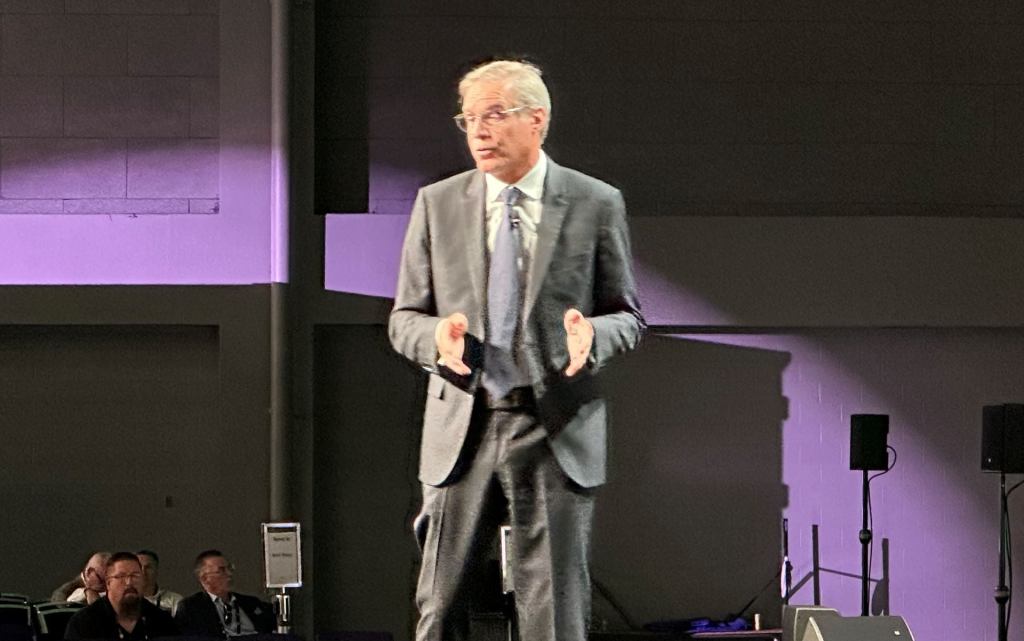
AUSTIN, Texas — “Self-promoting union bosses” encouraged by the “most pro-union president in history” are making trouble for the trucking industry, American Trucking Associations CEO Chris Spear said in his annual membership address.

But he had plenty of invective for California regulators. And he criticized a century-old excise tax that adds $25,000 to the typical cost of a new heavy-duty truck.

“Trial lawyers chasing jackpot justice, self-promoting union bosses and delusional environmental extremists. Together, they constitute a clear threat to our industry’s ability to grow and support our nation’s economic security,” Spear said as he paced the main stage Monday at the ATA Management Conference and Exhibition.

Spear: Organized labor failed Yellow workers

Spear took aim at the Teamsters for failing to negotiate further concessions that might have provided a lifeline for bankrupt Yellow Corp.

“Thirty-thousand hardworking Yellow employees lost their jobs because one of two parties refused to come to the table,” he said. “Say what you like. Blame who you want. But that’s the cold, hard truth.”

The ATA tried to help place out-of-work Yellow drivers in open jobs with association members, he said.

“What’s the International Brotherhood of Teamsters done? Nothing. Just self-promoting tweets and blame,” Spear said. “If that is representation, if that is what this president is selling, we want none of it.”

Union organizing campaigns backed by the Biden White House create peril for trucking and related industries. They account for one in 17 U.S. jobs, he said. Seeking to count gig workers as full-time employees and opposing autonomous trucking in California are two examples of Teamsters meddling with trucking livelihoods.

“These same organizers have told me candidly that truck drivers cannot speak for themselves,” he said. “[Drivers] can think for themselves. They don’t need some showboating union boss to do it for them.”

ATA backs California Trucking Association in CARB suit

The ATA is backing the California Truck Association’s suit challenging the California Air Resources Board (CARB) over its Advanced Clean Fleets rule . The regulation requires fleets to purchase increasing percentages of zero-emissions vehicles beginning in January.

Spear called CARB “an unelected, ill-informed band of extremists who have no clue the impact their timelines and targets will have on our economy.”

On Tuesday, Spear told members of the European Parliament that the international governing body should embrace realistic, achievable timelines to reduce emissions. He urged rejection of CARB’s mandates that also require OEMs to produce increasing numbers of zero-emission trucks.

“Given where the technology, infrastructure, power grid, cost and operational requirements stand, these regulations will undoubtedly fail to deliver the vehicles and market adoption California seeks,” Spear said.

Operational parity between diesel and battery-electric trucks is a long way off.

“It currently takes 15 minutes to fill a diesel-powered truck to go 1,200 miles regardless of extreme heat or cold. It can take six to 10 hours to charge an electric truck during nonpeak hours just to go 250 miles under the best of conditions,” he said.

Dueling regulations

Creating dueling sets of emissions regulations — CARB and its followers against a 50-state Environmental Protection Agency standard — follows the path the automotive industry faced with differing Corporate Average Fuel Economy standards for pollution-sensitive California and the rest of the country, Spear said.

In July, after months of acrimony between CARB and the Engine Manufacturers Association (EMA), the two sides agreed to flexibly implement the state’s toughest-in-the-nation emissions rules.

“CARB bullied our manufacturers, dangled the credits in exchange for their right to sue,” Spear said. “CARB seeks to defy our history, our voice, our ability to fight back.”

Spear also railed against the continuation of a 12.5% federal excise tax on new heavy-duty trucks that dates to 1917. It adds about $25,000 to the cost of a typical Class 8 tractor, he said.

U.S. Sens. Ben Cardin, D-Md., and Todd Young, R-Ind., unveiled the Modern, Clean and Safe Trucks Act of 2023. It would repeal the levy that generates about $5 billion in tax revenue a year.

Today’s trucks are 98.5% cleaner than more than half the trucks on the road in California with engines dating to 2010 and earlier, Spear said, citing American Transportation Research Institute (ATRI) data.

Zero-emission vehicles came in at No. 10 on the latest ATRI list of top industry issues. It was the first time the issue made the list.

Related articles:

California Trucking Association sues to block Advanced Clean Fleets rule

CARB and engine manufacturers compromise on emissions timing

Yellow’s demise: 2 decades in the making

Click for more FreightWaves articles by Alan Adler.

California Trucking Association sues to block Advanced Clean Fleets rule

With the first requirements of California’s Advanced Clean Fleets (ACF) rule set to go in effect  in just a few weeks, the California Trucking Association (CTA) has asked a federal court to block the regulation’s implementation.

The lawsuit, filed Monday in the U.S. District Court for the Eastern District of California, requests both a preliminary and permanent injunction to stop the California Air Resources Board (CARB) from enforcing the rule. 

CTA officials hinted in recent months that such a suit might be coming.

The CTA argues that California exceeded its authority in creating the ACF. The rule mandates a phase-out of internal combustion engines (ICE) in trucks by 2040. But on a more pressing timeline, no ICE-powered trucks could be added to the state’s drayage registry after Jan. 1, 2024; they must be zero-emission vehicles (ZEVs).

The CTA’s arguments are:

  • The ACF violates the Federal Aviation Administration Authorization Act (F4A), which coincidentally is a key argument used by the CTA in its lawsuit to block the implementation of the state’s independent contractor law, AB5, in California’s trucking sector. F4A, a law that dates back to the early 1990s, blocks a state from passing a regulation that impacts a “price, route or service” offered by a trucking company.

The other claims in the lawsuit are generally linked in one way or another to these two critiques and essentially argue that California wildly exceeded its authority in passing ACF.

“Instead of providing an assurance of clear and compliant regulations, the California Air Resources Board has promulgated the ACF regulations, which expands California’s regulatory authority well beyond its borders and establishes such untenable mandates that CARB itself has already been compelled to informally promise certain provisions will not be enforced,” the CTA suit states. CARB’s actions “represent a vast overreach that threatens the security and predictability of the nation’s goods movement industry.”

The suit notes that ACF may have had a pathway to legal federal approval. But as it notes, “EPA may, but has not, granted a waiver for CARB to adopt and enforce a regulation like ACF.  While CARB may claim otherwise, ACF cannot be enforced until such waiver is granted.” 

As far as CTA’s charge that ACF violates F4A, the CTA says ACF “creates precisely the type of patchwork the F4A was designed to avoid, as motor carriers must modify their services and routes to support ZEVs both inside and outside California. The impact on the nation’s logistics industry of ACF’s requirements would be nothing short of disastrous.”

CTA says in the suit that a state can implement its own requirements on the sale of vehicles in its borders, “but only when those mandates strictly comply with federal requirements.” It cites a provision of the Clean Air Act: the Clean Fuel Fleet Program (CFFP). But CTA says there are stricter guidelines under the CFFP on what a state can do than CARB has adopted in the ACF, in violation of what it says was “Congress’ carefully calibrated balance between federal and state authority over fleet vehicle emissions.”

CTA’s arguments regarding federal supremacy take several forms.

“In no form has the legislature granted to CARB, or Congress granted to EPA, the authority to adopt a regulation with such sweeping power over the California economy and by virtue of the interstate nature of California’s trucking industry, the national economy,” CTA argues.

That passage is under a request for relief because of the CTA’s view that the Clean Air Act preempts the ACF rule. But the question of federal supremacy shows up throughout the lawsuit. 

CTA rips CARB for confusion under its claim that the ACF violates due process. “ACF presents no clear regulatory scheme that can be understood by regulated parties, nor even by CARB itself,” the suit says. “The voluminous record during ACF rulemaking demonstrates the clear confusion regulated parties have in understanding their obligations under the rule.”

More articles by John Kingston

Once again, California tells a court AB5 isn’t disrupting trucking in the state 

CARB sets up unit to help fleets navigate California’s Clean Fleets rule

California Supreme Court to review rulings on constitutionality of Prop 22

Prologis beats Q3 expectations

A Prologis sign in front of a Prologis warehouse

Logistics real estate operator Prologis beat third-quarter estimates Tuesday before the market opened but noted softened demand.

The San Francisco-based company reported core funds from operations (FFO) of $1.30, 5 cents ahead of analysts’ expectations but 43 cents lower year over year (y/y).

“Our results reflect strong execution by our team and the quality of our global portfolio,” said co-founder and CEO Hamid Moghadam. “That said, until there is more stability in the economy, negative customer sentiment will weigh on demand. We remain focused on capturing our embedded lease mark-to-market, building out our land bank into a favorable future supply environment, and partnering with our customers to address their most critical pain points.”

Link to full story – Prologis sees demand uncertainty, posts Q3 beat

Occupancy across Prologis’ (NYSE: PLD) portfolio was 97.1% in the quarter, 60 basis points lower y/y. It commenced leases on 46.4 million square feet of space, which was a 9% reduction compared to the year-ago period.

Net effective rent change (over the entire lease term) was up more than 24 percentage points to 84%.

Prologis raised the front end of its guidance range by 2 cents to reflect the beat. The new range is $5.58 to $5.60, which brackets the current consensus estimate.

The company will host a call Tuesday at 12 p.m. EDT to discuss third-quarter results.

Link to full story – Prologis sees demand uncertainty, posts Q3 beat

Table: Prologis’ key performance indicators

More FreightWaves articles by Todd Maiden