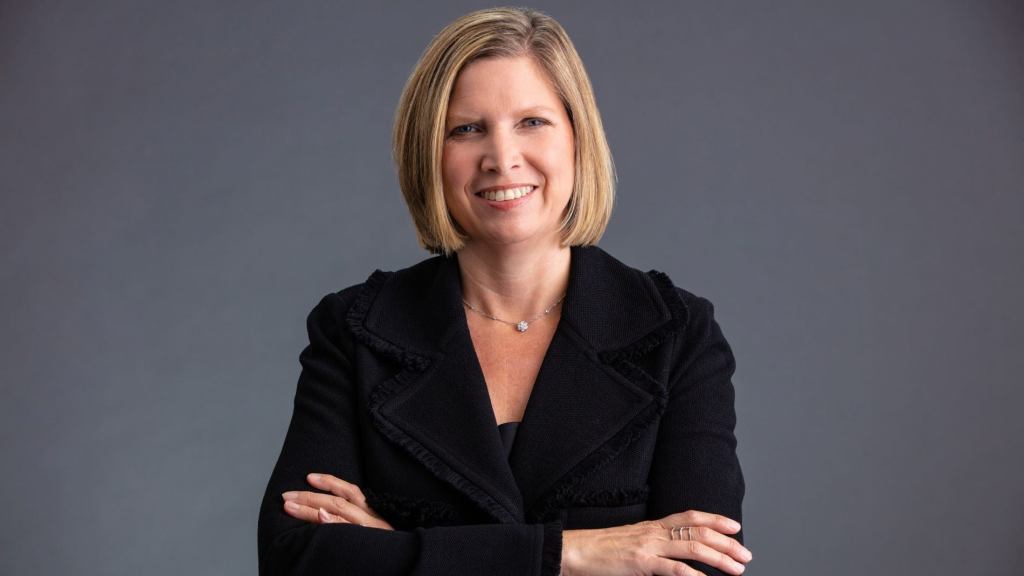
Cummins CEO moves company forward after record civil emissions fine

COLUMBUS, Ind. — Cummins Inc. CEO Jennifer Rumsey is moving the engine-maker and power distribution company forward after paying a record civil fine for emissions cheating that she said brought some over-the-top federal criticism.

Cummins in December settled a 4 ½-year-old case by paying a civil fine of $1.675 billion to the Environmental Protection Agency. About 1 million engines in Ram pickup trucks — Cummins’ biggest-selling engine program — contained data-defeating emissions software. The company in January agreed to pay California $175 million in the same case.

Together, the fines amounted to the second largest for Clean Air Act violations in history. Cummins’ fine trailed a $2.8 billion criminal penalty assessed of Volkswagen AG over the “Dieselgate” scandal.

“I am disappointed, frankly, at the number and some of the tone given how we did try to work through this,” Rumsey said Tuesday in an interview at company headquarters. “But we’re moving forward. We haven’t slowed down on our strategy.”

In a Dec. 22 news release, U.S. Attorney General Merrick Garland effectively said Cummins put its customers’ health at risk.

“Defeat devices on some Cummins engines have caused them to produce thousands of tons of excess emissions of nitrogen oxides. The cascading effect of those pollutants can, over long-term exposure, lead to breathing issues like asthma and respiratory infections,” he said.

In many cases, such comments get attributed to lower-ranking Justice Department officials.

Balancing strategy between legacy and future products

Rumsey’s strategy is balancing its legacy business as the world’s largest maker of diesel engines with funding advanced powertrain systems that can run on a range of alternative fuels and standing up an internal unit called Accelera focused on zero-emission technologies.

A 25-year Cummins veteran, Rumsey was named the company’s first female CEO in July 2022. She is just the seventh CEO in the company’s 105-year history. Rumsey became board chair in August.

“I think about the first two years as CEO, and I came into the role really clear with a focus on purpose, people and impact. That really was the centering driver for my career.”

The past 20 months have been busy. From ingesting the $3.7 billion acquisition of Meritor Inc. announced in February 2022, five months before she took over from her predecessor — and mentor — Tom Linebarger to rebranding the former New Power division into Accelera in March 2023 and recently completing the spinoff of a successful but ill-fitting filtration business, Rumsey didn’t exactly ease into the job.

Fuel-agnostic rebranding

Cummins is investing $1 billion in manufacturing upgrades and branding as HELMS its next-generation X15 engine platform. The same fuel-agnostic strategy applies to a new X10 engine family that replaces nine- and 12-cylinder engines. 

“HELMS stands for High Efficiency, Low Emission Multi fuel. These are going to be really innovative products that meet our customers’ diesel needs today with higher efficiency and let them move to these alternate fuels,” Rumsey said.

HELMS starts with a natural gas version that boasts fewer emissions. A diesel version compliant with 2027 EPA standards for smog-forming nitrogen-oxide emissions follows. A hydrogen fuel iteration comes in 2028. The fuel-agnostic approach also applies to the X10 family.

“We’re seeing a lot of interest in the natural gas engine. [But] it’s not going to be a broad replacement for diesel,” she said. 

Pressing a natural gas advantage

“Cummins is the natural gas leader in North America today,” she said.

It has made natural gas engines on its own since buying out joint venture partner Westport Fuel Systems for $20 million in February 2022. A 10-year partnership ended in December 2021. In that time, Cummins sold about 70,000 units. Already, the X15N has sold about 40,000 units in China, where it debuted in 2020.

“That market grew faster than we anticipated in part because of the differential between diesel and natural gas,” Rumsey said.

The X15N was always planned for North America, where major fleet operators like UPS and Walmart are among companies that have tested it. Launch partner Paccar Inc. delivered the first X15N engine in a Class 8 Kenworth T680 in February. Cummins could build 3,000 of the engines this year in Jamestown, New York, earmarked for $452 million of the $1 billion in new engine investment.

Cummins is also building the natural gas ecosystem. It purchased 50% equity in Momentum Fuel Technologies from Rush Enterprises in January 2022 to make Cummins-branded natural gas fuel delivery systems for commercial vehicles.

It also is working with Chevron and Trillium, the natural gas subsidiary of Love’s Travel Stops, to boost production of renewable natural gas (RNG) made from dairy waste and other nonpetroleum sources. RNG’s emission profile can reach negative net-zero carbon.

The abundance of natural gas, both compressed and RNG, gives it a price advantage over diesel, offsetting in about 18 months the high cost of a natural gas-powered system.

Global challenges

While China proved a successful launch site for the X15N, Cummins’ 50-plus years of engine-building joint ventures there has had to hold on for the ride as the country careened from pandemic to recovery to lockdown to a real estate bubble that has weakened the once-thriving economy. Along the way, China implemented tougher engine emission standards.

“We did an incredible job of continuing to operate even with the lockdowns to meet the demand that was there,” Rumsey said. “The China market is the hardest one for us to predict. So far, we’ve called the market gradually improving with replacement cycles and natural gas driving some demand.”

Russia is another matter. Cummins suspended operations, took a $158 million charge against earnings and broke off its joint venture in March 2022, the early days of Vladimir Putin’s invasion of Ukraine. There may be no going back.

“We’re out of business in Russia today,” Rumsey said. “And unfortunately I don’t see any signs of that conflict resolving anytime soon.”

To hear the full Rumsey interview, tune into Truck Tech on Wednesday, March 13, at 3 p.m. EDT on the FreightWaves YouTube channel.

Cummins names Jennifer Rumsey to succeed Tom Linebarger as CEO

Cummins replaces 2 legacy engines with new X10

New Power division rebranded as future tech-focused Accelera
Descartes sees ‘no end in sight’ for elevated supply chain investments

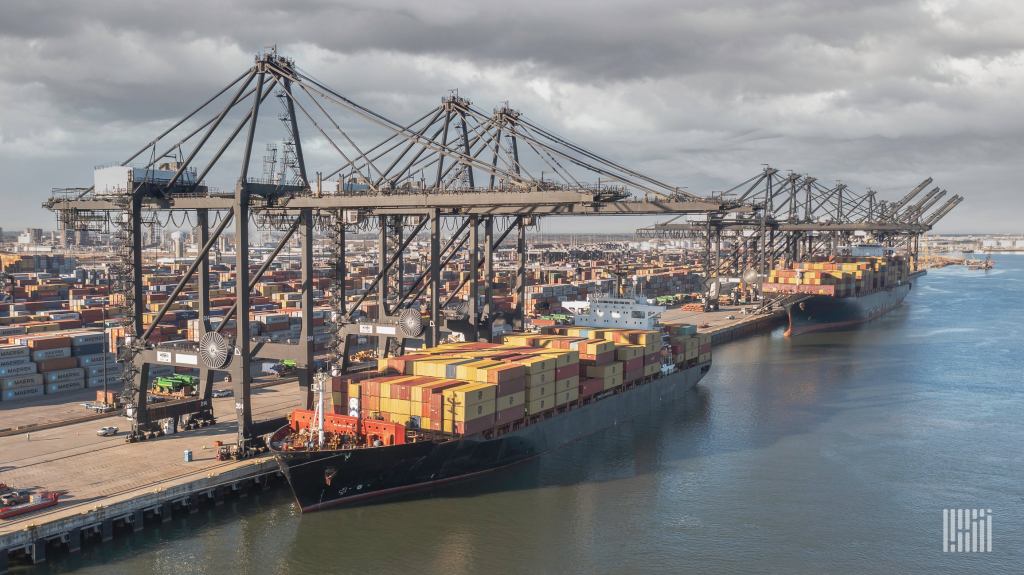
MSC Jeanne container ship with the MSC Antonia in the background at Port Houston, TX

Supply chain software provider Descartes again reported record quarterly results, noting it is “picking up a bunch of business from competitors.”

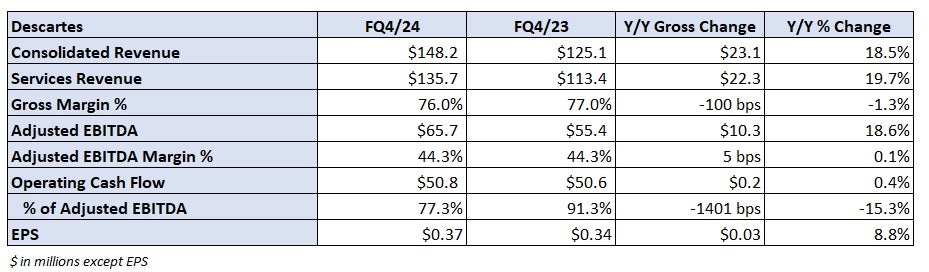
Descartes (NASDAQ: DSGX) reported consolidated revenue of $148.2 million, a 19% year-over-year (y/y) increase, for its 2024 fiscal fourth quarter ended Jan. 31. Services revenue was up 20% to $135.7 million. The period benefitted from prior acquisitions of final-mile solutions providers GroundCloud and Localz. Excluding the impact of those deals as well as changes in foreign exchanges rates, revenue was 10% higher on a same-store basis.

Earnings per share increased 3 cents y/y to 37 cents in the quarter.  

“Complexity and change is a big growth driver for us in our business and I think that’s why you’ve seen us outperform the logistics transportation market over the last year,” CEO Ed Ryan told analysts on a Wednesday evening call.

He said multiple conflicts across the globe have put more companies on sanctioned parties’ lists. There have also been numerous changes in tariffs and duties, providing additional growth opportunities as operators seek best-in-class platforms to ensure trade compliance.

“During tough times I think people tend to flock to a safe and reliable source,” Ryan said.  

Table: Descartes’ key performance indicators

The Canada-based company reported adjusted earnings before interest, taxes, depreciation and amortization of $65.7 million, a 19% y/y increase. For fiscal full year 2024 adjusted EBITDA was $247.5 million, 15% higher y/y.

Looking forward, the company forecast baseline revenue of $130.5 million and adjusted EBITDA of $49.5 million for its fiscal first quarter ending Apr. 30.

“The whole world has realized that supply chain and logistics is more important … the first place they [make] investments is into technology because it gives them the fastest return on investment and it’s the most visible for their customers,” Ryan continued. “I see no end in sight to that.”

The company generated $50.8 million in cash flow from operations in the quarter. The result included a $12.6 million negative impact from higher-than-expected earnout payments on past acquisitions.

Descartes ended the quarter with $321 million in cash and an untapped $350 million line of credit.

More FreightWaves articles by Todd Maiden

Ron DeSantis expected to sign truck-towing reforms

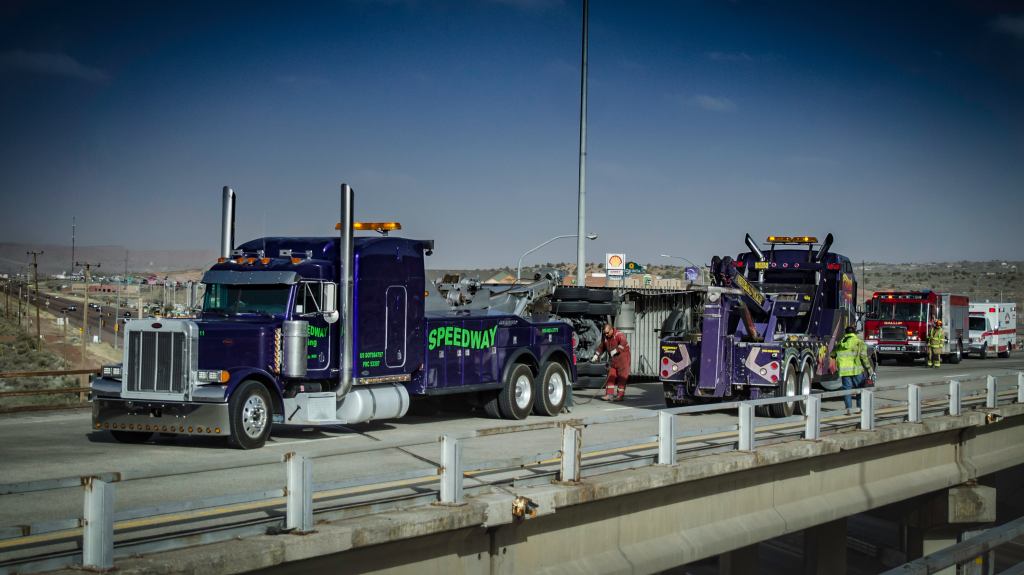
Wrecker towing a truck from crash site.

Legislation aimed at reducing predatory billing against truckers who need towing services in Florida is expected to be signed into law by Gov. Ron DeSantis, according to a source familiar with the reforms.

“We haven’t heard anything to the contrary, so we’re pretty confident the towing bill will be signed into law,” a Florida Senate staff member familiar with the legislation told FreightWaves. If approved by DeSantis, the law will go into effect July 1.

House Bill 179, sponsored by Republicans in the Florida House and Senate, was approved unanimously by the two chambers last week. The reforms have been a multiyear effort and a priority for the Florida Trucking Association, the group stated in a press release.

“This is a huge victory for trucking in Florida, the trucking industry nationally, who have seen invoices as high as $200,000, and the motoring public, who fall victim to predatory towing companies,” commented FTA President and CEO Alix Miller.

The new law, if signed, will revise provisions relating to:

  • Towing and storing of trucks, including requiring counties to establish maximum rates for certain cleanup and disposal.
  • Excluding or failing to designate certain wrecker operators.
  • Authorizing fees.
  • Requirements regarding removal of vehicles.
  • Requirements for liens, notices of lien, sale, notices of sale and types of payment.
  • Requiring towing operators to accept and maintain certain documents, rate sheets and invoices.
  • Criminal penalties for noncompliance.

According to FTA, towing and storage operators would be required to maintain and publicize a rate sheet listing all fees related to vehicle recovery, and provide it upon request to vehicle owners, lienholders and insurance companies.

The wrecker operator would have to furnish the rate sheet to the owner or operator, if present, before attaching a vehicle to a wrecker. Fees charged that are higher than those listed on the rate sheet would be considered unreasonable. The bill also requires operators to provide detailed, itemized invoices.

“The towing and recovery industry is vital to the Florida trucking industry, and we’re grateful to have many as members of FTA and for their input in the legislation,” Miller said. “HB 179 will weed out the predatory towing tactics of bad actors and make the entire industry better and safer.”

Data compiled by the American Transportation Research Institute in a report released in November underscored the severity of predatory towing fees charged in the aftermath of large truck crashes and offered recommendations to address the problem.

The study found that excessive rates and unwarranted additional service charges were the two most common forms of predatory towing, experienced by 82.7% and 81.8% of surveyed motor carriers, respectively.

Click for more FreightWaves articles by John Gallagher.

Data can unlock hidden potential, says Isometric Technologies COO

This fireside chat recap is from FreightWaves’ 3PL Summit on Wednesday.

FIRESIDE CHAT TOPIC: How to Use Data to Build a Competitive Advantage in Logistics

DETAILS: John Stauffer explains that more data has become accessible with growing digital capabilities since 2007 when freight operations began to become automated. Companies have learned to leverage large volumes of data to be more efficient.

KEY QUOTES FROM JOHN STAUFFER:

“I think leveraging data and understanding your strengths and weaknesses as an organization really unlocks a lot of power for the account management and customer-facing roles.” 

“From a carrier standpoint, it’s also [about] leveraging data, understanding underlying carrier strengths and weaknesses, and selling those strengths back across to the sales side. Then acting as basically a sales arm on behalf of your carriers inside your organization to bolster that partnership.”

“Challenges that happen from rolling out data is, once you’ve understood the data and it’s cleaned and well understood across the organization, it’s about if the incentives within an organization are aligned with taking a data-driven approach to operations. A lot of brokers have commission plans that are looking solely at margin. And if that’s the case, then that’s going to drive behaviors that only look at the max profitability rather than service. So making sure that whatever the incentive structure that you have in place for your organization matches up with the overall data strategy that you’re trying to take is critical.”

“I think that there’s going to be rapid innovation. The amount of data that’s available across the industry today is overwhelming. So leveraging [automated] tools to quickly make sense of it much faster than a human can is going to be very powerful.”

FTR, ACT report solid but not stellar new Class 8 truck build numbers

The weak trucking market is still not heavily impacting new truck orders, which remained reasonably strong in February, according to the two firms that most closely track the level of activity.

In releasing its report on preliminary orders for Class 8 vehicles, FTR Transportation Intelligence put the seasonally adjusted number for February at 25,700 units. That is down 9% from January but up 11% from February 2023. FTR said the number was “above seasonal expectations.”

The running 12-month total for new Class 8 orders is 263,700 units, averaging out to 21,975 per month.

At ACT Research, seasonal adjustment brought a not seasonally adjusted figure of 27,700 units down to 25,600 units. The not seasonally adjusted number was up 5% from January.

In a prepared statement released in conjunction with the figures, ACT President and Senior Analyst Kenny Vieth said conditions in the trucking market might seem to suggest that the order book should be trending down. But that isn’t the case.

“Weak freight and carrier profitability fundamentals, and large carriers guiding to lower capex in 2024, would imply pressure in US tractor, the NA Class 8 market’s largest segment,” Vieth said. “While we do not yet have the underlying detail for February order volumes, Class 8 demand continuing at high levels again this month suggests that US buyers continue as strong market participants.”

ACT Research said orders for Class 5-7 vehicles in February were 18,800 units, an annual increase of 7%. With seasonal adjustment, the total for the medium-duty class of vehicles was 17,900 units, a drop of 13% from the prior month. ACT Research said that figure is the lowest seasonally adjusted figure in 13 months.

FTR, in its statement commenting on the market, saw a balancing taking place at lower numbers than a few months ago.

“Concerns of a rapid easing of demand in 2024 are not coming to fruition nor is the market doing significantly better than replacement level orders,” the statement said. “After peaking last November at 36,000 units, orders have stabilized at a level roughly 10,000 units lower over the last three months.”

Chairman Eric Starks said FTR projects that build rates will be at replacement rates by the end of the year. But he said that at present, “order levels were above the historical average and above seasonal trends.”

More articles by John Kingston

If truckers haul bread and cakes, is their business baking or trucking?

Deadline near for filings as Werner seeks review of nuclear verdict

Live on stage: The complex relationship between a trucking job and life

Qatar Airways says goodbye to Boeing 747 freighter

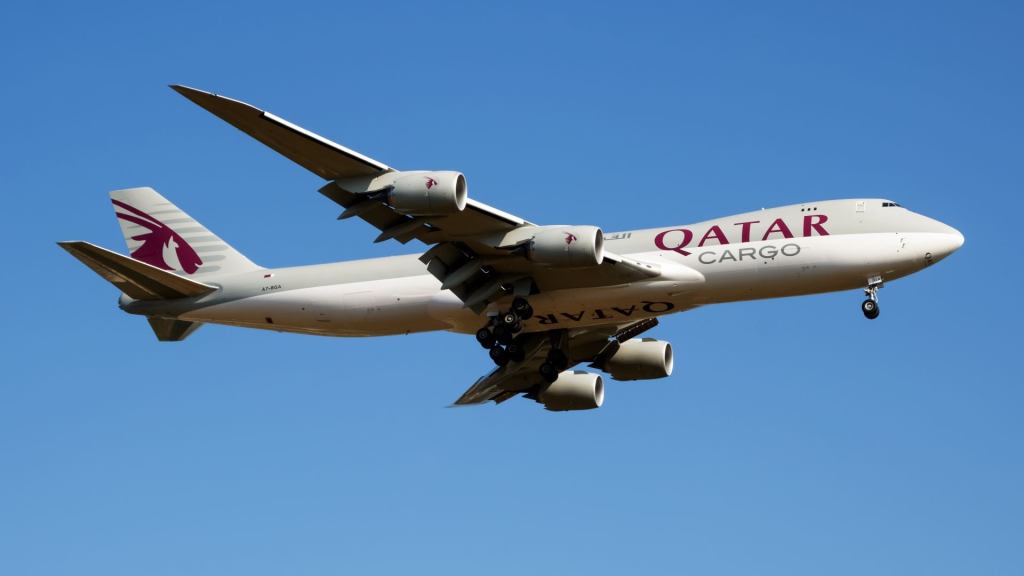
A gray Qatar Airways jumbo cargo jet seen from below as it flies low against a blue sky.

The 747 jumbo jet era is over at Qatar Airways. The company’s cargo subsidiary announced that its lone remaining Boeing 747-8 freighter finished its last flight on Friday, arriving at its base in Doha from Barcelona, Spain.

Qatar Airways Cargo acquired two 747-8s in 2017 and recently agreed to sell them to UPS. The airline will now operate an all-Boeing 777 fleet as it seeks better efficiency and emissions reductions.

The two cargo jets, which are young by freighter standards at 10 and seven years, logged more than 9,000 flights totaling more than 66,000 hours. Together hauled nearly 882,000 tons of goods, including racing cars and horses, around the world.

Qatar Airways Cargo is the largest cargo airline in the world by cargo ton miles. “When we welcomed our Boeing 747 freighters to the Qatar Airways Cargo fleet seven years ago we were responding to a sharp rise in customer demand for capacity, which we were quickly able to fulfill. Our Next Generation freighter strategy is based both on evolving customer expectations and our firm commitment on sustainability and efficiency. Efficiency is achieved through fleet harmonization and simplification, and sustainability is improved by the latest in-flight and fuel technology,” said Chief Cargo Officer Mark Drusch, in a news release.

Drusch moved to the cargo side in January from Qatar Airways, where he was senior vice president of revenue management, alliances and strategy. Prior to joining Qatar Airways in 2019, he spent 20 years at Delta Air Lines, Continental Airlines and Lufthansa LSG Sky Chefs. He took the position previously held by Guillaume Halleux, who left the company last year.

Qatar Airways Cargo operates 27 Boeing 777 freighters and expects to receive another aircraft by the middle of March. It has a firm order with Boeing for 34 next-generation 777-8 freighters, which will reduce fuel use and carbon emissions by 30% compared to the 747-8. 

Emirates CEO Tim Clark recently said he expects further development delays for the first 777X passenger plane .

UPS recently confirmed that the 747-8s picked up from Qatar Airways won’t join the fleet until late this year or early 2025. The planes require some modifications and a new paint job to meet UPS requirements. Aircraft tracking site FlightRadar24 shows the last Qatar Airways 747 arrived at Victorville Logistics Airport in Southern California, which has an aircraft maintenance facility. In 2014, Boeing painted the plane in the colors of the Seattle Seahawks football team to celebrate the team’s Super Bowl victory.

The 747-8s represent an environmental and fuel upgrade compared to the MD-11s that UPS is phasing out.

Click here for more FreightWaves/American Shipper stories by Eric Kulisch.

Sign up for the weekly American Shipper Air newsletter here.

Taiwanese startup Starlux orders 5 A350 freighters from Airbus

The state of 3PLs is fragmented along data analytics technology lines

This fireside chat recap is from FreightWaves’ 3PL Summit on Wednesday.

FIRESIDE CHAT TOPIC: How 3PLs Can Start Their Data Analytics Journey in the Age of AI

DETAILS: Brian Armieri, a co-founder and managing partner of Third Axiom Solutions, which builds analytics and AI for transportation companies, talks about how 3PLs can use AI to become data-driven organizations.

KEY QUOTES FROM BRIAN ARMIERI: 

“To look at the big 3PL picture or all 3PLs, I’d say in three words the state is fragmented, fragmented, fragmented. There’s a lot of disparity between the haves and the have nots. … Some organizations are invested so heavily in everything: in data science teams, in large-scale technical infrastructure, expensive software tools. They’re all-in on building it all themselves in-house or getting the best tools. Then, on the opposite end, we’ve got those smaller organizations that just don’t have those budgets available to them.”

“I don’t think it’s a stretch to say that as these trends continue, there’s just going to be increasing pressure on data science teams, on IT — all industries, not just transportation — to justify their analytics costs, to justify all those dollars that they’re spending on analytics.”

“If you want to use a technology like AI, I think of things in terms of table stakes and competitive advantage. Table stakes are less interesting, right? Your customers are going to tell you if there’s something you need to do that AI’s offering that they absolutely expect you to do and that they want right now and they value it. … The competitive advantage, that’s where it’s a lot more interesting but also a lot harder, because you have to do something unique. … So competitive advantage: good news, bad news. Bad news: You have to do something unique. Good news: You can use your own data to find competitive advantage, so go ahead and start combining your data that’s maybe telling you something that you can’t get from a market rate.” 

“Being truly data-driven in your organization is an ongoing process and the right road to analytic success, and it’s three things: Develop strong analytics capability, yes, but you have to — also second thing — apply an experimental approach and an experimental mindset to your business, and the third thing is keeping a strategic focus. If you deploy your analytics that way to make your organization data-driven, that’s where you see this compounding return on investment. … Give everyone the right related and targeted data insights up and down that management chain so everyone can plan that very next step better and make a more informed choice.” 

“You’re not looking for that one win. You’re looking for how to use it over and over for all the wins.” 

Why brokers should care about nuclear verdicts and speed limiters

Matthew Leffler

This fireside chat recap is from FreightWaves’ 3PL Summit on Wednesday.

FIRESIDE CHAT TOPIC: Legal issues and regulations to watch for in 2024.

DETAILS: Transportation attorney Matthew Leffler dives into three hot topics affecting commercial trucking — nuclear verdicts, speed limiters and noncompete agreements — and how brokers should prepare for them.

KEY QUOTES FROM MATTHEW LEFFLER:

“If I’m the plaintiff’s attorney with someone involved in a catastrophic accident, I’m going after the motor carrier and the driver. But I will go after the broker and the equipment provider if that’s what I have to do to make my plaintiff whole. So few brokers understand that when you’re operating in this industry, you can be held responsible even if you do everything right.”

“There is an underinsurance question within our industry, and we don’t see a lot of traction to increase those limits.”

“If you make your living paid per mile, the slower you go, the longer it takes. If [the Federal Motor Carrier Safety Administration] mandates speed limiters on trucks], things will take longer to get moved. It’s something brokers should be aware of, because if it takes your driver longer to make it to a destination, you want to be on top of the regulations that underlie that.”

“The FTC estimated that American workers are making $300 billion that they don’t get every year because of the use of noncompetition agreements. It’s a way to depress compensation for workers. They are by far the most hated — and most common — employment agreements we see.”

Borderlands Mexico: Mexican ports’ cargo volumes surge in January

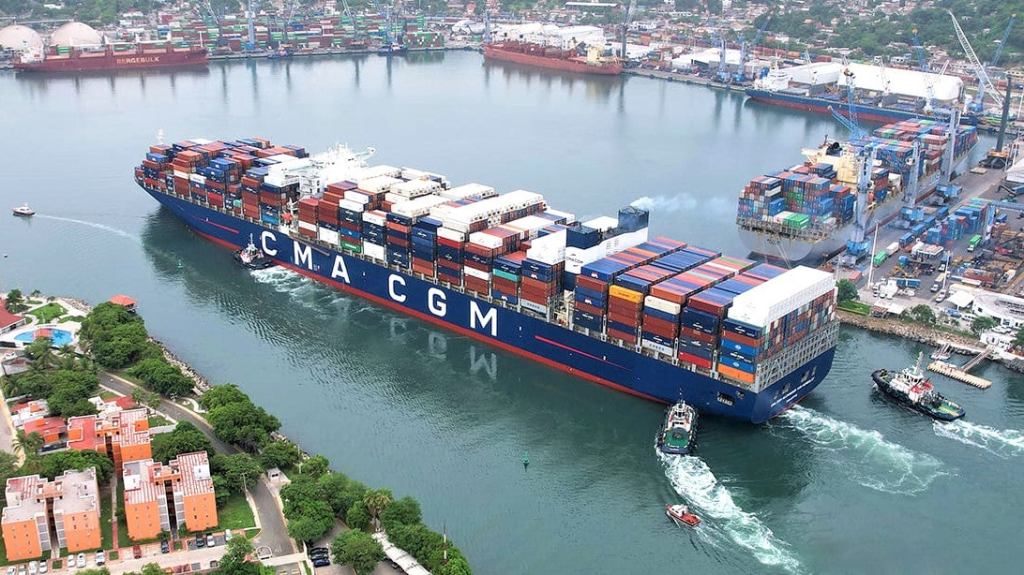
Mexico’s major ports handled 728,116 twenty-foot equivalent units during January, a 20% year-over-year (y/y) increase in total container volume for the country’s 18 ports, according to Mexico’s naval ministry.

The country’s nine Pacific Coast ports handled the bulk of container movements in January, totaling 532,534 TEUs for the month.

Mexico’s two largest Pacific Coast ports — Manzanillo and Lazaro Cardenas — reported record container movements for the month of January.

The Port of Manzanillo, the country’s busiest container port, reported 309,251 TEUs in January, a 13.8% y/y increase compared to the same period in 2023.

The Port of Lazaro Cardenas reported 185,406 TEUs in January, a 40% y/y increase compared to the same month last year.

Siddharth Priyesh, vice president of the Americas and Caribbean at CrimsonLogic, said more foreign manufacturers nearshoring their operations into Mexico — especially the border city of Tijuana — has boosted containerized freight import volumes into the country.

“You’ve had full-fledged new industries get created out of pretty much nowhere at the Tijuana border with the nearshoring that is happening there,” Priyesh told FreightWaves. “Companies are in fact bringing goods in there or doing some other manufacturing in the factories there and then actually trucking products across the [U.S.-Mexico] border.”

CrimsonLogic is a Singapore-based global technology company specializing in technology-enablement in the fields of trade facilitation and compliance, port operations, government services, and logistics.

“In the last five to six years, we’ve seen some of our clients grow 10 to 20 times in the size of their businesses, so nearshoring is definitely there and it’s a sustained pace so far,” Priyesh said. “We can take our customers’ tools that we have visibility with … . [W]e still see them doing millions of transactions and dozens and dozens of trucks crossing the border with the products and factories set up right across the border.”

Mexico’s Gulf Coast ports reported a total 195,582 TEUs in January, an 18.8% y/y increase compared to the same month in 2023.

The Port of Veracruz was Mexico’s busiest Gulf Coast container port in January, totaling 99,765 TEUs, a 13.1% y/y increase. The second-busiest Gulf Coast port was Altamira, totaling 76,646 TEUs, a 29.5% y/y increase.

Priyesh said containerized freight movements bound for the United States are also showing positive signs, with imports showing a 9% y/y increase in December.

“It’s really built on the foundation of increased demand from consumers,” Priyesh said. “Based on what we are seeing, it is actually sustained demand. At CrimsonLogic, we provide a lot of these services that are linked with a lot of e-commerce shipments coming in.  We actually saw volume sustained well into January, and it is on the back of direct cross-border business to consumer orders being placed. In order to service that, obviously, you need goods to be coming in, which is what is typified by the increased container volumes and shipments. If you think about it from a macro level, it really means that the overall sentiment has gone up to a level where people are comfortable placing a lot of orders in advance.”

More articles by Noi Mahoney

Texas-based customs broker expands cross-border footprint

Shifting supply chains boost trade in California-Baja mega-region

Mass furloughs reported at BNSF Railway operations in 4 states

FreightWaves’ 3PL Summit: Tech that is changing the industry – WTT

On Episode 690 of WHAT THE TRUCK?!?, Dooner is coming to you live from FreightWaves’ 3PL Summit, where we’re looking at tech that is transforming the industry.

Front’s Craig Klemp looks at emerging systems that aim to empower global and domestic trade. He’s breaking down what Front is seeing in the automation, AI and connected system space.

DHL Express’ Greg Hewitt tells us about the company’s new GoGreen Plus program. GoGreen Plus is a dedicated solution to help businesses reduce the carbon emissions associated with their shipments through the use of sustainable aviation fuel. We’ll also find out what he’s seeing in the broader freight market.

Highway’s Michael Caney is on a mission to fight freight fraud. We’ll hear stories from the front lines as his team looks to counter this $700 million problem.

Plus, transporting a giraffe; Mike’s Hard Lemonade heist; longest wait times; VR truckers; and staying clean while stuck on I-80.

Watch on YouTube

Subscribe to the WTT newsletter

Apple Podcasts

Spotify

More FreightWaves Podcasts