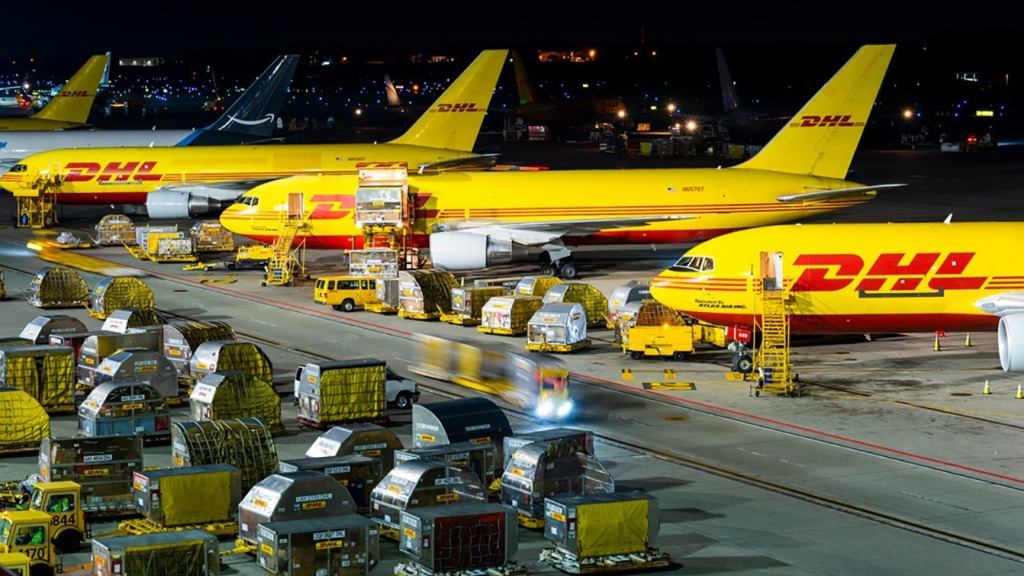
Transport and logistics provider DHL Group said Tuesday that it has relocated its Norfolk, Virginia, operations to a facility more than twice the size of its prior location.
The $7.3 million investment increases shipment capacity and enables faster processing, resulting in later cutoff times for shippers in eastern Virginia, said DHL, a German company with Americas headquarters in Plantation, Florida.
The new service center facility at 2551 Almeda Ave. serves Norfolk and the surrounding areas for local pickup and delivery, from the shipyards in Chesapeake to Kitty Hawk and the Outer Banks of North Carolina. It connects to the global DHL network through its daily dedicated 737 flight between Richmond International Airport and DHL’s global hub at Cincinnati/Northern Kentucky International Airport (CVG), in addition to trucking service to and from the DHL JFK Gateway, the company said.
“Through this new facility, DHL is thrilled to expand and improve its capabilities for international shippers within one of the nation’s largest export markets and continue to help customers — both large and small — capitalize on business growth opportunities beyond our borders,” said Nemer Abohasen, vice president and general manager of DHL Express.
With more than 30 operations and management staff, the new service center can process up to 2,000 pieces per hour, handling both U.S. domestic as well as time-definite international shipments to and from the 225 countries and territories served by DHL Express, DHL said. Local package delivery growth has been driven by business-to-business and business-to-consumer e-commerce shipping, as well as companies that provide services for federal contractors and other organizations associated with the U.S. government, DHL said.
The facility is also equipped with charging stations as it will soon introduce fully electric pickup and delivery vehicles, DHL said.
DHL, like other transport companies, has managed through weaker demand and higher costs. Its DHL Supply Chain unit earlier this week announced layoffs in Joliet, Ill.
Is Wall Street warming back up to containership line Zim?
For nearly two years, capital markets have punished Zim, the Israeli containership line whose fleet is the 10th-largest on the ocean. Zim’s model, which involves operating a subscale, highly chartered fleet of smaller vessels almost wholly exposed to the spot market, took a beating when collapsing spot rates collided with its high COVID-era lease expenses. The stock peaked at $84.50 per share on March 18, 2022, and took a series of nosedives before finally bottoming at $6.59 on Nov. 28, 2023.
But now the container market may be turning around. The Houthi missile and drone attacks in the Red Sea have forced steamship lines to divert their vessels away from the Suez Canal, around the Cape of Good Hope, and take the long way to Europe from Asia. Radically extending those important trade lanes and transit times has meant that it takes more containership capacity to move the same amount of freight, straining the global fleet and creating the conditions for spot rate increases even on unaffected lanes like the trans-Pacific.
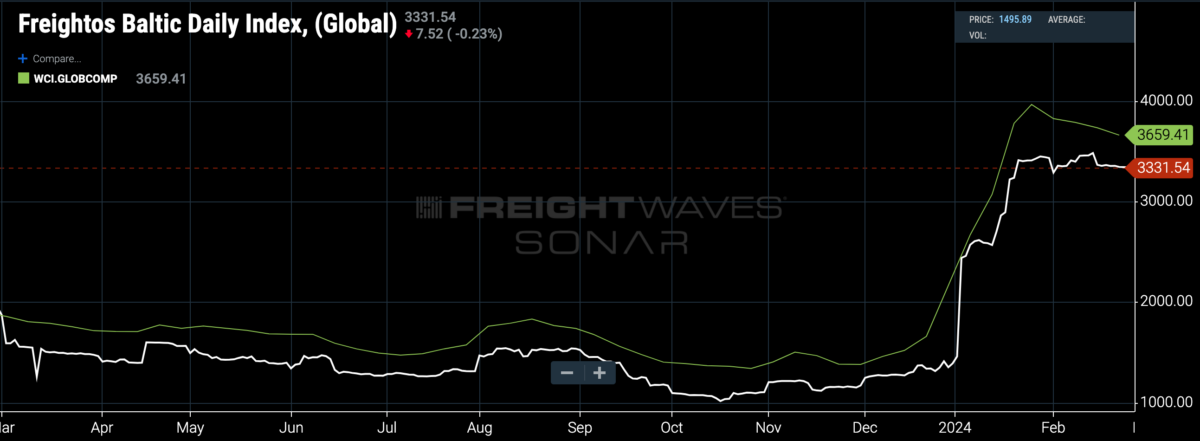
What could have been a temporary blip is taking much longer to resolve than initially anticipated, and now analysts think spot rates could stay higher for longer. Two important indexes tracking average global spot rates are showing sustained, elevated levels: Drewry’s World Container Index – Global Composite, now at $3,659.41, and the Freightos Baltic Daily – Global, now at $3,331.54.
(Both the Freightos Baltic Daily (green line) and Drewry’s World Container Index (white line) measure average global container spot rates. Chart: FreightWaves SONAR)
At the end of January, Jefferies equity analyst Omar Nokta upgraded Zim to a “Buy,” affixing a $20 price target to the stock.
“The story has changed for ZIM with cash burn shifting to significant cash generation,” Nokta wrote in the Jan. 29 client note. “ZIM’s high spot, high cost and high leverage platform was a major concern in a period of low freight rates, but it now provides substantial upside given the rise in spot rates.”
Nokta reckoned Zim’s cost per twenty-foot equivalent unit, including leasing fees, at $1,700. For much of 2023, Zim’s realized freight rate had fallen to approximately $1,200 per TEU, and the ocean carrier was burning $300 million per quarter. But Nokta estimates that Zim may be capturing as much as $2,100 per TEU across its service lines.
Zim’s guidance on the Q3 2023 earnings call — it doesn’t release Q4 results until mid-March — was bearish. CEO Eli Glickman cut full-year profitability expectations under some fairly negative baseline assumptions: Continued weakness in freight rates, a slight decline in volume and higher bunker fuel costs would all reduce earnings before interest, taxes, depreciation and amortization.
But just a week before that earnings call, which was on Nov. 15, 2023, Zim management made some moves that indicated the company was starting to see green shoots in the ocean freight market. It announced that it would relaunch its ZIM eCommerce Xpress or ZEX service from China to Los Angeles with its first sailing on Nov. 22 from Yantian. ZEX is a signature Zim service, first brought to market in 2020: It offers the fastest transit time from China to the West Coast (12.5 days), with no-roll guarantees, priority unloading and same-day availability when the vessel reaches its berth. It’s a premium service on small 4,200-TEU vessels meant to service time-sensitive freight and ultimately compete with air cargo, on the rationale that there should be a transportation option between typical ocean container transits (21 days) and typical air cargo transits (one day).
Air cargo is highly levered to the goods economy and freight markets: Volumes and rates can explode if the rest of the market is doing well, but they drop through the floor if ocean, truck and rail are unusually soft. So Zim’s decision to reintroduce its premium services implies a bullishness on the part of management — they thought that eastbound trans-Pacific ocean freight was getting so hot that the market would support a high-priced, high-touch option for overflow or time-sensitive cargo.
“While 4Q23 results are likely to be weak, we expect 1Q24 to be a bounce-back quarter and to set the stage for a stronger 2Q24,” Nokta wrote, concluding that “ZIM is a high-beta play on the container market improvement. While freight rates are likely to remain volatile, we believe they will hold at well above the lows seen in 2023.”
Zim’s network may be particularly well suited to take advantage of container market disruptions in 2024. There was already an outsize flurry of container bookings from China to the United States in the lead-up to the Chinese New Year; although surges in volume prior to the holiday are common, the bump in 2024 exceeded last year’s by a lot. Those bookings have Gene Seroka, executive director of the Port of Los Angeles, calling for a 20% year-over-year volume improvement in the first quarter. Notably, only 53% of LA’s volume now comes from China, down from more than 70% in years past, and Seroka predicts that China’s share of LA’s volume will fall below 50% in the next few years.
The possibility of a Trump electoral victory in November and the threat of draconian tariffs placed on Chinese exports may accelerate that trend. Shippers have already reported pulling forward extra volumes as they replenish their stateside inventories. While the most extreme form of reshoring — pulling their manufacturing operations out of China completely and returning them to the U.S. — is complex, expensive and rare, shippers are reengineering their Asian supply chains, changing the sequence of assemblies and shuttling goods from one port to another in order to export to the United States from countries that won’t face harsh tariffs, like Vietnam, Korea or Japan.
Zim is poised to take advantage of both of these trends — the tariff-avoiding pull-forward trade and the intra-Asia business. In the third quarter of 2023, the company reported carried volumes of 867,000 TEUs. Zim’s two biggest regions in terms of volume were the Pacific and Intra-Asia: the Pacific accounted for 339,000 TEUs, or 39.1% of its volumes, while Intra-Asia handled 250,000 TEUs, or 28.8% of its volumes. In other words, up to 67% of its business is in regions that are poised to get hotter as 2024 progresses.
New liquefied natural gas-powered charters being delivered to Zim throughout this year will help lower the company’s cost per TEU. LNG spot prices at Henry Hub briefly spiked during January’s cold weather but are otherwise staying extremely low, at $1.60 per million Btu. (Compare that to 2022, when prices exceeded $7/mmBtu for months on end.)
Nokta and other Wall Street analysts expect Q4 2023 results to come in fairly week, but a lot hinges on Glickman’s guidance, and whether he will formally raise expectations for what may prove to be another chaotic but lucrative year for Zim.
Deadline nears for filings as Werner seeks review of nuclear verdict
Deadlines are looming for all briefs to be filed with the Texas Supreme Court as it decides whether to review the enormous verdict against Werner Enterprises growing out of a 2014 fatal wreck. With interest, the sum now stands above $100 million.
A primary brief was filed in October by attorneys for the Blake family, which suffered one death, one catastrophic brain injury and other injuries in the Dec. 30, 2014, West Texas crash.
On Feb. 15, attorneys for Werner (NASDAQ: WERN) filed a brief for the company, and earlier this month the Texas Trucking Association filed a friend-of-the-court brief.
The Supreme Court’s page dedicated to the case lists March 6 as the final date for any respondents to file with the court.
Werner’s legal brief reviews well-trod ground on the accident and what happened in a lower court in 2018, when the decision against Werner was first handed down.
But it and the Blake brief also weigh in on the issue of extending liability out to Werner, as it appears clear that the trucking industry is concerned that precedents set in the case could impact future verdicts against carriers.
The facts of the accident are not in dispute. A pickup truck heading east on Interstate 20 in West Texas driven by Trey Salinas and ferrying members of the Blake family hit a black ice patch, streaked across a more than 10-yard-wide median and crashed into a westbound Werner truck driven by Shiraz Ali. Winter storm watches were in effect. One of the Blake children died, and a second was severely injured. Other passengers had less serious injuries.
The Blakes’ core argument is that Ali had not sufficiently slowed his truck to compensate for the weather. If he had, the Werner truck would not have been where it was when the pickup driven by Salinas crossed the median.
In its brief, Werner’s attorneys summed up the trial court’s ruling as saying that Ali “owed a duty to reasonably foresee that the Blakes’ vehicle might careen into his path.”
In apportioning blame, the lower court jury assigned 70% to Werner on one of the key questions of liability and 30% on another liability issue. On the former question, Salinas’ blame was assessed at 16%.
The arguments leveled against Werner by attorneys for the Blakes in their attempt to put blame on the carrier involved such disparate issues as driver training (along with a borderline personal attack on the person who filled the company’s role as head of training), the demand for on-time delivery, and the lack of a control system that could have instructed Ali to get off the road.
Appeals court upholds lower court ruling
The lower court award of just under $90 million was appealed, and ultimately the full Court of Appeals for the 14th District of Texas grabbed the case before a three-judge appellate court panel could issue its ruling. In a 5-4 decision, the justices ruled in favor of the Blakes. (Interest fees on the initial award resulted in the case being worth more at every stop through the judicial system).
The briefs filed by attorneys for the Blakes and for Werner both provide significant discussion of the “Admission Rule.” Attorneys for the Blakes describe the rule as “[barring] derivative-liability claims like negligent training and supervision when the employer concedes vicarious liability.”
They said the rule was “once the majority rule [but] the modern trend is to reject the rule.”
The Admission Rule is a “relic” of a period before juries could hand down very specific proportionate blame for an accident, according to the Blakes’ attorneys, and “conceals all the ways the employer contributed to the harm except its driver’s conduct, resulting in a fictional apportionment where much of the employer’s responsibility is redistributed among other parties.”
Dissent cited by Werner on issue of Admission Rule
Justice Randy Wilson, in a dissent to the 5-4 vote, wrote that the Admission Rule holds that if an employer acknowledges one of its employees “was acting in the course and scope of his employment when the employee allegedly engaged in negligent conduct (that) bars a party allegedly injured by the employee’s negligence from pursuing derivative theories of negligence against the employer.” His minority argument was that the Admission Rule should have barred the enormous liability claim against Werner, which employed Ali.
Attorneys for Werner concur and say the issues in the case could be precedent-setting. The brief says the “question [has] never [been] definitely resolved by this Court: whether a claimant injured by a person acting in the course and scope of employment may pursue derivative negligence theories against an employer” if the employer concedes the worker was performing duties for the employer.
Werner’s brief called Wilson’s dissent “powerful” but conceded that while courts recognize the Admission Rule, they aren’t in agreement on what its impact can be.
By not limiting liability down the line, the Werner attorneys argue, it effectively defined a driver’s duty as “one owed to the whole world.” “If affirmed, the trial court’s judgment will establish that a driver and his or her employer may be held liable for injuries to other motorists no matter how improbable, fantastic, or farfetched,” Werner said in its brief. “Because that result has no basis in Texas law, reversal of the trial court’s judgment is necessary.”
In its amicus brief, the Texas Trucking Association says the Admissions Rule helps provide “appropriate boundaries for argumentation on employer liability and reduce the likelihood of error.”
“Had Ali been driving outside the course and scope of his employment, [the Blakes] may have been able to use derivative liability theories like negligent hiring, training, entrustment, or supervision to find Werner responsible for Ali’s actions,” the association writes. “But when an employer stipulates to course and scope — as Werner did here — the employer’s negligence is no longer in doubt, so long as the employee is found to have been negligent.”
Werner attorneys also are raising the issue of the charge to the lower court jury, saying it improperly mixed issues that they believe should have remained separate, affecting the final verdict.
Daily Infographic: Feds charge Illinois trucking company owner in alleged CDL fraud
To view more FreightWaves infographics, click here
25% more containers out of LA/Long Beach ports possible: ITS Logistics
U.S. consumers are not as eager right now to open their wallets to purchase a lot, but that does not mean anticipated lower volumes cannot create any logistical hiccups. They still can.
Shippers are taking advantage of the longer transit around the Cape of Good Hope and the wait at the Panama Canal due to water restrictions. They don’t need the products, and they are more than happy to have their containers on the water and not racking up warehouse bills.
But while this present strategy is good, the attractiveness of longer transit times may start to wane for a variety of reasons.
The first is contract season. Paying more for a less productive route for a year may not make fiscal sense when you are heading into peak season.
The second is fears over a possible East Coast labor strike. Who wants to be locked in for a year with that threat looming? The labor contract between United States Maritime Alliance (USMX), representing employers at 36 ports on the East and Gulf coasts, and the International Longshoremen’s Association (ILA) union, which represents around 70,000 dockworkers, expires Sept. 30.
If the ILA does strike, it will be the first major labor disruption on the East Coast since 1977. That strike lasted almost two months. The threat of a West Coast ILWU strike resulted in a hemorrhage of trade moving to the East Coast. How much East Coast trade we will see revert to the West Coast is ongoing.
It’s these concerns that will be on the minds of shippers when they sit across the table from ocean carriers as they haggle over their respective contracts. Logistics managers tell American Shipper they will be curious to see how ocean carriers justify the expense of an East Coast transit.
Preparing ahead of contract season takes time and boots on the ground. There is always a plan for the plan. As a result of Red Sea logistics planning, ITS Logistics is warning clients to get their container transportation plans in place now. Paul Brashier, vice president of drayage and intermodal at ITS Logistics, tells American Shipper he has been on the ground surveying Los Angeles and clients are asking for more onboard capacity on the West Coast.
“They are looking for additional capacity for ground storage and cross-docking,” said Brashier. “I am anticipating at least 25% more out of the ports of Los Angeles and Long Beach.”
Clients concerned about East Coast labor and Red Sea diversions are driving this demand.
“As we go into contract season, customers that are planning on the Non-Vessel-Operating Common Carrier (NVO) and carrier side are looking for additional space to store containers,” said Brashier.
While peak season will come on its traditional schedule, the fact Brashier is seeing more containers scheduled to come into the West Coast has him beefing up the land infrastructure to make the movement of those containers out of the port to its next destination go as smoothly as possible.
Brashier is not alone in his assessment of how his team is planning to serve and execute clients’ logistical strategy. Other logistics managers have told American Shipper of similar plans.
This year with less container volumes, it is imperative for logistics companies to stand out with their service and their technology. As we see freight companies that claim they are disrupting the industry when it is just smoke and mirrors, the proof of a logistical disruptor or dependable logistics operator is the company’s execution and ability to harness the power of the technology they have. Clients want certainty.
Next week during contract signing, logistics managers will be placing their bets on being as nimble as possible and getting the best rate in a time of war and environmental crisis. After all, providing as much certainty as possible in the logistical supply chain separates the winners from the losers. Logistics companies thrive by providing that certainty.
Morgan Stanley cuts earnings expectations amid surging insurance costs
Morgan Stanley cut earnings estimates for all the transportation companies it covers on Tuesday, citing rising insurance costs. It continues to believe the truckload space will be the most impacted as large jury verdicts remain a threat.
The firm said both nuclear verdicts and a prolonged period of insurance companies incurring costs above general inflation are reasons the cost line will remain bloated. During the fourth quarter, several carriers called out insurance expenses as a drag on earnings.
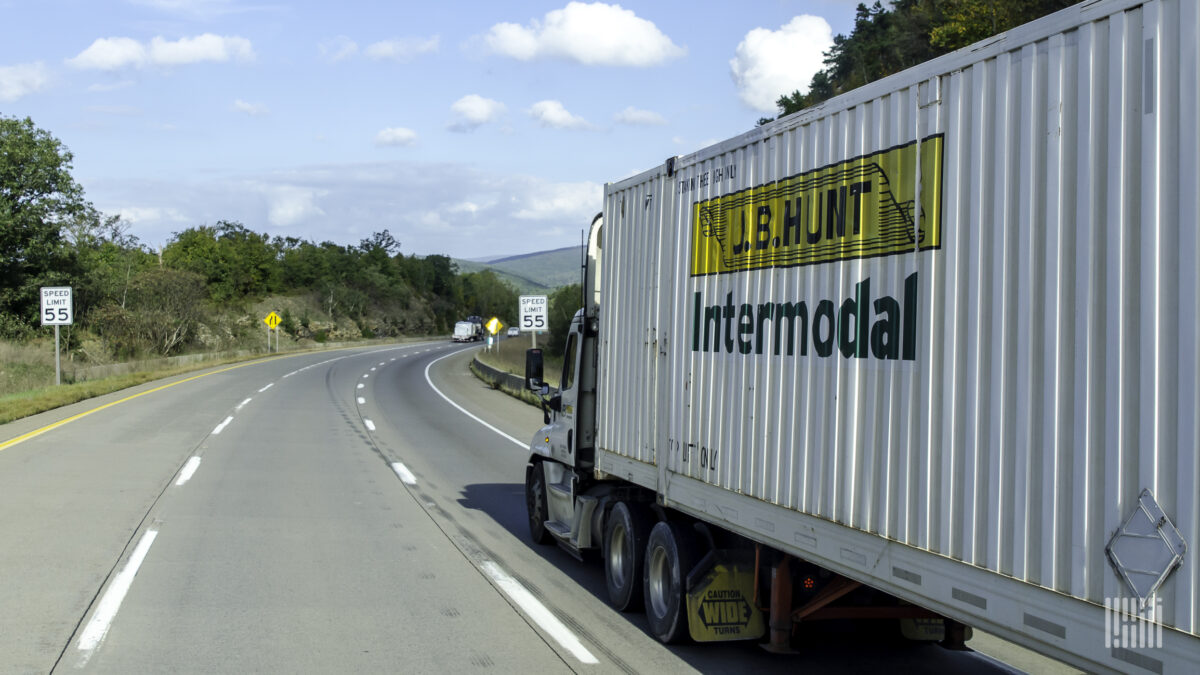
J.B. Hunt Transport Services (NASDAQ: JBHT) said the line item was a 43-cent drag on its $1.47 earnings-per-share result in the fourth quarter. An annual true-up of $53 million in the period was less severe than the $64 million incurred in the prior-year quarter, but still elevated to historical comparisons. Higher premiums and the expectation for much higher claim payouts were the culprits.
The company said premiums have reset between 50% and 60% higher this year despite the installation of several risk-mitigation programs.
Schneider National’s (NYSE: SNDR) full-year 2024 earnings outlook is approximately 11% lower than its 2023 result (at the midpoint of the new guidance range). It cited headwinds from higher insurance and claims expenses, among other items, for the lower-than-expected forecast.
“The social inflation phenomenon points to this inflation being persistent if not accelerating as the space will see pressure not only from higher jury awards and settlements but also the knock-on effects of higher premiums,” Morgan Stanley analyst (NYSE: MS) Ravi Shanker said in the report.
He cut EPS estimates for all companies by an average of 3% for 2025 and 2026. Mid-single-digit percentage cuts were made to the TL-centric companies he follows.
He acknowledged that insurance expense accounts for just 1% to 5% of total operating costs for most transportation companies (toward the higher end for TL carriers). His base case assumes 15% cost inflation in the line item moving forward even though some companies have reported higher increases. The increased costs will be fully absorbed by carriers unless they are able to pass them through in the form of higher rates, which is a tough task as bid season has been tougher than expected so far.
Shanker’s bear case showed insurance costs increasing by 35%, which would result in a 10% EPS reduction. He said such a scenario would likely accompany a reduction in valuation multiples applied to the stocks.
Knight-Swift (NYSE: KNX) said on its fourth-quarter call last month it was exiting a third-party insurance venture. The unit, which brokers liability coverage to small carriers, booked another operating loss in the quarter, this time $72 million. Higher-than-expected claims and carriers not paying their premiums were the reasons for the decision.
3PLs saw the second-highest earnings cut from Morgan Stanley. While brokers don’t haul the freight, they are usually named in lawsuits as they are often the largest party to the transaction and have the deepest pockets.
Freight broker Landstar System (NASDAQ: LSTR) flagged the cost line as a concern on its Feb. 1 fourth-quarter call. It said its annual liability coverage renewal would be more than $30 million this year compared to approximately $8 million in 2019.
Shanker said a spike in insurance costs contributed to the recent freight upcycle, which was marked by tight capacity and higher rates. He said the cost line was overlooked “as rates and margins soared.” However, with rates at depressed levels and insurance costs continuing to step higher, he said the line item is no longer “back of mind.”
He believes higher insurance costs could lead to further consolidation among transportation companies, especially among small operators that lack scale and risk-mitigation programs. That likely means more M&A opportunities, and market share, for large carriers and brokers.
A survey performed by Morgan Stanley showed most operators expect insurance costs to increase between 10% and 30%, with premiums alone increasing by low-double-digit percentages. The survey showed claims expense has been more severe at large companies, “given their propensity to be targets for lawsuits.”
No company surveyed, even those with enhanced safety programs in place, are expecting a decline in costs.
Fastfrate Group renews CPKC deal connecting US, Canada and Mexico
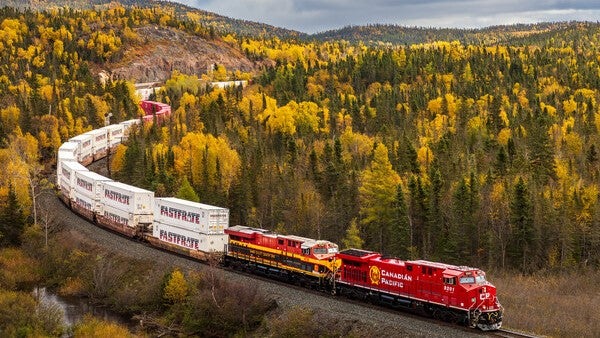
Fastfrate Group and CPKC railway announced Tuesday the renewal and expansion of their agreement that provides intermodal and drayage services across Canada, the U.S. and Mexico.
The five-year agreement aims to improve and speed up North America’s supply chain, while tapping into growing cross-border trade among the three countries, especially the automotive industry, Fastfrate officials said.
“The faster we can fix supply chains, the more activity that’s going to come,” Fastfrate Group Executive Chairman Ron Tepper told FreightWaves. “This agreement with CPKC is really critical, not only for Mexico, but for Canada as well, since Canada is a huge trading partner with Mexico, and supply chains are an issue. The goal here is to speed up the supply chain at less cost. That’s exactly what we’re putting together.”
Fastfrate and CPKC have been partners for 58 years, having entered into their first service agreement in 1966. As part of its pact with CPKC, Fastfrate co-locates with CPKC for its intermodal terminals throughout Canada, the U.S. and Mexico.
Since its founding in 1966, Fastfrate has grown into a group of five companies operating out of 40 terminals and final-mile hubs across Canada and the U.S. The Fastfrate Group is one of Canada’s largest privately held carriers with coast-to-coast facilities and services.
In 2022, Fastfrate acquired Canadian truckload and logistics provider Challenger Motor Freight. The deal made Fastfrate one of the largest cross-border trucking and logistics companies in Canada. Today Fastfrate operates more than 5,500 trucks and trailers, has 1.2 million square feet of facilities and employs about 5,000 workers.
Fastfrate’s latest agreement with CPKC makes Fastfrate subsidiary Canada Drayage Inc. (CDI) the largest coast-to-coast drayage provider in Canada, officials said. CDI will also become the largest drayage provider in North America for CPKC as part of the agreement.
The Fastfrate Group will also upgrade gate technology at CPKC facilities in Toronto and Montreal, aimed at decreasing wait times for drayage trucks, Fastfrate CEO Manny Calandrino said.
“At our two major centers in Montreal and Toronto, we now have a private gate for trucks to get into the CPKC facilities, as opposed to going through the front entrance of the intermodal facility of the other railroads,” Calandrino said.
Drayage trucks can spend hours waiting to enter the gates of a port or railway station.
“For trucks to try to get in and out of facilities, there’s a long waiting time, which can be horrific,” Calandrino said. “We’ve eliminated that with our private gate plus putting in automatic reader technology, which we call the Fast Pass with CPKC. That’s a major advantage that we’re going to bring to the marketplace because we’ll be able to pre-pull equipment on off hours, bypass the traffic there at the main gate terminals and come into our yard.”
The Fastfrate Group is also investing $7.4 million to create a 15-acre container yard next to CPKC’s Toronto intermodal facility and a pre-pull yard for CPKC’s domestic and international container line customers. Both facilities aim to streamline operations for domestic and international shippers.
As part of the CPKC agreement, Fastfrate will market CPKC’s services to Mexico and invest in more containers to meet the growing demand for cross-border transportation services. Fastfrate added 200 containers last year and plans to add an additional 200 by the end of the year.
The company has already deployed 100 containers on CPKC’s Mexico Midwest Express service to meet the growing demand for Mexico services, Calandrino said.
“We now have opened up the Mexico lane with CPKC. We just started this two weeks ago, and we’re going to be moving about 30 loads a week out of Mexico and coming into Canada,” Calandrino said.
Challenger Motor Freight will also benefit from the renewed Fastfrate-CPKC deal through the enhanced suite of services it can now offer its largest customer segment — just-in-time automotive parts.
“In Canada, Challenger is one of the largest trucking companies in the country. The biggest industry that they serve is automotive,” Tepper said. “The automotive industry is the biggest market for freight for Mexico, because they have parts coming north and they have loads that bring the parts back again.”
Along with expanding its market share in the automotive freight space, Tepper and Calandrino see opportunities in transporting goods from the aerospace, industrial and agricultural industries.
“Even though we’ve had a long-term partnership with CPKC, we really wanted to research the market ourselves, to understand what investments are required, and what the return on the investment is going to be,” Tepper said. “We have LTL, we have truckload, we have rail, we have home delivery, we have drayage, so we’re a full-service carrier. We wanted to take that into the U.S. and see whether it made any sense for us, and we think it does.”
Welcome to the WHAT THE TRUCK?!? Newsletter brought to you by Dynamic Logistix. In this issue, Family Dollar’s mouse-infested warehouse; Walmart’s moves; layoffs continue.
1,270 dead mice — Move over Disney, we have a new house of mouse.Family Dollar Stores are out $41.6 million after being ordered to fork over the largest fine of its kind for using a rodent-infested warehouse in Arkansas.
Yahoo News reports, “The company pleaded guilty to one misdemeanor count of causing goods to be ‘adulterated while being held under insanitary conditions’ at a federal court hearing in Little Rock on Monday.”
According to the plea agreement, Family Dollar, which is owned by Dollar Tree, first learned of the mouse and pest issues back in August 2020. Reuters reports, “The company continued to ship FDA-regulated products from the warehouse until January 2022, when an FDA inspection revealed live rodents, dead and decaying rodents, rodent feces, urine, and odors, and evidence of gnawing and nesting throughout the facility.”
“Having reached full resolution with the DOJ, we are continuing to move forward on our business transformation, safety procedures and compliance initiatives.” — Dollar Tree Chairman and CEO Rick Dreiling
The Department of Justice said over 1,270 dead mice were found after exterminators fumigated the warehouse. Here’s some cheese to nibble on. The company claims they’ve built a better mouse trap and have since solved the problem.
Sound off — What’s the grossest thing you’ve ever found in a warehouse? Email me.
J.B. Hunt acquires Walmart intermodal fleet — The Northwest Arkansas connection deepens as Walmart and J.B. Hunt have “entered a long-term intermodal deal with Walmart that includes volume and capacity commitments.”
“We think the investment by JBHT is significant, but it’s part of the company’s existing commitment to get to 150k containers … and we note this purchase would represent capacity that is already in the market and comes with incremental volume commitments.” — Deutsche Bank analyst Amit Mehrotra
While it’s unknown what the size of the fleet is or what the purchase price was, as part of the deal J.B. Hunt has picked up Walmart’s intermodal assets.
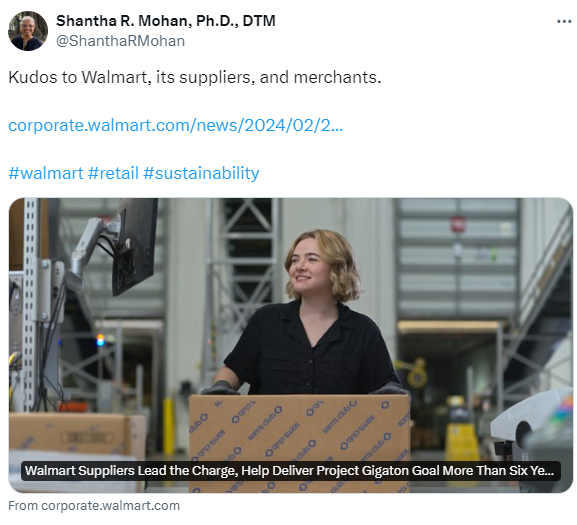
Gigaton — In 2017 Walmart set some ambitious goals through its Project Gigaton program for its suppliers to reduce 1 billion tons (1 gigaton) of emissions from their value chain by 2030. Now the company has announced that Project Gigaton has hit that milestone six years early.
How’d they get there? The Bentonville big box behemoth says industrywide participation was key. Over 5,900 of its suppliers signed up since launching in 2017. In fiscal year 2023, 75% of U.S. sales came from suppliers enlisted in the project.
Autonomous deal on deck? — Last week I caught up with Grayson Brulte on his show “The Road To Autonomy” to discuss all things AV. One news item we dove deep on was Kodiak’s James Reed joining Walmart as vice president of transportation development. With Reed staying on Kodiak’s board of directors, does that mean a Walmart x Kodiak autonomous truck deal could be on tap? You can catch that show right here
Boateng Logistics’ bankruptcy — Overcapacity issues in both brokerages and at carriers are still causing problems for firms as the freight bleedout continues. The latest victim is Boateng Logistics, headquartered in Carlsbad, California.
FreightWaves’ Clarissa Hawes reports, “Trucking, logistics and factoring companies are collectively owed millions of dollars after a California-based freight forwarder filed for bankruptcy liquidation.”
DSX Logistics = 80 layoffs and one closed Amazon facility
Quad Logistics Services = 74 layoffs and one closed printing facility Universal Intermodal Services = 42 layoffs
Meme of the week
X
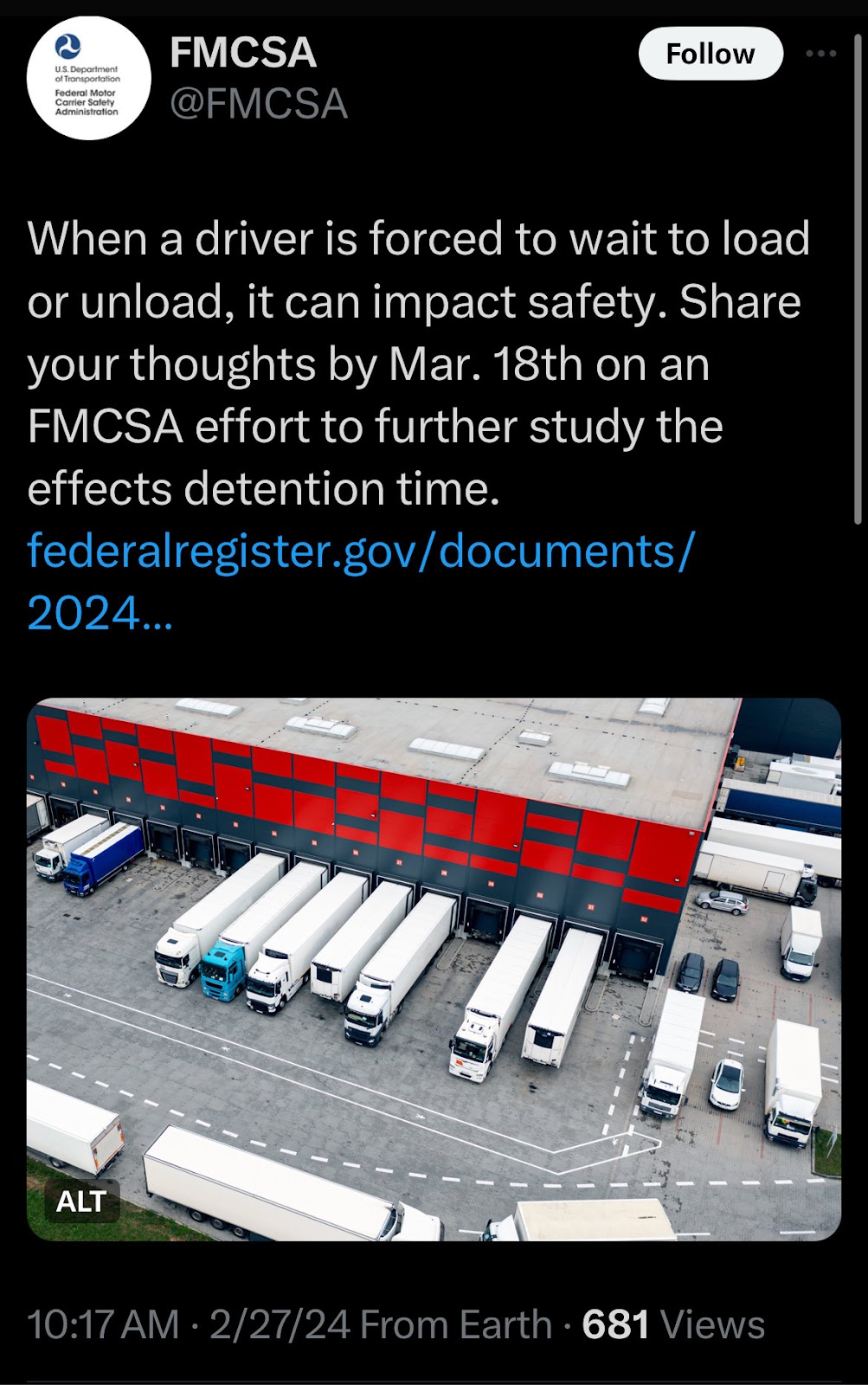
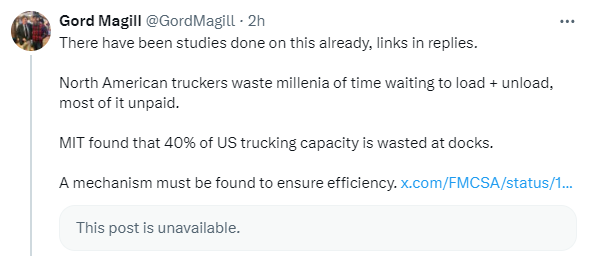
Stock footage — Whoever runs the Federal Motor Carrier Safety Administration’s social media account stepped in one Tuesday by using a stock photo of European trucks in a since-deleted post about detention time studies.
Some were concerned that they’d be conducting these in Poland as the photo depicts instead of the USA. Others were worried that the FMCSA doesn’t know what a U.S. truck looks like.
How AI is changing how you log inventory, pick a couch and buy a truck — This Wednesday on WHAT THE TRUCK?!?, I’m talking to Gather AI’s Sean Mitchell about the applicability of warehouse drones, AI and software in optimizing operations.
Couch.com founder and CEO Alex Beck is an e-commerce veteran and a direct-to-consumer expert. He’s built a new platform that helps users select a couch. He’s talking about the future of AI in the furniture industry and e-commerce in general.
It’s all about chassis when Consolidated Chassis Management LLC’s Mike Wilson joins the show. We’ll learn about the company’s South Atlantic Consolidated Chassis Pool.
FreightWaves’ Alan Adler covers the electric and the eclectic. We’ll learn about Hyliion’s Karno generator; ideal use cases for electric vehicles; and renewable natural gas as a growing factor in Class 8 truck orders.
Plus, latest news, weirdness and trends.
Catch new shows live at noon EST Mondays, Wednesdays and Fridays on FreightWaves LinkedIn, Facebook, X or YouTube or on demand by looking up WHAT THE TRUCK?!? on your favorite podcast player.
Or simply look up WHAT THE TRUCK?!? on your favorite podcast player.
Don’t be a stranger,
Dooner
Discipline, reward, retention: The grind with Jason Douglass – Taking the Hire Road
Jason Douglass, director of retention and recruiting at Utah-based Stokes Trucking, joined Jeremy Reymer on a recent episode of Taking the Hire Road. The pair discussed making retention a priority, the importance of fitness and how video content can build trust with drivers.
Douglass is dedicated to being the best version of himself he can be, and that same drive fuels his desire to create a work environment that helps drivers excel. One of the biggest ways Douglass does that is by getting personal.
“Empathy is such a big part of recruiting and retention,” Douglass said. “If you don’t have that … you’re going to struggle. I’m not in the recruiting business, I’m in the people business.”
Being empathetic toward drivers means meeting them where they are. With the ongoing driver health crisis — and the fact that truck drivers have an average life expectancy well over a decade lower than the average American — Douglass is passionate about creating pathways for drivers to be healthier, both emotionally and physically.
One way Douglass has achieved this is by implementing an Employee Assistance Program at Stokes. The program enables drivers to quickly access counselors and other mental health professionals, making it possible for them to get help wherever they may be.
Douglass and his teammates at Stokes have also worked to create a doable wellness program for truck drivers. The program incentivizes drivers to make healthy choices — including cooking healthy meals, exercising and meditating — by offering them a $300 monthly health savings account deposit in response to their efforts.
This level of care fuels retention at Stokes. Drivers know the company is invested in them personally, and they choose to return that investment. Stokes boasts a 14% turnover rate, leaps and bounds lower than industry averages that have, at times, surpassed 100%.
Douglass draws inspiration from his own wellness journey when working with drivers, allowing him to connect with them on a genuine level.
“My ‘why’ is to be a better me. In return, I’m a better husband, a better father, a better employee,” Douglass said. “I want to live longer and be healthy. I want to help people in the industry live longer and be healthy.”
In addition to promoting increased wellness across the industry, Douglass has focused on creating social media content — especially videos — that resonate with both new customers and potential drivers.
The videos, which cover a host of topics, allow viewers to get to know Douglass — and Stokes — through the screen before reaching out, leading to more productive conversations and new connections.
Welcome back to Check Call. Conference season is upon us, and wrapping up conference season is the one and only FreightWaves Future of Supply Chain. If you haven’t yet decided on going or you want to go but are looking for the best deal on tickets, then you’re in luck. Check Call subscribers get a discount. Go here to buy tickets or use CheckCallFSC24 at checkout to get the best deal around. It’s in Atlanta so flights are going to be cheap and plentiful, and all the coolest people are coming so you better too.
In this edition: East Coast ports take center stage, demurrage charges get a hike, and another acquisition is complete.
2023 brought the potential for the International Longshore and Warehouse Union strike at the West Coast ports. It’s only fitting that 2024 brings the potential for the same to happen on the East and Gulf coasts with the International Longshoremen’s Association.
The labor contract between the International Longshoremen’s Association and the United States Maritime Alliance (USMX) is set to expire at the end of September. The ILA represents some 70,000 dockworkers, while the USMX represents employers at 36 coastal ports — including three of the U.S.’s five busiest ports: the Port of New York and New Jersey, the Port of Savannah, Georgia, and the Port of Houston.
Talks for the contract began this time last year, but in a surprise to no one, negotiations couldn’t get past the issue of wage increases.
While both sides are still trying to come to an agreement, it seems as though nothing significant will happen till October 2024. That is when the ILA warned members of a possible coastwide strike, essentially crippling the East Coast and massively hindering the Gulf Coast as well.
The threat of a strike can sometimes be more powerful than the strike itself. Most recently that tactic paid off for UPS workers in 2023, with a new agreement between UPS and the Teamsters. A significant part of the cargo that switched to the East Coast from the tumultuous past two years at the West Coast has already returned to the West Coast, and more could be heading back.
It’s too early to tell if it’s likely that an agreement will be reached before the Oct. 1 deadline, but if East Coast imports or exports are a significant part of your business, that leaves about seven months to come up with a backup plan should the worst happen.
Everyone’s favorite charge to ignore just got harder to, well … ignore. The Federal Maritime Commission has imposed new billing standards on ocean carriers and terminal operators to crack down on late-container fees. These increased demurrage fees will absolutely be passed on to the shipper.
The new requirement pretty much only focuses on demurrage, so if you have a shipper that picks goods up from the ports in a timely manner, this is a nonissue. For shippers that treat a port like their own personal warehouse/storage lot, well, it’s going to get even more expensive for them.
FreightWaves’ John Gallager writes: “Starting May 26, container ship carriers and marine terminal operators will be required to issue detention and demurrage invoices within 30 calendar days from when charges were last incurred. Shippers and other billed parties will have at least 30 calendar days to request that charges be refunded. Carriers and terminal operators must try to resolve the matter within 30 calendar days unless the parties agree to a longer time frame.”
Some additional data requirements are also listed in the article. If they are not included in the detention or demurrage invoice, it eliminates any obligation to pay. Between 2020 and 2022, nine of the largest carriers serving the U.S. container trades charged approximately $8.9 billion in demurrage and detention.
Short story long, shippers, just pick up your containers in a reasonable time.
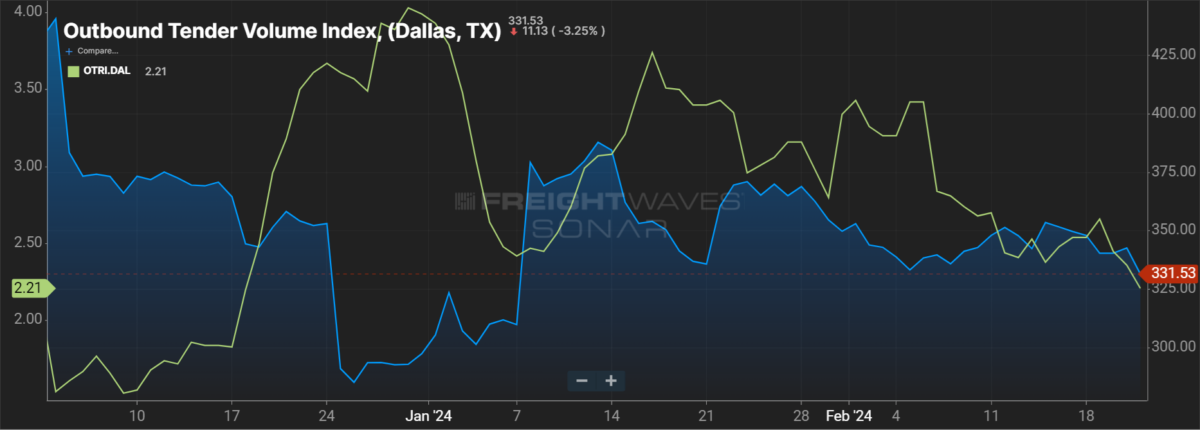
Market Check. Capacity is more than readily available in Dallas. Outbound tender rejections have dropped 17 basis points in the past week to settle at 2.21% rejections. Outbound tender volumes, on the other hand, haven’t rebounded since mid-January. Volumes are down 6.23% w/w and don’t show much chance of rebounding in the near future. While the drop in rejections isn’t significant, an OTRI of 2.21% is indicative of plenty of capacity in the market and of carriers having little trouble covering freight, much to the relief of shippers.
Who’s with whom? Keeping the M&A trend strong in 2024 is none other than RK Logistics Group Holdings. The Silicon Valley-based group expanded its network with the acquisition of New York-based On Time Trucking. On Time Trucking has more than four decades of experience, especially in New York City and the surrounding areas, which is a massive perk as some carriers refuse to go to the Big Apple for a host of reasons.
A Trucker News article quotes Joe Maclean, chairman and chief executive officer at RK Logistics: “On Time Trucking is one of the Tri-State’s most successful trucking and logistics firms, with an excellent reputation for reliable, cost-effective service throughout the five boroughs. This is a highly strategic acquisition for RK that allows us to offer lithium-ion battery and material storage services to support our energy transition customers on the East Coast.”










 X
X