Have inventories found their sweet spot?

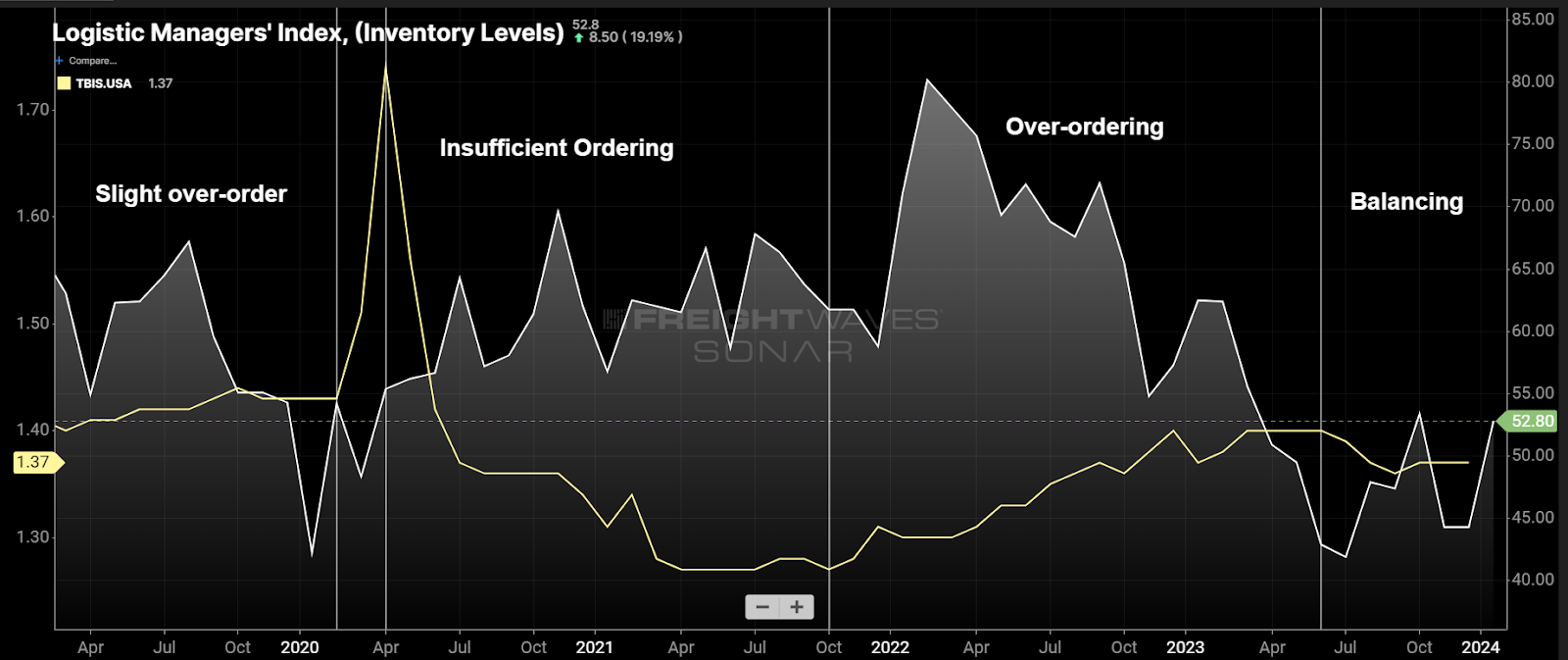
Chart of the Week: Logitics Mangers’ Index – Inventory Levels, Total Business Invetory to Sales Ratio – USA  SONARLMI.INVL, TBIS.USA

Inventories appear to have stabilized after years of volatility. The Logistics Managers’ Index (LMI) Inventory Levels component hovered in slight contraction territory last year while the Census Bureau’s Business Inventory to Sales (TBIS) fell into a more stable pattern.

It has been a bumpy ride for inventory managers and procurement teams over the past five years. The combination of a trade war, supply chain snarls and erratic demand has created extreme swings in ordering patterns. 

The LMI is a measure of movement, with values above 50 indicating expansion and below 50 indicating contraction. Values farther away from 50 indicate stronger movements. So the average value of 49 over the past nine months indicates a slow drawdown in inventory levels. 

The Census Bureau’s figures are measuring more where the inventory levels are today in relation to sales. So the most recent value of 1.37 in November translates to companies averaging just over one and a third month’s worth of sales on hand. 

For context, the average TBIS value in 2019 was 1.42, when the trade war with China created a pull-forward effect. During 2021 it averaged 1.29, in the height of the pandemic spending. 

The story here lies in the recent stability of both the LMI and TBIS values. This is an indication that procurement teams are finding consistency once again in their demand forecasts. The risk is that consistency develops complacency.

While there has been a return to some degree of normalcy after the pandemic, the world remains more hostile than it was before COVID wrecked supply chains around the globe. There are now two major conflicts disrupting sea shipping patterns. And while they are not terribly disruptive to North American shipping services, they have pushed spot rates higher.

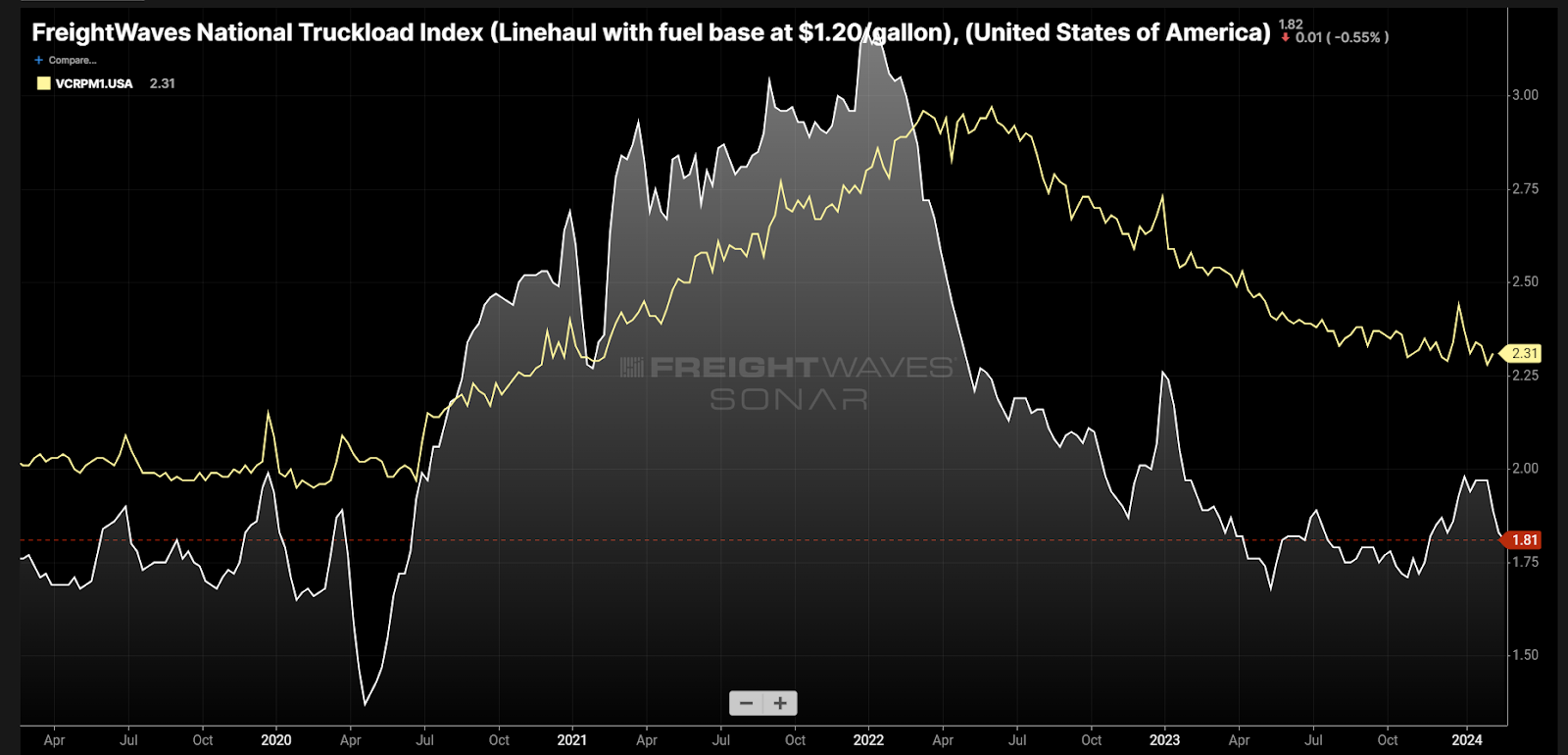
Domestic transportation capacity also remains abundant, with prices falling to their lowest levels in three years. Truckload van contract and spot rates are well below their peak 2022 values. 

If inventory levels fall too low, they are not buffered against unexpected demand. Unanticipated spikes in demand bleed into the need for transportation services, which drives transportation prices up quickly and causes severe service disruptions.  

An extreme case of this occurred in March 2020 when unexpected runs on consumer goods created severe shortages and crippled transportation networks as people were locking down. Tender rejection rates spiked from 5% to 20%, and spot rates jumped 20% in a three-week period.

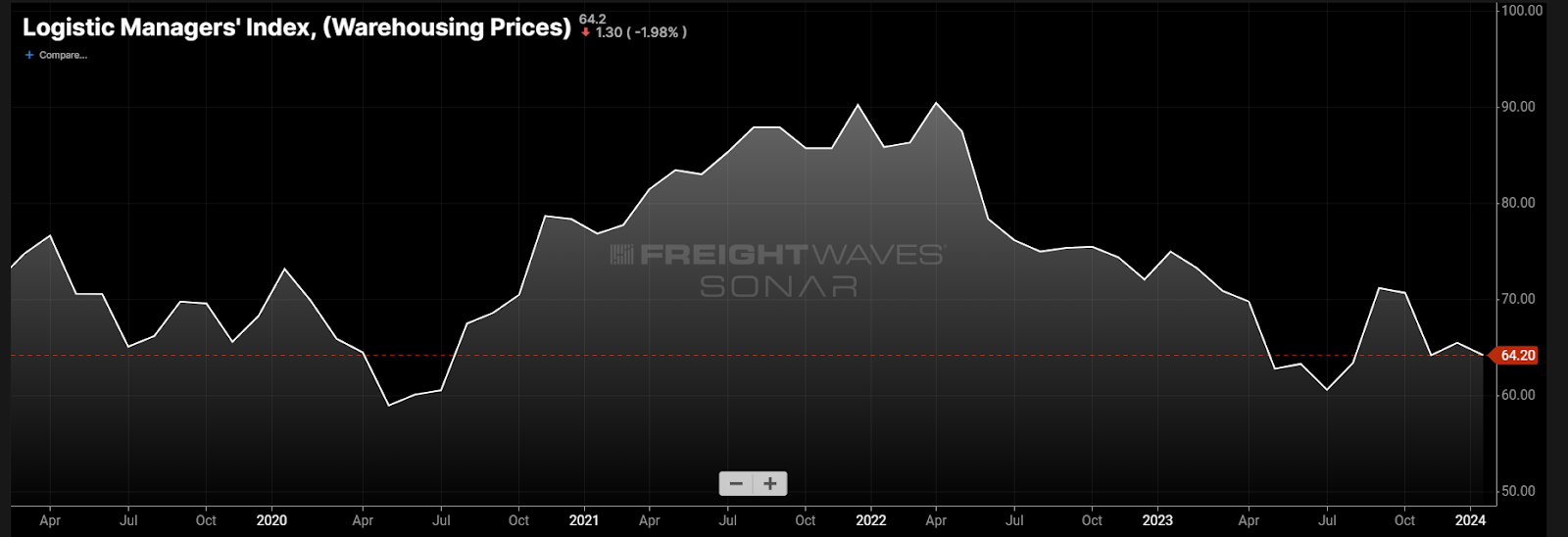
On the flip side, if inventory levels are too high, companies pay the cost of holding those goods. The LMI warehouse pricing component still measured a relatively strong increase in prices to start the year, with a value of 64.2, though that was muted off the pandemic-era increases, when the index averaged an 83 from November 2020 to May 2022. 

Holding elevated inventories presents other problems, such as stagnation and pilferage. Some goods lose value over time. An argument could still be made that underserved inventories are more costly in the form of missed revenue opportunities if demand increases. 

The question is, just how reliable is the current procurement environment? There is no sign of a demand shock-type event, but there rarely is any warning. The fact that inventory levels are on the low end of the historical spectrum means that the chances of a March 2020-esque moment are more likely.

ODeX survey spots barriers to digital documentation adoption in global trade

The maritime industry is rapidly evolving due to technological advances and demand for efficient logistics, all crucial for global trade growth.

Recently, documentation and fintech platform ODeX conducted a survey to assess the maritime industry’s views on digital documentation in ocean freight shipping. The survey aimed to understand challenges and adoption rates in digital platforms, as well as leadership attitudes on the subject.

“I was shocked when I started looking into these problems,” ODeX founder and CEO Liji Nowal told FreightWaves at the Manifest conference in Las Vegas.

“Most companies are already using Gmail and other simple technologies. Yet, here are these carriers and freight forwarders making six, seven copies of documents and printing them off.”

As a founder who had held multiple professional positions prior, she found it funny that the industry was not only working with such mundane procedures, but that forwarders had to hunt down invoices for months just to keep the books straight.

Survey results

Nowal is optimistic for a more digital future in global trade and the survey gave insight into the cause behind the slowness of change.

“The survey found that 50% of operational problems in global trade are documentation-related. The documentation may be inaccurate or incomplete and it impacts two parties. One, the forwarder is not able to provide the delivery service, and two the cargo owner may have millions of dollars of product just sitting around somewhere, leaving them vulnerable,” she explained.

Among other results:

  • About 30% of respondents highlighted issues like blank sailings and rollovers as logistical challenges.
  • A fifth of respondents noted delays and issues at customs and regulatory compliance as problems as well.

Again, Nowal noted that those issues could be avoided with shipment data being shared electronically, while also giving shippers, forwarders and carriers time during transit to remit any missed information instead of waiting for shipments to reach the bottlenecks throughout transit.

Yet, with many different actors involved in global trade, what will get the community to switch from traditional methods of information sharing?

Nowal and ODeX’s study points to two issues: not realizing solutions are available and fear of implementing the technology appropriately and safely.

“When we looked at the study, it says that 40% of people have not used any digital tools or don’t want to use them due to concerns with data security. Although the one thing that stood out for me is the 30% of people who were not even aware of digital tools being available to fix these problems,” she said.

Nowal said more awareness should fix that. 

“The topic doesn’t make mainstream media. It doesn’t sound fancy, but people agree it gets things done,” she said.

According to the company’s survey, 70% of respondents understand that everyone in the global shipping ecosystem must play a part in implementing digital documentation platforms.

Nowal noted that many of the respondents has already implemented digital, real-time payment solutions and now she believes it’s time to consider implementing digital documents and “marrying the two” technologies.

“I feel it’s a criminal waste of resources to not be considering both since the economy is import-driven. This economy is completely sustained by trade. If we, as a tech community, do not have these conversations with stakeholders, it is going to be very difficult to see the amount of adoption that needs to take place.”

In October, ODeX took its first steps into digitizing U.S. markets as Hapag-Llyod announced it had implemented the technology for its payment reconciliation processes. ODeX’s solution was already being used by Hapag-Lloyd customers in Asia, the Middle East and Africa.

“We are excited to go live with ODeX and anticipate substantial benefits for our customers as we further optimize and streamline our processes,” said Stuart Sandlin, Hapag-Lloyd’s president of region North America, in the release.


Vizion partners with Dun & Bradstreet on risk management offering

FreightTech experts: 2024 is the year for laggards to catch up

Navigating the brokerage landscape in 2024

FMC tightens rules on charging container late fees

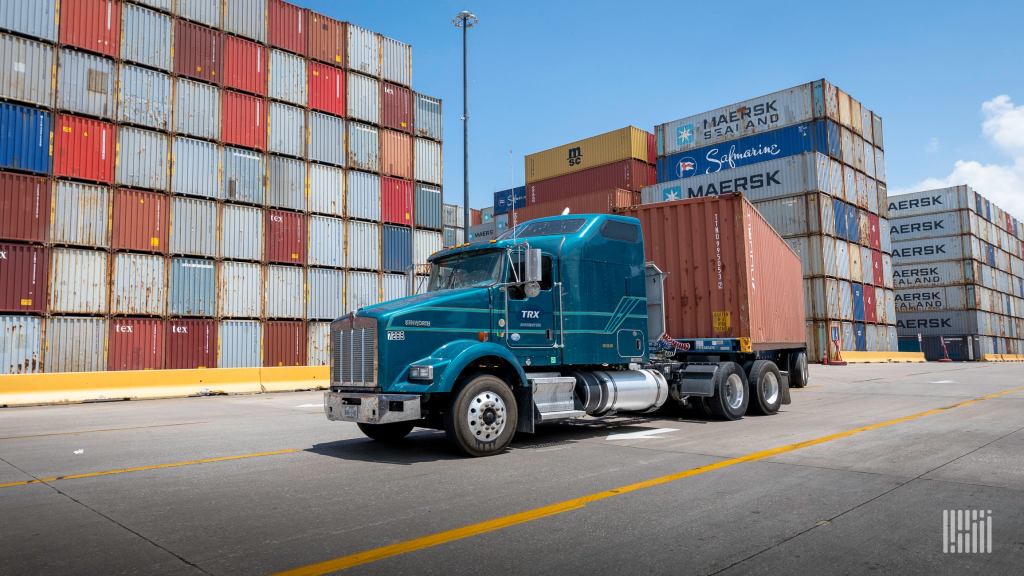
Truck hauling container from port

The Federal Maritime Commission has imposed new billing standards on ocean carriers and terminal operators in an effort to crack down on abusive container late fees.

The new requirements focus on demurrage fees charged by carriers and container terminals when full containers have not been picked up by customers within a certain number of days, and detention fees charged to customers if they are late returning the empty containers to the terminal.

Starting May 26, container ship carriers and marine terminal operators will be required to issue detention and demurrage invoices within 30 calendar days from when charges were last incurred.

Shippers and other billed parties will have at least 30 calendar days to request that charges be refunded. Carriers and terminal operators must try to resolve the matter within 30 calendar days unless the parties agree to a longer time frame.

The new rules also stipulate minimum data requirements for demurrage and detention invoices:

  1. The invoice date
  2. The invoice due date
  3. The allowed free time in days
  4. The start date of free time
  5. The end date of free time
  6. For imports, the container availability date
  7. For exports, the earliest return date
  8. The specific date(s) for which demurrage and/or detention were charged

“Failing to include any of the required information in a detention or demurrage invoice eliminates any obligation of the billed party to pay the applicable charge,” the rule states.

Another provision of the rule states that demurrage or detention invoices can be issued to a consignee — that is, the ultimate recipient of the cargo — as an alternative to the shipper.

The new rule “will advance the Commission’s goal of promoting supply chain fluidity by ensuring a clear connection between the failure to pick up cargo or return equipment in a timely manner and the appropriate fee,” the FMC stated in announcing the changes.

“The rule ensures that billed parties understand the demurrage or detention invoices they receive by requiring certain identifiable information be included by the billing party on the invoice.”

The FMC’s demurrage and detention regulation was authorized by the Ocean Shipping Reform Act of 2022, which itself was prompted by what many, including President Joe Biden, saw as market power abuse by foreign-owned container carriers taking advantage of supply chain disruptions during the pandemic.

The FMC states in the preamble to the rule that between 2020 and 2022, nine of the largest carriers serving the U.S. container trades charged approximately $8.9 billion in demurrage and detention.

Praise from shippers, port truckers

The Agriculture Transportation Coalition (AgTC), which represents U.S. importers and exporters, said the FMC’s rule “marks a major step towards the long-sought objective of AgTC – reform of abusive detention and demurrage practices … despite vigorous (but ultimately unsuccessful) opposition by the ocean carrier and marine terminal organizations.”

Because the new regulation also clarifies that motor carriers — port drayage truckers in particular — that do not contract with ocean carriers will no longer receive demurrage and detention bills, the American Trucking Associations’ Intermodal Motor Carriers Conference (IMCC) also praised the changes.

“Motor carriers often face major detention and demurrage charges from ocean carriers when shipping containers are delayed either on the dock or after being taken off the port complex,” the IMCC stated in response to the rule.

“This is the case even though trucking firms are not party to the contracts between the ocean lines and their shippers. During the supply chain disruptions of the pandemic, these charges resulted in major increases in costs for shippers that ultimately were passed onto American consumers.”

Warning from carriers

The FMC estimated the costs for carriers and terminal operators to comply with the updated invoicing requirements at between $6.3 million and $12.7 million.

John Butler, president of the World Shipping Council (WSC), whose members will be responsible for implementing invoice changes, told FreightWaves that he is “digesting the final rule and will discuss with our members, so we do not have any public statement now.”

In comments filed with the FMC when the rule was proposed in 2022, WSC warned that if adopted, the stricter requirements “will disincentivize many parties in the supply chain from timely collecting goods from marine terminals and returning empty equipment for use by other customers. That in turn will only increase congestion in our nation’s ports — threatening to worsen the very problem that properly applied detention and demurrage charges are designed to minimize.”

Click for more FreightWaves articles by John Gallagher.

If truckers haul bread and cakes, is their business baking or trucking?

The never-ending question of defining the employment status of a truck driver, key to battles over California’s AB5 and the U.S. Department of Labor’s recent independent contractor status regulation, was on display this week at the U.S Supreme Court.

The issue at hand wasn’t specifically whether a driver should be considered an employee or an independent contractor, but the question of the reach of the Federal Arbitration Act and its treatment of transportation workers came very close to that contentious subject.

The court on Tuesday heard arguments in the case of Bissonnette et al. vs. LePage Bakeries et al. The “et al” with Neal Bissonnette is Tyler Wojnarowski. Both were truck drivers who had purchased distribution rights for Flowers Foods.

The three defendants are Flowers Foods (NYSE: FLO), its subsidiary LePage Bakeries and CK Sales, a subsidiary of LePage. 

Bissonnette and Wojnarowski distributed products made by Flowers, such as Wonder Bread. Court documents describe the men as “franchisees that each entered into a ‘Distribution Agreement’ with CK Sales, through which they acquired certain distribution rights in exchange for monetary consideration.”

The initial lawsuit filed by Bissonnette and Wojnarowski, according to a document in the appeal of the lower court ruling, was over a claim against Flowers of “unpaid or withheld wages, unpaid overtime wages and unjust enrichment pursuant to the Fair Labor Standards Act and Connecticut wage laws.”

A key issue: Arbitration agreements were signed

There is no dispute over one fact in the case: Bissonnette and Wojnarowski did sign arbitration agreements with Flowers. But the argument of the two men is that the agreements are unenforceable under a loophole in the Federal Arbitration Act, which was adopted in 1925. Flowers argued at the lower court level that arbitration should be pursued given the agreements signed by the two drivers.

The loophole is a provision in the act given to “seamen, railroad employees or any other class of workers engaged in foreign or interstate commerce.” That definition over the years has come to be defined as including other transportation workers.

Those workers could take their disputes to court because of the loophole, whereas other workers who had signed arbitration agreements would need to settle disputes through that process.

In the request for Supreme Court review, attorneys for Bissonnette and Wojnarowski summed up the initial dispute, which touches on the question of defining an independent contractor.

“Having characterized its truck drivers as independent contractors, Flowers decided it could withdraw its own operating expenses from its drivers’ paychecks, charge them for the privilege of working for the company, and decline to pay them overtime — none of which, the plaintiffs allege, is legal,” the request states.

The plaintiffs’ arguments also were that the interstate commerce workers’ inclusion in the language meant that they should be able to take advantage of the loophole given that at the very least some of the products they were delivering originated outside Connecticut, hence they were interstate workers.

In May 2020, the U.S. District Court for the District of Connecticut came down on the side of Flowers and its subsidiaries.

In a decision that turned partly on the definition of worker status, the court concluded that Bissonnette and Wojnarowski were not employees. The two men had “a much broader scope of responsibility that belies the claim that they are only or even principally truck drivers,” Judge Kari Dooley wrote. “Rather, because the Plaintiffs purchase and own the territories comprising their routes, their distribution efforts are the means by which they realize and increase sales and profits for their franchise businesses.”

Since they were not transportation workers — and in fact not “workers” at all but owners of a business — “they accordingly must be compelled to arbitrate their claims pursuant to the Arbitration Agreement incorporated in their Distributor Agreements,” Dooley wrote.

Bakery workers, not truck drivers

In an appeal to the U.S. 2nd Circuit Court of Appeals, Flowers and the subsidiaries won again.  But the basis for the decision handed down in May 2022 was different from that of the lower court: The workers were bakery workers, not transportation workers, so they could not invoke the loophole in the Federal Arbitration Act, which applies only to transportation workers.

The Supreme Court accepts less than 2% of all requests for review. It often looks not just for key issues but areas where circuit court cases are in conflict with each other. (But that doesn’t always matter either). 

Circuit cases still in disagreement

In the request for review from Bissonnette and Wojnarowski, several cases are cited as being in conflict with the 2nd Circuit’s decision in the Flowers case. Even in that decision, the circuit was split; Judge Rosemary Pooler, who died in August, said the “movement of goods through interstate commerce is a central part of the plaintiffs’ occupation as truckers,” and that she would have held that they were engaged in interstate commerce and could use the loophole.

The 2nd Circuit rejected a request for a full en banc hearing. But there were dissents on that decision, too, and the judges favoring a full hearing said they “expressly reject the notion … that the industry in which an employer operates, rather than the work that the employee does, determines whether the employee belongs to a ‘class of workers engaged in foreign or interstate commerce.’” In the case of Bissonnette, the question is whether the two plaintiffs were in the transportation business, and could avoid arbitration, or whether they were in the bakery business.

Among the complicating factors is a case known as Southwest Airlines vs. Saxon. In June 2022, after the 2nd Circuit decision, the Supreme Court ruled in favor of a ramp worker at the airline, holding that she was a transportation worker and could invoke the Arbitration Act. That’s what Bissonnette and Wojnarowski want decided in their case.

In an email sent out after the arguments at the high court, Scopelitis attorneys Braden Core and Prasad Shama noted one aspect of the arguments that is particularly important to the trucking industry.

“The Court’s ruling could have an impact on private motor carriers whose principal business is something other than transportation (i.e., retailers),” they wrote.

They noted another aspect to the case as well, though it isn’t being heard at the Supreme Court: Do final-mile deliveries constitute interstate commerce that would trigger the Arbitration Act exemption?

If the case goes back to the lower courts, counsel for the drivers made it clear that “while that would be an issue in the case on remand, determining what it means to be engaged in interstate commerce is not presently before the Court,” the Scopelitis attorneys wrote.

A Reuters report from the Supreme Court said statements made by the justices suggested sympathy with the plaintiffs’ arguments.

The Reuters report said Justice Samuel Alito indicated that “focusing on what an employer does, rather than a worker’s job duties, would create confusion.”

“It really imposes a difficult burden and it would seem to me … you’d have a conflict among the lower courts in considering how this applies,” Alito said, according to the Reuters report. He raised the issue of Amazon, saying it would be difficult to determine if a dispute in its transportation operations would define those activities as being involved in transportation — where the Arbitration Act loophole could come into play — or retailing.

More articles  by John Kingston

California’s AB5 argument: Trucking in state hasn’t become chaotic

NLRB decision in opera case favors defining workers as employees, not ICs

Live on stage: The complex relationship between a trucking job and life

Running on Ice: Oakland has more than one set of A’s

Blue Truck on a sheet of ice over a blue background and Running on Ice Logo

Hello, and welcome to the coolest community in freight! We know each other by now. What better way to celebrate the past year of bringing you cold chain news than to bring you a COOL discount on Future of Supply Chain tickets. June 4-5 in Atlanta, come hang out with the coolest community in freight. If you use RunningOnIceFSC24 at checkout, you can get a cool discount. 

All thawed out 

(Photo: Jim Allen/FreightWaves)

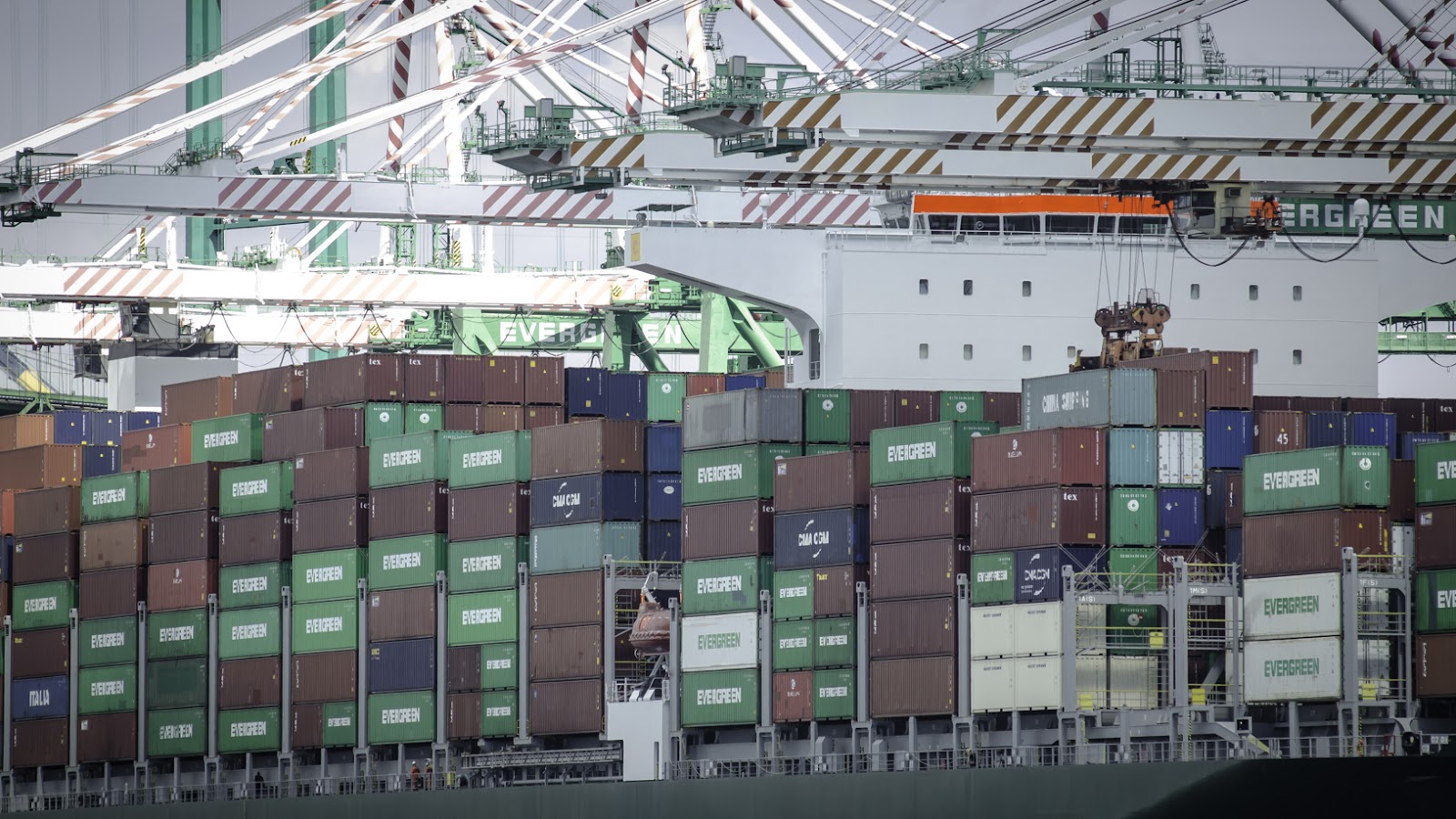
Just about every port in the U.S. can handle refrigerated cargo to some extent. There are some better at it than others. However, one holds the title as the preferred gateway for refrigerated export cargo. That would be the Port of Oakland, California. The Port of Oakland has taken the title as the one everyone wants to work with.

Cementing its cargo powerhouse title, the port is No. 1 by twenty-foot equivalent unit volume in refrigerated export trade among U.S. ports. It has held the top spot for seven consecutive years. That volume hit a value of a casual $7.1 billion in 2023.

The port is often the last U.S. port of call for container ships before they set sail for Asia. Therefore, refrigerated cargo can arrive fresher to overseas markets by leaving from Oakland. 

Temperature checks

(Photo: Jim Allen/FreightWaves)

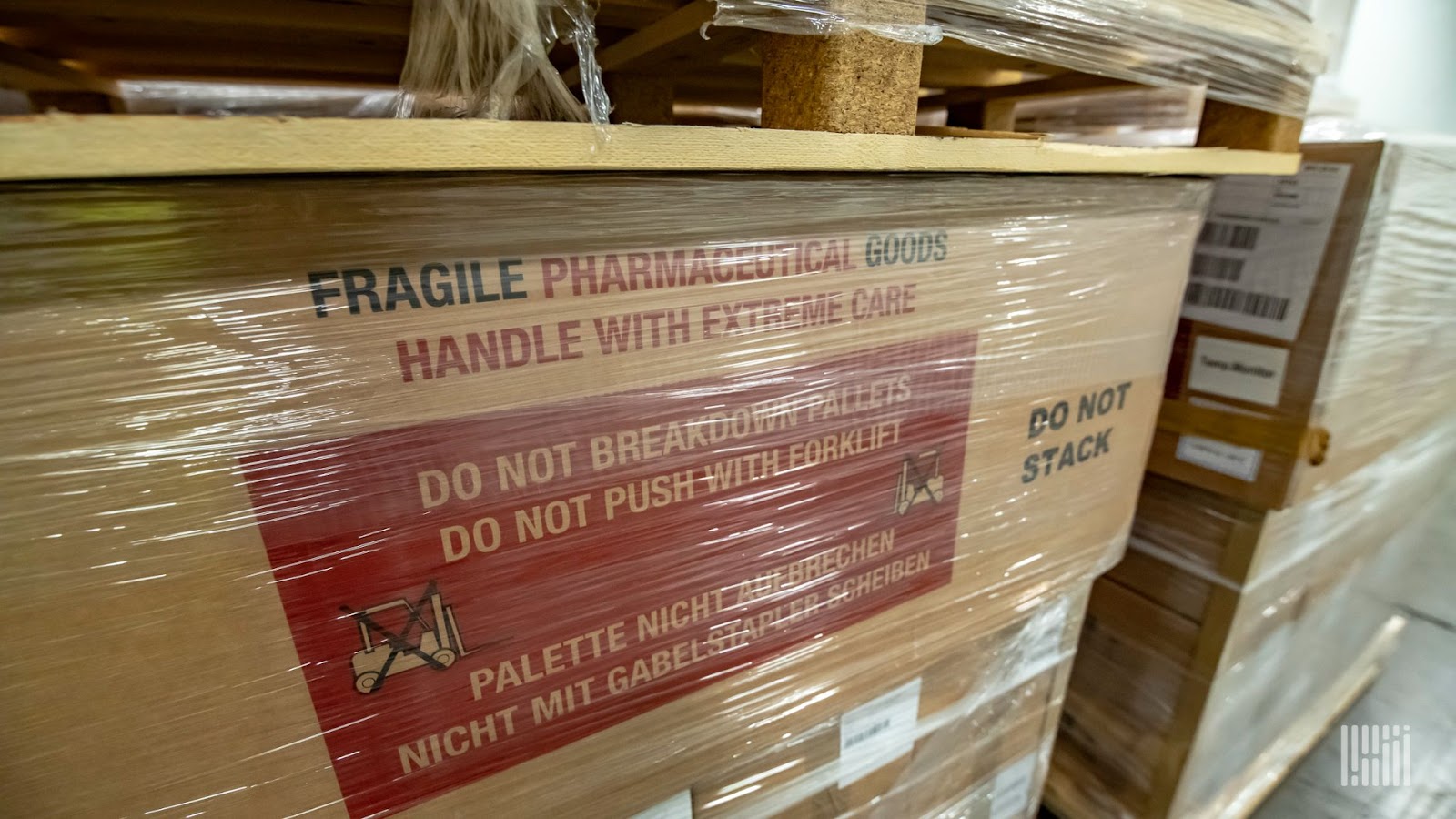
In the cold chain world, the shipments with the least margin for error hail from the biopharmaceutical space. It’s currently estimated that $35 billion a year is lost in the biopharmaceutical industry due to improper temperature storage or shipment delays. It’s not just the financial loss that’s a problem. It’s the people loss as a portion of the pharmaceuticals shipped are literally lifesaving medications.

This brings up the packaging side of things. Packaging in pharmaceutical products protects the delicate goods from external factors such as temperature variation and outside contaminants. At the root of any new drug, therapy or vaccine, there is always the conversation of how to get it to those who need it most. This conversation combined with companies’ interest in reducing carbon footprints and wasted packaging, has brought about some multiuse packaging materials. 

A Pharma News Intelligence article says: “The pharmaceutical industry is estimated to produce more than 300 million tons of plastic waste annually, half of which is single-use. Considering that 85% of the waste generated by healthcare-related entities — including packaging for pharmaceuticals and medical equipment — is non-hazardous, there is potential to replace it with more environmentally friendly or reusable alternatives.”

We love to see a packaging revolution.

Food and drugs

(Photo: Jim Allen/FreightWaves)

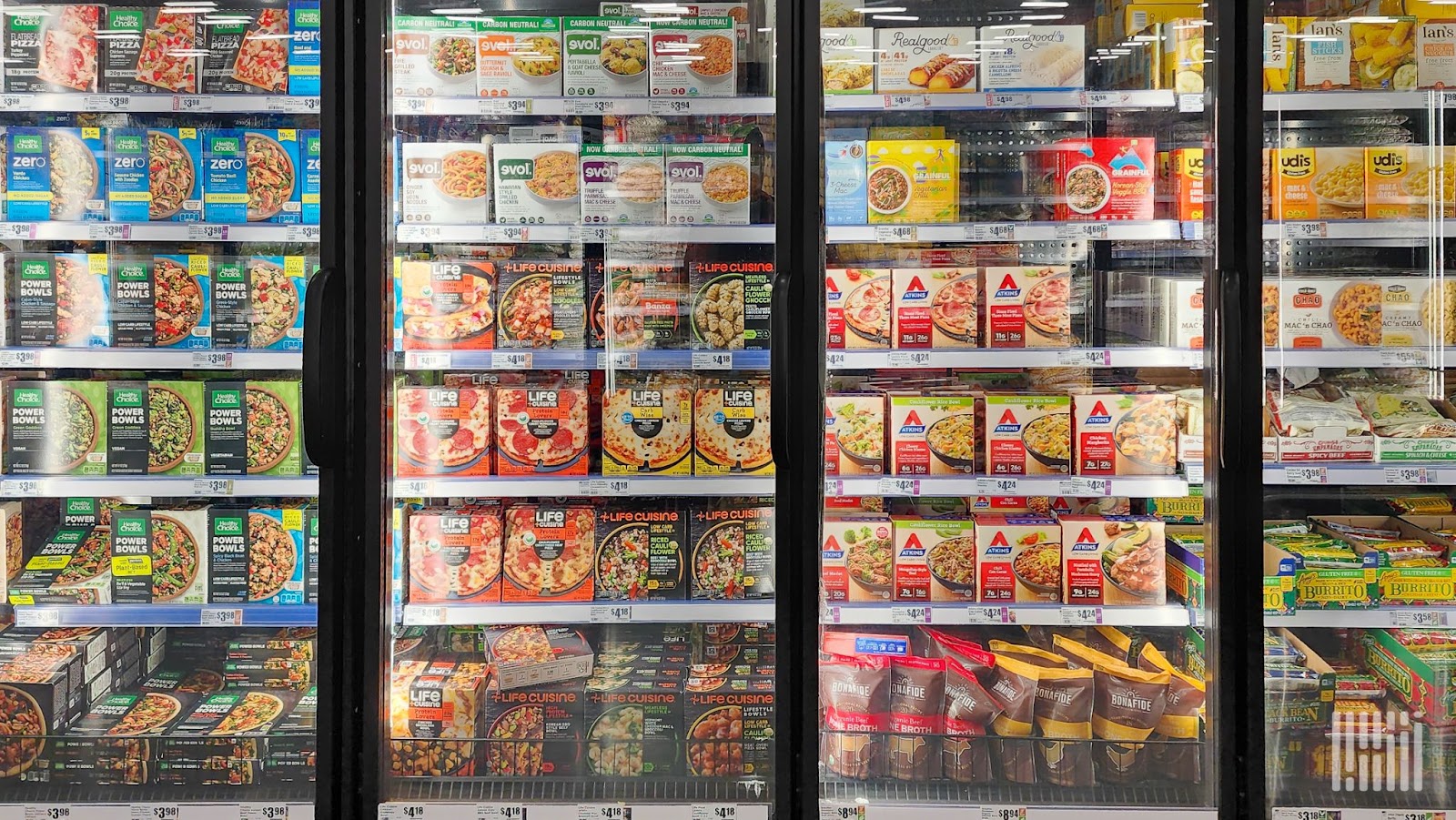
The world of frozen food is a harsh one. New products are coming out almost weekly, meaning some of the classics are getting overlooked. Gone are the days when Stouffer’s, Lean Cuisine and Michelina’s were the undisputed champions of the frozen aisle. It would appear that consumers are going elsewhere as Nestle, the parent company of the aforementioned frozen food staples, reported sales growth slightly below expectations, rounding out 2023 on a less-than-stellar note.

The lacking performance is being blamed on a few things – mostly the sharp price increases. The rising pricing across grocery stores, but specifically in the prepared frozen food section, has really taken a toll. Many are split as to whether consumers have been pushed too far in regard to price hikes, and if they would be willing to come back to the brands if prices were lowered. 

A Reuters article says: “Worries that companies are pushing price rises too far, especially as the cost of living crisis helps retailers’ private label brands grab market share, have led some investors and analysts to urge a focus on marketing and innovation. With many consumers swapping costly branded goods for cheaper alternatives, Unilever CEO Hein Schumacher said earlier this month that his company’s “competitiveness remains disappointing.”

Cold chain lanes

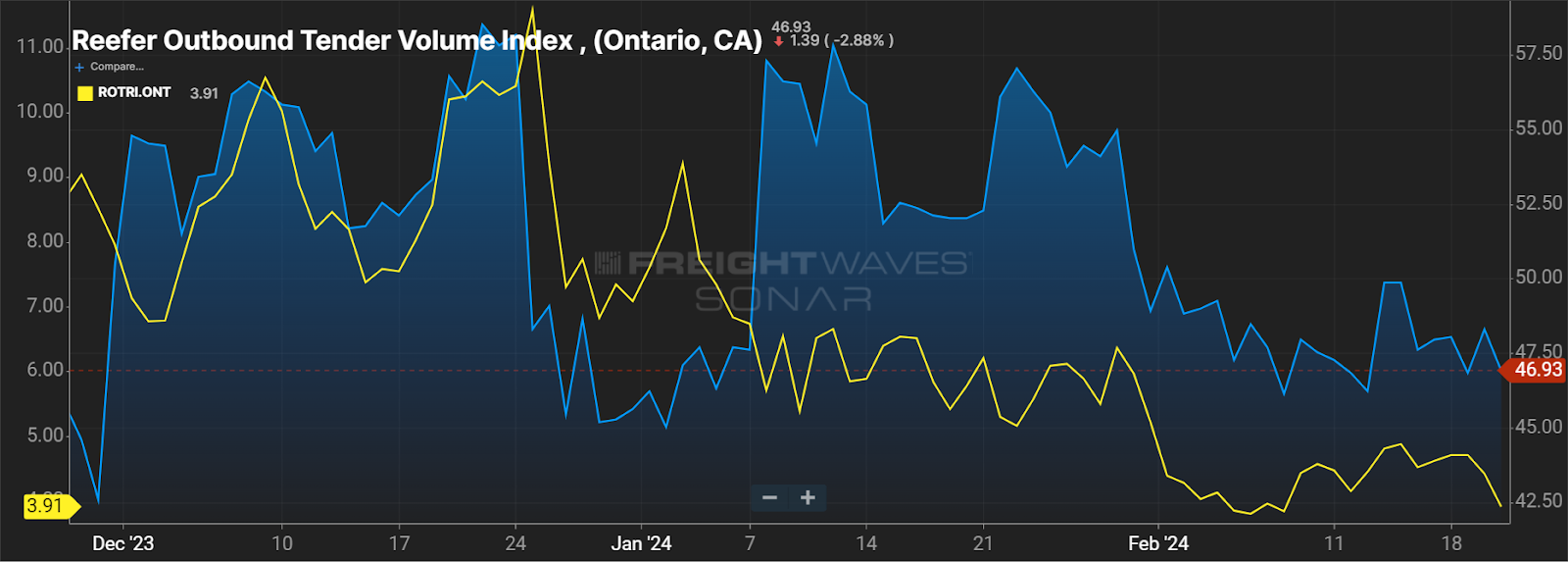
SONAR Tickers: ROTVI.ONT, ROTRI.ONT

This week’s SONAR market is heading to Southern California – Ontario, California, to be more specific. Ontario is close to the ports of Los Angeles and Long Beach, pretty well-known import and export centers. Reefer outbound tender rejections are certainly on the decline and don’t seem to be coming up for air anytime soon. Rejection rates have dropped 90 basis points week over week to 3.91%. Reefer outbound tender volumes on the other hand have held on stronger than rejections but are also on the decline with a 5.91% drop w/w.

Capacity is loose and readily available in Southern California. Expect rates to be driven down on all fronts.

Is SONAR for you? Check it out with a demo!

Shelf life

BGL announces the sale of arctic industries and Store It Cold to Kinzie Capital

Africa Centre of Excellence for sustainable cooling and cold-chains (ACES) 

Kuehne+Nagel Air Logistics expands services at JFK

Cold storage facility has huge $75m price expectation

Cold Chain Federation launches manifesto to unlock industry’s potential

Wanna chat in the cooler? Shoot me an email with comments, questions or story ideas at moconnell@www.freightwaves.com.

See you on the internet.

Mary

If this newsletter was forwarded to you, you must be pretty chill. Join the coolest community in freight and subscribe for more at www.freightwaves.com/subscribe.

2024 presidential election may have big impact on supply chains

By Bart De Muynck

The views expressed here are solely those of the author and do not necessarily represent the views of FreightWaves or its affiliates.

The first two months of 2024 have already put stresses on U.S. supply chains due to many global disruptions. We find ourselves in the midst of a presidential election year, leaving many people wondering how this will further impact the U.S. economy. This year marks the 60th quadrennial presidential election, scheduled for Tuesday, Nov. 5.

Predicting the specific impacts of a presidential election on supply chains and logistics is challenging due to the inherent uncertainty of future events and the complex interplay of various factors. One thing that is sure is that presidential elections do create additional risk and disruptions to supply chains. The actual effect of the 2024 election on supply chains will depend on several key factors, such as the specific platforms and policies of the candidates, the overall economic climate, and the level of political polarization and gridlock.

We can analyze historical data and identify potential trends from previous election years and provide a general understanding of how election years might impact supply chains. The COVID-19 pandemic overshadowed any potential election-related effects on supply chains in 2020. However, some analysts suggest the trade war between the U.S. and China, initiated during the Trump administration, contributed to preexisting disruptions. The election of Donald Trump in 2016 led to increased uncertainty in trade policies, causing some businesses to delay investments and stock up on inventory, temporarily impacting supply chains. There were no significant disruptions in 2012 that were directly attributed to the election, but existing economic factors like the eurozone crisis continued to impact supply chains. The financial crisis in 2008 significantly impacted global supply chains, making it difficult to isolate any specific election-related effects.

While past elections offer limited concrete examples, there are several areas where the 2024 election might influence supply chains and logistics. First comes trade policy, where Democratic and Republican candidates typically have distinct stances on trade agreements, tariffs and foreign relations. These policies can significantly impact the cost and flow of goods imported and exported from the U.S. Both parties generally agree on the need for infrastructure improvements but differ in funding priorities and specific projects. Infrastructure upgrades can directly affect transportation efficiency and logistics costs, which have been pivotal in the past few years. Changes in regulations and labor laws can impact production costs, worker availability and overall supply chain efficiency. This can vary significantly depending on the specific policies enacted. We know that talent is a challenge that will not be solved anytime soon, and immigration policies might cause further impacts on already existing labor shortages, for example in warehouses. Election outcomes and resulting economic policies can further influence consumer confidence and spending patterns, affecting the demand for goods and potentially causing temporary disruptions in specific sectors.

While the 2024 presidential election might have an impact on supply chains and logistics, it’s difficult to predict the exact nature and extent of these effects. The specific policies implemented, the overall economic climate and the level of political cooperation will all play crucial roles in determining the outcome. Nevertheless, the election will disrupt supply chains combined with existing disruptions. Hence businesses should stay informed about the candidates’ platforms and potential policy changes but also consider other factors influencing the supply chain landscape in order to make informed decisions and mitigate potential risks. Risk management solutions, digital twins and simulation tools can all help supply chains build different scenarios for potential outcomes and help better prepare for the outcome of the election.

Bart

Bart De Muynck is an industry thought leader with over 30 years of supply chain and logistics experience. He has worked for major international companies, including EY, GE Capital, Penske Logistics and PepsiCo, as well as several tech companies. He also spent eight years as a vice president of research at Gartner and, most recently, served as chief industry officer at project44. He is a member of the Forbes Technology Council and CSCMP’s Executive Inner Circle.

New report details challenges, opportunities in freight market

A new report from venture capital firm UP.Partners takes a look at the impact of the freight recession and new developments in the industry. 

The freight section of the recently released “Moving World Report 2024” from UP.Partners reviews the current depressed state of the freight market but first drives home the point that the cost trend has been in a downward direction for a long time.

In one of the first slides of the 143-page report, UP looks at the cost of moving freight via various modes going all the way back to 1830. That means, of course, that the 1830 comparison works only for moving freight by sea since other technologies weren’t around then.

But what it shows is that the compound annual growth rate, or in this case, decline rate for every type of freight movement has been on a downward trajectory since they first came on the market.

For example, since 1830, sea freight has declined on average by 3.56% annually. For rail freight, it’s minus 3.92%; for air freight, minus 6.17%; and for space freight, minus 8.16%.

“Technology has given us mobility solutions that our ancestors only dreamed of,” the UP report says.

When the report shifts to current conditions, it opens with a quote from FreightWaves founder and CEO Craig Fuller. “This freight recession is unlike any other in history.”

The report illustrates that the depths of the freight recession trod on some familiar ground, ranging from the Federal Motor Carrier Safety Administration on the number of drivers and companies, to ACT Research data on the price of used trucks, as shown in FreightWaves SONAR.

But as an investor in new mobility technologies, UP also highlights specific developments that it sees as significant. The two that are featured are the Gatik robot truck for middle-mile freight transportation and the Range Energy electrified trailer.

Among some of the highlights of the review of the freight market:

  • “Sea freight is faring no better and may have some other issues to contend with.” The report highlights the recent 10,000-person job cut at Maersk.
  • Drought-related cutbacks at the Panama Canal and the war-related reductions through the Suez Canal are having a serious impact. As the report notes, the former carries 40% of U.S. container traffic and the latter carries 30% of global container traffic. A map spells out the impact of lower traffic through those passages. Avoidance of the Panama Canal and the Suez Canal for shipments from the U.S. Gulf Coast to Asia turns a 20-day shipment into 32 days.
  • China’s shipbuilding capacity is 232 times that of the U.S., “and that’s not a typo,” the report advises readers.

As the report shifts to energy, it notes the paradox that reduced sulfur emissions coming from ocean shipping as a result of the IMO 2020 rule may be contributing to rising global temperatures. Lower ship emissions means less smokestack emissions, and that means there are fewer ship contrails to block sunlight.

“It’s as if the world suddenly lost the cooling effect from a fairly large volcanic eruption each year,” Michael Diamond, an atmospheric scientist from Florida State University, said in the report.

To read about the aviation coverage of the report click here.

CEO spends week in semi to solve parking problem; Will’s Journey; Convoy returns – WTT

On episode 685 of WHAT THE TRUCK?!? Dooner is joined by Truck Parking Club’s Evan Shelley and Autumn Transport owner-operator Chris Thomas. Shelley just spent over a week riding along with Thomas so he can better understand the truck parking problem and issues driver face. We’ll find out what the two learned from each other and about solving these issues.

Will Jenkins is back with his latest venture Journey. After successfully building MoLo and selling it to ArcBest for $235 million, Jenkins is back to building. Now his new company Journey aspires to be the transportation recruiting resource and the premier community-based sales academy for the industry.

Plus, AT&T outage fallout; Convoy returns; MATS 2024; stolen semi bursts into flames and more.

Watch on YouTube

Visit our sponsor

Subscribe to the WTT newsletter

Apple Podcasts

Spotify

More FreightWaves Podcasts

Bills in Wisconsin, Indiana could reduce nuclear verdicts against carriers

A newly passed bill in Wisconsin would limit non-economic damage awards in lawsuits involving commercial vehicle accidents, and Indiana lawmakers have passed a bill that would allow a plaintiff’s seat belt use to be entered as evidence in accident lawsuits.

Both bills, which have implications for multimillion-dollar nuclear verdicts against trucking companies, now go to the states’ governors for their signatures.

The Wisconsin bill would cap nonmonetary damages — such as pain and suffering — at $1 million. Republicans passed the measure on a mostly party-line vote in the State Senate. The State Assembly approved the bill on a voice vote, the American Trucking Associations, which backs the measure, stated in a news release.

In testimony in January backing the bill, Republican state Rep. Rick Gundrum cited an American Transportation Research Institute study finding that verdicts of greater than $1 million in truck crash lawsuits had risen on average from $2.3 million to $22.3 million from 2010 to 2018.

ATA urged Democratic Gov. Tony Evers to sign the bill, saying huge verdicts promote “frivolous lawsuits that have perverted the system into a profit center for the plaintiffs’ bar.” Neal Kedzie, president of the Wisconsin Motor Carriers Association, said in the ATA release, “Wisconsin’s trucking industry is essential to everyone in our state, and rampant lawsuit abuse is impeding our ability to do our job safely and efficiently.”

But the Wisconsin Association for Justice, an attorney organization, has labeled the bill “an attack on Wisconsin citizens’ ability to obtain justice after experiencing catastrophic injuries and death on Wisconsin roadways.”

Evers’ office did not immediately return a phone message seeking comment. The Wisconsin Civil Justice Council, which represents various industries in the state and supports the bill, stated on its website that Evers would likely veto it.

Indiana targets ‘seat belt gag rule’

Meanwhile, Republican Indiana Gov. Eric Holcomb will decide whether to sign into law the bill that permits a plaintiff’s seat belt use to be admitted as evidence in vehicle accident lawsuits. Juries could reduce damage awards based on that information, the Indiana Capital Chronicle reported.

Holcomb’s press secretary, Erin Murphy, said a decision by the governor on whether to sign the bill should come within days.

ATA President and CEO Chris Spear praised the Indiana legislation, saying in a release that it would remove the “seat belt gag rule” and provide jurors “complete information when rendering a fair and just verdict.”

Critics say the bill puts the focus on issues other than who actually caused an accident, according to the Capital Chronicle.

Feds charge Illinois trucking company owner in alleged CDL fraud

Federal prosecutors have charged the owner of an Illinois trucking company in an elaborate scheme to help applicants cheat on CDL exams by using hidden microphones and earpieces.

Mykola Datkun, 33, of Port Barrington, Illinois, is accused of directing CDL applicants attempting to cheat on their CDL examinations to his Island Lake, Illinois, testing facility.

Prosecutors claim that he and unnamed co-conspirators provided test-takers with an earpiece, which was synched to the individuals’ phones, and a microphone receiver, also connected to the phones, that was placed near test-takers’ shirt collars.

Datkun was charged on Feb. 14 with one count of conspiracy to produce fraudulent documents.

As of publication, Datkun’s attorney Steven R. Shanin had not responded to FreightWaves’ request seeking comment.

According to court documents, federal prosecutors allege that from 2019 until December 2022, Datkun, owner of Maximum Services of Island Lake, Illinois, helped individuals “cheat on the written Illinois CDL examination.”

The documents allege that Datkun and unnamed co-conspirators listened to the questions from the CDL exams and “agreed to and did relay via the earpiece the answers to the questions in real time to the individuals taking the examination.”

Prosecutors say Datkun and co-conspirators received at least $500 from individuals they allegedly helped cheat on the exams.

Do you have a news tip to share? Send me an email or message me @cage_writer on X, formerly known as Twitter. Your name will not be used without your permission.

Feds charge Massachusetts state troopers in alleged CDL bribery scheme
Ex-Slync CEO Chris Kirchner guilty of wire fraud, money laundering

Tech battle: Samsara sues Motive Technologies for patent infringement, false advertising