Taiwanese startup Starlux Airlines orders 5 A350 freighters from Airbus

A Starlux Airlines jet approaches an airport, viewed from below.

Taiwan-based Starlux Airlines, which has only existed for four years and operates 21 passenger jets, on Tuesday inked a deal to buy five next-generation A350 cargo jets from Airbus.

The announcement, which was made by the companies during the Singapore Airshow, is noteworthy because Starlux is so new and currently doesn’t operate cargo jets, and because Airbus is on a winning streak against rival Boeing’s future freighter, the 777-8.

Starlux Airlines will become the first Taiwanese airline to operate Airbus’ newly designed freighter later this decade. It said the aircraft will be deployed on major intercontinental trade routes. Starlux diversified into cargo to take advantage of expected demand for electronic components and semiconductors, for which Taiwan is a major source, according to aviation news site The Air Current.

Starlux also received an option for five additional freighters, Reuters reported. It’s main competitors in Taiwan are China Airlines and Eva Airways.

Airbus didn’t provide a delivery timeline but has previously said the first unit will be ready in 2026. With several other airlines already in line, it could be 2028 before Starlux sees its first freighter.

The A350s will offer the benefit of familiarity and fuel economy for Starlux. The airline has an all-Airbus fleet of varying sizes, including four Airbus A350-900 passenger jets. 

Starlux also placed an order for three additional A330neo widebody passenger aircraft.

Currently under development, the A350F will be able to carry a payload of up to 122 tons and fly up to 4,700 nautical miles, according to Airbus. 

The A350F will feature the industry’s largest main deck cargo door. More than 70% of the airframe is made of advanced materials. Airbus claims the lighter airframe and efficient Rolls Royce engines produce a 20% advantage in fuel burn and CO2 emissions over the legacy Boeing 777 currently in production, as well as the older Boeing 747-400. 

How the A350 and Boeing 777-8 measure up

The Starlux contract puts Airbus at 55 orders for the A350 freighter from nine airlines and leasing companies. In December, Turkish Airlines committed to five of the widebody freighters and Hong Kong-based Cathay Pacific said it would buy six of them. Air France-KLM in early 2023 ordered an additional four A350Fs for a total of eight aircraft. 

Boeing also has 55 orders for the 777-8, although the largest number was placed in January 2023 by launch customer Qatar Airways and there were none in 2023. 

Cargo airlines have been cautious since mid-2022 about investing in new aircraft because of the severe downturn that gripped the air cargo industry and only began to ease in the final months of last year.

Although Boeing has been shut out since late 2022 in the battle for the next evolution in freighters, it’s too early to say whether the market is beginning to favor the Airbus product. Many airlines are heavily influenced by whether they already have Boeing or Airbus fleets because pilot training, maintenance, spare part logistics and operations are easier, and less expensive, with a common platform. 

The 777-8 has a slight payload advantage and one extra pallet on both the main and lower decks than the A350. 

Aerospace expert Mike Stengel, a principal at Aerodynamic Advisory, added that Boeing’s future freighter has a single supplier for the cargo loading system that maneuvers containers into place on each flight deck, whereas Airbus is using different vendors. “Some operators might find this to be a pain for maintenance and overseeing an additional supplier for one of the more expensive systems on the aircraft,” he said.

In addition to a wider cargo door, the A350 beats the 777-8 on range by 600 nautical miles. The Rolls-Royce Trent XWB97 engines on the A350 also have proven quite durable over the past decade, which Stengel noted could be a big selling point considering how many airlines have been burned in the past year by quality issues related to GE, CFM and Pratt & Whitney engines. 

Click here for more FreightWaves/American Shipper stories by Eric Kulisch.

Sign up for the weekly American Shipper Air newsletter here.

Turkish Airlines picks Airbus over Boeing for widebody freighter order

How to use transportation business intelligence to drive profitability

Data has been a hot topic across the logistics industry for the past several years. Historically,  the majority of conversations have revolved around capturing data. In today’s world, however, companies need to move beyond simply collecting information and begin leveraging it to make better business decisions. 

Leveraging data hinges on understanding data. That is where third-party partners like Körber Supply Chain can make all the difference. 

“When a company receives  data from multiple carriers in different ways, getting it all aggregated into one spot is the starting point,” Brett Hamrick, director of Business Intelligence and Analytics at Körber Supply Chain, said. “From there, that data needs to be normalized and turned into a language that makes sense to the organization. The final hurdle is democratizing the data for the end user.”

Until data is democratized, it is unusable for the vast majority of individuals – including decision-makers – at any given organization. Hamrick compared having unusable data to having a Lamborghini sitting in a garage, with no key to turn it on. 

At Körber, the company’s goal is to ensure that each customer’s data is presented to their users in such a way that it is both easy to understand and adaptable to their organization’s needs. 

When data becomes actionable in this way, it can be used to drive business intelligence initiatives across an organization. 

“Building business intelligence starts by understanding your data and turning it into actionable insights,” according to a recent Körber white paper. “By taking a proactive approach and setting clear goals you can drive down transportation costs and improve operational efficiencies.”

Körber’s white paper highlighted a handful of areas where transportation data and business intelligence can come together to create efficiencies. 

• Carrier performance tracking

• Accounting and financial reporting

• Accrual reporting

• Open/unpaid invoice reporting

• Payment cycle time reporting

• Track audit provider performance

• Carbon emissions and sustainability reporting

When companies capture these kinds of efficiencies, they can skyrocket their profitability and customer service acumen. Körber sets itself apart from the crowd by making this level of data-informed decision making accessible to business leaders with no formal data analytics training. 

“The unique element of Körber is our democratized approach to data. We do not offer a platform that requires keyholders to understand data on a highly technical level,” Hamrick said. “By making actionable data, like KPIs, as easily accessible as possible, we offer complete flexibility while eliminating intimidation”

Korber continues the conversation on February 27th as it hosts Optimize freight spend with advanced analytics from a transportation business intelligence (BI) tool webinar with FreightWaves. Click below to register.

Ryder opens new logistics center in Texas amid US-Mexico trade boom

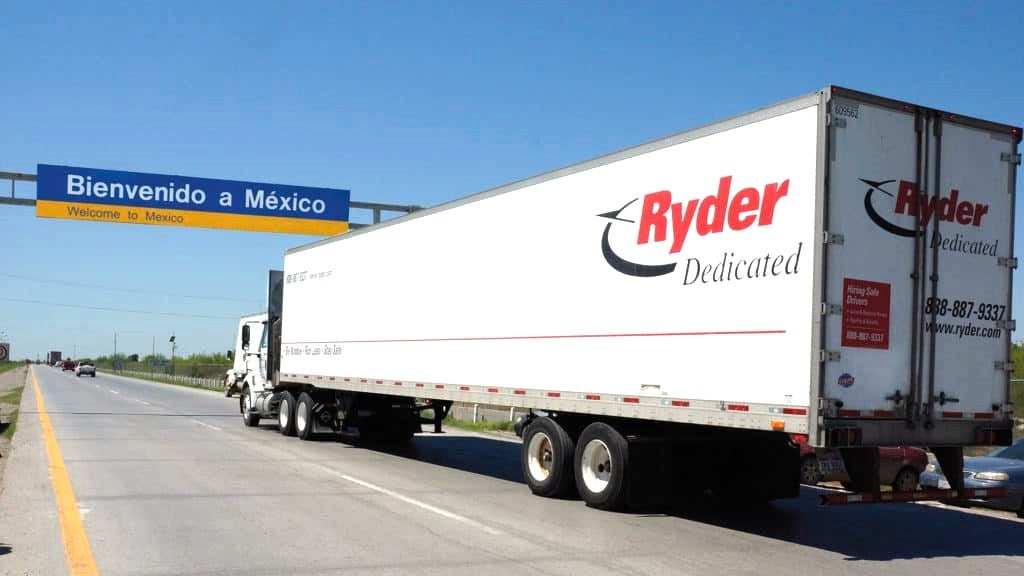
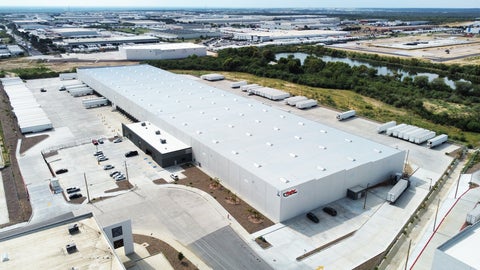
As U.S.-Mexico trade continues to expand, Ryder System has opened a 228,000-square-foot logistics warehouse and cross-dock facility in Laredo, Texas.

The warehouse is about 3 miles from the World Trade Bridge and includes 102 truck dock doors and parking spaces for 143 trailers.

Just across the border in Nuevo Laredo, Mexico, Ryder is expanding a drayage yard in its logistics operation. This will improve facilitation of the transfer of freight across the World Trade Bridge to U.S. drivers, officials said.

Ryder (NYSE: R) is a Miami-based leasing, fleet management, transportation and supply chain solutions provider.

“Truck border crossing activity between the U.S. and Mexico is up more than 20% annually since the pandemic, as more businesses look to nearshoring to diversify their supply chains and shorten lead times,” Ricardo Alvarez, vice president of supply chain operations for Ryder Mexico, said in a news release. “With Mexico, you put what you need on a truck and it can be in a final-mile distribution center within days, not months.”

Ryder’s logistics warehouse is about 3 miles from the World Trade Bridge and includes 102 truck dock doors and parking spaces for 143 trailers. (Photo: Ryder)

In 2023, more than 7.35 million commercial trucks crossed the U.S.-Mexico border. Laredo ranked as the No. 1 border crossing in the U.S. for commercial trucks, processing 2.93 million vehicles last year.

Ryder Mexico manages more than 250,000 freight movements annually across the Mexican border, supporting customers in the automotive, industrial, technology and consumer packaged goods industries. The company also operates about 5 million square feet of multiclient and dedicated warehouse and yard space across Mexico.

Ryder officials said the new facility in Laredo is located within a 6-mile radius of Ryder’s existing operations in the city, which allows for overflow and pooling of labor and resources for added flexibility.

“As our customers’ needs evolve, we can seamlessly transition them into dedicated warehouses and offer a flexible mix of transportation solutions, including integrated dedicated fleets with professional drivers,” Frank Bateman, Ryder’s vice president of supply chain operations, said in a statement.

Ryder is the latest company to expand or open new facilities in Laredo. In September, 3PL giant C.H. Robinson opened one of the largest distribution facilities on the Mexico border in recent years in the city.

Truckload broker RXO opened a $30 million, 127,000-square-foot facility in Laredo in April. In May, Pennsylvania-based carrier PGT Trucking began construction of a 7.7-acre trucking terminal that is scheduled to open later this year.

More articles by Noi Mahoney

Trump-supporting truckers boycott loads to New York City

Border bridges blocked as former rail workers seek back pay

329 layoffs hit freight-related firms in Texas

Daily Infographic: January imports grew at fastest pace in 7 years


To view more FreightWaves infographics, click here

Analysis: Expeditors blames pandemic volatility for results but needs to tackle bloat

On Monday, Seattle-based freight forwarder Expeditors International (NYSE: EXPD) released another lackluster quarterly earnings report, this time for the fourth quarter of 2023. Compared to Q4 2022, top-line revenue was down 34%, to $2.3 billion, operating income was down 40%, to $199 million, and net earnings were slashed by 28% to $159 million.

Similar large drops in year-over-year revenues and profits have become a common sight in the transportation industry as providers and intermediaries in all modes have had to deal with the double whammy of receding volumes and excess capacity in the come-down from the pandemic highs of 2021 and 2022. Indeed, Expeditors President and CEO Jeffrey Musser was quick to blame COVID and more recent geopolitical uncertainty for his company’s performance.

“While ocean and air markets have been recovering from the massive disruptions brought on by the global Covid-19 pandemic, we continue to face further market uncertainty due to the current conflicts in the Middle East and on the Red Sea,” Musser said in the earnings release.

Unfavorable year-over-year numbers are forgivable in the context of the aftermath of a pandemic when goods spending and shipment volumes were inflated to historic levels, transportation capacity was strained, and rates soared to the moon. The problem is that blaming COVID doesn’t tell the whole story of what’s happening inside the Expeditors organization.

In fact, Expeditors is underperforming where the company was five years ago, in the fourth quarter of 2018, well before the pandemic began. Since then, the forwarder has barely grown top-line revenue, from $2.24 billion in Q4 2018 to $2.3 billion in Q4 2023. Through generally higher rates charged to customers and better buying power, Expeditors generated significantly more net revenue, which increased from $681 million in Q4 2018 to $764 million in Q4 2023.

That net revenue number is important because it indicates how Expeditors is performing in the freight market itself — it’s the top-line revenue of the freight services that Expeditors has sold to shippers minus the cost of purchased transportation, or what Expeditors has to pay steamship lines to actually move the freight. If “market volatility” or the “depressed rate environment” were causing poor results, it’d show up in net revenue, but net revenue has grown by $83 million over the past five years.

Expeditors is making more money by selling high and buying low in the freight market, but its bloated organization is consuming more and more of its margin. In the fourth quarter of 2018, $681 million of net revenue was good for $217 million in operating income and $179 million in net earnings. But in the fourth quarter of 2023, $764 million of net revenue yielded just $199 million in operating income and $159 million in net earnings. In other words, $83 million in additional margin resulted in profits that were lower by $20 million.

Musser addressed higher costs at Expeditors in the earnings release.

“As a company we have continued to remain focused on bringing expenses in line with revenue, as shown by headcount reductions,” he said. “Compensation remains our second largest expenditure behind freight costs and is the area where we know we can have the largest impact from the standpoint of controlling expenses. We also know that there is more work that we can and will do to control expenses moving forward.”

It’s worth looking at how Expeditors’ workforce has evolved over the past five years. Total head count has been almost flat, growing by just 2%, from 18,081 full-time employees at the end of 2018 to 18,452 full-time employees at the end of 2023. But there are proportionally larger technology and administrative — i.e., non revenue-generating — workforces: “Corporate” grew by 15.6%, from 352 employees in 2018 to 407 in 2023. Most strikingly, head count in “information systems,” which presumably represents highly compensated data scientists and software engineers, ballooned by 38%, from 912 employees in 2018 to 1,259 in 2023.

It appears that Expeditors’ rapidly growing technology organization is eating its margins. Yet this is one area where Expeditors is not right-sizing head count, but continuing to invest: At the end of 2022, there were 1,173 information systems employees. Current job postings at Expeditors support the notion that the firm is leaning into a tech-heavy workforce balance: There are 57 sales roles currently posted on the Expeditors website, some of which are more than six months old. But there are 32 openings in information systems currently posted on the website — many of them amorphous project management jobs requiring “Scrum Master” certifications — and 28 of those were posted in the past month. Expeditors leadership is hell-bent on filling its roster with more middle managers in its already-bloated tech organization, to the detriment of the shareholders’ earnings.

Expeditors is making less money than it did five years ago and should at some point consider that there are reasons for that other than the COVID-19 pandemic, which is receding in the rearview mirror. Other large third-party logistics providers have made bets on technology that yielded poor returns; a failed $1 billion initiative at C.H. Robinson ended up costing CEO Bob Biesterfeld his job at the beginning of 2023. A renewed focus on revenue generation and operational efficiency might have a bigger impact on earnings growth than another class of newly hired Scrum Masters.

CloudTrucks launches new offerings, acquires Shipwell’s brokerage

Trucking technology provider CloudTrucks recently acquired the brokerage arm of SaaS provider Shipwell to give its driver network more consistent loads and revenue streams.

“We have been obsessing over what truck drivers need in the market,” CloudTrucks CEO and co-founder Tobenna Arodiogbu told FreightWaves.

“As things started to turn in the market, I think there was more and more of a need for stability and consistency for our drivers. That is why we decided to acquire Shipwell’s brokerage arm as a way to provide more quality loads to drivers and provide more consistency working with the brokerage,” he explained.

A new solution

Using the acquired brokerage, CloudTrucks has created a new offering, CT Exchange, for its carrier users. 

The company currently offers three services to carriers: Virtual Carrier, its leasing service; Flex, its TMS; and CT Credit, its credit card solution.

Until recently, CT Credit also offered a factoring service, although CloudTrucks announced in December it would be handing that off to its factoring partner RTS Financial to focus on building new products and services like CT Exchange, Arodiogbu told FreightWaves.

“CT Exchange allows us to have a portion of our freight come directly from shippers, and we can offer those to our internal driver base. This gets them a lot closer to the direct shipper experience to ensure that those drivers have more consistency in the freight that they are booking,” he said.

This reliability not only entails a higher frequency of loads during slower market periods but also offers the opportunity to interact with familiar shippers, routes and individuals more frequently. This helps mitigate the daily challenges of trucking, such as detention, parking issues and empty miles.

CloudTrucks also released a new service in January called its Guaranteed Revenue Program to help with market lulls.

This program offers owner-operators an opportunity for more predictable earnings typically associated with company driving roles. Participants who meet their weekly mileage targets can earn competitive rates that exceed recent spot market averages.

According the CloudTrucks, the program provides mileage-based revenue guarantees, offering a weekly revenue guarantee of $4,500 for drivers averaging 2,000 loaded miles ($2.25 a mile) over two-week periods and $3,250 for those averaging 1,500 loaded miles ($2.16 a mile) each week.

“Something else we noticed as we reviewed internal data is how drivers maneuver through current market conditions. If they end up in a bad market, they just sit and wait for that perfect load. One or two days go by and before you know it, they’re behind. This starts to hurt their ability to keep up with their various expenses. So with the Guaranteed Revenue Program, we give them peace of mind to get back on the road and keep moving,” Arodiogbu said.

For its part, Shipwell plans to focus on its technology endeavors. According to the company, “this deliberate reallocation of focus and resources towards its SaaS capabilities enables Shipwell to pioneer innovations, forge groundbreaking partnerships, and introduce advanced integrations.”


OTR Solutions acquires back-office automation platform Epay Manager

Uber Freight begins piloting the Scheduling Standards Consortium’s protocols

GoodShip releases procurement scenario builder solution

After big gain last week, key diesel benchmark price holds steady

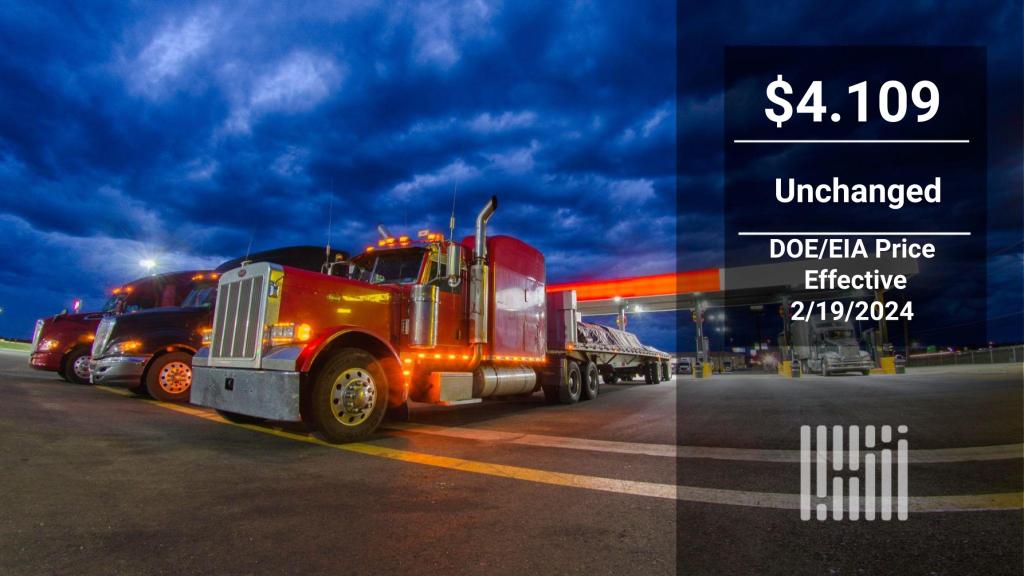
After two weeks of trading in the futures market during which the price of ultra low sulfur diesel shot higher before sliding back down, the benchmark retail diesel price did much the same, coming in unchanged this week.

The Department of Energy/Energy Information Administration average weekly retail diesel price effective Monday was $4.109 a gallon, the same price as last week. It’s the second time since July that the price has not moved.

The stability stands in sharp contrast to what happened last week, when the price at the pump, according to the DOE, was up 21 cents a gallon from the prior week, a large gain but only the sixth-biggest one-week jump since the Russian invasion of Ukraine two years ago.

The stability is ironic because underneath that lack of movement is a great deal of movement in the ultra low sulfur diesel price but in an up-and-down direction that has brought that benchmark price to a level it was at about two weeks ago.

On Feb. 5, ULSD on the CME commodity exchange settled at $2.7248 a gallon, marking a gain of 6.48 cents from the prior week’s close.

From there, it moved up to $2.9642 a gallon in just four days before beginning a move down, interspersed with some daily increases in the slide, that brought the settlement Tuesday to $2.7315 a gallon, a one-day drop of 7.51 cents.

News stories that appeared extremely bullish just 10 days ago seem to have faded from the market’s memory. The diversion of crude and oil products away from the Red Sea and the Suez Canal is firmly under way, yet the trends in markets have been downward.

The monthly International Energy Agency report last week did show inventories of middle distillates including diesel in European members of the Organization for Economic Cooperation and Development — market-focused countries — running well below average. The weekly inventory report of the EIA showed U.S. ULSD inventories getting tighter once again as well.

But even as the diversions around southern Africa and away from the Suez Canal continued, Bloomberg reported that Indian diesel exports that would normally have gone to Europe were “flooding” Asia. Although that means markets are bearing higher freight costs due to the diversion, it also means that global supplies are not affected and prices will eventually adjust to that reality.

Not only has the outright price of ULSD on futures markets declined, the physical market spreads in various U.S. key regions are weakening as well.

According to data from DTN, the spread between the CME ULSD price and physical pipeline barrels in Chicago has weakened to minus 24.5 cents a gallon Tuesday from minus 9 cents a gallon on Feb. 7. In the Gulf of Mexico market, the decline is to minus 9.5 cents a gallon from minus 1.75 cents a gallon on Feb. 12. And in Los Angeles, the spread has weakened to plus 7.5 cents a gallon from plus 13 cents a gallon on Feb. 8.

Overall, the 3-2-1 spread, which is a basic measure of refinery profitability and the strength of gasoline and diesel relative to crude, finished trade Tuesday at about $23.80 a barrel, based on settlement prices for crude and RBOB gasoline on the CME. That’s the lowest since Jan. 10, even as refinery maintenance season — which reduces product output — should be in full swing within the next two weeks, thereby reducing supply of refined products.


Within the flat price for the DOE/EIA price, used as the basis for most fuel surcharges, were some significant swings. In particular, the Rockies price was up 15.2 cents a gallon to $3.957, still more than 15 cents a gallon less than the national average

.

Although prices in the Rockies are generally lower than in the rest of the country, it is not a region with tremendous ability to bring in product from other parts of the country by water or pipeline. The Phillips 66 refinery in Billings, Montana, suffered a fire last week, likely driving the price in the Rockies higher. At 60,000-barrels-per-day capacity, Billings is one of the largest refineries in the Rockies.

More articles by John Kingston

Teamsters ousted at Dr Pepper Wisconsin, face off against Anheuser-Busch

FMC upholds ruling upending current chassis pool system

Ryder continues shift toward less reliance on leasing, talks up Cardinal

FMCSA issues warning after chemical tank ‘rockets’ hundreds of feet

U.S. Department of Transportation headquarters.

WASHINGTON — Federal regulators “strongly recommend” that owners of certain types of hazardous chemical tanks conduct voluntary tests due to the potential for catastrophic failure based on new test results.

According to an advisory issued jointly by the Federal Motor Carrier Safety Administration and the Pipeline and Hazardous Materials Safety Administration, concern over the stability of “nurse tanks,” used typically to transport anhydrous ammonia over public roadways and farm fields, stems from an incident in August 2023 at a farm co-op lot.

Failure of a nurse tank manufactured by American Welding and Tank (AWT) “caused the tank shell to ‘rocket’ over 300 feet from its original location,” the agencies stated.

“While no injuries were reported, this event is an indicator of potential continuing problems with AWT nurse tanks that have now been in service for over a decade.” 

Blown-out end of a nurse tank. Credit: FMCSA

AWT was not immediately available to comment.

After the incident, the owner of the tank contracted with a third-party testing company and found that seven of eight other nurse tanks it owned that were manufactured between 2008 and 2012 had extreme stress corrosion cracking.

The parent company of the farm co-op also conducted tests on 142 AWT nurse tanks manufactured between 2007 and 2012 and 100 failed the test. All 2012 tanks passed, according to FMCSA and PHMSA.

The advisory points out that current hazardous materials regulations do not require periodic inspection and testing of nurse tanks that have American Society of Mechanical Engineers (ASME) identification plates and meet other requirements. “Requirements for periodic inspection and testing of nurse tanks apply only when the ASME plate is missing or illegible,” the agencies stated.

However, “the FMCSA and PHMSA nevertheless strongly recommend that owners of AWT nurse tanks manufactured between January 1, 2007, and December 31, 2011 that are exempted from periodic inspection and testing requirements … conduct voluntary periodic visual inspection … thickness testing … and pressure testing” in accordance with federal regulations.

“For owners of affected AWT nurse tanks unable to conduct voluntary pressure testing, FMCSA and PHMSA recommend that either radiographic or ultrasonic testing be conducted. While the period of voluntary inspection and testing is at the discretion of the nurse tank owner, FMCSA and PHMSA recommend conducting the inspection and testing at least once every five years,” consistent with regulations.

The advisory stated that nurse tanks manufactured by AWT from 2009 to 2010 had been the subject of a prior FMCSA investigation and enforcement responding to improper manufacturing procedures.

A 2013 FMCSA study on nurse tank safety found that many of the reportedly 200,000 nurse tanks in use in the United States are 30 to 50 years old, and that several failures “caused extensive property damage, serious injuries, and death.”

Click for more FreightWaves articles by John Gallagher.

FreightWaves SONAR flatbed data now available in Trucker Tools app

FreightWaves SONAR is dedicated to creating a fair and transparent marketplace for all transportation players to manage their businesses effectively and efficiently. In order to build that brighter future, we need to establish clear market signals that all players can agree upon to act fairly and equitably. This builds stronger relationships and boosts service and compliance levels.

For brokers and carriers specifically, these relationships hinge on fair and transparent rate negotiations. Trucker Tools and SONAR have partnered for some time to deliver real-time dry van rates directly inside Trucker Tools’ Smart Load Board. While this integration was a step forward in rate transparency, it didn’t address the complexities of flatbed freight, an important sector for both Trucker Tools and the industry. To take the partnership a step forward, the companies have now added real-time flatbed rates into the Trucker Tools Smart Load Board, a feature that will be live as of February 29.

“We’ve added dozens of flatbed-focused brokers over the last year, and we’ve heard requests from flatbed carriers to include flatbed rates from SONAR into our Smart Load Board. This was definitely a customer-driven request, and it’s something that we’re really excited about,” said Trucker Tools CEO Kary Jablonski. “The market feels like rates for dry van and reefer are pretty standard. Everyone says flatbed rates are more complicated, so we’re excited to be offering this solution on both the broker and the carrier side. We know how making a market match can be that much more difficult when it comes to flatbed.”

Unlike the van and reefer rate methodology, which includes market calculations based on a radius from a ZIP3 location, flatbed rates are calculated on the key market area level. This expands the capabilities of Trucker Tools users to accurately price freight in real time and creates a layer of trust between the carriers and brokers who use their system.

“The SONAR team is extremely excited about teaming up with Trucker Tools,” said SONAR CFO Spencer Piland. “The ability to provide transparency to the market through such a great freight matching provider is tremendous. Our goal is to build upon this partnership to continue to deliver additional value to the countless users of their platform.”

Some of the advantages for users include:

  • Immediate access to lane-specific rate data: The ability for both parties to trust the same data will make negotiations fairer and more efficient.
  • Market temperature check: Visibility into which lanes are hot and which are cold will help simplify strategic decisions.
  • Automation for greater broker efficiency: Brokers can use the integration to quickly assess carrier rates against current market trends, leveraging automated tools to respond to offers more efficiently.
  • Free tool for carriers: Trucker Tools is dedicated to helping carriers grow their businesses by providing the Smart Load Board free for carriers. The new flatbed rates — alongside existing dry van rates — help them do so with confidence.

New modes and powerful data are the tip of the iceberg when it comes to possibilities. As both companies continue to innovate and deliver powerful solutions to the freight community, you can expect to see game-changing updates in the very near future.

Click here to learn more about Trucker Tools’ offerings and how you can take advantage of flatbed rates within their Smart Load Board.

Kenya Airways more than doubles capacity with 737-800 freighters

Kenya Airways will double the size of its cargo fleet with the arrival this quarter of two Boeing 737-800 converted freighters from the United States, part of an effort to capture growing freight demand in Africa and the Middle East. 

Each plane is nearly 25% larger than the airline’s existing freighters, which essentially means Kenya Airways Cargo is adding 150% capacity.

The first 737-800 aircraft was delivered to Kenya Airways in mid-January, and the second will be ferried to the airline’s Nairobi base in a few weeks, said Robert Convey, senior vice president of sales and marketing at Miami-based Aeronautical Engineers Inc., which was responsible for transforming the used aircraft to carry containers rather than passengers.

Kenya Airways is acquiring the aircraft under long-term leases from GA Telesis, an aerospace services and leasing company also based in South Florida. GA Telesis, which began its freighter leasing business in 2021, said it acquired the aircraft last year and sent them to AEI to install the conversion kit, including a large cargo door. 

GA Telesis has secured a dozen conversion slots from AEI and used at least seven of them so far. Last year it sent two 737-800 cargo jets to Bluebird Nordic in Iceland.

Kenya Airways operates two Boeing 737-300 converted freighters, which are 25 years of age, around eastern Africa. The 737-800 received last month entered passenger service 22 years ago and was operated for several years by airlines in Russia, according to aircraft databases.

The 737-800s are being designated for extended-range routes. Kenya Airways in November said the new freighters will be deployed to Sharjah in the United Arab Emirates; Jeddah and Riyadh, Saudi Arabia; Dakar, Senegal; Lagos, Nigeria; Ndjamena, Chad; Mogadishu, Somalia; Mumbai, India; Free Town, Sierra Leone; and Monrovia, Liberia.

So far the first converted freighter has shuttled between Nairobi; Sharjah; Harare, Zimbabwe; and Lusaka, Zambia, with occasional stops in Mogadishu and Mumbai, according to Flightradar24. On Feb. 9, Kenya Airways began weekly service between Sharjah and Mogadishu and said the frequency would increase to twice per week in April. GSA Cargo LLC in the UAE is providing sales and logistics support for the route.

“UAE, being a multimodal logistics hub, acts as a primary gateway to Africa, and having a dedicated Kenya Airways Cargo freighter to offer this service helps cut transit times and offer scheduled main deck capacity into several remote destinations across the region. This service would cover a market characterized by narrowbody belly-only options, lengthy transit times, and expensive rates,” GSA Cargo CEO Kannan Nachiappan said in a news release.

The new aircraft offer up to 26 tons of cargo capacity versus 21 tons for the 737-300 and can fly up to seven hours.

Kenya Airways said the new free trade agreement among African nations is expected to spur more demand for air transport of fresh produce, textiles, electronics, pharmaceuticals and other goods.

Africa has a 2% share of the global air cargo market, according to the International Air Transport Association. Middle East carriers control 13% of cargo traffic. Demand in Africa dipped 1.8% in 2023 versus the prior year, but was up 6.7% against the 2019 baseline. 

Click here for more FreightWaves/American Shipper stories by Eric Kulisch.

Sign up for the weekly American Shipper Air newsletter here.

Nontraditional airlines in Brazil, Indonesia pursue 737-800 freighters

Air Canada reaffirms cargo commitment after 777 freighter cancellation