




Daily Infographic: Cummins will pay California $175M over emission-rigged engines


This story originally appeared on Flyingmag.com.
Wing — the drone delivery arm of Google parent Alphabet so far responsible for more than 350,000 deliveries across three continents — is ready to think bigger.
On Wednesday, the company unveiled a new larger drone, which it said will be added to its fleet to “simplify and streamline” bigger orders. Wing will work with partners and regulatory stakeholders to introduce the unnamed model, which boasts double the payload of its predecessor, to service areas worldwide in the next 12 months.
The news follows Wing’s recent Dallas-Fort Worth expansion with Walmart, which the retailer claims to be the largest drone delivery expansion of any U.S. company. Wing began flying in DFW in 2022, partnering with Walmart in August to add service out of two regional Supercenters. Combined, the stores serve 60,000 homes.
The company also picked up new permissions from the FAA in December, allowing it to fly drones beyond the visual line of sight (BVLOS) of the operator, without human observers on the ground. Only a handful of drone delivery providers have that approval, which can improve range and reduce costs by cutting down on human capital.
According to internal company data, 70% of Wing’s U.S. orders are delivered by a single aircraft. That means the remaining 30%, however, require two or more drones. The company’s revamped design is intended to address that issue.
“Think of it like how airlines operate different aircraft for different routes: This new aircraft will streamline our deliveries of larger orders,” said Adam Woodworth, CEO of Wing. “For example, you could order last-minute ingredients for dinner — pasta, marinara sauce, parmesan cheese, canned olives and garlic.”
Wing’s larger design was borne out of its Aircraft Library approach, wherein engineers develop a variety of aircraft configurations that build on the core components of its flight-proven aircraft. This allows the firm to quickly adapt its design to meet needs identified in the market, such as a bigger drone.
The latest design shares much of its hardware and architecture with the drones comprising Wing’s fleet. These can carry up to 2.5 pounds on 12 square miles (10 nautical miles) flights, cruising at 65 mph (56 knots). The new drone maintains that range and speed but doubles the payload to 5 pounds, using the same standardized cardboard delivery box. It also keeps a hybrid aircraft configuration, which combines vertical takeoff and landing (VTOL) and precision hovering capability with fixed wings for cruise flight.
The updated model is also designed to work with the infrastructure and automation supporting the company’s current fleet, which comprise the Wing Delivery Network. Announced last year, the system aims to streamline deliveries by intelligently calculating routes, allocating drones based on demand, and flying fluidly between Wing hubs.
It also introduces new technologies to simplify operations on the customer side, such as the Autoloader. In lieu of loading the aircraft themselves, store associates can simply leave packages to be picked up. Essentially, it’s curbside delivery for drones.
Crucially, Wing’s new drone won’t replace other aircraft within its fleet. Part of the Wing Delivery Network philosophy is using multiple aircraft for different mission profiles.
“It’s always been our vision to implement a multimodal drone delivery model, in the same way that ground delivery uses different vehicle sizes for different orders,” Woodworth said. “We’re committed to making that vision a reality so more shoppers can experience the convenience of drone delivery. With the new aircraft carrying more food, medicine and household essentials, customers in urban and suburban areas will be able to bundle their orders better — and receive them in one quick trip.”
The introduction of a larger aircraft could add to Wing’s momentum. Outside of Zipline, which focuses primarily on medical deliveries (and is also partnered with Walmart), it boasts more deliveries than any other firm. By cutting back on the number of inefficient two-drone deliveries, that figure could rise even faster.
And while the new model has the same range as Wing’s other aircraft, the company’s entire fleet may soon fly farther. Before receiving Federal Aviation Administration approval to remove visual observers, the firm was limited to 6 square miles (5 nautical mile) trips, which needed to be monitored continuously by human eyes. Now, computers can do the tracking, which should enable longer routes.
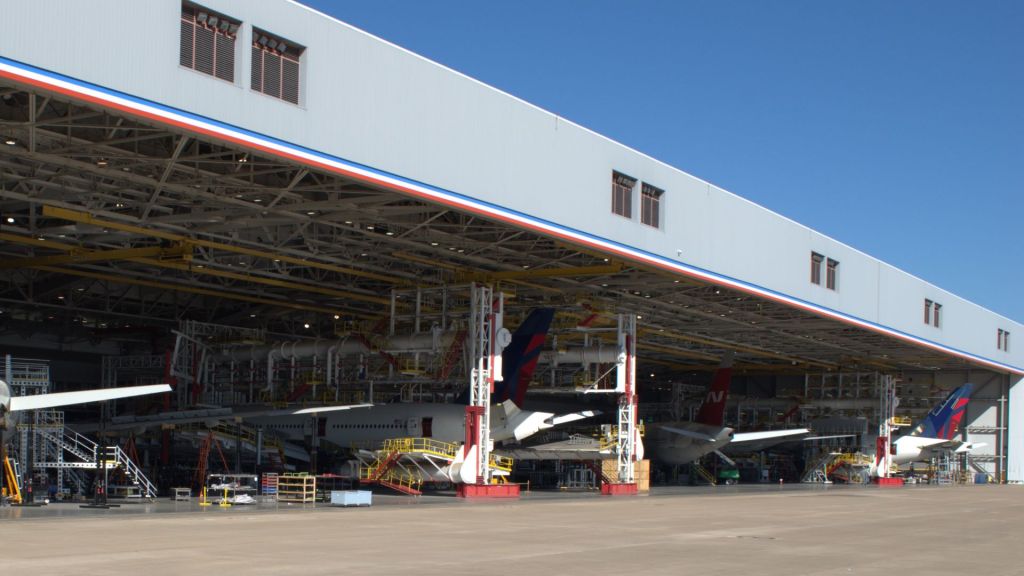
Aircraft dealer Jetran LLC has acquired the rights to four Boeing 777-200 converted freighters from Cargojet, which this week dropped plans to buy the long-haul aircraft along with a modification package for main-deck cargo transport, FreightWaves has learned.
Cargojet on Monday said it was backing out of commitments with Mammoth Freighters, a startup aerospace firm backed by Fortress Investment Group that has designed an airframe conversion kit for 777 passenger aircraft, because of soft international demand for airfreight. Instead, it will focus on maximizing utilization of existing Boeing 757 narrowbody and 767 medium freighters in its Canada overnight express network and on international charter routes.
The airline had previously telegraphed that two of the large freighters would be operated for DHL Express, but co-CEO James Porteous on Thursday said Cargojet changed its mind when it couldn’t get firm commitments for the other two units and realized economies of scale weren’t possible with such a small fleet.
Cargojet originally envisioned having eight 777s, but last year it decided not to move forward with an investment in four 777-300s — eventually selling them and canceling production slots at an Israeli retrofit company. Porteous said the -300s were speculative investments that didn’t pan out with express operators or other cargo airlines once demand began contracting in 2022 from record highs fueled by the pandemic’s disruption of supply chains.
Spreading the fixed cost of hiring crews, pilot training, flight simulator time, spare parts and maintenance infrastructure across several revenue aircraft is much more efficient with a larger fleet, according to aviation experts, and Cargojet realized that even four aircraft were too few to justify the upfront expenditures. It had budgeted $1.2 billion to launch the 777 program.
“When we looked at the cost of capital as a public company — everything from ramping up the number of pilots [and maintenance staff] we would need to hire to cover the first two aircraft and routes for DHL, plus all the spare parts and tooling, and we’d have to buy or build a hangar at our hub in Hamilton [Ontario] because the aircraft doesn’t fit in our existing hangars — we just finally came to the conclusion this doesn’t make economic sense. It’s not a great use of capital,” Porteous said in a phone interview from an investor conference in Whistler, British Columbia.
Cargojet netted $75 million to $82 million from buying and selling the 777-200s, according to Monday’s announcement.
Porteous declined to identify who bought the 777-200s and a flight simulator, but Jetran confirmed it is the buyer.
“Jetran basically decided to step into Cargojet’s commitments to take those four airplanes because we see tremendous value in the [777 passenger-to-freighter] program and that asset class,” CEO Jordan Jaffe said in an interview. He declined to say how much Jetran paid for the aircraft or who the end user will be.
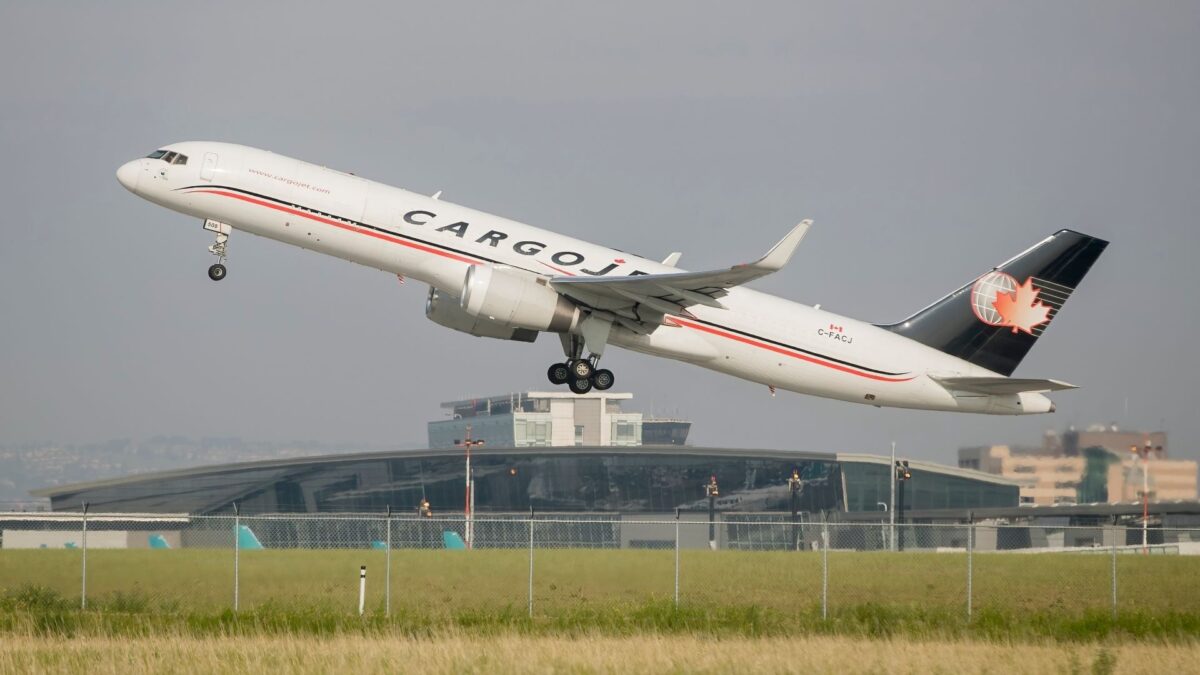
Mammoth Freighters, which is working to validate its design and get it certified by the Federal Aviation Administration for use in commercial aircraft, has 35 confirmed orders. Jetran has more than 20 of them, including nine 777-200s that will be resold to DHL Express.
Mammoth has a large maintenance hangar in Fort Worth, Texas, where conversion kits are being installed using Mammoth’s design, as well as a licensed contractor in the United Kingdom. It will also offer conversions for the 777-300.
Assembly work involves gutting the plane’s interior, adding a rigid barrier to protect the cockpit, installing a large door for pallets and reinforcing the floor to support heavy loads. The process typically takes four to five months for a large airliner, but prototype aircraft used for validation flights and certification take longer to complete.
The downturn in the air cargo market since the spring of 2022 has chilled orders for factory-built and converted freighters, raising concerns of a potential glut in narrowbody freighters as prior orders continue to be fulfilled. Analysts say there still is a need for more widebody capacity with Boeing last year ending production of the 747 jumbo jet, Western sanctions against Russia for invading Ukraine effectively removing many extra-large freighters from the market, airlines retiring MD-10 and MD-11 freighters, and other aircraft starting to reach the end of their useful life.
Jaffe said Cargojet’s decision doesn’t reflect on its sales forecast or confidence in Mammoth Freighters.
“They’re extremely well capitalized. They have an A-team of industry experts and some of the best facilities we’ve ever seen,” he said.
Jetran, based in Horseshoe Bay, Texas, last year acquired five 747-400 freighters, which are more than 20 years old, from Taiwan-based China Airlines in a sale-leaseback as a gateway platform for new 777 converted freighters or next-generation 777s to be built by Boeing, said Jaffe.
The jumbo freighters, he explained, allow Jetran to pursue new customers that can eventually move into the 777 and provide a bridge for existing customers that need aircraft until the Mammoth conversions are available. Airlines can take a short-term lease of three or four years and then transition to the 777 converted freighters.
“I don’t mind using the 747 as essentially a stopgap airplane,” Jaffe said.
The 777s are heavy-lift aircraft that can carry more than 100 tons. The wide fuselage makes them well suited for dense freight and light e-commerce shipments. Mammoth’s 777-300 converted freighter is designed with 14% more volume than a 747-400 and is ideal for lightweight freight that takes up space because it has more interior volume but a similar weight payload to the 777-200. That translates into 10 more main-deck pallet positions than the -200LR. The 777-300 is ideal for medium-length routes of about eight hours. The 777-200 is aimed more at long, intracontinental routes. Both variants are twin-engine aircraft and much cheaper to operate than four-engine 747s.
Cargojet is focusing on its existing fleet of 41 freighters — 17 Boeing 757 narrowbody aircraft and 24 Boeing 767 medium widebodies.
“The commonality of the flight deck with one pilot for both aircraft types, commonality of parts, makes a lot more sense for us to continue,” especially in the domestic Canada market, Porteus told FreightWaves. “We feel we can continue to grow the ACMI [dedicated contract transport] business with DHL with the 17 or 18 aircraft that we have operating with them today.”
Porteus acknowledged that Cargojet likely won’t be able to sell four Boeing 757s recently identified as surplus because the industry has an oversupply of standard-size cargo jets. He said Cargojet may be able to lease two aircraft and will return the others to service when parcel and freight demand pick up again.
Click here for more FreightWaves/American Shipper articles by Eric Kulisch.
Contact reporter: ekulisch@www.freightwaves.com
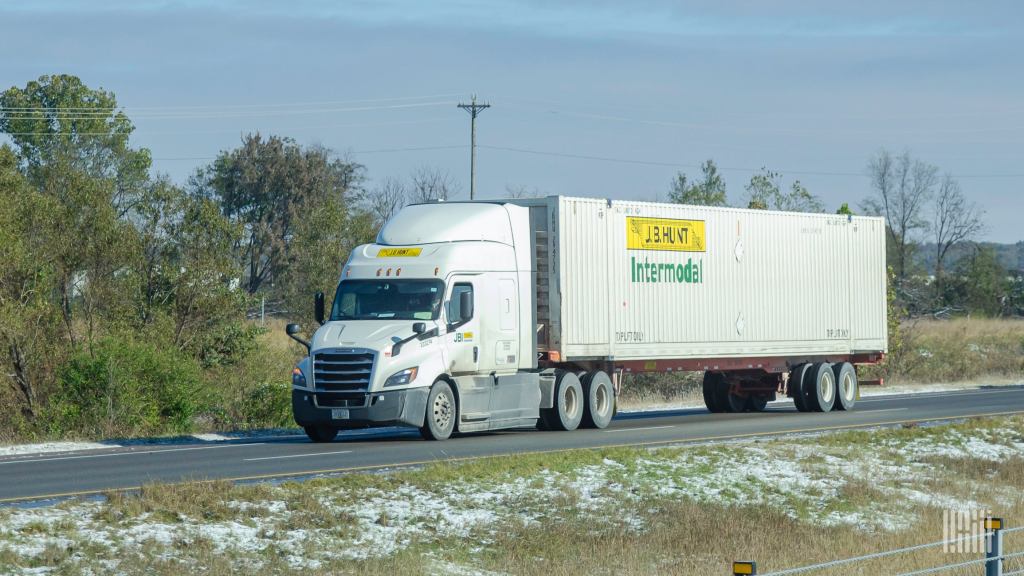
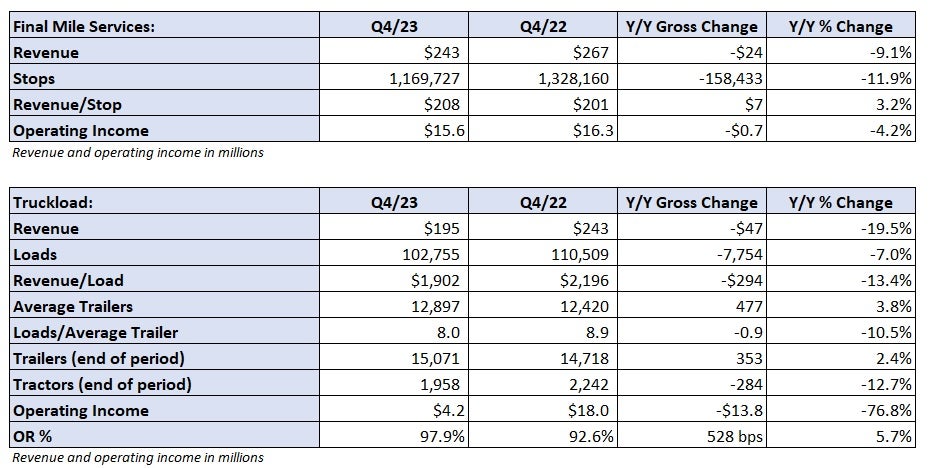
Management from J.B. Hunt Transport Services called out cost pressures on multiple fronts several times on a Thursday evening call with investors. Insurance costs were the most notable reason for a headline miss to fourth-quarter expectations.
J.B. Hunt (NASDAQ: JBHT) reported headline earnings per share of $1.47 for the fourth quarter, which was below the consensus estimate of $1.75. However, the period included $53.4 million in incremental pre-tax charges tied to elevated premiums and the expectation of much higher per-claim payouts. Excluding the 43-cent insurance headwind, EPS would have been $1.90.
The true-up was larger during the 2022 fourth-quarter as the company recorded a $64 million charge tied to incremental reserve adjustments for prior casualty claims, which produced a 46-cent hit to that period.
“Given that the majority of motor carriers in the industry carry only $1 million in coverage, just above the legal minimum of $750,000 in coverage, it’s the larger carriers who bear the brunt or disproportionate share of the escalating insurance and claims cost,” said CEO John Roberts. “And ultimately, these inflationary costs get passed on to customers and consumers.”
Roberts said the number of claims above $1 million jumped 867% from 2010 to 2018. J.B. Hunt’s premiums resetting in 2024 have been 50% to 60% higher despite the company’s numerous safety and risk-mitigation initiatives.
The company also had a $15 million increase in losses on equipment sales during the quarter, which was a 12-cent headwind. Higher interest expense was a 3-cent detractor as net interest expense increased 46% year over year (y/y) with the company’s debt load increasing by 25% in comparison. A lower tax rate compared to last year was a 14-cent tailwind. These items were included in the $1.90 number.
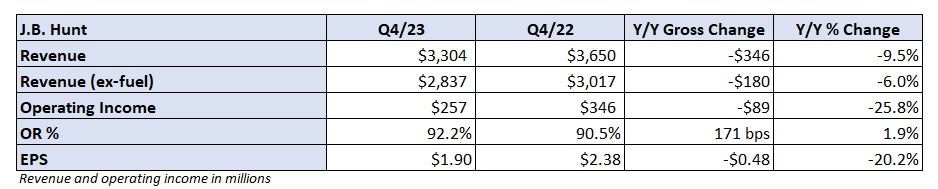
Segment results below have also been adjusted to exclude allocated incremental insurance expenses.
The inclusion or exclusion of these amounts will likely be a topic of debate among the investment community. One-off and nonrecurring items are typically excluded to produce an earnings number more reflective of ongoing operations, which is then used as the basis for valuation. However, if the current environment proves to be the new norm for insurance premiums and claims costs, the items may be included going forward.
Management said it believes the recent charges incurred to correct insurance reserves won’t likely be as severe moving forward.
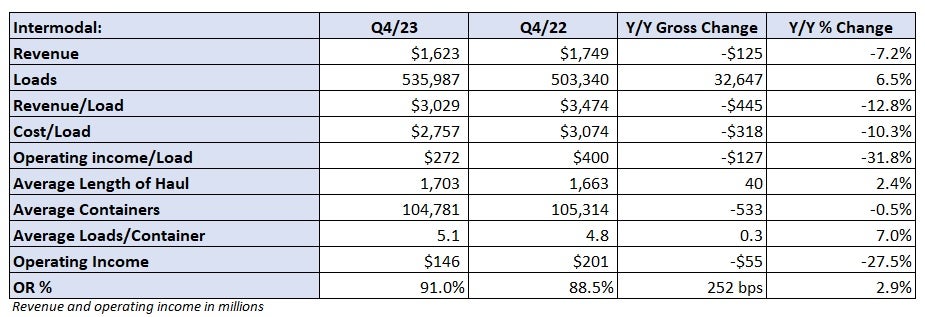
Intermodal volumes were up 6.5% y/y and 3% higher than in the third quarter, which slightly outpaced the broader industry. Intermodal traffic on the U.S. Class I railroads was up 6% y/y, according to the Association of American Railroads. By month, J.B. Hunt’s October and November volumes were up 6% y/y, with December increasing by 8%.
Revenue per load was down 13% y/y (up 2% sequentially) but cost per load fell just 10% y/y (up 1% sequentially). Revenue per load was down 10% y/y excluding fuel surcharges. The segment reported a 91% operating ratio, which was 250 basis points worse y/y but 80 bps improved from the third quarter.
Management didn’t provide any guidance for the intermodal division in the new year as forecasting from its customers remains cloudy. It noted that indications are for volumes to continue to shift to the West Coast given conflict in the Red Sea, which has diminished ocean carriers’ willingness to navigate the Suez Canal. A West Coast mix shift increases length of haul (revenue dollars) and lifts margins.
Mostly due to prior-year comps — strength in the East with weakness in the West due to a port labor dispute — J.B. Hunt’s transcontinental loads increased 13% y/y in the quarter while Eastern loads were down 2%.
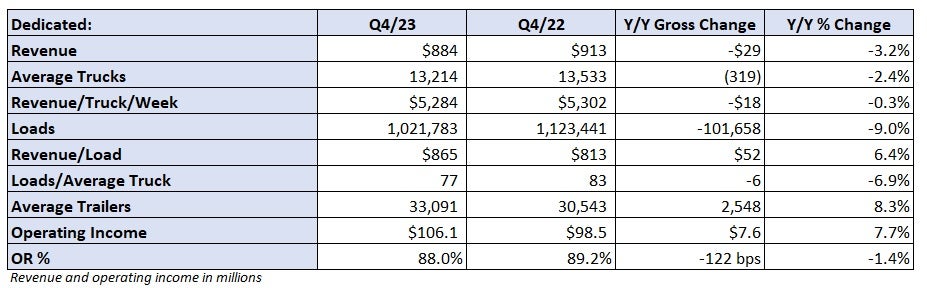
Dedicated revenue fell 3% y/y as loads were off 9% and revenue per load increased 6%. Average trucks in service fell 2% and revenue per truck per week was flat (up 3% excluding fuel surcharges). The unit saw some fleet downsizing within accounts given a weaker demand environment as well as some customer attrition as J.B. Hunt remains “disciplined” on pricing.
The segment recorded an 88% OR, which was 120 bps better y/y. Maturation of previously onboarded accounts has resulted in better productivity.
The company inked contracts with customers representing 300 trucks in the quarter. It sold dedicated service on a total of 1,150 trucks during 2023.
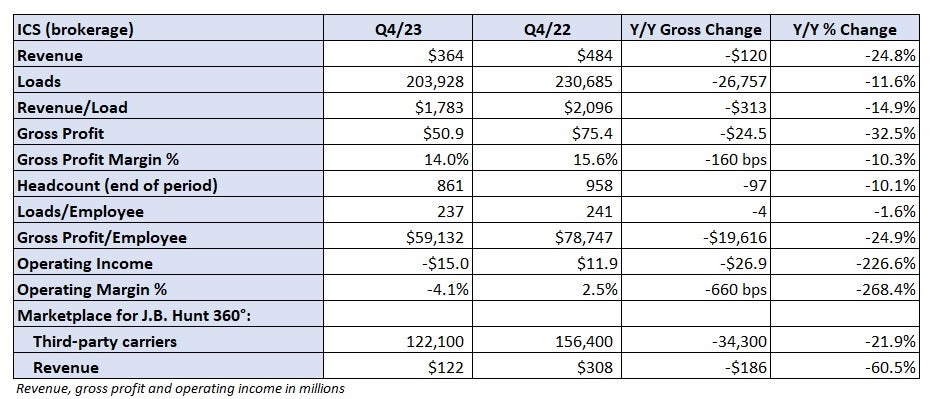
Integrated Capacity Solutions recorded a 25% y/y decline in revenue to $364 million as loads fell 12% and revenue per load dropped 15%. The decline included a $90 million revenue contribution from the brokerage operations of BNSF Logistics (NYSE: BRK.B), which was acquired in September.
The unit lost $15 million in the quarter compared to a profit of $12 million last year. Acquisition-related costs were likely a $5 million to $6 million drag on the period.
Shares of J.B Hunt were up 4.2% in after-hours trading Thursday evening.
“Net net we’d expect a stock reaction that is commensurate with the 3.5% underlying profit beat,” Deutsche Bank (NYSE: DB) analyst Amit Mehrotra said shortly after the earnings report was released. “Shares are already richly valued, so we don’t think we’ll get much multiple expansion, if any.”

Accelera by Cummins, Daimler Truck and Paccar Inc. followed the incentives in choosing northern Mississippi for a $2 billion battery-making joint venture. The factory for medium- and heavy-duty commercial trucks will create 2,000 manufacturing jobs.
Mississippi lawmakers Thursday approved $365 million in state incentives for the jobs expected to have an average salary of $66,000, according to an Associated Press report.
The three companies announced the JV in September. Its goals in making lithium iron phosphate (LFP) batteries in the U.S. include securing local supply and reducing costs. LFP technology is more durable and safer than lithium-ion technology in wide use. It also reduces reliance on imports from China of nickel, manganese and cobalt.
The 21-gigawatt hour (GWh) factory in the Magnolia State expects to begin producing battery cells in 2027. Accelera, Daimler Truck and Paccar will each own 30% of, and jointly control, the business. Huizhou, China-based EVE Energy has a 10% stake in the JV and will contribute battery cell design and manufacturing expertise.
“This site selection represents an exciting and tangible step toward advancing our Destination Zero strategy. And [it advances] our vision to lead the industry toward a decarbonized future,” Jennifer Rumsey, Cummins chair and CEO, said in a news release.
Cummins promoted LFP battery chemistry at the IAA Transportation show in Hanover, Germany, in September 2022. Both DTNA and Paccar currently use LFP battery cells from China’s Contemporary Amperex Technology Co. Cummins, through its Accelera unit, makes electric buses for Gillig as well as fully integrated electric chassis for commercial vehicles.
The failure of two U.S. battery-making startups — Romeo Power and Proterra — reduced availability of U.S.-produced batteries. Sweden’s Volvo Group, acquired Proterra’s battery-making assets for $210 million in Proterra’s Chapter 11 bankruptcy reorganization. Volvo competes with Daimler and Paccar
Michigan-based startup Our Next Energy focuses its LFP production on passenger cars and medium-duty trucks.
“We’ve very, very conscientiously created a joint venture with a rigid competitor [Daimler] and a long-term collaborator [Cummins],” John Rich, Paccar chief technology officer, told FreightWaves. “We saw a need to move down an adoption curve in batteries that was afforded by scale that none of us could do alone.”
Paccar builds engines for its Kenworth and Peterbilt brands in Columbus, Mississippi. It announced a $209 million, 50,000-square-foot expansion there in October to add engine remanufacturing. The investment created 100 jobs.
“The state, the communities and the people of Mississippi are wonderful business partners for Paccar,” CEO Preston Feight said in the release.
The joint venture awaits approvals, including from a voluntary notice to the Committee on Foreign Investment in the United States. The JV has not yet been named.
“We are living in a global economy,” Republican Rep. Trey Lamar of Senatobia, chairman of the state House Ways and Means Committee, was quoted by the AP as saying during a special legislative session. “The fact that we have companies that may be coming from outside of the United States to invest and provide jobs to Americans is a good thing.”
Related articles:
Daimler Truck, Cummins and Paccar partner to make battery cells in the US

Robin Hutcheson is resigning from her post as head of the Federal Motor Carrier Safety Administration, a U.S. Department of Transportation source confirmed to FreightWaves on Thursday.
Her last day at the agency will be Jan. 26. No reason was given as to why she is leaving.
Sue Lawless, FMCSA’s assistant administrator, will head the agency in an acting administrator role after Hutcheson’s departure. Lawless also serves as the agency’s executive director and chief safety officer.
In a statement released by FMCSA on Friday, Hutcheson said it has been a “profound honor” to serve under the Biden-Harris administration.
“I thank Secretary Buttigieg for his leadership and confidence and recognize the dedicated team of professionals at the Department of Transportation who work hand in hand with industry partners to serve the American people and keep our country moving forward.”
Hutcheson, who was confirmed in September 2022, was FMCSA’s seventh administrator since the agency was established in 2000.
Her predecessors — Jim Mullen, Wylie Deck and Meera Joshi — led the agency in acting roles since Ray Martinez resigned in 2019.
Hutcheson was criticized by lawmakers during a hearing on Capitol Hill last month for taking part in a fundraiser while a proposed regulation that would limit truck speeds was — and still is — pending. The fundraiser was allegedly sponsored by “labor unions and trial attorneys” that are supporters of the controversial rule.
Hutcheson denied that the credibility of the rulemaking was damaged, noting that “we take very seriously the fidelity of the process of rulemaking, and we don’t discuss the contents of the rule even as we’re engaging with our stakeholders.”
At a Capitol Hill hearing on Wednesday, FMCSA came under fire again — from the Transportation Intermediaries Association — for paying too much attention to non-safety issues such as private contracts between brokers and trucking companies.
Hutcheson previously served as deputy assistant secretary for safety policy for DOT under the Biden administration.
She led the development of the National Roadway Safety Strategy, which DOT unveiled in January 2022. She also helped secure $13 billion in additional funding for safety programs and initiatives included in the Bipartisan Infrastructure Law signed in 2021.
“As FMCSA Administrator, Hutcheson focused on the safety of commercial motor vehicle drivers to improve safety outcomes and strengthen the supply chain,” FMCSA noted regarding Hutcheson’s departure.
“She took numerous regulatory actions to enhance roadway safety, improve quality of life for drivers, leverage technology and innovation to improve safety, increase the impact of FMCSA grant dollars in communities across the country, and promote transparency across the industry.”
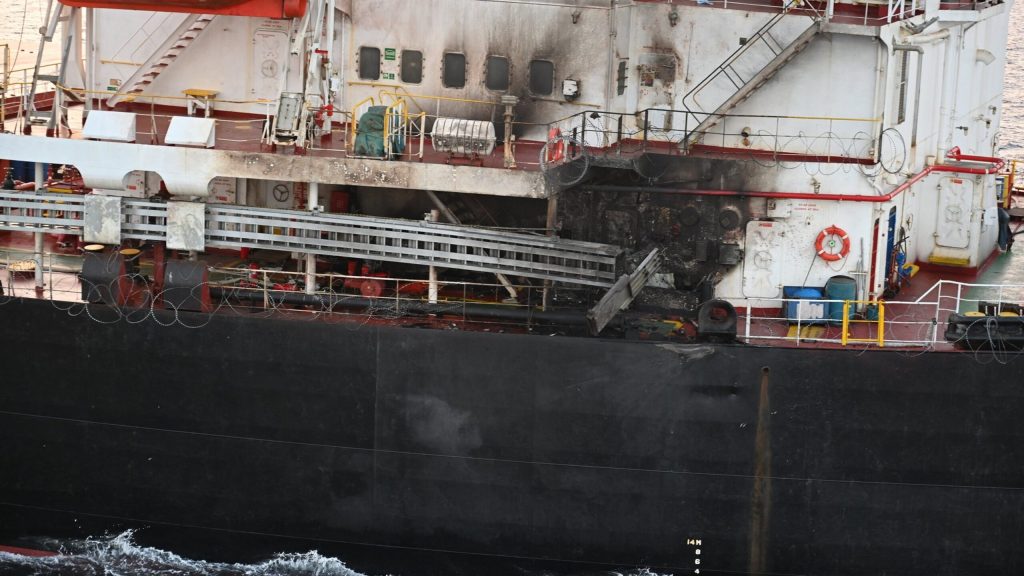
It’s now crystal clear that container ships will not return to the Red Sea anytime soon. Lengthy detours around the Cape of Good Hope have already pushed spot container rates far above pre-COVID levels, and rates continue to climb.
Yet another commercial ship was hit by Houthi rebels on Wednesday, the bulk carrier Genco Picardy, owned by New York-based Genco Shipping & Trading (NYSE: GNK). This was followed by another barrage of coalition airstrikes in Yemen, then more Houthi attacks on shipping on Thursday.
The Drewry World Container Index (WCI) Global Composite jumped to $3,777 per forty-foot equivalent unit for the week ended Thursday. It’s now up 173% year to date.
With the exception of the COVID boom period in December 2020 through October 2022, this week’s global spot-rate reading is the highest on record since the WCI debuted in June 2011.
This was supposed to be a terrible year for container lines, courtesy of a tidal wave of newbuilding deliveries. According to Alphaliner, 2.3 million TEUs of new capacity were delivered last year, with an additional 3.2 million TEUs set to arrive in 2024.
But ocean shipping rates are acutely exposed to geopolitical events. The Houthi attacks, which have forced container ships to reroute en masse around Africa’s Cape of Good Hope, changed the supply-demand equation. Linerlytica now predicts “windfall earnings for carriers in Q1 2024.”
Connor Helm, Flexport’s manager of ocean procurement, said during a Flexport presentation on Thursday: “Carriers are committed to going around the Cape of Good Hope. They’re no longer waiting to see if this situation is going to be mitigated. It’s very clear that this is going to be a kind of long-term situation and carriers are reacting that way.”
The majority of the world’s containers move under contract rates, not spot rates. However, rising spot rates will boost contract rates negotiated this year.
And even though legacy contract rates are currently much lower than spot rates, shipping lines are jacking up contract revenues with emergency fees that bring contract rates closer to spot.
All of the indexes are showing a spike in spot rates this month — not just in the lanes directly affected by Red Sea diversions, but also in trades that are not, such as the Asia-West Coast trade.
“The Red Sea impact is most disruptive on the Far East westbound, India and Middle East trades, but have no doubt, it is a global-network-impacting event and it has brought instability to the TPEB [trans-Pacific eastbound] trade as well,” said Kyle Beaulieu, Flexport’s head of trans-Pacific, during Thursday’s presentation.
According to Nathan Strang, Flexport’s director of ocean freight for the U.S. Southwest, shipping lines “really have to support those Cape of Good Hope transits. They’re not able to shift more service [to the West Coast]. So, if you are going to look to the West Coast, you have to start booking that capacity as soon as possible.”
The Freightos Baltic Daily Index (FBX) posted yet another jump on Wednesday, on top of soaring gains since the end of last year.
The FBX global average hit $3,220 per FEU on Wednesday, up 131% year to date.
The Asia-Europe trade is most exposed to the Red Sea crisis. The FBX Asia-Mediterranean index, at $6,944 per FEU, was 2.4 times its Dec. 31 reading. The FBX Asia-Northern Europe index was 3.6 times higher than at the end of last year, at $5,784 per FEU.

FBX Asia-U.S. rates have doubled year to date.
Asia-East Coast rates are directly exposed to Red Sea diversions because many services had previously rerouted from the drought-stricken Panama Canal to the Suez Canal. The FBX China-East Coast assessment had risen to $5,398 per FEU on Wednesday. The FBX China-West Coast rate had risen to $3,232 per FEU.
Rate data from Xeneta highlights how the Red Sea crisis is having a major knock-on effect on services that are not detouring around the Cape of Good Hope.
Xeneta assessed average Far East-West Coast short-term rates at $3,418 per FEU on Thursday, 2.2 times the average on the same day in 2020, pre-COVID.

Xeneta put average short-term rates in the Far East-East Coast trade at $4,890 per FEU, up 71% from the same time in January 2020.

Data from Platts, a division of S&P Global (NYSE: SPGI), shows the same escalating rate trend.
Platts put Thursday’s North Asia-Mediterranean rate at $6,500 per FEU, and the North Asia-North Europe rate at $5,200 per TEU. In both cases, rates have roughly quadrupled since Dec. 1.
Asia-U.S. rates are now around 2.7 times Dec. 1 levels, according to Platts data. Its latest assessment is $6,000 per FEU for Southeast Asia-U.S. East Coast, $6,200 per FEU for North Asia-U.S. East Coast, $4,000 per FEU for Southeast Asia-West Coast and $4,400 per FEU for North Asia-U.S. West Coast.

Click for more articles by Greg Miller
Although some once-high-flying FreightTech firms folded in 2023 and others are cutting staff, some supply chain-related technology startups continue to secure venture capital and funding deals.
Sayari, a supply chain risk intelligence provider, recently announced private equity firm TPG is making a $228 million strategic majority investment in the company.
Meanwhile, global supply chain-focused startups TrusTrace and Kusari recently secured $24 million and $8 million, respectively, and e-commerce platform Cart.com announced it has secured a $70 million debt facility from Silicon Valley Bank.
Sayari announced it has signed an investment agreement with TPG aimed at accelerating the startup’s global expansion and supporting the launch of a new AI supply chain illumination platform.
TPG Growth, the firm’s middle market and growth equity platform, is making a $228 million majority investment in Sayari, which will give TPG a majority investment in the company. However, Sayari’s founders, employees and existing investors will retain a significant stake in the company, according to a news release.
“We see a massive opportunity in the supply chain risk space to drive down costs and deliver superior insights to decision makers and we’re pleased to have a partner who shares our vision,” Farley Mesko, co-founder and CEO of Sayari, said in a statement. “TPG brings tremendous resources, operational expertise, and a customer-first philosophy that is truly unique.”
Founded in 2015, the Sayari platform integrates global corporate and supply chain data to provide risk insights for investigations, analytics and supply chain strategies. Sayari’s customers include regulators, law enforcement and national security agencies, and public and private companies.
Sayari, which is based in Washington, D.C., has raised more than $300 million in venture capital and debt financing over the past nine years.
TPG (NASDAQ: TPG) describes itself as an alternative asset management firm. Founded in San Francisco in 1992, the company has over $212 billion worth of assets under management and investment around the world.
The transaction was announced Tuesday and is expected to close in the first quarter.
TrusTrace has completed a $24 million growth investment round led by Circularity Capital, which will enable the company to strengthen its presence in key markets, as well as expand product developments and collaborations.
Stockholm-based TrusTrace is a software-as-a-service company founded in 2016. TrusTrace’s platform provides companies with product traceability and compliance.
“A growing number of fashion and textile brands are adopting supply chain traceability to support their sustainability goals and ensure competitiveness in the face of mounting regulatory and consumer pressure,” Shameek Ghosh, CEO and co-founder of TrusTrace, said in a news release. “The completion of this growth investment is further evidence that businesses see traceability as critical to achieving their sustainability goals.”
Other participants in the latest funding round include existing investors Industrifonden and Fairpoint Capital. TrusTrace has raised over $31 million in venture capital.
Supply chain security startup Kusari announced Thursday it raised $8 million in pre-seed and seed round funding led by J2 Ventures.
Ridgefield, Connecticut-based Kusari was founded in 2022. The firm is a security provider aimed at helping companies assess the software used to run supply chains and prevent costly issues, such as cyberattacks.
“With the investment, we will continue to develop tools that make it easier for organizations to understand modern software and identify costly vulnerabilities,” Tim Miller, Kusari’s co-founder and CEO, said in a news release.
In addition to J2 Ventures, the seed round was co-led by Glasswing Ventures with participation from Unusual Ventures, which previously invested $2 million in pre-seed funding.
“Code breaches are increasingly becoming a top priority,” Kleida Martiro, partner at Glasswing Ventures, said in a statement. “In an era where software supply chain attacks are on the rise, the demand for stringent security measures has never been more critical.”
Houston-based Cart.com, a commerce and logistics technology provider, announced Thursday it has finalized a $70 million debt facility from Silicon Valley Bank.
The latest facility is part of a larger $100 million debt refinancing provided by SVB’s Technology Corporate Banking Division and Trinity Capital Inc.
Officials for Cart.com said the funds will be used to scale and grow in 2024.
“Cart.com’s business grew 50% amid a challenging year for retailers and commerce enablement providers alike — a testament to the innovative logistics and commerce infrastructure solutions that are helping our mid-market and enterprise customers unlock more efficient growth,” Omair Tariq, Cart.com’s founder and CEO, said in a news release.
Cart.com provides physical and digital infrastructure to more than 6,000 multichannel merchants to sell and fulfill customer orders around the world. In June, Cart.com announced it had raised a $60 million Series C equity funding round at a valuation of $1.2 billion.
More articles by Noi Mahoney
Canadian authorities suspend two more trucking companies after crashes
Mexico top US trade partner in November, Laredo No. 1 gateway

On Wednesday, autonomous trucking startup TuSimple went private after voluntarily delisting from Nasdaq following two years of stock and boardroom drama. FreightWaves’ Alan Adler writes, “TuSimple was the first autonomous trucking company to demonstrate driverless operations on an open highway. One of its trucks traveled 80 miles with no human on board from Tucson, Arizona, to Phoenix in December 2021.”
TuSimple’s decision to delist and focus on operations in China and Japan leaves only two startups — Aurora Innovation and Kodiak Robotics — as autonomous players, with both companies planning for limited commercial launches in Texas later this year. TuSimple was under threat of delisting since last year due to delinquent financial reporting, which saw the company change auditors when KPMG quit amid a boardroom shakeup. Nasdaq requires shares listed on its exchange to trade above $1. Price per share was originally not an issue for TuSimple, which had a $1.1 billion initial public offering in April 2021 that saw shares trading at nearly $70 per share after going public. Adler notes when the decision to go private was announced, TuSimple shares plummeted 57% to intraday lows of 30 cents per share.
For TuSimple’s operations in China and Japan, there appear to be resources to work with. Adler writes, “Unlike other transportation startups, TuSimple is relatively flush, reporting cash and cash equivalents of $776.8 million as of Sept. 30. The company caught up with required financial filings in November when it reported an operational loss of $248.6 million for the first nine months of the year.”
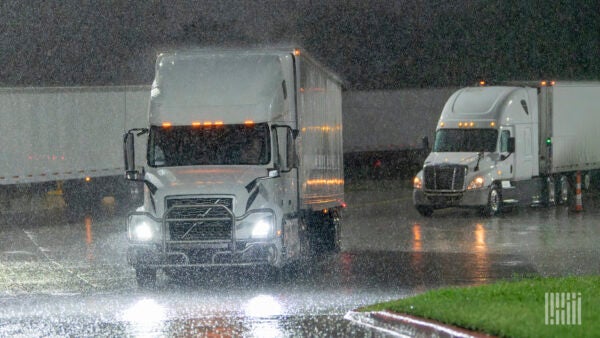
Truckload earnings season may begin not with a bang but with a whimper, according to recent analyst cuts to projected earnings leading up to Q4 results later this week. FreightWaves’ Todd Maiden writes, “Recent channel checks revealed a notable falloff in fundamentals in the back half of December, dispelling hopes that the quarter would be a transitionary period.”
Morgan Stanley analyst Ravi Shanker told clients, “In fact, we are starting to hear of potential scenarios where inventory levels may never return to prior decade levels as long as interest rates remain elevated with Shippers preferring to limit SKUs and running shorter, faster, tighter supply chains with higher turnover instead.” Shanker made earnings estimate cuts to all the public transportation and logistics companies he watches while publishing an outside-of-consensus bullish 2024 outlook a week ago.
Bank of America Global Research, using survey data to feed its proprietary Truck Demand Indicator, believes that better signs are ahead against the current soft backdrop. Its 2024 Year Ahead report notes, “While it is early, the stabilization and solid base sets up well for the next upturn. Given extended inventories, strong carrier balance sheets, shift in consumer preference from goods to services, and excess capacity (in trucking), it may still be a few months before we see strength in results.”
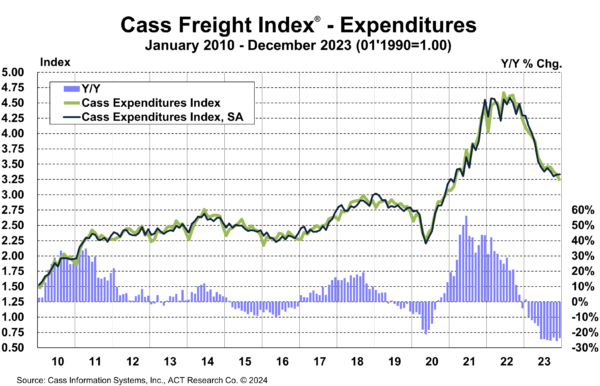
On Monday, freight audit and payment provider Cass Information Systems released its December Transportation Index, which saw freight and linehaul rates show early signs of stabilization. The Cass Shipments Index fell 1.6% month over month and 7.2% year over year. Total freight expenditures fell 3% m/m but seasonally adjusted rose 0.1%. The Truckload Linehaul Index saw a small bump of 0.4% m/m.
ACT Research’s Tim Denoyer noted in the report: “With spot rates steady over the past several months, downward pressure on the larger contract market is lessening, with some instances of contract rate increases bucking the downtrend of late.”
A trend to watch moving into Q2 2024 will be shippers’ restocking strategies to determine if the freight cycle upswing begins in earnest. The report notes, “Destocking and declining goods consumption have been key features of the freight recession, but both cycle drivers seem to be starting to reverse course. Real retail sales recently turned positive after a year of declines, and after 18 months of destocking, a restock is drawing near, likely spurred by ocean risks.”
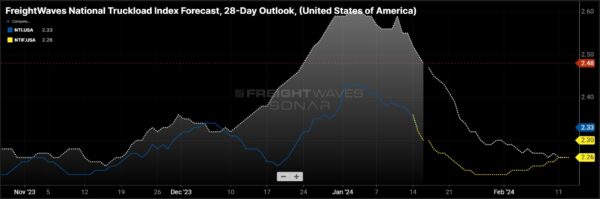
Summary: Nationwide all-in spot rates continue to decline following New Year’s despite nature’s best efforts from winter storms and Arctic air masses, which impacted transit across much of the Lower 48 states. The FreightWaves National Truckload Index (NTI), highlighted in blue, fell 6 cents per mile w/w from $2.39 on Jan. 8 to $2.33. NTI Linehaul rates less an estimated fuel surcharge saw a similar decline, falling 5 cents per mile w/w from $1.77 on Jan. 8 to $1.72. Excess truckload capacity remains the largest impediment to positive movement in spot market rates.
Declines in contracted freight volumes may be a contributing factor, as nationwide outbound tender volumes fell 1,338.26 points or 11.24% w/w from 11,909.66 points on Jan. 8 to 10,571.4 points. OTVI levels more closely resemble levels not seen since Dec. 24, when OTVI was at 10,657.21 points. Falling tender volumes are a development worth watching, as freight volumes are seasonally lower in Q1 before spring inventory movement causes higher truckload demand beginning in Q2.
The NTI spot market 28-day outlook (NTIF28) suggests further spot rate declines through the first weeks of February. Spot market rates are forecast to fall 7 cents per mile from $2.33 all-in to $2.26 by Feb. 12.
FTR Forecasts Only Incremental Freight Market Improvement in 2024 (Heavy Duty Trucking)
TIA warns Congress of rampant fraud in trucking (FreightWaves)
Truck parking 2024 outlook: optimistic but no miracles (Fleet Owner)
Congress again floats massive increase to trucking insurance minimums (Commercial Carrier Journal)
Shortages 2024: What supplies are still at risk after years of disruption? (Supply Chain Dive)
Is FMCSA tipping its hand on carrier safety fitness? (FreightWaves)

January’s State of Freight Webinar shifted to a virtual format Thursday, as frozen roads in Chattanooga, Tennessee, kept the two regular participants away from FreightWaves’ headquarters. That deep freeze is a situation much of the middle of the country finds itself in — and one that may be impacting freight markets as well.
That was one of several takeaways from this month’s webinar featuring FreightWaves CEO Craig Fuller and Director of Freight Market Intelligence Zach Strickland. Here are some of the key points in the hourlong discussion Thursday.
Fuller noted that blaming poor first-quarter financial performance on the weather is a frequent theme of earnings for the January-to-March period at publicly traded companies. But this year, he said, “I do think it is sort of legit.”
The type of weather the U.S. has gone through in the past week, with snow, ice and bitter cold, has an impact that goes beyond just slowing deliveries from trucks moving along impacted roads, Fuller said. Some of it could be a shift of demand for products into February as people avoid retail outlets or activities.
FreightWaves data in SONAR for several data series has turned soft. And the cold weather “sort of takes away from some of the confidence that people have, as well as the fact that store traffic is going to be down because of these weather impacts,” Fuller said. He noted that in his role as CEO of Flying Media Group, in the short term “we’ve seen a pretty significant drying up both in web traffic and subscriptions this week, as well as our e-commerce business,” which he attributed to the weather.
Fuller said the early January weakness hasn’t changed his growing bullishness on the second half of the year. And the primary reason is what he called the “capacity burn-off,” which lagged expectations in 2023 but is now picking up steam.
Strickland showed a chart of SONAR data, drawn from U.S. Department of Transportation numbers, that showed a drop in capacity appears to be well underway.
He also displayed data on capacity through the Outbound Tender Reject Index and the Outbound Tender Volume Index. The OTRI is rising, a sign of capacity starting to get tighter. Volumes on OTVI are up as well. Another chart displayed by Strickland showed the OTVI versus the DOT capacity numbers, showing the former rising steadily while the capacity numbers were declining, a combination that would eventually push the OTRI higher.

“Tender volumes exceeded last year’s levels coming into January,” Strickland said of 2024. The combination of all the data, he said, is that the soft market of early 2023 is in a completely different direction this year. Data from early 2023 suggested that was “arguably the bottom of the demand cycle for the freight market,” he said. But trends are combining that could be seen as bullish and signaling a turn in the market.

Fuller said the U.S. is “more immune to the flow of freight through the Red Sea than Europe is. It’s largely a European lane.” But he added the flows through the Red Sea and the Suez Canal to the U.S. are not zero, so there is an impact.
What’s “actually shifting now,” Fuller said, is freight away from the drought-stricken Panama Canal and back to the U.S. West Coast, which lost a significant amount of freight during the pandemic because of massive backups that resulted in container ships headed to East Coast ports instead. And with more ships going into the Los Angeles and Long Beach ports, Fuller said, “that means you’ll see more domestic and surface demand that will really provide some level of support for the freight market.”
Shifts in recent years to ports such as Newark, New Jersey, and Charleston, South Carolina, have been “one of the worst things for trucking,” Fuller said, because freight coming in there doesn’t usually require the long-haul trucking to pull containers and other freight out of the West Coast ports and into other U.S. population centers. “If it is flowing into Los Angeles and Long Beach, that is actually pretty bullish for surface freight, both intermodal and trucking,” Fuller said. “So these things are good.”
The broader impact of ships diverting from the Red Sea/Suez Canal combination is that it ties up capacity longer, as a trip around South Africa means longer times to deliver freight. “You’re actually increasing the amount of available dispatchable capacity because you have a longer distance to go,” Fuller said.
Fuller discussed the work of Peter Zeihan, an author and thought leader on China who sees few good things ahead for the country. Citing one statistic from Zeihan’s work, Fuller said the cost to produce a manufactured good in China has gone up by a factor of 10 in the past 10 years. “It is now more expensive to produce products manufactured in China than it is in Mexico,” he said.
Stepping into the political arena, Fuller said a renewed Donald Trump presidency is not likely to view the U.S. Navy as a protector of all the world’s sea lanes. “Supply chain managers have got to consider these issues,” he said.
With a corporate push for greater transparency and implementation of environmental, social and governance principles, these supply managers “are going to want to see sourcing from parts of the world that don’t have such a bad environmental track record,” Fuller added. And that is going to push manufacturing back toward the U.S. and other countries in North America with their “better quality rules than they have in China.”
“We’re going to see a lot of emphasis on reshoring manufacturing in the United States and North America, simply because the risks are too big,” Fuller said, noting that shipping insurance companies are going to charge rates reflecting those risks in other parts of the world.
With the closure of less-than-truckload carrier Yellow increasingly in the rearview mirror, Fuller said other companies have been able to absorb its customer demand “because the market was incredibly weak.”
But as the market heats up, “we could see LTL run out of capacity relatively quickly,” Fuller said. He spelled out a scenario in which the unique nature of LTL freight, carrying “shapes and sizes that aren’t as big,” could find itself in a capacity squeeze before tightness in truckload. At that point, “we may see some more flow into the truckload sector.” LTL executives during strong times have made clear on earnings calls with analysts that freight spilling over from truckload is not good for business; it may get priced the same as standard LTL freight but it is seen as damaging to “mix,” that vague goal where the combination of freight carried on an LTL carrier yields the greatest amount of revenue.
Strickland said LTL markets ultimately follow truckload trends but that the Yellow exit was able to block the worst of the freight recession from hitting LTL carriers. “But I think at the end of the day, LTL is a much smaller segment,” Strickland said. “So they are much more resilient to these cycles in terms of up and down movements because they’re just more stable.”
More articles by John Kingston
State of Freight takeaways: Strong volume, stuck OTRI and caution for shippers in ’24
State of Freight takeaways: From the floor of a very weak trucking market
State of Freight takeaways: Low rates, low OTRI mask market improvement