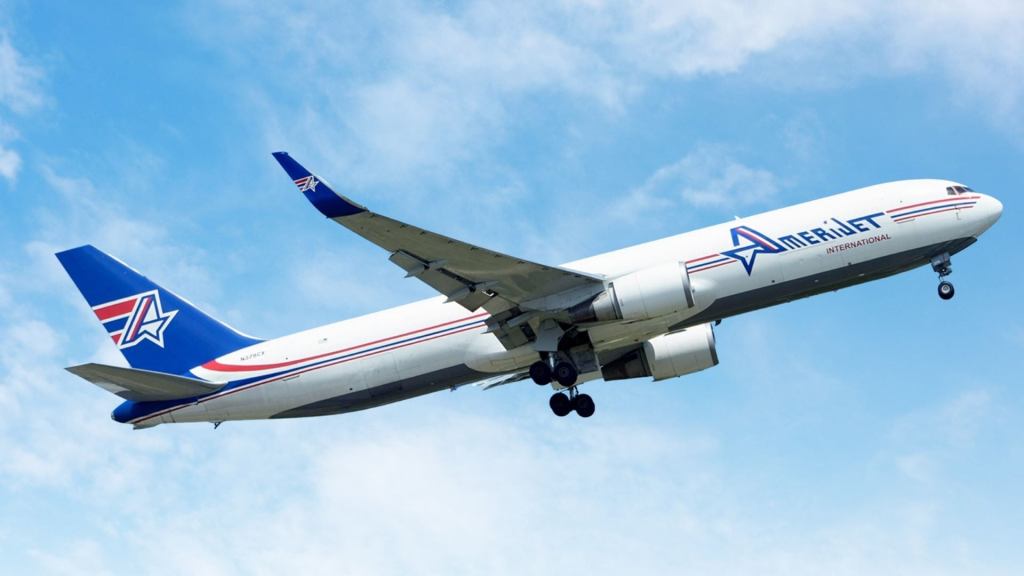
Cargo airline Amerijet in distress sale, terminates 6 aircraft leases
Amerijet, a midtier cargo airline based in Miami, said Wednesday it is returning six freighters to lessors, laying off nonpilot personnel and securing $55 million in capital from existing lenders as part of a restructuring aimed at stabilizing faltering finances and operations.
The company said it will hand back six Boeing 757 freighters to its lessors and defer agreements to add additional Boeing 767 cargo jets to improve cash flow.
The announcement provided few details, but an industry source with knowledge of the situation said the arrangement involved a distress sale by ZS Fund to another private equity company. The new ownership forced the board of directors to resign and has named new members, according to the source.
The circumstances of the transaction suggest that the banks involved may also have received an ownership position in exchange for the capital. Amerijet officials declined to provide more details.
Amerijet has struggled for the past year under a severe downturn in airfreight volumes that have hit the company harder than most. The company was caught by falling revenues at the same time it was expanding on expectations that a surge in business from the pandemic would continue. FreightWaves reported in early December that the company was struggling financially. The inability to utilize some aircraft due to weak demand, maintenance issues with 757 freighters, an overly long certification process for 757 converted freighters that sat idle for months, and the erosion of key flying business from DHL Express and the U.S. Postal Service combined to take their toll on the bottom line.
Amerijet’s fleet had grown to 22 aircraft a year ago, but seven of them were out of action in recent months. The company, which has fewer than 1,000 employees, underwent two small rounds of layoffs last year.
“We are pleased that we were able to complete this restructuring with the support of our investors and lessors. … These strategic actions have strengthened the company’s financial foundation, ensuring its scheduled service, and contract flights will continue to operate as usual,” said CEO Joe Mozzali in the announcement.
Mozzali took the helm at Amerijet in early October after then-CEO Tim Strauss departed in a disagreement over the company’s direction.
Ameijet did not say how many employees it was terminating, but another Miami-based source said more than 50 workers were given notice Wednesday.
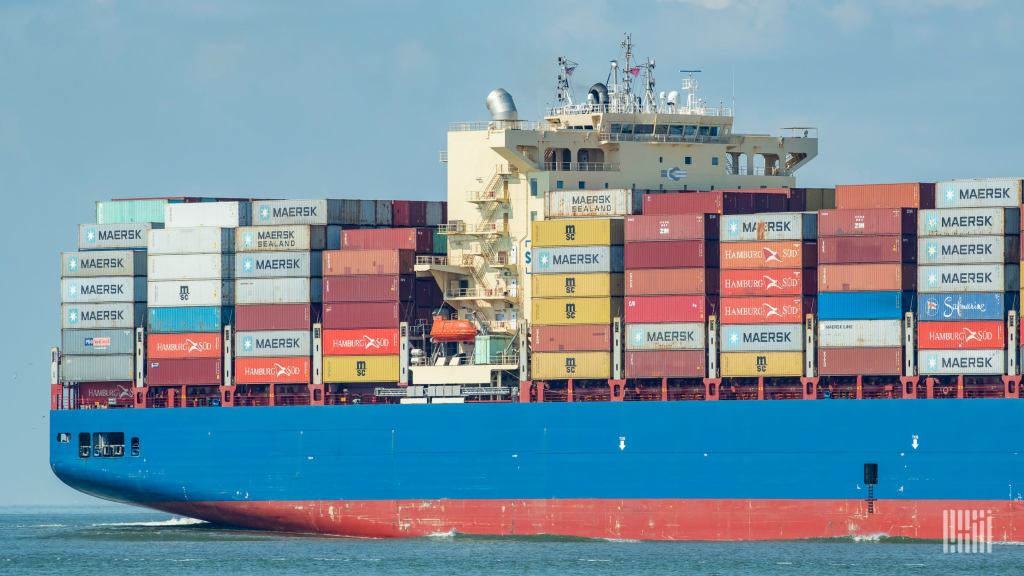
The airline operates three Boeing 767s for Maersk Air Cargo between Asia and the U.S. Maersk owns the aircraft and uses Amerijet to fly them.
Meanwhile, Amerijet said it has secured a new contract operating four weekly flights between Bogota, Colombia, and Miami as well a new multiyear contract transporting a global integrator’s express and cargo volumes in Central America and the Caribbean.
Amerijet said it used FTI Capital Advisors as its investment banker.
Lenzing levels up supply chain transparency with real-time shipment, carbon visibility from project44
Major disruptions combined with increasing customer expectations have been the primary driver for the rise in popularity of real-time visibility solutions over the past several years. While many leading organizations today recognize that visibility is a requirement for efficiently moving goods throughout the global supply chain, their needs continue to evolve.
Heightened pressure from investors and consumers, combined with new regulatory mandates has upgraded supply chain sustainability from a nice to have to a board level priority for many. In response to this growing focus on sustainability, many companies have begun making public commitments to reducing emissions by target dates in the near-term or mid-term future.
Measuring and reducing carbon footprints, with a specific focus on Scope 3 – indirect emissions that occur within a company’s value chain – is required to achieve this. Analysis from Accenture has identified that 70% of Scope 3 emissions, or a total of 60% of a company’s emissions are supply chain related. In order to achieve – and prove – these improvements, companies will need access to high-quality emissions data.
Lenzing Group, Most recently, project44 teamed up with Lenzing Group, a leading provider of specialty fibers, chose to partner with project44 to enhance its ocean visibility offerings one step further to capture accurate emissions. The duo designed a solution that embodies the technology and predictive capabilities that project44 is known for, while moving beyond location and status tracking.
With this new solution, Lenzing and its customers can gain full visibility into carbon emissions data. This information is collected at both a shipment and container level, creating the most holistic picture possible.
“Our real-time shipment visibility tool reinforces our commitment to transparency,” said Thomas Panholzer, VP of global supply chain at Lenzing. “Supply chain transparency and sustainability are critical, and our groundbreaking carbon emission tracking showcases our eagerness to set ambitious carbon reduction targets in collaboration with our customers.”
This partnership between project44 and Lenzing is a tangible example of what is possible when innovative companies across the supply chain team up to solve industry headwinds and work toward a common goal.
“Supply chain visibility continues to depend on successful collaborations,” said Jett McCandless, founder and CEO of project44. “Lenzing’s shipment visibility solution, powered by project44’s unique data and insights, gives unprecedented customer access to real-time information that locates shipments across the globe.”
Click here to learn more about the project44 and Lenzing collaboration.
Container lines had rough Q4 before Red Sea-driven rate rebound
Container shipping stocks are back in vogue among retail traders, courtesy of Houthi rebel attacks in the Red Sea that suddenly changed the balance of transport supply versus cargo demand.
The share price of ocean carrier Zim (NYSE: ZIM) is bouncing around like a pinball as traders place bets on how the geopolitical chaos will play out.
But Red Sea disruptions won’t have a major effect on carrier financials until the first quarter of 2024 — and results for Q4 2023 will hit the market over the coming weeks. If the early disclosures out of Asia are any indication, container shipping stockholders should brace for some ugly headlines.
Shipping stocks are supposed to move on forward projections, not past performance, particularly after markets experience a major change. But in practice, backward-looking shipping results have a habit of denting sentiment.
Cosco Q4 profits down 62% vs. Q3
China’s Cosco, the world’s fourth-largest liner operator, reported preliminary fourth-quarter results on Tuesday.
It posted net income of 2.399 billion yuan ($336.3 million) for Q4 2023, down 62% from the third quarter and 79% from the second quarter, periods when container markets were already past the COVID boom.
On a positive note, COSCO’s full-year 2023 profits of 28.389 billion yuan ($3.98 billion) were almost triple profits of 10.194 billion yuan in full-year 2019, pre-COVID.
OOCL revenue per FEU down 8% quarter on quarter
Cosco subsidiary OOCL reported information on revenue per container on Tuesday.
The new numbers highlight how weak Q4 2023 was, and how important the Red Sea attacks are to container shipping’s profitability in the coming quarters as annual contracts reset.
OOCL’s global average revenue per forty-foot equivalent unit fell to just $1,732 in Q4 2023, down 8.2% from the third quarter and 18.5% from the second quarter.
OOCL’s average revenue was $2,484 per FEU in the trans-Pacific, down 5.7% quarter on quarter, $2,477 per FEU in the trans-Atlantic, down 8.8%; only $1,625 per FEU in Asia-Europe, plunging 14.9% versus Q3; and $1,284 per FEU in intra-Asia, down 5.3%.
(Chart: FreightWaves based on OOCL securities filings)
Looking back to the pre-COVID era, OOCL’s average revenue per FEU was down 3% from Q4 2019.
The latest quarterly average was the lowest recorded since Q2 2018.
(Chart: FreightWaves based on OOCL securities filings)
Revenues fall for Evergreen, Yang Ming
Listed Taiwanese carriers disclose their monthly revenues in securities filings. December revenues have just been posted by Evergreen, Yang Ming and Wan Hai, the world’s seventh-, ninth- and 11th-largest ocean carriers, respectively.
Evergreen’s Q4 2023 revenues fell 4.3% versus the third quarter. Yang Ming’s dropped 8.5%. Wan Hai’s was flat quarter on quarter.
December was a particularly weak month for Yang Ming. It posted its lowest monthly revenue since May 2020, during the peak of COVID lockdowns.
(Chart by FreightWaves based on securities filings by Evergreen, Yang Ming, Wan Hai)
Big losses still foreseen for Zim
Trading of Zim’s stock has been highly volatile in recent weeks, as the Houthi’s Red Sea attacks spur mass ship diversions around the Cape of Good Hope, pushing the supply-demand balance back in favor of liner operators.
Zim has posted the weakest results among container lines in 2023, due to its high spot-rate exposure and high chartering costs. It reported a net loss of $58 million in the first quarter, $213 million in the second quarter and $2.27 billion in the third quarter. (Excluding a noncash impairment, Q3 2023’s adjusted net loss was $207 million.)
The current Bloomberg consensus is for Zim to post a net loss of $203.5 million for Q4 2023, roughly in line with the prior two quarters’ adjusted losses.
Jefferies analyst Omar Nokta is on the more optimistic end of the spectrum. He projects Zim will only lose $126.5 million in Q4 2023.
Nokta raised his outlook on the liner sector on Friday, based on the sudden shift in market dynamics due to Red Sea diversions. Even so, Nokta still expects Zim to post nine-figure losses through 2025.
In mid-November, after Zim’s last results release, Nokta estimated that Zim would lose $527.6 million this year and $502.1 million in 2025, for a combined two-year loss of $1.03 billion.
Nokta halved his loss estimate for this year on Friday. He now projects Zim will lose $260.1 million in 2024 and $506.3 million in 2025, for a combined two-year loss of $766.4 million.
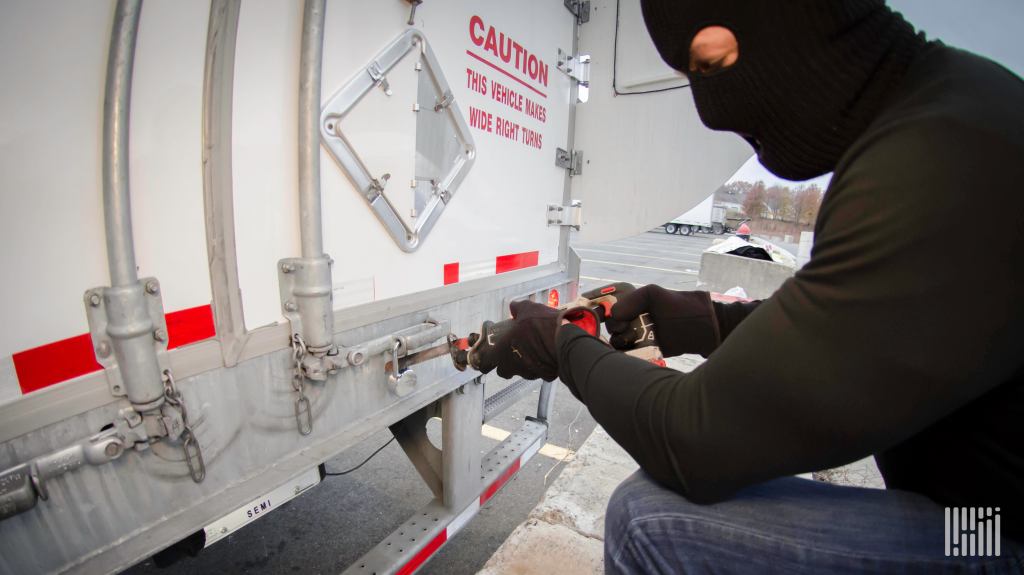
Cargo theft has been dominating headlines in recent months. As a result, logistics leaders have increased their focus on the growing prevalence of strategic theft incidents. Rampant – and often overlooked – hijacking across Mexico are another key piece of the North American cargo fraud puzzle, however.
There were 6,030 reported hijackings in Mexico between January 2023 and September 2023, according to a new data portal launched by Borderless Coverage Powered by Reliance Partners This number represents an 8% increase over the same period in 2022, representing a growing concern for shippers, carriers and individual drivers operating in the country.
While the rising number of hijackings in Mexico is alarming, it is not surprising that many North American logistics leaders are not aware of the severity of the issue. Despite often being more dangerous in nature, cargo-related crimes in Mexico receive a fraction of the attention that is afforded to similar issues happening in the U.S. and Canada.
In fact, The Mexican Cargo Hijacking Data Portal is the first and only open data source portal dedicated to highlighting this issue. Borderless Coverage produces the database by compiling and consolidating information from Mexico’s National Public Security System.
“Cargo truck hijackings are a major risk affecting companies moving goods through Mexico and from central Mexico into the U.S,” Reliance Partners reported in its key findings.
Companies should be keenly aware of this risk as the trend toward nearshoring continues to grow, causing a significant increase in the already substantial amount of cargo that moves from Mexico to the U.S. on a daily basis.
By analyzing the data they collected, Borderless Coverage was able to pinpoint where the majority of hijackings take place. The duo found that most incidents are concentrated around Mexico City, with over 85% of recent hijackings happening in Estado de Mexico, Puebla or Michoacán.
Understanding this geographical data is critical because it empowers companies to ramp up their security efforts in the right places.
Historically, logistics companies have contracted the bulk of their cross-border security efforts to areas within close proximity to the Mexico-U.S. border. These methods appear to have been successful, as only about 1% of truck hijacking occurred in border states in the first nine months of 2023. Now, however, it is time for companies to focus some of their attention deeper into Mexico in order to protect both shipments and truck drivers along their entire journeys.
The first place logistics companies – including brokerages, freight forwarding companies and carriers – should turn is their insurance companies.
“When crossing borders, many organizations do not understand that insurance law, standards, and enforceability change,” according to the Borderless Coverage website. “Oftentimes, shippers will take on the full responsibility of their cargo when it is moved into Mexico without knowing it.”
Borderless Coverage works with companies operating in Mexico, the U.S. and/or Canada to create cross-border insurance plans that works to protect valuable cargo while still affording companies the flexibility they need to operate in these vastly different environments.
Ryder opens Indiana distribution center for printing giant Lexmark
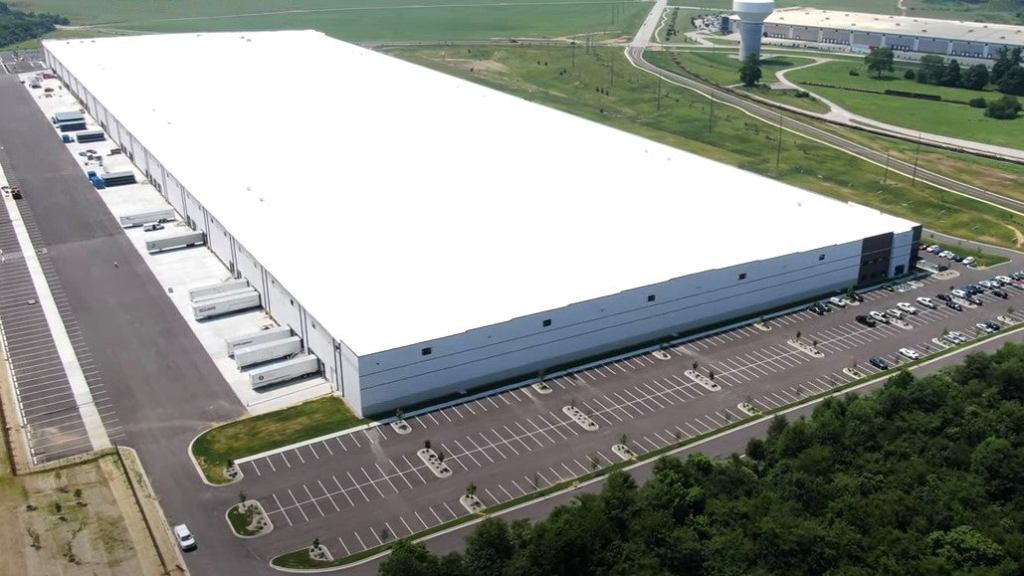
Ryder has opened a 1 million-square-foot distribution center for printer and imaging technology manufacturer Lexmark International in Jeffersonville, Indiana.
The facility streamlines Lexmark’s supply chain, while also speeding up shipping times and adding cost savings to deliveries, according to a news release.
“Lexmark’s business is time critical, so equipment handling and transit time is a primary concern, as is keeping costs competitive,” Norm Brouillette, senior vice president of supply chain for Ryder, said in a statement.
Lexmark, founded in 1991, is a privately held company that manufactures laser printers and imaging products, along with developing cloud-enabled imaging and Internet of Things technologies.
The Lexington, Kentucky-based company has manufacturing facilities in Boulder, Colorado, and Juarez, Mexico, as well as a sales office in Mexico City. Lexmark has customers in over 170 countries, and includes clients such as eBay, Panasonic Corp., and Fujitsu Ltd.
Brouillette said the Jeffersonville location was selected because of its access to major road, rail, river and air transportation options.
Miami-based Ryder (NYSE: R) is a leasing, fleet management, transportation and supply chain solutions provider.
Jeffersonville is located along Interstate 65, just across the Ohio River from Louisville, Kentucky. The distribution center is about 5 miles from the Port of Indiana-Jeffersonville, which is serviced by railroads CSX and Norfolk Southern.
“We conducted a network analysis considering markets served, shipping volumes and times, transport costs, nearby ports, real estate prices, and the labor market,” Brouillette said. “It pointed to one ideal location that would provide Lexmark with both a reduction in total outbound shipping cost and an improvement in two-day transit — not to mention the added ability to provide same-day shipping and next-day air.”
Ryder has provided Lexmark with transportation management solutions since 2009, including cross-border operations between the U.S., Canada and Mexico.
“Ryder brings the technology, solutions, and expertise we need to stay ahead of the curve in this rapidly changing supply chain environment,” Billy Spears, senior vice president and chief product delivery officer for Lexmark, said in a statement.
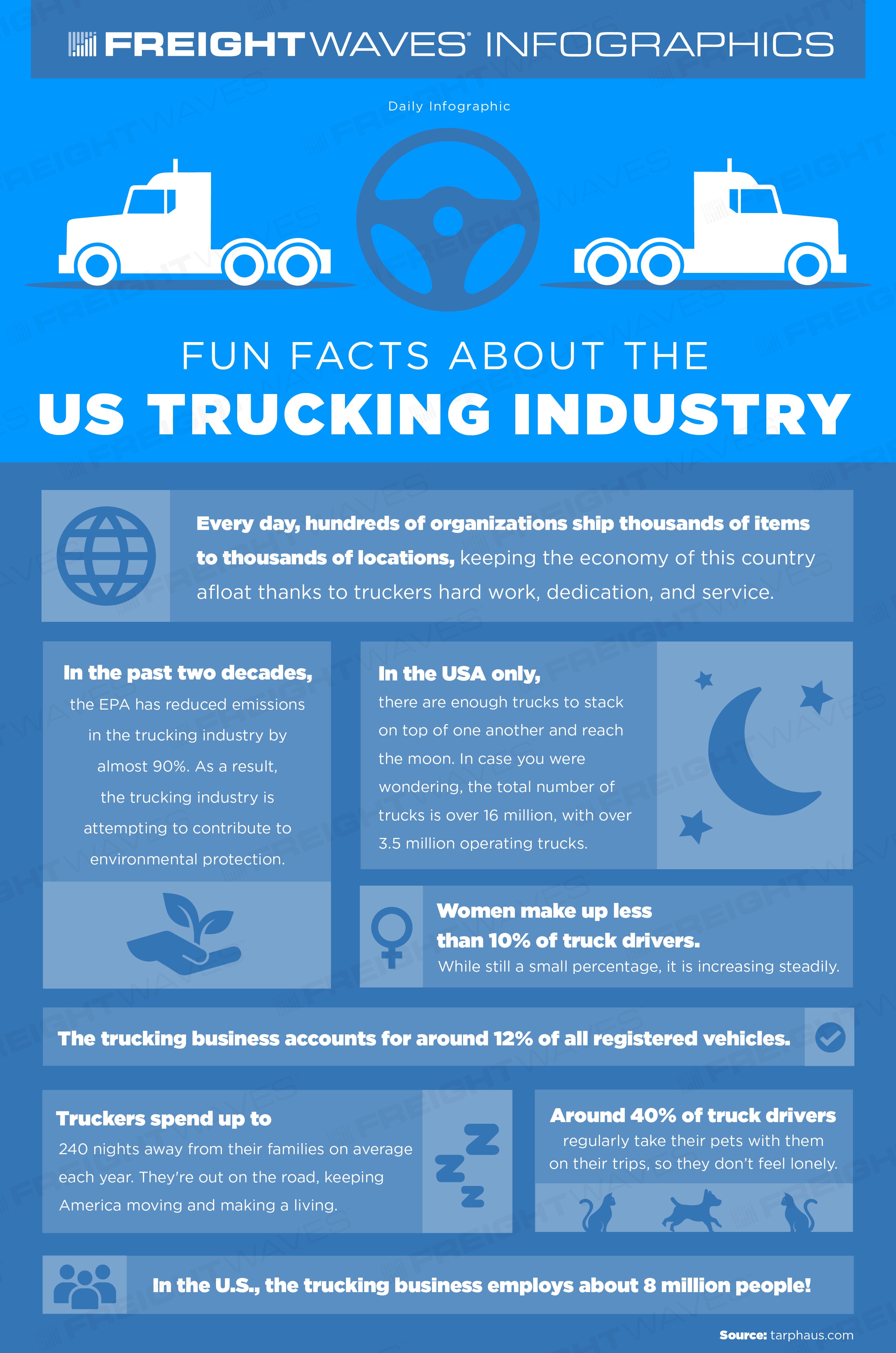
Daily Infographic: Fun facts about the US trucking industry
To view more FreightWaves infographics, click here
We got too accustomed to peaceful seas
Why don’t you gaze upon your IKEA table with wonder? This is a piece of furniture that couldn’t have existed a few decades ago. One such table could be imagined in Sweden and manufactured in China with trees from Romania. It may then transit in a shipping container on a 400-million-pound ship, on a truck to a warehouse in Los Angeles, on a train to Chicago and to your home, eventually. Such a table is yours for, say, $200 — until you get sick of it or decide to upgrade to a $400 table.
Such intensively globalized supply chains are a somewhat recent invention. There once was a time where you could not buy tangerines in Minneapolis in January or receive South Korean face wash through free, next-day shipping. Little, if anything, that we use or eat everyday did not spend some amount of time in a shipping container. “In 1956, the world was full of small manufacturers selling locally; by the end of the twentieth century, purely local markets for goods of any sort were few and far between,” wrote economist Marc Levinson in his seminal book “The Box.”
For this, we can thank (or blame) the development of the diesel-powered semi-truck, the shipping container, and intermodal rail. But above all, we must appreciate the fact that ocean trade can happen at all.
It’s somewhat ahistorical that the world’s oceans have been relatively painless to navigate in the second half of the 20th century, permitting trade to flow around the world. That was not the case for much of human history. “Pirates, predatory states, and the fleets of great powers did as they pleased,” wrote Jerry Hendrix, senior fellow at the Sagamore Institute, in The Atlantic last year. “The current reality, which dates only to the end of World War II, makes possible the commercial shipping that handles more than 80% of all global trade by volume — oil and natural gas, grain and raw ores, manufactured goods of every kind.”
Such peace can no longer be assumed. It’s unclear whether ongoing diversions from the Suez Canal will become the norm going forward, but it’s clear that things are shifting — and it’s not in the favor of frictionless trade or a U.S. hegemony.
“It was almost like you had a conveyor belt from the shoe factory in Bangladesh to the shop in Chicago,” said Simon Sundboell, founder and CEO of Copenhagen-based maritime intelligence company eeSea. “That’s just not happening anymore. You’re in a world that’s going increasingly from American-controlled unipolar to multipolar globally. You’re going to have a much more fraught supply chain, and every BCO [beneficial cargo owner], importer, exporter, and logistics provider is going to have to deal with that going forward. The Houthis are just one step in that.”
Here’s what’s going on in the Red Sea
Since the end of November 2023, a militant group called the Houthis, who control about half of Yemen, has targeted “Israeli-linked” container ships transiting the Red Sea. The Houthis, who are allied with Iran, have fired drones and missiles towards these ships, and have even landed armed men from helicopters on one of them. No ships have been destroyed and no casualties have been recorded.
“They’re trying to boost their prestige,” said Gregory Brew, an analyst for the Eurasia Group who focuses on Iran and the geopolitics of oil, of the Houthis. “They’re trying to show off, essentially: We’re the new kids on the block. Here’s our arsenal of missiles and drones. We’re capable of doing this. Don’t mess with us. But they’re also trying to have a say in what’s going on in Gaza.”
In response, the U.S. announced a naval coalition with certain allies called Operation Prosperity Guardian on Dec. 18. The U.S. Navy said on Jan. 4 that U.S. warships have shot down 61 Houthi missiles and drones.
Some 1,500 commercial ships have transited safely through the Red Sea since Operation Prosperity Guardian launched. Still, many major container shipping companies don’t seem assuaged. Data from Flexport, a global shipping platform, on Jan. 9 reflects a massive diversion. Out of the approximately 735 vessels that would be expected to traverse the Red Sea, 517 are diverting, planning to divert or already diverted the key shipping corridor. That’s 25% of the world’s overall shipping capacity by container volume.
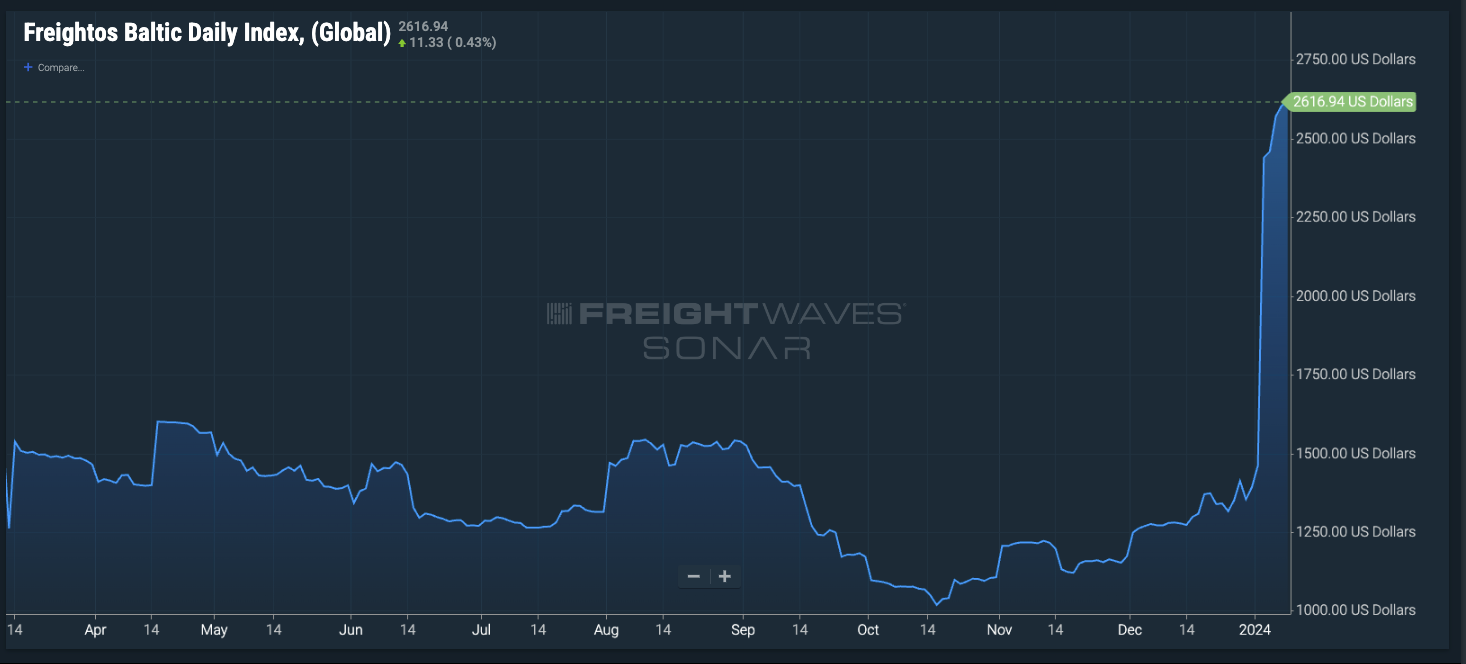
Rates from Asia to North America have popped by 75% over the last month, according to Flexport. The firm expects rates to increase by an additional 50% to 100% in the second half of January. Meanwhile, Asia to Europe rates have soared by 200% from mid-December to early January. Ocean carriers now must transit around the southernmost tip of Africa to avoid the Red Sea, increasing transit times by 10 to 14 days.
Global shipping rates have exploded since the Houthis started attacking ships in the Red Sea. (Chart: FreightWaves SONAR)
Peter Sand, the Copenhagen-based chief analyst at ocean and air freight platform Xeneta, said that has “ripple effects” for ocean trade outside of the Suez Canal. A typical container shipping company that has weekly sailings out of Asia to Europe, for example, would need to add three new ships to its service. That would likely take ships out of other parts of its service.
“That is a tall order and a tall task,” Sand said. “Not many of the big carriers have three ultra-large carriers doing absolutely nothing right now, even though the industry is working with overcapacity, but you need to find those ships and you need to feed them in.”
Diverting ships also requires ocean carriers to reorder their containers as it means a ship is visiting ports in a different order than it may have previously planned, said Anders Schulze, the Flexport senior vice president and head of ocean freight.
“That’s a very complicated logistic puzzle,” Schulze said. (I believe him!)
The attacks reveal a chasm in global trade
The Houthis claim to be attacking ships that have Israeli connections. Ocean shipping experts told FreightWaves that the uncertainty, for many companies, relates to how their ship could be categorized as Israeli-linked. Sundboell said a ship could be deemed such if, say, the carrier has previously serviced Israel in the past or if the ship has a feeder vessel that brings containers from that ship to Israel.
The Houthis have largely avoided targeting Chinese container ships. That shows how the militant group is aligned with a larger geopolitical strategy, Brew said. Iran counts the Houthis among its “axis of resistance” that seeks to repel American and Israeli influence. Going after China doesn’t align with that strategy.
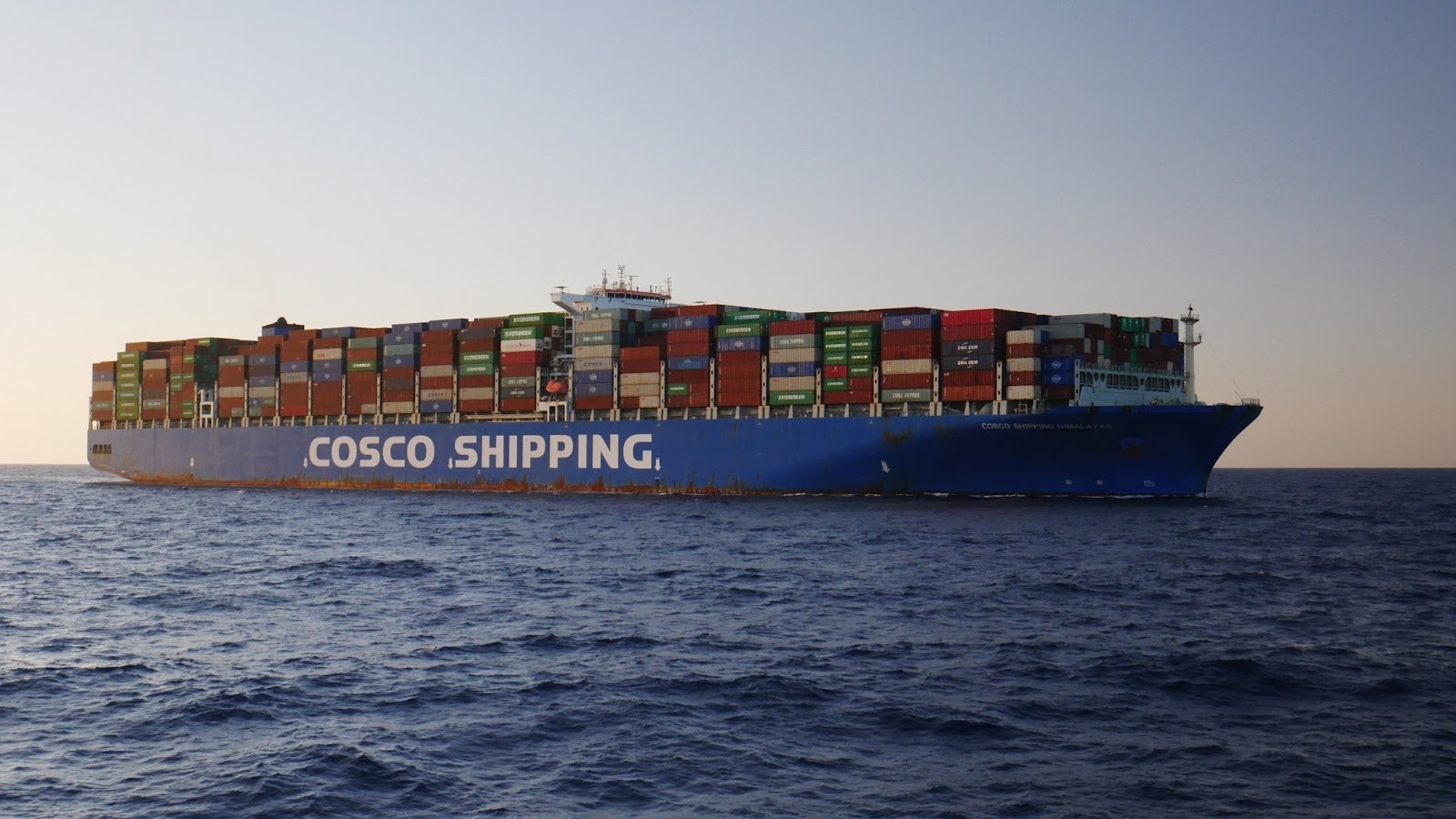
COSCO is the fourth-largest container shipping company in the world. It’s owned by the Chinese government. (Photo: Shutterstock)
“The Houthis are a little reckless as far as taking risks that other groups in the resistance front haven’t been willing to take,” Brew said. “But I think they know well enough not to go after Chinese ships, because that would complicate Iran’s relationship with China. [The Houthis] probably want a relationship with China.”
Chinese carriers have appeared to largely diverted from the Suez Canal, though without the splashy press releases that European carriers made.
Still, no one wants the Red Sea debacle to transform into a larger war
Some 15% of global shipping traffic, and 30% of container traffic, passes through the Red Sea and Suez Canal, which a key Iranian ally has disrupted. Meanwhile, 21% of the world’s total petroleum consumption transits through the Strait of Hormuz, which separates the oil-rich Persian Gulf from the rest of the seas. Iran directly borders that supply chain chokepoint.
By blocking the Strait of Hormuz, Iran could very easily throw supply chains into chaos; there’s no other seaborne route out of the Persian Gulf. It’s understandable, then, why some bellicose commentators have pushed for the U.S. military to plan for a larger land war.
Still, Brew said it’s unlikely that Iran would want such chaos, especially in the Strait of Hormuz. The heavily-sanctioned country has found much economic success in increasing its oil exports to — you may have guessed it — China.
According to a November report from Reuters, China’s oil imports from Iran, during the first 10 months of 2023, were 60% above imports during the same time span in 2017, before the U.S. had reimposed sanctions on Iranian oil trade. That’s in spite of Chinese customs not logging any direct imports from Iran since 2020. Importers appear to be using a “dark fleet” of oil tankers that have fake locations or origin points.
“The general consensus view has been: Iran wants to pressure Israel, it wants to pressure the United States, it wants the war in Gaza to end,” Brew said. “What it does not want is a regional war. It does not want the situation to escalate to the point that it starts to become directly involved.”
The Somali pirates, however, never managed to fully upheave global trade in the way that the Houthis have in less than two months. And the Houthis doing that without ships of their own or even fighter jets — just relatively cheap drones and websites that track the world’s shipping fleet.
“Global shipping has been safe because, when you only have one naval power, you only have one state exerting or projecting power over the flow of commerce,” Brew said. “If that naval power is also the hegemon, the status quo power, that means there’s really no ability for anyone to disrupt the flow of trade.
“What we’ve seen from the Houthis in Yemen has been a suggestion that the status quo may be changing,” Brew added.
It’s probably time again to remind our fine retailers and manufacturers to not depend on, say, just-in-time inventories coming from any part of the world.
“We’ve now in the past couple of years seen enough meaningful black swan events to definitely ensure that you have to have a resilient supply chain with sort of a diversified footprint,” Schulze of Flexport said. “You don’t put all your eggs in one basket. It would simply be too risky.”
At C.H. Robinson, it’s been a long, difficult trip
On Jan. 3, 2023, the transportation world awoke to the news that Bob Biesterfeld, president and CEO of freight broker and 3PL giant C.H. Robinson Worldwide Inc., had resigned his posts. The company’s stock, which had already dropped more than 15% from around $120 a share in August, registered little immediate reaction to Biesterfeld’s abrupt departure.
Analysts, however, were less forgiving, raising concerns about a leadership vacuum and the company’s general direction. Almost to a person, they began lowering their 12-month price targets, with many dropping their estimates into the double-digit range.
The ensuing 12 months proved those analysts right. In a rough trucking market, and with no clarity on a recovery plan, C.H. Robinson (NASDAQ: CHRW) shares followed the path of least resistance, which was down. Shares descended into the high $70s in the fall before drifting up into the mid to high $80s, the level it trades at today. It took six months for the board and an executive search committee to pick Biesterfeld’s successor. When it came, the new leader, an outsider with virtually no C-suite experience and a relatively modest transportation background, was not who many had expected.
A year and a week since Biesterfeld stepped down, the story has largely stayed the same. Robinson’s North American truckload volumes, the core business of the company, continue to decline. C.H. Robinson’s freight forwarding business, whose performance was so strong during the pandemic that the company considered selling it at a premium, has fallen back and is no longer on the block. Questions have been raised about the cost-effectiveness of its proprietary technology, Navisphere, especially when less-expensive and equally functional off-the-shelf alternatives exist.
The company’s costs have risen and remain mis-aligned with volume trends. Margin pressure continues almost unabated. Analysts are hard-pressed to identify trends that illustrate short to intermediate-term improvement, especially with demand and pricing expected to remain weak at least through the first half of the year. On the anniversary of Biesterfeld’s departure, Ken Hoexter of Bank of America/Merrill Lynch published a note setting a 12-month price target of $80 a share, more than $7 a share below where shares traded on Tuesday
The question is whether C.H. Robinson’s problems are due to the punishing cyclicality of the current trucking market, or if the company faces a secular problem separate from industry cycles, namely if it has lost its relevance. There are approximately 18,000 brokers in the U.S., and C.H. Robinson’s volumes could likely be absorbed without much of a hiccup should the company slide into some form of long-term abyss.
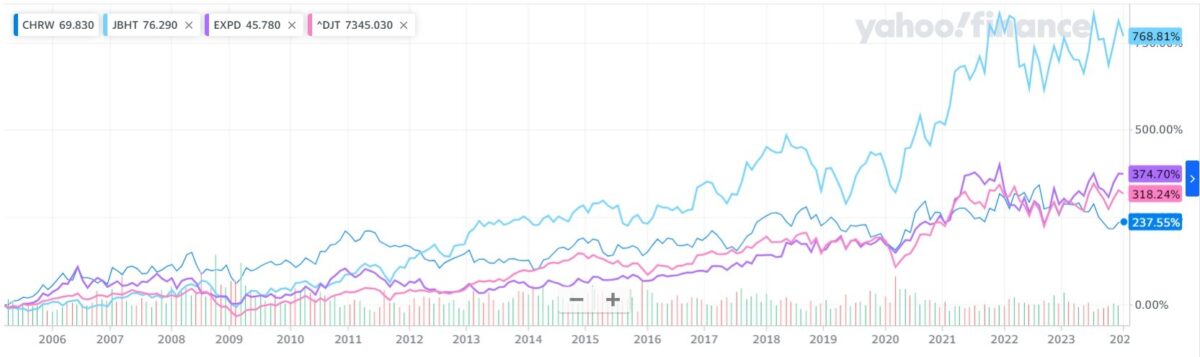
All of this is to the chagrin of C.H. Robinson’s long-term shareholders, who have relatively little to show for their investment over the past 15 years. On Jan. 5, 2009, as financial markets were mired in the depths of the Global Financial Crisis, the company’s shares closed at $49.29 per share. An expected close on Tuesday of slightly below $87 a share means that shares have gained, on a compounded basis, 3.88% a year, a dismal performance given how much the shares of competitors and the major equity indices have appreciated over that time. C.H. Robinson’s shares currently pay a dividend of 2.79%
Mollifying aggrieved shareholders is just one of the issues on the plate of Dave Bozeman, who became president and CEO of the company at the end of June. Bozeman’s hiring came despite concerns that five years serving as vice president of Amazon Transportation Services did not qualify him to run a $15 billion global enterprise, especially with Jim Barber on C.H. Robinson’s board. Barber, who expressed interest in being CEO, had served as COO of UPS Inc. (NYSE: UPS), and had run UPS’ vast international business.
Bozeman has begun to remake the C-suite, starting with a new CFO to replace Mike Zechmeister, who will retire by the end of May if a successor hasn’t been named by then. He is also pushing to improve productivity at the company’s North American Surface Transportation unit, by far its biggest operation, by 15% in 2023 and by an additional 15% in 2024. To do that, Bozeman has said he will embrace lean process strategies, uncommon among transport companies. Bozeman has created an office designed to support the company’s strategic initiatives to be run by Jim Reutlinger, a lean process expert.
In a statement to FreightWaves, C.H. Robinson acknowledged that it “could have done a better job managing costs” during the pandemic-driven market upcycle, when it brought on a lot of people and boosted its IT spending only to be saddled with excess expenses during the subsequent downturn. It added in the statement that the “strategies and productivity improvements currently being implemented, combined with our expert people and strong customer value proposition, are putting the company in a better and more competitive position.”
A truckload of challenges
Bozeman had nothing to do with C.H. Robinson’s subpar performance over the past decade in a half. For that, there are any number of explanations. Founded in 1905, Robinson spent 92 years as a private company before going public in mid-1997. Not every deeply ingrained privately held culture is able to optimally adapt to the unfamiliar rigors of the public markets.
“I’ve always contended that the worst thing they could have done was to go public,” said Jason H. Seidl, analyst at investment firm Cowen & Co.
C.H. Robinson’s first 10 or so years as a public firm were bountiful, mainly because it remained the go-to broker in a world where many carriers did not have in-house brokerage businesses. C.H. Robinson’s world began to change after asset-based carriers, realizing that the company was using their assets to call on their customers, and reaping big margins in the process, began to develop their own brokerage arms and in the process undercut C.H. Robinson on pricing. according to Seidl,
A source familiar with C.H. Robinson said the proliferation of asset-based brokerage divisions was part of the problem, but far from all of it. Pure-play truckload brokerages such as TQL, Arrive Logistics and Echo Global Logistics, have been around for 10 years or more and have managed to compete with C.H. Robinson and grow their truckload volumes over the past five years while Robinson’s traffic has stagnated or declined, the source said.
The rivals’ push into C.H. Robinson’s core business begs the hardest question of all, the source said. “If you’re not a truckload broker, then what are you doing,” the source said.
Part of the blame, the source said, lies with board governance. Four of the company’s 12 board members have served for 10 years or more, and must take some degree of responsibility for the company’s underperformance, the source said. Two board members were added in 2022 at the request of Ancora, which owns 2% of Robinson’s stock and has been pushing for changes within the enterprise.
Tweaks in final independent contractor rule could benefit trucking
More than a year after it was first proposed, the Department of Labor has formally released its final independent contractor rule that one leading analyst said was “little … changed substantively in comparison to the proposed rule.”
But there are provisions in the changes, though minor, that are being viewed as positive for the trucking industry.
The DOL’s rule becomes the guidance that the Wage and Hour division of the DOL will use in settling issues that come before it.
Reibstein, in a blog post published soon after the early Tuesday release of the rule, said there was “no surprise” in the final version. “Only a few tweaks were made despite the fact that over 55,000 comments to the proposed regulation were posted in a two-month period by individuals and organizations both in support of and in opposition to the proposed regulation,” he wrote.
Within an hour of the rule being published in the Federal Register, the American Trucking Associations released a statement blasting its contents.
“I can think of nothing more un-American than for the government to extinguish the freedom of individuals to choose work arrangements that suit their needs and fulfill their ambitions,” ATA President Chris Spear said of the rule.
“It’s unfortunate that the Administration has chosen to replace a clear and straightforward standard with a tangled mess that weakens our supply chain and undermines the livelihoods of hundreds of thousands of truckers across the country. ATA will work with members of Congress and other stakeholders to defeat this ill-advised rule.”
That apocalyptic view of the rule differs sharply from what Reibstein wrote. In his blog posted Tuesday, he referred back to an earlier statement of his on the proposed rule. “Unlike most regulations with hard and fast rules, the regulation was in the nature of an administrative interpretation comprising the Labor Department’s review of existing court decisions and its articulation of a preferred legal analysis … [that] courts would give little if any deference to.”
His conclusion was that “the Biden Administration’s final 2024 regulation is no different.”
“Incrementally positive”
Trucking-focused law firm Scopelitis said in an email alert that “as compared to the initial proposed rule, there were some incrementally positive changes in response to comments filed by commenters, including comments filed by Scopelitis, though not enough to make the final rule favorable on balance.”
One area cited by Scopelitis is a change in the consideration of capital investment by a worker.
Whereas the word “truck” and “trucking” were barely mentioned in the proposed rule, there is an extensive discussion of independent contractors and their owned or leased vehicles in the final rule.
One of the more controversial aspects of the original rule was that investments by a worker were not necessarily evidence of “capital or entrepreneurial investment” and would not necessarily indicate independent status. That could be read to include ownership of a truck.
Use of personal equipment
For example, the proposed rule said that “the use of a personal vehicle that the worker already owns to perform work — or that the worker leases as required by the employer to perform work — is generally not an investment that is capital or entrepreneurial in nature.”
That provision alarmed many in the trucking sector. The DOL rule published Tuesday noted that Real Women in Trucking, in a comment submitted about the rule, said of truck drivers who own their vehicles: “Truck drivers who wholly own or independently finance a truck are true owner-operators because ‘[t]his type of investment gives [them] the ability to keep their truck if they decide to stop working for any particular company, and accordingly some measure of economic independence.’”
While the DOL did not outright change its original proposal, it did express sympathy for some of the arguments it received that were similar to those of Real Women in Trucking and would modify its view on investment.
Looking at investments in a “qualitative” manner — the types of investments rather than a dollar amount — ”is a better indicator of whether the worker is economically dependent on the employer for work or is in business for themselves,” the DOL wrote. “That is because regardless of the amount of size of their investments, if the worker is making similar types of investments as the employer of investments of the type that allow the worker to generate independent in the worker’s industry or field, then the facts suggest that the worker is in business for [themselves].”
The end results were revisions in the DOL’s language on investments. New wording focuses on the qualitative nature of the investment, not just the quantitative, and that the DOL’s focus should be on whether the investments are similar to the investments the employer needs to make. That would seem to suggest that a trucker owning a truck might be seen as making the same type of investment as a trucking company, raising the possibility that the worker will be found to be independent in a case before the Wage and Hour division.
Six key factors
The six key factors in the Biden administration rule are similar to what was in the Trump rule. Determination of a worker’s status as an employee or independent contractor is dependent upon:
The extent to which the services in question are an integral part of the employer’s business.
The amount of the so-called contractor’s investment in facilities and equipment.
The nature and degree of control by the principal.
Opportunities for profit and loss.
The amount of initiative judgment or foresight required for the success of the claimed independent enterprise.
Permanency of the relationship.
There is also a provision for unspecified other factors.
The Trump rule used the same six factors as the Biden rule. But when the Biden DOL rule was first proposed, observers said it differed from the Trump rule in that the latter elevated the issues of control and opportunity to profit above the others. The totality of the circumstances approach in the Biden rule has all six factors as equal.
Another key concern in the original rule was a suggestion that if an employer required an independent contractor to take certain legal or safety-related steps, that could be seen as proving control.
But Scopelitis liked what it saw in the revised rule. “The final rule includes a change so that actions taken for the sole purposes of compliance with a specific law or regulation are not indicative of control,” the law firm said. “However, actions beyond compliance with a specific law or regulation and those taken for the putative employer’s safety or quality control standards may be indicative of control.”
And in a clear victory for the trucking industry, the DOL concluded that having a CDL is a “specialized skill.” That consideration can aid in finding a worker to be an independent contractor.
“The Department clarifies that it recognizes the distinctive nature of CDLs and further recognizes that drivers performing work requiring such licenses are likely using specialized skills as compared to drivers generally,” the agency said. “As with any worker, consideration of whether a driver with a CDL uses that specialized skill in connection with business-like initiative determines whether this factor indicates employee or independent contractor status.”
Scopelitis called that finding “potentially helpful.”
The history of the DOL’s IC rule is that the Trump administration rule, viewed as leaning more to a definition of certain workers as independent contractors, was implemented in the final days of that administration. The incoming Biden administration yanked it, but a court later said that revocation was illegal and the Trump rule went back into effect. It now will be replaced by the Biden administration’s rule.
Reibstein’s blog reminded its readers that while the DOL rule has been the source of controversy, it isn’t the end-all in independent contractor regulation.
“Regulatory bodies do not have the final say on who qualifies as an independent contractor and who does not; courts do,” he wrote. “Regulations are not laws. (His italics). While courts typically give deference to valid regulations, that is not a given where regulations keep changing and where the regulation appears to be little more than an agency’s interpretation of prior court decisions on a particular subject.”
Logistics veteran joins board of insurtech LuckyTruck
Despite challenges, the trucking industry has seen improvements in operational efficiencies and enhanced driver safety through technology adoption. However, insurance costs are rising as a result of nuclear verdicts and increased repair expenses.
Yet, logistics professionals and technology experts believe that by leveraging telematics and operational data, insurance costs can be lowered and can become more competitive.
This is the thesis behind trucking insurance startup LuckyTruck, a commercial trucking retail insurance agent that uses historical truck data and automation in its platform to provide one place for carriers to purchase and manage their insurance functions.
Will Urban takes a board position at insurance provider LuckyTruck. (Photo: Matternet)
The company announced it has appointed Will Urban to its board of directors to help manage top and bottom-line growth at LuckyTruck.
“LuckyTruck has the right go-to-market strategy in place already. They have been focused on product and service execution, which has poised them for growth,” Urban told FreightWaves. “They have a great sales leader, and their CEO, Julie Zimmer, knows how to sell and is a very compelling person to listen to in this space. I am certainly going to leverage my network to get folks I think would benefit from the LuckyTruck service offering.”
Before joining the company’s board, Urban spent 30 years contributing to the logistics industry at several legacy companies, including 25 years at Expeditors. He most recently led growth strategies at technology-enabled freight forwarder Flexport as the company’s chief revenue officer.
Urban currently advises several FreightTech companies —Matternet and BorderBuddy— and holds venture partner roles at r7 and Companyon Ventures.
“Working with literally hundreds of trucking companies or large importers that have their dedicated fleets over the years, I understand the challenges they face. Not just for insurance, but the overall landscape in terms of managing their businesses. Running a successful trucking company and/or fleet is extremely challenging,” Urban said of the current industry obstacles.
With all these challenges in mind, Urban believes the right technology solution can make the insurance landscape less disheartening for carriers.
“I think it’s all about driving down the cost to serve in all aspects of the supply chain, insurance being one of them. … Obtaining pricing and understanding insurance is difficult and daunting. LuckyTruck can help its customers do that by using tech to streamline and democratize the process and give the smaller guys a competitive advantage,” said Urban.
According to its website, LuckyTruck is currently serving more than 700 customers on its platform.
In April 2022, the company raised $2.5 million of seed funding in a deal led by Candid Insurance Investors with participation from SiriusPoint, Markd, Draper University and Blue Trail Partners. It has raised a total of $6.5 million since being founded in 2019.