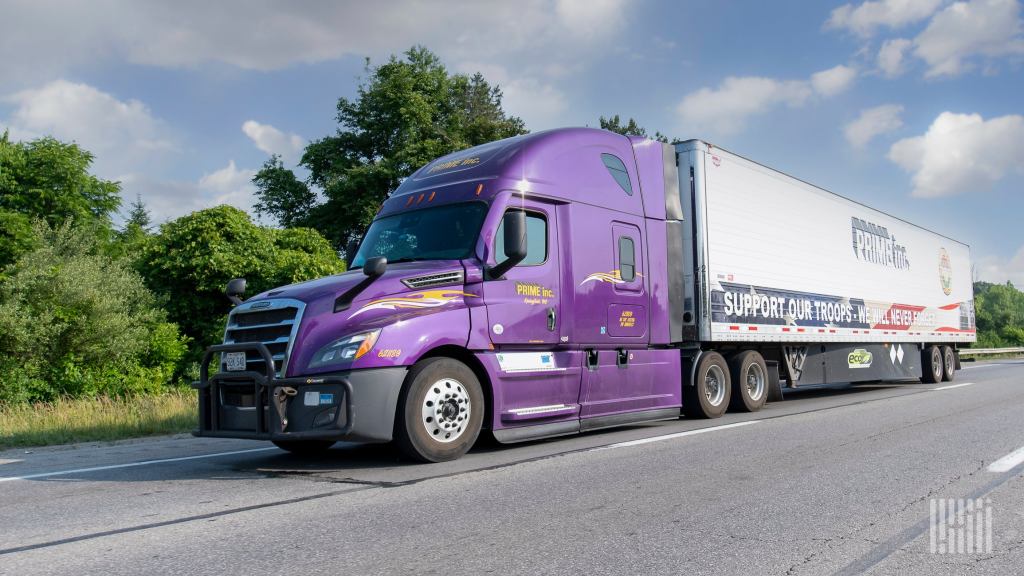
Prime moves into hopper trucks with highly transparent way of announcing it

Giant truckload carrier Prime is getting into a new business, and on Wednesday, it took a highly public approach in letting the world — and prospective drivers — know about it.

In a live presentation and question-and-answer session on Prime’s YouTube channel, two leading executives at the company announced that Prime would be adding hopper service to its offerings, with an initial focus on a few cities and routes that will allow drivers to generally be home at nights and on weekends.

Brett VonWiller, Prime’s director of its tanker division, said on the company’s YouTube channel that the idea for a move into the hopper market came at a conference last spring, where VonWiller said he and a colleague had attended “looking for new business.”

“And a majority of those customers that we reached out to asked us if we had hopper trailers as a way to get into the hopper business,” VonWiller said. Some of the queries came from existing customers and others came from new prospects, he added.

“So we came back, huddled up and decided it was something we wanted to look into and get involved with.”

VonWiller said operations began Tuesday with seven loads, all focused in the Indianapolis area. Prime’s new hopper division is starting with 25 trailers “and we’re going to start with our core customers,” he added.

At the helm of the group is Kyle Walk, an 18-year veteran of Prime who was on the video presentation with VonWiller. He had been working in Prime’s tanker group and “[VonWiller] approached me that we’ve got this hopper thing going on, and there’s a lot of potential there.”

 Walk said the hopper business initially will be moving agricultural products like corn, soybeans and meal mixes. “There’s a lot of other commodities out there that we’re interested in,” he said. “We’re just kind of getting our feet wet right now, but there is some potential to move other products.” He cited salt and rocks as areas for possible hopper business expansion. 

Truck hopper traffic is often billed by the bushel or weight, Walk said, though drivers will be paid per mile. Some of the routes the Prime hopper business plan to expand in are longer and those will be billed on a mileage basis, Walk said.

Expansions are set for Tennessee and Maryland, VonWiller said, though drivers for that business are lined up. But that was a prelude to the recruiting part of the call, as VonWiller urged potential drivers interested in joining the Prime hopper team to send an email to Walk, preparing for future growth.

Walk said the initial focus on grain helps to ensure drivers operate a daytime schedule without weekends. Grain elevators do not operate at nights or on weekends, he said, “so the majority of your workload is going to be Monday through Friday.”

“You’re probably going to be sleeping at home every night and have a little bit more home time,” Walk said. 

The seasonal aspect of hauling agricultural products actually isn’t all that extreme, Walk said. Silos, as Walk said Prime has learned, “can hold quite a bit of product.” Harvest season kicks off around August, but there is product being delivered out of the silos into June. “So we think that year-round, we’re going to stay pretty busy,” Walk said. 

More articles by John Kingston

SoCal warehouse emissions rule and possible impact on trucks upheld by judge

California holds off on only allowing zero-emission vehicles in drayage registry

Logistics M&A slower but opportunities still there

C.H. Robinson creates office to implement strategic initiatives

Brokerage and logistics giant C.H. Robinson Worldwide Inc. said Thursday it has created an office designed to support the company’s strategic initiatives and has tapped a lean processes methodology expert to run it.

The Program Management Office, which came into being Wednesday, is headed by Jim Reutlinger, who headed his own consultancy after many years at Danaher Corp., a global conglomerate that designs and manufactures medical, industrial, and commercial products and services. Reutlinger had been serving as a consultant to Robinson.

According to a statement from Eden Prairie, Minnesota-based Robinson (NASDAQ: CHRW), the new office will be “focused on strengthening capabilities needed to further enable” the company’s strategic priorities. Reutlinger, who was named vice president, enterprise strategy program management, reports to Dave Bozeman, Robinson’s president and CEO, who assumed the top job last June.

The office’s launch is seen as a step in Bozeman’s implementation of a strategy to revive Robinson’s flagging fortunes. The company, the nation’s largest freight broker and a sizable 3PL, has experienced income and revenue declines for a number of quarters and has been hit hard by the deep freight recession. It did not participate strongly in the freight upturn during and after the pandemic and was caught with a bloated organizational infrastructure when freight markets turned down. It has also been criticized for not having the IT chops needed to respond to increasing digital demands from shippers and carriers.

Bozeman has spent much of his first six months or so learning about Robinson’s business and devising a plan to turn things around. Reutlinger’s appointment dovetails with Bozeman’s plans to apply lean process structure to Robinson’s operations. Robinson, like many in the transport sector, has not pushed aggressively into lean process management. One company that did, the old Con-Way Inc., had its lean less-than-truckload operations dismantled by XPO Inc. (NYSE: XPO) following XPO’s $3 billion purchase of Con-Way in 2015.

Separately, Robinson disclosed that it has agreed with activist investor Ancora, which controls about 2% of Robinson’s stock, to renominate Ancora’s two appointed board members.

In a Dec. 29 filing with the Securities and Exchange Commission, Robinson agreed to renominate current Directors Henry “Jay” Winship and Henry J. Maier, provided that Ancora doesn’t nominate other individuals to the board, make any proposals or engage in any proxy solicitation ahead of Robinson’s annual stockholder meeting in May.

Last January, Ancora signed a one-year extension of a prior agreement from February 2022 that put two Ancora representatives on the Robinson board but with the promise that Ancora would not seek changes at the company for at least another year.

West Coast shipping rates surge as Red Sea fallout goes global

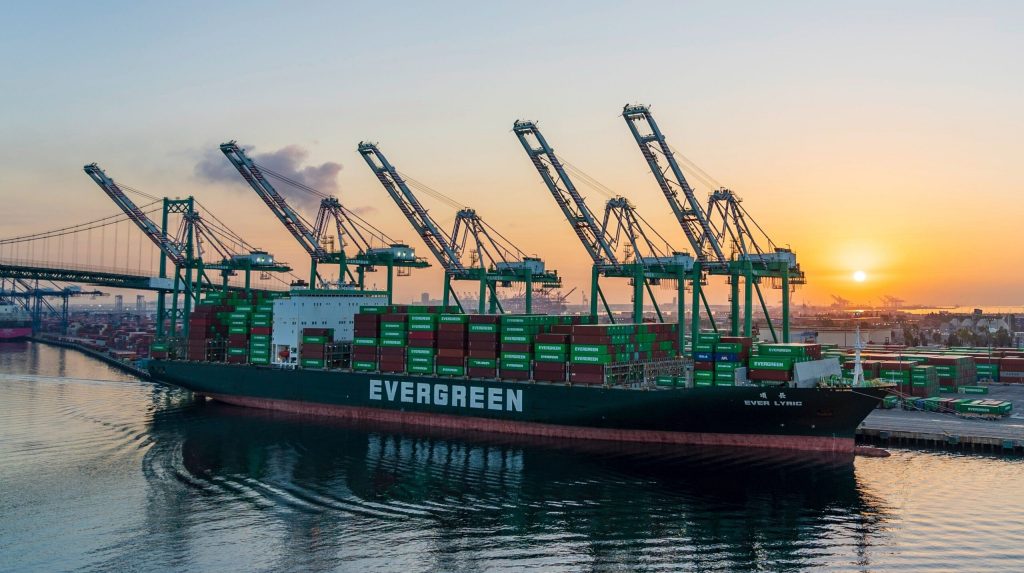
a ship on West Coast; Red Sea crisis now affecting West Coast rates

As Red Sea disruptions intensify, container shipping spot rates are rising on the other side of the globe: for cargo shipped from Asia to the U.S. West Coast.

The Red Sea crisis coincides with drought restrictions in the Panama Canal. Asian cargo bound for East and Gulf Coast ports had previously been switched from Panama to the Suez Canal, and is now being rerouted on even longer voyages around the Cape of Good Hope.

The much shorter route from Asia to the West Coast is looking increasingly attractive.

At 14 knots, a direct voyage from Shanghai to New York via the Cape of Good Hope takes 43 days, according to Sea-Distances.org. A direct voyage from Shanghai to Los Angeles takes only 17 days (plus additional time for cross-country land transport).

The question now is how long Panama and the Red Sea disruptions will persist, giving new strength to Asia-West Coast spot rates.

Annual trans-Pacific contracts generally run from May 1-April 30 and are negotiated in February-April. If trans-Pacific spot rates are supported for months, not weeks, disruptions could push annual contract rates higher.

Asia-West Coast rates up double digits

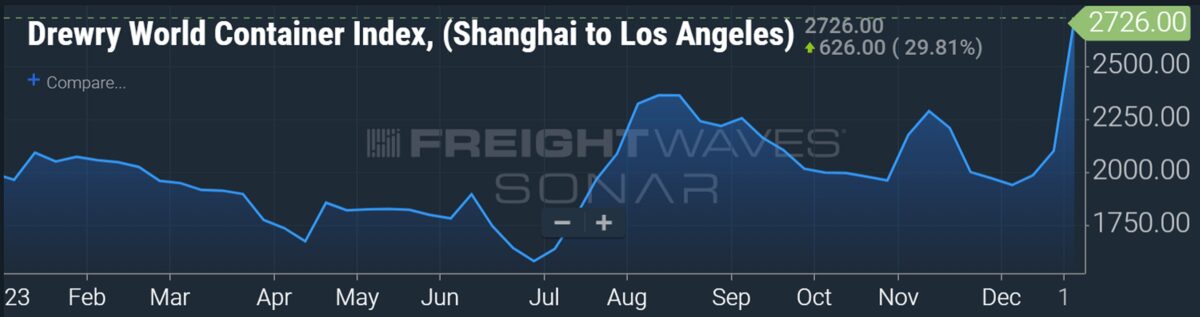
The Drewry World Container Index (WCI) assessed Shanghai-Los Angeles spot rates at $2,726 per forty-foot equivalent unit for the week ending Thursday, a jump of 30% from the prior weekly reading (Dec. 21, due to the holiday break).

Spot rate in USD per FEU. (Chart: FreightWaves SONAR)

The Freightos Baltic Daily Index (FBX) put China-West Coast rates at $2,713 per FEU on Wednesday. Compared to pre-COVID levels, the current FBX reading is now 34% above rates at this time of year in 2019 and 95% higher than rates in early January 2020.

Spot rates in USD per FEU. Blue line: 2023-2024. Purple line: 2019-2020. Yellow line: 2018-2019. (Chart: FreightWaves SONAR)

The FBX China-West Coast index surged 73% between Monday and Wednesday. The FBX China-East Coast index — which is directly exposed to Panama and Red Sea issues — was at $3,900 per FEU on Wednesday, up 51% from Monday.

Spot rates in USD per FEU. Blue line: China-West Coast. Green line: China-East Coast. (Chart: FreightWaves SONAR)

Xeneta tracks both short-term (spot) and long-term (contract) rates. Its data showed average Far East-West Coast spot rates of $2,282 per FEU on Thursday, up 28% from Sunday.

(Chart: Xeneta)

Far East-West Coast contract rates exceeded spot rates for virtually all of 2023, even as annual contract rates reset much lower last spring, according to Xeneta data. However, after the recent spike, average spot rates are now 36% higher than average long-term rates in this lane (for all contracts still in place, including those signed during the last round of annual negotiations).

Will disruptions boost trans-Pacific contract rates?

Whether recent West Coast spot rate gains hang on long enough to boost annual trans-Pacific contract rates that renew in May hinges on the duration of Red Sea and Panama Canal disruptions.

The Red Sea situation is highly uncertain. On Wednesday, a U.S.-led military coalition issued a final warning to the Houthis, implying that ground strikes in Yemen could be imminent. There was yet another security incident on Thursday; a Houthi seaborne drone laden with explosives detonated in the Red Sea.

Meanwhile, Panama Canal restrictions look almost certain to extend through the trans-Pacific contract negotiation period, despite higher-than-expected rainfall in November that prompted a modest increase in transit reservation slots for this month and February.

Panama is currently in the midst of its dry season. The next rainy season begins in May, by which time annual trans-Pacific contracts will have already been signed.

“Come May of 2024, the rainy season will restart and that is the time horizon we have been working for,” said Ricaurte Vásquez Morales, the head of the Panama Canal Authority (ACP), in a presentation in late December.

“Everything we do as far as scheduling, reduction of transits, adjusting advisories and regulations, allocation of slots and everything else we do to manage capacity is geared toward operating the canal throughout the dry season. When the rainfall restarts we will normalize our operations, depending on the actual precipitation we see.”

Deutsche Bank: ‘A short-term phenomenon’

Amit Mehrotra, transport analyst at Deutsche Bank, does not believe the current rate strength is sustainable.

“We believe upward pressure on rates will be a short-term phenomenon based on the overall container freight environment, which remains challenged,” Mehrotra cautioned in a research note on Thursday.

“Based on the latest orderbook and delivery schedule, we expect net fleet growth of 7-8% in 2024 and 5-6% in 2025 [while] ton-mile demand growth is likely to increase by just 3-4% in 2024 and 3-4% in 2025.

“In other words, we don’t believe we are returning to any multi-quarter or multi-year container freight cycle like we saw during the pandemic. While the current situation may be positive for freight rates in the short term, this is happening against a larger backdrop of a weaker container freight market.”

Regarding the Red Sea crisis, Mehrotra said, “Geopolitically, the U.S., Europe, Egypt, China, etc. all have a vested interest in ensuring the free flow of energy commodities and containerized goods through the Suez Canal. Given the number of self-interested parties wanting stability in the region, we think it is only a matter of time [before] some stability is enforced.”

Click for more articles by Greg Miller 

Conagra’s supply chain is ‘humming again’

Conagra sees evidence of continued consumer caution

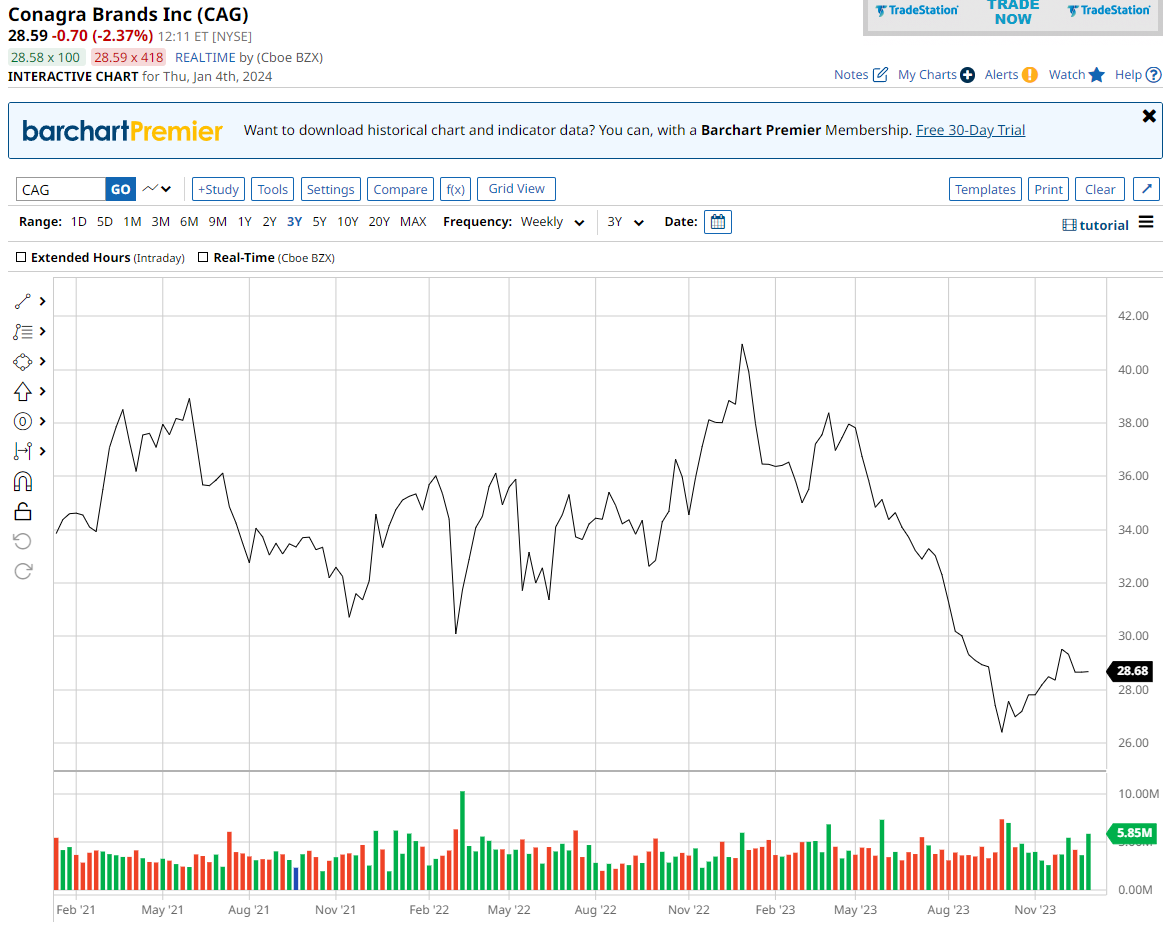
Conagra shares are down 26% in the past year. (Chart: Barchart.com Inc.)

One of the biggest CPG events of 2023 was Conagra Brands highlighting a shift in consumer behavior last spring. At that time, it became increasingly evident that inflation was pressuring grocery store purchases, such as consumers making meals from scratch instead of more convenient ready-made meals that Conagra sells. Management considers those shifts temporary. On Thursday’s analyst call, while still labeling those shifts temporary, management said it sees lingering evidence of consumer caution and that shift back to “normal” has been slower than expected. Accordingly, management cut sales guidance for its fiscal year to a decrease of 1%-2% from guidance of a 1% increase. Even so, the company put a positive spin on volume declines by citing a narrower year-over-year volume decline in fiscal Q2 of 3.5%, relative to year-over-year volume declines of 7%-9.9% the prior three quarters. CEO Sean Connolly said, “the supply chain is humming again, especially on key brands and around merchandising windows.” In addition, its now-fluid supply chains mean there are more opportunities for new product introductions, such as canned Wendy’s chili. Management also cut margin guidance — to 15.6% from 16%-16.5%; the company is expecting 3% cost inflation this year with inflation in tomato-based ingredients more than offsetting deflation in edible oils.

Health to be major CPG focus this year

These two Just Food articles (here and here) described that trend well and also challenged my thinking on plant-based foods. Rather than being dead in the water, the possibility remains for the category to recover from the past two years’ challenges by adjusting formulas. The misstep wasn’t just that plant-based alternatives offered worse taste at higher prices (a tough sell in any environment, but particularly when living costs rise), but also that the demographic interested in plant-based alternatives wants to avoid ultraprocessed foods. In short, consumers were unconvinced that plant-based alternatives were any healthier. Food companies could shorten their ingredient lists and remove ingredients that are difficult to pronounce, a tip of the hand that the food is ultraprocessed.

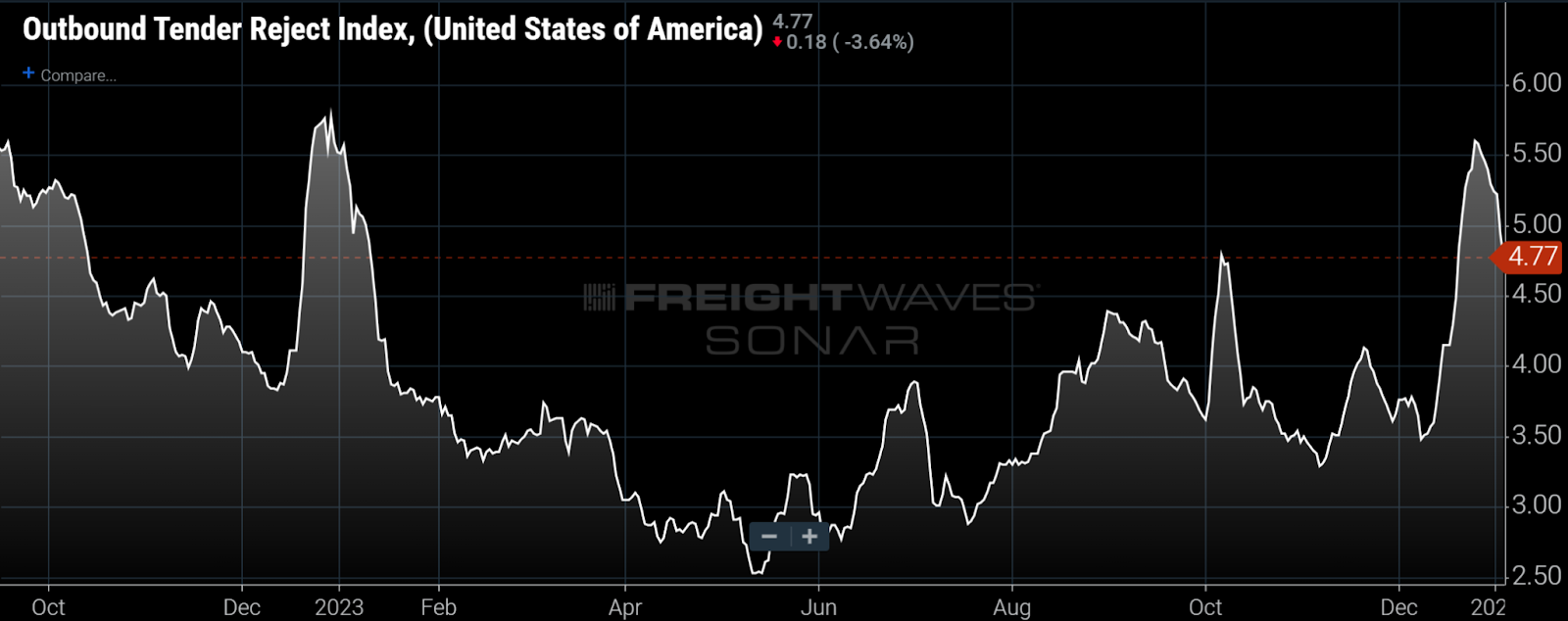
Tender rejection rates likely to stay below 5% amid seasonal weaknessRejection rates reached their recent high of 5.6% on Christmas before steadily declining to the current 4.77%. As more capacity enters the market as drivers return from holidays, tender rejection rates are likely to decline further in the seasonally soft January and February, perhaps settling in the 3%-4% range. The overall tender rejection rate shown above is primarily driven by the dry van rejection rate of 4.58%. The current national reefer and flatbed tender rejection rates are 7.91% and 10.1%, respectively.
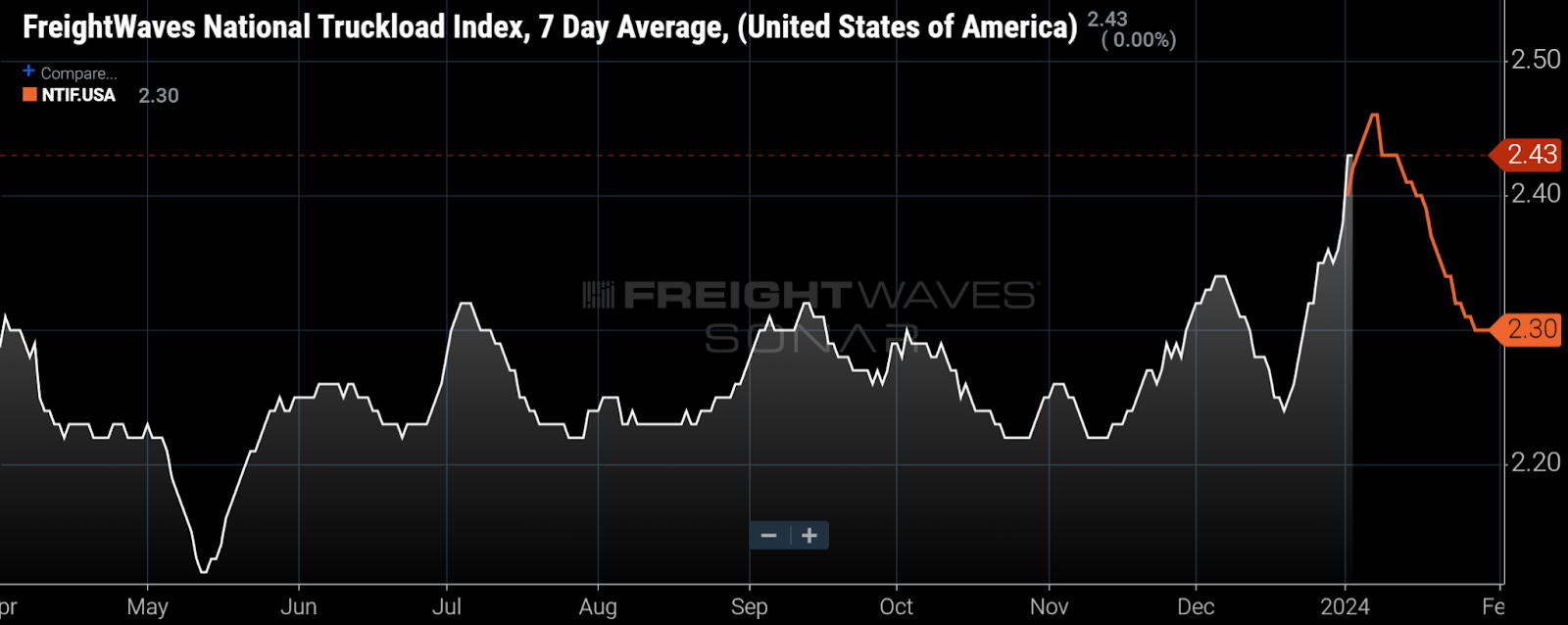
SONAR forecasts a 5% average spot rate decline by the end of the month.  

Red Sea turmoil could boost rail intermodal volume

While the trade lanes that traverse the Red Sea and Suez Canal are far more important for Europe than for North America, the situation is also having an impact on rates and routings for Asia-to-U.S. cargo. Prior to the attacks, ocean carriers, including Maersk, had been diverting vessels away from trans-Pacific routings in favor of routings through the Suez Canal in response to drought conditions at the Panama Canal. The situation changed by the day as ocean carriers have taken different approaches and have gone back and forth on whether they would traverse the region. If the attacks continue, a greater share of U.S. imports would traverse trans-Pacific routes, hitting the U.S. West Coast. Freight hitting that coast is far more likely to move via rail intermodal than freight that hits the East Coast ports. (Some estimates are 65%-70% versus 20%-25%.) In addition, longer routes’ avoidance of the Red Sea not only reduces the productivity of oceangoing vessels, but also reduces the productivity of international containers, including disrupting the repositioning of those containers. The potential for a scarcity of international containers encourages the transloading of imported goods hitting the West Coast ports from international containers to domestic containers, which could benefit carriers including J.B. Hunt, Hub Group and Schneider. For ongoing coverage of the Red Sea, see our maritime articles here.

To subscribe to The Stockout, FreightWaves’ CPG and retail newsletter, click here.

Vocational trucks, Mexico demand prop up Class 8 orders

Lower-than-expected Class 8 truck orders in December barely impacted the seasonally adjusted five-and-a-half months it takes to build and deliver a new unit. Strong orders for vocational trucks, demand in Mexico and exports softened slack bookings for over-the-road tractors.

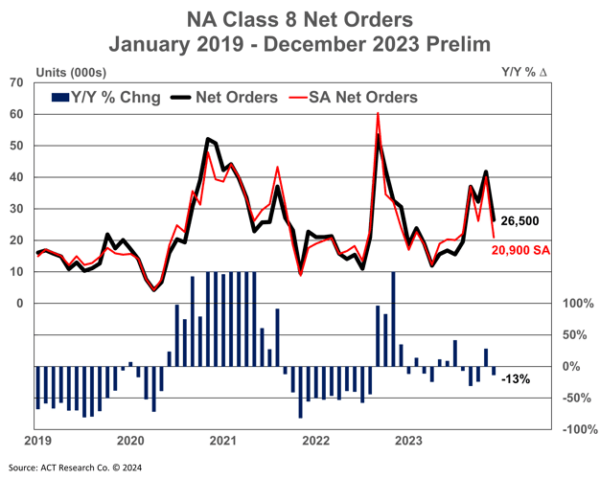
Preliminary North America net orders of 26,500 in December came in 15,000 below November. Adjusted for seasonal factors, the intake was closer to 20,900, ACT Research reported.

2023 orders down 7% compared t0 2022

Full-year 2023 orders fell to 278,500 units, down 7% from 2022, according to ACT. Truck manufacturers produced about 337,000 Class 8 trucks last year — far more than orders supported. But the backlog of about 180,000 units left the industry in good shape entering 2024, Kenny Vieth, ACT president and senior analyst, told FreightWaves.

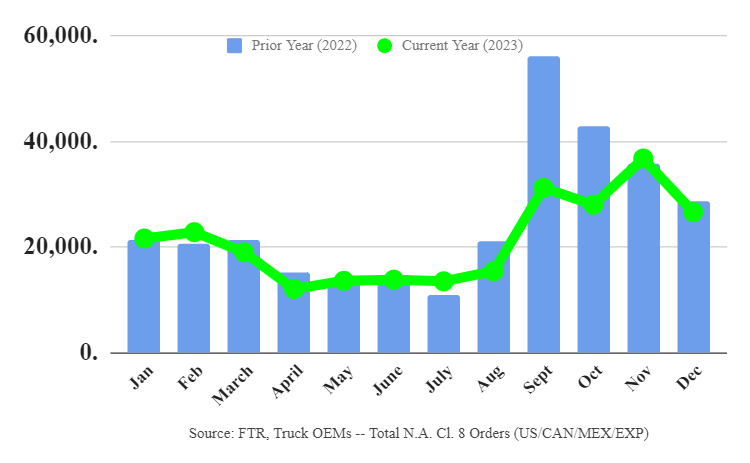
FTR Transportation Intelligence put the full-year order number at 253,000 with the annualized rate over the past six months at 302,000 units. The last quarter of the year ran at an annualized rate of 362,000 units.


Class 8 orders fall in final report of 2023


FTR pegged preliminary December orders slightly higher at 26,620. That was 26% below November and 6% lower than December 2022.  

“Despite the slight year-over-year decrease in orders in December, the market is still performing at a high level historically,” Eric Starks, FTR chairman, said in a news release. “Even as the freight markets have been weak for an extended period, fleets are still ordering equipment.”

Pent-up demand from 2021 that followed the pandemic was largely sated in 2023, according to ACT. About 12,000 new trucks were exported in 2023. Thousands more used Class 8 tractors also found their way to Central America, the Persian Gulf and some parts of Africa, Vieth said.

Seeking a soft landing for Class 8 equipment in 2024

“The tractor market is unfortunately overcapitalized, so there’s no avoiding some slowdown in 2024,” ACT’s Vieth said. “There are lower lows in the trough because of the ongoing strength in vocational, Mexico and export markets.”The Mexican economic recovery helped it pull ahead of China in July as the biggest trading partner for the U.S. 

“As the Mexican economy has revived, demand has been constrained because U.S. and Canadian truckers were in line first,” Vieth said. “You had a very weak pre-pandemic Mexican new truck market. As a result, the fleet age is as old as it’s been in 20 years.

“We’ve been talking about reshoring for a decade. But between the supply chain breakdowns and COVID, over the last couple of years it has been more than lip service.”

Vocational demand a support pillar but pull-ahead orders could deepen trough

Strong orders of vocational trucks needed for commercial construction and oil production should continue in 2024.

“There’s a lot of brick and mortar being put in place on the heels of the infrastructure and CHIPS acts,” Vieth said. 

Fleets and dealers elevated orders in California last year ahead of the delayed Advanced Clean Fleets rule that was supposed to begin setting quotas for zero-emission truck purchases this month.

“You had a pull forward in 2023 because of California, so that becomes a drag in 2024,” Vieth said. “The question becomes as you look out into EPA (nitrogen oxide emissions rules in) 2027, when does that [pull-ahead] start? 

“The OEMs will say they’re going to do everything they can to get their customers to start spending money in 2024 because they want to make this ’24 trough as shallow as they possibly can. But because of these ancillary markets doing well, that helps with a soft landing. We call it the best recession ever.” 

New Class 8 truck deliveries fall for 4 consecutive months

Class 8 orders hit 14-month high in November

Class 8 catch-up largely over as replacement iron drives orders

Click for more FreightWaves articles by Alan Adler.

Loaded and Rolling: Team drivers eligible for compensation under FLSA

Team drivers eligible for compensation under FLSA

(Photo: Jim Allen/FreightWaves)

In December, a federal appeals court ruled that company team drivers’ time spent in sleeper berths after eight hours can be compensated under the Fair Labor Standards Act. The case involved a former CRST trainee who sued CRST in 2016 alleging that the team-based driver training program violated the FLSA based on the carrier’s compensation policy. The court noted that CRST calculates team pay based on the total number of dispatched miles, with pay rates corresponding to driver experience. 

The U.S. Court of Appeals for the 1st Circuit believes sleeper berth pay should be included for company team drivers. Matt Cole with the Commercial Carrier Journal writes that CRST “does not count time spent in the sleeper berth as hours worked and so does not include the sleeper berth hours in the calculation of the drivers’ hourly wage. If the sleeper berth time is counted as hours worked, however, CRST’s drivers receive an hourly wage that falls short of the minimum wage under the FLSA.”

This development could have implications for truckload carriers that use teams for expedited freight. While the Federal Motor Carrier Safety Administration and Department of Transportation regulate the number of hours worked, the FLSA under the Department of Labor handles compensation and has separate regulations. Currently, motor carriers are exempt from paying overtime under the FLSA, but the unique situation of team driving, in which one driver is sleeping while the other is on duty, created additional questions on whether that sleeper berth time was benefiting the driver or the company. The court noted solo drivers are able to stop at a rest location and have greater access to basic living essentials compared to team drivers who cannot leave while the truck is in motion.

December Class 8 preliminary orders fall

ACT Research’s preliminary December Class 8 order data, released Wednesday, saw net orders fall to 26,500 units, a loss of 15,000 units compared to November.

“After a strong and upside-surprising November, Class 8 orders surprised in the opposite direction in 2023’s last report,” said Kenny Vieth, ACT president and senior analyst. “With the largest seasonal factor of the year, seasonal adjustment pushes December’s intake sharply lower, to 20,900 units. The full-year 2023 Class 8 order tally fell 7.0% y/y to 278,500 units.”


This comes as new Class 8 deliveries have fallen over the past four months, with ACT Research noting that private fleet buying continues to fuel pent-up demand. Used truck prices continue to decline but at a slower pace. FreightWaves’ Alan Adler notes that according to J.D. Power’s December Guidelines newsletter, 4-to-6-year-old trucks sold for 3.9% less than in October and 40.2% less than in November 2022. In the first 11 months of the year, late-model sleepers sold for 41.6% less than in the same period of 2022. Monthly depreciation in 2023 has dropped to 4%.

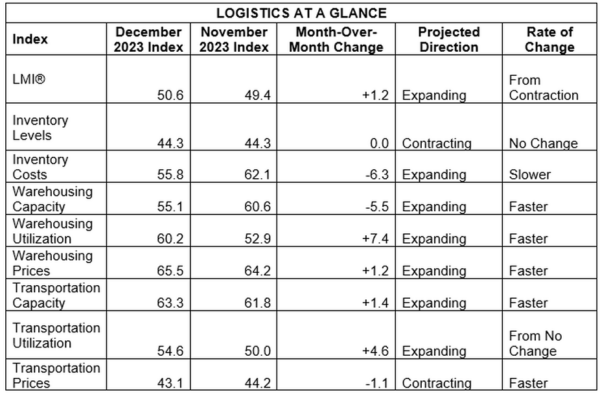
Market update: LMI December data shows capacity up, prices falling faster

(Source: Logistics Managers’ Index)

December data released by the Logistics Managers’ Index (LMI) saw transportation capacity continuing to expand, which caused transportation prices to fall. A LMI index reading above 50 indicates expansion while a reading below signals contraction among respondents. Transportation capacity for December was up 1.5 points month over month to 63.3 points, contributing to prices declining 1.1 points m/m to 43.1 points. Lower fuel prices and surcharges were cited as one reason for the declines.

Inventory levels saw a similar pace of decline to November, registering at 44.3 as retailers revert to just-in-time inventory strategies. FreightWaves’ Todd Maiden writes of the report, “Downstream respondents returned a neutral response for inventory levels one year from now, but those upstream said they would be growing stockpiles over that time (56.2), which the report said was ‘the clearest sign yet that retailers are looking to get back to JIT and get off the inventory roller coaster they have been riding over the last few years.’”

Regarding a 2024 outlook, the report notes that while the U.S. macroeconomic situation is better than 2023, consumers remain somewhat pessimistic about the economy, with some dubbing it a “vibe-cession.” That is to say, “consumers feel the economy is in bad shape despite positive numbers (and in many cases a positive personal situation).”

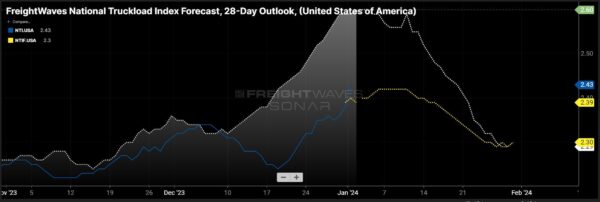
FreightWaves SONAR spotlight: Holiday spot rate jump more like a bump

(Source: FreightWaves SONAR)

Summary: The predicted spot rate jump resembles a mild bump as spot rate expectations moderate moving toward February, according to data from the FreightWaves National Truckload Index Forecast (NTIF). The FreightWaves NTIF 28-Day Outlook predicted on Dec. 5 that spot rates would be at $2.59 per mile all-in compared to the current NTI seven-day moving average of $2.43 per mile. The earlier forecasts for December expected a larger spot rate improvement, impacted by fuel and seasonality. However, excess truckload capacity and downward pressure on diesel prices from a warmer-than-average December blunted the rise.

New revisions for the next 30 days, according to the NTIF, updated daily, show spot rates peaking at $2.57 per mile on Sunday before declining 27 cents to $2.30 per mile on Saturday. When looking at the NTIF data sets, keep in mind the NTIF will predict daily the spot rate for the next 30 days, while the NTIF28 is a historical snapshot of what the NTIF predicted 28 days ago. 

Spot market linehaul rates (NTIL) continue to climb as carriers resume operations and drivers return to work. Linehaul rates less fuel (DTS.USA/6.5mpg) climbed 12 cents per mile from $1.69 on Dec. 25 to $1.81 per mile. While spot rates are rising, if seasonal trends continue, spot market linehaul rates will gradually decline following the first week of January as freight volumes sag and competition for fewer available spot market loads drives down prices.

Navigating the brokerage landscape in 2024 (FreightWaves)

Bankruptcies, fraud and a missing trucker: Key trucking stories in 2023 (FreightWaves)

Electric trucks should shake off setbacks in 2024 (FreightWaves)

American Central Transport kick-starts wellness outreach with life coach role (Commercial Carrier Journal)

CVTA: Trucker wages at stake in Florida’s CDL exemption request (FreightWaves)


Universal Logistics announces $50M truck division expansion in Virginia (FreightWaves)

Like the content? Subscribe to the newsletter here.

Kenco acquires Dallas-based warehousing company

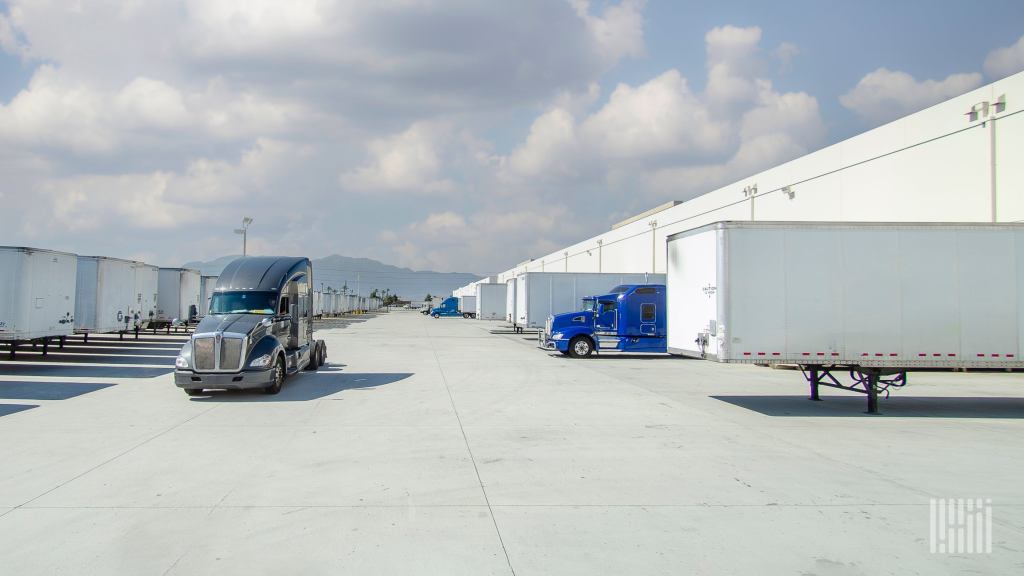
Trucks and trailers at a warehouse

Third-party logistics provider Kenco said Thursday it has acquired regional warehousing provider The Shippers Group. The deal adds 3.8 million square feet of space to Kenco’s network.

Founded in 1901, The Shippers Group is a Dallas-based provider of warehousing, co-packaging and fulfillment services out of eight facilities in Florida, Georgia and Texas. The transaction adds to Kenco’s network of more than 100 distribution sites. It will also provide additional transportation capacity to the platform.

Terms of the transaction were not disclosed.

“Together, we bolster the combined suite of capabilities with increased scale and reach in key growth markets, enabling us to capitalize on market momentum, while continuing to deliver exceptional service to our customers,” said Kenco CEO Denis Reilly.

Chattanooga, Tennessee-based Kenco provides multiple supply chain services in addition to warehousing, like freight brokerage, transportation management and dedicated contract carriage. The company now operates more than 40 million square feet of space.

Last year, private equity firm Pritzker Group acquired a majority stake in Kenco.

“Today marks a pivotal moment in The Shippers Group’s journey to optimize supply chains for the benefit of our customers,” said Rob Doyle, president of The Shippers Group. “Kenco has built an exceptional platform from which to scale, and I am confident that our customers will welcome access to Kenco’s proven operating systems.”

The Shippers Group CEO Graham Swank was listed as the majority owner of the operation.

More FreightWaves articles by Todd Maiden

CBP reopens 4 Southwest ports of entry after weekslong closures 

U.S. Customs and Border Protection resumed full commercial operations Thursday at an international bridge in Eagle Pass, Texas, as well as two Mexico crossings in Arizona. CBP said it also was reopening an international pedestrian border crossing in San Diego. 

An influx of migrants arriving in November along the U.S.-Mexico border prompted the agency to redirect personnel to assist U.S. Border Patrol with taking migrants into custody.

Resuming full operations Thursday are:

  • Eagle Pass, Bridge No. 1.
  • Lukeville, Arizona, port of entry.
  • Nogales, Arizona, Morley Gate border crossing.
  • San Diego, San Ysidro’s Pedestrian West border crossing.

The resumption of operations reflects a drop in migrant crossings that peaked last month, according to Troy Miller, acting CBP commissioner. Miller said that illegal crossings had reached as many as 10,000 migrants a day in December, according to the Associated Press.

In Eagle Pass, the port’s Bridge No. 1 had been suspended to northbound passenger vehicle traffic since Nov. 27. Bridge I in Eagle Pass services passenger vehicles, while the city’s Bridge II, also known as the Camino Real Bridge, remained open for cargo trucks. 

The closure of Bridge I affected commercial cargo truck movements carrying shipments from Mexico to the U.S., increasing wait times to more than two hours on some days when trucks normally face no delays. 

Along with the disruption from migrants, the Texas Department of Public Safety (DPS) began safety inspections on Nov. 28 for all cargo trucks arriving from Mexico in Eagle Pass and Del Rio, Texas.

The Texas DPS continues to conduct safety inspections on all commercial tractor-trailers coming through Eagle Pass, border officials said.

“The Port of Eagle Pass will experience long commercial crossing and wait times because of the Texas DPS safety inspection truck exams occurring right outside CBP’s import cargo facilities,” Armando Taboada, assistant director of field operations at CBP’s Laredo Field Office, said in an email to the trade community on Tuesday. “The long Texas DPS safety inspection truck exam lines prevent the commercial trucks from exiting CBP’s import cargo facilities and accessing Texas roadways.”

DPS officials said the renewed inspections were aimed at disrupting cartel activity at the border.

“We hope that frequent enhanced commercial vehicle safety inspections will help deter cartel smuggling activity along our southern border while increasing the safety of our roadways,” DPS Director Steven McCraw said in a statement to the El Paso Times

Homero Balderas, general manager for the city of Eagle Pass International Bridge System, said the Texas DPS inspections continue to negatively impact freight movements through the port.

“We were hopeful the news of reopening Bridge 1 would get them to tone down the inspections but that wasn’t the case,” Balderas told FreightWaves. “Hopefully soon they will react and allow us to return to normal.”

Cargo truck wait times at the Eagle Pass port of entry were one over an hour as of midmorning Thursday.

During the month of December, Eagle Pass processed 12,115 cargo trucks, a 27% year-over-year decrease compared to the same month in 2022.

More articles by Noi Mahoney

US, Mexican partnership to expand international rail-car ferry service

Canadian trucking company suspended after multiple overpass crashes

Thieves spirit away 19,000 bottles of tequila from US distributor

STB general counsel retires after 51 years of public service

A close up of the wheels of a freight train as it rolls down the track.

After more than 51 years as a public servant, Craig M. Keats, general counsel for the Surface Transportation Board, officially retired on Jan. 1.

Keats’ career began in 1972 as an attorney for the Interstate Commerce Commission, which was the predecessor of the STB. He joined the Office of General Counsel in 1980, saw through the transition of ICC to STB and was appointed deputy general counsel in 2000 before becoming general counsel in 2013. 

During his career, he provided legal advice to the board and he briefed and argued many of the board’s important cases in federal court and the U.S. Court of Appeals, STB said Wednesday. He was named the John T. Stewart, Jr. Transportation Lawyer of the Year by the Federal Bar Association’s Transportation and Transportation Security Law Section in 2018. 

“Craig has been an invaluable pillar of knowledge to the agency, providing sound and reliable counsel to many Board chairs and members, including myself, and mentoring numerous staff attorneys,” STB Chairman Marty Oberman said in a news release. “His wisdom, counsel, friendship, and quick wit have been essential to me, personally, and to the entire agency. He will be sorely missed. We wish him all the best on a well-earned retirement.”

Deputy General Counsel Anika Cooper will serve as acting general counsel during the leadership transition. 

Subscribe to FreightWaves’ e-newsletters and get the latest insights on freight right in your inbox.

Click here for more FreightWaves articles by Joanna Marsh.

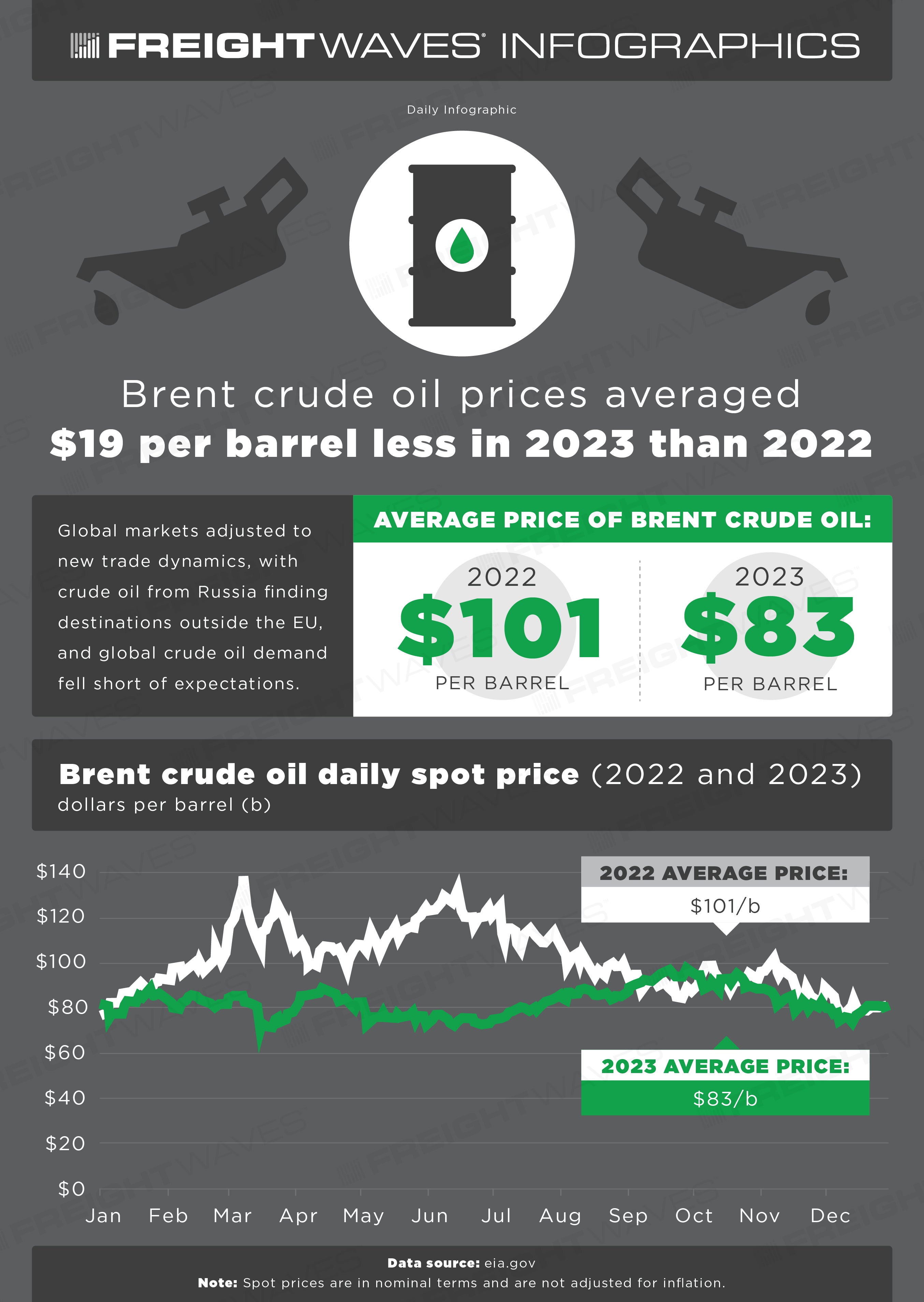
Daily Infographic: Brent crude oil prices averaged $19 per barrel less in 2023 than 2022


To view more FreightWaves infographics, click here