Thieves spirit away 19,000 bottles of tequila from US distributor
Almost $400,000 worth of tequila is missing after the shipment was hijacked somewhere en route to North Carolina, according to officials for spirits company Daytoon Distributors.
The Wilmington, North Carolina-based company said in a news release that cargo thieves stole 19,000 bottles of tequila sometime after the shipment arrived in the U.S. from Mexico, according to a report from WRAL.
The stolen goods — Hacienda Chactun Tequila — were the company’s first shipment of its new tequila line from its production facility in Jalisco, Mexico. Daytoon, through subsidiary Blue Shark Vodka, is preparing to launch Hacienda Chactun Tequila to retail outlets in the U.S. in January.
“Daytoon Distributors is a veteran owned and operated business; we have not yet begun to fight,” Geoff Losee, who serves as legal counsel for Daytoon, said in the news release. “We’re currently exploring alternative distribution channels to get Chactun Tequila into the hands of our customers as soon as possible.”
Company officials believe cargo thieves infiltrated the company’s logistics network after the shipment crossed the U.S.-Mexico border around Dec. 21. A logistics team was working with a trucking company to deliver the load from Mexico to Wilmington, according to Mark Bloomquist, chair of Daytoon Distributors.
“I’m shocked and disgusted. … They’ve put a ding in this, but we will be back. We have only just begun,” Bloomquist told the Wilmington Star-News.
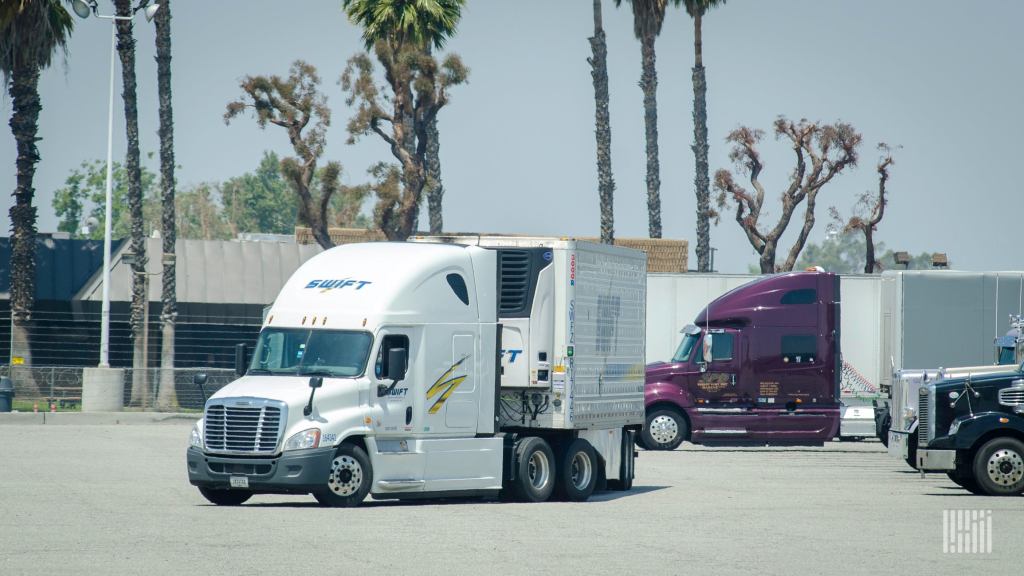
A logistics team was receiving updates on the shipment as it was allegedly headed to North Carolina, but the updates and the truck driver turned out to be fictional, Bloomquist said. Police and federal authorities believe the shipment is in California.
Bloomquist and officials for Daytoon Distributors did not immediately return a request for comment from FreightWaves.
Bloomquist, his daughter Brooke Bloomquist and Mark Milliken founded Daytoon Distributors and Blue Shark Vodka in 2019, according to the company’s website. In 2022, they decided to launch a tequila brand.
To be considered an authentic “tequila,” the spirit has to be made in one of five designated Mexican states where blue agave grows. Daytoon uses blue agave for its Hacienda Chactun Tequila that is cultivated from 100 acres in Jalisco, according to the Port City Daily.
Daytoon Distributors has a distilling facility in Jalisco to produce Hacienda Chactun Tequila. Once the tequila is created and shipped cross-border, it makes stops in California, Nevada and North Carolina, where Daytoon has warehouses and production facilities.
Hacienda Chactun Tequila comes in two varieties, including a reposado, aged one year, and blanco, which is unaged.
Milliken, Hacienda Chactun Tequila CEO, said the company is moving forward.
“We plan to still launch in January with our blanco product and begin to meet demands with blanco and reposado by February,” Milliken said, according to WRAL.
New Class 8 truck deliveries fall for 4 consecutive months
The strength in new Class 8 orders belies a four-month slide in deliveries while used truck prices continue to fall, albeit more slowly as 2023 comes to a close.
Through the first 11 months of the year, the industry has delivered 242,881 new Class 8 trucks, 7.8% more than the same period in 2022, according to Ward’s Intelligence. But the year-over-year lead has shrunk each month since February when sales were 35% ahead compared with 2022.
This contrasts with ACT Research, which reported net orders for North America — not just the U.S. — at 41,732 units in November. The robust bookings led to a longer wait time for deliveries, currently about six months.
Vocational truck orders are rising, especially trucks equipped with dump, concrete, refuse and other bodies that depend on construction activity.
Only Navistar International saw higher sales in November
In November, according to Ward’s, all major manufacturers except Navistar International reported lower deliveries. The Traton Group brand reported 2,952 units sold, up 4.2% month over month from October but 2.1% below November 2022.
Market leader Freightliner reported 5,796 trucks sold, down 31.4% from November 2022. For the first 11 months, Freightliner sales were up 3.6%. Daimler Truck North America sibling Western Star sold 713 units, up 29.2% from a year ago and a proof point of the strength in vocational equipment.
Paccar Inc. brands Kenworth and Peterbilt reported month-over-month declines of 17.2% and 11.5%, respectively. They were down 18.2% and 11.5%, respectively, from a year ago. Paccar accounted for 29.2% of new truck sales through November, two-tenths of a percentage point below a year ago.
Volvo Trucks North America reported 1,980 Class 8 truck sales in November, down 10.5% from October and 6.6% below November 2022. Volvo is the only manufacturer with 11-month sales trailing the same period a year ago. Year-over-year sales are down 1%.
Sibling Mack Trucks reported 10.1% lower sales in November compared to October and a 20.7% decline from November 2022. Year-to-date Mack sales are up 11.4%.
Private fleets drive remaining pent-up demand
As the freight market finds the bottom of the cycle, order cancellations can rise. Fleets are obligated only when an OEM orders the materials to build a certain order.
“There may be some pent-up demand remaining for tractors,” said Kenny Vieth, ACT president and senior analyst. “If so, and given freight rates, it remains largely with private fleets.”
Slower sales has caused new truck inventories to rise, something dealers had not experienced in the previous two years as supply chain disruptions hampered truck production.
Used truck prices falling more slowly
After months of steep year-over-year declines, used equipment prices are falling more slowly.
Late-model trucks with average or lower mileage have lost less than 4% of their value each month in the fourth quarter, according to J.D. Power Valuation Services. Higher-mileage trucks likely have experienced the worst of their devaluation.
Four-to-6-year-old trucks sold for 3.9% less than in October and 40.2% less than November 2022, Power said in its December Guidelines newsletter. In the first 11 months of the year, late-model sleepers sold for 41.6% less than the same period of 2022. Monthly depreciation in 2023 has fallen to 4%.
Values for the newest model years available at auction remain just under the strong pre-pandemic period of 2018 or about 20% less if adjusted for inflation.
Retail used equipment prices fell across the board in November
While individual models varied, each year Power tracked for retail used truck prices reported substantial decreases in November.
The average sleeper tractor sold for $62,252, was 71 months old and had 429,243 miles. Compared with October, the average sleeper was the same age, had 7,984 (1.8%) fewer miles and sold for $5,189 (7.7%) less. Compared with November 2022, the average sleeper was two months newer, had 40,249 (8.5%) fewer miles and sold for $27,558 or 30.7% less.
The declines ranged from 3.2% to 13.9% depending on the model year.
“Excess truck inventory will continue to filter through auction, wholesale and retail channels through the first half of 2024, but the post-pandemic correction looks to be maturing,” Power reported.
Many logistics professionals are experiencing a somber holiday season, as the freight recession continues to rage. Despite what Reliance Partners CFO Thom Albrecht has dubbed a “brutal winter,” supply chain companies can look forward to renewed hope as the market begins to shift in the spring and summer.
“The first signs of encouragement may be around May or June 2024,” Albrecht said. “We might start to get a sense that the worst is in the rearview mirror and things are beginning to stabilize.”
Reliance tracks the number of insured drivers in the marketplace at any given time. That number has gone down 18% since hitting its peak in May 2022. If contraction continues at its current run rate, the first signs of change could begin to appear as early as March, according to Albrecht.
It is important to note, however, that this market stabilization is expected to come as a series of slow changes, not a single monumental shift. It will not be as simple as flipping a switch on the market.
While carrier contraction is one of the primary driving forces behind the coming changes, the correction of bloated inventories also plays an important role in the market. General merchandisers — including retailers like Walmart and Costco — have seen significant improvement in this area already.
“General merchandise is so important because that is a lot of replenishment freight,” Albrecht said. “Folks are going to be buying those items monthly or maybe weekly — a steady state of freight. They are probably in the best shape right now.”
Specialty retailers, like electronic or sporting goods stores, are also seeing some inventory correction, though this is happening at a slower pace. The industrial space, including building materials, is seeing the slowest inventory correction.
The industrial space may get some reprieve from excess inventory in mid-2024, as Albrecht predicts long-awaited improvements to both new housing starts and existing home sales to come during that time period.
Most of the market change in 2024 will be due to supply-side corrections, as consumers largely continue to face difficult financial situations. In the third quarter of 2023, auto loan delinquencies were up 25% year over year. During that same period, mortgage delinquencies grew 41% and credit card delinquencies rose 57%, according to Albrecht.
At the same time, savings rates are down. This is indicative of additional financial strain, which will likely prompt consumers to focus their attention on spending less in 2024. This time of reconstitution could lead to renewed spending in 2025, however.
Overall, while the change will be slow and steady, there is hope on the horizon for stressed supply chain companies.
“By the end of next year, it is going to be clear that the market is in a much better place,” Albrecht said.
Rewarding drivers for fuel-efficient behavior goes a long way
Fuel economy is a hot topic and the ongoing focus on reducing fuel waste is expected to continue into the new year. Carriers hoping to see improvements should increase their attention on the relationship between fuel efficiency and driving behavior.
Historically, carriers have relied heavily on equipment improvements to provide improved fuel efficiency to their fleets. Truck manufacturers have integrated new technologies into vehicles, allowing for significant average mile-per-gallon improvements over the past several years.
The bulk of these improvements can be attributed to the shift from manual truck transmission to automatic or automated manual transmissions. These improvements have not, however, eliminated the impact that driving behavior has on fuel efficiency.
Negative driving behaviors — including speeding, rapid acceleration and harsh braking — can have a serious impact on fuel economy and, ultimately, a carrier’s bottom line.
“The way a driver handles the truck can affect fuel economy by as much as 20-30%,” according to Lloyd Palum, CTO of Tenstreet’s True Fuel division. “The driver continues to have a significant impact no matter how high the vehicle’s MPG goes.”
To address these issues, carriers often institute fuel economy programs that reward drivers based on their MPG statistics alone. This is misguided, as overall MPG can be affected by a myriad of factors outside a driver’s control, from vehicle specs to road conditions. As a result, these programs often lead drivers to become disillusioned or apathetic about their fuel use.
Tenstreet’s fuel incentive program, True Fuel, is different. The solution is specifically designed to reward drivers for engaging in proven fuel-saving behavior, no matter what their overall MPG ends up being.
“We only measure things within our fuel efficiency product that are directly within the driver’s control,” Palum said. “There is a fairness aspect that comes into play. In the past, drivers have had exposure to programs that may try to use MPG, and it is frustrating for them.”
By putting drivers in complete control of their standing within the True Fuel program, Tenstreet enables drivers to take ownership of their performance while simultaneously improving fleetwide fuel economy for carriers.
Rewarding drivers for positive choices is a cornerstone of the True Fuel solution.
“We have built rewards into our program. We run a networkwide sweepstakes that drivers get entries into based on their fuel efficiency, and every fleet has the ability to fund their own incentives as well,” Palum said.
Additionally, Tenstreet has created training modules addressing each of the factors its fuel economy solution takes into account. This empowers carriers — and individual drivers — to improve driving behaviors in a real-time, on-demand fashion.
This training element is especially useful for larger carriers. Fleets with thousands of drivers may have hundreds of individuals in need of fuel economy coaching at any given time. Providing individual feedback on that scale is impossible for virtually all carriers without tech help. By automating the coaching process and providing baseline comparison reports that show and demonstrate the lift in efficiency resulting from the impact of consistent driver feedback on reduced fuel spend, Tenstreet’s True Fuel solution takes this pressure off carriers.
Truck Parking Club: Looking for property owners with unused space
Truck Parking Club, a marketplace with 210 locations across the U.S., is dedicated to helping truckers save time and fuel by efficiently finding and reserving truck parking. Having provided reliable parking for thousands of drivers in 2023, Truck Parking Club has executed on an innovative solution to the nationwide truck parking shortage. Truck Parking Club is actively seeking businesses and property owners with extra space suitable for truck parking across the United States.
How Truck Parking Club works
Truck Parking Club provides an online and mobile app platform where property owners and businesses can list their available spaces for truck parking. These spaces can range from yards at trucking companies to tow truck companies, truck repair shops, warehouses, storage companies, CDL schools, truck parking operators, real estate investors and more. There are no leases or commitments. Truck drivers can then search for and reserve parking spots through the platform, ensuring they have reliable and convenient places to park during their breaks and resets.
To sign up, it is as easy as going to https://truckparkingclub.com, clicking “Become a Property Member” and following the steps. It takes 15 minutes or less to submit a property for approval.
Truck Parking Club has helped hundreds of landowners get into the truck parking business, automating the entire process from reservations to bookings, customer service and payment processing.
Benefits for property owners and business owners
By joining Truck Parking Club, businesses and property owners can generate additional income from their underutilized spaces. This land can be located near major highways, truck stops, transportation hubs or even rural areas.
The need for more truck parking
Truck drivers often face challenges when it comes to finding safe and convenient parking options during their long-haul trips. A lack of adequate truck parking spaces can lead to drivers parking in unauthorized areas or wasting time and fuel to find suitable parking. The average driver takes 50 minutes to find parking. This impacts the driver’s well-being and productivity, losing thousands of dollars over the course of a year.
Furthermore, by offering truck parking, landowners can contribute to the safety and efficiency of the transportation industry.
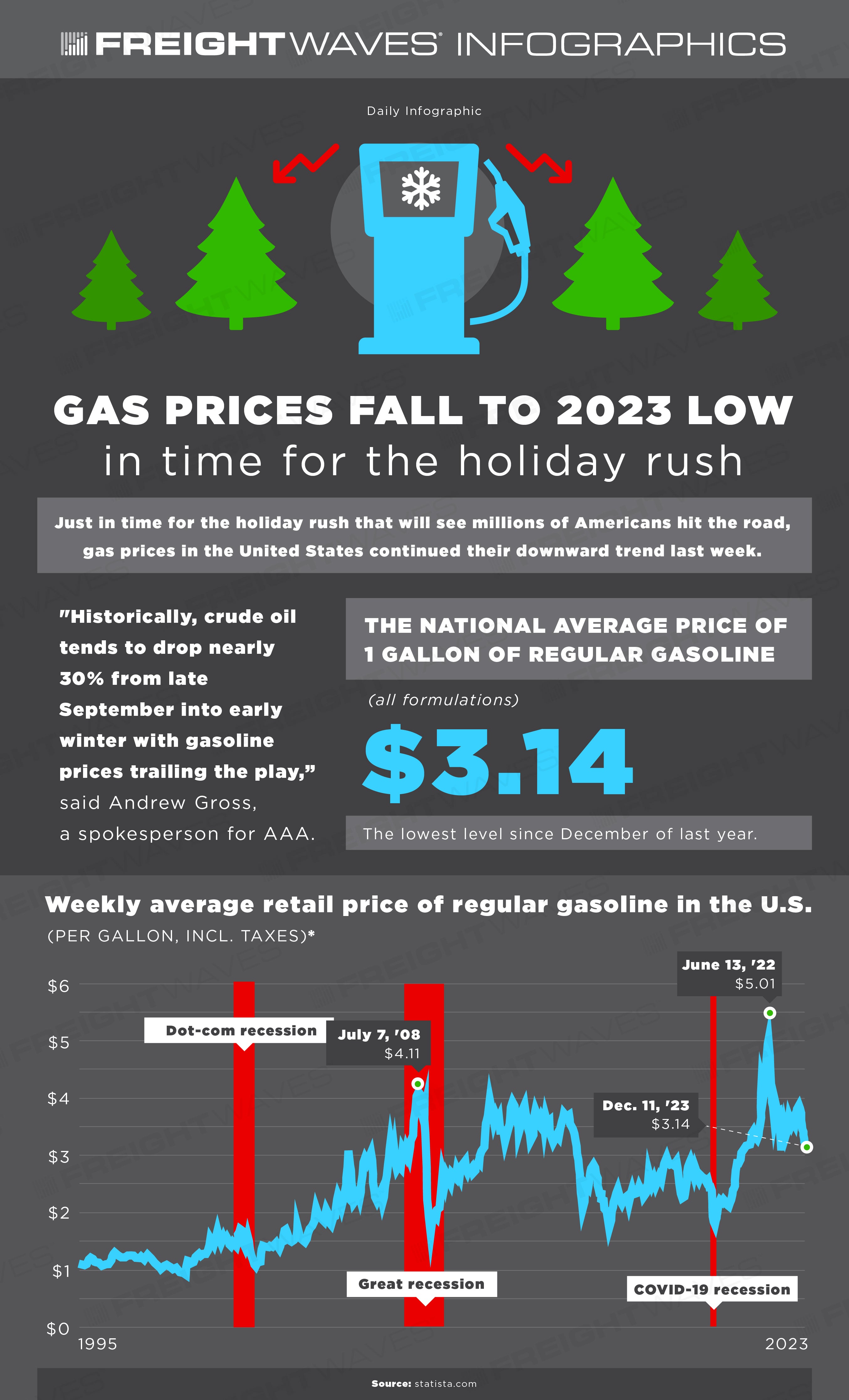
Daily Infographic: Gas prices fall to 2023 low in time for the holiday rush
To view more FreightWaves infographics, click here
Mexico’s booming exports expected to boost cross-border trade in 2024
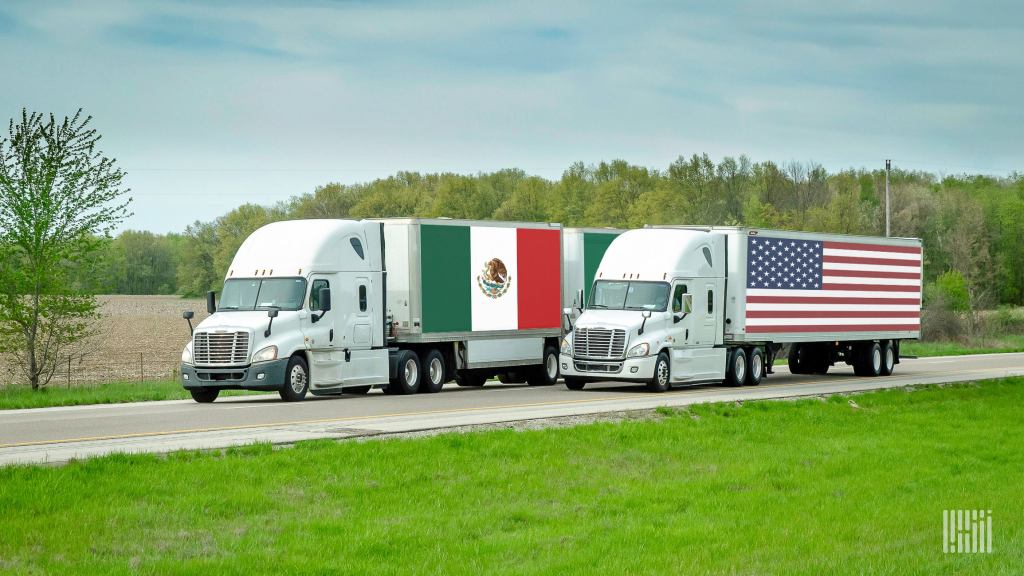
As more global supply chains shift manufacturing to Mexico, cross-border operators said nearshoring will be a key economic driver for the North American freight economy in 2024.
Nearshoring — the relocation of production and manufacturing operations from one country to another to be closer to end consumers — has fueled manufacturing growth across Mexico as shippers look for supply chains that are closer, cheaper and more favorable to doing business with the U.S.
One of the largest nearshoring projects headed to Mexico will be Tesla’s $5 billion automotive factory in Monterrey, which is scheduled to be completed within the next two years.
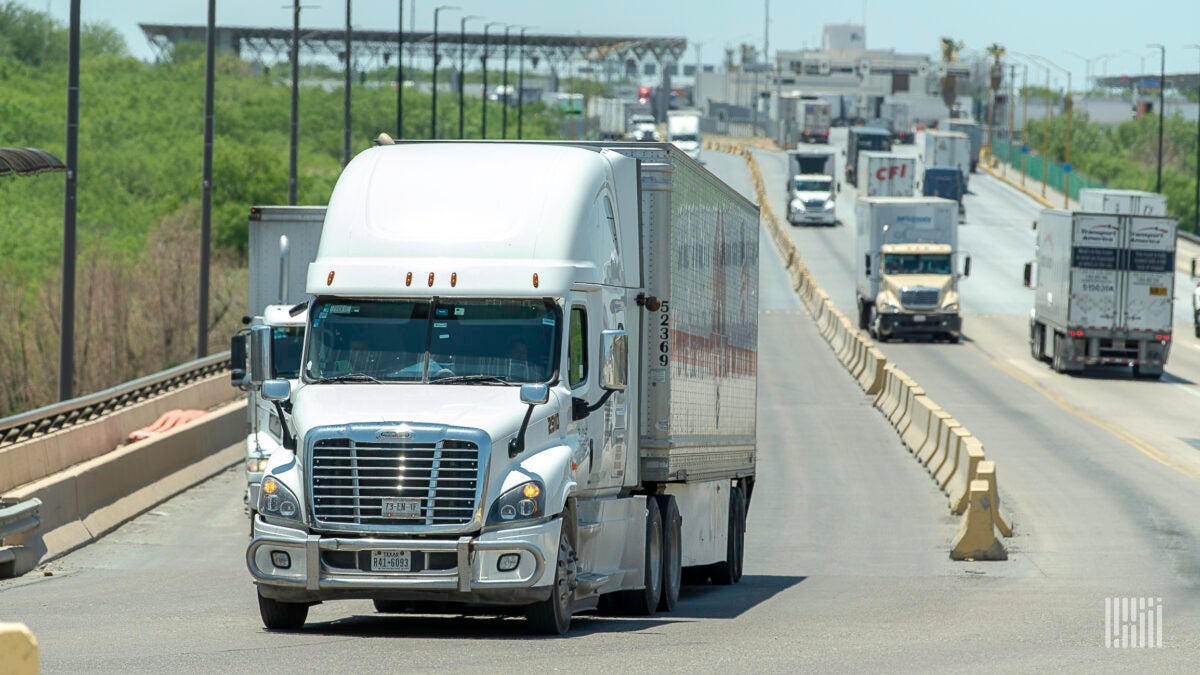
The increased focus on bringing supply chains back to North America helped Mexico replace China as the top U.S. trading partner in 2023. Mexico has been the top U.S. trading partner since the beginning of the year, reporting $656 billion in two-way trade from January through November, according to the U.S. Census Bureau.
FreightWaves recently spoke with trade professionals who mostly remain bullish about the prospect of U.S.-Mexico cross-border freight flows next year. They also discussed nearshoring, cargo capacity and hot commodities in 2024. Trade professionals interviewed include:
Ed Habe, vice president of Mexico sales for cross-border LTL carrier Averitt Express.
Deepak Chhugani, founder and CEO of cross-border technology platform Nuvocargo.
Mike Hamill, vice president of strategy for the transportation division at Trimble.
More freight will flow between the US and Mexico in 2024
Dewart: “What we’re seeing is certainly … foreign direct investment is still pouring into Mexico. Just every single day, multiple companies are announcing either brand new construction or expansions of existing facilities for players that are already in Mexico. Production is coming and a lot of it is going to be coming online in 2024. We’re very, very bullish about 2024.”
Habe: “I’m bullish on Mexico in 2024. Just say even if global manufacturing were not to increase next year, just the jockeying of existing manufacturing to Mexico will represent good things, not just for Averitt, but North America in general. At Averitt, we are in a good spot. We have terminals in the southeastern U.S.. We’re also on the Texas-Mexico border. Cross-border trade is a natural positive for us.”
Chhugani: “We expect 2024 to be a year of expansion and of consolidation. For companies already trading between Mexico and the U.S., we’re seeing accelerated expansions into more facilities and new commodities in their supply chain. And for companies new to trade across the U.S. and Mexico, we’re seeing more and more entrants consolidating their positions and committing to this trade lane long term. For us this has translated into an opportunity to help companies take their first steps into U.S.-Mexico trade and act as a key ally to set up everything — freight, customs, insurance — for them for added simplicity end to end.”
Hamill: “Many forecasts indicate there will be little to no overall growth in the freight market for 2024. There’s also a lot of uncertainty around consumer demand with very little consistency in consumer spending as it relates to specific end markets. Consumer spending has shown resilience over the past several quarters and has the ability to continue in 2024 despite interest rates, the global economy and geopolitical environment. I’m taking a neutral position related to end markets due to consumer spending patterns, which I believe will closely correlate with interest rates. I expect some opportunities for improvement in … automotive, consumer packaged goods and retail, with less opportunity in chemicals.”
“We expect 2024 to be a year of expansion and of consolidation,” said Deepak Chhugani, founder and CEO of Nuvocargo. (Photo: Jim Allen/FreightWaves)
Despite excess US trucking capacity, cross-border lanes may tighten
Hamill: “The capacity buildup that occurred in the market post COVID-19 lockdowns was unlike anything the industry had seen before as rates and freight volumes increased, and capacity was added on a large scale. Given this huge influx of capacity over an extended period of time, it’s taken longer than normal for that capacity to exit the market. We saw capacity leave the market throughout 2023 and will continue to see more in 2024. Because the macroeconomic outlook doesn’t support any large increase in demand, supply exiting will be the driving factor to bring capacity and freight into greater equilibrium, which I suspect will occur sometime in mid to late 2024.”
Chhugani: “As the market comes out of this bottom, we don’t expect to see Mexican carriers entering the market like they do in the U.S. Carrier supply is much more stable in Mexico, so we already know who the vast majority of the carrier base will be, and they will still face driver and equipment shortages. Freight rates will likely continue to come up as the demand increases and supply is not as elastic as a perfectly competitive market with free entry and exit would suggest.”
Dewart: “I think 2024 will absolutely take over cross-border trade. We are participating in a lot of requests for proposals, bids currently. You get to see many, many different companies, what they’re forecasting for booking for 2024. All of them are higher than what they produced in 2023. That is a forecast, of course. Then on the flip side, the carrier side, we’re not seeing any investment into growing their fleets, adding more trucks. The cross-border carrier market isn’t planning on making major investments in trucks. They’re finally taking receipt of trucks they ordered 18 months ago, but they’re just using those to reduce the age of their fleets, not adding trucks. I think the No. 1 reason is not so much on the demand side, but there’s just not enough drivers to go into these trucks in Mexico.”
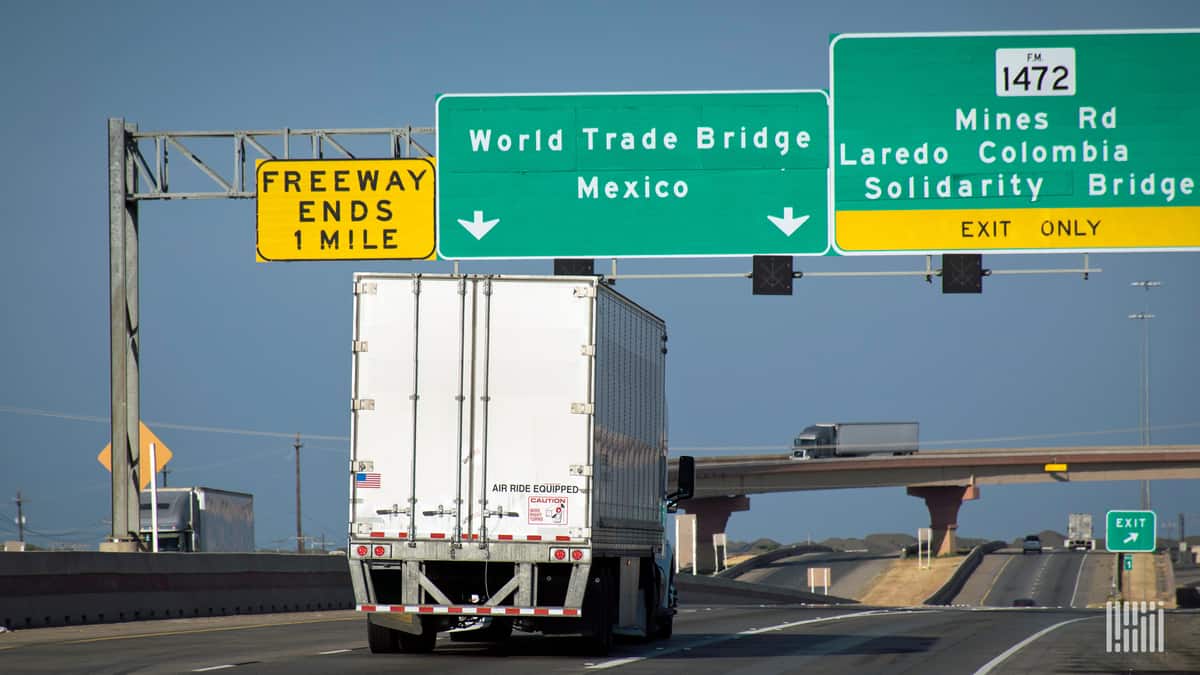
Habe: “We have actual infrastructure along the border, millions of dollars in infrastructure. It’s a given that there’s going to be an impact in Mexico. How explosive will it be in the next few years? That’s the big question. Is it going to be single-digit, double-digit, triple-digit impact? I would bet on the higher side, the impact coming out of Mexico, because it just makes sense. These new economic blocs, North America and Monterrey, Mexico, is obviously the one that’s going to have and is already seeing some of the biggest impact investment-wise. I was at a conference in Mexico recently and there was a big talk about the Interstate 35 corridor, Austin, San Antonio, Laredo, and Monterrey, representing a huge impact to the U.S.”
“I was at a conference in Mexico recently and there was a big talk about the Interstate 35 corridor, Austin, San Antonio, Laredo, and Monterrey,” said Ed Habe, vice president of Mexico sales for cross-border LTL carrier Averitt Express. (Photo: FreightWaves)
Where cross-border loads are headed in 2024
Chhugani: “When we’re talking about loads that will thrive in 2024, it’s impossible not to highlight the automotive industry. The growth in Mexican car production is remarkable, 13.54% year on year in the first three quarters of 2023, and it’s not just the giants like GM, Ford, Nissan, VW — even smaller players in the parts and components game are set to benefit significantly. We are anticipating a surge in demand for raw materials and unfinished goods crucial for car and machinery production, especially given the highly integrated nature of the auto industry.”
Habe: “Averitt is very diversified across the board in U.S.-Mexico loads. There were times in the past where maybe we were dependent on things, especially automotive. Now we are diversified in the case of not just automotive, but foodstuffs, liquors, electronic products, office supplies — you name it, it’s getting moved cross-border nowadays.”
Dewart: “I don’t think a day goes by that we haven’t talked about a new customer, a new project that we’re working on, and it’s things like video lottery machines, or it’s some product that you never would have imagined that’s being made in Mexico. All of the big retail customers are ramping up their production in Mexico, and they’re trying to get products sourced out of Mexico, your Walmart, Home Depot, Lowe’s, Target, all of them are looking very heavily to Mexico to source products in the fast-moving consumer goods space. Looking forward into the future, companies like Google, Samsung, LG, GE, Mattel, Lego, all of those brands, almost every product they make is going to be ramped up and coming in from Mexico.”
“As companies look to reduce costs and increase their supply chain resiliency, working with vendors and suppliers in Mexico and Latin America makes perfect sense,” said Mike Hamill, vice president of strategy for the transportation division at Trimble. (Photo: Jim Allen/FreightWaves)
Prospects for continued nearshoring growth in Mexico
Hamill: “As companies look to reduce costs and increase their supply chain resiliency, working with vendors and suppliers in Mexico and Latin America makes perfect sense. Momentum from investments in infrastructure continues and it’s expected that these strategies will lead to additional freight opportunities, especially in the manufacturing sector. However, cargo theft and security remain concerns in the region, while demand for warehousing and cold chain space has increased, making these things harder to find and more expensive.”
Chhugani: “I don’t see the nearshoring trend slowing down anytime soon. Foreign direct investment in Mexico is expected to grow by around 10% annually, reaching approximately $60 billion by 2027, and there are at least 495 new companies projected to enter the country between 2024 and 2025, which makes for a very promising outlook as we consider the long-term effects of this trend.”
Habe: “We saw immediate impact, especially in 2023 with companies already in Mexico, which I refer to as phase one. I’ve seen the second phase, brand new companies that have started to open up facilities, initially planning to come online this year, and now it’s been pushed off to 2024. Part of it is because of the U.S. economy; we have been getting mixed signals on the economy. I’ve been in factories in Mexico that have been built, they’re just kind of waiting to get turned on, and they don’t really have a good idea on volumes yet. The impact right now is more on existing companies that have the existing manufacturing in place, and they’re basically relocating that existing manufacturing into Mexico. The big part that everyone’s hoping for is the brand new manufacturing that everyone’s been telling me will be happening in the next year to two years.”
After dropping for 8 weeks, benchmark diesel price turns higher
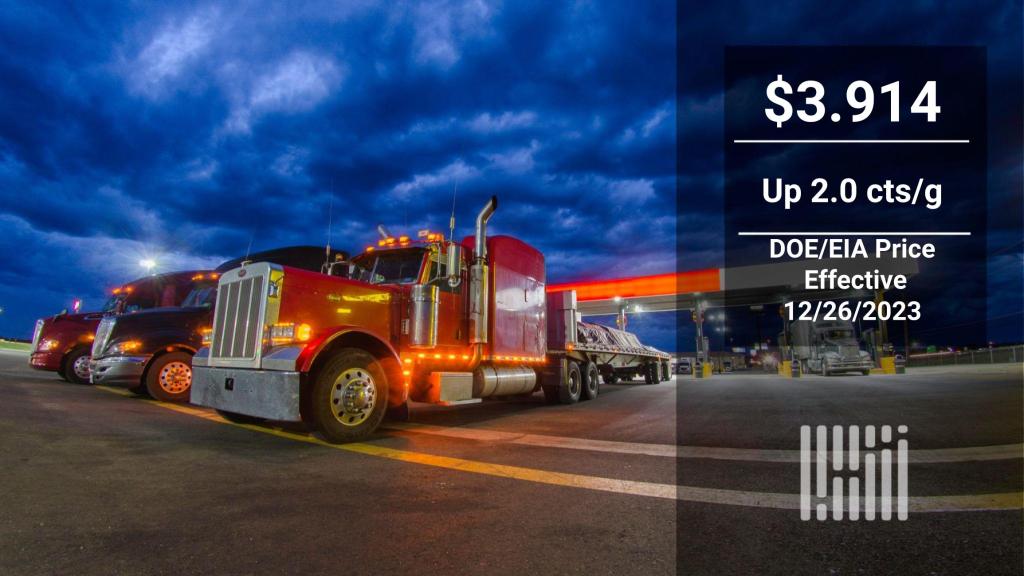
Tuesday marked the end of the eight-week decline in the benchmark diesel price used for most fuel surcharges. The Department of Energy/Energy Information Administration price posted a 2-cents-per-gallon increase.
The upward move to $3.914 a gallon marked the first increase since a big 10.1-cent jump to $4.545 a gallon on Oct. 23. Since that date and through the price published Dec. 21, the average retail diesel price published by the DOE/EIA had fallen 65.1 cents a gallon before the 2-cent upward move Tuesday.
There has been a significant shift in oil market sentiment in recent trading, particularly the past several days, which is visible in the latest increase in the DOE/EIA price.
Given that much of the shift has occurred because of geopolitics that might spill over into supply worries, and possibly has been driven by short covering in the crude market that has not been as evident in product markets, crude has been the strongest performer in recent weeks as bearish sentiment faded and the bulls took over.
Brent on the CME commodity exchange hit a recent settlement low of $73.24 a barrel on Dec. 12. It had not settled above $80 a barrel since Nov. 30.
After that Dec. 12 nadir, Brent rose nine of the next 12 trading days, breaking past the $80-per-barrel settlement level Tuesday by rising $2.53, to $81.07, an increase of $7.83 a barrel or 10.7%.
The movement in ultra low sulfur diesel (ULSD) on the CME took it to a settlement Tuesday at $2.6688 a gallon, up from its Dec. 12 low settlement of $2.5074 a gallon, a day that saw it plummet more than 10 cents. The Tuesday settlement of $2.6688 equated to an increase of 6.4% during that time, with crude far outpacing diesel.
The 3-2-1 spread, a simple measurement of refinery profitability derived by using the price of three barrels of crude and subtracting that from two barrels of RBOB gasoline and one barrel of ULSD, has fallen on a Brent basis to $16.73 a barrel Tuesday from $20.43 a week ago, showing how the recent market surge has been led by crude markets with product markets following.
That sort of movement, with crude leading the way and products following, is often seen when geopolitical incidents and fear of a potential disruption to supply manifests itself in markets. Rerouting of ships away from the Red Sea and the Suez Canal around South Africa’s Cape of Good Hope to avoid attacks by Houthi rebels in Yemen does not reduce supply as measured in actual barrels. But the addition of steaming time of anywhere from seven to 12 days does tie up supply on the water longer, which effectively acts to tighten supply.
“Despite container giant A.P. Moller-Maersk A/S stating Sunday that it’s preparing to resume using the Red Sea under the protection of the new multinational maritime task force, many other shippers continue to shun the route through the Suez Canal in favor of safer but longer voyages, delaying the delivery of oil cargoes,” Bloomberg reported.
Exclusive: Nikola CEO Girsky upbeat despite myriad challenges
In his career as a Wall Street analyst, an adviser to the United Auto Workers and a vice chairman of General Motors, Steve Girsky made his bones by unwaveringly telling the unvarnished truth to power.
As the CEO of struggling Nikola Corp., he retains his boldness.
“I think our prospects are great,” Girsky said in a Friday interview with FreightWaves. “I think 2024 is going to be the best year in the history of the company.”
It would not take much to accomplish that. After a litany of setbacks, the company’s cash is still tight. But it is at its highest level in 18 months. Nikola is producing fuel cell trucks at its plant in Coolidge, Arizona, and beginning deliveries to customers.
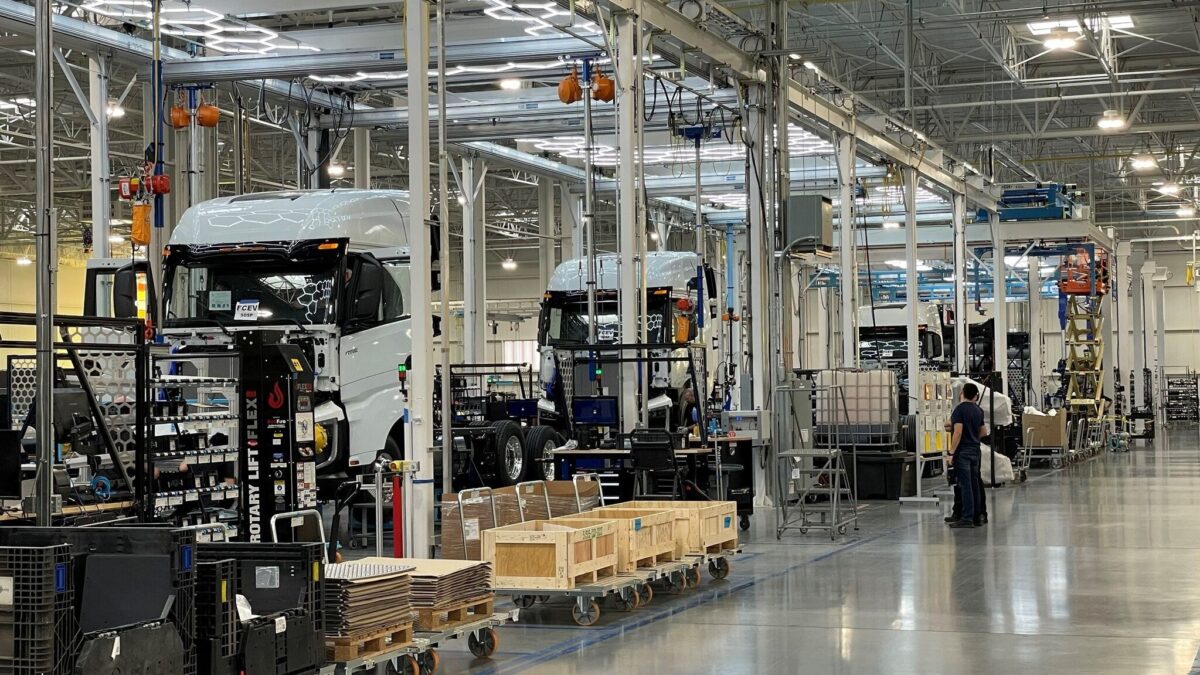
Nikola is producing hydrogen-powered fuel cell trucks in Coolidge, Arizona. (Photo: Nikola)
Nikola is patching together a network of hydrogen fueling stations in California that would allow the trucks it sells there to operate. And it is a leader in generating vouchers worth hundreds of thousands of dollars per zero-emissions electric truck from the California Air Resources Board.
Nikola founder Trevor Milton’s shadow recedes
The shadow of founder Trevor Milton is receding. He was sentenced last week to four years in prison on wire and securities fraud convictions. Nikola wrested $165 million from Milton in arbitration in October. And the company is “pursuing all avenues to recover as much as we can” to cover the tens of millions it paid for Milton’s defense as part of a September 2020 separation, Girsky said.
“Everything we’ve heard so far says they want to continue to run the business as a stand-alone and scale it,” Girsky said.
Nikola’s stock (NASDAQ: NKLA) languishes around $1 a share — it traded intraday at 87 cents on Tuesday — in part because more than 1 billion of 1.6 billion authorized shares are on the market. Newly activated shares dilute the value of longer-term holders.
Slowing the revolving door of Nikola executives
Then there’s the revolving door of senior executives. Two CEOs, two CFOs, the head of the energy business and others departed in 2023.
“There’s been a lot of turnover. But I think morale at the end of the year is much better than it was when I took over [in August],” Girsky said. “The situation is stabilizing from a personnel perspective. There’s more to come. But I think we’re all starting to row in the same direction.”
Girsky, 61, became Nikola’s fourth CEO in as many years, giving up the role of board chairman to oversee daily operations.
“The board asked, ‘Do you want to do a search?’ I said, ‘No. This company’s had four CEOs in four years. It needs stability.’ I wanted to lead this team.”
CFO search likely to conclude in January
Like most CEOs, Girsky surrounded himself with people he trusts. That started with recruiting Mary Chan, his partner at VectoIQ, as Nikola’s first chief operating officer. He elevated Steve Schindler, VectoIQ’s CFO, from director to chairman to succeed him. All three knew Nikola intimately from taking it public in June 2020 as its special purpose acquisition company sponsor.
“Mary Chan is a very capable, seasoned executive,” Girsky said. “She [spent] 25 years at Lucent. I brought her in to run OnStar [at GM]. She speaks to the engineers in a way that is different from the way I speak to them. Yes, she was part of VectoIQ. I think that helped because she actually knows the company. I went through wars with her.”
“We have candidates that we are chatting with. You’d be surprised at the number of people who are actually interested in this,” Girsky said. “I would expect to get something announced, hopefully, sometime in January.”
Running toward Nikola
The recent addition of turnaround expert Jonathan Pertchik to Nikola’s board demonstrates that, rather than being a pariah, Nikola appeals to exceptional leaders.
“It’s a great example of another very seasoned, very capable executive running towards Nikola. There’s this perception that everybody’s running away from Nikola,” Girsky said.
“There may be some adds in some places and subtractions in other places. Energy is a business we’re growing, so there’s going to be resources that are deployed there, especially as we put more dispensing locations out there.”
Won’t rule out a reverse stock split to raise the price of Nikola shares. A reverse split awards a single share for a multiple of existing shares; Nikola has those because shareholders agreed to double the number of authorized shares to 1.6 billion in August.
“[A reverse split] doesn’t change anything except the share price,” Girsky said. “That doesn’t mean we won’t consider it at some point in the future. I don’t want to close off any options. But when we look at the top five things we’re working on, that’s not one of them.
“The share price will take care of itself. I was an analyst for almost 20 years. Stocks are connected to companies like rubber bands. Sometimes they get ahead, sometimes they get behind. We can only control what we control, which is the performance of the company and satisfying our customer.”
Recalled trucks should begin returning to customer in Q1
Has little concern about the “notice of going concern” filed as part of the company’s 10-K filing for 2022 in February. A going concern filing says a company may not be in business 12 months from the time it is put into effect.
“We’re not managing to getting rid of a going concern. We’re managing to improve the cash profile of our business, satisfying our customers [and] getting trucks in the field. We’ve taken our burn rate down from where it was in the beginning of last year.”
Sticks to the projection that customers whose battery-electric trucks were recalled in August will begin getting their trucks back in the first quarter of 2024. He declined to name a battery supplier or suppliers.
“We’ll share the decision at a later date. You should just know we have a plan A and a plan B. The goal is to start to get them back in customer hands in Q1 and then build from there. So, we get the trucks back to customers, we restock the dealers and then we have a handful that we can incrementally sell.”
Registration deadline for California Clean Truck Check gets another month
California has tacked on another month for a key registration deadline impacting trucks operating in the state.
The California Air Resources Board (CARB) said Tuesday it would extend the deadline for trucks to be registered for the state’s Clean Truck Check to Jan. 31. The deadline had been New Year’s Eve.
The Clean Truck Check rule is not part of either the state’s Advanced Clean Fleets rule or Advanced Clean Truck rule.
The deadline is for registration with a state registry. There are no compliance regulations tied to the deadline, though the regulation itself involves several emissions reporting mandates that kick in later in 2024. A $30 fee also accompanies the deadline.
Clean Truck Check is seen mostly as an extension of the state’s Smog Check regulations. However, Clean Truck Check applies to all trucks operating in the state, not just trucks based in California.
Another informational webinar about the Clean Truck Check rule has been scheduled by CARB. It will be Jan. 9 and online registration can be accessed here. There has been concern expressed within the industry that many truck owners affected by the rule were not aware of the deadline.
A full explanation of the Clean Truck Check rule was reported by FreightWaves earlier this month and can be read here.