CBP reopens key ports of entry for freight trains at US-Mexico border
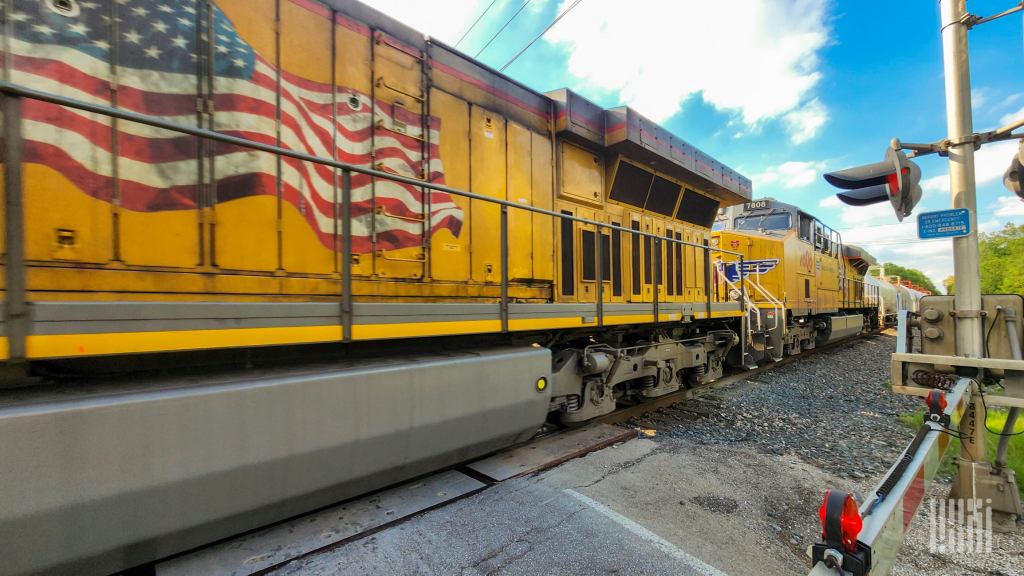
U.S. Customs and Border Protection reopened the three international border bridges at Eagle Pass and El Paso, Texas, on Friday afternoon, allowing freight rail operations to proceed through those checkpoints, affected railroads said Friday.
CBP reopened the international gateways at 1 p.m. CST, thus resuming 24/7 operations there, according to a Friday customer notification from Western Class I railroad BNSF (NYSE: BRK-B).
The agency had suspended freight rail operations at three border bridges connecting Texas and Mexico in response to increased levels of migrant smuggling operations in the region. El Paso has two railroad bridges, one each for BNSF Railway and Union Pacific, while Eagle Pass has one rail bridge that serves both railroads.
The railroads expressed relief at the reopening of the border crossings, which have been closed since Monday. Union Pacific (NYSE: UNP) said this week that the closure resulted in the holding of nearly 10,000 rail cars on both sides of the border.
“The Biden administration made the right decision to protect our supply chain and keep goods moving between the U.S. and Mexico,” said Ian Jefferies, president and CEO of the Association of American Railroads, in a statement Friday. “In the face of the unprecedented humanitarian crisis, CBP has been working under exceptionally difficult circumstances, but these ill-advised closures were a blunt force tool that did nothing to bolster law enforcement capacity. As CBP continues their work to address this crisis, railroads strongly encourage the agency to abandon this tactic moving forward in favor of approaches that are capable of meaningfully enhancing its response capabilities.
“With the crossings reopened, railroads are focused on closely partnering with CBP to maintain the secure, reliable service that customers deserve and our nation requires,” Jefferies said.
UP called the border crossings at Eagle Pass and El Paso “critical” to international commerce and said it would seek to “restore normal operations as quickly as possible as we work through the five-day backlog of shipments holding to cross the border.”
BNSF’s temporary permit embargo affecting southbound traffic moving through Eagle Pass and El Paso, Texas, to Mexico, still stands for now, according to its Friday customer notification, with permits being issued on a case-by-case basis. The embargo impacts all shipments excluding automotive and intermodal, which are being managed through alternate means, BNSF said.
Following the reopening, CBP issued a statement, saying: “CBP will continue to prioritize our border security mission as necessary in response to this evolving situation. We continue to assess security situations, adjust our operational plans, and deploy resources to maximize enforcement efforts against those noncitizens who do not use lawful pathways or processes such as CBP One and those without a legal basis to remain in the United States.”
CBP previously closed the Eagle Pass gateway in September because of a surge in migrants attempting to cross the border in South Texas.
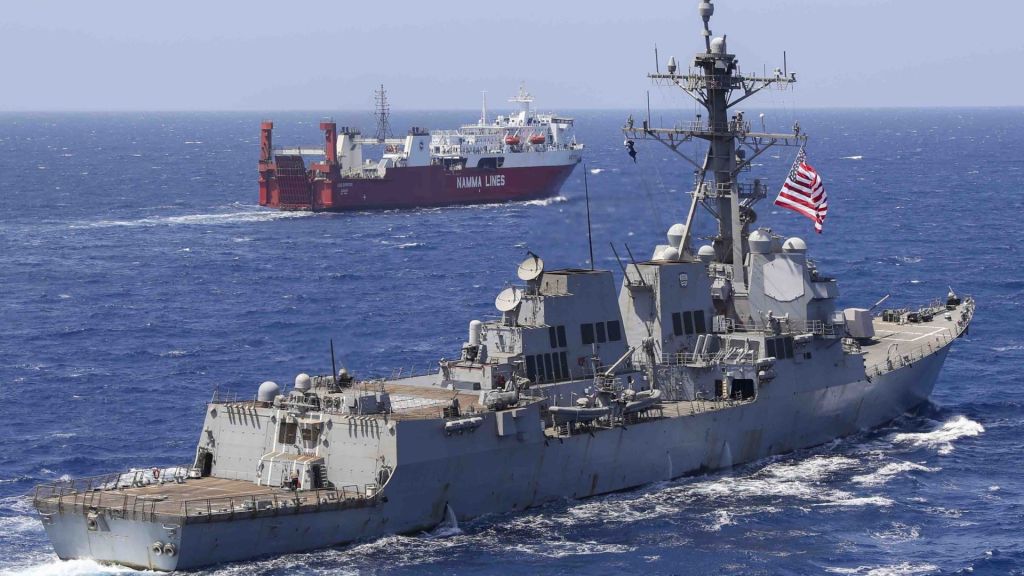
US-led forces in Red Sea will be defensive ‘highway patrol’
The longer container lines detour from the Red Sea around the Cape of Good Hope, the more vessel capacity will be soaked up, and the higher freight rates will go. Rates are already rebounding. New surcharges just announced by ocean carriers imply freight costs are headed higher still.
Container lines have a perfectly valid reason to avoid going through the Bab-el-Mandeb Strait from a corporate governance perspective: They cannot guarantee the safety of their seafarers, ships or cargo due to indiscriminate attacks by Yemen’s Houthi rebels.
From a bottom-line perspective, the timing couldn’t be better. The Red Sea-driven rate rise coincides with annual contract negotiations for Asia-Europe service that renew Jan. 1.
If disruptions extend for months, not weeks, they will impact negotiations for Asia-U.S. annual contracts that renew May 1. Numerous Asia-East Coast services that previously transited the Panama Canal switched to the Red Sea/Suez Canal route due to drought-induced restrictions in Panama.
But a press conference by Defense Department spokesman Maj. Gen. Patrick Ryder on Thursday (transcript here) offered little guarantee that disruptions will end soon — unless civil-war-hardened Houthis are easily cowed by tough talk.
‘Think of it as the highway patrol’
Ryder made no mention of full-scale military-escorted convoys for commercial ships. Rather, he said Operation Prosperity Guardian would provide expanded patrols, i.e., what the U.S. Navy is already doing, but with more warships and international partners.
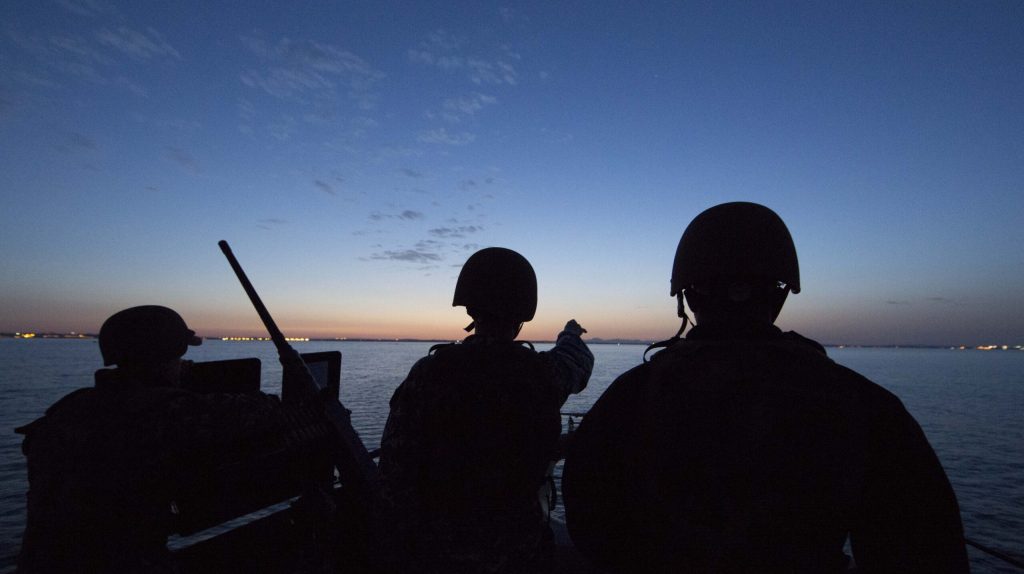
“The [Houthis] have become bandits along the international highway that is the Red Sea,” he said. “And so, the forces assigned to Operation Prosperity Guardian will serve as a highway patrol of sorts, patrolling the Red Sea and Gulf of Aden to respond to and assist commercial vessels as necessary.
“The distance we’re talking about here, from the Suez Canal down to the Gulf of Aden, is about the distance from Boston to Washington, D.C., so you’re talking about a pretty extensive stretch of water that the international community will be covering.”
Asked whether the member nations of Operation Prosperity Guardian have the authority to attack Houthi targets in Yemen, or whether it is primarily a defensive operation, Ryder responded, “This is a defensive coalition. Again, think of it as the highway patrol to safeguard maritime.”
There was a veiled threat of retaliation, however.
“The Houthis need to stop these attacks,” Ryder said. “They need to stop them now. And they really need to ask themselves if they’ve bitten off more than they can chew when it comes to taking on the entire international community and negatively impacting billions and billions of dollars in global trade.”
‘Like 20 police cruisers trying to cover entire Pacific coast’
James Stavridis, vice chairman of global affairs at the Carlyle Group and a retired Navy admiral, addressed the shortcomings of an expanded-patrol-only option in an op-ed piece in Bloomberg on Tuesday.
“The sea space that the maritime operators must cover is remarkably vast. The Red Sea — from the Suez Canal to the Bab-el-Mandeb on the horn of Africa — is the size of California. To cover the rest of the North Arabian Sea and the approaches to the Red Sea, you can add another chunk nearly double the size of Alaska.
“Even if you had 20 warships on patrol — a very high number for a maritime mission — it would be like 20 police cruisers trying to cover America’s entire Pacific Coast,” wrote Stavridis.
“The U.S. and its partners may have to do more than put additional warships on defensive patrol,” he said. “We must be prepared to go on offense: to carry out offensive strikes against targets ashore … against Houthi infrastructure on the southern Arabian peninsula.”
Nightmare scenario: A ‘lucky strike’
Investment bank Evercore ISI held a client webinar on the Red Sea crisis on Thursday, featuring Michael Rubin, a senior fellow at think tank American Enterprise Institute and director of policy analysis at the Middle East Forum.
His concern is that the crisis will escalate if the Houthis get a “lucky strike” that kills American Navy personnel.
“The nightmare scenario is … you have a situation like the U.S.S. Cole and there’s a lucky strike on an American ship and 30 people get killed or the ship is crippled. That’s going to change the dynamic in Washington, especially against the backdrop of an election campaign.”
According to Rubin, “The model in many people’s minds goes back to the counter-piracy efforts with regard to Somalia. There you had an international task force.
“The difference between that and what we’re seeing here is that off the coast of Somalia you were in deep blue territory — deep blue in terms of ocean depth and so forth. Therefore, the ships we were sending were largely out of range or they could hang out in areas that were out of range until they needed to move forward to render assistance.
“With the Bab-el-Mandeb, you’re going to be in range of almost anything when you enter that area. So, it becomes a much more difficult problem set for the U.S. Navy. It becomes vulnerable to drones. It becomes vulnerable to cruise missiles, and it becomes vulnerable to speed boats laden with explosives.”
Asia-Med spot rates rising fast
Spot rate indexes already show a significant effect from the Red Sea attacks.
The Shanghai Containerized Freight Index (SCFI) jumped 15% this week, driven by a 45% week-on-week surge in Shanghai-North Europe rate assessments.
The Drewry World Container Index (WCI) put average spot rates from Shanghai to Genoa, Italy, at $1,956 per FEU for the week ending Thursday, up 40% since the last week of November.
The WCI assessment for Shanghai to Rotterdam, Netherlands, was at $1,667 per FEU, up 42% over the same period. The WCI Global Composite was at $1,661 per FEU, up 20%.
Spot rate in USD per FEU. Blue line: Shanghai-Genoa. Green line: Shanghai-Rotterdam. Orange line: global average. (Chart: FreightWaves SONAR)
According to data from Xeneta, spot rates in the Asia-Mediterranean market averaged $2,327 per FEU on Friday, with the low spot rate at $1,578 per FEU and the high at $3,000 per FEU. The average spot rate was 45% above the average contract rate signed in the past three months of $1,603 per FEU.
The average Asia-Mediterranean spot rate has increased 34% since Nov. 30 and 24% since Dec. 14, according to Xeneta data.
(Chart: Xeneta)
Carriers tack on emergency charges
While rates are rising, ocean carrier profits will not increase to the same extent, because their costs are also up due to sudden diversions. Longer voyages hike fuel bills and other expenses.
Carriers are now tacking on charges to offset those costs.
MSC, the world’s largest ocean carrier, has introduced a contingency adjustment charge (CAC). It is adding a CAC of $1,500 per FEU on shipments from the Middle East and India to Europe starting Saturday, and $1,500 per FEU for shipments from the Middle East and India to the U.S. East and Gulf coasts starting Jan. 18.
MSC said that it was invoking clause 19.2 of its bill of lading, which states that it reserves the right to charge additional freight and is not responsible for delays.
Other carriers are adding similar charges.
Hapag-Lloyd added an emergency revenue charge of $2,000 per FEU on cargo scheduled to transit the Suez eastbound through the end of the month, and $3,000 per FEU on westbound cargo.
Maersk is levying a transit disruption surcharge of $400 per FEU for cargo on the water that was diverted from the Red Sea, and a peak season surcharge of $1,000 per FEU starting Jan. 1 for Asia-North Europe cargo, $2,000 per FEU for Asia-Mediterranean cargo, and $600 per FEU for Asia-U.S. East Coast cargo.
Japan Airlines dedicates first 767 freighters to DHL Express
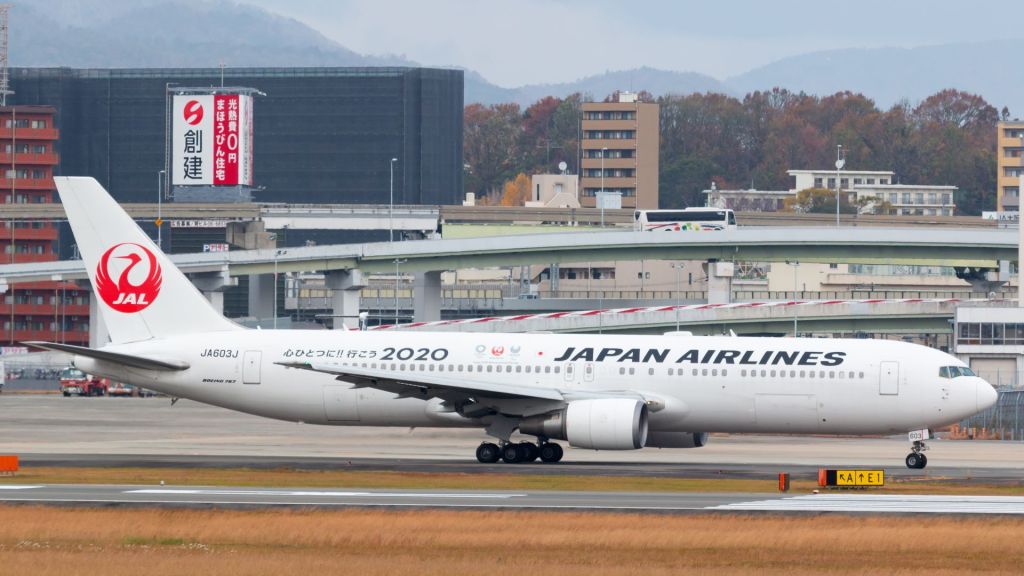
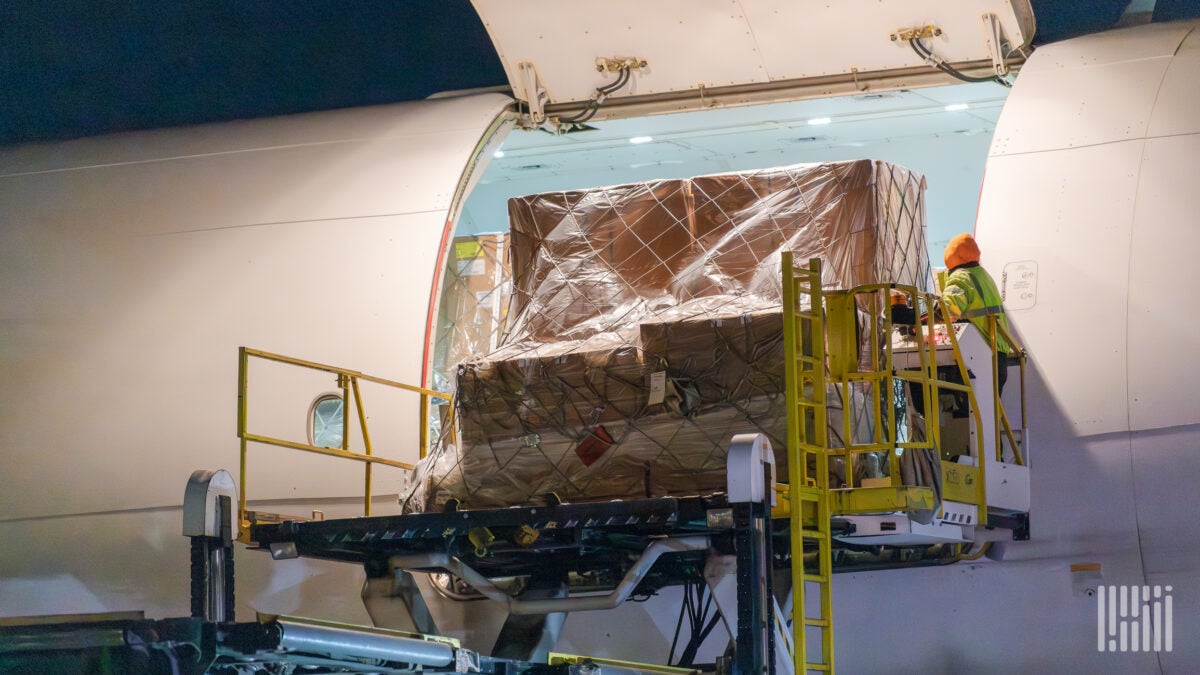
DHL Express has signed a long-term, full-service charter agreement with Japan Airlines to utilize the carrier’s new Boeing 767-300 converted freighters in its express network between Japan and northeast Asia.
Japan Airlines said it will commence service on Feb. 19 with one 767-300 converted from its passenger fleet, marking the first time in 13 years the carrier has operated its own freighter aircraft. Two more freighters are expected to be delivered in 2024.
The two companies announced Wednesday that JAL will connect Tokyo; Seoul, South Korea; Shanghai, China; and Taipei, Taiwan, with two routes to gain an extra share of the growing e-commerce shipping market. DHL recently completed the final phase of expansion at its Hong Kong air hub.
“This new agreement with JAL is an important milestone for DHL as we continue to strengthen our air network between Japan and East Asia. By ensuring the stability of our air network, we can also provide a more flexible and stable response to shipment growth and demand changes, especially between China and Japan, which is one of the most important routes,” said Tony Khan, president of DHL Express Japan, in the news release.
DHL Express has similar flying arrangements with Singapore Airlines and Cathay Pacific in the region. Singapore Airlines flies Boeing 777 freighters to the United States on DHL’s behalf. DHL contracts with Air Hong Kong, which is owned by Cathay Pacific, for intra-Asia airlift.
JAL’s international cargo revenue for the second half of its fiscal year, ending Sept. 30, fell 53.6% year over year to $354.5 million, representing a 70% improvement from the same period in 2019. Cargo traffic as a function of weight and distance fell 12%, roughly mirroring the performance of Asia peers under weak market conditions.
JAL said in May that it planned to restart a freighter subsidiary to take advantage of strong cargo demand in the region using three 767-300s that were phased out of its passenger fleet. It also has established a new venture that will fly Airbus A321 converted freighters on domestic routes for Yamato Transport.
The airline stopped flying its last Boeing 747-400 in 2010.
The views expressed here are solely those of the author and do not necessarily represent the views of FreightWaves or its affiliates.
As we are approaching the end of the year, we can reflect back on 2023, but we should also start making preparations and provide some predictions for 2024. Well, here’s my technology prediction for next year: While 2024 will be another challenging year for the logistics industry plagued with many disruptions and supply chain challenges, it will also be a year of continued investment in logistics technology.
The focus will be on back-to-basics investments that can support major business processes and create massive value to the organization. When I refer to back to basics in the context of supply chain and logistics technology investments, I specifically think of the following evolutions in 2024.
First, expect an emphasis on core infrastructure and data quality through modernization of legacy systems. Many companies still rely on outdated legacy systems for their core supply chain functions. In 2024, we might see a shift toward investments in modernizing these systems with solutions that are cloud-based, flexible and offer better data integration.
We will see higher adoption transportation solutions driven by newer, dynamic types of TMSs aided by intelligent optimization. These TMSs will simultaneously offer data cleansing and standardization to ensure accurate and reliable information throughout the supply chain and will help strengthen foundational processes using automation and best practices that lead to significant efficiency gains without requiring complex new technologies.
Second, there will be a rebalancing focus on operational visibility and transparency. Real-time visibility into the location and status of goods continues to be crucial for managing disruptions and optimizing delivery. Additionally, investments in more advanced track and trace technologies like RFID tags or sensor-based tracking systems that provide better insights into inventories at rest will gain traction.
These newer solutions will also allow for improved communication and collaboration. This is important as companies are often still very siloed and the lack of accessibility of information across the organization and the lack of collaboration between different stakeholders can hinder efficiency. Investments in newer types of foundational technologies that offer solutions for scenario planning, supplier diversification and contingency planning will support building more resilient supply chains that can withstand disruptions.
Third, embracing low-tech solutions alongside high-tech will enable lean process optimization. Implementing lean principles and methodologies to eliminate waste and optimize workflows can provide significant benefits without requiring expensive technology. But the human element will remain critical as we will continue to utilize existing human expertise as a core part of transportation processes. Leveraging the expertise and experience of existing workers through training and upskilling programs can be more effective than relying solely on automation in certain situations.
Overall, the TMS technology market is poised for continued growth in 2024, driven by strong demand for cost optimization, e-commerce fulfillment and advanced technology features. Companies that develop flexible, AI-powered solutions catering to specific industry needs and offer seamless integration with existing systems will be well positioned to capitalize on this growth.
While investments in cutting-edge technologies like AI and automation will continue, there is a growing recognition of the importance of addressing the fundamentals in 2024. Back-to-basics solutions, in the sense of focusing on core applications like TMS, data quality, operational visibility and risk management, are likely to see increased investment to strengthen the foundation upon which more advanced technologies can operate effectively.
About the author
Bart De Muynck is an industry thought leader with over 30 years of supply chain and logistics experience. He has worked for major international companies, including EY, GE Capital, Penske Logistics and PepsiCo, as well as several tech companies. He also spent eight years as a vice president of research at Gartner and, most recently, served as chief industry officer at project44. He is a member of the Forbes Technology Council and CSCMP’s Executive Inner Circle.
Cummins will pay $1.675B fine for engine emissions violations
Cummins Inc. will pay federal and California regulators $1.675 billion to settle a 4 1/2-year-old case over emissions-defeating devices on engines in 630,000 Dodge Ram pickup trucks.
The engine manufacturer also allegedly installed undisclosed auxiliary emission control devices on 330,000 model year 2019 to 2023 Ram 2500 and 3500 pickup truck engines. Such parts or software bypass, defeat or render inoperative emissions controls such as emission sensors and onboard computers.
The civil penalty is the largest ever related to violations of the Clean Air Act. It trails only the $2.8 billion criminal penalty that Volkswagen AG was fined in 2017 in the “Dieselgate” emissions-cheating scandal.
Cummins admits no wrongdoing
Cummins admitted no wrongdoing in the settlement. An internal investigation found no one at the company acted in bad faith, Cummins spokesman Jon Mills said. The company will take a $2.04 billion charge in the fourth quarter. That will cover the fine and future expenses, including software updates on 2013-2018 Ram engines.
It earlier set aside $59 million to cover the recall cost of the 2013-2018 engines.
“The company unlawfully altered hundreds of thousands of engines to bypass emissions tests in violation of the Clean Air Act,” U.S. Attorney General Merrick Garland said in a news release.
“The types of devices we allege that Cummins installed in its engines to cheat federal environmental laws have a significant and harmful impact on people’s health and safety,” Garland said.
The case dates to 2019. That’s when Cummins began reviewing its emissions certification and compliance process for its pickup truck applications after questions from the U.S. Environmental Protection Agency and the California Air Resources Board (CARB). The questions involved the diesel engine powering the 2019 Ram 2500 and 3500 trucks.
“Defeat devices on some Cummins engines have caused them to produce thousands of tons of excess emissions of nitrogen oxides. The cascading effect of those pollutants can, over long-term exposure, lead to breathing issues like asthma and respiratory infections,” Garland said.
Cummins said it cooperated with the Justice Department, CARB and other agencies throughout the 4 ½-year investigation.
“We are looking forward to concluding this matter,” Mills told FreightWaves. “Cummins has reduced emissions by 95% over the past 20 years and we are committed to a zero-emissions future.”
TFI buying Daseke for $1.1B, contemplating spinoff of truckload unit
Serial acquirer TFI International announced Friday it will buy flatbed truckload carrier Daseke in a $1.1 billion transaction. TFI also said it’s exploring spinning off its TL unit into a separate publicly traded company.
TFI (NYSE: TFII) will pay $8.30 per share for Daseke (NASDAQ: DSKE), a 69% premium to Thursday’s closing price of $4.91. The price tag values Daseke’s equity at nearly $400 million, with the remainder tied to a $658 million debt load. If completed, the deal would be executed at just under six times Daseke’s 2023 adjusted earnings before interest, taxes, depreciation and amortization forecast.
TFI plans to fund the deal with cash and debt. It said it may assume some of Daseke’s current equipment financing agreements.
The merger agreement has been unanimously approved by the boards of both companies but Daseke’s shareholders still need to approve the deal. The transaction is expected to close in the second quarter of 2024.
“This attractive acquisition is highly complementary to our existing operations and scales our Truckload segment into a leading North American truckload transportation and logistics business,” said Alain Bédard, chairman, president and CEO at TFI.
Acquisition price
$1.1B enterprise value
Combined value
~$14B enterprise value
Daseke annual revenue
$1.8B
TFI annual revneue
$7.5B
EPS accretion
neutral in 2024, 50 cents in 2025
Recent acquisitions by TFI
more than 90 since 2014 (5 major deals including UPS Freight)
Financing
debt and cash
Table: Company reports
Daseke is a rollup of flatbed TL fleets. It has executed more than 20 acquisitions since its 2009 inception. After the first acquisition, Daseke had a fleet of just 60 tractors generating $30 million in annual revenue. Today, the carrier has approximately 4,900 tractors, 11,000 trailers and 1 million square feet of warehousing space. It produced $1.8 billion in revenue last year.
Daseke will continue to operate its various brands and will report financial results through TFI’s TL unit, doubling that segment’s size, which has Bédard contemplating a spinoff.
“This acquisition also advances our strategic consideration of creating a unique opportunity for shareholders to separately invest in a specialized truckload business and in an LTL, [package and courier] and Logistics business,” Bédard said. “Our immediate focus will be on improving Daseke’s financial results, with the strategic consideration to follow and be ongoing.”
Daseke has been involved in a multiyear cost-cutting initiative designed to better integrate past acquisitions. In the decade that followed its opening, the company’s founder, Don Daseke, continued to bolt on new fleets without realizing any material cost synergies through integration. That left it with a large debt load and thin operating margins.
Don Daseke stepped down as chairman and CEO in 2019. He was bought out of his more than $100 million position in the stock a year ago.
TFI said the deal should have a neutral impact to results next year but will likely contribute 50 cents in earnings per share in 2025.
“Daseke’s deep expertise in servicing a broad portfolio of specialized and industrial end markets such as high-security cargo, agriculture, manufacturing, and construction, is critical given the relative strength of specialized market dynamics today,” Bédard said.
Earlier in the year, Bédard had planned for more than $500 million in acquisitions in 2023 with the hope of landing a larger deal in 2024.
Shares of DSKE were 65% higher at 10:54 a.m. EST Friday while shares of TFII were up 5.5%. By comparison, the S&P 500 was up 0.4%.
Cargo owners consider airfreight alternative to Red Sea shipping delays
Global businesses, uncertain how long the shipping crisis in the Red Sea will last and with a looming shortage of vessels for the export rush before China’s New Year celebration, are scrambling to shift some ocean cargo to airlines, according to logistics specialists.
Major container lines have rerouted vessels around the Horn of Africa or docked them in safe locations to avoid the threat of drone and missile attacks by Yemen’s Iran-backed Houthi rebels in the Red Sea and Gulf of Aden. The Houthis say they are targeting vessels with links to Israel in support of Palestinians under siege in the Gaza Strip. Thirty percent of container volumes transit the Red Sea and Suez Canal shortcut between Europe and Asia.
With no end in sight to the Gaza war and tensions rising, air cargo providers could see a surge in business following a prolonged market downturn that only lifted in recent months behind rising e-commerce exports from China for the holidays.
“The e-commerce wave just broke and rates began crashing down this week. We expect the Red Sea shipping crisis will reverse this,” Marc Schlossberg, executive vice president at Unique Logistics International, told FreightWaves. “We are already seeing an impact on airfreight across multiple regions, industries, and supply chains. Some retailers are already flipping cargo bound for the U.S. East Coast from ocean to air from the Indian subcontinent as there are no good options that do not add two weeks. We have other customers assessing their needs to the U.K. and Europe from Asia.”
Shipping experts say diversion around the Cape of Good Hope, which adds seven to 14 days’ sailing time to Europe and five to seven days to the U.S. East Coast, has unleashed a chain reaction that includes knocking vessels off scheduled arrivals, vessel bunching in ports, terminal congestion and difficulty repositioning containers around the world. Transits could be longer in some cases because the tip of Africa often has rough seas and storms.
Vessels returning to reload with factory goods in Asia will now arrive a couple of weeks late for the seasonal pickup before Chinese New Year, which will result in a shortfall of shipping capacity, said Lars Jensen, CEO of consultancy Vespucci Maritime, on a Wednesday webinar presented by freight forwarder Flexport.
Chinese New Year falls on Feb. 10, but factories will begin to slow production in mid-January before completely shutting down for the holiday and then slowly ramping up again — a lull that can last more than a month. Businesses pull forward their shipping requirements each year, which leads to a rush at Chinese ports, transportation delays and increased shipping rates.
About 540 vessels are assigned to Suez services, with 136 currently being diverted around Africa and 42 that have paused their journey, according to a Flexport analysis.
Chicago-based Seko Logistics has had some inquiries about converting ocean shipments to air leading up to the Chinese holiday, “but this could very well extend and expand into 2024,” said Chief Commercial Officer Brian Bourke in an email.
About 97% of total containerized trade by weight moves by sea, so even a slight shift in the mix could have a huge impact on airfreight volumes.
Importers and exporters will likely transition their most critical goods to air carriers to make sure enough arrive on time for production or sales needs, especially since many flights from Asia to Europe are still quite full, Niall van de Wuow, chief airfreight officer at market intelligence firm Xeneta, said on a company webinar.
Widebody freighters could soon be in greater demand if the supply chain disruption in the Red Sea is protracted. (Photo: Jim Allen/FreightWaves)
“I had a call with a global appliance company with sites around the world. Airfreight is cheaper than lines down. We expect to see an airfreight surge for manufacturing as automotive, electronics and other supply chains assess their inventory needs in the next few days,” said Schlossberg.
“We have customers searching for solutions from Egypt where the ports have been shut down and from Jordan where customers are not comfortable with the cross-border option. And ocean routing via Israel and Aqaba is no longer viable,” he added.
Companies spent the better part of a year bringing down excess pandemic inventories to normal levels and may not have sufficient safety stock if the Red Sea bottleneck continues to disrupt shipping, said Trine Nielsen, Flexport’s head of ocean for Europe, the Middle East and Asia. She encouraged shippers to plan for extra lead times and rate increases, and to book shipments early.
“Most of our fashion apparel retail customers had a strong holiday season. Inventories are in relatively good shape so a disruption like this will drive significant airfreight demand,” echoed Schlossberg.
There is less urgency to make mode-conversion decisions because the industry is past the Christmas shopping rush, but that will quickly change without a resolution of the Middle East conflict, according to logistics managers.
The airfreight market could get heated by mid-January as importers place new orders with Asia suppliers, especially since many airlines reduced freighter schedules in anticipation of a lull in transport demand, said Christos Spyrou, founder and CEO of wholesale network Neutral Air Partner.
He predicted an increase in charter flights to meet demand, especially for time-critical and valuable goods, as well as more use of sea-air services via Dubai to Europe. Flexport, which helps companies place orders with overseas manufacturers and then manages shipment delivery, has also fielded inquiries about deferred airfreight and sea-air options through Dubai and Doha, Qatar, said Zeid Houssami, global head of airfreight, in an email.
The hybrid services are less expensive than airfreight but faster than ocean.
Air capacity on the trans-Pacific might get tighter after Chinese New Year if ocean carriers divert vessels to Asia-eastbound lanes to provide more reliability, Houssami observed.
Open-ended risk to ocean shipping
The Suez route attracts a high proportion of the world’s largest vessels. Peter Sand, Xeneta’s chief data analyst, said shipping lines need 50 more ultralarge container ships on the eastbound corridor. Ship broker Clarksons estimates that 19% of global shipping capacity will be diverted from the Suez route.
Carriers have idle capacity at the moment, but not all vessels are suitable or can easily be restarted.
In addition to dealing with heightened supply chain uncertainty, shippers will face higher transportation costs because of the diversion of shipping away from the Red Sea.
For starters, adding ships to move the same amount of containers means spending for extra crews, fuel, supplies, port charges and other expenses. If smaller ships are deployed they will have higher unit costs per nautical mile.
Carriers will save $400,000 to $700,000 in Suez Canal tolls, but the 3,000 extra nautical miles to go around Africa to Europe will add $1 million in fuel costs per vessel, which will be passed on to customers, Sand explained.
Liner companies ZIM, Hapag-Lloyd and Maersk are now charging a war risk surcharge of between $20 and $100 per container and ZIM is charging more for the longer route around Africa.
China-Northern Europe container spot rates increased about 15% since vessels were attacked in early December. (Chart: FreightWaves SONAR)
Shipping line CMA CGM this week declared force majeure and implemented surcharges of up to $1,550 per container unit, depending on the origin and destination. Invoking a force majeure clause tells customers the carrier may not be able to fulfill contractual obligations due to circumstances beyond its control.
The formation of a multinational task force, led by the U.S., to protect commercial shipping is unlikely to alleviate the risk of attacks, prolonging the disruptive effects on supply chains, maritime experts say.
Partner nations have previously escorted convoys to defend vessels against hijacking by Somali pirates, but air attacks present another level of danger for commercial operators. Participating navies may not have the right kind of anti-missile technology and no system is foolproof.
Vespucci Maritime’s Jensen said small drones may not seem like a major threat to massive container ships but noted the danger from an explosion is fire that could quickly spread.
“Are you going to risk life and limb of your seafarers and a billion dollars worth of cargo on the ship in the hope that they will shoot down all of those missiles? … Unless there is also a solution whereby the attacks themselves from land stop, or at least are eliminated drastically, I have a hard time seeing the carriers resume sending supersized post Panamax vessels through that region,” he said.
The biggest shipping problem will be in the Mediterranean Sea because carriers that used to call on ports such as Genoa in Italy, on their way to major gateways in Northern Europe, will bypass the smaller destinations, said Jensen.
Shippers should also brace for Med-bound containers to get stuck for up to a week in unfamiliar transshipment ports such as Tangiers in Morocco or Algeciras in Spain, where carriers will offload them to avoid lengthy detours from the main route.
Jensen also warned that some consumer goods may swing back to the Panama Canal, pricing out Chilean and Peruvian agriculture growers who are less able to pay the reservation fees for priority access.
Shippers that bring products to the East Coast through the Suez Canal also have the option of using the trans-Pacific route and then moving inland by rail or truck.
Jensen said the combination of strong Chinese New Year demand and the effective decrease in global container capacity because of the extra ships necessary to sustain diversion around Africa could lead ocean rates to triple. Interviewed on CNBC on Friday, Jensen predicted the average global rate would double to about $3,000.
Ocean rates are already spiraling upward. The rate for a forty-foot equivalent unit reached $1,875 between Asia and the Mediterranean on Dec. 14, according to the Xeneta platform – a 25% increase from the previous week. But shippers are being quoted more than $6,500 for high priority shipments on Mediterranean Shipping Company’s Diamond Tier service. And MSC implemented peak season surcharges of $2,000 for Asia-Mediterranean cargo.
And, Jensen noted, a new European emissions trading scheme for maritime that is scheduled to go into effect on Jan. 1 will be much for expensive as carriers have to pay carbon tax on emissions for going all the way around Africa.
Wife of Iowa trucker seeks answers a month after his disappearance
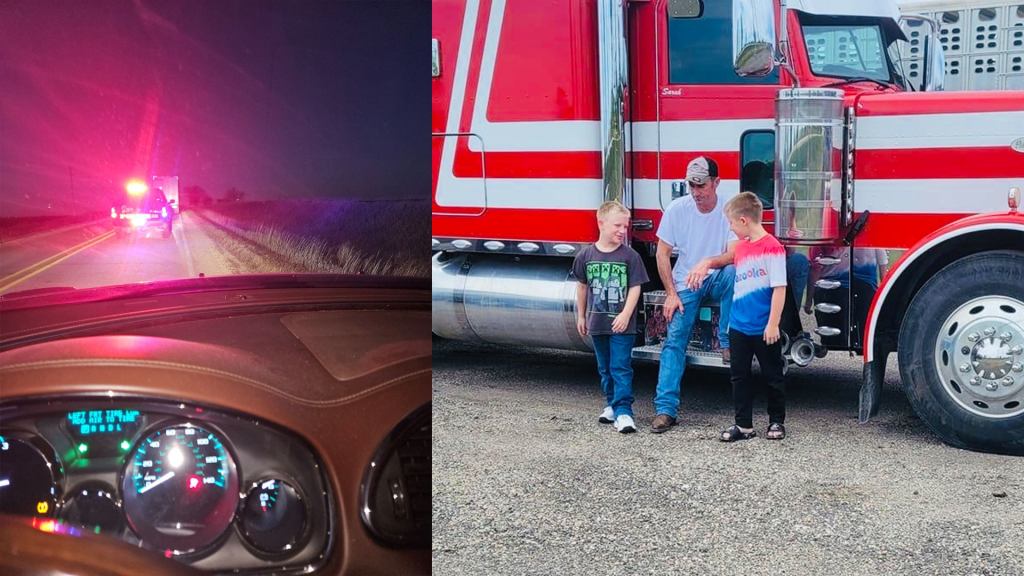
It’s been a month since Sarah Schultz last saw her truck driver husband, David Schultz, 53, of Wall Lake, Iowa, when he dropped by the house around 7 p.m. on Nov. 20, long enough to grab a change of clothes before heading out to pick up another load of pigs.
“Dave called me and said, ‘Hey, could you set out a change of clothes for me? I’m late,’” Sarah Schultz told FreightWaves.
She said her last conversation with Dave was about the fact that he didn’t like the pants she had picked out for him because the pockets weren’t deep enough.
After running upstairs and grabbing a different pair, Dave gave her a kiss goodbye and headed out, Sarah said.
What happened next remains a mystery as local, county and state law enforcement agencies are still searching for answers — and Dave.
Dave picked up a load of 120 pigs near Eagle Grove, Iowa, but authorities say he never arrived for his appointment time of midnight at the site where he was supposed to offload the pigs: Wiechman Pig Co. buying station in Sac City, Iowa. Wiechman’s home office is in Fremont, Nebraska, but it has 16 locations in the Midwest, including six pig-buying stations in Iowa.
Around 3 p.m. on Nov. 21, a Sac County secondary road employee reported seeing Dave Schultz’s red- and white-striped Peterbilt with his loaded trailer of pigs parked in the middle of the northbound lane of County Road N-14, but no Dave. His rig was found facing the wrong direction of the buying station where he was scheduled to arrive with his load of pigs.
Inside the cab of Dave’s truck, investigators found his wallet, including his driver’s license, his cell phone and around $2,000 in cash, which Sarah confirmed was still in his wallet. His coat was found in a nearby ditch.
Sac County Sheriff Ken McClure said his office is investigating all leads and is “waiting for subpoenas to come back from different personal data [belonging to Dave].”
“I think, today, any scenario you could run through your head is probably a possibility,” McClure told FreightWaves.
After Dave’s rig was found, law enforcement searched the immediate area on foot and with a K-9, according to a Dec. 9 press release by McClure.
“The Sac County Sheriff’s Office requested assistance from the Iowa State Patrol airwing unit,” McClure said. “An airplane was dispatched from Iowa City that was equipped with forward-looking infrared. A State Patrol pilot flew over the surrounding area and did not detect a heat signature that would be consistent with a person. For the next two days, law enforcement, area firefighters and volunteers expanded the ground search on foot and with the use of drones. Nothing of significant value was located.”
The United Cajun Navy and volunteers searched over 100,000 acres in the area where Dave’s tractor-trailer was found.
Iowa truck driver David Schultz, 53, of Wall Lake, Iowa, has been missing for 30 days. (Submitted image)
Investigators obtained video footage showing Dave at 11:15 p.m. on Nov. 21, 2023, at the Marker 126 Travel Center east of Fort Dodge, Iowa, on U.S. Highway 20. According to the press release, Dave was there for 16 minutes before leaving the truck stop. He is then seen on a Department of Transportation camera on Highway 20 west of the truck stop heading west.
“This was the last time David was seen,” McClure said. “Cell phone data obtained from David Schultz’s phone corroborates this timeline.”
Investigators claim there was no usable video from the DOT camera. Cell phone records show Dave’s phone arrived at the intersection of Highway 20 and U.S. 71 at around 12:18 a.m. The data shows the phone traveling north to where the truck was found and that it may have been there since 12:40 a.m., according to McClure.
Over the past month, Sarah said she’s read hurtful comments on social media saying that maybe Dave doesn’t want to be found and left the family to start a new life.
Sarah said she is convinced that Dave was taken and that he wouldn’t have left his family, including the couple’s 10-year-old twin boys, Isaack and Joseph, for a new start.
“He would have never left our family. I know some people say, ‘Well, maybe this was his choice,’” she said. “This was not his choice. I guarantee you. He had nothing to do with this.”
“He wanted a wife and children his whole life and he finally got it in his 40s. Our twins are his life and his little buddies.”
If Dave wanted to disappear, she added, why didn’t he take the cash out of his wallet or drain their bank account? Sarah said Dave had purchased a bright yellow Peterbilt and was fixing it up. He planned to sell the red and white Pete, according to Sarah.
“Now he doesn’t even, hasn’t even had a chance to drive it yet,” she said. “He had goals. … He didn’t, wasn’t just sitting there hating his life. All he needed was a headlight to get it up and running.”
More questions than answers
Sarah said the days before Dave mysteriously disappeared were busy. Her daughter, Sabrina, and grandson, Niko, were visiting from Fort Lauderdale, Florida. While the family celebrated Thanksgiving a few days early on Nov. 19, she said Dave was working and unable to attend the dinner.
“He had another load before this one that made him late,” Sarah said. “I think they were cleaning out those hog barns. I think he said he’d already been there once and this was the second time.”
Dave leases a livestock trailer from Les Brown, owner of B Bar R Livestock out of Denison, Iowa, who also finds him loads. Brown told FreightWaves that Dave had already delivered a load to the Wiechman Pig Co.’s buying station in Sac City and was planning to repeat the same route as before.
Investigators confirmed that Dave loaded the pigs and left the hog barn in Eagle Grove around 10:40 p.m. on Nov. 20. But after reviewing nearby businesses’ surveillance footage, they said he never arrived at the buying station.
However, Brown said he’s convinced that Dave arrived at the pig-buying station and that “something happened” to him when he got out of his truck to unload the pigs. He claims that someone else drove Dave’s custom-painted Peterbilt out of the station but that Dave wasn’t behind the wheel. He understands there’s no video evidence to back up his claim.
“There’s one thing about Dave is that if he had pigs on that had to go somewhere, they got there,” Brown said. “If he had truck trouble, he made it work to get the pigs where they needed to be. All of our company drivers, everybody in the industry who hauls livestock that knows Dave are pretty confident that he made it down to the place he was supposed to go and that things, whatever happened to Dave, went on there.”
Brown said Dave was familiar with the buying station in Sac City and had hauled the same load for him the night before.
“The same route, the same deal, the same place, everything was the same as the night before,” Brown told FreightWaves.
Sarah and Brown agree that Dave wouldn’t have left his rig in the middle of the road without turning his flashers on or finding a safer spot to pull over. In his latest update about Dave’s disappearance, McClure stated that Dave’s truck was shut off.
Kevin Sievers, assistant manager of Wiechman Pig Co., works out of the Sioux City, Iowa, facility but also oversees the Sac City site where Dave was scheduled to unload.
“We had a guy come in the next morning to work up the hogs, and he noticed that there weren’t as many hogs as there were supposed to be in the pens,” Sievers told FreightWaves. “We contacted where the hogs came from and if something had gotten changed with their scheduling or something. They reached out to the trucking firm and the site where the hogs were loaded and said the hogs had been loaded but not delivered.”
Brown said he learned around 7:30 a.m. on Nov. 21 that Dave’s load of pigs hadn’t been delivered. Less than an hour after not being able to reach Dave by phone, Brown went out looking for him.
He also drove to Sarah’s house to let her know that Dave didn’t show up to his delivery point. He remembers asking her if she had a GPS location-sharing app on her phone that would help locate Dave.
She didn’t.
Sarah later called the police in Lake View, Iowa, to report Dave missing with a possible medical emergency after she was unable to reach him by phone or find him or his tractor-trailer.
Sievers said the site where Dave was to unload the pigs is a smaller facility and had a couple of semi-loads arrive earlier that night.
“We don’t buy a lot of hogs there,” Sievers said. “ It doesn’t have hogs in it all the time — we just use it as necessary. A lot of drivers will drop off their pigs and they’ll drop off their load paperwork in a box and put them in the pens and leave.”
Sievers said Dave was supposed to be the last truck to unload that night.
Investigators said the farm where Dave picked up the pigs was searched and the manure pit in the barn was pumped and drained.
Lack of communication
Sarah said she’s frustrated that very little information into Dave’s disappearance is being shared with her by the Sac County Sheriff’s Office, adding that she wants the Federal Bureau of Investigation to look into her husband’s case.
“I’m just worried that law enforcement around here won’t ask for the FBI’s help,” she said.
Sievers said he has had little contact with law enforcement since Dave went missing 30 days ago.
“They [the Sac County Sheriff’s Office] called one of our facilities close by and talked to the guy there and asked if we had cameras at the Sac City facilities, and I told him we did not,” Sievers said.
He said the company is considering installing cameras at the facility that it has been overseeing for the past 10-15 years.
Sievers’ and Dave’s paths crossed over the years at the pig-buying facilities.
“He’s a good trucker,” Sievers said. “I never had any problems with Dave.”
Do you have a news tip or story to share? Send me an email or message me @cage_writer on X, formerly known as Twitter. Your name will not be used without your permission.
Ramaswamy advocates trucker-friendly policy at Iowa 80
Vivek Ramaswamy, a Republican presidential candidate, unveiled his trucking policy at Iowa 80 on Thursday. He also shared his opinions on the current state of America’s $875 billion trucking industry.
“Each of us deserves to live in a country where we’re each allowed to achieve that maximum of our potential,” said Ramaswamy, speaking about the American dream. “I don’t think that’s the case today for the way we’re treating truckers in this country, who are the backbone of our economy, are the invisible glue that holds the supply chain together.”
The livestream from Iowa 80, the largest truck stop in America, started with Ramaswamy arriving in a semi-truck. He greeted several drivers and posed for a picture in front of the truck with those drivers and his son, Karthik.
Presidential candidate Vivek Ramaswamy poses in front of a truck with his son and truck drivers. (Credit: Ramaswamy campaign livestream)
Truck driver Lee Schmitt of the CDL Drivers Unlimited, a new membership alliance for truck drivers, asked questions submitted by truck drivers after Ramaswamy delivered a brief introduction.
The conversation touched upon a slew of trucker issues, including the risks of increased technology, mental health, speed limiters and reforms to the Department of Transportation (DOT) and Federal Motor Carrier Safety Administration (FMCSA).
“The ideas I’m sharing with you, these aren’t Black ideas or white ideas,” Ramaswamy said. “These aren’t even Democrat ideas or Republican ideas. They shouldn’t be. … This is common-sense, American ideas to say that every person should be free from regulatory overreach, that every person should be free to achieve the maximum of their potential without anybody standing in their way. [T]he truckers of this country should not be an exception to that standard.”
There are more than 2 million tractor-trailer truck drivers in the United States, per federal data. However, presidential candidates rarely speak with truck drivers about their concerns. Ramaswamy’s policies appear friendlier to truck drivers than to large trucking companies or the mega-retailers and manufacturers they serve.
“We will say no to the World Economic Forum and standards of 2030 zero-emissions standards for truckers,” Ramaswamy said. “‘Zero emissions by 2030,’ says the World Economic Forum. Truck no!”
The Republican primary calendar officially begins on Jan. 15, 2024, when Republicans in Iowa will caucus to vote for their preferred candidate.
Several candidates are vying for the Republican nomination for president, including Ramaswamy, Florida Gov. Ron DeSantis and former South Carolina Gov. Nikki Haley. However, former President Donald Trump has captured by far the largest chunk of votes among likely voters, according to recent polls.
Given Trump’s dominance in those polls, some are already speculating who might be the former president’s pick for vice president. Trump previously stated in an interview that Ramaswamy would be a “great” running mate.
The policy relies on three key points:
Ramaswamy says DOT needs to study driver retention over driver recruitment
One chunk of Ramaswamy’s policy urges the DOT how to retain drivers.
“We don’t have a trucker shortage as we’re taught to believe,” Ramaswamy said Thursday. “What we really have is a retention problem. And what we have right now, especially post-COVID, is an environment where, in that short window where there was a sharp demand, a lot of people were able to get a truck [and] use debt potentially to do it. But now, we’re burned on the opposite side when we have a glut of supply.”
The trucking industry, especially employers in the large truckload space, has unusually high turnover rates. Large truckload fleets saw an annual turnover rate of around 94% from 1995 to 2017. Rather than boost retention, many fleets instead try to find ways to increase the number of potential truck drivers. Researchers concluded in a 2023 study that higher turnover is more profitable for trucking companies than paying drivers more.
Vivek Ramaswamy greets truck driver Lee Schmitt of the CDL Drivers Unlimited. (Credit: Ramaswamy campaign livestream)
However, Ramaswamy pointed out that reduced driver turnover means reduced administrative costs and better safety. That’s backed up by research, too; one federal study from 2017 indicated that less experienced truck drivers were more likely to cause a serious accident on the road. The analysis found that a trucker with fewer than three years of experience, for example, was 47% more likely to cause an accident than one with more than three years on the road.
Trucker policy advocates for ‘common-sense’ safety regulations
Ramaswamy’s policy drills down on hours-of-service regulations, a topic that’s hotly debated among truck drivers. Some drivers say these rules undercut safety, as they’re unable to dictate their own working hours, while a federal study found that enforcing these rules could prevent up to 24 deaths annually.
Ramaswamy’s policy states he believes better parking availability would be a larger boon to driver safety. A 2016 study from the American Transportation Research Institute found that the average truck driver spends 56 minutes per day looking for parking. That translates to $4,600 in lost wages every year.
In recent years, lawmakers have repeatedly introduced bills to direct federal funding for more parking, but these efforts haven’t yet succeeded.
Ramaswamy says it’s time to crack down on broker fraud, not owner-operators
Ramaswamy’s trucking policy turns away from California’s AB5 law, which curtailed the owner-operator trucking model in that state.
Ramaswamy said AB5’s test to determine whether an independent contractor is an employee could undermine good practices that integrate those contractors into a given company. He said compliance monitoring, educational programs and the like may be used to prove that a contractor is an employee. The IRS’ more open-ended checklist would be a better way to tackle employee misclassification.
Instead, Ramaswamy’s policy says this investigatory might should be used to investigate broker fraud and increase broker transparency. Brokers are the intermediaries that contract truck drivers and companies seeking to move freight.
The Transportation Intermediaries Association, which represents freight brokers, told FreightWaves’ John Gallagher that these rules are overdue but “a huge step towards addressing potential financial fraud and making sure that funding is available to protect motor carriers and brokers.”
Freight broker and third-party logistics provider C.H. Robinson Worldwide Inc. said late Thursday that CFO Mike Zechmeister will be leaving his post in 2024.
The Eden Prairie, Minnesota-based company (NASDAQ: CHRW) said it has begun a search for a replacement. Zechmeister will remain with the company until a successor is named, or no later than May 31, at which time he plans to retire.
“We greatly appreciate Mike’s dedication and contributions to Robinson over the past four years to ensure the company’s continued success,” David Bozeman, president and CEO, said in a statement. “During his tenure as CFO, Mike built a strong finance organization that will continue to serve Robinson well.”
Zechmeister joined Robinson in 2019 from United Natural Foods Inc., where he had been CFO. Before that, he spent 25 years at General Mills Inc. in a variety of finance leadership roles.