DOT’s freight data exchange processing 65% of US container imports

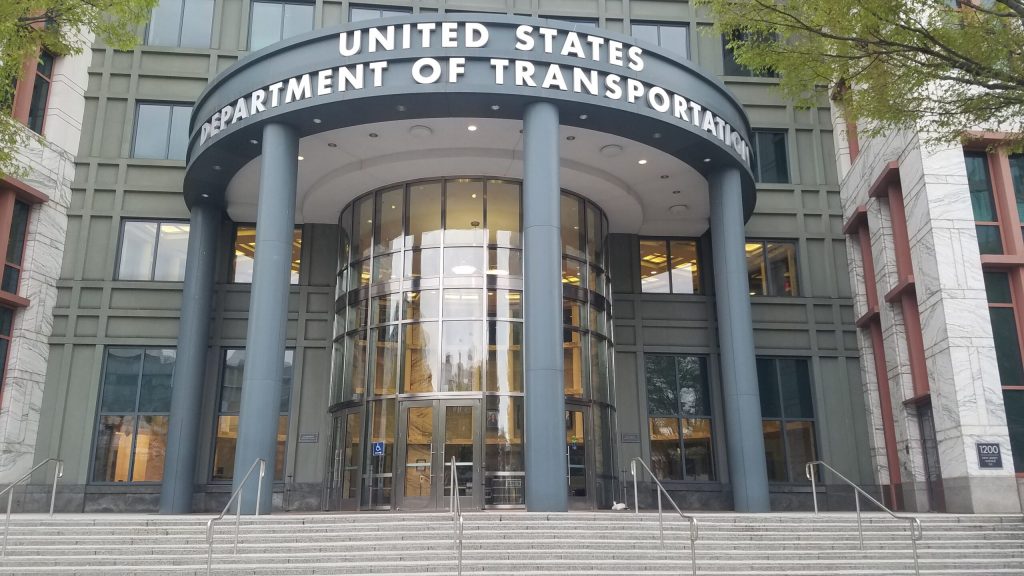
U.S. Department of Transportation in Washington, D.C.

WASHINGTON — The Biden administration’s pick to head the first high-level cabinet office dedicated exclusively to freight is setting a high bar for the value her office will bring to the nation’s freight markets.

Deputy Assistant Secretary Allison Camden (Photo: U.S. DOT)

Allison Dane Camden will lead the U.S. Department of Transportation’s new Office of Multimodal Freight Infrastructure and Policy as the first deputy assistant secretary for the office. 

Camden brings to the office experience she gained at the Washington State Department of Transportation when she served as deputy assistant secretary for multimodal development and delivery.

The stakes at the U.S. DOT are higher. Camden is tasked with coordinating national freight policy with all 50 states, creating a National Multimodal Freight Network (NMFN), and overseeing a data portal that has figured out how to get cargo owners and carriers to share their freight data in exchange for a deep look into the country’s supply chains.

Camden spoke with FreightWaves to outline her vision of what government agencies and private companies can expect from her office and from that data portal, Freight Logistics Optimization Works (FLOW), which the Biden administration launched in March 2022.

[This interview was edited for length and clarity.]

FREIGHTWAVES: Companies involved with moving goods through the nation’s freight networks, along with those that build and maintain those networks, have been anxious to see your office get up and running since it was authorized under the Bipartisan Infrastructure Law in 2021. What immediate benefits can they expect now that the office is officially underway with its first leader?

CAMDEN: Freight now has a permanent seat at the table. There’s been great work happening at U.S. DOT for a lot of years, but it has often been siloed, as departments can be. So this new office is housed within the office of the secretary and is really meant to lead on freight policy and knit together the good work that has already been happening.

So my goal for the freight office is to be a one-stop shop to tackle freight needs, collaborate with the other parts of DOT, with industry partners, and with state and local governments to strengthen the supply chain and ensure goods can move more efficiently. I think folks are going to start seeing that soon.

We’ve also got the National Multimodal Freight Network designation that’s part of the mission of this office. [Among the goals of the NMFN, required by Congress in 2015 but never finalized, is to prioritize investment in freight infrastructure.] We want to get that started in 2024.

And even before I got here the work of FLOW was underway. And we’re starting to see the fruits of that effort already, and that’s only going to grow with time.


Source: U.S. DOT

FREIGHTWAVES: Speaking of FLOW, what is your vision for that initiative?

CAMDEN: I see it as an innovative solution to a pretty pernicious problem that came up during the supply chain crisis.

Two years ago when some were saying Christmas was going to be canceled, the Biden administration and this department brought together the private sector partners of the supply chain and the public sector partners of the states and local governments and ports to solve that problem.

Christmas wasn’t canceled. People received 99% of their packages on time from major shippers. Part of what we saw and what we were consistently hearing at that time was that we didn’t just need better physical infrastructure, we also needed better data infrastructure. So that’s what FLOW is aiming to get at.

We’re seeing great results so far. We just had the first tranche of data go out to our private sector partners, and they’re starting to be able to put it to use, to add it to their own models to aid their decision-making, and we’re getting positive feedback from them.

FREIGHTWAVES: There are some big players notably absent from FLOW’s current 59-member participant list, including two of the major Class 1 railroads [Norfolk Southern and CSX], and there are just a handful of trucking companies. Is FLOW’s effectiveness hindered given the amount of freight capacity represented by these and other carriers that are not yet part of the platform?

CAMDEN: I don’t think that’s hindering it at all. We always intended to start small and grow, so I’m proud of what the team’s done in such a short amount of time — it hasn’t even been two years. We currently have 65% of all [import container] bookings — no one else has that. We have the top five U.S. container ports, all the major chassis providers, seven of the major ocean carriers, four of the largest importers.

This is unprecedented. To me it is so impressive to see the federal government and the private sector partner together in this way. This is proprietary data, but we found a way to make the private sector comfortable sharing it, knowing that it’s going to be for a greater good that’s going to help them and the overall supply chain.

Participants are already using the data and are excited about it. We think more industry partners will be interested in joining as they see the real-world value.

FREIGHTWAVES: Will nonparticipants, or the general public, be able to tap into FLOW and see the data?

CAMDEN: The system was meant to work so that if you share your data, you get data back out that can be used for decision-making, so only those participating will have access. But anyone will be able to access the demo once it’s up and allow them to understand how the system works.

FREIGHTWAVES: The FLOW website indicates that an interactive portal demo is “coming soon.” When can we expect to see that?

CAMDEN: It should be available by early next year.
Click for more FreightWaves articles by John Gallagher.

Diesel benchmark down again, futures markets up amid Red Sea tension

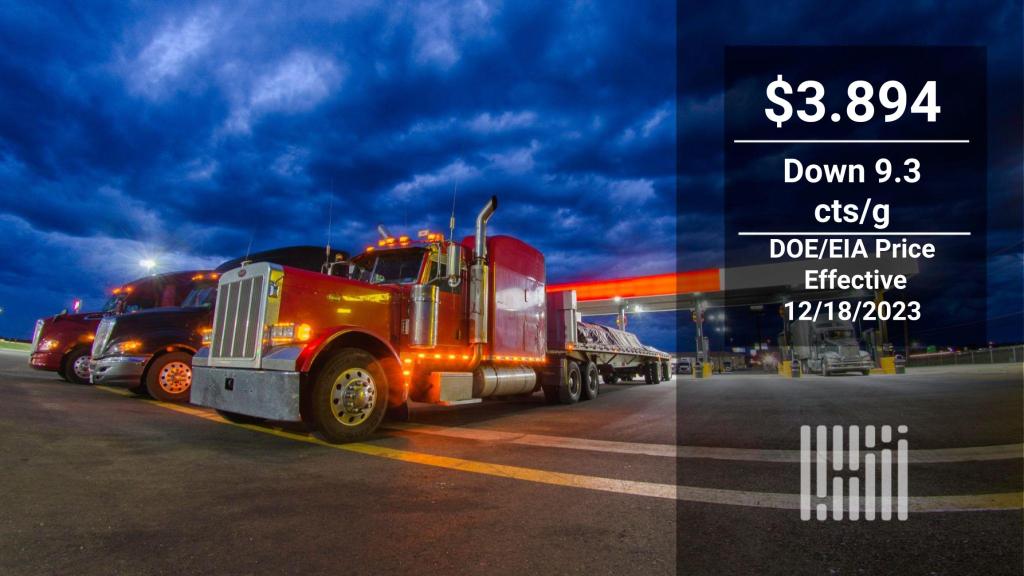
While the benchmark diesel price used for most fuel surcharges fell Monday, the eighth consecutive week it has declined, oil futures reacted strongly to the cutbacks in the use of the Suez Canal by shipping companies, including a Monday decision by a major oil company to bypass the Red Sea.

The Department of Energy/Energy Information Administration weekly average retail diesel price fell to $3.894 a gallon Monday. That is down 9.3 cents from the prior week. In the eight-week period of unbroken declines, the price used for most fuel surcharges has fallen 65.1 cents.

But the decline hasn’t been just in that period. The DOE/EIA price has fallen 11 of the past 13 weeks, down 73.9 cents per gallon during that time from the $4.633-per-gallon price on Sept. 18, before that significant series of declines commenced.

However, market conditions in the past several trading days are signaling that retail prices might be challenged to continue dropping.

Oil markets reacted strongly to news that BP was the first major oil company that said it would suspend the movement of its tankers through the Red Sea because of the attacks on shipping launched by the Iran-backed Houthi movement which controls much of western Yemen, including a significant coastline with the Red Sea.

As with other cargo movements, ships avoiding the Red Sea would no longer go through the Suez Canal and instead go around South Africa’s Cape of Good Hope. Flexport last week reported that the added shipping time to go around the Cape instead of through the canal would be seven to 10 days. 

Reuters reported data published by the EIA — in turn quoting a company called Vortex — that in the first half of this year, oil transiting the Suez Canal was about 9.2 million barrels a day. With global oil consumption at about 102 million to 103 million barrels/day, that would be about 9% of world oil consumption through the key passage that is now threatened.

The pace at which retail prices might react to any sharp moves higher is uncertain. Retail prices already have been moving closer to a more normal spread against wholesale prices, although the volatility of markets dating back to the start of COVID makes “normal” a relative term.

Since Dec. 8, the FUELS.USA data series in SONAR, which reflects the spread between the average national retail diesel price in the DTS.USA data series and the average national wholesale diesel price as measured in the ULSDR.USA price has fallen by 21.3 cents, to $1.406 a gallon from $1.619 a gallon. If “normal” is defined as something closer to $1.10 a gallon, it is possible that retail prices will continue to fall, or at least not rise as fast as the ongoing increase in wholesale prices created by the surging futures market for crude and ultra low sulfur diesel (ULSD).

In the futures market, ULSD on CME bottomed Tuesday at $2.5074 a gallon. The bottom came after a steep fall that took ULSD on CME down 41.75 cents a gallon between Nov. 21 and Tuesday.

Since then, ULSD on CME has tacked on 16.54 cents to a settlement Monday of $2.6728 a gallon. 

The increase in prices in the ULSD market is coming even as physical indicators are not  showing any new signs of tightness. 

Before the Red Sea issues, the rise in oil markets could be attributed to several factors, including a falling dollar that slid with the decline in U.S. interest rates — oil prices generally have an inverse correlation with the greenback’s strength — and the fact that markets that fell as hard as oil has for several weeks will eventually find at least a temporary bottom as profitable short positions are unwound.

Key physical indicators that are suggesting the price increase is not tied to new tightness include spreads in the physical market. Those spreads mark the differential between the CME ULSD price and physical barrels of ULSD in barges or on a pipeline.

Some of the spreads are stronger in the past week; the Gulf Coast spread, according to DTN, strengthened to minus 19.5 cents a gallon from minus 40 cents. But that latter price is well below historic norms so a rebound was all but inevitable.

Meanwhile, in New York Harbor, the spread weakened to minus 2.25 cents a gallon from plus 4 cents a week ago. And in Chicago, the spread was barely changed near minus 40 cents a gallon.   

More articles by John Kingston

California asks EPA for waiver to implement Advanced Clean Fleets rule

GlobalTranz wants Supreme Court to punt on broker liability issue

Convoy autopsy continues; panel sees capacity issues, lack of discipline

Red Sea chaos should boost tanker and container shipping rates

a photo of military operations in Red Sea

The number of shipping companies refusing to risk Red Sea transits is growing by the day. The waters off the Cape of Good Hope are about to get much busier as more ships circumvent Africa on a detour around the Red Sea and Suez Canal.

As of early Tuesday, companies confirmed or reported to be pausing Red Sea transits and/or rerouting around the Cape of Good Hope included container lines Maersk, MSC, Hapag-Lloyd, CMA CGM, Zim (NYSE: ZIM), Evergreen, Yang Ming, Cosco, OOCL, HMM and ONE; tanker owners Frontline (NYSE: FRO) and Euronav (NYSE: EURN); car carrier owner Wallenius Wilhelmsen; and oil and gas companies BP (NYSE: BP) and Equinor.

That list doesn’t capture the full effect, as ships controlled by other operators are also detouring. Argus reported that three liquefied natural gas (LNG) carriers and three very large gas carriers (VLGCs) diverted from the Red Sea route on Monday.

Longer voyage distances should boost rates

Diversions around Africa are driven by ongoing attacks on commercial shipping by Yemen’s Houthi rebels near the 20-mile-wide Bab-el-Mandeb Strait.

The attacks continue. According to U.S. Central Command, there were two more attacks on Monday: on the product tanker Swan Atlantic and on the bulk carrier Clara.

Ship diversions around the Cape significantly extend voyage distance, increasing shipping demand measured in ton-miles (volume multiplied by distance) and constraining transport capacity, a positive for rates.

“Longer voyages are effectively a synthetic reduction in capacity due to fewer asset turns, which drives up pricing,” said Deutsche Bank analysts Amit Mehrotra and Chris Robertson in a client note.

The “dangerous dynamics” in the Red Sea highlight “how delicate global supply chains are” and how “prone to disruptions” they remain, said Mehrotra and Robertson.

How long will Cape detours persist?

The longer the period in which ships divert around the Cape, the greater the upside for freight rates and shipping stocks.

Thus, the focus of the rate and equity debate is on whether this will be a brief event, à la the Ever Given grounding in the Suez Canal in March 2021, or a more sustained trend, as with Panama Canal diversions due to low water levels across the second half of this year.

photo of Cape of Good Hope; ships diverting there due to danger in Red Sea
More ships are headed to the Cape. (Photo: @iamcathie25)

A new U.S.-led multinational military effort to protect commercial shipping from Houthi attacks — Operation Prosperity Guardian — was announced Monday by Secretary of Defense Lloyd Austin.

The questions on Operation Prosperity Guardian, from a freight rate and shipping stock perspective: Will ship operators feel comfortable enough to swiftly resume passages through the Bab-el-Mandeb as part of military-protected convoys? Or, will the new initiative lead to coalition strikes in Yemen that further escalate regional hostilities, making ship operators less likely to take a route through a war zone? And if military action does escalate, how long would it take for the Houthis’ attack capabilities to be destroyed?

“Convoys will take time to form and are not an ideal long-term solution, as vessels face added queueing time, slower sailing speeds and limited versatility,” said Omar Nokta, shipping analyst at Jefferies. “However, they are a much better alternative time-wise than sailing around Africa.”

Upside for container freight rates

Potential rate and shipping stock upside from the Houthi attacks varies by sector, depending on exposure to the Suez Canal route.

Nokta, citing data from Clarksons Research, said that 21% of global container shipping moves transit the Suez, with the share at 12% for refined product moves, 11% for LNG, 8% for liquefied petroleum gas (LPG), 8% for crude and 5% for dry bulk. For crude tankers in the Suezmax size category (1 million-barrel capacity) or smaller, the share jumps to 20%.

“Containers have the biggest upside, in our view, given the potential for a severe tightening of capacity. This is followed by midsize crude and product tankers, as those segments are already stretched thin,” said Nokta.

Pareto analyst Eirik Haavaldsen noted that most of the Cape detours so far involve container ships, and pointed out that container-ship operators have a sector-specific business rationale to do so. “Market conditions are obviously extremely weak, and as such [there is a] great incentive for the larger liner companies to boost distance,” he said.

Frode Mørkedal, analyst at Clarksons Securities, said that Red Sea upside to Asia-Europe spot rates is particularly timely for container shipping lines.

“This increase … comes just as liner companies are wrapping up annual Asia-Europe contract negotiations with customers for the coming year. Because of the recent [spot] rate increase, they may be able to secure more favorable Asia-Europe [contract] rates than previously anticipated,” said Mørkedal, who added that trans-Pacific spot rates are also rising.

Upside for tanker spot rates

Mørkedal believes there is more upside in tanker stocks than container stocks.

Container shipping capacity is set to grow 8% in 2024 due to newbuilding deliveries, versus expected trade growth of 3%-4%. Cape detours “could theoretically close the gap,” but because “the likelihood of long-term disruptions remains low,” it won’t change the fundamental negative outlook in container shipping, he maintained.

Mørkedal said that current crude and product tanker stock prices have yet to reflect potential Red Sea disruptions and “the market is already in a tight balance and any disruptions could have a significant impact.”

Rates for Suezmax tankers “could in theory soar to around $200,000 per day,” he said. That’s more than quadruple current spot rates of $48,800 per day.

Ship brokerage BRS does not see enough tanker reroutings yet to sharply increase rates for Suezmaxes, but does see near-term upside potential for Aframaxes (tankers that carry 750,000 barrels of crude).

“We would need to see a larger extent of rerouting for Suezmax utilization to be boosted to levels that would be highly inflationary,” said BRS on Monday. 

“The immediate positive upward reaction is more likely to be seen in Aframax trades in the Atlantic, with Europe stepping up imports from the Med, the U.S. and Latin America in fear of further losses of supplies from the Middle East.”

Import fallout ahead

The most exposed import markets in container shipping are European imports from Asia, Asian imports from Europe, and — to an increasing extent due to Panama Canal diversions — U.S. imports from Asia.

The abrupt decisions to divert around the Cape will lead to a gap of around 12 days versus previously scheduled container cargo arrivals. Going forward, ocean carriers are in position to bring weekly schedules back on track by adding more ships to their weekly service strings; container lines happen to have extra ships handy due to the deluge of newbuilding deliveries.

In the tanker trades, the largest southbound flows through the conflict zone are Russian cargoes of crude bound for India and China, according to Kpler. These tankers are considered unlikely to be attacked, given that the Houthis are backed by Russian ally Iran.

Northbound product tanker flows point to looming import risks for Europe on two fronts: jet fuel and diesel.

Kpler analyzed the share of bulk seaborne commodity flows via the Suez Canal versus total trade, and jet fuel’s share was more than twice that of any other commodity.

“Jet fuel is the most exposed, at over 30%, as a result of the important trade flow from the Middle East and India to Europe,” said Kpler. “Should attacks escalate, the supply of jet fuel shipped to Europe will be affected first.”

Argus said of the diesel supply risk: “The Mideast Gulf to Europe is a key route for diesel, as the Mideast Gulf has supplanted Russia as Europe’s primary supplier. If diesel shipments through the Suez Canal become impossible, tankers will instead sail around the Cape of Good Hope, leading to a much longer journey time and higher costs.”

Click for more articles by Greg Miller 

FedEx expands boxless, label-less returns

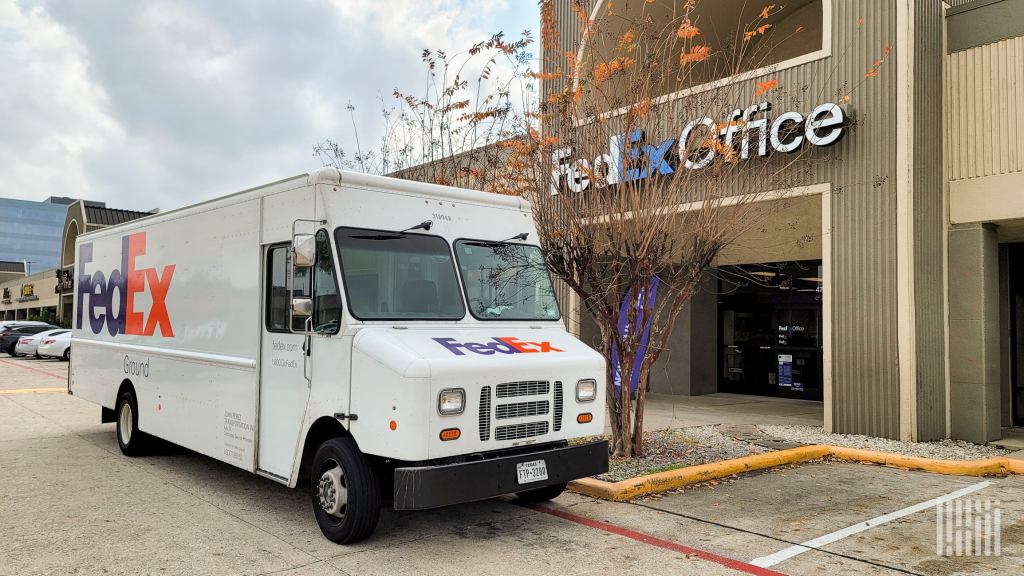
FedEx Corp. (NYSE: FDX) said Monday that it has expanded a program in which consumers can return merchandise without a box or shipping label to more than 10,000 locations, including 2,000 FedEx Office stores.

Customers wanting to complete an in-store return of online orders can request a QR code on their mobile phone that can be scanned at drop-off points. FedEx said it will also offer contactless drop boxes where goods can be returned without any person-to-person interaction.

Competitors Amazon.com Inc. (NASDAQ: AMZN) and UPS Inc. (NYSE: UPS) already offer merchandise returns without boxes and shipping labels.

Separately, a forecast published Monday by real estate services firm CBRE and returns technology provider Optoro said that 2023-2024 holiday returns could total as much as $82.1 billion. The figure is derived by taking the projected $273.7 billion in holiday e-commerce sales and applying a 30% returns rate, which is considered the high end of the range for online sales.

Optoro estimates that the cost of returns in the U.S. has increased to $149 billion, since 2018. According to CBRE and Optoro, the cost of processing returns equates to an average of 27% of the purchase, putting a significant dent in retailers’ margins.

White Paper: The State of Freight – December 2023

This monthly report analyzes the current state of the freight market based on critical insights from our SONAR platform. The themes for December are current freight market conditions and macroeconomic trends. All insights are provided by FreightWaves’ Craig Fuller, Founder and CEO, and Zach Strickland, Head of Freight Market Intelligence.

The report’s key topics include:
• What December’s capacity levels are indicating for the freight market in 2024
• Holiday season expectations for shippers
• Freight market weakness doesn’t equal a recession

This recap is a takeaway from our monthly State of Freight webinar series that offers expert industry insights, previously made available only to subscribers of FreightWaves’ supply chain analytics and high-frequency data platform, SONAR.

To download the full white paper and access our latest insights, complete the form below.

The AI advantage: Shaping the future of enterprise efficiency

The past year has been characterized by plentiful capacity and rock-bottom rates. While the current freight recession has continued longer than initially expected, industry experts are anticipating a significant market shift in the new year. 

“Having navigated through a cyclical trough for the ages, both spot and contract truckload linehaul rates are now poised to break materially higher in 2024,” Flock Freight Chief Operating Officer Chris Pickett said. 

It’s a well-known — and often begrudgingly accepted — reality that neither shippers nor carriers can hold onto pricing power for too long. The cyclical nature of the transportation industry requires regular power shifts; shippers should begin preparing for the next pendulum swing now. 

“Anticipate the acceleration of truckload spot linehaul rates, breaking into year-over-year inflationary territory as early as Q1 2024, and to surge 30-40 plus % throughout 2024 and into 2025,” Pickett said. “This surge will be driven primarily by the ongoing exit of surplus capacity from the market, but also supported by continued post-COVID strength in consumer spending on durable and nondurable goods.” 

This market shift is expected to put pressure on routing guides sooner rather than later. In fact, shippers should expect to begin feeling the impact within the next few months. 

“Brace for escalating pressures on contract routing guides by early Q2 next year, leading to potential erosion in both primary tender acceptance rates and overall service levels,” Pickett said.

While navigating shifting market conditions can be stressful, shippers that focus their attention on increasing their own operational efficiency and cost effectiveness can thrive during this time. The key is to take stock — and make any necessary adjustments — early.

Make data-informed decisions

In order to respond to the market in real time, shippers need to know what is happening around them. While this concept seems simple, many companies rely on historical data to predict future conditions, making it difficult to understand what is actually happening in the market today. 

Shippers can utilize high-frequency data — like that housed in FreightWaves SONAR — to step away from the age-old guessing game and get a clear view of the market. This knowledge can empower them to respond to the market in real time instead of reacting after their bottom lines take a hit. 

Stop paying to ship air

Once a shipment gets too large to move via less-than-truckload, shippers tend to send it out with their next available truckload partner. Freight is loaded onto trailers and moved as soon as possible, with little regard given to the empty space left on the trailer. In fact, almost half of the trucks traveling down the highway are running at half capacity, which means one-fourth of all available truck space is wasted on a daily basis. 

Because this model has been the status quo for so long, shippers are accustomed to paying for empty, unused space in truckload trailers. This costly reality is not their only option anymore, though.

Flock Freight’s shared truckload solution, FlockDirect, uses real-time data to pool freight for multiple customers. The solution effectively dismantles the physical hub-and-spoke constraints that have defined the supply chain for more than a century. 

By utilizing FlockDirect, shippers can realize up to 20% cost savings over full truckload rates. In fact, Flock saved businesses tens of millions of dollars in shipping costs against the full truckload alternative in 2022.

Invest in just-in-time supply chains 

Just-in-time supply chains are designed to handle unexpected variable demand without having to worry about the risks and costs of overstocking or understocking. Historically, however, operating under a just-in-time model required shippers to develop complex and fragile inventory management models in order to avoid shortages or sky-high transportation costs.

With FlockDirect, shippers don’t have to wait for a critical mass of product to accrue before accessing a cost-effective way of shipping their products. This allows shippers the opportunity to employ an on-demand model to handle market volatility.

At the highest level, FlockDirect addresses rampant industry waste by offering a terminal-free shipping option with truckload-level service without requiring shippers to pay for empty trailer space. Flock Freight accomplishes this by using its patented technology, powered by machine learning, to find and fill the empty space on trucks.

How FlockDirect works

  • At the point of quote, Flock’s patented technology analyzes dozens of data points to predict the poolability of the shipment.  
  • Flock uses that individualized assessment to enable shippers to only pay for the space they need in a trailer, providing nuance and flexibility.
  • Once the shipment is ordered, Flock leverages real-time data and advanced network optimization algorithms to determine the most efficient way to move the shipment.  
  • Flock’s technology handles all of the coordination complexities associated with pooling, ensuring on-time service and safety rates equivalent to truckload by using their data to model transit times, packing configurations and timing constraints.
  • Flock continues to optimize shipments all the way up until pickup, thereby taking advantage of all available lead time, giving them the best possible chance of pooling.

In short, Flock Freight’s innovative shared truckload solution has created a new shipping option that allows each individual shipper to pay less, while simultaneously helping drivers earn more and reducing the negative impact of trucking on the environment.

Some shippers — especially enterprise operations — have had difficulty utilizing shared truckload options due to historical inefficiencies in tracking pallet count and utilizing technologies. Flock Freight has created options specifically designed to assist these customers in visualizing pallet counts to reduce waste and has invested in a new TMS partnership with e2open and integrations with OTM and others to enable shippers to tap into the efficiencies and savings of using FlockDirect. 

Ahead in 2024

Shippers do need to take action to prepare for next year’s market, but Pickett is optimistic about what is to come. 

“As we look ahead to 2024, despite the ongoing supply-side challenges in the market, we see plenty of reasons to be optimistic,” Pickett said. “The market dynamics might be tough, but historical patterns indicate that this is a phase we’ve weathered many times before and it sets the stage for a strong rebound in the near future. The deeper the trough, the higher the next peak … for good or for worse.”

Flock Freight and FreightWaves recently teamed up to host a webinar — “How enterprise companies are using AI to drive cost efficiency within truckload programs” — to help shippers understand their modern options. 

Click here to view the recording of the webinar.

Is a reduction in maritime emissions a market mirage?

The maritime industry has raised environmental concerns, mainly related to emissions.

According to reports, ocean shipping accounts for more than 80% of global trade by volume and contributes nearly 3% of the world’s total greenhouse gas output. Efforts to curb emissions in this industry have gained momentum in recent years, fueled by increasing awareness of climate change.

A December report titled “Decoding Maritime Emissions” questions whether a significant reduction in emissions is a genuine step toward sustainability or a byproduct of market conditions.

The report was created by VesselBot, a greenhouse emissions reporting tool for the maritime sector that leverages virtual models of ocean fleets, or digital twins, to produce accurate emissions records for stakeholders.

“We know where the vessel has been, which ports it has called, how much time it’s been at anchorage, the vessel’s average speed, how many containers it has unloaded for each voyage and much more. … We are using technology in conjunction with real data, content from satellites coming from all different sources, so it gives you a more holistic understanding of the [ocean] market and how that market performs in regards to a specific carrier’s performance,” VesselBot co-founder Constantine Komodromos told FreightWaves.

This month’s report attributes a noteworthy reduction in maritime emissions to a combination of technological advancements, operational improvements and the adoption of cleaner fuels. It suggests that the industry is making significant strides toward meeting international emission reduction targets.

For example, from January to July 2023, container vessels saw a notable 12% decrease in greenhouse gas emissions, measured in kilograms of carbon dioxide emitted per metric ton of goods shipped, in comparison to the corresponding period in 2022.

While the report paints an optimistic picture, the broader context stirs some skepticism. It is unclear whether the reduction in emissions is a result of genuine efforts to mitigate environmental impact or a consequence of market dynamics.

Reduced demand for shipping in the initial half of 2023 prompted shipping companies to take measures including canceling voyages, slowing down sailing speed and redistributing large container vessels away from major trade routes. Large container vessels operating on those routes covered extended distances between the point of origin and destination, leading to a notable increase in carbon dioxide emissions per metric ton of goods they shipped, according to the VesselBot report.

The maritime industry is susceptible to economic fluctuations, and during periods of economic downturn, there is often a decline in shipping activity. This can inadvertently lead to lower emissions due to reduced demand rather than intentional emission reduction strategies.

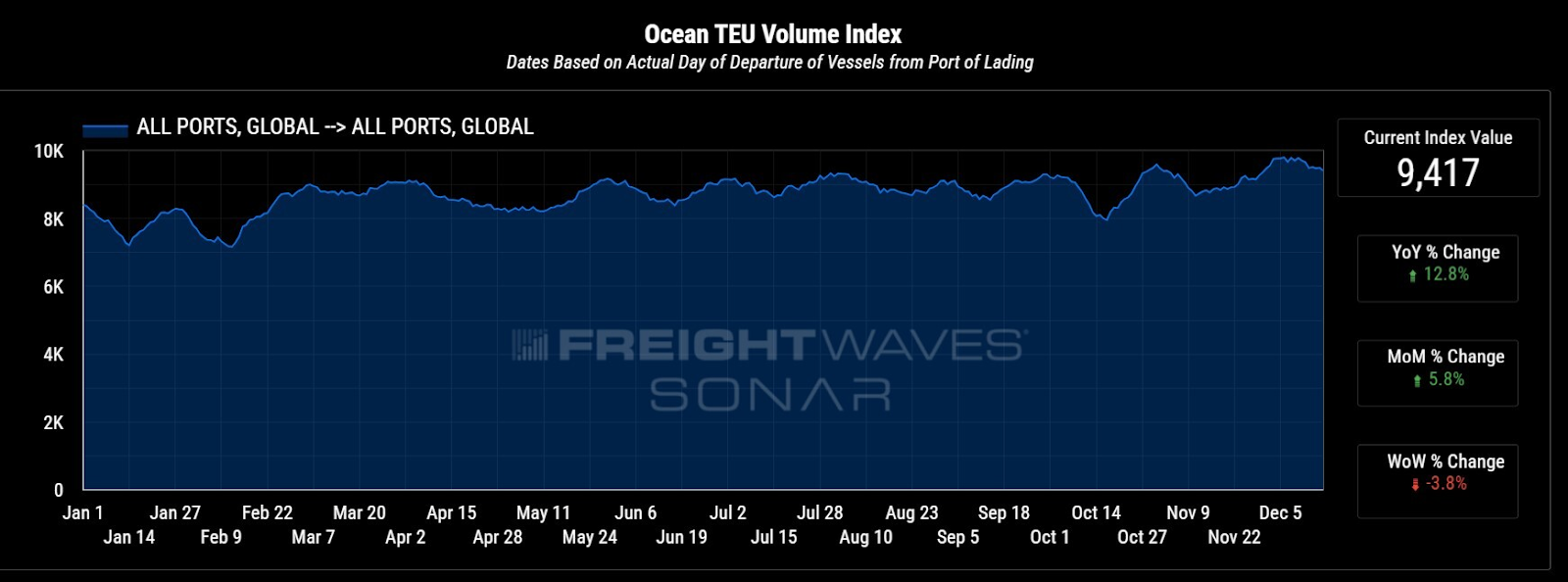
SONAR’s Container Atlas Ocean TEU Volume Index, All Ports Origin to All Ports Destination. Click here to learn more about SONAR.

The maritime sector is also subject to evolving environmental regulations, and compliance with these regulations may be a driving force behind emission reductions. However, meeting regulatory standards does not necessarily equate to a proactive commitment to sustainable practices.

“This market is slower to adopt [alternative fuel] solutions. It’s not like you can go and buy a new car or truck within the next month; you need two or three years to build a new vessel, and some alternatives are not readily available to invest in. These are also not easy to use and require a lot of investment in infrastructure to be able to utilize a network of alternative fuels available at all ports. You have got a much slower process for decarbonization in the maritime industry,” said Komodromos.

While any reduction in maritime emissions is a positive development, it is essential to approach such reports cautiously. The interplay of market conditions, regulatory requirements and economic considerations must be considered when evaluating the authenticity of emission reductions, Komodromos explained to FreightWaves.

Survey: Cutting emissions a top 2024 priority in transportation sector

Professor urges standardization for shippers to track truck emissions

Environmental groups sue BNSF over grizzly bear deaths

Nikola founder sentenced to 4 years on fraud convictions

Nikola Corp. founder Trevor Milton was sentenced to four years in federal prison and fined $1 million on Monday following a legal saga that began with a short seller’s report that the electric truck maker was built on an “ocean of lies.”

Milton was allowed to remain free on the $100 million bond he posted before his 2022 trial. No surrender date was set.

Prosecutors sought an 11-year sentence, a $5 million fine, forfeiture of a ranch in Utah that was the subject of one of Milton’s three fraud convictions and an undetermined amount of restitution to investors. Milton sought probation. Revised federal sentencing guidelines suggested 27 to 33 years and nine months. U.S. District Judge Edgardo Ramos said he was sentencing Milton to four years on each of three convictions to be served concurrently.

According to data from the U.S. Sentencing Commission’s Judiciary Sentencing Information database, 29 white-collar crime defendants convicted during the last five years received an average sentence of 16 years and four months. 

In its sentencing recommendation, prosecutors pointed to numerous false and misleading statements about Nikola’s achievements and technology prowess including:

Sentencing pleas

During the 2 1/2-hour sentencing hearing in U.S. District Court in Manhattan, New York, the government stressed that Milton caused real harm to real people.

“He lied repeatedly and doubled down,” assistant U.S. Attorney Matthew Podolsky told Ramos. “General deterrence is important. The case has notoriety in the press. People listened to podcasts. There has to be a message that you have to be honest. A message must be sent.”

Milton defense attorney Marc Mukasey said Milton had no malice in his actions.

“Trevor was open with executives about a real belief that communicating with investors would bring real value to Nikola,” he said. “Multiple jurors gave interviews afterward and said ‘We didn’t think he intended to harm anyone.’ The portrayal of Trevor by some in the media… that Trevor is a financial serial killer is wrong. There was nothing predatory here. He wanted to be loved and praised like [Tesla founder] Elon [Musk].”

During Milton’s trial, top Nikola executives testified they warned Trevor about telling the truth in his interviews, even to the point of holding an “intervention” with him.

Mukasey also tried an emotional appeal based on Milton’s wife. Chelsea, who suffers from Lyme disease.

“She needs his warm heart as a caregiver,” Mukasey said. “Her doctor’s [sentencing recommendation] letter says she needs him. His heart beats for her.”

A sobbing Milton told the judge he feels “terrible for everyone involved.” But he never apologized during a rambling statement. Instead, he talked about ethnic cleansing of the Cherokee Indians; the wrongful conviction of boxer Rubin “Hurricane” Carter in 1967; colors in heaven that don’t exist on earth; and difficulties he encountered while serving as a Mormon missionary in South America. He concluded with: “Let me stay with my wife. Thank you, your Honor.”

Outside court, Milton told reporters he felt Ramos was a “very compassionate” judge who “understood the situation.” He said “I think we’re going to win” an appeal of his sentence.

Joining the annals of white-collar fraudsters

Milton, 41, joins the growing annals of white-collar criminals, such as Elizabeth Holmes, founder of the Theranos blood-testing scam, and Sam Bankman-Fried, the founder of the FTX cryptocurrency exchange. Both were convicted of misleading investors while personally reaping hundreds of millions of dollars.

The government said investors lost between $660.8 million and $673.6 million by bidding up Nikola’s share price following Milton’s claims in hundreds of social media posts and in broadcast, print and online media interviews. 

Milton was convicted of one count of securities fraud and two counts of wire fraud in October 2022 following a 3 1/2-week jury trial. He was acquitted on an additional securities fraud count. He has been free on a $100 million bond. Milton lost a bid for a new trial in August.

Judge Ramos dismissed a comparison between Milton and Holmes, who began serving an 11-year, nine-month sentence in May.

“Ms. Holmes put it out there knowing it did not work,” Ramos said. “That’s not what Mr. Milton did, I find. I sat through the trial. I believe the jury got it right. Over the course of many months, you used your talents to tout the company in ways that were false.”

But he also chided Milton for his misstatements.

“What you said was materially wrong,” Ramos told Milton. “There was a theme to your letters, that you are a visionary and you have enthusiasm that causes you to get ahead of yourself. Today, you said you never intended to harm anyone. The jury found otherwise.”

From the beginning …

Nikola began in the basement of Milton’s Utah home in 2014. The goal was to build a hydrogen-powered fuel cell heavy-duty truck for hauling freight while emitting zero emissions other than water vapor. Milton showed a prototype of the truck called the Nikola One in 2016, claiming it was capable of operating under its own power and was not just a “pusher” concept truck.

A video of the truck posted on the internet gave the impression it was running on its own power. Investigations later found the truck was coasting down a steep grade with no propulsion.

That contention became the heart of dozens of falsehoods alleged by Hindenburg Research in September 2020, a little more than three months after Nikola went public in a reverse merger with VectoIQ Acquisition Corp., a special purpose acquisition company. 

The 67-page Hindenburg report landed just two days after Nikola announced a manufacturing and equity tie-up with automotive giant General Motors. That deal later collapsed, as did a plan to make battery-powered refuse trucks for Republic Services.

Subpoenas, a fine and convictions

After vowing on social media to refute the claims, Milton resigned as Nikola executive chairman and gave up his board seat. Hindenburg’s allegations led the U.S. Justice Department and Securities and Exchange Commission to open investigations and subpoena Nikola executives. The SEC fined the company $125 million in December 2021. 

At one time, Milton owned more than 25% of the company’s stock. His holdings rose in value from approximately $1.1 billion in March 2020 to a peak of approximately $7.3 billion in June 2020. He has sold hundreds of millions of dollars in shares following the expiration of a six-month lockup period three years ago. 

Milton still owns about 8% of the company whose share price traded Monday on the Nasdaq at 89 cents. It closed at $79.73 on June 6, 2020, two days after the SPAC merger closed.

Nikola on the ropes

In a statement, Nikola continued a stance of distancing itself from Milton despite the arbitration and possible future financial actions.

Nikola itself is on the ropes, having filed a notice of going concern with the SEC in February that suggested it might not be in operation in 12 months. Macroaxis, a San Francisco-based fintech company, suggests Nikola has an 81% probability of bankruptcy.

The company is short of cash to scale the fuel cell trucks it is building at a plant in Coolidge, Arizona. Following shareholder approval that doubled the number of authorized shares to 1.6 billion, Nikola has rapidly diluted current shareholders by selling new shares and borrowing money that would be repaid by stock.

The company won $165 million from Milton in an arbitration case that concluded in October. It is also seeking to claw back legal fees paid for Milton it agreed to pay as part of his separation.

Nikola continued to distance itself from Milton despite the arbitration and possible future financial actions.

“We are pleased to move forward and remind the public that the company founder has not had any active role in Nikola since September 2020,” a company statement said.

Nikola recalled 209 battery-electric trucks in August after several battery fires that began in June. It has set aside $61.8 million to replace the batteries, a cost it must bear alone because it owned the battery supplier Romeo Power. 

Nikola purchased Romeo in August 2022 in a $144 million stock deal and liquidated the company in June of this year, selling Romeo’s battery pack production assets to Mullen Automotive for $3.5 million. It has not announced a new battery supplier for the recalled trucks, which it paid to have shipped to its Arizona plant.

Editor’s note: Updates with Nikola comment and remarks from Milton outside court.

Feds seek 11-year prison term for Nikola founder

Feds detail Elizabeth Holmes and Trevor MIlton fraud case parallels

‘Ambitious dreamer’ Trevor Milton seeks probation instead of prison

Click for more FreightWaves articles by Alan Adler.

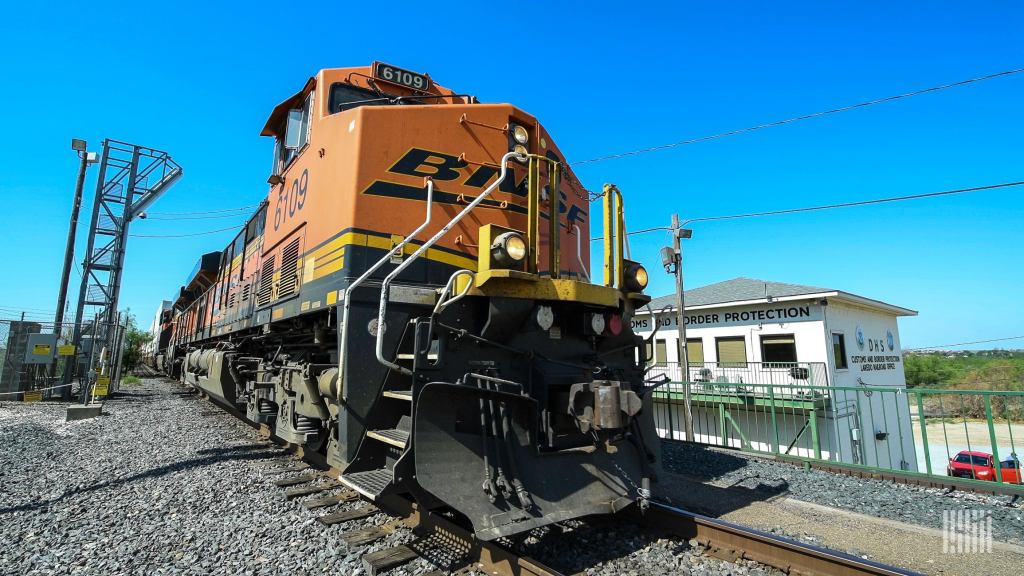
CBP halts freight rail operations at 2 Texas ports of entry

U.S. Customs and Border Protection on Monday suspended freight rail operations at three border bridges connecting Texas and Mexico in response to increased levels of migrant smuggling operations in the region.

The suspension of cross-border freight rail operations in El Paso and Eagle Pass, Texas, was made after reports of smuggling operations attempting to use trains in Mexico to transport migrants into the U.S., CBP officials said.

“CBP is continuing to surge all available resources to safely process migrants in response to increased levels of migrant encounters at the Southwest Border, fueled by smugglers peddling disinformation to prey on vulnerable individuals,” CBP said in a statement. “After observing a recent resurgence of smuggling organizations moving migrants through Mexico via freight trains, CBP is taking additional actions to surge personnel and address this concerning development, including in partnership with Mexican authorities.”

The El Paso and Eagle Pass rail bridge suspensions took effect at 9 a.m. EST Monday. CBP officials said the suspensions will be temporary but did not provide a time frame for the reopening of the rail bridges.

El Paso has two railroad bridges, one each for BNSF Railway and Union Pacific (NYSE: UNP). Eagle Pass has one rail bridge that serves both Union Pacific and BNSF.

In response to the suspensions, Union Pacific has placed an embargo on its U.S.-Mexico freight operations in Eagle Pass and El Paso. Union Pacific said the embargo will affect 60 trains and nearly 4,500 rail cars.

“These locations represent 45% of cross-border Union Pacific business and include goods critical to the U.S. economy,” the company said on its website. “There isn’t enough capacity at our other four gateways to reroute them. With Christmas and the New Year’s holidays just days away, Union Pacific is in close communication with multiple government agencies and our customers, urging that the crossings closed by CBP be reopened.”

Union Pacific said the suspension affects the transport of everything from agricultural products, food and beverages, automotive products (finished vehicles and parts), consumer goods and industrial commodities (metals and cement).

CBP previously closed the Eagle Pass gateway in September because of a surge in migrants attempting to cross the border in South Texas.

BNSF officials said they were disappointed with the decision to close the El Paso and Eagle Pass rail bridges.

“BNSF is committed to border security as well as protecting the U.S. economy. BNSF Railway was disappointed to learn that the Eagle Pass and El Paso border crossings have been closed, given how important the movement of goods by rail is for businesses, consumers and the economy, particularly with Christmas just days away,” BNSF spokeswoman Lena Kent said in an email to FreightWaves. “We are in regular communication with CBP and other federal agencies urging both crossings be re-opened immediately. We are also working closely with our customers to meet their needs and to prevent further congestion stemming from the crossing closures. Every day of closure increases the impact to the supply chain for critical commodities, including automobiles, industrial products and grain.”

The Association of American Railroads (AAR) called for an immediate reopening of both rail crossings.

“The urgency of reopening these crossings and restoring rail service between the two nations cannot be overstated,” AAR President and CEO Ian Jefferies said in a news release. “There are not separate U.S. and Mexican rail networks; there is only one interconnected North American rail network. Every day the border remains closed unleashes a cascade of delay across operations on both sides of the border, impacting customers and ultimately consumers.”

Union Pacific and BNSF operate 24 trains daily at the two crossings, moving agricultural products, automotive parts, finished vehicles, chemicals, consumer goods and more, according to Jefferies.

CBP has adjusted its operations to handle an influx of migrants attempting to use illegal pathways into the U.S.

In Eagle Pass, northbound passenger vehicle traffic remains suspended at Eagle Pass International Bridge 1, which has affected commercial cargo truck movements. In San Diego, San Ysidro’s Pedestrian West operations remain suspended. In Lukeville, Arizona, the Lukeville port of entry remains closed, CBP said.

“Over the past several weeks, CBP has made a number of operational adjustments in order to maximize our ability to respond, process, and enforce consequences,” CBP said. 

Along with the disruption from migrants, the Texas Department of Public Safety began safety inspections on Nov. 28 for all cargo trucks arriving from Mexico in Eagle Pass and Del Rio, Texas.

Cargo truck wait times at the Eagle Pass port of entry are currently over two hours.

More articles by Noi Mahoney

Mexico averaged 57 thefts a day from cargo trucks in Q3

The top US-Mexico business stories of 2023

Borderlands: Texas company aims to help keep returns out of landfills

New York becomes next state requiring 2-person freight train crews

New York will now require Class I and II railroads operating in the state to have at least two crew members involved in running a freight train.

Democratic New York Gov. Kathy Hochul signed the state Senate bill addressing train crew size on Dec. 8. The bill calls for an amendment to the existing laws governing freight train movements to include language requiring a minimum of two people to operate a freight train. The bill goes into effect 30 days after being signed into law. 

New York is the third state this year to sign a train crew size bill into law, behind Ohio and Kansas.

The rail unions representing locomotive engineers and train conductors applauded Hochul’s decision to sign the bill.

The International Association of Sheet Metal, Air, Rail and Transportation Workers – Transportation Division (SMART-TD) noted that Hochul had chosen to veto a similar bill in late 2022. The 2022 bill on train crew sizes passed both houses of the New York Legislature last year, but according to the Brotherhood of Locomotive Engineers and Trainmen (BLET), Hochel vetoed the bill over concerns about federal preemption. 

“Something changed this year — perhaps it was seeing legislatures and governors in both Ohio and Minnesota to the west take the steps to pass legislation or the catastrophic derailment in East Palestine, Ohio, that happened in February,” SMART-TD said last Wednesday, referring to the Feb. 3 Norfolk Southern train derailment. Local officials had vented tank cars containing vinyl chloride as a result of the February derailment, sending a large plume of smoke over the accident site.

BLET quoted Hochul as saying in her approval memo that “the horrific disaster in East Palestine, Ohio, highlighted the need for strong regulatory protections. … Federal action remains pending and state-level regulation is therefore necessary.” 

The Federal Railroad Administration’s proposed rulemaking governing train crew sizes, which was introduced in July 2022, is still pending. Action on the proposed rule could take place in 2024. The issue has also been before the FRA for years, with the agency under former FRA Administrator Ron Batory withdrawing in May 2019 an earlier proposed rulemaking on train crew sizes. 

Including New York, 11 states now have laws addressing train crew size, according to BLET: Kansas, Ohio, California, Wisconsin, Arizona, West Virginia, Minnesota, Washington, Nevada and Colorado.

Subscribe to FreightWaves’ e-newsletters and get the latest insights on freight right in your inbox.

Click here for more FreightWaves articles by Joanna Marsh.