UPS reinstates 35 union workers in Louisville, averts strike
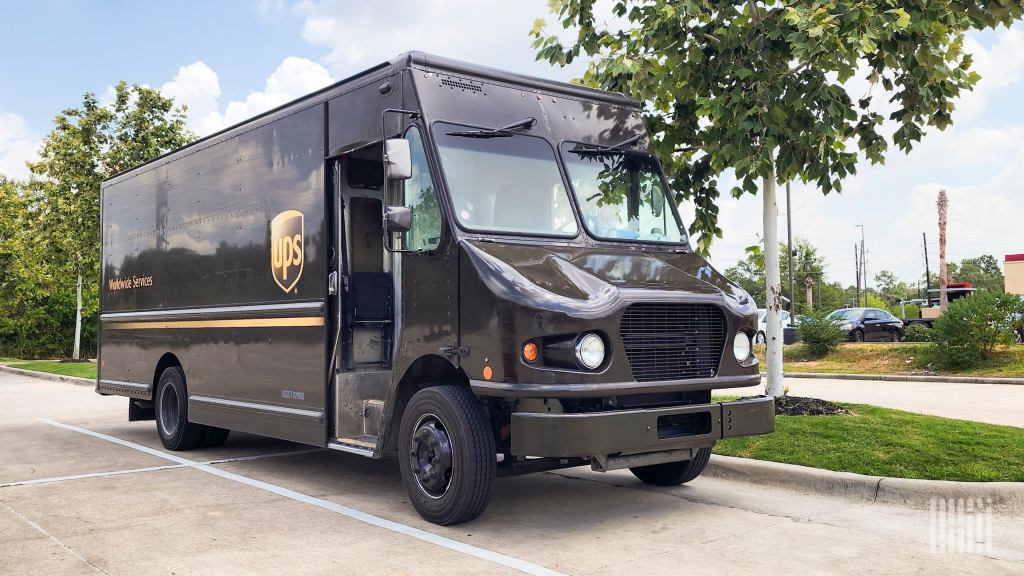
UPS Inc. has reinstated 35 unionized workers at its Louisville, Kentucky, ground hub who it had laid off late last week, thus averting a threatened work stoppage by the Teamsters union that could have affected operations at UPS’ ground hub and its primary air hub there.
The 35 specialist and administrative workers were reinstated with full back pay and will return to their positions on their next scheduled workdays, the union said in a Facebook post.
The affected workers at UPS’ (NYSE: UPS) Centennial ground hub, who were laid off last Thursday, had joined Teamsters Local 89 in Louisville in October. According to a Teamsters communique on Thursday, UPS laid off the workers on grounds that management could perform their duties. Teamsters General President Sean O’Brien warned that same day that UPS was prepared to strike at both UPS facilities if the situation wasn’t resolved by Monday.
O’Brien and General Secretary Fred Zuckerman intervened on Friday to discuss the matter with UPS executives and an “amicable resolution” was reached that night to return the employees to work, the union said.
Local 89 represents more than 2,000 workers at the Centennial hub and more than 12,000 Teamsters at its primary air hub, known as Worldport, in Louisville.
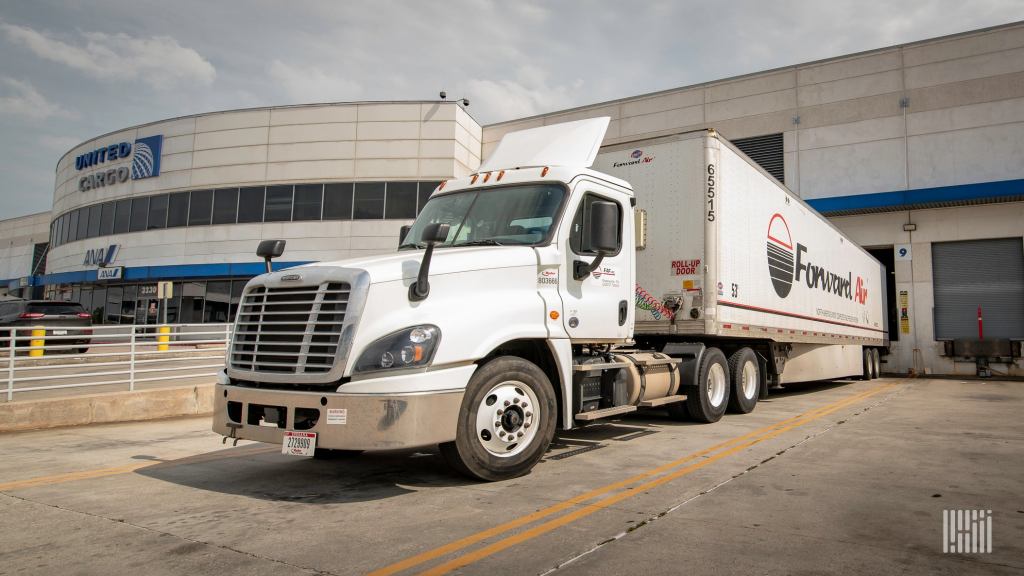
Forward Air said Monday it will implement a 5.9% general rate increase (GRI) on tendered shipments starting Feb. 5. The announcement follows rate hikes from other less-than-truckload carriers, some of which were implemented ahead of schedule this year as Yellow’s exit shrunk the industry’s available capacity.
LTL carriers use GRIs to reset base rates to offset cost inflation and to fund capital investments. The announced increases are the expected averages the rate changes will produce. The rate bumps usually vary by lane, distance and weight class.
Forward’s (NASDAQ: FWRD) GRI was the same amount last year with implementation also on the first Monday in February.
“The rate changes will enable the Company to continue investing in customer support, safety and service enhancement, as operating costs have risen for many in the freight transportation industry,” a news release said. “Factors necessitating the GRI include increased costs in real estate, equipment, cost per mile and economic inflation.”
In recent weeks, carriers have announced GRIs ranging from 4.9% to 7.5%.
Last week, Forward announced tonnage in its expedited segment was up 5.5% year over year (y/y) for the first two weeks of the fourth quarter. The increase was the result of an 11% increase in weight per shipment, which was partially offset by a reduction in shipment counts. Forward’s tonnage inflected positively y/y in September for the first time in a year.
Some Convoy carriers say collapsed startup owes them thousands of dollars
Several trucking companies that hauled loads for Convoy, a digital freight brokerage that shut down in October, said the defunct company owes them thousands of dollars for loads they completed.
Before Convoy closed, it had some 80,000 carriers in its network and more than 500 employees. On Oct. 18, Convoy employees told its carriers that all loads were suspended. One former employee told FreightWaves he assumed that a company was going to acquire Convoy, while another believed there was just a temporary outage of the load board.
Instead, the freight brokerage shuttered on Oct. 19. Most of its 500-odd employees were immediately laid off with no severance pay, save for a small team of workers. On Nov. 1, Flexport, a digital freight forwarder, announced it was acquiring Convoy’s technology but none of its liabilities or assets.
Since opening in 2015, Convoy had billed itself as an app that would empower small trucking businesses, including one-person operators and small fleets. Convoy aimed to eliminate waste from the supply chain chiefly through freeing up truck capacity to the market. On that mission, the Seattle-based startup had attracted nearly $1 billion in funding from the big leagues. Such investors included Amazon founder Jeff Bezos, Microsoft co-founder Bill Gates and prominent firms like T. Rowe Price and CapitalG.
That cash seems elusive now. The sudden shutdown has left Convoy carriers scrambling for work during a freight downturn. It’s also left several saying they’re owed thousands of dollars for work completed during the final days that the company existed.
FreightWaves spoke to three carriers that said they’ve been unable to recover payments from Convoy. Each provided documentation to FreightWaves indicating that they had not received payment for loads completed. FreightWaves also spoke to two former Convoy employees who worked with carriers.
A source familiar with the wind-down operations said it was important to Convoy that these carriers were paid. That person added that the reduced workforce remaining with the company after its Oct. 19 shutdown paid the vast majority of carriers. It’s unclear how many total carriers are owed money.
FreightWaves received an automated reply after reaching out to a Convoy human resources email address, which a former employee provided in November to a driver seeking payment. Hercules Capital, Convoy’s lender, did not respond to requests for comment from FreightWaves. Dan Lewis, former CEO and co-founder of Convoy, declined to comment on the record for this story.
“Trucking is core to Flexport’s operations. Every shipment starts and ends on a truck,” a Flexport spokesperson said in an emailed statement. “The acquisition of Convoy’s technology and IP will help Flexport provide more comprehensive services to our customers, and importantly, improve our offering to carriers. Right now our teams are laser focused on relaunching parts of the Convoy platform so we can continue to drive value with carriers and support them through a turbulent market.”
It’s likely that more carriers will find themselves caught between factoring companies and brokerages that aren’t able to pay up during this historic freight recession. In a freight brokerage bankruptcy proceeding, courts may classify carriers as preferred or non-preferred creditors. That determines whether a carrier could receive payment quickly and in full. In the case of Convoy, which never filed for bankruptcy, it’s unclear how or if Convoy will pay carriers with outstanding invoices.
One small business owner says Convoy owes her factoring company nearly $160,000
Biljana Filipov, who owns a small Illinois-based trucking company with her husband, said Convoy owes the factoring company they use almost $160,000. According to a screenshot of a Nov. 2 email reviewed by FreightWaves, the factoring company will start to withhold $1,000 a week from future factoring checks if Convoy does not pay outstanding invoices. A spokesperson for factoring company declined to provide comment for the article.
“If Convoy goes down, we are going down because of them,” Filipov said.
Their small trucking company is called Eagle Radovish. The fleet had nine trucks, or power units, on Convoy’s network, according to a screenshot Filipov provided of her company’s profile on the Convoy website. Eagle Radovish had worked with Convoy for more than three years, landing a 98% on-time score for its work with the carrier, according to the screenshot.
Filipov said all of Eagle Radovish’s loads were canceled immediately on Oct. 18. That same day, her factoring company received its last payment from Convoy for a load completed on Sept. 5. Some loads completed on that date and all loads after that remain outstanding. This information comes from a screenshot of the Convoy app and a spreadsheet of invoices indicating hundreds of outstanding payments, both provided by Filipov.
According to the documents reviewed by FreightWaves, Convoy did not pay Eagle Radovish’s factoring company for 203 loads completed from Sept. 5 to Oct. 18. The total outstanding amount, according to the invoice spreadsheet, is $156,820.97. Filipov said she paid her employees for each job completed.
Eagle Radovish used a factoring company to receive payment for loads. Typically, this factoring company would pay Eagle Radovish within a day of the job’s completion, taking a 2% cut. Meanwhile, the customer of the trucking services would pay Convoy. Convoy would pay the factoring company around 45 days of the load being delivered, according to screenshots viewed by FreightWaves.
Convoy also offered a service called QuickPay. That offered payment within two days for free or same-day payment for a 1.5% cut. Some carriers, like Eagle Radovish, used an outside factoring company. Often, factoring companies require carriers to use them for each broker in their network, even if a more economical or faster-paid option exists.
In weeks after Convoy’s shutdown, Filipov emailed and called the brokerage’s many email addresses dozens of times. She’s sent LinkedIn messages to Lewis, Convoy’s former CEO. Filipov has also contacted the retailers that her trucking company hauled loads for. She said she is considering legal action if Convoy does not pay her factoring company by the end of the year.
Other truck drivers are owed smaller amounts but still feel left in the lurch
Other carriers that spoke to FreightWaves said they were owed for work completed in the final days before Convoy’s shutdown. They were owed a smaller amount because, unlike Eagle Radovish, they used Convoy’s QuickPay service. A former Convoy employee who worked with carriers said most trucking companies opted to use QuickPay.
John Adrian, a small trucking fleet owner based in South Texas, said Convoy owes him thousands. According to screenshots from the Convoy app reviewed by FreightWaves, Adrian’s company is owed around $3,500 for six different loads completed from Oct. 15 to 18.
“We were working with them constantly, two to three loads a day,” Adrian told FreightWaves. “Everything was good.”
Today, Adrian’s truck drivers are hauling for some of the same customers that they had previously. These loads are not as well paid as they were through the Convoy platform. Convoy used to pay $450 for a 250-mile haul of bottled water from McAllen, Texas, to metro San Antonio. Now the same job on another brokerage platform pays just $400. That tallies up to a $6,000 a month difference — a “big loss,” Adrian said.
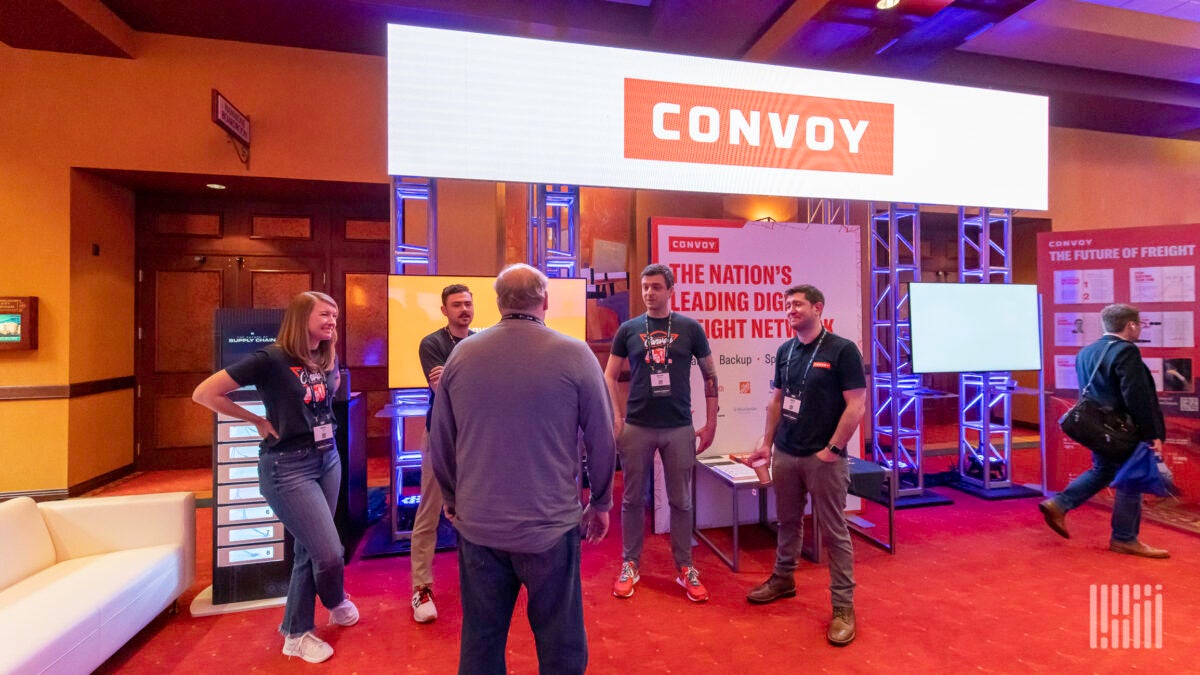
Convoy, pictured here at the FreightWaves Future of Supply Chain event in 2022, was one of the buzziest startups in freight before its collapse. (Photo: Jim Allen/FreightWaves)
Steve Seek, an owner-operator in western Maryland, said Convoy owes him $7,700 for loads he hauled in the days leading up to the shutdown, according to communications with a Convoy employee that Seek shared.
Seek used to haul for a slew of brokers until early September, when he joined Convoy’s cohort of drivers on a dedicated route. Following that, Convoy paid him $1,100 per day to haul loads for Sam’s Club, according to documents viewed by FreightWaves. Seek said he typically got his rate confirmation a few days in advance.
It was a good gig until Oct. 18, when Seek had already driven to a distribution center and waited two hours for his next Sam’s Club load. The account manager told him Convoy “had an unexpected situation” with its loads, according to a screenshot of text messages Seek provided FreightWaves. Shortly after that, the account manager told him that all contracts were canceled for the rest of the week.
The next day, Seek saw the headlines that Convoy was shutting down. The account manager did not respond to his texts asking for more information on the Sam’s Club job.
Seek, along with some other truck drivers on Convoy’s dedicated contracts with Sam’s Club, managed to get in touch with a Convoy employee with the job title “transition specialist,” according to text message screenshots viewed by FreightWaves. However, the employee stopped responding to messages on Oct. 24 and did not ultimately secure payment for Seek. Seek has also reached out to a state helpline for small businesses but wasn’t able to reach anyone when he last tried.
Seek said he would like to file a lawsuit against Convoy but, because the company has shuttered, he’s not clear how exactly to do that — and the amount he’s seeking might be too low to justify hiring a lawyer.
Seek has not reached out to Sam’s Club. The bulk retailer, which is owned by Walmart, did not reply to a FreightWaves inquiry on how the company works with brokers and outside carriers.
Seek said he shouldn’t have put all of his eggs in Convoy’s basket. Still, the dedicated haul for the brokerage had steady pay with relatively little overhead. It seemed like decent work for a name-brand broker and shipper. And just 18 months prior to its shutdown, Convoy had raised $260 million in funding, reflecting a valuation of $3.8 billion.
“They were one of the biggest digital freight brokers in the world,” Seek said. “Who would have known?”
Building products mark the spot for Brad Jacobs’ new focus: QXO
Brad Jacobs is turning his attention to building products distribution.
The man who built XPO, now an LTL-specific carrier but which had been a large logistics-focused conglomerate before spinoffs, is sticking with the X in the name of his new venture: QXO.
The two publicly traded spinoffs from XPO (NYSE: XPO) also feature X in their names: 3PL RXO (NYSE: RXO) and contract logistics provider GXO (NYSE: GXO). Jacobs remains executive chairman of XPO and nonexecutive chairman of the other two companies.
In a prepared statement released Monday, building products distribution was announced as the focus of QXO. It’s an industry that the statement said is “highly fragmented, with approximately 7,000 distributors in North America and 13,000 in Europe.” Jacobs decided on that industry after what was said to be a yearlong search.
“QXO’s strategy is to create a tech-forward leader in the building products distribution industry through accretive M&A and organic growth, including greenfield openings, with the goal of generating outsized stockholder value,” Jacobs said in the statement.
“We expect to achieve a revenue run-rate of at least $1 billion by the end of year one, at least $5 billion within three years, and tens of billions of dollars over the next decade,” Jacobs said in the statement.
For perspective, a publication called ProSales in 2019 ranked the largest building products distributors. The list does not appear to have been updated since then. Sitting at the top of that list was privately held ABC Supply. ABC has said it has $12 billion in sales. Sales of $1 billion in the first year would put QXO near the top 10 rankings.
The smallest company on the list, ranking No. 100, had sales of approximately $13 million.
Activities under the banner of building products distribution, according to the statement, include access control, construction supplies, doors and windows, electrical components, fencing and decking, HVAC, infrastructure, landscaping, lumber, plumbing, pools, roofing, siding and water.
The platform Jacobs will use for this growth is the publicly traded SilverSun Technologies (NASDAQ: SSNT). Jacobs led a group that pumped $1 billion into the company, which in turn will spin off its existing software operations into a privately held company. The shell company that is left will be rechristened QXO and Jacobs will be chairman and CEO.
Jacobs has said in the past that he prefers to operate in public markets.
The prepared statement suggests that building products distribution is lagging in technology adoption.
That “fragmented” industry offers “a significant opportunity to unlock growth potential through scale and technology,” the statement said. “National distributors can serve large customers across multiple geographies and project types with standardized efficiencies, providing consistent, data-driven customer services across a broad operating scope.”
Daily Infographic: Kodiak Robotics makes autonomous pickup for military
To view more FreightWaves infographics, click here
FRA’s proposed rule on certifying rail car origins earns kudos from trade groups
A proposed rule to prevent freight rail cars produced by Chinese entities from being used in the U.S. freight rail network is earning praise from the heads of the Rail Security Alliance (RSA) and the Railway Supply Institute (RSI), who view such rail cars as a potential threat to national security.
What would it mean for national security “if we don’t have the capability to build and manufacture these types of vehicles that not only carry grain and lumber, but also carry nuclear waste and tanks and Blackhawk helicopters and personnel?” RSA’s executive director Erik Olson told FreightWaves.
The Federal Railroad Administration is proposing that new freight rail cars in the U.S. must prove that they have been manufactured in a country that’s not on U.S. watchlists for raising U.S. national security concerns or allegedly violating U.S. intellectual property laws.
The notice of proposed rulemaking, published in the Federal Register on Friday, calls for new freight rail cars operating in the U.S. to be manufactured or assembled by a “qualified manufacturer in a qualified facility.” The proposed rule would also require sensitive technology that would be located on the rail car to be sourced from a country not on U.S. watchlists.
According to the proposed rulemaking, China would be the only country that would be on all the U.S. watchlists.
RSA was founded in 2015 in response to concerns that state-owned enterprises in China expressed intentions to dominate the global market for passenger and freight rail cars. The creation of RSA was to curb that influence in North America, although CRRC, a state-owned rolling stock manufacturer, managed to successfully win four contracts from transit authorities in Boston, Philadelphia, Chicago and Los Angeles, Olson said.
“Freight rail really is the cyclical market and the opportunity to continue to build every year,” as opposed to transit contracts, which don’t have that same cycle, Olson told FreightWaves. “And so our members were concerned that [the manufacturing of] passenger [rail cars] would leak into freight, and then you’d start to see cost-cutting measures there [as well as] a degradation of freight rail, the builder market and the manufacturing market.”
Under the proposed rule, rail car manufacturers would need to electronically certify to FRA that each freight car complies with the rule before it can operate on U.S. railroads. However, rail car manufacturers would not have a continuing obligation to certify their assets on a regular basis, nor would the rule apply to those involved in aftermarket activities, such as those performing repairs or maintenance.
RSA worked with members and other stakeholders involved in rail car manufacturing, such as RSI, American Iron and Steel Institute, United Steelworkers and others, to press Congress to consider placing restrictions on the manufacturing origins of freight rail cars. The group also in 2018 expressed concern about interest from Chinese companies to invest in the manufacturing of rolling stock.
Sens. John Cornyn, R-Texas, and Tammy Baldwin, D-Wisc., introduced the SAFE Trains Act, which sought to address the issue of national security and freight rail car production. Language from that bill eventually made its way to the Infrastructure Investment and Jobs Act of 2021, which calls upon FRA to issue a rulemaking on the manufacturing origins of freight rail cars.
FRA’s proposed rule would amend existing federal code on freight rail car standards. There is also a similar legal framework in the trade agreement between the U.S., Mexico and Canada, according to the Federal Register notice.
Along with RSA, RSI is lending its support to the proposed rule, based on an initial reading.
“The Railway Supply Institute strongly supports protecting the freight rolling stock supply chain from bad actors and unfair competition,” RSI President Patty Long said in a Friday statement to FreightWaves. “We applaud the FRA for its work to ensure our freight rail network is secure and are encouraged by our initial review of the proposed rule. We are hopeful that the final rule will mirror congressional intent of the SAFE TRAINS provision in the Infrastructure Investment and Jobs Act.”
Olson agreed, saying that the proposed rule appears to be close to the intent of Cornyn and Baldwin’s bill, which sought to put policies and procedures “to ensure that in the future, Chinese state-owned enterprises like CRRC — which have clearly said they want to dominate the market and take over this market — are barred from building rail cars for the U.S. interchange system touches Canada and Mexico.”
The idea of certifying rail cars’ manufacturing origins is also pertinent because rail cars are becoming more technologically complex and could hold sensitive information through their use of sensor systems, GPS technology and transmission technology, Olson said.
“They’re not the dumb boxcars that we see in the movies. These are highly interconnected vehicles that have a lot of data and will increasingly have more. Not only will they have some automated features, whether it’s for opening and closing doors and release valves and other things, but also monitoring software,” Olson said.
Freight rail cars will also be part of a system or network collecting and transmitting data to wayside detectors, and that information on what the train is carrying, where it’s going and how fast it’s moving could all be sensitive information, he said.
Indeed, other U.S. lawmakers are wary of using certain technological tools from China to monitor supply chain data because of national security concerns, with the U.S. House of Representatives recently approving a defense spending bill that included a provision limiting China’s ability to monitor the flow of ocean containers into and out of the U.S.
“It’s one thing to have to protect the system from outside intrusion. It’s another to let the intruders into the system,” Olson said.
Borderlands: Texas company aims to help keep returns out of landfills
Borderlands is a weekly rundown of developments in the world of United States-Mexico cross-border trucking and trade. This week: A Texas company aims to help keep holiday returns out of landfills; a U.S. logistics firm is building a border trade hub in South Texas; a logistics provider snaps up space in the Houston area; and DHL Supply Chain lays off workers in Texas.
Texas company aims to help keep returns out of landfills
A few months ago, one of Heather Hoover-Salomon’s colleagues bought a large piece of furniture online but decided not to keep it.
Hoover-Salomon, CEO of Austin, Texas-based uShip, said she was surprised when the company told her colleague the furniture would probably end up in a landfill rather than on a sales floor or in a warehouse.
“They told my colleague, ‘We’ll come take the furniture back and refund you,’” Hoover-Salomon told FreightWaves. “My colleague asked, ‘What happens with this? Do you guys resell it?’ They’re like, ‘Actually we’re just going to scratch it and it’s going to go to a landfill.’ I was like what?”
Consumers returned more than $816 billion worth of retail merchandise purchased in 2022, according to a report by the National Retail Federation and Appriss Retail. Optoro, a firm specializing in sustainable returns and resales, estimates that returned inventory creates about 5.8 billion pounds of landfill waste each year and the shipping of returns emits 16 million metric tons of carbon dioxide.
Hoover-Salomon said she was interested in learning more about returns and how retailers’ bottom lines are affected after the incident with her colleague, as well as after attending a Gartner Inc. symposium earlier this year.
She explained that uShip helps people and businesses haul items through use of its online marketplace that connects shippers with customer-reviewed carriers.
“One of the big buzzwords at the Gartner symposium was returns and it was mind-blowing how big it is in the industry and how we have not solved this problem, especially for items that are in the large and bulky space,” Hoover-Salomon said.
Large and bulky items can be furniture, home goods, appliances and hardware.
The Gartner symposium propelled Hoover-Salomon and uShip to work with WBR Insights to examine how returns affect companies and what could be done to help the issue. Uship recently published its findings in a report titled “Mastering Oversized Returns: Logistics Executives Weigh In On Their Top Challenges.”
Many businesses said they only recover a small percentage of the original sales price of oversized item returns, if any at all, because of the cost of reverse logistics and struggling to book reliable return shipping solution providers.
Based on insights from 100 business leaders that took part in the uShip research report:
91% said the costs of reverse logistics for oversized items are at least a somewhat significant problem.
87% struggle to find and book reliable return shipping solutions for big and bulky goods when they need them.
83% are not satisfied with their ability to track damage rates.
“What I took away from the research was that 87% of the respondents are struggling in some way with returns. They’re not pleased with their reverse logistics or returns process for those large and bulky goods,” Hoover-Salomon said. “Large and bulky goods, once they’re out of the box, predominantly, they don’t get put back in a box.”
More than 50% of retailers said they can’t resell up to one-third of the oversized items that are returned to them due to damage, loss or missing parts.
“Financially speaking, people or businesses are losing a lot of money and are not able to recoup that because the value of the good post-return is severely diminished,” Hoover-Salomon said.
Key suggestions from the research report concluded that investing in AI and digitalization technology could help companies recoup money from returns. Other suggestions include improving packaging practices, specifically by using reusable packaging and refining onsite product assessments, and investing in a delivery and logistics solution that emphasizes transparency.
“Where we can really kind of fit in is in making sure that we’re targeting customers who have these more complex or larger goods that they’re trying to get returns on,” Hoover-Salomon said. “Because our service can be point to point and highly customizable in terms of packaging — getting it out of the home and then back to the retailer’s warehouse or if they are consigning it, then it can go to a consignment center, but ensuring that the goods are not further damaged, so that they have a higher probability of getting a higher return value. Maybe it’s not full value, but better than some of the values we hear about — a lot of them were less than 50% of the original value of the item.”
US logistics firm to build border trade hub in South Texas
The CiL Group recently began construction of the Nearshoring Industrial Park in McAllen, Texas.
The 117-acre park is intended to attract companies that are shifting manufacturing and production operations from abroad to Mexico and Rio Grande Valley, according to Joaquin Spamer, CEO of the CiL Group.
“The McAllen Nearshoring Industrial Park brings along a crucial concept: nearshoring,” Spamer said in the Rio Grande Guardian, “one that perfectly fits with our goal of bringing production and manufacturing closer to home.”
The Nearshoring Industrial Park will total 1.5 million square feet once completed. The park is built-to-suit property, with lot sizes ranging from 3 to 30 acres.
Founded in 1992, McAllen-based CiL Group offers global door-to-door logistics services, including import and export services, through land, rail and ocean transport, as well as warehousing and distribution handling.
Logistics provider snaps up space in Houston area
Tigerhawk Logistics has inked a lease for 135,285 square feet of space at the Portside Logistics Center in Baytown, Texas.
Portside Logistics Center is a 1 million-square-foot industrial development from Stream Realty about 26 miles southeast of Houston. The facility offers warehousing, cross-dock capabilities and truck/trailer parking with access to Port Houston’s Barbour’s Cut and Bayport container terminals.
Pasadena, Texas-based Tigerhawk Logistics is a drayage and container logistics operator. The company has 21 power units and 13 drivers, according to the Federal Motor Carrier Safety Administration.
“As a logistics company working with a variety of clients, we had certain space and design-related needs that Portside Logistics Center met perfectly,” Ruben Sanchez, co-founder and COO of Tigerhawk Logistics, said in a news release.
DHL Supply Chain lays off workers in Texas
DHL Supply Chain is closing two Houston-area operations and laying off 60 employees, according to a WARN notice filed on Dec. 1 in Texas.
The closure and layoffs are at DHL facilities in Missouri City and Sugar Land.
DHL officials did not provide a reason for the two facilities’ closure. The operations will be permanently shut down by the end of January.
DHL Supply Chain is a division of Germany-based Deutsche Post DHL Group.
The Ypsilanti, North Dakota Post Office serves ZIP Code 58497. Photo by Jimmy Emerson, some rights reserved. Photo shared under the Creative Commons License.
Ypsilanti Post Office
218 1st St
Ypsilanti, North Dakota 58497
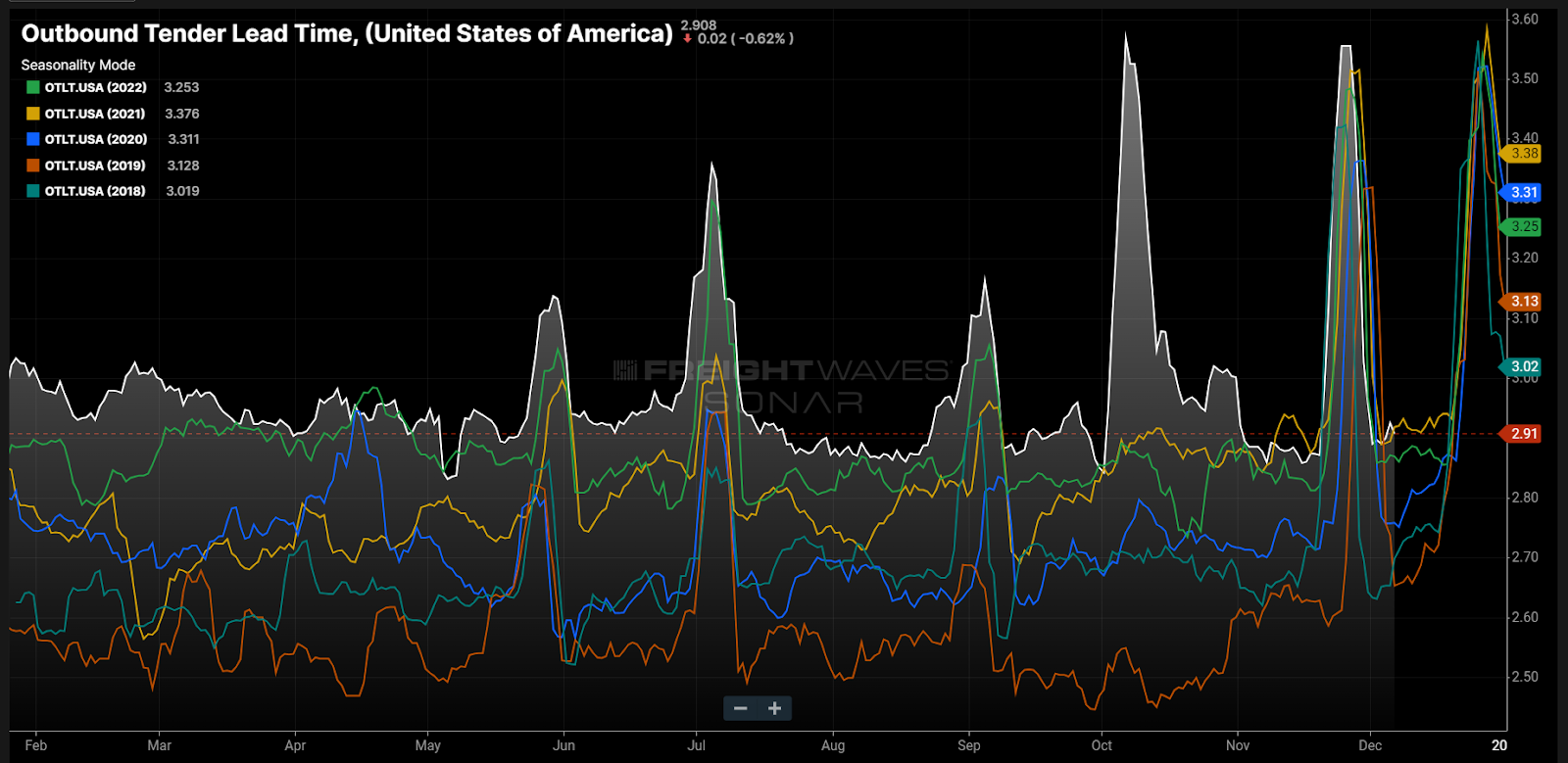
Chart of the Week: Outbound Tender Lead Time, USA SONAR: OTLT.USA
Tender lead times — the time between the initial request for truckload capacity and the requested pickup date — have remained 10-15% above pre-pandemic norms throughout 2023. This has been the one transportation management trend that has stuck and not regressed since the end of the shipping boom. It is also a trend that benefits both shipper and carrier.
Lead times have an optimal range depending on the origin. Generally speaking, a three- to five-day lead time gives a carrier plenty of time to prepare and adjust its networks to make a pickup, even in some of the more remote areas.
Lead times spike in front of holidays as shippers push orders for the future before they leave the office.
When lead times shrink rapidly, it can be an indication that shippers have had unexpected demand spikes. Gradual moves in lead times are more dependent on shipper expectations of capacity availability. This current pattern does not fit historical patterns.
National lead times (OTLT) averaged around 2.6 days in 2019, which was the shortest amount of time of the past five years.
So far in 2023, the OTLT has averaged just under three days. A half day may not seem like much, but think about it in terms of potential miles a truck drives in that time. The 0.4 days is roughly 200 miles or slightly longer than the distance from Chicago to Indianapolis for a truck.
Shippers typically average shorter lead times in soft markets because they know capacity will be available.
This is supported by the fact that lead times fell 3.3% from 2018 (a relatively tight market) to 2019 (a very loose market). They subsequently increased in 2020-22 and have remained elevated in 2023 even as the market loosens.
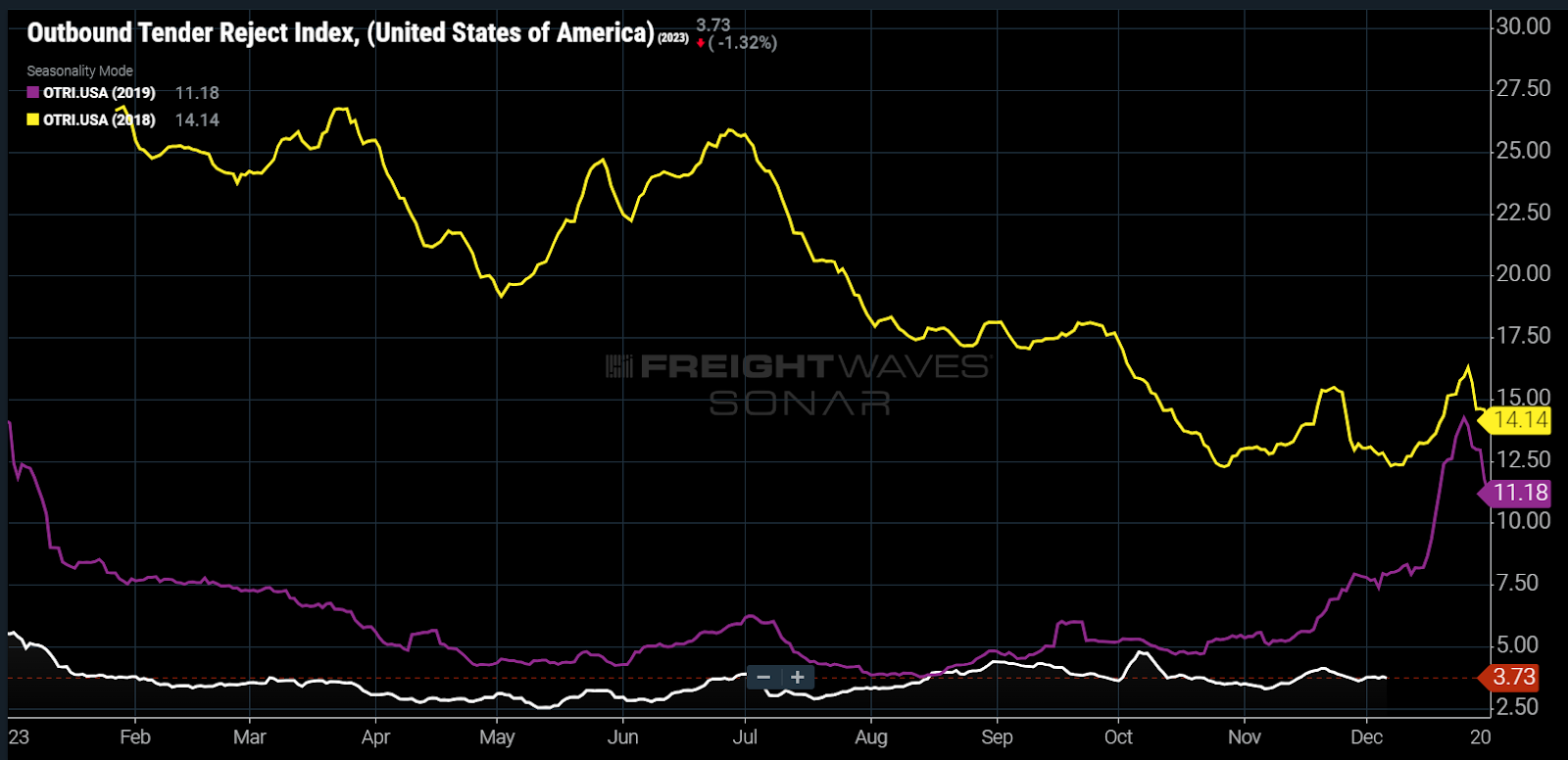
The National Outbound Tender Reject Index (OTRI), which measures the rate at which carriers turn down requests for truckload capacity, shows capacity was significantly harder to secure in 2018 than in 2019 (purple) and this past year (white). Higher rejection rates equal tighter capacity.
One would expect this year’s lead times to be similar to 2019, except they are 8% higher than 2018. So why has this trend stuck?
It is nearly impossible to pin down, but shippers may have realized the benefits of giving more time for carriers to prepare after two years of struggling. Service levels were abysmal in 2020-21, but some companies probably noticed their odds improved with more days to prepare.
This could also be a byproduct of shippers own internal processes changing. Inventory management has been a primary focus over the past few years. Shippers may have improved their planning and warehouse management practices, leading to better visibility on when to ship.
Shippers may also lack the sense of urgency due to having relatively elevated inventory levels. This means they can ship at their leisure due to a lack of urgency.
More than likely it is a combination of all of these and possibly more. The good news for carriers is that it appears to be sticking regardless of market conditions. This practice will definitely help shippers when the market inevitably turns the other direction.
About the Chart of the Week
The FreightWaves Chart of the Week is a chart selection from SONAR that provides an interesting data point to describe the state of the freight markets. A chart is chosen from thousands of potential charts on SONAR to help participants visualize the freight market in real time. Each week a Market Expert will post a chart, along with commentary, live on the front page. After that, the Chart of the Week will be archived on FreightWaves.com for future reference.
SONAR aggregates data from hundreds of sources, presenting the data in charts and maps and providing commentary on what freight market experts want to know about the industry in real time.
The FreightWaves data science and product teams are releasing new datasets each week and enhancing the client experience.