The launch of the shipping container

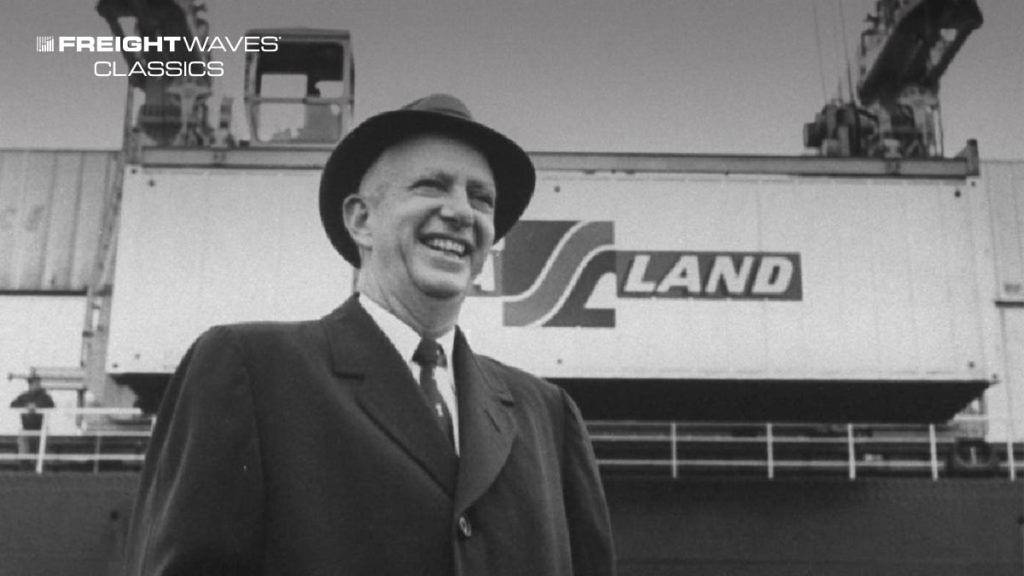
Malcom McLean in the foreground with a Sea-Land container behind him. (Photo: Maersk)

FreightWaves Classics is sponsored by Old Dominion Freight Line — Helping the World Keep Promises. Learn more here.

The shipping container is one of the most influential inventions in the shipping industry. For better or for worse, it arguably paved the way for globalization and a new take on the supply chain and logistics industry simply by streamlining the loading and unloading process. 

But where did the shipping container come from? 

A man named Malcom McLean started a small trucking company focused on farming supplies in the 1930s to support his family during the Great Depression, according to PBS’ “Who Made America?” He was known for his resourcefulness and ability to tackle problems from a different angle than most people. Because of this, by the 1950s McLean Trucking grew to 1,700 trucks and was worth $12 million when McLean sold it. 

One day while watching dockworkers loading and unloading shipments from truck to ship, McLean thought that there must be a more efficient way. At the time, it would take eight days on each end of a ship’s trip to load and unload cargo, according to American Business History

McLean gained inspiration from railcars on ships to Cuba in 1929 and World War II experimentation with early ideas of small containers. He believed there was a new strategy waiting to be uncovered that would streamline operations, using a large container that would easily transfer from truck to ship. But others only saw government regulations, unions and workers who feared job loss, logistical issues and expense. 

“His colleagues report that he could not see problems like others saw them — he took big issues and broke them down into components, which he attacked one at a time,” says American Business History. 

The determined businessman realized that oil tankers traveled with empty top decks, added American Business History, which meant room for containers on top. So McLean bought an oil tanker, the Ideal X, added a steel deck to support the extra load and on April 25, 1956, sailed from Newark, New Jersey, to Houston. The ship transported 58 containers. 

The Ideal-X gets its first container loaded onto its deck. (Photo: Maersk)

One anecdote says that while McLean marveled at the feat, a longshoreman had another opinion, remarking, “I think they ought to sink the sonofabitch.” 

Officially, this is the first recorded successful container ship transport. And despite the naysayers, it paid off. McLean invested further in the idea of the containers and named a new company Sea-Land. 

The Port Authority of New York opted to put in a new container port in Elizabeth, New Jersey, the first of many to come, according to PBS. Shipping became much faster due to the decrease in loading and unloading time. But it also became much more secure. The containers offered more security due to their concealed nature. There were many less opportunities for theft. 

Eventually, the Vietnam War pushed container ports into Asia and imported consumer goods prices lowered thanks to the more efficient way of shipping. In 1969, McLean sold Sea-Land for $160 million. He continued to create more inventions, including a new way of transporting patients from a stretcher to a hospital bed and other shipping ideas, until he passed away in 2001 at age 87.

FreightWaves Classics articles look at various aspects of the transportation industry’s history. Subscribe to our newsletter!

Have a topic you want us to cover? Email bjaekel@www.freightwaves.com.

Is truck towing predatory; truckers on OpenAI board; FIU’s supply chain program – WTT

On today’s episode of WHAT THE TRUCK?!? Dooner is talking to FreightWaves’ Rachel Premack about whether a trucker should be on the OpenAI board, if there should be a trucking Barbie doll, the dangers of Panera’s Charged Lemonade and the lifestyle of DINKS.

Corey at Dad of Two Roadside takes us inside the world of truck towing and claps back at an article calling the industry “predatory.” 

FreightWaves’ Justin Martin breaks down the Grand Theft Auto 6 trailer, daring bridge rescues, lowering CDL standards, FedEx truck lootings and hauling nukes.

And Florida International University College of Business’ Gregory G. Maloney shares the latest in supply chain education.

Watch on YouTube

Subscribe to the WTT newsletter

Apple Podcasts

Spotify

More FreightWaves Podcasts

DHL Express diverts freighters from Cincinnati hub as strike precaution

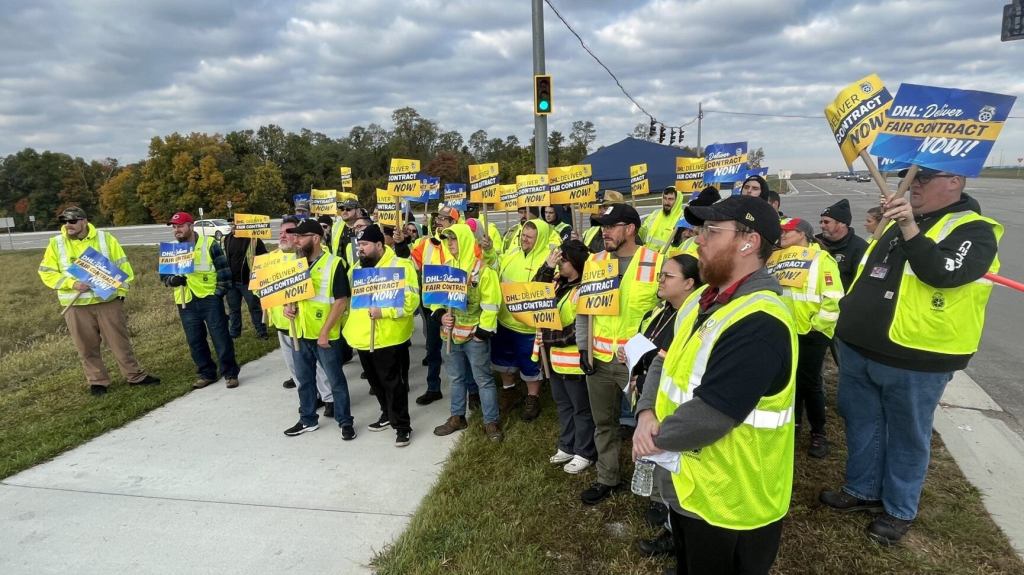
DHL workers wearing yellow vests and holding signs on a street corner picketing for a better contract.

DHL Express has activated contingency plans to keep delivering packages without interruption in the event ramp and tug workers at its North American air hub near Cincinnati go on strike as contract negotiations continue this week.

The Teamsters, which represents more than 1,100 DHL employees who load and unload freighters at Cincinnati/Northern Kentucky International Airport (CVG), announced Sunday that members overwhelmingly authorized leadership to call a work stoppage if there isn’t progress on demands for better pay and safety and an end to unfair labor practices.

DHL Express is lining up supplemental staff at CVG and temporarily moving flights and volume away from its hub to regional terminals throughout the Americas to prevent shipping delays. In the United States, DHL also has large airport sort centers in Atlanta, Miami, Los Angeles and New York.

“We are confident these prudent and proactive measures will ensure we maintain our high level of delivery standards and performance for our customers in their most critical peak period of the year. We expect no disruption to service,” the parcel logistics unit of Germany’s Deutsche Post Group said in a statement.

Workers voted in April to join Teamsters Local 100 after a yearlong campaign and began collective bargaining for their first contract in July.

The union claims DHL management is dragging its feet on a deal and that its proposals are  “insulting.” It has repeatedly called out DHL for alleged hardball tactics at the negotiating table, denying Local 100 officials access to members and safety violations. Last year, there were at least 22 workplace injuries at CVG that required transport to a hospital or emergency room, according to the Teamsters. 

Safety hazards listed by the union in a recent online petition include:

  • Inadequate lighting for unloading planes at night, forcing workers to use their cellphone lights or buy non-DHL equipment like headlamps.
  • Faded striping for guiding tugs on the taxiway.
  • Tugs with faulty windshield wipers and engine cover latches.
  • Exhaust fumes leaking into tug cabs.

“Equipment is so poorly maintained that there is free-for-all at the start of shifts among staff trying to get the working equipment. DHL consistently disregards or encourages employees to violate its own policy regarding safety and communication among crews pushing out planes. We often don’t have the minimally required number of headsets for crews to communicate with our colleagues or the pilots. Some crews do not have headsets at all. Those headsets that do exist are often dysfunctional,” the petition said.

Meanwhile, the National Labor Relations Board is prosecuting before an administrative judge claims of harassment, intimidation and retaliation, including threats of being terminated for wearing union insignia on safety vests, surveillance of workers talking to union organizers in public settings and dismissing some employees involved in the organizing effort. 

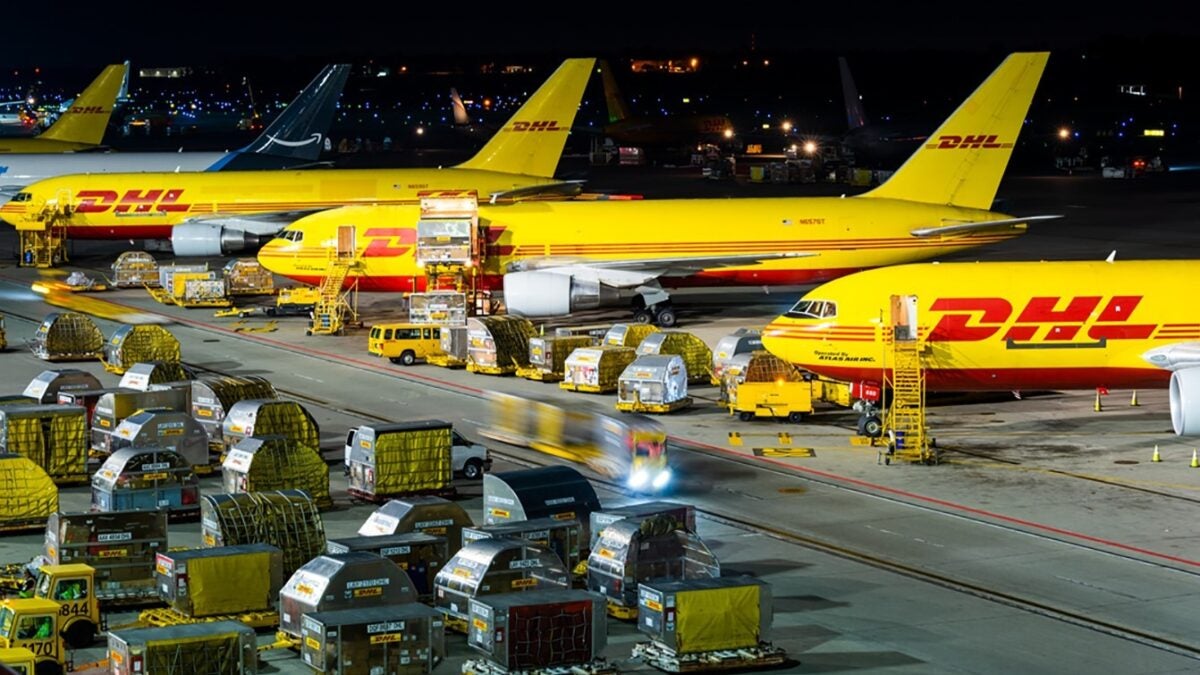
DHL Express operates an extensive night operation at Cincinnati/Northern Kentucky International Airport with banks of inbound and outbound flights carrying international packages. (Photo: CVG airport)

“Our members are fed up with the company’s stall tactics. The members have voted and are prepared to walk. DHL will not get away with denying working people good wages and safe conditions on the job,” said Bill Davis, president of Local 100, on Sunday. 

The Teamsters union represents 6,000 workers at DHL across the country, raising the possibility that they could withhold their services in solidarity with the CVG team.

Unions in the U.S. are feeling emboldened after labor shortages during the pandemic strengthened their hand and with a pro-labor administration in Washington. One of the biggest contract wins this year was at UPS, where the Teamsters won generous pay increases and upgrades to package cars for 340,000 part- and full-time workers on the eve of a strike deadline. Autoworkers and Hollywood writers went on strike and achieved most of their goals. Airline pilots, railroad workers and West Coast longshoremen have all seen big hikes in pay and benefits over the past year. 

Teamsters President Sean O’Brien is now training his guns on organizing workers at Amazon.

A year ago, ground workers at Amazon Air’s superhub at CVG began a campaign to form a union. Workers there have complained they are paid far less than counterparts at DHL’s facility. Organizers are pushing for a $30 per hour wage and improved health benefits. At Amazon’s West Coast air hub in San Bernardino, California, warehouse workers are demanding a $25 starting wage.

The DHL talks are scheduled to continue through Thursday, with the company saying it is ready to return to the bargaining table in January.

“While it is unfortunate the Teamsters have decided to increase the external rhetoric and communicate inaccuracies around the status of these CVG hub negotiations, we have consistently sought to bargain in good faith and to find constructive solutions at the negotiating table. Their latest decision was anticipated and a situation for which we are fully prepared,” the DHL statement read. “DHL Express remains committed to working with the Teamsters and agreeing to a contract for the portion of the CVG employees they represent. … Our customers should remain confident in our ability to provide the excellent service they expect and require.”

Click here for more FreightWaves/American Shipper stories by Eric Kulisch.

DHL Express rotates Americas CEO to Europe

DHL Express to build $192M maintenance hangar at CVG hub

Ambrey expands advisory for Israel-linked vessels amid Red Sea attacks

The pool of vessels in the Red Sea and the Gulf of Aden that could be targets of Iran-backed Houthi rebels has greatly increased, according to maritime security firm Ambrey.

On Wednesday, the firm issued a new advisory to vessel owner-operators to expand their review to include the last three years to assess whether their vessels have been connected with Israel. This comes on the heels of recent attacks on commercial vessels in the Red Sea, which Ambrey said were based on old data being used by the rebels. Iran, according to Ambrey, is an integral part of Houthi maritime intelligence gathering.

Read more: Viewpoint: What Red Sea attacks mean for shipping

The Number 9 vessel was one of the targets of the Monday attacks, and Ambrey explained Houthi records were outdated by two years. The vessel was operated by the Israeli company Zim, the world’s 10th-largest container line operator, until November 2021.

Ambrey warned that there has been other potentially mistaken targeting in similar incidents involving Iran, including the Unity Explorer. While owned and operated in the U.K., the Israel connection is among its management. Unity Maritime is controlled by Danny Ungar, the son of Israeli shipping businessman Abraham “Rami” Ungar. In November, the Houthis hijacked the 5,100-unit car carrier Galaxy Leader, part of Ungar’s shipping company, Ray Car Carriers.

“Sunday’s events indicated that used information may be out of date by as many as two years,” said Daniel Mueller, Ambrey’s lead analyst for the Middle Eastern region. “This is why we are advising vessel reviews to be expanded by three years.”

Ambrey recently calculated that more than 600 vessels worldwide may be affiliated with Israel. By expanding the vessel search by three years, Mueller said the number of vessels potentially at risk of being targets could increase up to 50%.

In its advisory, Ambrey urged owner-operators of any vessel found to be connected to Israel within the three-year window to assess the vessel’s route and its route predictability, as well as the vessel’s proximity to Islamic Revolutionary Guard Corps, Iranian Navy assets and Houthi-controlled sites. It is also advised to identify the vessel’s planned ETA to those sites and the position relative to other potential targets. Considering the electronic signals policy, including information and minimization days before entry to the Red Sea, the Bab el Mandeb, and the Gulf of Aden, is also recommended.

Judah Levine, Freightos’ head of research, said there have not been reports of a significant downturn in Suez traffic yet.

“Israel’s Zim Lines did announce last week that its ZMP service, which employs 12 vessels in the service, will now be going around the Cape of Good Hope instead of transiting the Suez,” he said.

Mueller added that before the conflict, approximately 20 vessels connected to Israel were traversing the Suez Canal from both sides each week. Now Ambrey is tracking around 13 a week.

Ex-Roadrunner dispatch manager sentenced to 18 months for wire fraud

A federal judge has sentenced a Kansas woman to 18 months in prison for stealing nearly $113,000 from Roadrunner Temperature Controlled, the trucking company where she worked for nearly three years.

Amy Shepherd, 44, of Wichita, Kansas, was sentenced Friday in the U.S. District Court for the District of Nebraska after pleading guilty in August to one count of wire fraud.

U.S. District Court Judge Brian Buescher has ordered Shepherd to serve three years of supervised release and pay more than $112,000 in restitution after she is released from prison. 

According to the indictment, from July 2016 through June 21, 2019, Shepherd worked remotely from her home in various roles, including as a customer service manager, a driver business leader manager and finally as a dispatch lead manager during her employment at Nebraska-based Roadrunner Temperature Controlled.

In August 2020, FreightWaves reported that Roadrunner Transportation Systems Inc. had sold its reefer division, Roadrunner Temperature Controlled, to Laurel Oak Capital Partners.

Shepherd didn’t work alone

Johnny Bradford II, 52, of Lancaster, California, drove for the refrigerated division of Roadrunner from Feb. 28, 2017, through May 4, 2018.

At the time, Roadrunner used EFS, an electronic wire transfer service, to issue driver cash advances for equipment repairs, trailer washouts or to pay lumper fees to third-party workers to unload its trailers.

Prosecutors allege that beginning in February 2018, Shepherd used her position as a dispatcher lead manager to fraudulently generate advances and enter EFS check codes, which she then sent to Bradford over a 16-month period. 

According to court documents, Bradford would cash the checks at vendor establishments, then he would “use Western Union to send portions of the money he received from the fraudulent driver advances back to Shepherd.” 

It’s unclear in court documents how Shepherd continued to send electronic wire transfers to Bradford for a light repair for $300 in February 2019 and for a trailer alternator costing nearly $827 in June 2019 through Roadrunner’s accounting system nearly a year after the truck driver was no longer employed by the refrigerated carrier.

Bradford pleaded guilty to one count of wire fraud in September and is slated to be sentenced on Dec. 14.


Do you have a news tip or story to share? Send me an email or message me @cage_writer on X, formerly known as Twitter. Your name will not be used without your permission.

VC-backed CloudTrucks exits factoring business to focus on core offerings
Michigan trucking fraudster sentenced to 17 years for $40M Ponzi scheme
Roadrunner sells off remaining truckload units; adds former Celadon head to board

Solvento pushing digitization with invoicing software, $53.5M in debt and new funding

Latin American fintech startup Solvento on Wednesday announced the release of Solvento Audita, an AI-powered auditing and invoicing software to provide invoicing transparency throughout the supply chain. 

As part of the launch, Solvento also announced it has taken on a $50 million debt facility from investment platform Lendable along with raising a $3.5 million seed extension led by Quona Capital, with participation from Dynamo Ventures, Ironspring Ventures, Proeza Ventures, and Zenda VC to expand its current Latin American lending product.

“We unfortunately still live in a paper world,” said Jaime Tabachnik, co-founder and CEO of Solvento. “Shippers don’t benefit from eliminating the paperwork because the inefficient process often gains them more time to pay. That is why we believe in our mission of acquiring this working capital to make these processes digital. Recognition of the root cause of slow payments has inspired us because we believe we can break these paradigms, push digitization and hugely impact the Latin American economy.”

Mexico City-based Solvento has raised $10 million in equity since its founding in 2021. The company has also paid back $3 million from a previous debt facility.

By leveraging APIs into transportation management systems and other popular Latin American applications like WhatsApp, Solvento Audita can automatically recognize and verify the documentation required for invoicing, ensuring the accuracy of the information requested from shippers. This automated process replaces the common manual practice undertaken by shippers and brokers.

Regulations need AI’s support

Tabachnik said Mexican tax regulations have become more complex, needing AI more than ever for proper invoicing.

“We believe the most risks in the industry come from internal fraud and human error. The best practice to avoid those problems is to provide an outside auditor and technology to find those errors. Solvento Audita adds both of those to your workflows creating a sole source of truth,” Tabachnik told FreightWaves.

The Carta Porte, mandated by the Mexican Tax Administration Service (SAT) since January 2022, is a digital document accompanying the Digital Tax Receipt by Internet (CFDI) to improve control over goods transportation in Mexico. Applicable across various transport modes, it replaces traditional documents like CFDI and waybills, facilitating the digitization of processes. All entities engaged in transporting goods bear the responsibility of ensuring accurate reporting.

Enforcement of an updated version, Carta Porte 3.0, began on Nov. 25, with a grace period until Jan. 1, providing users with time to adjust to modifications to enhance the completeness and accuracy of consignment note information.

One reasoning behind these regulatory changes is to mitigate contraband issues and fraud, which are also challenges afflicting domestic supply chains in the United States.

“This is a huge opportunity for Mexico to be the biggest trading partner with the U.S. and drive all this new investment. We are very excited to show companies how much profit they are missing out on with the software we have built. We are also very excited to have an incredible social impact by helping carriers grow their business that has lacked access to working capital for decades,” Tabachnik said.


Mexico truck driver strike delayed after officials, carriers reach deal

Borderlands: Truck driver salaries in Mexico averaged $4,400 in 2022

5 things Mexico must do to win at nearshoring

Daily Infographic: DoorDash tests warning non-tippers


To view more FreightWaves infographics, click here

Hydrogen’s slow march as fuel gets boost on San Francisco waterfront

Should hydrogen ever become the long-distance trucking fuel of the future, its abilities are increasingly likely to be proved out first in applications other than an 18-wheeler.

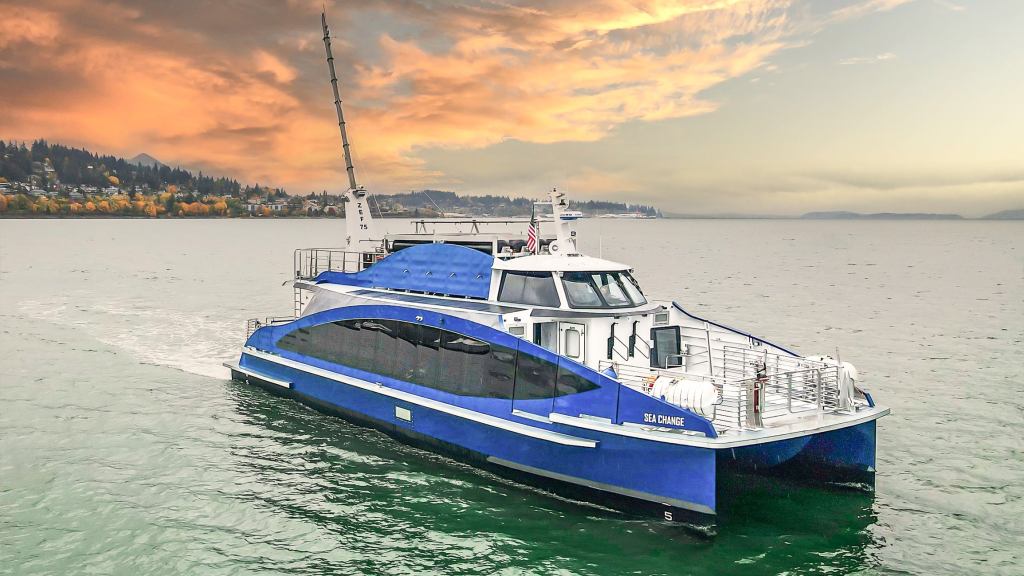
One test of hydrogen’s reliability as a fuel is ongoing along the San Francisco waterfront, where a company called Switch is already operating a hydrogen-powered ferry, the Sea Change. The catamaran ferry launched in August.

The ability to move from one hydrogen-powered vessel to a bigger fleet got a boost last month with a $10 million investment in Switch by Nexus Development Capital. Nexus’ CEO, Josh Kaufman, described it in an interview with FreightWaves as a fund that backs teams developing low-carbon infrastructure. He said Nexus considers itself more as “early-stage infrastructure” capital rather than traditional venture capital.

Kaufman described the work that Switch had done with the Sea Change to be “really the most advanced decarbonized asset in the country.” Discussions between Switch and Nexus went on for 18 months before the commitment was made.

And while there are plenty of funds out there that are investing in more traditional renewable energy sources like wind and solar, those funds are “just not quite comfortable with a lot of other sectors,” Kaufman said. Hydrogen would be one of them and “that can be because the business model is not proven yet or there are still development risks.” 

Pace Ralli, CEO and founder of Switch, said his background was in “the utility world” but that he had been looking at the decarbonization of shipping since 2012. It was about that time that the International Maritime Organization was beginning to look at reducing the carbon footprint of shipping, an effort that led to a historic deal earlier this year. 

Ralli told FreightWaves that “even though we’re at an early stage, what the investment allows us to do is really just sort of switch our focus to expanding the fleet.”

He added that Switch has “new commercial opportunities that we’re advancing with this capital and start building new vessels.” 

The Sea Change is not a retrofit; it was built from the ground up at a shipyard in Bellingham, Washington. Its operation was approved by the U.S. Coast Guard. 

In the announcement of the Nexus investment in Switch, the companies said that Coast Guard approval was not only necessary but provides a further pathway to growth. “Establishing a regulatory framework for this technology unlocks the possibility of progressing to larger ferry designs capable of operating at higher speeds on longer routes,” the prepared statement said.

By not being a retrofit, and by delivering a finished hydrogen-powered ferry, Switch is able to push one of its value propositions: It’s a turnkey solution. 

As the company said in its announcement of the Nexus investment, Switch takes care of the vessel design and construction, leasing options and “pre-packaged carbon neutral fueling.”

Ralli said he can see the maritime industry being large enough to serve as a base for greater penetration of hydrogen into other areas. It can help provide supply “and that’s going to be a benefit to trucking.” 

For now, Ralli said, there are adequate supplies of hydrogen in the San Francisco Bay Area to ensure that the Sea Change will not have any difficulty finding fuel.

In the push by the renewable industry to move into transportation markets, total cost of ownership is touted for the next generation of fuels. That effort tries to get past the upfront costs of renewable cars or trucks, which are often significantly higher than conventional transportation modes, and instead focus on the long-term financial benefits from electric engines and the alternative fuel that powers them. 

Also at play might be tax credits, which is the case with hydrogen as green hydrogen, produced from renewables, earns a tax credit that is roughly equivalent to about $3 per gallon in a comparison with diesel. This is particularly true in California, where transportation using low-carbon fuels can earn Low Carbon Fuel Standard credits. The prices have fallen considerably from the high-water mark earlier this year but would still be a factor in the total cost of ownership. 

Hydrogen as a transportation fuel primarily takes three forms. One is what is happening on the Sea Change: Hydrogen is injected into an onboard fuel cell, a chemical reaction converts it to electricity and an electric motor is powered by that.

Another is to introduce the hydrogen into an engine via ammonia, which is a combination of hydrogen and nitrogen but has the advantage of being plentiful given its role as a fertilizer. The ammonia can be combusted but that creates significant emissions of nitrous oxide (Nox).

Getting hydrogen from ammonia without the Nox emissions is the core of the approach being spearheaded by several companies, including Amogy. That New York-based startup is also looking to ships as its basis, constructing a prototype system that will take in ammonia, crack it into hydrogen and nitrogen and vent the latter into the atmosphere, where it already is the primary element in the air that people breathe. The hydrogen then is fed into a fuel cell, like with the Sea Change, and the resulting electricity powers the boat.

More articles by John Kingston

Fuel cell maker CEO boosts use of hydrogen on the rails

Amazon-funded startup tackles storage issue as key in hydrogen trucking

Environmental group raises caution flag on hydrogen’s impact as fuel

America’s energy boom: Crude exports soar to record high

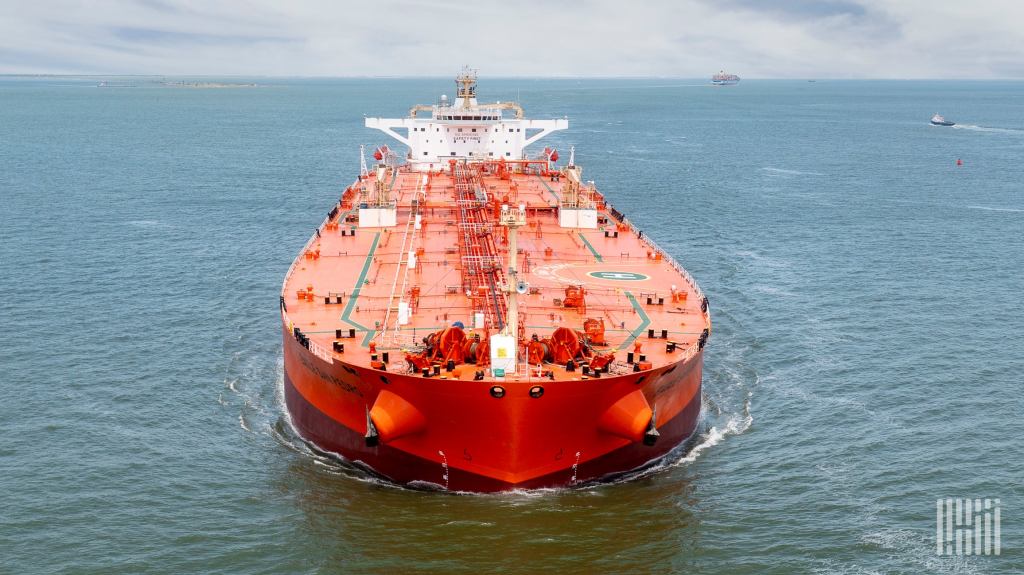
a photo of a crude tanker

As diplomats convene at the United Nations’ COP28 climate change summit, fossil fuel production and consumption are hitting new highs, and tanker owners are in prime position to profit from rising trade flows.

The Biden administration is a leading proponent of decarbonization, yet the U.S. is pumping out record volumes of hydrocarbons. America is on track to be the world’s largest producer and exporter of natural gas this year, as well as the leading exporter of refined products and liquefied petroleum gas.

There are also big wins — for energy producers and shipowners, not decarbonization advocates — on the crude oil front.

The U.S. produced 13.2 million barrels per day (b/d) of crude oil in September, according to data released Thursday by the Energy Information Administration. That is the country’s highest monthly production level ever.

And not only is America producing more crude, it is exporting a larger share of the crude it produces, further boosting volumes aboard tankers bound for Europe and Asia.

Seaborne crude exports up 19% vs. 2022

Exports of U.S. crude were banned between 1975 and 2015. For 40 years, U.S. production could only be sold overseas if it was refined first, then exported as petroleum products.

The end of the ban dramatically increased market opportunities for U.S. production, thereby stimulating higher output — creating more business for oil companies and tanker owners.

That upward momentum continues. Seaborne crude exports are tracked by commodity intelligence provider Kpler. In January-November, its data shows that U.S. seaborne crude exports averaged 4 million b/d, an all-time high and up 19% year on year.

a chart of US crude exports
* 2023 average for January-November. (Chart: FreightWaves based on Kpler data)

Exports in November averaged 4.45 million b/d, the second-highest monthly average on record, just slightly below the peak of 4.46 million bpd in March.

Volumes rise sharply to both Europe and Asia

The Panama Canal is wreaking havoc on many cargo supply chains, but it has virtually no effect on U.S. crude exports.

U.S. crude exports to Asia are loaded on very large crude carriers (VLCCs; tankers that carry 2 million barrels) via ship-to-ship transfers in the U.S. Gulf. VLCCs are too large to transit either the Panama or Suez canals; they use the Cape of Good Hope.

U.S. exports to Europe are shipped aboard Aframaxes (750,000-barrel capacity), Suezmaxes (1 million-barrel capacity) and VLCCs.

a map of crude tanker locations
Positions of tankers laden with U.S. crude on Tuesday. (Map: MarineTraffic)

Since the invasion of Ukraine, Europe has hiked its purchases of U.S. crude to help offset banned Russian supply. According to Kpler data, an average of 1.83 million b/d of U.S. crude flowed to Europe in January-November, up 26% from the 2022 full-year average.

Europe’s share of total U.S. crude exports has risen to 46% this year compared to 37% in 2021, the year prior to the invasion, while Asia’s share is 41%, down from 47% in 2021.

“In volumetric terms, the story has been all about Europe this year,” Reid I’Anson, senior commodity analyst at Kpler, told FreightWaves. “Europe continues to grow increasingly reliant on U.S. energy — not just LNG [liquefied natural gas] but across the board.”

Despite the pull of Europe, U.S. crude exports to Asia have also continued to escalate. According to Kpler data, exports to Asia are averaging a record-high 1.65 million b/d year to date, up 15% from last year and up 26% from 2021.

Rising volumes to Asia translate into profitable business for VLCC owners. Brokerage True North Chartering counted 40 spot VLCC cargoes loading in the U.S. Gulf in both October and November, matching the prior monthly high in April.

Click for more articles by Greg Miller 

Old Dominion reports muted November

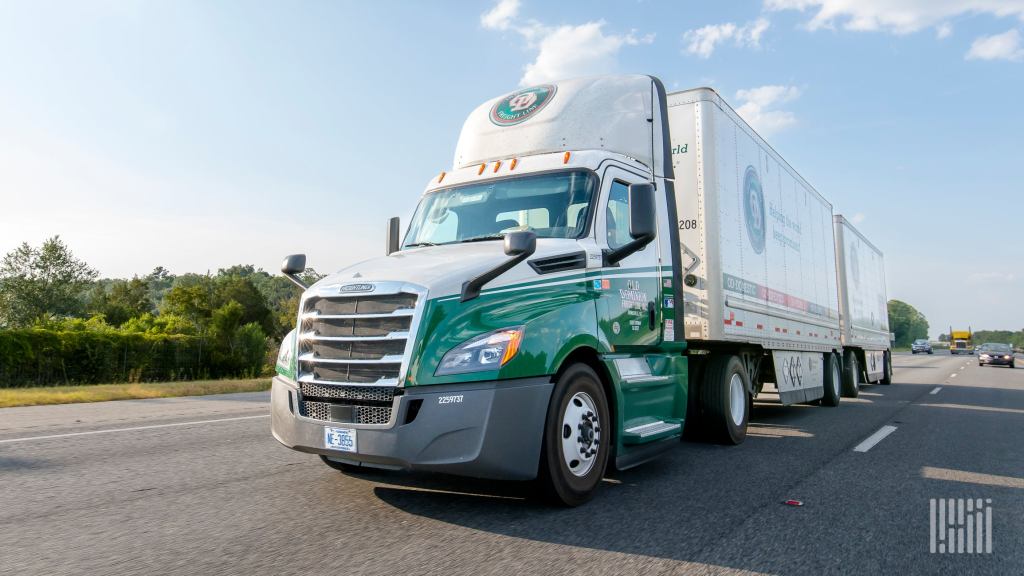
An Old Dominion tractor pulling two LTL trailers on a highway

A weak freight environment was to blame for a dip in tonnage during November, less-than-truckload carrier Old Dominion Freight Line said Tuesday after the market closed.

The company reported a 2.3% year-over-year (y/y) drop in tons per day during the recent month, which followed a 1.9% decline in October. The carrier was up against weak comps from a year ago, which included y/y declines of 6.5% and 8.6% in October and November 2022, respectively.

Many carriers benefited from an early October cyberattack at Estes, which forced some shippers to seek capacity elsewhere. However, most of the repositioning was short term, with freight finding its way back to Estes’ network by the end of the month.

Old Dominion’s (NASDAQ: ODFL) latest y/y tonnage declines were smaller than the 6.9% drop it recorded in the third quarter. Shipment counts were modestly positive in the recent two months, but shipment weights continued to erode.

Table: Company reports

Industrial-related freight can account for roughly two-thirds of total revenue for many carriers. The Purchasing Managers’ Index for manufacturing has been in contraction territory for more than a year now. A 46.7 reading in November (50 is neutral) was unchanged from October. Further, the new orders subindex, an indicator of future production, improved but continued to contract at 48.3.

Old Dominion did benefit from the freight reshuffle following Yellow’s exit, but management recently said it hasn’t altered its freight selection process in efforts to keep yields high.

Revenue per hundredweight, or yield, was 3.1% higher y/y in the first two months of the fourth quarter, up 7.6% excluding fuel surcharges. However, the metric was again aided by a decline in shipment weights. When comparing Old Dominion’s yields to two years ago, the growth rates are roughly 20%, which is likely the highest in the industry.

“The decrease in our November revenue reflects continued softness in the domestic economy,” said Marty Freeman, Old Dominion president and CEO. “We were pleased, however, to see both the continued improvement in our yield metrics and a slight increase in our LTL shipments per day.”

Old Dominion was not mentioned in a Delaware court filing naming the winning bidders of Yellow’s terminals on Monday. It briefly held the top stalking horse bid at $1.5 billion but was later outbid by Estes. Old Dominion could still pursue some of the properties at a later date, or it may continue on its current course of adding more than a handful each year to its network of more than 250.

The company has made roughly $2 billion in real estate investments over the past decade, which it credits for its industry-leading operating results.

More FreightWaves articles by Todd Maiden