UPS unveils integrated supply chain platform

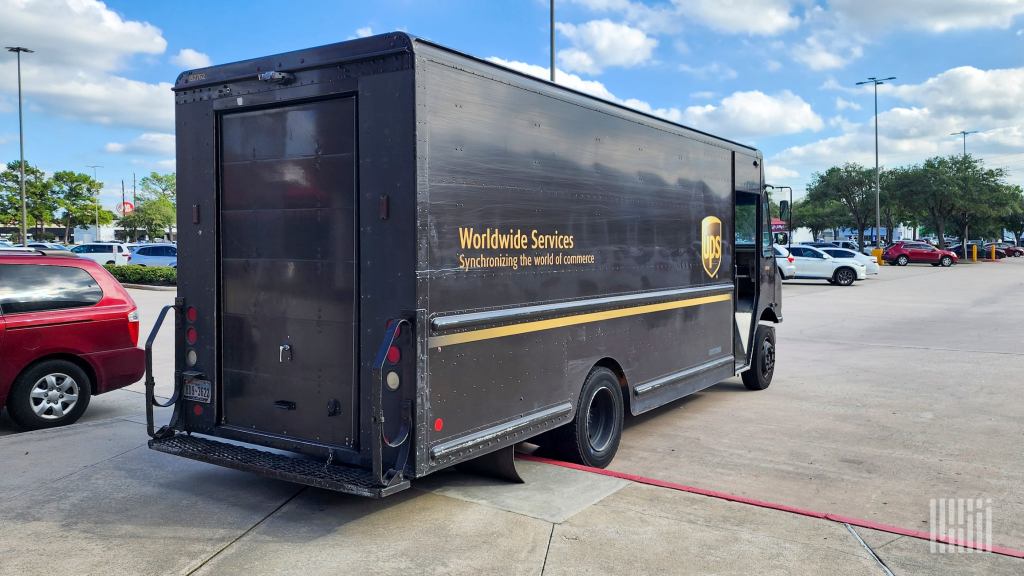
UPS Inc. (NYSE: UPS) on Wednesday unveiled its Supply Chain Symphony platform, which it said will integrate into one platform the visibility of multiple services that had previously been siloed.

The new tool will enable customers to monitor simultaneously and in real time every aspect of their global supply chains, UPS said. In the past, visibility could not be obtained without shifting to different platforms, according to a company spokesperson. The tool will also enable customers to generate real-time reports on service performance.

Many companies have trouble connecting their separate spreadsheets or databases, and most shippers find it difficult and time-consuming to turn supply chain data into useful information, UPS said in a statement. “An integrated logistics system can give companies a competitive advantage,” UPS said. Customers using the cloud-based software-as-a-service solution will benefit from improved customer service, collaboration, asset utilization and forecasting accuracy, according to the company.

The integrated tool supplants previously stand-alone UPS tools that cover shipping services, global logistics and distribution, global freight forwarding, customs brokerage, and supplier management. It also includes the company’s Express Critical urgent-delivery service, its Mail Innovations service for high-volume mailers, and its Coyote Logistics brokerage service.

FourKites reshuffles leadership team

There’s been a leadership shake-up at FourKites.

The visibility platform, which was reportedly valued at $1 billion last year, announced new leadership positions in a Wednesday news release

Sean Fallon, FourKites’ former president, has rejoined the company as chief strategy officer, according to the news release. In this role, Fallon will “drive strategy and support continued growth.”

President Rocky Subramanian confirmed to FreightWaves he is no longer with FourKites. He joined in April. FourKites would not comment and its release did not name a replacement.

Priya Rajagopalan, who is currently the chief product officer, will take over the responsibilities of chief customer officer, FourKites CEO and founder Matt Elenjickal wrote in an email on Tuesday to FreightWaves. She will oversee customer operations, product and R&D, according to the Wednesday release. 

The chief customer officer role was previously held by Bob Slaby. Fabrizio Brasca previously held the chief strategy officer title. Neither returned requests for comment on whether they remain at the company, and Elenjickal declined to comment on their status at FourKites. 

Brasca’s name had been removed from the FourKites’ leadership team page as of Wednesday morning, while Subramanian’s and Slaby’s remained. 

Elenjickal told FreightWaves on Tuesday that these were “routine internal organizational changes.”

FourKites has had a total of eight funding rounds, the most recent in September 2022. Elenjickal told The Wall Street Journal last year that FourKites was valued at $1 billion. FourKites counts Best Buy, Dow, Coca-Cola and other top brands among its customers.

Supply chain visibility platforms have struggled in the past year and a half. A depressed freight market and a downturn in investment deals have slammed venture-backed startups across FreightTech. According to Pitchbook data, the first half of 2023 saw 404 supply chain tech venture deals with a total value of $5.7 billion. That’s considerably lower than the same period last year: 567 venture deals with a total value of $23 billion.

FourKites laid off an undisclosed number of employees in August 2022, FreightWaves reported. However, according to LinkedIn data, FourKites has not seen an overall slump in its employment numbers. The company has nearly 660 employees, up 10% from two years ago.

“We are excited to announce these appointments at a time when customers are looking for more opportunities for digitization than ever before,” Elenjickal said in the Wednesday news release. “These additions bring a tight connection between the voice of the customer and our high-velocity R&D team, which will yield accelerated opportunities for innovation and customer value.”

Have a story to share about FreightTech? Email rpremack@www.freightwaves.com

White Paper: Q4 2023 Carrier Rate Report

FreightWaves’ Carrier Rate Report — presented in partnership with DDC FPO and Trimble — provides a review of the previous quarter and a forecast for the coming months. Featuring insights from a survey of carriers alongside data from SONAR, the report is designed to provide intelligence that carriers can use to inform their strategies in the months ahead.

Key areas of exploration include:

  • Key survey findings
  • Review of recent carrier exits
  • Increase in freight brokers in the market
  • Carrier earnings reports
  • Outlook for the holiday season

Complete the form below to download your complimentary copy.

How the Port of Portland saved itself from Mount St. Helens eruption

FreightWaves Classics is sponsored by Old Dominion Freight Line — Helping the World Keep Promises. Learn more here.

FreightWaves explores the archives of American Shipper’s nearly 70-year-old collection of shipping and maritime publications to showcase interesting freight stories of long ago.

In this week’s edition from the October 1980 issue, FreightWaves looks at how the Port of Portland had a unique advantage to a quick reopening after the Mount St. Helens volcanic eruption earlier that year. 

Port of Portland practices ‘do-it-yourself’ dredging

Most ports rely on the U.S. Army Corps of Engineers or private contractors to keep their navigation channels open. The Port of Portland, Ore., does that, too, but also has its own dredge, the “Oregon,” for maintenance and development work. It saved time when Mount St. Helens blew her top.

When Mount St. Helens volcano blew its top on May 18, it meant a lot of extra work for government and private dredges that were rushed in by the Army Corps of Engineers to reopen the 40-foot navigation channel in the Columbia River between the sea and the Oregon ports of Kalama, Vancouver, and Portland.

For one of the dredges that was engaged in dredging on the shoal that temporarily closed the river to deep-draft navigation, the job was old hat. The Port of Portland dredge Oregon spends about six months a year doing routine maintenance dredging work in the Columbia, keeping the channel open.

Long line of dredges

The Oregon is the latest in a long line of dredges operated by the Port of Portland in something of a unique situation. Other ports have owned and operated their own dredges in the past (New Orleans once had a “fleet” of dredges), but the Port of Portland is now one of the few in the nation that still operates its own.

“We are required by federal statute to assume responsibility for maintaining the channel,” explained Port of Portland spokeswoman Christine Kammer. “We lease the Oregon to the Corps about six months of the year and use the other six months for development work.”

Actually, the history of Portland’s dredging efforts is as old as the port itself. An Oregon statute of 1891 describes the purpose of the Port of Portland as to “improve the Willamette … and Columbia rivers … as that there shall be made and permanently maintained … a ship channel … of not less than 25 feet.

Channel restored

The channel is now 40 feet deep and 600 feet wide, or will be once again by the end of October, when the debris and mud from the Mount St. Helens eruption is completely removed. Portland is still engaged in maintaining the waterway at the greater depth with the Oregon.

The Oregon is a 30-inch pipeline dredge, one of the largest on the West Coast. She follows a long succession of similar pipeline dredges, which are favored in river dredging work.

The first dredge to go to work in the river was in service between 1864 — when Portland merchants joined with the city government to form a corporation for dredging — until 1902, and was never named.

Since 1902, the dredges in service of the Port of Portland have included the Columbia, the Columbia II, the Clackamas, the Willamette, the Tualatin, and, finally, the Oregon.

The Port of Portland bore all the costs of maintenance dredging until 1930, when, with the onset of the 35-foot channel project, the Corps of Engineers began reimbursing the port for dredging costs, a practice that continues today.

Back to normal

Sara Walter, speaking for the Corps in Portland, said Phase 3 of the cleanup project was completed on schedule July 29 with a channel 38 feet deep and 300 feet wide opened on the Oregon side of the river. Phase 4 — a 40-foot-deep, 300-foot-wide channel on the Washington side — is targeted for completion September 30, she said. By October 31, the channel is expected to be restored to its full 600-foot width.

The eruption sent millions of tons of mud, boulders, timber, and other debris coursing down the Toutle River watershed and into the Cowlitz River, which empties into the Columbia at Longview, Wash. The debris piled up in a shoal nine miles long, blocking navigation to Portland and Vancouver by oceangoing vessels. The port at Longview, however, escaped closure.

Walter said 6.8 million cubic yards of debris were removed on the Oregon side of the Columbia. Eventually, a total of 22 million cubic yards will be taken from the river.

The Port of Portland said the financial impact of the eruption on its operation is much less severe than originally estimated. Executive director Lloyd Anderson said the loss of revenues through August 31 would be about $1.4 million because of the slowdown in river traffic. Original predictions by the port had set the figure as high as $7 million.

Anderson praised the Army Corps of Engineers for moving quickly to restore navigation on the Columbia.

FreightWaves Classics articles look at various aspects of the transportation industry’s history. Click here to subscribe to our newsletter!

Have a topic you want us to cover? Email bjaekel@www.freightwaves.com.

2023 Shipper of Choice profile: Shorr Packaging

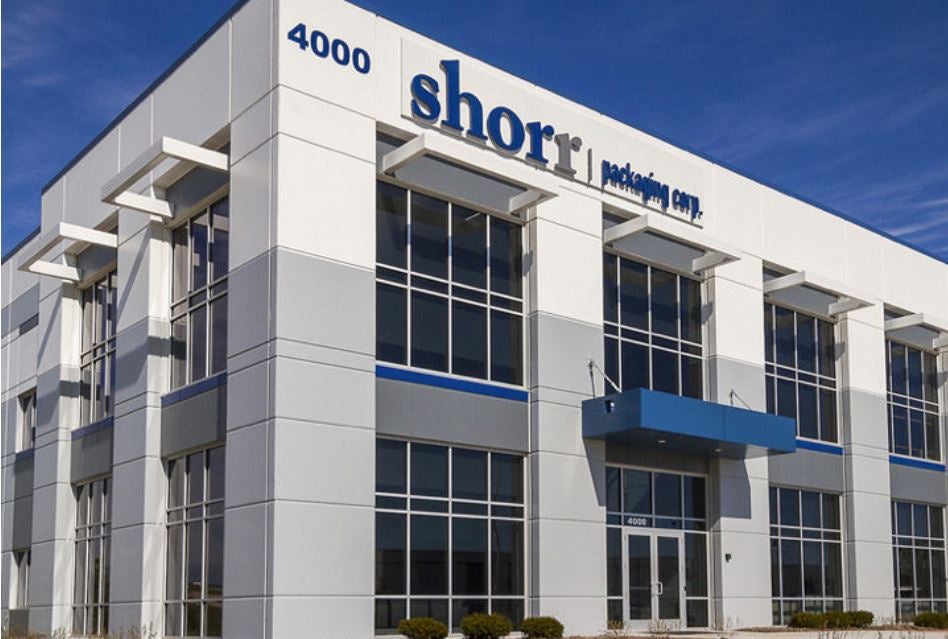
Shorr Packaging Corp. cracked the Top 25 list as a 2023 Shipper of Choice. The award recognizes retailers and distributors that value their carrier relationships.

The Shipper of Choice award, presented by FreightWaves and sponsored by TriumphPay, recognizes the manufacturers, distributors and retailers that do the best job of keeping the American economy moving by fighting driver detention, providing accessible facilities and understanding what it takes to remove inefficiencies from the supply chain.

Shorr is among the top 25 Shippers of Choice.

About Shorr

U.S. headquartersAurora, Illinois
Shipper of ChoiceFirst appearance
Private100% employee-owned

Why Shorr made the cut 

Shorr is a full-service packaging solutions provider with a national footprint and expertise serving eight industries: manufacturing, third-party logistics, distribution, e-commerce, food, medical, pharmaceutical and printing.

“Whatever the industry, we begin each engagement with a deep curiosity about the customer’s unique packaging challenges and needs,” the company says on its website. “First we listen, then we deliver the innovative solutions your business requires to move forward.”

Arrive Logistics nominated Shorr. Arrive books 50-60 loads a week for Shorr.

“They’re really communicative and constantly looking out for us,” Zac Conforti, strategic solutions manager at Arrive, said. “They appreciate the service and they make sure it’s rewarded. Shorr’s just one of those really good partners that everyone would be really fortunate to work with.

“This job is hard. The deadlines are constant. They’re one of those customers appreciative of high levels of execution.”

Shorr grew through several significant expansions since its founding in 1922 as the Northern Illinois Candy Co., which sold paper bags, janitorial supplies, candy, chewing gum and notions. It became 100% employee-owned in 2012.

“We are grateful to our dedicated employee-owners who have demonstrated outstanding dedication and professionalism in building strong relationships with our carrier partners,” said Nick Matuck, Shorr senior director of global logistics. “Their hard work, combined with our shared values of communication and mutual respect, have made this achievement possible.”

About Shipper of Choice sponsor TriumphPay

TriumphPay is the transportation industry’s premier payment network trusted by leading shippers, brokers, factors and carriers. Its innovative and highly automated fintech payment solution brings cost savings and efficiencies to antiquated transportation payment processes for network participants. Integrated financing options leverage the strength of TriumphPay’s parent bank and can provide liquidity and cash flow visibility.

TriumphPay is a division of Triumph Financial Inc. (NASDAQ: TFIN).

Korean Air says Amerijet-Maersk cargo partnership violates trade agreement

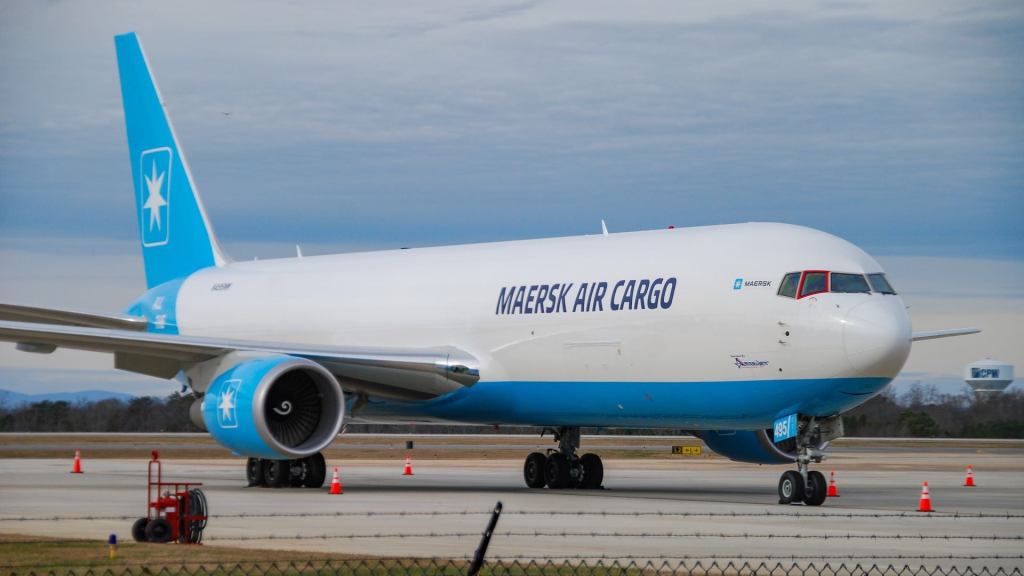
Diagonal close up of a light-blue tailed Maersk Air Cargo plane.

Korean Air has rejected claims by Amerijet that it impeded an application for a foreign carrier permit to protect its turf in South Korea, telling U.S. regulators that any delays are tied to a confusing arrangement between the Miami-based cargo airline and Maersk Air Cargo that does not comply with the Korea-Denmark air trade agreement.

In a filing, the Korean flagship carrier said the Department of Transportation should disregard Amerijet’s complaint and review without delay business jet subsidiary K-Aviation’s recent request to operate 10 to 15 flights per year for a small number of customers. 

Amerijet last month blamed Korean Air for stealthily opposing its request for a foreign carrier permit to provide scheduled service at Incheon International Airport in Seoul. It asked the DOT to suspend action on the K-Aviation application until Korean transport authorities gave their approval.

Amerijet currently operates a route multiple times per week via Seoul as a contractor to Maersk Air Cargo, but must apply every month for charter flights — at extra legal expense and operational uncertainty for the partners. 

Korean Air said it had no idea why it was taking longer for the Ministry of Land, Infrastructure and Transport (MOLIT) to process Amerijet’s application for full market access, but subsequently acknowledged it contacted the ministry to express concerns about “the integrity of the licensing process and to ensure fair competition” in light of the relationship with Maersk.

“Amerijet should look to its own arrangements and its own commercial partner — not K-Aviation and Korean Air — as the source of any alleged delays in processing its scheduled application,” Korean Air said in the Nov. 1 filing. “Rather than substantively objecting to K-Aviation’s application, Amerijet points to alleged delays in the processing of its own application for scheduled cargo authority by MOLIT, painting itself as a victim of a protectionist bureaucracy acting at the supposed direction of Korean Air.” 

Korean Air operates a fleet of 23 freighter aircraft and is the world’s third-largest carrier by volume when express parcel carriers FedEx and UPS are excluded. Cargo revenue in the third quarter fell 51% year over year to $703 million, the company said this week. Privately held Amerijet is a midsize cargo airline with a fleet of more than 20 aircraft. 

Amerijet began providing crews and operating flights for Maersk Air Cargo, the rebranded in-house airline of ocean shipping powerhouse A.P. Moller-Maersk, last November. Maersk, a Danish company that has transformed itself into an end-to-end provider of logistics services, provided Amerijet with three Boeing 767-300 purchased directly from Boeing. 

Amerijet operates one route three times per week connecting Shenyang, China, Seoul and Maersk Air Cargo’s hub at Greenville-Spartanburg International Airport in South Carolina. The other two freighters provide six days of weekly service between Hangzhou, China, Seoul and Maersk’s other U.S. hub at Chicago Rockford International Airport. 

Korean Air said MOLIT is simply doing its job to check whether Maersk is circumventing the air service agreement between Korea and Denmark, under which Danish carriers don’t enjoy seventh-freedom cargo rights, and Korean law, which doesn’t permit long-term wet leasing.  

A seventh freedom of the skies is when a state allows international airlines to provide scheduled air service without any connection to their home state. Wet leasing is an aircraft rental bundled with services — crew, maintenance and insurance — to operate the aircraft as opposed to a straight lease under which the customer operates the aircraft itself.

The review is complicated by the way Maersk Air Cargo is intertwined in the broader Maersk corporate structure and the outsourcing arrangement with Amerijet, according to Korean Air. It said it brought the arrangement to MOLIT’s attention because the Amerijet aircraft are painted in its partner’s livery, even though Maersk Air Cargo holds no traffic rights in Korea, and the companies presented confusing information about which legal entity within Maersk hired Amerijet.

For 20 years, Maersk operated Star Air, which provided outsourced airlift to UPS and other parcel organizations. Maersk Air Cargo was incorporated in early 2022 as a subsidiary of Maersk Aviation Holding A/S when Maersk decided to expand the use of the cargo jets, and acquired a large German airfreight forwarder, to move goods for its own customers. Star Air was rolled into the air operator’s certificate Maersk Air Cargo. Amerijet identifies its commercial partner as Maersk Logistics & Services International.

Korean Air argued it is natural for MOLIT’s review to take longer because the Amerijet case is unprecedented in the Korean air cargo market and Maersk has touted itself in marketing campaigns as providing the airfreight service between Korea and the U.S. It said the partners have obscured the exact nature of their relationship with misleading and incomplete information.

“Amerijet is seeking to implement (for the South Korean market) a novel arrangement … that  has apparently been accompanied by great confusion thanks to its commercial partner’s public statements and course of conduct,” Korean Air said in its response. 

Amerijet has had a difficult year because weak market conditions have sharply reduced revenue. Tim Strauss was abruptly replaced as CEO by the company’s CFO in early October. The company said Strauss resigned, but sources say he was fired because expenses were out of line with revenue and morale was poor.

More FreightWaves/American Shipper stories by Eric Kulisch.

Write to Eric Kulisch at ekulisch@www.freightwaves.com.
RELATED NEWS:

Amerijet turns tables on Korean Air for opposing commercial permit

Maersk Air Cargo unveils Denmark-to-China freighter service

Lazer Logistics’ latest deal adds yard management tech to network

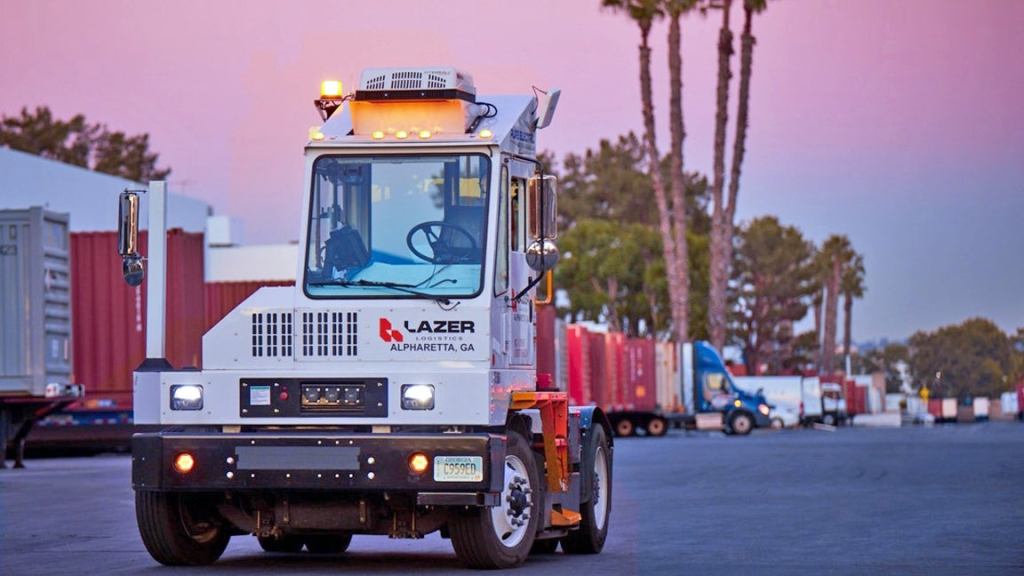
A Lazer Logistics terminal tractor

Yard management provider Lazer Logistics announced Wednesday it added new workflow management software in its latest acquisition.

Last week, the company announced the acquisition of refrigerated carrier Hirschbach Motor Lines’ spotting division. In addition to adding 45 locations and increasing its electric terminal tractor fleet by 20%, it added Spotlight YMS (yard management software), which provides real-time visibility into yard operations.

Spotlight is expected to improve the efficiency of yard operations by integrating the gate and dock management functions. Lazer expects to be able to rapidly dispatch drivers and trailers across its network of more than 620 facilities while also managing workflows at its gates and on its docks.

“As yards become increasingly complex due to higher rates of utilization and product velocity, our customers require more flexibility to rapidly scale up their operations to meet peaks in throughput,” said Lazer Logistics CEO Adam Newsome.

Atlanta-based Lazer Logistics is the largest outsourced end-to-end yard management provider in North America. It has more than 6,000 employees and a fleet of over 9,800 assets. Lazer provides a full suite of spotting, shuttling, drayage, gate management and trailer rental services.

The company was acquired in March by EQT Infrastructure.

“Our clients have varying technological needs; some want real-time visibility in the yard, while others want daily or weekly performance and efficiency insights,” Newsome said. “Spotlight will be integrated with our current offerings to provide this range of flexible capabilities.”

More FreightWaves articles by Todd Maiden

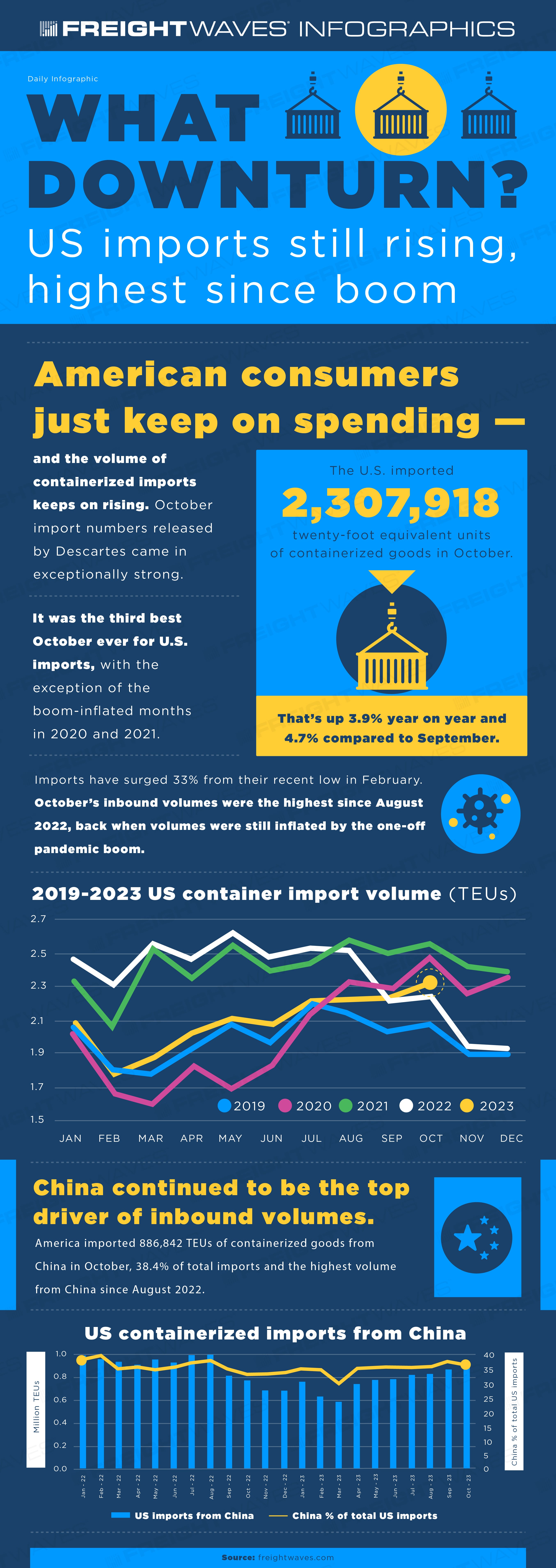
Daily Infographic: What downturn? US imports still rising, highest since boom


To view more FreightWaves infographics, click here

AIT launches expedited LTL offering

Supply chain provider AIT Worldwide Logistics has thrown its hat into the U.S. expedited LTL ring.

The privately held Itasca, Illinois-based company said Tuesday it has launched a middle-mile transportation service operating on more than 160 lanes and supported by hubs in international gateway cities like Atlanta, Chicago, Columbus, Ohio, Dallas and Los Angeles.

The program, which is being touted as particularly beneficial for North American importers, has been in the works since 2021, AIT said. The program is aimed at enterprise shippers and not forwarders.

AIT will mostly use a group of about half a dozen carriers, though it will use its own vehicles for some deliveries. It wanted to roll out the program ahead of the holidays and before 2024, when it expects other non-asset-based competitors will be poised to launch similar services.

An example of the AIT service involves an international shipment cleared in Los Angeles and bound for Minneapolis. After clearance in Los Angeles, the shipment would be picked up and taken to AIT’s Los Angeles hub. There it would be routed to AIT’s middle-mile network for the trip to its Chicago hub. The shipment would then move to Minneapolis on one of three weekly truck routes. There, it would be routed to a cartage service for final delivery.

AIT becomes another player in a market segment dominated by Forward Air Corp. (NASDAQ: FWRD), which provides expedited linehaul between major markets bracketed by pickups and deliveries.

Forward Air’s new long-term targets don’t include Omni

An unidentified tractor pulling a Forward Air trailer in the desert

Forward Air announced new financial targets Tuesday and reiterated plans to primarily focus on the premium less-than-truckload market going forward. However, its new forecasts didn’t include freight forwarder Omni Logistics, which it made a bid to merge with in August.

Forward (NASDAQ: FWRD) is forecasting consolidated annual revenue of $2.5 billion by 2026 compared to just under $2 billion last year and implied guidance of $1.67 billion for 2023. That represents nearly a 15% compound annual growth rate over the three-year period from this year’s depressed level. Of that, 80% is expected to be generated by its LTL segment compared to an estimate for a 57% contribution this year.

Management has identified $15 billion in premium LTL opportunities, which include freight associated with events and trade shows as well as the transportation of high-priced medical equipment, both of which are areas of expertise for the expedited service provider. The company will now sell its services directly to shippers in addition to its legacy business, which markets service through freight forwarders.

The new forecast calls for LTL to see a sub-80% operating ratio, which compares favorably to the 85% OR the unit is operating at now.

Forward (NASDAQ: FWRD) also reiterated plans for a strategic review of its noncore business segments. Those plans could include divesting the units if they are found to not be fully supportive of its LTL operations.

Forward’s foray into direct selling was advanced in August when it announced it would merge with freight forwarder Omni in a $3.2 billion transaction. However, the deal quickly received backlash from shareholders and some customers.

Shareholders were able to temporarily block the transaction in a Tennessee court, saying their rights were violated when they weren’t given a vote on the deal. However, that restraining order was recently dissolved, allowing Forward to proceed with the closing. That’s when Forward said it may not close on the transaction, alleging Omni hadn’t performed certain pre-closing requirements.

“At this point, we do not feel there’s an obligation to close,” said Forward Chairman, President and CEO Tom Schmitt on Tuesday at Stephens 25th Annual Investment Conference in Nashville, Tennessee.

“We, over the last several weeks, feel very strongly that in the process of going through the transaction … as we went to credit rating agencies, as we went to the debt markets, that there was a breach by Omni in terms of providing information to us late or incomplete and we were put in a situation where we represented facts perhaps differently than we would have done if we had that information,” Schmitt explained.  

Omni, however, maintains it has complied with all pre-closing obligations.

Omni filed a lawsuit at the end of October asking a Delaware court to force Forward to carry through with the planned merger between the two companies. It said Forward is trying to exit the deal after receiving pushback from shareholders that have publicly criticized the price tag and the amount of debt Forward will take on to fund it.

Shares of FWRD gapped more than 40% lower in the days that followed the deal announcement.

Omni said in the court filing that Forward has misrepresented an exchange of information between the parties as a breach of the merger agreement.

Omni claims it provided Forward with fourth-quarter projections as requested, but that Forward failed to provide any guidance on how to divide expected deal synergies the merger would produce. It said Forward is using a “what if” scenario against it, claiming the forecasts are “substantially lower than what Omni had reaffirmed at due diligence meetings.”

On Friday, Forward filed a counterclaim against Omni and asked a Delaware court to let it out of the deal.

The transaction faces challenges on two fronts. Shareholders are still attempting to block the deal in a Tennessee court and a Jan. 19 court date has been set in Delaware regarding the dispute with Omni.

No update was provided Tuesday regarding deal-related expenses Forward is incurring.

A previous court filing showed Forward was paying net interest expense of $100,694 per day as it closed on a $725 million notes issuance in early October. It was also paying $70,313 daily to retain lender commitments for a $1.125 billion term loan facility. However, the ticking fees to retain those lenders were set to increase to $309,586 per day after Nov. 23.   

Schmitt said even with the “anxiety” the proposed transaction has caused, its domestic forwarders are shipping more freight with it today than they were prior to the announcement. He also said Omni has become Forward’s largest LTL customer over the last several months and remains so today.

“We are going after the high-value LTL market with or without Omni,” Schmitt said, adding that he expects Forward to have a commercial relationship with Omni regardless of the outcome.

Shares of FWRD were up 4.4% on Tuesday at 2:15 p.m. EST compared to the S&P 500, which was up 1.8%.

More FreightWaves articles by Todd Maiden