ATI cargo pilots give union power to call a strike

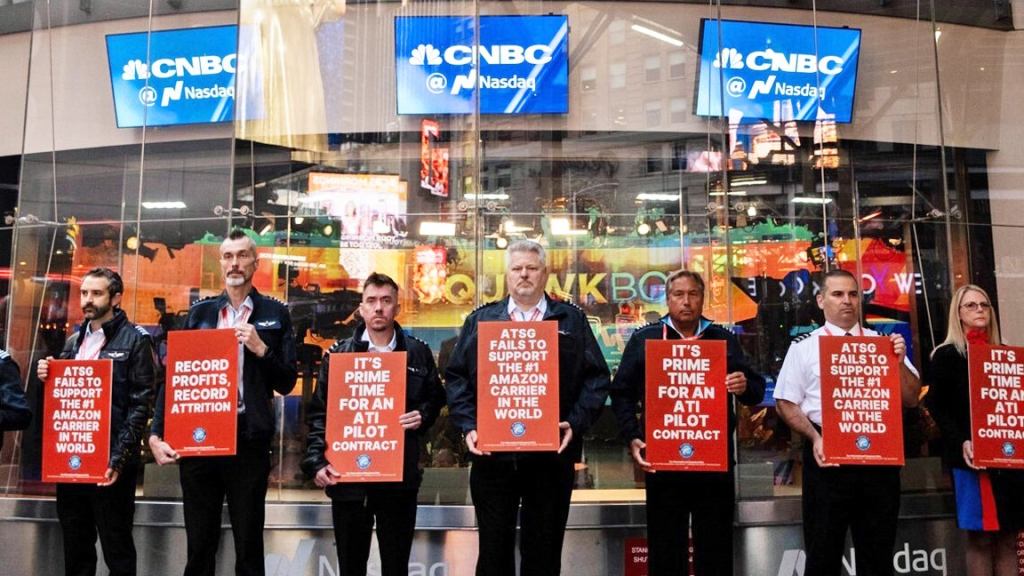
Pilots with red signs picketing outside the Nasdaq stock exchange.

Pilots at Air Transport International, a cargo airline owned by Air Transport Services Group that provides airlift to Amazon and DHL Express, have authorized union leaders to call a strike over stalled labor talks once such action becomes permissible under federal law.

The Air Line Pilots Association (ALPA) said Tuesday that 99.7% of union members voted in favor of strike authorization, with nearly all of Air Transport International’s (ATI) 540 pilots participating. 

Management and the union have been negotiating a new contract for 3.5 years and the talks are now being mediated by the U.S. government. 

A strike authorization is a signal to the company that the pilots are serious and ready to walk off the job, especially when it has overwhelming support. 

No labor action against the ATI is imminent. The company hauls packages for Amazon, provides supplemental airlift to UPS and supports U.S. military missions, in addition to offering charter service to logistics companies and other customers. 

Under federal rules designed to prevent work interruptions in critical interstate commerce, workers are prohibited from striking and companies from locking out workers until a lengthy series of bargaining steps, including federal mediation, are completed.

The federal mediator has the power to hold the parties in mediation indefinitely. Federal mediation has been underway since late March.

If no progress is made, the National Mediation Board (NMB) at some point may release the union to a 30-day cooling-off period, during which negotiations can still take place but no strike or lockout can occur.

If the NMB determines the parties have reached an impasse, it can propose that the remaining issues be sent to a special panel for binding arbitration. Arbitration in the airline industry is rare because both sides must agree to it. 

The law allows the president to create an emergency board to investigate a labor dispute and issue a report within 30 days if the parties reject binding arbitration. That is followed by another 30-day period to consider the board’s recommendations and reach an agreement. If no agreement is reached at the end of the cooling-off period, the parties may take action, such as a strike or lockout. 

Pilots are seeking a contract that improves pay, retirement and work rules. U.S. passenger airlines American, Delta, United and Hawaiian have agreed to new contracts that raise pilot pay as much as 35% to 40% over four years.

“Today, ATI pilots sent a clear, unified message to management that we are willing to go the distance to secure a new contract,” said Capt. Mike Sterling, chair of the ATI ALPA Master Executive Council. “Now is the time for ATI to deliver a new contract that reflects the value we bring to the airline as highly skilled professionals. Our goal is to reach an agreement, not to strike. The ball is in management’s court, and it’s time for them to get serious at the bargaining table and invest in our pilots.” 

ALPA claims 220 pilots, more than a third of the pilot base, have defected to other carriers for better work conditions so far this year. A quarter of the pilots left last year. In late September, it said ATI was unable to fill captain vacancies for the third consecutive month. Many passenger airlines are offering large signing bonuses to lure pilots from other employers. The attrition rate at ATI is far higher than at other airlines, according to ALPA.

“At the end of the day, you’ve got to have a contract that works for both sides. So if you’ve got the union side asking for FedEx or UPS wages or industry-leading, and that’s not in the cards from what we get from our customers, then that’s just not something we can agree to,” said Joe Hete, CEO of Air Transport Services Group (NASDAQ: ATSG), during last week’s earnings briefing. “So the key is finding a happy middle ground between their demands and our needs to keep things on the rails.”

Management said last summer that it doesn’t expect to reach a labor deal in 2023.

Hete was reinstated last week as CEO after ATSG’s board fired Rich Corrado because the company’s stock has underperformed the market and airline sectors for a long period of time. The company has taken lower revenues and profits this year, as has the rest of the industry, because demand has contracted from the heyday of the pandemic. 

Shareholders appear unable to benchmark ATSG against peers because it is not a pure cargo airline. The company is the largest lessor of freighter aircraft in the world and operates two cargo airlines that predominantly operate under long-term, fixed-price contracts for e-commerce and express delivery companies that require daily scheduled service. Other business units carry out aircraft maintenance, freighter conversions and airport logistical services.

ATSG reported third-quarter revenues increased 1% to $523 million year over year. Adjusted earnings before interest, taxes, depreciation and amortization were $137 million, 16% below the third quarter of 2022.

ATSG last year generated a record $2 billion in revenue and adjusted profits before accounting measures of $641 million, an 18% increase from 2021. The pilots made their demands before the industry realized the extent of the market downturn.

A new pilot contract is expected to increase costs at a time when the company’s income stream is declining. But attrition is also costly because ATI has to hire new pilots and train them for several months, during which time they are not flying aircraft that generate revenue. 

Click here for more FreightWaves stories by Eric Kulisch.

RECOMMENDED READING:

Cargo airlines throttle back on aircraft leases, ATSG says

Malaysian cargo airline Raya leases ATSG’s 1st Airbus freighters

3PLs get fresh legal win in fight to block liability in truck accidents

(Editor’s note: the original article has been supplemented with information about a request for Supreme Court certioari filed by the attorneys for Ying Ye in a case that deals with the question of broker liability).

A brokerage has once again been found not to be liable for a fatal accident, adding to a conflicting body of law that the legal industry hopes may eventually make its way to the Supreme Court.

And to add a twist to the case involving UPS (NYSE: UPS) subsidiary Coyote Logistics, the load in question was double brokered, and Coyote didn’t hire the carrier involved in the October 2020 wreck on Interstate 81 in Lackawanna County, Pennsylvania. Not only that, the decision by Judge Karoline Mehalchick in the U.S. District Court for the Middle District of Pennsylvania notes that Coyote didn’t even know about the accident until two weeks after it occurred.

The specific action taken by Mehalchick last week was to rule favorably on a request by Coyote for summary judgment to dismiss the plaintiffs’ charges against it in the case brought by the estates of the two people killed in the accident, Raven Lee and Anderson Bastone. The lawsuit against other defendants, including the two carriers involved in the double brokering, will continue.

The Lee/Bastone case adds to a body of decisions that mostly have favored the conclusion that the Federal Aviation Administration Authorization Act (F4A) precludes brokers from being held liable for injuries or death caused by a carrier they hired to deliver a load. But it isn’t unanimous; the Miller vs. C.H. Robinson case, which last year was denied review at the Supreme Court, held the giant 3PL liable for injuries suffered in an accident that involved a carrier hired by Robinson (NASDAQ: CHRW).

As Mehalchick wrote, “neither the Supreme Court nor the Third Circuit have addressed this specific issue of whether such claims against brokers are preempted by the FAAAA.” She added: “Federal district courts are sharply divided on how to apply these guiding principles.”

When the Supreme Court punted on reviewing Miller vs. Robinson, it left the 3PL legal industry looking for a trip back to the Supreme Court for another attempt to have the high court resolve the conflicting views of broker liability. A conflict in the Circuit Court decisions since then is what lawyers had hoped for, and the Ying Ye v. GlobalTranz Enterprises case, in which an appellate court found GlobalTranz not liable in a fatal accident, gave them one part of it. It is possible that the Coyote Logistics case now adds a second federal court decision that stands, with Ye, in opposition to the findings of Miller vs. Robinson.

Ironically, just a few days before the Coyote decision was handed down, attorneys for Ying Ye did file a request for certiorari with the Supreme Court. That now appears to be the best path for a SCOTUS review. Cases such as the Coyote case would need to first go through an appellate process before a request could for certiorari could be made. The Ye decision already was one that came out of the appellate division for the Seventh Circuit, which would mean the Supreme Court is next.

(Another could be the case involving Landstar and “a guy named James,” which didn’t involve death or injury but found that Landstar (NASDAQ: LSTR) did not have liability in the stolen cargo case.)

Todd Rubenstein of the law firm of Taylor Nelson, which has been involved in several other cases involving brokers and F4A preemption, said in an email that the court in the Coyote case “rightfully concluded that plaintiffs’ allegations strike at the heart of Coyote doing what Coyote does … being a freight broker. In other words, plaintiffs didn’t allege that Coyote failed to exercise reasonable care required by any other member of the general public, but rather, that Coyote was negligent in its actions specifically as a broker, as the one who arranged for the transportation of the freight.”

In the Coyote case, Michael Lee, representing the estates of the two people killed in the accident, sued Golf Transportation, which Coyote had booked to move the load of soup. The defendants in the suit also included JP Logistics, O’Connor Trucking, and food distributor UNFI and its subsidiary UNFI Transport. UNFI was the consignee that hired Coyote to move its load. JP Logistics owned the trailer that was being hauled by driver Greg Lesdowski on the night of the wreck. (JP Logistics also sought summary judgment to have itself removed from the case; that was denied.)

The judge’s decision extensively reproduces the terms of the contract between Coyote and Golf. One section of that contract prohibits Golf from double brokering the load.

But it happened anyway. The load was picked up by a driver named Victor Bordo, and as the judge writes in the recap of the brokerage path, “neither Golf nor (a Golf employee named Mark Myslek) know who Victor Bordo is.” Golf also said it didn’t know what carrier picked up the load.

But it was O’Connor Trucking that ultimately was supposed to deliver the cargo after a cross-country journey between Oregon and New York. Golf, according to the judge, did not know how it got delivered between those two points.

The recap of the case is a bit unclear on how the cargo picked up by Bordo eventually was transported in a truck driven by Lesdowski. He was behind the wheel when it collided with a car carrying the two people who died, with the driver— according to a separate document —found to have been under the influence of marijuana. (A recap of the crash in the original complaint portays an incident in which both the truck and the car were changing lanes in proximity to each other, and the car eventually ended up under the truck.)

The heart of the federalism argument about F4A is that any state regulation that could impact a “price, route or service” of trucking — that term taken directly from the 1994 law — is preempted by F4A unless it falls under what is known as the “safety exemption.” That part of F4A holds that state regulations regarding safety and liability are not necessarily precluded by the federal law.

Citing an earlier case known informally as Bedoya, Mehalchick said the plaintiffs’ claims were preempted by F4A “because imposing Pennsylvania’s common-law negligence liability upon Coyote would directly target and significantly impact the broker’s services.”

The focus on Coyote’s brokerage activities is “based entirely upon Coyote’s decision to select Golf as the motor carrier to transport the … load,” the judge wrote. “Plaintiffs’ claims have a significant impact on Coyote’s service with respect to the transportation of property because the claims seek to enforce a duty of care related to how Coyote, the broker, arranges for a motor carrier to transport shipments.”

Doing that would “require Coyote to perform additional services, such as hiring, retaining and supervising a qualified driver,” the court wrote. That would have “substantial financial consequence” for Coyote, and that would “hinder the objectives of the FAAAA.”

The court also rejected the claim by the plaintiffs that the safety exemption under F4A could be the basis for finding Coyote liable.

“A broker, by definition, may not provide motor vehicle transportation for compensation; only a motor carrier may perform that task,” Mehalchick wrote.

Given that the safety exemption involves motor vehicles, Coyote’s role in the supply chain means it has “no direct connection to motor vehicles,” shooting down the plaintiffs’ safety exemption claim.

More articles by John Kingston

Reliance’s Albrecht sees capacity disappearing from market at rapid pace

Uber Freight records tiny levels of improvement in Q3

Haslam family sues Berkshire over valuing of final chunk of Pilot

Teamsters unionizes some truck drivers at large US Postal Service fleet

New terminals at a major contractor of the U.S. Postal Service voted to unionize with the Teamsters union, according to a Thursday press release from the Teamsters.

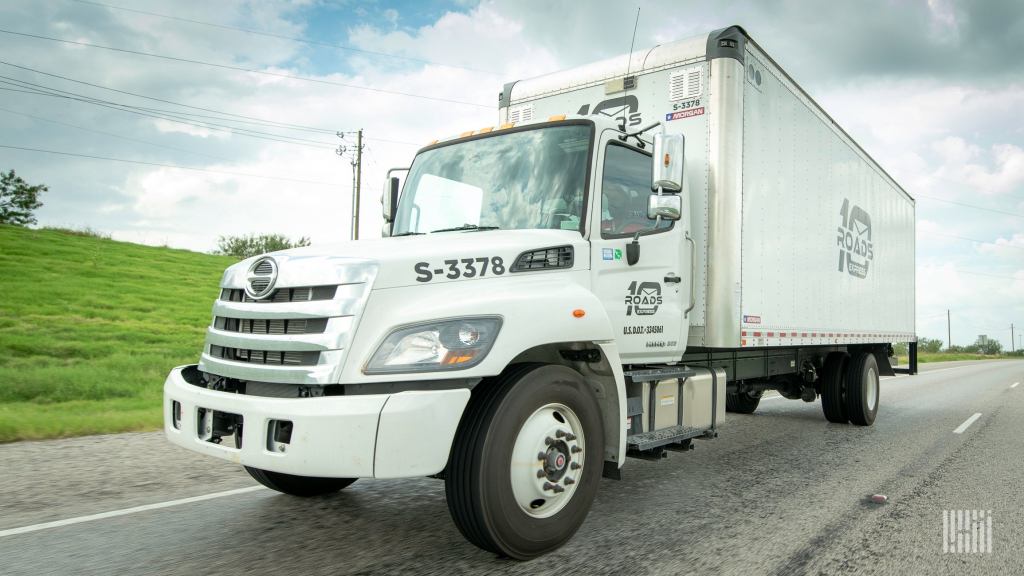
10 Roads Express, the trucking company, employs more than 4,400 truck drivers, according to SAFER Web. Thirty-six drivers at 10 Roads Express voted to join the Teamsters last week, according to the union; the drivers are based in Carter Lake and Council Bluffs, Iowa, as well as Omaha, Nebraska.

More than 30 truck drivers at 10 Roads Express, all based in Kansas, voted to join the Teamsters in June, according to the union.

A Teamsters spokesperson said the union represents some 300 employees at 10 Roads Express. Around 200 of them joined the union in the past two years.

10 Roads Express did not respond to a FreightWaves request for comment. Reached by the CCJ, 10 Roads Express declined to comment on the Teamsters’ organizing efforts in the fleet or why drivers decided to unionize. 

10 Roads Express was the second-largest contractor with the Postal Service in the 2022 fiscal year, according to a list of top Postal Service vendors from Culhane Meadows, a law firm that specializes in government contracting work. That year, the Postal Service awarded more than $700.4 million to 10 Roads Express.

Under Postmaster General Louis DeJoy, the Postal Service has diverted some of its over-the-road freight spending from its longtime trucking partners into the freight brokerage market, as FreightWaves reported in 2022. That pivot is expected to save the Postal Service cash, but it’s expected to squeeze carriers that have worked with the quasi-governmental agency for decades.

Large carriers like 10 Roads Express may be protected during this transition, as longtime parcel expert Satish Jindel told FreightWaves last year.

Meanwhile, trucking companies have seen drivers increasingly unionize this year amid a nationwide push for more labor organizing. Several dozen employees at a subsidiary of Werner, an Omaha-based trucking company, voted to unionize in August and September. Werner employs some 10,200 truck drivers.

Drivers at the Richmond, Virginia, terminal of Napa Transportation, a trucking company that employs nearly 400 drivers, voted to join the Teamsters in June.

Email rpremack@www.freightwaves.com with your thoughts. Subscribe to MODES for weekly trucking insights.

Check Call: November steals

people gathered around a desk of computers. Check Call news and analysis for 3pls and brokers
(Gif: Tenor)

It’s Q4 and cargo theft is on the rise. It’s a down market and end of the year, and cargo thefts typically rise this time of year. However, this year CargoNet saw a 59% increase year over year in thefts and pilferage in the U.S. and Canada during the third quarter. The top way goods were ending up in the wrong hands was through “shipment misdirection,” in which thieves were using stolen identities from truckers and freight brokers to get freight from the intended receiver. 

FreightWaves’ Mark Solomon’s article says, “Cargo theft, especially strategic thefts, is expected to continue at ‘unprecedented levels’ through year’s end, CargoNet said. … Throughout the year, strategic cargo theft rings have accelerated their efforts during holiday periods, and the upcoming holidays will be no different.”

Top targets are loads containing copper, brass, aluminum, licensed sports apparel and personal care and beauty products. It cannot be stated enough that driver safety is the No. 1 thing. Work with carrier partners to make sure drivers are practicing safe habits. No load is worth a driver’s life. And especially now closing out the year, it’s crucial to validate carriers’ insurance as it’s not a matter of if something happens, it’s a matter of when. 

(Image: ImgFlip)

Those who dabble in international freight or container shipping, I’ve got some bad news: The Panama Canal is still limiting the number of ships able to pass daily. There doesn’t seem to be an end in sight for when the canal will lift the restriction. The pain of the canal has been felt in the various sectors for a while, but the new industry that is feeling the effects is the grain market

The U.S. primarily exports grain via container ship. The main route from the U.S. Gulf travels through the Panama Canal to Asia. Due to the drought, exporters have had to look to alternative routes such as the Suez Canal. Ships now are leaving the U.S. Gulf Coast, traveling across the Atlantic Ocean, going through the Suez Canal in Egypt, through the Red Sea to come out in the Indian Ocean and then sail up to China. Since it is an arguably longer route, it adds about 10 days onto the journey and many more miles. 

For those shipping commodities via dry container, this situation is far from resolved as Panama still has restrictions and the escalation of conflicts near the Suez Canal could create additional problems with the Suez option. Here’s hoping Panama gets a lot of rain in the near future to bring some normalcy back to container shipping. 

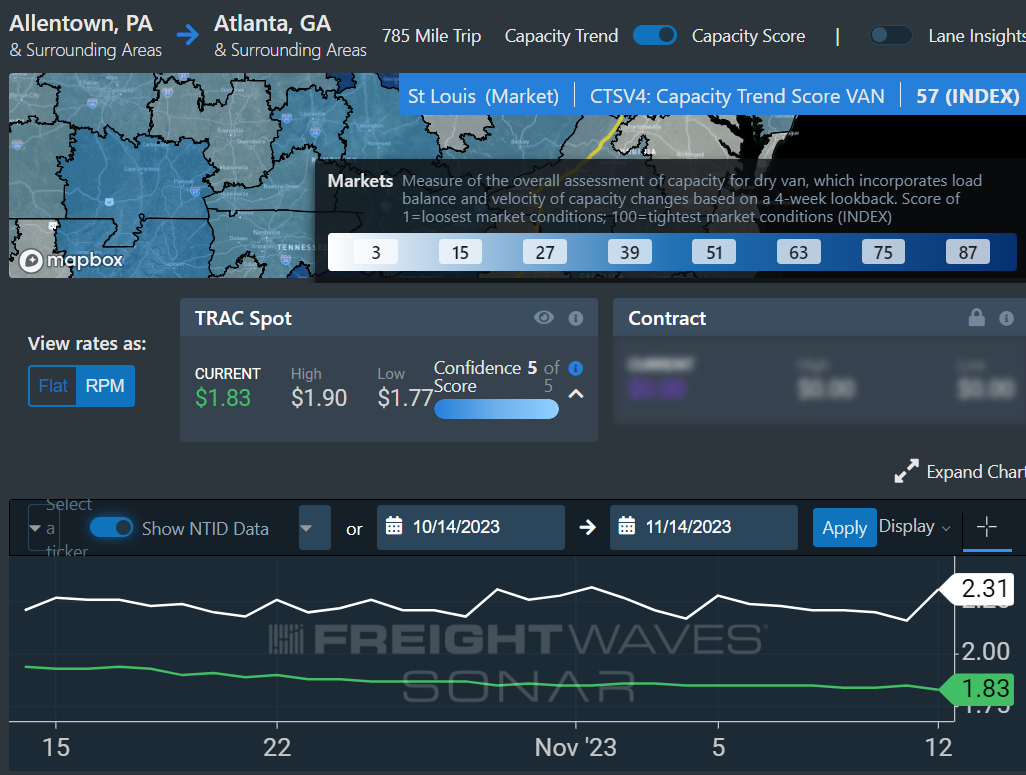
Trac Tuesday. This week’s TRAC lane of the week is from one top freight market to another, from Allentown, Pennsylvania, to Atlanta. The 785-mile trip comes in 48 cents cheaper than the National Truckload Index. Outbound tender volumes in Atlanta have risen 7.28% week over week. The same can’t be said for Allentown, as outbound tender rejections have dropped 3.14%. As a result of both markets rising and falling at close rates, that has pretty much brought spot rates to a standstill. The one good thing is that a carrier heading into either of these markets should have little issues getting out of the market. 

(Gif:GetYarn)

Who’s with whom? The U.S. government is with the truck drivers. That’s a sentence I never thought I’d type. However, two Democratic senators and a bipartisan team of two House representatives are pushing for a bill that would give truck drivers the right to overtime pay. Currently drivers aren’t subject to overtime pay as they are exempt from the 1938 law guaranteeing overtime pay to workers who work more than 40 hours a week. 

The bill has been proposed and it still has to go through committee review before potentially going for a vote in the House and the Senate. The industry is mixed about it. The Owner-Operator Independent Drivers Association, Teamsters union, Truck Safety Coalition and the Institute for Safer Trucking support the bill while the American Trucking Associations is against it on the grounds that it would throw the supply chain into chaos and increase impacts for inflation. 

FreightWaves’ Rachel Premack’s article says, “Studies suggest that increasing pay for truck drivers reduces crash count. Reducing uncompensated work, like the hours that drivers often spend unpaid waiting at warehouses to get loaded or unloaded, also is a boon for safety and overall supply chain efficiency, studies suggest.”

The more you know

Fillogic closes $13M Series A, grabs third spot on FreightTech 25

Daily Infographic: US holiday spending to climb 3%-4% over 2022, NRF predicts

Diminished inventories may boost holiday expediting

Lawyers will square off on California trucking’s latest AB5 exemption request 

Trucks and teen motorists a dangerous mix, NTSB panelists say

See you on the internet.

MaryJoin the community in freight and subscribe for more at www.freightwaves.com/subscribe.

New logistics terminal opens along Texas Gulf Coast

Project freight forwarder deugro announced it has opened a 96,775-square-foot operations and logistics terminal in Baytown, Texas, about 26 miles east of Houston.

The facility offers access to the nearby Houston Ship Channel, as well as commercial ports in Houston and Galveston, according to Jeff Smith, deugro USA’s global head of supply chain logistics.

“Adjacent to Port Houston, deugro is starting a new chapter of growth and prosperity — providing seamless logistics solutions, climate-controlled warehousing, and customized packing and crating in the operational environment of a true project freight forwarder,” Smith said in a news release

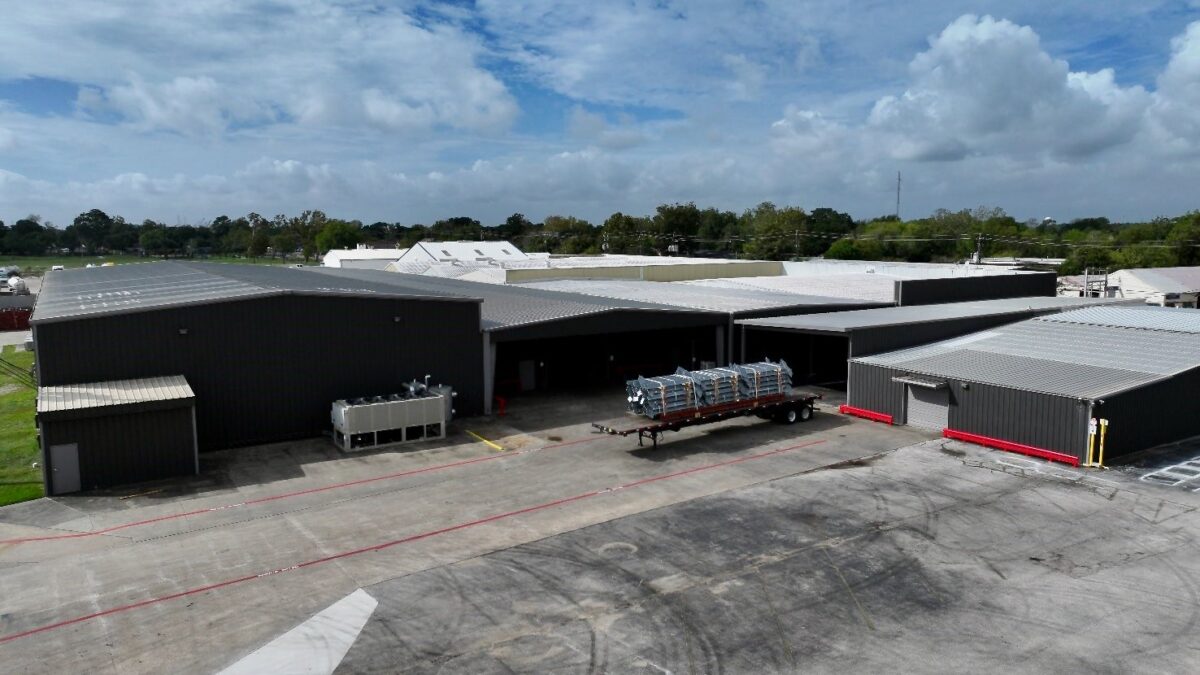
duegro’s Baytown logistics facility offers shippers out-of-the box solutions for storing industrial and oilfield services equipment. (Photo: deugro)

The terminal offers a range of long-term and short-term storage solutions — from palletized storage to bulk storage — designed to accommodate various needs, including out-of-the box solutions for storing industrial and oilfield services equipment, the company said. Full packing services are also available on site, including customized export crating, casing, container packing and unpacking, and cross-docking. 

The facility is equipped with two all-weather container loading docks; an oversized door for cargo access; 14 grade level overhead doors; and a 7-acre outdoor secure hardstand area featuring six dock high truck wells.

Founded in 1924, the deugro organization is a specialized forwarder in the capital project and heavy-lift field. The Switzerland-based company has a network of more than 70 offices in over 40 countries, with about 3,000 global employees.

Port Houston’s monthly container flows slipped in September to 325,588 twenty-foot equivalent units, a year-over-year (y/y) decrease of 8% compared to the same period last year. 

Container volumes from January through September at Port Houston totaled 2.8 million TEUs, a 4% y/y decrease compared to the same period in 2022.

Click for more FreightWaves articles by Noi Mahoney.

More articles by Noi Mahoney

Mexico remains top US trade partner, Laredo No. 1 gateway

FreightWise acquires TMS provider Kuebix from Trimble

5 takeaways from XPO’s Brad Jacobs at Future of Freight Festival

STB gets earful on proposed rule for reciprocal switching

The Surface Transportation Board recently closed the comment period for rail stakeholders to file their thoughts on whether reciprocal switching should be considered as an option to address subpar rail service in the U.S.

And among the thousands of pages in filings to the board about the issue were dozens of suggestions and questions. How can regulators create a formula that can recognize when subpar rail service has occurred but can also account for unusual circumstances such as flooding? Should reciprocal switching be an option provided to all shippers, including those that ship commodities that have historically been exempt from regulations, such as crushed stone or scrap metal? And how could reciprocal switching affect collective bargaining agreements?

STB will be mulling over these questions over the next several weeks. Meanwhile, stakeholders’ responses to the filings will be due Dec. 6.

Reciprocal switching is a process that would grant a shipper with access to the network of another Class I railroad at an interchange, with the idea that the shipment would continue on the network of the competing Class I railroad because of lackluster service on the originating Class I railroad. 

The board first heard the calls to allow reciprocal switching in the U.S. 12 years ago when the National Industrial Transportation League brought the issue before the board in July 2012. 

Class I railroads respond to plan to establish a metric that could trigger a request for reciprocal switching

One theme weaved throughout the filings of the Class I railroad submissions was concern about what possible downsides could arise from creating a metric that measures when prescribed service levels drop for a certain stretch of time.

The Association of American Railroads “agrees that using service metrics to identify a potential service inadequacy worthy of further examination is an appropriate starting point” but has concerns about determining whether a situation warrants a reciprocal switching remedy.

“The goal should be to use metrics in the most effective way possible, so that the Proposed Rule is properly calibrated to draw attention to potential service inadequacies for which the remedy of a forced switch could potentially be appropriate and effective,” AAR said.

It said that “longer-term, severe service issues demand the Board’s intervention more than do transient, mild drops in performance. Similarly, lanes with unusually poor service levels are better candidates for the Board’s attention than those with service levels that may reflect only the inherent variability in railroad common carrier service levels.”

Canadian Pacific Kansas City (NYSE: CP) recommended that STB examine available data on actual rail service outcomes — including data that reflects high levels of service — and calibrate a metric that would be triggered only when situations truly warrant further examination. 

But CPKC also warned the board that reciprocal switching “might inadvertently incentivize opportunistic behavior by some shippers” and STB should ensure that its deployment doesn’t lead “to an inappropriate restructuring of the rail network.”

CPKC also said data-related obligations under the proposed rule could cause the railroads to invest substantial time and investment since the railway’s internal data isn’t set up to provide shipper- and commodity-specific lane-by-lane metrics. CPKC recommended that STB set up technical workshops to understand the data-related requirements. 

Eastern U.S. Class I railroad CSX (NASDAQ: CSX) also listed potential drawbacks to developing a model that could trigger a request for reciprocal switching, saying that a model that relies on dips below a predetermined service threshold over any 12-week period “is too mechanical and not a reliable way to identify actual service problems within a complex, interdependent rail network.”

Canadian railway CN (NYSE: CNI) said that the “proposed metrics, standing alone, cannot provide the needed context to evaluate service performance; rather, a more qualitative approach is needed to be consistent with the statutory requirements.”

Norfolk Southern (NYSE: NSC) said it “is under constant market pressure to improve its service product to meet its customers’ demands. Government imposition of a ‘serious remedy’ should be applied to only the narrowest set of cases where it can be shown that outcomes in unregulated markets are inconsistent with outcomes observed in competitive markets. Otherwise, the STB risks distorting markets rather than promoting them.” 

Instead of relying heavily on a model to gauge times when service levels drop, the board should also compel a shipper to provide evidence showing a potential rail service inadequacy and give testimony about how reciprocal switching could actually address the problems, CSX said. 

“The Board should require proponents of forced switching orders to demonstrate that the requested reciprocal switching would remedy the claimed service inadequacy. A service inadequacy cannot create a compelling need for forced switching if the forced switching would do nothing to resolve the inadequacy,” CSX said. “In the same vein, the current NPRM would allow a metric dip over any 12-week period of time to justify a forced switch — even months or years after the identified 12-week period. There can be no compelling need to force switching for a service inadequacy that has already been resolved.”

However, prior to STB ordering that a reciprocal switching remedy take place, the board should allow opportunities for the railroad and the shipper to address the situation, the railroads said.

STB should “encourage collaboration between railroads and their customers before prescribing  switching by establishing a brief 30-day pre-filing period during which the incumbent can work to cure any service deficiencies. It would be in the interest of all shippers — both the complaining shipper and those who might suffer the unintended market consequences of regulatory intervention — to achieve better service, if possible, without the burdens that regulatory litigation imposes on them, the railroads involved, and the Board,” BNSF (NYSE: BRK-B) said.

Shippers: Reciprocal switching is a good start but STB still needs to address promoting rail competition

As the railroads argued against a one-size-fits-all approach to examining what conditions prompt a response that calls for reciprocal switching, shippers generally argued that the proposed rulemaking is a good first step toward addressing rail service. However, some shippers also expressed disappointment that the proposed reciprocal switching rule didn’t fully address the question of whether there is lack of competition, which is what shippers say is the heart of the matter.

The American Chemistry Council (ACC) “stands firmly behind efforts to foster rail competition and believes the STB’s framework could provide significant relief when railroads fail to provide adequate service to their customers,” said Jeffrey Sloan, ACC senior director of regulatory and scientific affairs, in a Monday news release on behalf of ACC, The Fertilizer Institute and the National Industrial Transportation League. “However, the Board’s proposed standards are too limited, potentially leaving our members with substantial operational challenges before qualifying for competitive service.”

The three groups are calling for increasing the minimum standard for on-time deliveries from 60% to 70%; adopting a stronger standard for service consistency; instituting more stringent measures for local car delivery and pickup service; and setting a minimum of five years for the duration of a reciprocal switching prescription “to provide a sufficient incentive for alternate carriers to offer competitive service.”

Some shippers disagreed with how the current proposed rule gets triggered only after a shipper experiences subpar service. 

“A rail shipper would need to experience potentially devastating service for twelve weeks before they could even begin the process of seeking a reciprocal switching remedy. Poor rail service for just one week severely hurts operations and can even shut down a refinery or petrochemical facility, and rail shippers should not have to wait until service is unacceptable for a predetermined duration to have access to reciprocal switching,” Rob Benedict, AFPM vice president of petrochemicals and midstream for American Fuel & Petrochemical Manufacturers, said. 

Benedict said AFPM “strongly advocates for broader access to reciprocal switching based solely on lack of competition given the utter lack of competition in the rail market. This 2023 NPRM is built on the premise that when faced with the fear of increased competition in the form of alternative access or reciprocal switching, railroads will do whatever it takes to avoid that outcome. This premise is concerning and yet another reason why broader access to reciprocal switching is needed.”

Whether to include short lines and exempt commodities

Some stakeholders argued that reciprocal switching should also apply to short-line railroads.

“Limiting the availability of reciprocal switching prescriptions to those situations that only involve Class I rail carriers or their affiliated companies means that Class I railroads could limit access to what would otherwise be an effective interchange location under the STB’s proposed rule. Given the large number of Class III carriers that operate as handling carriers for the Class I railroads, this situation is not unique to NMA members and their shipments. The STB should expand its proposed rule to cover Class II and Class III carriers,” the National Mining Association said in its filing.

But the American Short Line and Regional Railroad Association (ASLRRA) said short-line railroads should not be included in the rule in part because of the potential for high compliance costs.

“While a Class I carrier could potentially absorb a relatively small reduction in overall revenues due to mandated reciprocal switching, short lines cannot. Unlike larger railroads, the costs of short line railroads cannot be spread over a vast rail system or large customer base. All the freight revenues generated by customers on a short line are vitally necessary to sustain the financial viability of that line. The light density operations, coupled with high infrastructure costs and fewer customers, would render the loss of revenue from any one customer as a result of imposed reciprocal switching is devastating,” ASLRRA said. 

NMA also called for expanding when and where STB can prescribe trackage rights in situations where the board is addressing local service issues. 

NMA “believes that a significant portion of rail customers are not located within defined terminal areas, and instead have facilities along main line routes of service or on branch lines. These shippers suffer from poor rail service just as much as customers located in defined terminal areas and may, in fact, suffer more. This is because many rail shippers located within terminal areas may have access to transload facilities adjacent to alternative railroads and could avail themselves to alternative rail services with minimal extra costs.” 

It noted that “in contrast, those shippers that are 50 to 100 miles from an alternative rail carrier cannot as easily reach transload facilities on other railroads. Therefore, the only way to remedy poor service in non-terminal areas is through access to another rail carrier via trackage rights on the incumbent railroad.”

The American Forest & Paper Association and the Institute of Scrap Recycling Industries were among the shippers of commodities that would be exempt from reciprocal switching but argued they also should have access to it. 

“Although such commodities may have been exempted for reasons related to competition, that rationale should not extend to this rule which is by contrast explicitly designed to address universally poor service,” said the Private Railcar Food and Beverage Association (PRFBA). “PRFBA members move such exempt commodities and are united in asserting that if their transportation is excluded from this rule, they will continue to experience the shoddy service this rule is meant to address.”

The Virginia Port Authority said reciprocal switching should be expanded to provide ports with an opportunity to address service deficiencies, including “port congestion and inefficiency … regardless of commodity exemptions or contracts.” The port authority recommended that port facilities served by only one Class I railroad should have access to rail performance data as well as to reciprocal switching itself. 

The Norfolk International Terminal at the Port of Virginia is serviced solely by Norfolk Southern, although CSX can move traffic to the terminal via the Norfolk and Portsmouth Belt Line Railroad, according to the port authority, while the Newport News Marine Terminal and the Richmond Marine Terminals are served solely by CSX. 

But CN argued in its filing that STB lacks authority to regulate contract traffic and exempt traffic, thus the reciprocal switching proposal wouldn’t apply to those situations.

“While it is true that the Board retains jurisdiction over exempt traffic, jurisdiction does not equate to having the authority to regulate. Rather, the agency and the courts have been clear that exempt traffic is not subject to regulation,” CN said.

Unions say STB should focus instead on defining common carrier obligation

While union groups in their filings were supportive of shippers’ rail service issues, that support stopped short of advocating that STB adopt the proposed reciprocal switching rule.

That’s because of concerns over how the rule might affect collective bargaining agreements. The unions are also concerned that allowing railroads to use their own employees to perform work on the lines of a railroad covered by a different contract could infringe on workers’ current rights and cause the railroads to provide service based on who pays the lowest wages versus who provides the best service, said Eddie Hall, president of the Brotherhood of Locomotive Engineers and Trainmen. 

Labor attorney Richard S. Edelman said the railroads may try to recoup any financial losses from reciprocal switching by shifting “some of those losses to their workers.”

“To the extent that an STB rule might require a railroad to act in a manner inconsistent [with] negotiated scope and seniority rules, that is highly problematic for the unions,” said Edelman, whose filing represented five rail unions. 

What STB could do instead is ensure all labor agreements and seniority rights are being upheld, as well as eliminate the provisions related to trackage rights so that the reciprocal switching is performed by the railroad owning the right of way where the customer is located, according to Jeremy Ferguson, president of the International Association of Sheet Metal, Air, Rail and Transportation Workers – Transportation Division. 

But since lack of rail competition and its effect on rail service are at the heart of why the board is looking at reciprocal switching as a potential solution, STB should focus on defining the common carrier obligation, union leaders said.

The common carrier obligation calls upon the railroads to provide rail service on a reasonable request. The federal statute came out of the Staggers Act of 1980, which deregulated the freight rail industry. Shippers — and some Democratic congressional leaders — have argued that revising the definition could help STB better address rail service issues.

“Enforcing a robust common carrier obligation, rather than relying on forced reciprocal switching agreements, would hold railroads collectively accountable for providing a higher quality of service and more effectively address many of the problems shippers continue to experience,” said Greg Regan, president of the Transportation Trades Department of the AFL-CIO.

Edelman said, “What is needed to remedy the service problems experienced by shippers under the new business model [of precision scheduled railroading] is [a] better definition of the common carrier obligation and better enforcement of that obligation; adoption of the proposed new regulations will not make a dent in those service problems.”

RELATED: Reaction to the STB clearing the way for reciprocal switching

Subscribe to FreightWaves’ e-newsletters and get the latest insights on freight right in your inbox.

Click here for more FreightWaves articles by Joanna Marsh.

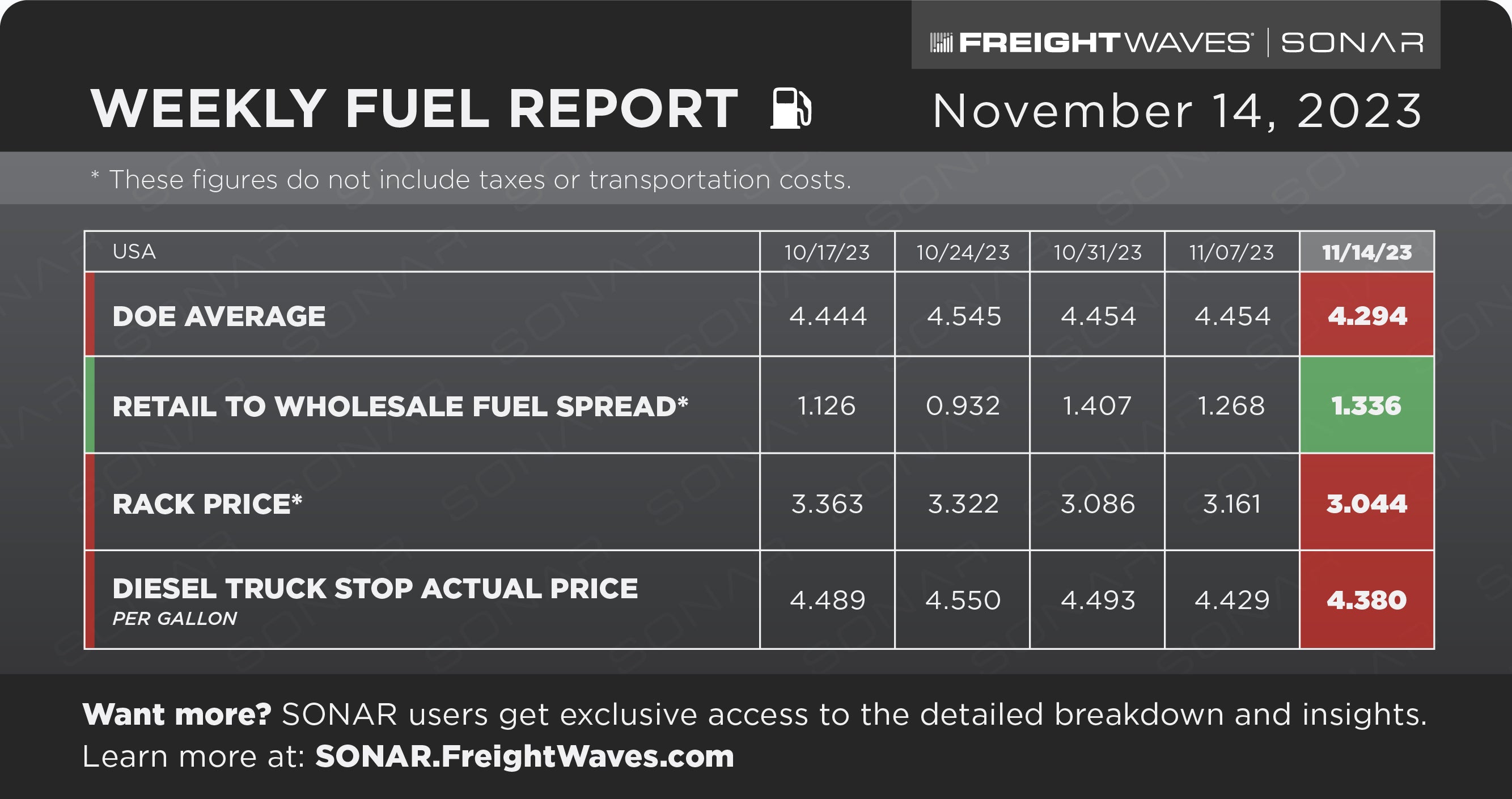
Weekly Fuel Report: November 14, 2023


Learn more at SONAR.FreightWaves.com

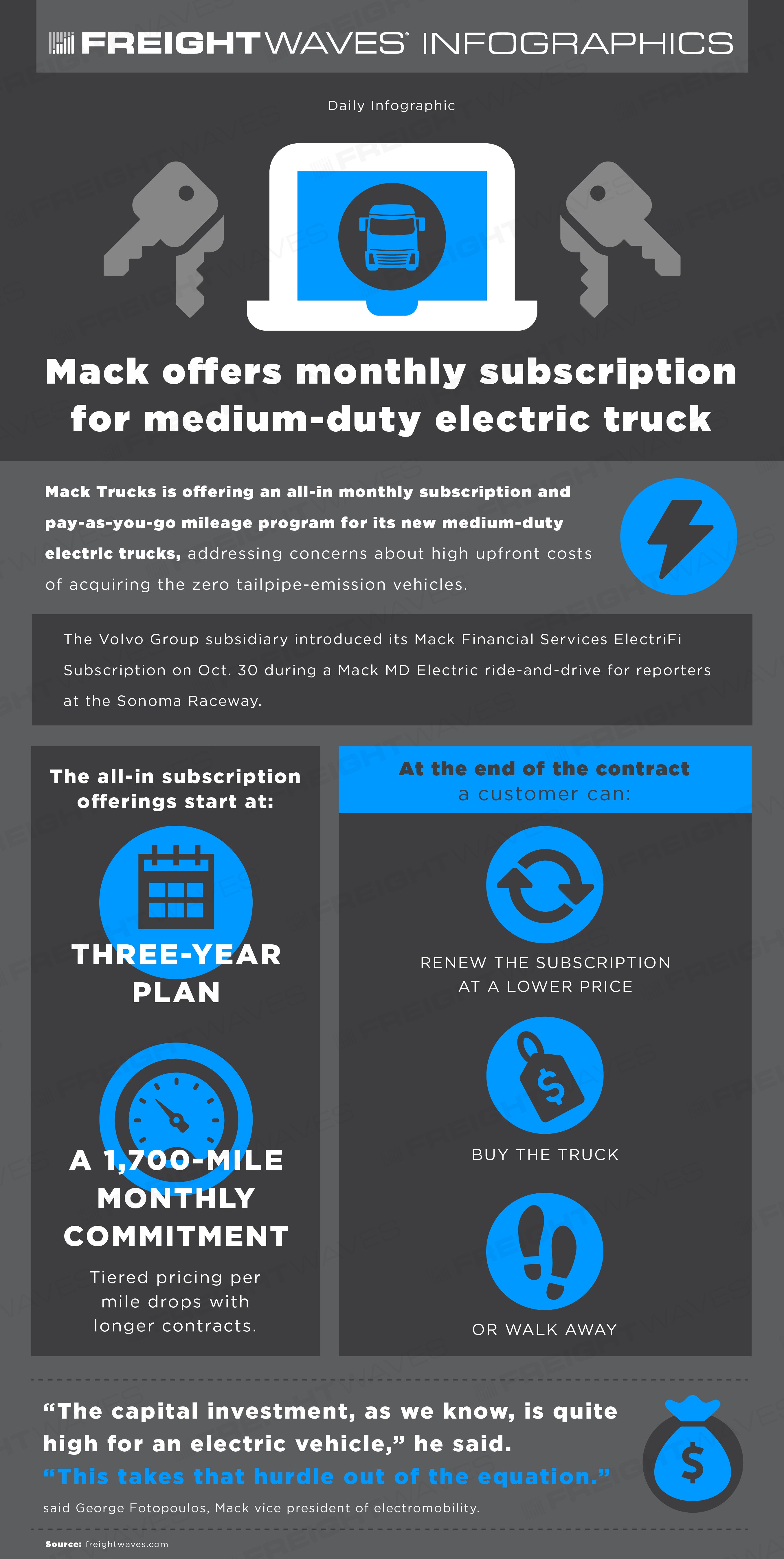
Daily Infographic: Mack offers monthly subscription for medium-duty electric truck


To view more FreightWaves infographics, click here

White Paper: Big Picture 2024 Supply Chain Outlook – Delivering resilience in adversity

Global supply chains have faced a decade of disruptions. In 2023, supply chains were impacted by a variety of natural disasters, financial failures, and operational difficulties. Supply chain activity has normalized in operational terms since the pandemic ended, but as we look at the industry outlook for 2024, there are significant risks across the industrial policy, labor action, and environmental policy implementation.


To download the full white paper and access the outlook for supply chains in 2024, complete the form below.

JB Hunt, BNSF and GMXT to launch Mexico-to-Midwest intermodal service

BNSF, J.B. Hunt Transport Services and Grupo Mexico’s Ferromex (GMXT) are launching an intermodal service that they say will slash a day off transit time between Monterrey in Mexico and Chicago and offer opportunities for customers to grow into expanding markets in Mexico.

The service will begin Jan. 1, 2024. Service will be offered between the Monterrey, Silao-Bajio and Pantaco-Mexico City regions and Chicago and the U.S. Midwest via the border gateway at Eagle Pass, Texas. The Dallas-Fort Worth area in Texas is also a potential interchange point with BNSF’s broader U.S. network, according to the map below.

Utilizing Eagle Pass will also serve as an alternative option to the gateway at El Paso, Texas. The El Paso gateway is also serviced by BNSF, as well as Union Pacific.

Here is how the three describe the service: Trains carrying intermodal containers from the U.S. will interchange at Eagle Pass with trains operated by GMXT. At the border, GMXT’s trains will take those containers to Monterrey, Silao-Bajio and Pantaco-Mexico City six days a week.

The new service comes just after BNSF (NYSE: BRK-B) and J.B. Hunt (NASDAQ: JBHT) announced last week at FreightWaves’ F3 event that they have launched Quantum, a premium intermodal offering designed to ensure improved delivery times with consistent service. Quantum will be run by employees from both companies at a new intermodal center at BNSF’s headquarters in Fort Worth, Texas. The customized offering will cut delivery times by one day from normal intermodal service. The shipments will be given priority drayage and rail positions to meet the time thresholds. The companies are informing customers to expect 95% on-time delivery.

Meanwhile, GMXT also has a partnership with BNSF rival Union Pacific and Canadian railway CN that seeks to bolster intermodal service between Mexico, the U.S. and Canada. And Canadian Pacific Kansas City said earlier this year that it is offering daily intermodal service between Chicago and San Luis Potosi and Monterrey in Mexico.

“Our organizations are committed to growth in Mexico and this joint service offering is a direct reflection of that commitment,” BNSF President and CEO Katie Farmer said in a Tuesday release. “By utilizing the capacity and expertise of the largest intermodal railroad in the U.S., the largest railroad in Mexico, and the largest domestic intermodal carrier, this product will seamlessly connect the North American intermodal network.”

The green-highlighted arrows show the origins and destinations of intermodal service that J.B. Hunt, BNSF and GMXT will offer starting Jan. 1. (Image: BNSF and J.B. Hunt)

“This new service offering will provide resilient, cross-border solutions that give our customers optionality to support their growing supply chain needs in Mexico,” J.B. Hunt CEO John Roberts said.

“GMXT is ready to support the freight demand growth that nearshoring presents with North America by providing flexible and top-notch rail services to our customers. Eagle Pass is a strategic gateway, and we are committed to connecting México and the U.S. through smart and secure borders while helping our countries facilitate the trade,” said the railway’s president, Fernando López.

Subscribe to FreightWaves’ e-newsletters and get the latest insights on freight right in your inbox.

Click here for more FreightWaves articles by Joanna Marsh.