As a record-setting drought throttles transits through the Panama Canal, most of the focus has been on higher-capacity ships: the container vessels, liquefied natural gas carriers and liquefied petroleum gas carriers that use the larger Neopanamax locks.
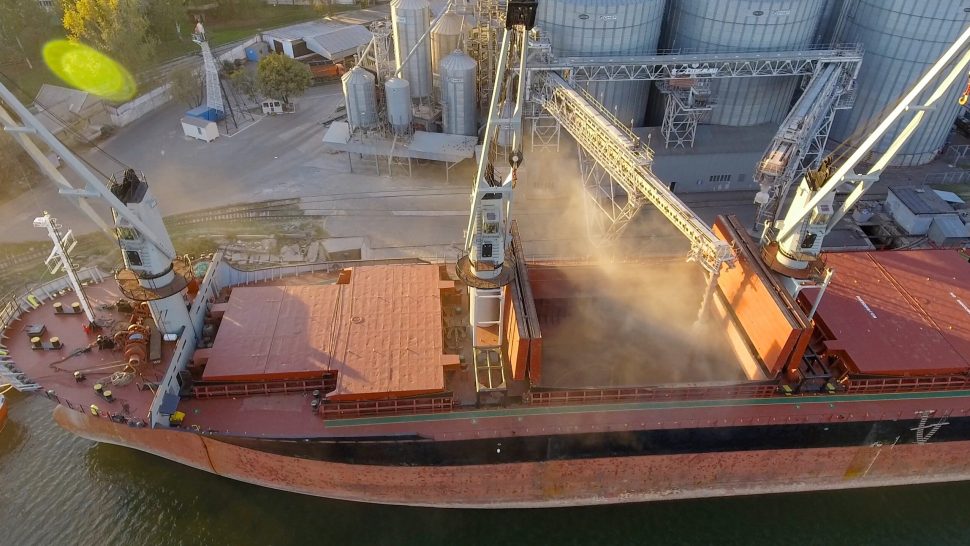
But there’s another shipping segment that’s seeing major fallout: the dry bulk vessels carrying U.S. grain that use the smaller Panamax locks.
Trade patterns have already seen a major shift, with the majority of these dry bulk vessels now opting for the longer route via the Suez Canal.
Bulker execs confirm new route
“Particularly for grain cargoes out of the U.S. Gulf to China and Asia, [the Panama Canal route] is the typical trade historically,” said Gary Vogel, CEO of Eagle Bulk (NYSE: EGLE), during a conference call last Friday. “We’re now routing our ships through the Suez, which adds about 10 days and is slightly more expensive in terms of canal dues.”
Peter Allen, CFO of Genco Shipping & Trading (NYSE: GNK), said during a conference call Thursday, “We are getting some help from the Panama Canal situation. Instead of going through the Panama Canal, ships are going through the Suez, which is extending ton-miles.” (Ton-miles is shipping demand measured in volume multiplied by distance.)
“It’s definitely meaningful,” said Vogel, who also noted that ballasting (sailing empty) to the U.S. Gulf from the Pacific side of South America is “a non-starter right now.” This has led to fewer vessels available to load American grain exports, pushing up freight rates.
“We have seen this just in the past week. We fixed one of our ships out of the U.S. Gulf at a rate of $32,000 per day for a trip to the Far East routed via the Suez.”
To put that in perspective, Clarksons Securities put average global spot rates for the ship sizes used by Eagle Bulk — Ultramaxes and Suezmaxes, with capacity of 45,000-65,000 deadweight tons (DWT) — at $12,400 per day last week, less than half the number cited by Vogel.
Suez now much more important to US agriculture
U.S. grain cargoes are carried aboard vessels of the Panamax size or smaller, with capacity of 90,000 DWT or less, as a result of terminal constraints in both the U.S. and Asia.
Ship-position data from MarineTraffic shows that the majority of dry bulk vessels loaded with U.S. cargoes in that size category are now taking the Suez route and avoiding the Panama Canal. (The data also includes bulkers carrying coal and other cargoes).

According to U.S. Department of Agriculture (USDA) data on loading inspections, 67% of year-to-date soybean, corn and wheat exports have loaded in the Atlantic Basin, with 56% loading in the U.S. Gulf.
The heightened importance of the Suez Canal to U.S. agriculture in the wake of Panama Canal restrictions raises another concern: The Suez Canal itself faces risks on the geopolitical front. The Suez Canal has been shut due to military action involving Israel twice before, in 1956 and in 1967-1975.
Polys Hajiouannou, CEO of Safe Bulkers (NYSE: SB), said during a conference call Wednesday: “There is a concern with the conflict. We don’t know how Egypt will react if there is an escalation, and if Egypt will take some steps to reduce the number of commercial ships passing through the Suez Canal. This is a question for the months to come.”
Any restrictions to Suez Canal transits due to an escalation of the Israel-Hamas war would lead to even more rerouting of U.S. agribulk exports, and even longer voyages via the Cape of Good Hope.
Lower US exports temper Panama Canal fallout
The Panama Canal water-level crisis would be having a greater effect on U.S. farm exports if outbound volumes were higher.
Canal restrictions are coinciding with a period of reduced American exports, due to both lower crop production and low water levels in the Mississippi River.
USDA data on inspections of agribulk export cargoes shows year-to-date volumes through early November down 22% versus the same period in 2022 and 27% versus the same period in 2021.

Inspections of wheat exports collapsed in the week ending Nov. 2 to just 71,608 metric tons, the lowest reading in 20 years, which Bloomberg attributed to drought conditions drying up the Mississippi.
The focus ahead will turn to soybeans. U.S agribulk exports seasonally spike in November to January, driven by soybean cargoes.

Here too, Panama Canal fallout is expected to be alleviated by reduced volumes.
The USDA recently lowered its forecast for U.S. soybean exports in the 2023-2024 marketing year (starting Sept. 1) to 47.8 million tons, down 12% from 2022-2023 and 18% from 2021-2022.
“U.S. soybean exports, which usually dominate the fourth quarter, will remain weak this year due to a lower harvest,” said shipping consultancy Drewry in a report published Tuesday. As a result, Drewry predicted that the upside in dry bulk freight rates due to diversions through the Suez “will be capped.”
Click for more articles by Greg Miller
Related articles:
- Shipping braces for impact as Panama Canal slashes capacity
- War in Israel: The new geopolitical flashpoint for ocean shipping
- Panama Canal restrictions are rerouting LPG shipping flows
- Shipping ‘traffic jam’ at Panama Canal: Why it’s not a crisis (yet)
- How war, shipping boom, China lockdowns impact Panama Canal
- How the Panama Canal traffic jam is affecting ocean shipping
- How Panama Canal navigated COVID, drought and trade war
- The Panama Connection: By truck and rail, not canal
Brokerage Compliance Symposium
The day before F3. Every compliance issue you face - fraud exposure, carrier liability, FMCSA rules, cargo theft, insurance gaps - navigated by attorneys and operators defining best practices in a changing industry.
F3 Awards Dinner
The night before F3. FreightTech100 companies honored. FreightTech 25 and Shipper of Choice winners revealed live. Cocktail reception into dinner and live music - 300 industry leaders in one purpose-built room.
F3: Future of Freight Festival
Industry-defining keynotes, rapid-fire technology demos, and industry leaders networking in experiences across Chattanooga - plus the inaugural F3 Awards Dinner featuring the FreightTech and Shipper of Choice reveals.
The day before F3. Every compliance issue you face - fraud exposure, carrier liability, FMCSA rules, cargo theft, insurance gaps - navigated by attorneys and operators defining best practices in a changing industry.
The Signal at Chattanooga Choo Choo • Chattanooga, TN Register NowThe night before F3. FreightTech100 companies honored. FreightTech 25 and Shipper of Choice winners revealed live. Cocktail reception into dinner and live music - 300 industry leaders in one purpose-built room.
The Signal at Chattanooga Choo Choo • Chattanooga, TN Register NowIndustry-defining keynotes, rapid-fire technology demos, and industry leaders networking in experiences across Chattanooga - plus the inaugural F3 Awards Dinner featuring the FreightTech and Shipper of Choice reveals.
The Signal at Chattanooga Choo Choo • Chattanooga, TN Register Now