How maritime workers challenged controversial omnibus bill in Congress

FreightWaves explores the archives of American Shipper’s nearly 70-year-old collection of shipping and maritime publications to showcase interesting freight stories of long ago.

In this week’s edition from the July 1980 issue, FreightWaves looks at a controversial bill that angered maritime workers.

Shipyard workers want to kill it all

Clearly dissatisfied with the final version of the maritime omnibus bill approved by the House Merchant Marine & Fisheries Committee, most industry and labor officials would rather go back to the drawing board on controversial promotional aspects of the legislation and move ahead with its more-or-less agreed-upon regulatory provisions during this session of Congress.

Nowhere was this feeling against the promotional aspects of the bill more evident than during the course of a mid-May two-day National Shipbuilders’ Conference, sponsored by the International Brotherhood of Boilermakers, Iron Ship Builders, Blacksmiths, Forgers & Helpers Union, held in Washington to stimulate opposition to the bill.

Indeed, speaker after speaker either voiced outright opposition to the bill or attacked its various provisions, especially those which would permit owners of foreign-built vessels to qualify (under certain conditions) for operating differential subsidy (ODS); allow the eventual phasing out of the essential trade route concept; and give the secretary of Commerce the right to disapprove ODS for vessels found to be overly manned or inefficiently operated.

Boilermakers’ president lashes out

The Boilermakers’ international president, Harold J. Buoy, led off the two-day session stressing the union’s opposition to the legislation. “I would be less than candid if I did not at this time express the steadfast opposition of the boilermakers to the bill. … For us boilermakers, one issue is central to all others — the bill, if enacted, will not build ships in U.S. yards.”

Citing the controversial reflagging provision, Buoy said, “The measure should be retitled the Foreign-Jobs Creation Act of 1980.”

The union leader indicated that problems concerning the bill are so severe that a compromise among various segments of the maritime community would be next to impossible.

“I could go on and on, but the defects of the omnibus bill are so severe and so well known that our primary challenge is the bill, if enacted, will not build ships in U.S. yards,” Buoy said.

MEBA hits

Speaking for Jesse M. Calhoon, president of the national Marine Engineers’ Beneficial Association (MEBA), David A. Leff, Joint Maritime Congress executive director, also lashed out at the bill, calling it “purposeless” since, in MEBA’s view, it is not an improvement over existing law.

Leff noted that the legislation is opposed by practically all segments of the maritime industry and is not supported by any economic analysis.

“The record has not been developed on detailed economic evidence,” Leff said. “Instead, the record is filled with self-serving statements.”

Calhoon’s spokesman said the Murphy committee failed to address the bill’s economic impact on the shipbuilding industry, on the U.S.-flag operators, and on the overall costs of the existing ODS program.

Leff charged that the legislation discards many “positive developments” put forth before the committee, such as full ODS and CDS parity. The MEBA spokesman also hit out at the proposed phasing out of the essential trade route system for liner operators, the reflagging provision, and allowing the secretary of Commerce to “invade the collective bargaining process” through a new manning-level review authority in connection with ODS applications.

Leff said MEBA is particularly disturbed over the bill’s expanded role for the secretary of Commerce in overseeing manning levels when determining ODS applications. The legislation would permit the Commerce secretary to deny the full ODS request — without a public hearing — upon determining excessive manning.

Under current law, the secretary of Commerce can deny ODS for crewmen over and above a certain number but does not have authority to deny the complete application. Under these conditions, subsidized lines can receive ODS and elect to pick up the tab for the extra crew members.

Leff said the bill would result in undue interference in the collective bargaining process, which is unparalleled in any other industry. Such an intrusion into labor-management bargaining, according to the MEBA spokesman, is clearly contrary to existing law and Supreme Court rulings.

“It’s a revolutionary idea. … It’s totally off the wall,” Leff said.

Brand: Bill developed in “punitive way”

Claiming that neither labor nor management were consulted before the bill was drafted, Transportation Institute president Herbert Brand said the legislation was developed in a rather punitive way.

“That is not the way you develop aggressive and progressive plans,” Brand said, indicating that private consultation is required in the developing stages of legislation. “The industry was called in to testify,” Brand noted, “but management cannot be as candid in public.”

Nemirow hinted possible policy change

Assistant Secretary of Commerce for Maritime Affairs Samuel B. Nemirow indicated the Carter administration might modify or drop its opposition to the reflagging provision of the bill in view of the various changes made by the Merchant Marine Committee, including amendments to require the replacement of foreign-built tonnage in U.S. shipyards and granting the secretary of Commerce authority to bar foreign building if such construction would seriously harm the U.S. shipyard mobilization base.

“The omnibus bill has been analyzed and evaluated in minute detail during some 30 days of committee hearings, in articles in the maritime press, and in public comments by interested parties, including the administration. Therefore, I do not want to engage in a rehash of the pros and cons of this very complex bill,” Nemirow said.

“However, I do want to reiterate the administration’s and MarAd’s opposition to one of the most controversial provisions, which is opposed by the labor and management segments of the American shipbuilding industry. I refer, of course, to the proposal which would permit foreign-built vessels and reflagged foreign vessels brought under U.S. registry to be eligible for ship operating subsidies.

“I testified before the committee that this provision would severely curtail shipbuilding opportunities for American yards and erode the shipyard mobilization base, which is essential for national defense. It also would contribute to unemployment and our balance of payments deficit.

“Since that time, numerous changes have been made, which appear to be designed to safeguard the interests of shipbuilders, and we are reviewing these changes at this time.”

Unless something is done to change the picture, Nemirow predicted a layoff of some 26,000 shipyard production workers during the next two years because of deliveries outpacing new orders. However, the unemployment slump, according to the assistant secretary, should bottom out by late 1982, when an upswing in U.S. shipbuilding is expected.

Between fiscal year 1980 and fiscal year 1985, Nemirow projected orders for 100-150 commercial vessels and 20 major conversions, with tankers and oceangoing dry bulk carriers leading the way.

Dry bulk package plugged

Nemirow put in a plug for the administration’s dry-bulk legislative package, which, he said, could mean well over 100 ships of various sizes. He also expressed hopes that the current controversy over the omnibus bill will not cause the administration’s dry-bulk program to be pigeonholed on Capitol Hill.

Rep. Lindy Boggs (D-La.), who co-chairs the Congressional Shipyard Coalition along with Rep. Paul Trible (R-Va.), said the Murphy committee should be given credit for bringing the industry’s problems to the attention of the public but indicated she could not fully support the bill since it failed to address all the problems of the industry. However, she called the legislation a product of a great deal of effort, noting it consumed thousands of hours of consultation.

Gibson Comments: Former MarAd administrator Andrew E. Gibson, now president of Delta Steamship Lines, voiced concern over the waning state of the U.S. merchant fleet, declaring that the “U.S. is the only trading nation that seeks to justify its merchant marine on purely economic grounds.”

Instead of continuing this policy, Gibson called on Congress and the administration to support full construction- and operating-subsidy parity.

Even Delta Lines, which he described as “one of the few lines operating at a very healthy profit,” within the next decade will have trouble replacing aging vessels without full CDS parity, Gibson said.

The bill, as reported out of the Merchant Marine & Fisheries Committee, retains a 50% CDS ceiling unless the secretary of Commerce determines that an increase is needed to sustain an adequate shipyard mobilization base.

Gibson said the trades between the U.S. and Latin America have generally “assured a reasonable share of goods for U.S.-flag carriers.”

JMC: “Needless repressive conditions”

Joint Maritime Congress (JMC) president Robert L. Leggett said wide-ranging opposition to the bill was due to “needless repressive conditions imposed by the House Merchant Marine Committee.”

Leggett, a former Congressman, said the opposition is deep-rooted and is not based upon cosmetic issues. Citing figures supplied by the Congressional Budget Office, the former Congressman and Merchant Marine Committee member, said the Congressional Budget Office statistics show that the legislation apparently would have no effect on ship trends or defense readiness if enacted.

Under a medium level of participation, the Budget Office projected the construction of zero ships in 1981, one vessel in 1982, two in both 1983 and 1984, and three in 1985.

“It is no wonder that industry and labor are totally unenthusiastic over the pending bill,” Leggett said. “If this pending bill is the program for the ’80s, it charts disaster — not a [defense] readiness program.”

Leggett called on the industry, labor, and Congress to go back to the drawing board on the legislation.

Later, the JMC president told American Shipper he doubted the Senate would consider such a confusing bill which lacks broad-based support.

Leggett expressed hopes that the Merchant Marine Committee will rewrite the promotional aspects of the legislation in the next congressional session and garner the united support of industry and labor. Otherwise, Leggett feared a bloodbath over the bill if it goes to the floor in its present form. “The fighting will give the industry a bad name,” Leggett warned.

Boilermakers’ Resolution: The Boilermakers wound up the two-day meeting by unanimously adopting a resolution calling on President Carter and the Congress to “recognize the precipitous and dangerous decline of U.S. naval and merchant marine capabilities and of U.S. shipbuilding and marine support industries, as they relate to the present global strategy decisions, and to make a firm, aggressive commitment of national talents and resources in an effort to reverse this trend so potentially perilous to U.S. survival as a free nation.”

“The resolution is only a piece of paper, but a very important piece of paper which groups can rally around to work for legislation to secure a strong merchant marine and naval force in this country,” Buoy said.

Although the resolution does not specifically mention the omnibus bill, Page Groton, who represents the union in Washington, told American Shipper he will lobby against the legislation.


FreightWaves bolsters SONAR TRAC with more data, flatbed spot rates

CHATTANOOGA, Tenn. — FreightWaves announced during its F3: Future of Freight Festival on Wednesday new SONAR features as well as data contributor growth for its Trusted Rate Assessment Consortium (TRAC), which provides daily transactional spot rate data.

“We’ve added seven new contributors and now we have several dozen contributors that represent the largest logistics service providers in the country,” Daniel Pickett, chief data and technology officer, told the audience in Chattanooga, Tennessee. 

With its additional contributor relationships, FreightWaves has built data partnerships with 30% of the top 100 brokers and 3PLs, adding to TRAC’s reliability and accuracy.

TRAC data also will be added to SONAR’s Supply Chain Intelligence (SCI) platform, enabling customers to leverage the data while managing their RFP processes. The TRAC Benchmarking tool will give customers a unique way to see how their businesses stack up against the industry.

Flatbed rates

FreightWaves SONAR has been collecting flatbed freight data since 2019, although the velocity of that data had not reached certain thresholds for analysis. 

Pickett on Wednesday confirmed that flatbed spot rate pricing, currently available to clients via an API connection, will soon be available in TRAC.

“You’ll be able to quote flatbeds to and from key market areas. … [Flatbed now pulls] the data density that we feel good about quoting and is accurate to the transaction level,” said Pickett. “This is a long time coming and we’re excited to get it out there, get feedback and ultimately hope that we have more companies who want to join the consortium, contribute their data and continue to make our data products superior.”


Kodif demos customer support automation platform at Innovation Alley

J.B. Hunt, BNSF launch premium intermodal service Quantum

Epstein lays out benefits — and morality — of fossil fuel use

Epstein lays out benefits — and morality — of fossil fuel use

CHATTANOOGA, Tennessee — To an audience full of people most of whose livelihoods are directly tied to economic activity that consumes diesel, Alex Epstein gave a full-throated defense of the continued and growing use of fossil fuels.

Epstein is an author and the president of the Center for Industrial Progress. His most recent book, “Fossil Future,” followed another in 2014 titled “The Moral Case for Fossil Fuels.”

Interviewed by FreightWaves CEO and founder Craig Fuller in a keynote address to the Future of Freight Festival, Epstein said, “If you care about human life on Earth, the basic fact is that fossil fuels are currently and I believe will remain a uniquely cost-effective source of energy and scale.”

He defined cost-effective as “affordable, and people can afford to use a lot of it, rely on that it’s available in the quantity needed, and it needs to be versatile.” He noted that “most machines in the world are not powered by electricity, they are powered by the direct burning of fossil fuels, because that’s the most cost-effective or sometimes the only way to do something.”

The move to other fuels “involve using solar and wind in the near future, and I think there’s no evidence that’s doable,” Epstein said.

He took aim briefly at California’s fleet regulations without specifically identifying the Advanced Clean Fleets rule or the Advanced Clean Trucks rule. Those rules call for zero-emission vehicles as the only ones acceptable in the state over a regulatory calendar that goes past 2040. They do not have leeway to permit lower-emission vehicles than diesel trucks, such as those powered by natural gas.

Epstein said particulate emissions from trucks are especially important in areas like those near the ports of Long Beach and Los Angeles. “You could do natural gas engines with a lot of these trucks pretty effectively,” Epstein said. “But California is saying no, we just demand battery trucks, even though they’re not as good and they don’t exist.”

That sort of stance, Epstein said, shows that the movement against fossil fuels is “not a scientific movement because the science is not pro-human.” A “pro-human” approach would look more at costs and benefits, Epstein said, “but instead they just dogmatically say we want to eliminate emissions at all costs, and we don’t even care whether it works. It’s just symbolism.”

The fact that fossil fuels have become unpopular is irrelevant, Epstein said, when weighed against the fact that “the vast majority of the world’s…people use less electricity than a typical American refrigerator.”

Although Epstein has been criticized as a “climate denier,” a term he rejects, he said climate impact is a “side effect” from fossil fuel consumption that needs to be factored into the equation. “But we at least need to first recognize the incredible and irreplaceable benefits to fossil fuels that if we lose them, we will ruin billions of lives in the near future,” Epstein said.

Epstein’s support of energy sources besides fossil fuels was mostly focused on nuclear power, which he said had been “criminalized” by climate activists. “I don’t think in 1,000 years we use fossil fuels,” he said. “I hope we have something way better and it will probably be a nuclear basis, because the best sources of energy are usually the densest.”

The nuclear industry needs to take a different approach in marketing itself as an energy alternative, according to Epstein. He described the current position as, “We’re not as dangerous as you think.”

“But if you say we’re the safest form of energy, then it really wakes people up,” he said. Epstein noted that his books’ titles offered up a positive case for fossil fuels. “Imagine if I had said in those books, ‘Fossil fuels aren’t as bad as you think,’” he joked.

More articles by John Kingston

Georgia extends fuel tax suspension again 

A flatbed commercial truck passes a sign that reads "Welcome to Gerogia"

Georgia Gov. Brian Kemp’s office said Wednesday that the state has extended its moratorium on diesel and gasoline taxes through Nov. 29.

The suspension of motor and locomotive fuel taxes, at 31.2 cents per gallon of gasoline and 35 cents per gallon of diesel, was set to expire Saturday. Kemp’s office said he wanted to provide fuel tax relief to drivers through the Thanksgiving holiday period.

Wednesday’s measure marks the third time since early summer that a fuel tax moratorium has been signed into law. 

According to AAA, the average diesel pump price in Georgia stands at $3.999 a gallon. That is down from $4.96 a gallon a year ago. The national average for diesel pump prices stands at $4.39 a gallon, according to AAA data.

Motor fuel taxes in Georgia are paid to the state by fuel distributors and not by local gas stations. The gap between when distributors pay for taxed fuel and when the fuel reaches the pump means that fuel prices will rise based on the fill-up point.

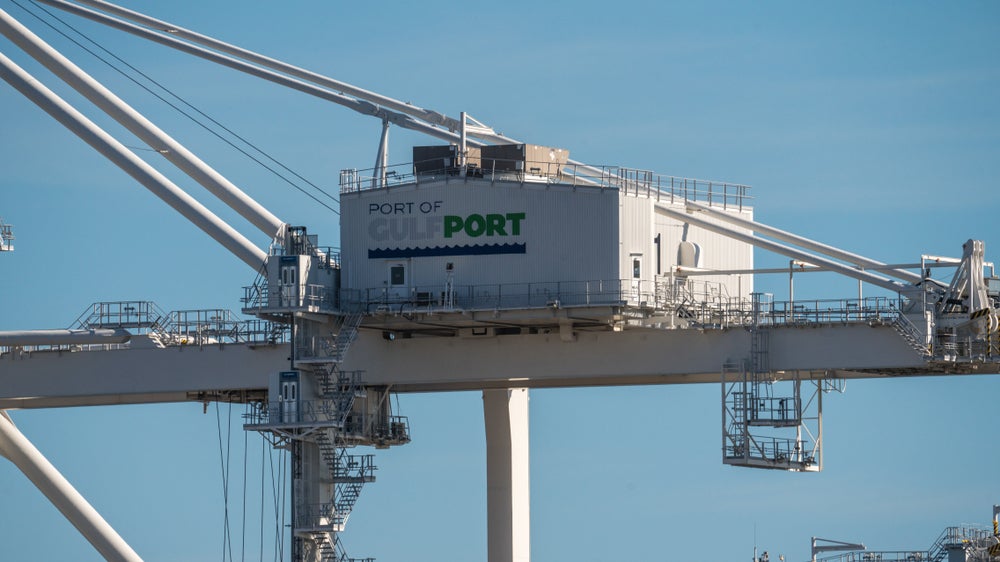
CN to offer intermodal service via Gulfport

CN, the Mississippi State Port of Authority at Gulfport and Ports America have signed a memorandum of understanding that will enable the Canadian railway to provide a new intermodal service at the Port of Gulfport.

A trial run of the new service “will launch in the coming weeks,” CN said Wednesday.

The new service comes as CN (NYSE: CNI) and other Class I railroads have been seeking to beef up their intermodal options amid efforts to take market share from trucks. J.B. Hunt Transport Services and BNSF Railway announced Tuesday the launch of Quantum, a premium intermodal offering ensuring improved delivery times with consistent service. CN also previously announced expanded intermodal service offerings, one with Union Pacific and Grupo Mexico and another with Norfolk Southern.

(RELATED: Will Class 1 railroads collaborate in order to take market share from trucks?)

The new intermodal offerings come following the April formation of Canadian Pacific Kansas City, itself a merger between smaller Class I railroads Canadian Pacific and Kansas City Southern.

According to the Mississippi Department of Transportation, the Port of Gulfport is currently serviced by CPKC. The port specializes in refrigerated and large container storage and shipments; break bulk shipments; foreign trade; warehousing for bulk, break bulk and containerized cargo; stuffing; stripping; and consolidation and deconsolidation needs.

The new service “will provide shippers with new Ocean connectivity options to move goods between the Gulf Coast, US Midwest and Canada. By working collaboratively with partners, CN will continue to maximize the use of its capacity in its southern network to accelerate sustainable, profitable growth,” Dan Bresolin, CN vice president of intermodal, said in the Wednesday news release. 

Ports America COO Rob Kusciel said, “This agreement is a great source of pride for us at Ports America. By leveraging CN’s incredible reach and network into different points in North America, we will be offering our customers direct access to new markets and opportunities for business. This represents a significant step forward in our commitment to delivering world-class service to our customers and creating value for our stakeholders.” 

Subscribe to FreightWaves’ e-newsletters and get the latest insights on freight right in your inbox.

Click here for more FreightWaves articles by Joanna Marsh.

GXO lowers full-year organic revenue estimates

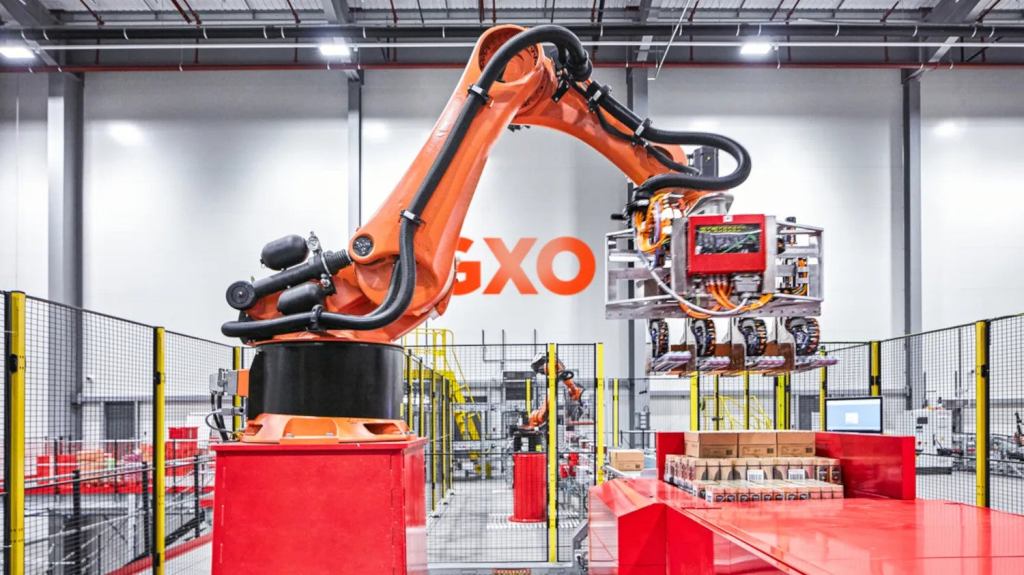
GXO robot arm in warehouse setting

Contract logistics provider GXO Logistics Inc. cut its full-year guidance for organic revenue growth as a weaker-than-expected peak season cut into top-line activity.

Despite that, Greenwich, Connecticut-based GXO (NYSE: GXO) beat Wall Street’s third-quarter forecasts by 3 cents a share with adjusted diluted earnings per share of 69 cents. The EPS figure beat the company’s own estimates by 4 cents per share. GXO posted adjusted diluted EPS of 75 cents per share in the third quarter of 2022.

Organic revenue growth for 2023 was revised to a range of 2% to 4%, down from 6% to 8%, the company said. Executives told analysts Wednesday morning — results were released late Tuesday — that the consumer market vertical is weak and will remain that way through the fourth quarter. Other verticals like information technology and food service are holding up relatively well.

CEO Malcolm Wilson said that GXOs continental European markets are “doing OK,” while its U.K. business is “at the bottom” of the currency cycle and the North American business is nearing a bottom.

GXO is not expecting a spike in seasonal warehouse activity this peak because inventories are well supplied and consumers remain cautious about their holiday spending, Wilson said.

Third-quarter revenue grew 8% year over year to a record $2.5 billion, while organic revenue rose 3%. Operating income grew 25% to $90 million, while adjusted net income fell to $82 million from $89 million.

The company said it has won $841 million in new business year to date. In the third quarter, the company won $181 million in new business, with nearly half coming from companies outsourcing their logistics operations for the first time.

GXO closed its $181 million acquisition of luxury goods fulfillment provider PFSweb on Oct. 23. The transaction puts GXO in new niche verticals. Company executives would not comment on any future M&A activity but said the PFSweb deal would serve as a template for future deals that it would like to pursue.

Near midday Wednesday on the New York Stock Exchange, GXO shares were trading 3.4% higher at $54.10.

Where does FreightTech go from here?

Not only is a soft freight market generating significant headwinds for tech companies that serve the transportation and logistics industry, but trends in capital markets are also working against FreightTech startups. Raising venture capital is harder, valuations are lower and the path to a successful exit is more difficult to navigate.

“The FreightTech funding environment will probably be in a lull for the next year — 2024 may still be a tough funding environment broadly,” said Chris Stallman, a partner at Fontinalis Partners, a Detroit-based venture capital firm focused on mobility with a portfolio that includes Chain.io, Elementum, FreightWaves, SmartKargo, Veho and Turo. Past portfolio companies that Fontinalis has exited include Lyft, Postmates, Nutonomy and Telogis.

In the second quarter of 2022, Federal Reserve Chairman Jerome Powell began sharply raising the federal funds rate, the cost for financial institutions to borrow money overnight, in an attempt to curb inflation, which was averaging 8% that year. Higher fed rates slowed down the flow of money across the economy, tightening credit conditions, raising bond yields and reducing asset prices. 

Venture capitalists are getting squeezed from both ends: The floor, the minimum return that their limited partners expect, is rising, while the valuations of late-stage companies are falling. Ten-year Treasury bonds are now yielding approximately 4.5%, which means that a venture capitalist who holds his or her LPs’ money for 10 years has to return 1.55x the initial investment just to clear the risk-free rate. In theory, that should force VCs out on the risk curve in order to deliver superior returns, but there are other factors militating against bullish sentiment.

For one, capital markets are pricing technology companies differently: They’re simply worth much less than they used to be. In the summer of 2021, median revenue multiples in the Bessemer Cloud Index were touching 18x, meaning that a typical publicly traded SaaS would enjoy a valuation 18 times its revenue. Those same multiples are now down between 5.5x and 6x. 

“Rising interest rates suck a lot of capital out of the system,” Stallman explained. “LPs become more risk averse, and that’s resulted in VCs becoming slightly more risk averse. We can’t take undue risks without a lot of upside, which translates into pricing rounds lower so that if they do achieve what they seek to achieve the returns are higher — this puts a lot of downward pressure on tech company valuations.”

So while venture capitalists’ portfolio investments have to perform better than ever just to outpace Treasury yields, the potential upside on the best-performing companies is being constrained by lower valuations. Identifying the right founding team and shepherding it to product market fit, growth and through multiple capital raises starts to look more like threading a needle than playing a high-risk, high-reward game of chance.

“In a zero interest rate environment, even if the company doesn’t figure it out, if they have even a semblance of [product market fit], they can raise their next round,” Stallman said. “In this tighter environment, they really really need to figure it out — they have to hit their objectives and targets. We see a financing risk that’s higher than it was in 2020 or 2021, because we know capital scarcity means their margin for error is so much lower.”

By “capital scarcity,” Stallman was referring to generally lower levels of venture funding on a global basis. According to Crunchbase, global VC funding reached $221 billion in the first three quarters of 2023, a 42% drop from the $381 billion deployed in the first three quarters of 2022. Late-stage deals have held up better than seed and angel rounds: Crunchbase reported 3,570 angel and seed rounds in Q3 2023, down from 5,917 in Q3 2022, while the count of late-stage and technology growth deals fell to 490 in Q3 2023 from 670 in Q3 2022 (although late-stage funding increased slightly from $39.2 billion in Q3 2022 to $42.9 billion in Q3 2023). 

“Our deal flow is off the charts right now because companies can no longer start a financing round on a Monday and get term sheets on a Friday,” Stallman explained. “Now they’re having to go out and talk to more groups; they’re not building quite as much early momentum in their processes. We’re seeing so many more companies out there in market because everyone’s talking to every investor.”

FreightTech in particular has lost a couple of key reference points that stimulated investment in digital freight brokerage: Convoy and Transfix. Convoy, valued at $3.7 billion as late as an April 2022 funding round, shut down its freight operations on Oct. 19. After it breached debt covenants, Hercules Capital took over in order to wind down the business, ultimately selling the technology platform to San Francisco-based digital freight forwarder Flexport for an undisclosed sum. Meanwhile, on the very same day, Transfix closed a $40 million Series F funding round that slashed its valuation by 60%, from $940 million to $376 million. 

The failure of those companies to deliver returns to their investors will have a chilling effect on funding for operationally intensive, low-margin marketplace businesses like digital freight brokerages. Many venture capitalists are momentum investors, chasing hot trends that look like they’ll pay off, if only by virtue of the fact that there are bigger, later-stage players looking to get in on the action too. But momentum can fade just as quickly as it builds, and after a couple of conspicuous flops in a sector like digital freight brokerage, appetite for similar companies can disappear.

“You’re always going to find venture investors playing a momentum story,” Stallman said. “In their early days, a number of businesses like digital freight marketplaces and digital 3PLs look like sexy disruptors and post very strong growth but many often mature into looking like the companies they’re disrupting, and at the end of the holding period they look like their comps, worth 2x revenue. Founders and VCs are learning a lot of this at the moment. A lot of venture is a psychology game: There’s so much anchoring that’s involved, a lot of investors are momentum players, and the second they feel momentum is no longer there, they become very risk averse and pull back.”

Stallman said that despite tighter monetary conditions and lower valuations, many funds still have significant dry powder. The market for Series A and B rounds isn’t great, he said, so larger funds are looking to get in earlier, even as early as pre-seed and seed stage, where the market hasn’t seen as much of a pullback.

“The earliest stages are still very active: Pre-seed rounds are $1 [million] to $2 million for any founder with credibility, seed is $4 [million] to $6 million, which pushes As to $10 [million] to $12 million when they do get done — this is still pushing a lot of dollars onto founders very early on,” Stallman said. “We see Y-Combinator companies raising millions just a few months into their journey; it’s great to have the capital to get the runway but it’s important to maintain some flexibility. Every investor is preaching efficiency and companies are taking a lot of action to reduce burn and lengthen runways, so we will hopefully be able to see companies hit product-market fit before they raise too much capital.”

For its part, Fontinalis is looking at digital infrastructure firms that can help supply chain participants fundamentally rebuild their tech stacks, which in many cases are becoming overloaded, clogged and clunky with too many point-solution tools and overlapping, shoddily connected architectures.

“In a first-wave moment you get these point solutions — visibility tools or process automation tools, and those tend to be point solutions,” Stallman explained. “You find that with a lot of point solutions, IT departments have procured a lot of stuff that doesn’t talk to each other. We back a few companies that are in API models or data interconnectivity models, things like that.

FreightTech saw a lot of tools come to market and now IT teams have to rebuild their tech stacks to work in a new way and rebuild foundations from scratch.”

Stallman remained confident that despite the harsher conditions for FreightTech startups, it’s a great time for him to identify and partner with great founders who need capital to fund their companies.

“I continue to be a big believer in FreightTech and think it will endure some bumps along the way,” Stallman said. “When the market cools down is when we find the founders that truly execute well. They’ll have a shining light on them: There may be a little more pain and a few more failures, but hopefully when we get to the other side the companies that navigate these conditions well will be at an advantage to their competitors.”

Ramp in transportation capacity slows in October, report says

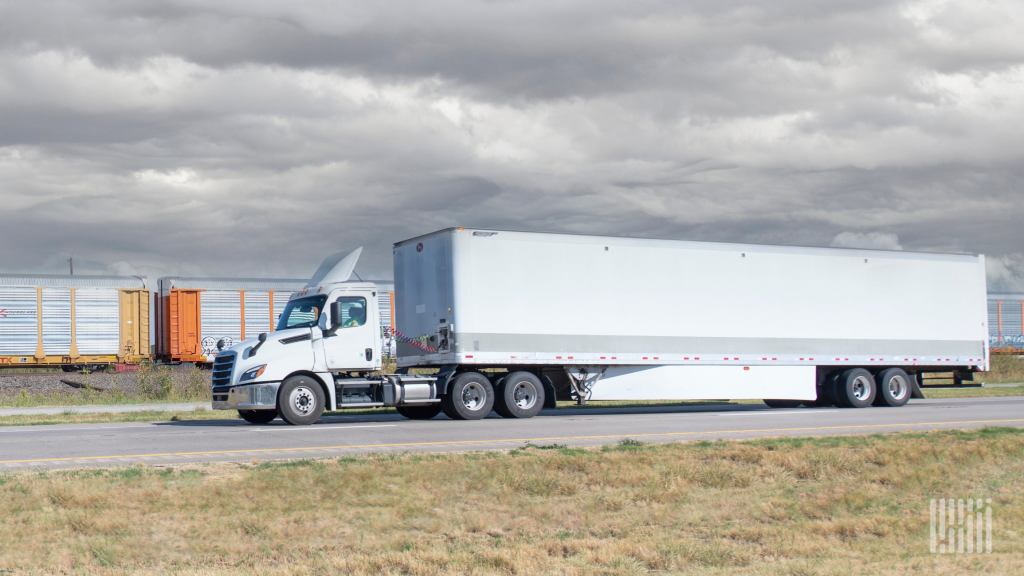
A white tractor-trailer on the highway near a train hauling cars

Transportation metrics were less bad in October, according to a survey of supply chain executives.

The Logistics Managers’ Index (LMI) report showed transportation capacity continued to expand and pricing continued to decline but at less severe rates. The data is compiled in a diffusion index where a reading above 50 indicates expansion while one below 50 signals contraction.

Transportation capacity (56.7) continued to increase in October but at a rate that was 7.6 percentage points lower than in September. The October reading was the slowest growth rate registered since March 2022. The capacity reading was just 52.3 in the back half of October compared to 60.6 at the beginning of the month.

Capacity utilization (60.7) was up 7.2 points from September and well above a 41.8 reading in July.

Transportation prices (44.4) declined for a 16th straight month, but the October level was nearly 1 point higher than the prior month. Downstream companies closer to the consumer like retailers actually reported growth in transportation rates, registering a 53.7 reading.

“The freight recession is by no means over,” the report said. “But with all three of our transportation metrics hitting their most encouraging readings in over a year, we may be taking steps in the right direction (something our respondents seem to reaffirm in their future predictions).”

When asked to forecast conditions one year out, respondents returned an inverted outlook. Future transportation capacity had a reading of 47.8, which was 6.1 points lower than the prior-month reading.

Transportation utilization is expected to be 65.2 a year from now, with pricing at 65.0.

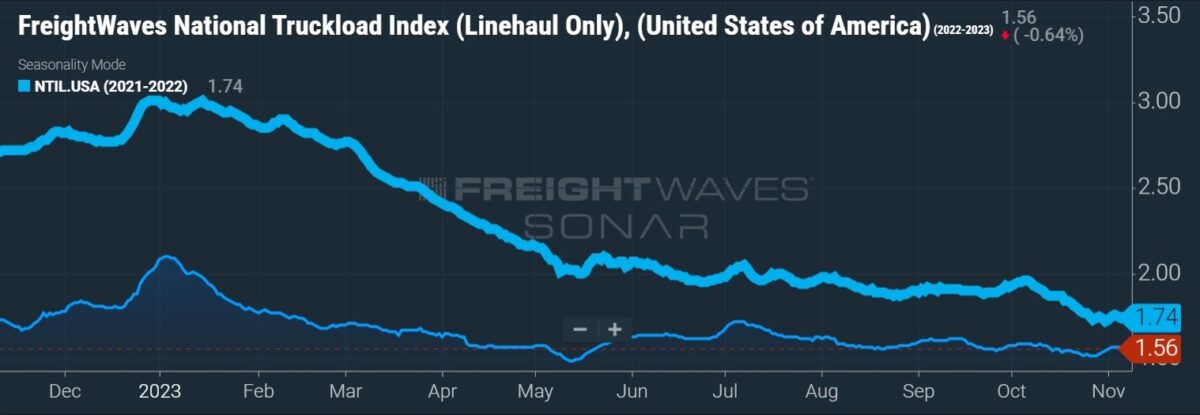
Chart: (SONAR: NTIL.USA). The National Truckload Index (linehaul only – NTIL) is based on an average of booked spot dry van loads from 250,000 lanes. The NTIL is a seven-day moving average of linehaul spot rates excluding fuel. Spot rates are currently 10% lower y/y.

The overall LMI was up 4.1 points to 56.5 during the month. October was the third straight month the growth rate increased but it remained below the all-time average of 62.8 for the 7-year-old index.

Inventory Levels (53.4) moved back into expansion territory following five months of contraction. Inventory levels grew 8.5 points faster for downstream respondents (59.3) than they did for upstream manufacturers and wholesalers.

“Whether increased inventories are temporary bursts of seasonal expansion or the sign of a larger move back towards stronger economic growth remains to be seen,” the report said. “What we can say however is that October’s inventory and overall index scores are a marked step forward for the logistics industry.”

The survey showed warehousing capacity (57) continued to expand but utilization (66.9) also continued to grow. Warehousing prices (70.7) were down slightly in the month but remained well into inflationary territory.

The LMI is a collaboration among Arizona State University, Colorado State University, Florida Atlantic, Rutgers University and the University of Nevada, Reno, conducted in conjunction with the Council of Supply Chain Management Professionals.

More FreightWaves articles by Todd Maiden

Efficiency in motion for trucks and trailers

The future of energy is precarious, with many energy analysts noting volatility and pressure to the upside of the energy and oil markets. These analysts are watching the price of diesel since its increase can have an inflationary effect on delivered goods, including food.

Future-looking analysts note that there will not be a “second shale revolution” and declining current reserves are not being replaced by current investments in oil and gas drilling, which could result in shortages in as little as a few years.

This revelation points to the importance of maximizing energy efficiency across all industries, including and especially the transportation sector.

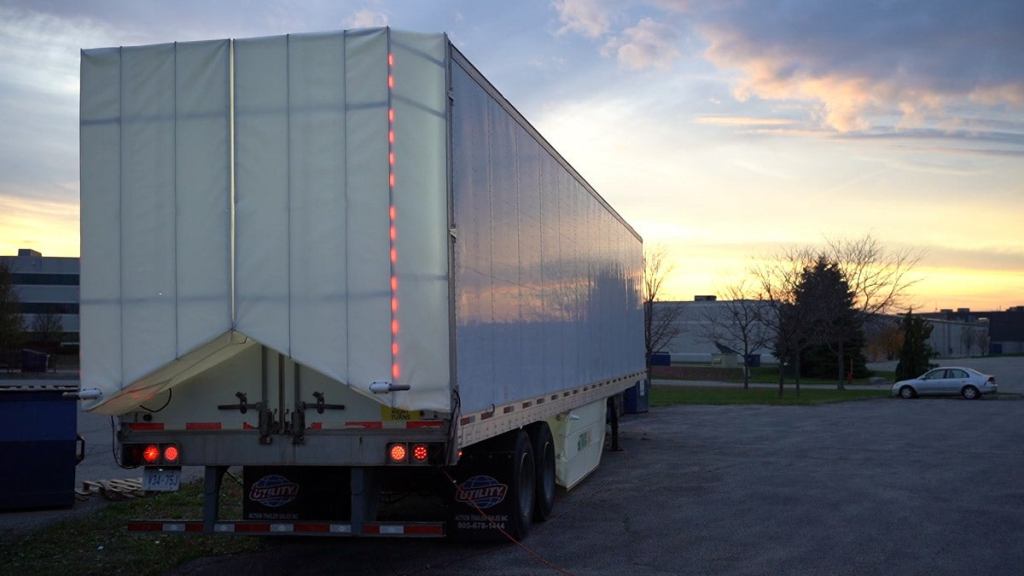
Truck Sail has set out to help trucking companies do just that by installing aerodynamic, drag-reducing devices on their trucks. This not only saves fuel costs, but also extends the working life of trucks and trailers through energy demand.

Truck Sail has patents for a 3D, ram-air pressurized design for three aerodynamic devices for transport trailers and straight trucks: boat tails, trailer skirts and gap fairings. 

In addition to these patents, Truck Sail boasts the manufacturing know-how to help transfer technology to purchasing corporations –  or to enable rapid manufacturing set-up for launch and scale-up.

Ultimately, these innovative devices have the power to change how the industry operates and transform the concept “Super Truck” into reality.

Resource conservation

Truck Sail’s suite of devices is designed to help fleets conserve valuable resources through a combination of increased fuel efficiency and extended equipment lifespans.

Currently, fully loaded trucks traveling at highway speeds use about half of their fuel supply to overcome air drag. For shorter and lighter trucks, that number climbs even higher. This contributes to both suppressed revenue and environmental challenges on a daily basis. Reducing fuel waste is crucial for fleets working to become more efficient and more sustainable.

According to Truck Sail’s wind tunnel and test track data, carriers can achieve fuel savings of 4.5% with the Truck Sail boat tail on a 53’ trailer and about 10%  on a straight truck. The company’s trailer skirts provide even more savings, coming in at 6% savings  on average, with an additional 4%  savings available via skirt extensions on 53’ trailers. 

Finally, the company said carriers should expect 1.5% to 4% in fuel savings for the gap fairing, depending on existing truck and trailer configuration.

By increasing fuel efficiency, Truck Sail’s devices also promote greater equipment longevity. This is because the working life of the tractor or straight truck relates directly to energy throughput over time.  

When a trailer is driving in crosswinds without an aerodynamic shape, the energy demands on the engine surge and contribute to earlier maintenance demands and a shorter equipment lifespan.

Trailers, on the other hand, are vulnerable to water damage and corrosion over time. Truck Sail’s trailer skirts and boat tails also promote longer trailer lifespans by covering vulnerable zones while streamlining airflow.

Road and street safety

Trucks are involved in thousands of serious or fatal accidents on an annual basis. As a result, trucking companies have been subject to an increasing number of nuclear verdicts in recent years. Many of these devastating crashes – and business-pending court cases – can be prevented through the use of advanced street safety measures.

Some of the most important measures for increasing street safety can be simple. Increased lighting around a truck’s rear wheel bogie could alert passenger vehicles, cyclists and pedestrians to its presence, instantly preventing potentially tragic accidents.

Truck Sail advocates for this type of safety lighting, whether it is conventional amber strips or a diffuse soft glow effect, made possible by the unique 3D enclosed design. Any amount of lighting can greatly enhance conspicuity at night.

From a more tech-oriented perspective, Truck Sail is also a proponent for utilizing – and protecting – advanced driver assistance systems.

Much like Truck Sail’s devices protect the trailer, these tools serve as protective housings for ADAS technology. Additionally, Truck Sail has demonstrated radar proximity safety sensors in their trailer skirts. These sensors can trigger both audio and visual cues, allowing them to warn the truck driver of approaching vehicles, cyclists, pedestrians and wildlife.

In addition to sensors, Truck Sail is developing a full-length, light-weight safety rail system to address the common side underride crash issue to help reduce collision fatalities and serious injuries.

Taken together, these safety features can contribute to enhanced road safety, which may be reflected in fewer insurance claims and, with continued use, reduced insurance costs.

Return on investment

Standout durability is one of the basic tenets of return on investment, and Truck Sail has worked hard to ensure its devices stand the test of time.

Automatic boat tails offer a myriad of benefits over more manual options. When a boat tail deploys automatically on the highway and retracts at slow speed, it is much easier to ensure that neither the boat tail nor the dock door is damaged when a trailer is parked near a wall or loading dock. 

Likewise, trailer skirts commonly encounter hump clearance impact over high railway tracks or docking ramps. Trailer skirt aerodynamic performance relates directly to height. Repeated passive flexing alters the shape and appearance of semi-rigid skirts, which then may flutter in cross winds. One solution to this size-shape-flutter compromise is a ram-air pressurized system that can be speed-automated to avoid clearance contact. While an automated system is expensive compared to formed plastic, the cost differential can be more than recovered through greater fuel economy alone.

The potential for high-impact advertising, back-lit by safety lighting, could also provide a future revenue stream. The idea of ads paying for technology in the virtual world is well established. This concept could be transferred to the physical world of trailers. Significant return on investment could be realized through this type of AdTech because there are multiple surfaces available for ad placement – including boat tails, trailer skirts and gap fairings. Some of the ad revenue could be returned to trucking companies to induce participation in the program and ensure that ads are maintained properly, including being kept clean.

Click here to learn more about Truck Sail.

Cincinnati voters approve sale of city-owned railroad to Norfolk Southern

Cincinnati voters decided on Election Day to allow their city to sell the Cincinnati Southern Railway to Norfolk Southern.

Tuesday’s vote was 51.56% in favor of the sale and 48.44% against the sale, according to Ballotpedia. By votes, those supporting the sale were 43,173 and those against the sale were 40,559 — a difference of 2,614.

The Cincinnati Southern Railway Board of Trustees owns the 382-mile railroad in a trust and leases it to NS (NYSE: NSC) for Cincinnati’s benefit. The city currently receives about $25 million annually from NS, according to a local news report in February.

The city announced in November 2022 that it was considering selling the railway to NS for $1.62 billion to help fund city infrastructure improvements, according to news reports. NS would pay for the transaction through a combination of internal and external sources, the railroad said last year.

Cincinnati has owned the land beneath the track for almost two centuries, but NS operates the rail line, according to NS.

In response to Tuesday’s note, NS spokesperson Tom Crosson said: “This is a victory for the citizens of Cincinnati. Current and future generations will reap the benefits of new infrastructure investments, helping to create a better future for the city. We appreciate all of the community leaders and groups who endorsed Issue 22 — especially Mayor Aftab Pureval, the City Council, and the Board of Trustees of the Cincinnati Southern Railway. We also thank the staff and volunteers who made this a successful campaign. Now, we will work with the city to finalize the sale, which we expect to close in Q1 of 2024.”

Subscribe to FreightWaves’ e-newsletters and get the latest insights on freight right in your inbox.

Click here for more FreightWaves articles by Joanna Marsh.