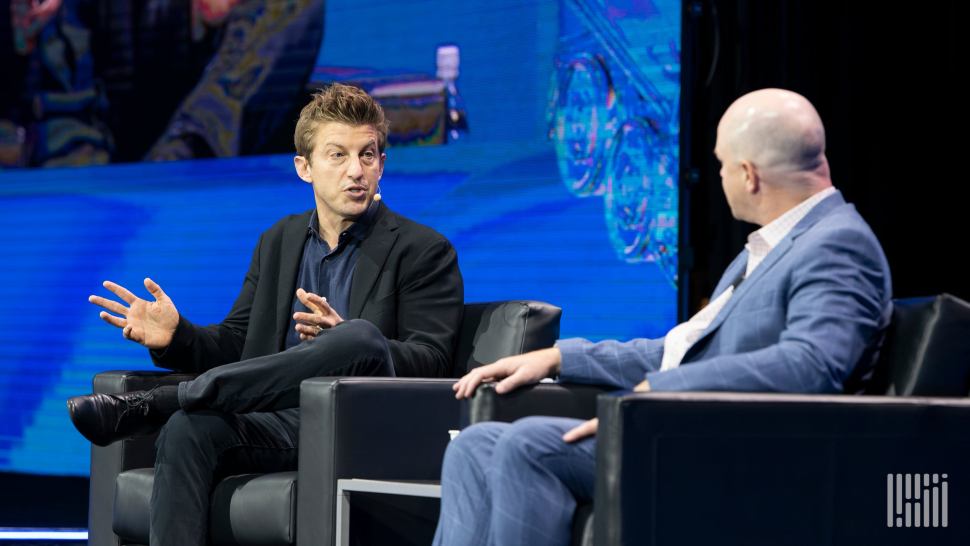
CHATTANOOGA, Tennessee — To an audience full of people most of whose livelihoods are directly tied to economic activity that consumes diesel, Alex Epstein gave a full-throated defense of the continued and growing use of fossil fuels.
Epstein is an author and the president of the Center for Industrial Progress. His most recent book, “Fossil Future,” followed another in 2014 titled “The Moral Case for Fossil Fuels.”
Interviewed by FreightWaves CEO and founder Craig Fuller in a keynote address to the Future of Freight Festival, Epstein said, “If you care about human life on Earth, the basic fact is that fossil fuels are currently and I believe will remain a uniquely cost-effective source of energy and scale.”
He defined cost-effective as “affordable, and people can afford to use a lot of it, rely on that it’s available in the quantity needed, and it needs to be versatile.” He noted that “most machines in the world are not powered by electricity, they are powered by the direct burning of fossil fuels, because that’s the most cost-effective or sometimes the only way to do something.”
The move to other fuels “involve using solar and wind in the near future, and I think there’s no evidence that’s doable,” Epstein said.
He took aim briefly at California’s fleet regulations without specifically identifying the Advanced Clean Fleets rule or the Advanced Clean Trucks rule. Those rules call for zero-emission vehicles as the only ones acceptable in the state over a regulatory calendar that goes past 2040. They do not have leeway to permit lower-emission vehicles than diesel trucks, such as those powered by natural gas.
Epstein said particulate emissions from trucks are especially important in areas like those near the ports of Long Beach and Los Angeles. “You could do natural gas engines with a lot of these trucks pretty effectively,” Epstein said. “But California is saying no, we just demand battery trucks, even though they’re not as good and they don’t exist.”
That sort of stance, Epstein said, shows that the movement against fossil fuels is “not a scientific movement because the science is not pro-human.” A “pro-human” approach would look more at costs and benefits, Epstein said, “but instead they just dogmatically say we want to eliminate emissions at all costs, and we don’t even care whether it works. It’s just symbolism.”
The fact that fossil fuels have become unpopular is irrelevant, Epstein said, when weighed against the fact that “the vast majority of the world’s…people use less electricity than a typical American refrigerator.”
Although Epstein has been criticized as a “climate denier,” a term he rejects, he said climate impact is a “side effect” from fossil fuel consumption that needs to be factored into the equation. “But we at least need to first recognize the incredible and irreplaceable benefits to fossil fuels that if we lose them, we will ruin billions of lives in the near future,” Epstein said.
Epstein’s support of energy sources besides fossil fuels was mostly focused on nuclear power, which he said had been “criminalized” by climate activists. “I don’t think in 1,000 years we use fossil fuels,” he said. “I hope we have something way better and it will probably be a nuclear basis, because the best sources of energy are usually the densest.”
The nuclear industry needs to take a different approach in marketing itself as an energy alternative, according to Epstein. He described the current position as, “We’re not as dangerous as you think.”
“But if you say we’re the safest form of energy, then it really wakes people up,” he said. Epstein noted that his books’ titles offered up a positive case for fossil fuels. “Imagine if I had said in those books, ‘Fossil fuels aren’t as bad as you think,’” he joked.
Brokerage Compliance Symposium
The day before F3. Every compliance issue you face - fraud exposure, carrier liability, FMCSA rules, cargo theft, insurance gaps - navigated by attorneys and operators defining best practices in a changing industry.
F3 Awards Dinner
The night before F3. FreightTech100 companies honored. FreightTech 25 and Shipper of Choice winners revealed live. Cocktail reception into dinner and live music - 300 industry leaders in one purpose-built room.
F3: Future of Freight Festival
Industry-defining keynotes, rapid-fire technology demos, and industry leaders networking in experiences across Chattanooga - plus the inaugural F3 Awards Dinner featuring the FreightTech and Shipper of Choice reveals.
The day before F3. Every compliance issue you face - fraud exposure, carrier liability, FMCSA rules, cargo theft, insurance gaps - navigated by attorneys and operators defining best practices in a changing industry.
The Signal at Chattanooga Choo Choo • Chattanooga, TN Register NowThe night before F3. FreightTech100 companies honored. FreightTech 25 and Shipper of Choice winners revealed live. Cocktail reception into dinner and live music - 300 industry leaders in one purpose-built room.
The Signal at Chattanooga Choo Choo • Chattanooga, TN Register NowIndustry-defining keynotes, rapid-fire technology demos, and industry leaders networking in experiences across Chattanooga - plus the inaugural F3 Awards Dinner featuring the FreightTech and Shipper of Choice reveals.
The Signal at Chattanooga Choo Choo • Chattanooga, TN Register Now