Iowa bank failure tied to bad trucking loans

As everyone in and associated with the trucking industry knows, most of the last two years have been very difficult ones for the industry. 

Trucking companies large and small have gone out of business. There are too many trucks chasing too little freight. Rates on most lanes are at or below 2019 levels — another bad year for the industry. 

In addition, brokerages have also been hurt. As widely reported by FreightWaves and other media, Convoy, a very high-profile brokerage, recently shut down for financial reasons. Other brokerages have also gone out of business, and layoffs have become relatively commonplace.

There are hiring freezes and other belt-tightening moves in effect throughout the freight industry.

Citizens Bank goes under

Now the trucking bloodbath has taken down a bank. 

Citizens Bank of Sac City, Iowa, has failed, and it appears that its exposure to commercial trucking is the cause.

Citizens Bank was a small state-chartered bank. Its loan portfolio was focused on “commercial and industrial loans,” according to Bank Reg Blog.

The blog reported on Nov. 3 that the Federal Deposit Insurance Corporation (FDIC) “announced that Citizens Bank, a $66 million asset nonmember bank … had failed.”

Supervised by the FDIC and the Iowa Department of Insurance and Financial Services, all of the deposits of Citizens Bank were assumed by Iowa Trust & Savings Bank, the blog reported. 

Citizens Bank was a state-chartered bank that was closed by the Iowa Division of Banking on Nov. 3 and the FDIC was then appointed receiver. At the time of Citizens Bank’s closure, the FDIC estimated that the bank had losses of $14.8 million due to the bad loans.

To protect depositors, the FDIC entered into a purchase and assumption agreement with Iowa Trust & Savings Bank of Emmetsburg, Iowa. Iowa Trust & Savings assumed all the deposits and substantially all the assets of Citizens Bank, but not the bad loans.

Bad trucking industry loans? 

The superintendent of the Iowa Division of Banking (IDOB), which is part of the department, also issued a statement, according to the blog, saying that in the course of a joint FDIC/IDOB examination, “examiners identified significant loan losses that had not previously been identified by the bank.”

In addition, the superintendent’s statement included information that Citizens Bank’s loan portfolio was concentrated in “out-of-territory and out-of-state loans to one industry.” The blog noted that “some of those loans had incurred heavy losses.” In the statement, the industry in question was not identified.

However, prior to the failure of Citizens Bank, the FDIC and IDOB entered into a consent order with it in August, the blog reported. 

As part of the consent order, according to Bank Reg Blog, Citizens Bank was required to engage an “independent third-party loan consultant” with “requisite knowledge, skills, ability and workout experience.” 

Additionally, the consent order focused on one loan portfolio, the blog reported. The consultant had “full authority and discretion to administer and service the Bank’s commercial trucking loan portfolio.” 

Sac City’s population is just over 2,000 people; the population of Iowa is only about 3.2 million people. Citizen Bank’s assets were only $66 million.

Prices for new Class 8 trucks in 2023 vary by brand, as well as by the number and type of features and equipment. However, they are expensive; prices range between $150,000 for basic models to over $220,000 for models with custom features. 

How or why a small state-chartered bank in the very small town of Sac City, Iowa, was making loans on expensive trucks is unknown, but doing so seems highly speculative.
Class 8 catch-up largely over as replacement iron drives orders

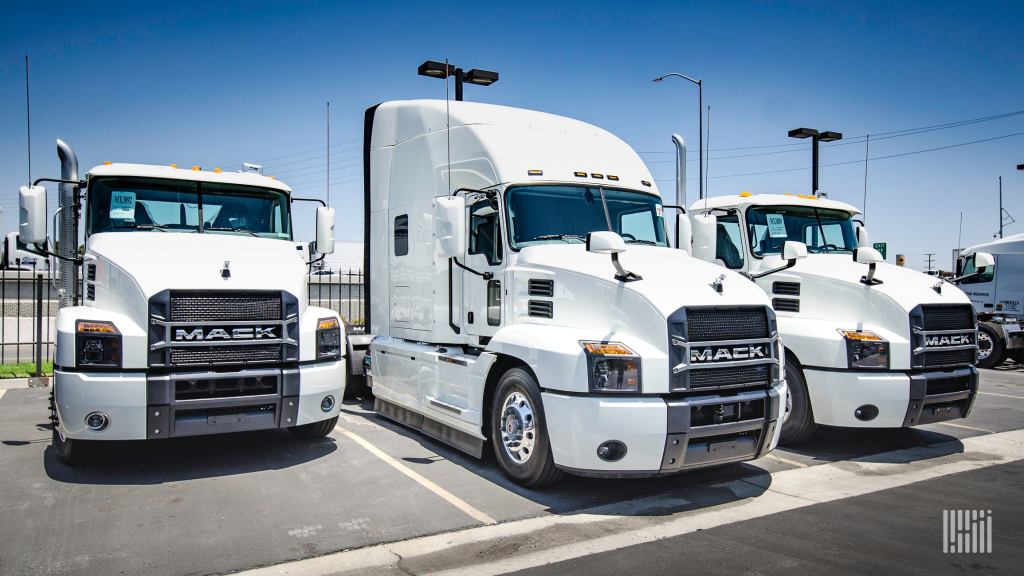
White Mack Trucks

Pent-up demand for new Class 8 trucks in a slowing freight market has rebalanced equipment orders to replacement purchases.

This is not an altogether bad thing as manufacturers look to a slower quarter with more holidays.

“The Class 8 backlog should rise by around 3,400 units when full October data are released in mid-November,” Kenny Vieth, ACT Research president and senior analyst, said. “If those numbers hold, Class 8 backlogs will have ended October at around 165,000 units.”

That’s a healthy number of orders awaiting fulfillment. Some parts shortages in the supply chain continue to vex OEMs. But the whack-a-mole supply chain disruptions of a year ago have largely disappeared.

Class 8 ‘steadiness of supply has been improving’

“The steadiness of supply has been improving. But we certainly had some impacts from that,”  Preston Feight, Paccar Inc. CEO, said on the company’s third-quarter earnings call on Oct. 24.

Preliminary net orders were 31,900 units in October compared to 36,900 units in September, the traditional opening of order books for the next year. Adjusted for seasonal factors, the count was 25,800, still the third-best number in the past 12 months, ACT reported. 

“The overall picture for truck demand is steady,” said Eric Starks, chairman of FTR Transportation Intelligence. “Despite freight weakness, fleets continue to be willing to order new equipment, affirming our expectations of replacement demand during 2024.”

FTR pegged preliminary October orders at 28,000 units, down 10% from September, reflecting freight transportation weakness. Class 8 orders totaled 255,000 units over the past 12 months.

Class 8 pockets of strength

Less-than-truckload and vocational orders remain pockets of strength against slowing orders for over-the-road tractors, Feight said.

“The first quarter looks pretty good,” he said. “While there may be some moderation in truckload, people are trying to figure out how to think about the next three years.”

Fleets purchasing trucks with current emissions technology, a so-called pre-buy, is expected ahead of stricter regulations on nitrogen oxides (NOx) in 2027. Estimates on how large the pre-buy will be or when it will impact orders vary.

Elevated Class 8 tractor orders in 2022

The catch-up elevated long-haul tractor purchases to 52% of the market in 2022, Jonathan Randall, president of Mack Trucks North America, said Oct. 16 at the American Trucking Associations’ annual Management Conference and Exhibition.

“That market usually hovers in the 50% [range]; it is the engine that powers the train of the North American commercial truck market,” he said. “A couple of years ago, that number was 48%. When we had the real trial, that number was about 42% long-haul registrations. We’re not going to go down to 42% long haul. But you should probably see a little bit of a pullback.”

Without the large backlog cushion of the past two years, seasonal orders take on greater importance, Vieth said.

Mack strike impact unclear

A United Auto Workers strike at Mack Trucks enters its fourth week Monday with contract talks scheduled to resume Tuesday. It is unclear how much production Mack has lost. Sibling Volvo canceled two shifts last Monday because a Hagerstown, Maryland, engine plant that serves both OEMs is involved in the strike.

For Mack, catching up on strike-impacted units might be a greater priority than building on-highway trucks. It mostly services the off-highway vocation and refuse markets.

Class 8 orders hit year’s peak in September

August Class 8 truck orders hit highest level since February

Mack Trucks fires back at striking UAW’s new demands

Click for more FreightWaves articles by Alan Adler.

Borderlands: 3 Texas seaports awarded $37M in federal upgrade grants

Borderlands is a weekly rundown of developments in the world of United States-Mexico cross-border trucking and trade. This week: Three Texas seaports are awarded a combined $37 million in federal upgrade grants; Arcadia Cold Storage opens a Phoenix-area facility; an investment firm acquires California-based Source Logistics; and Fictiv opens a facility in Monterrey.

3 Texas seaports awarded combined $37M in federal upgrade grants

Three major seaports across Texas will receive almost $38 million in federal funding aimed at speeding up supply chain operations and improving trucking capacity.

The awards in Texas are part of $653 million in grants to upgrade and expand 41 coastal and inland ports announced by the U.S. Department of Transportation on Friday as part of the government’s annual round of funding under the Port Infrastructure Development Program.

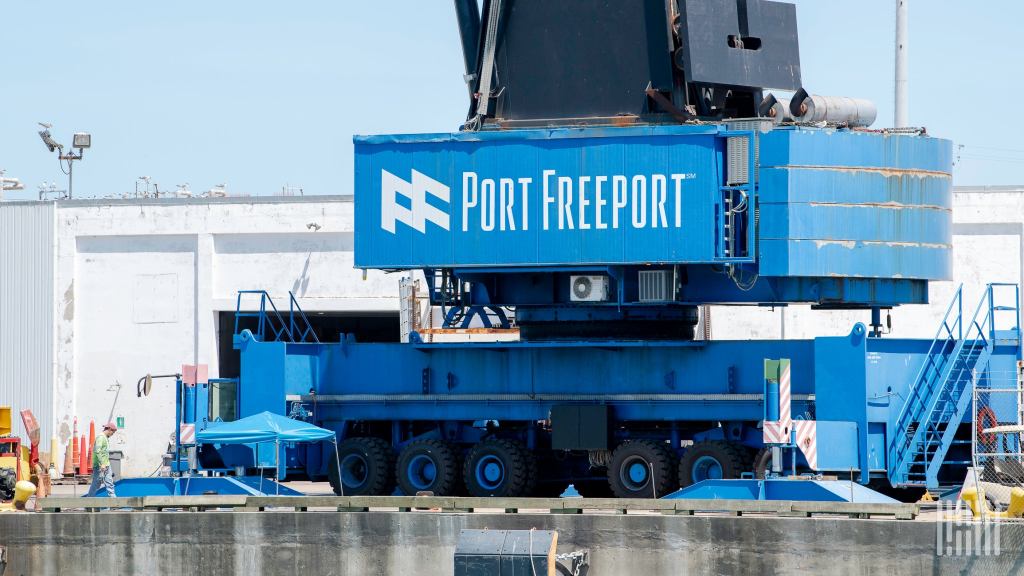
Port Freeport, about 60 miles south of Houston along the Gulf of Mexico, will receive nearly $16 million to expand its Velasco Terminal.

The expansion includes the construction of a 36,900-square-foot cross-dock warehouse and a new terminal access truck gate.

“The cross-dock facility will enable cargo to be unloaded, sorted, and loaded onto trucks without interfering with other terminal traffic, reducing congestion,” DOT said in a news release. “The warehouse design improves safety by incorporating wider maneuvering, loading, and aisle-way space for forklifts, which will reduce hazards for forklift operators and warehouse workers. The new truck gate will reduce truck turn times to improve productivity and enhance safety by adding truck lanes off the adjacent roadway.”

In June, Port Freeport completed the expansion of its Velasco Container Terminal, aiming to transform the port into a regional shipping hub by accommodating larger container and tanker vessels, officials said.

Port Freeport is one of the leading exporters of crude oil and natural gas liquids in the country. More than 1,189 vessels called Port Freeport in 2022, transporting 31.2 million tons of freight.

In addition to the expansion of its Velasco Terminal facilities, the port is undergoing a widening and deepening project for the Port Freeport Ship Channel. The $295 million project, of which the federal government is chipping in $165 million, includes deepening the Freeport channel from a depth of 51 feet to 56 feet. The project is scheduled to be completed in 2025.

Port Freeport is one of the leading exporters of crude oil and natural gas liquids in the country. (Photo: Port Freeport)

In Baytown, about 26 miles east of Houston, the Cedar Port Industrial Park will receive $10.9 million to expand the dock and channel near the facility, while also adding a heavy-haul road connecting the barge dock to the park’s tenant area.

Spanning 15,000 acres along the Houston Ship Channel, Cedar Port Industrial Park is one of the largest master-planned rail-and-barge-served industrial facilities in the U.S.

The Port of Bay City will receive $9.9 million for its West Basin Bulkhead Project, which will construct a 400-foot-long bulkhead and an associated paved cargo dock and loop road for truck access. The port is located about 80 miles southeast of Houston along the Gulf of Mexico.

Arcadia Cold Storage opens Phoenix-area facility

Arcadia Cold Storage and Logistics recently opened a 293,000-square-foot temperature-controlled facility near Phoenix.

The cold storage facility offers a convertible freezer and logistics center with 40,500 pallet positions designed to support a combination of regional distribution, import export activity and high-volume throughput handling services.

The site will serve as a hub for the Southwest, with access to metropolitan markets in Southern California, Arizona, Nevada, Utah, New Mexico and Colorado.

Arcadia Cold’s new facility will serve as a hub for the Southwest region. (Photo: Arcadia Cold)

“The facility represents our westernmost site to date and will satisfy our customers’ need for a well-designed and operated building to help manage their product storage and handling requirements,” Arcadia Cold CEO Chris Hughes said in a news release.

Atlanta-based Arcadia Cold Storage and Logistics also has cold chain centers in Texas, Pennsylvania and Georgia.

Investment firm acquires California-based Source Logistics

New York-based Palladium Equity Partners has acquired a majority stake in Source Logistics, a Montebello, California-based provider of warehousing, distribution and third-party logistics services to the consumer goods sector, with a focus on Hispanic food and beverage brands.

Terms of the financial transaction were not disclosed.

Founded in 1999, Source Logistics serves its customers from 12 facilities across the country, including in California, Texas, New Jersey and Oregon. The company imports products from Mexico, along with Central and South America.

Officials for Palladium said the investment in Source Logistics broadens their reach in the Mexican food and beverage value chain. Palladium is an investment firm with more than 200 companies in its portfolio.

“Our firm has invested over $1.3 billion in the U.S. Hispanic market across consumer, healthcare, services and industrial sectors,” Daniel Ilundain, co-head of Palladium’s flagship funds, said in a news release. “Source Logistics represents Palladium’s 20th platform investment addressing this rapidly growing demographic that accounts for $3.2 trillion in gross domestic product.”

Fictiv opens custom manufacturing hub in Monterrey

Fictiv, an operating system for custom manufacturing, recently opened a facility in Monterrey, Mexico, aiming to offer more options for on-demand manufacturing services across North America.

The manufacturing hub in Monterrey provides customers with added manufacturing capacity, supply chain options and agility in meeting product development needs, officials said.

“Mexico is an incredibly exciting region for manufacturing growth, full of untapped potential,” Dave Evans, co-founder and CEO of Fictiv, said in a news release. “We’re thrilled to leverage our digital platform and supply chain management excellence to connect our U.S. customers with Mexico’s premier manufacturing talent and vice versa.”

In addition to Mexico, Fictiv also has operations in the U.S., China and India. San Francisco-based Fictiv was founded in 2013. The company has manufactured more than 20 million parts for both early-stage companies and large enterprises.

Click for more FreightWaves articles by Noi Mahoney.

More articles by Noi Mahoney

Trimble’s transportation revenue jumps 35% in Q3

US mulls terminating tomato trade agreement with Mexico

Universal Logistics’ Q3 earnings decline in ‘sluggish freight market’

Binford, North Dakota Post Office 58416

Binford Post Office

The Binford, North Dakota Post Office serves ZIP Code 58416. Photo by Jimmy Emerson, some rights reserved. Photo shared under the Creative Commons License.

Binford Post Office
215 Whinery St
Binford, ND 58416

Location at Google Maps

Key US lane shows soft freight market still vulnerable to shipping imbalance

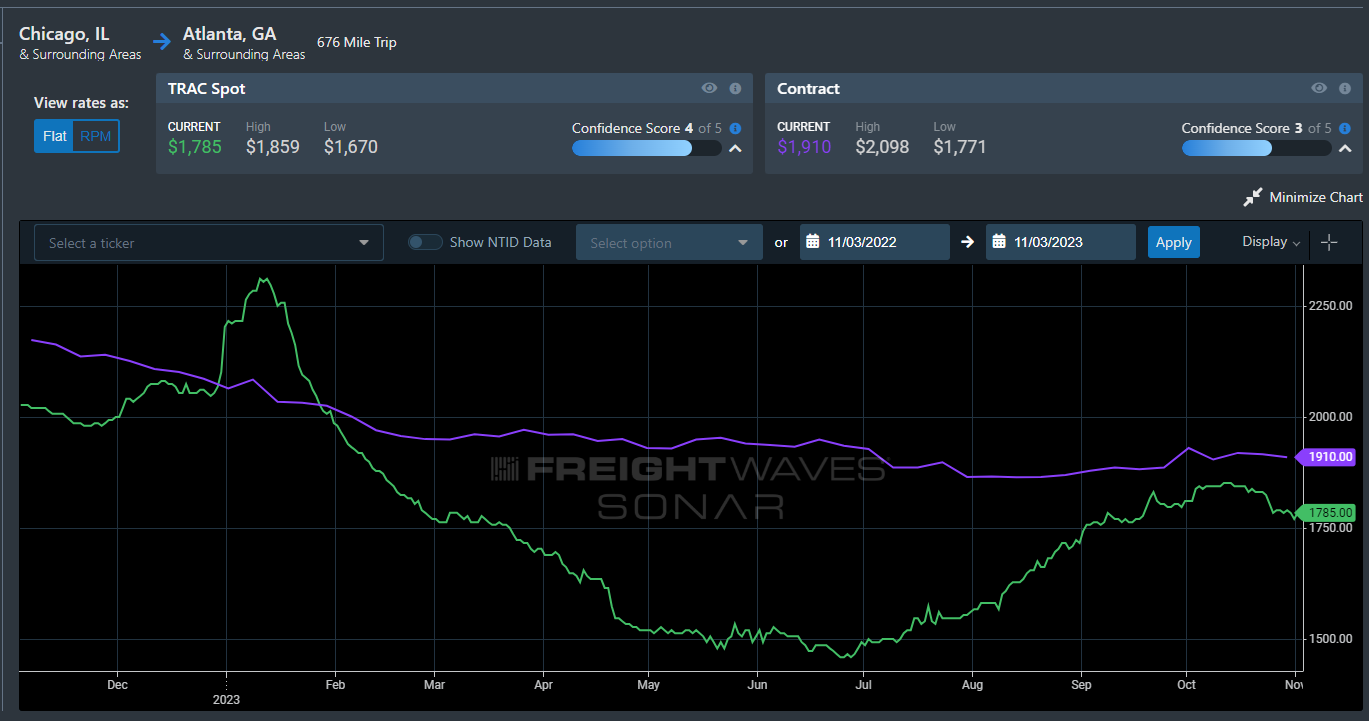
Chart of the Week: Spot and contract rate (including fuel) – Chicago to Atlanta  SONAR: Market Dashboard

The spread between truckload contract and spot rates has contracted significantly in one of the most densely traveled lanes in the U.S. — Chicago to Atlanta — according to the FreightWaves Trusted Rate Assessment Consortium (TRAC) and database of invoice data. It shows that while the domestic transportation market continues to be in an extremely oversupplied state, there are small signs that it is not as loose as it has been. 

Transportation service providers continue to struggle in what has been an extremely competitive environment since Q2 of 2022. Spot rates plummeted in the spring last year from all-time highs, but contract rates, as is their nature, fell much more gradually. 

The general rule is that contract rates follow spot rates as they are negotiated with a much slower cadence and are locked in place for longer periods of time, normally a year. There has been little indication from the spot market that contract rates will stop falling, but looking into smaller lane-level granularities, this is less true. 

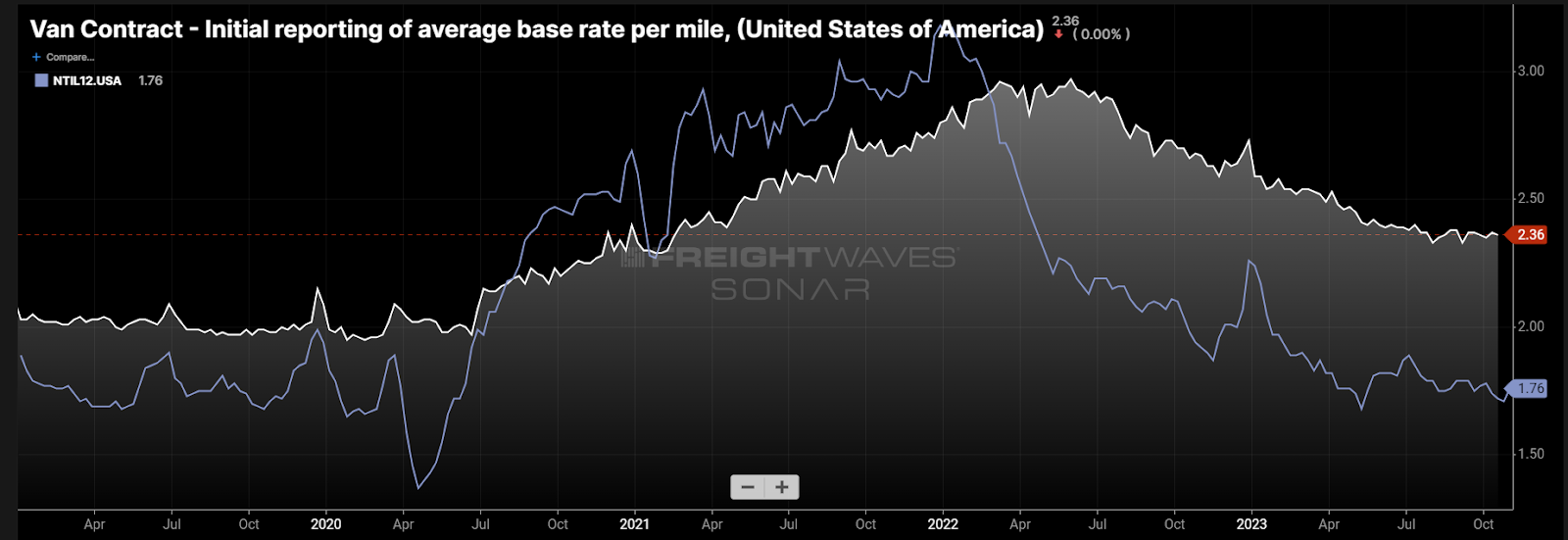
At a high level of aggregation, contract rates remain extremely elevated from a historical perspective in relation to spot rates. The chart above shows the average rate for dry van contract and spot loads moving more than 250 miles excluding fuel charges in the U.S. Contract rates are currently ~34% higher than spot rates. 

To put this in perspective, contract rates averaged about 10-15% lower than spot rates in the historically tight late-2021 market and were around 15% higher than spot rates in the fall of 2019, when conditions were very loose. The current relationship paints a very soft picture. 

The Chicago-to-Atlanta lane is considered a backbone lane in the domestic freight market. Thousands of loads a day move between these two markets. Both markets represent high levels of consumption, being large population centers, and production. 

This lane should be one of the more well covered in the nation, yet the imbalance in the flow of freight has pushed spot rates gradually higher over the past four months. Contract rates (including fuel) were ~22% higher than spot rates at the beginning of July this past summer. At the end of October that gap had shrunk to 6%. 

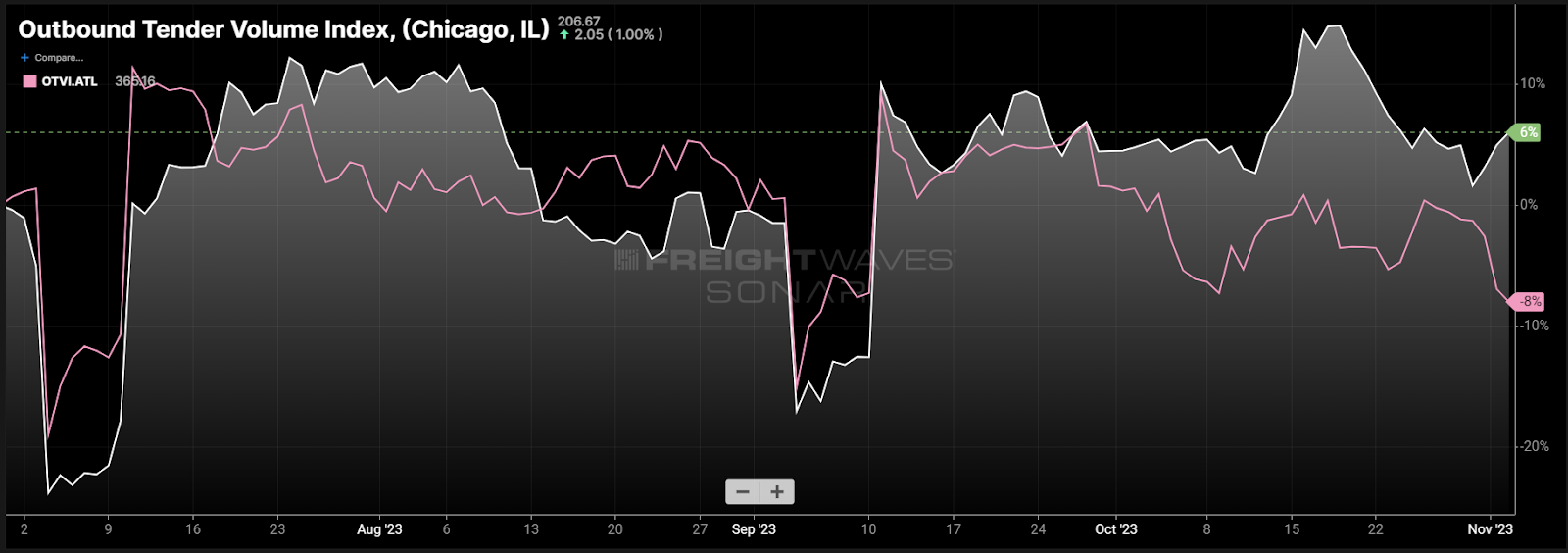
One of the big reasons for this is the growth in demand out of Chicago has outpaced Atlanta. Outbound tender volumes for the Chicago market averaged ~8% above summer levels in October, while Atlanta’s daily tender volumes were ~6% lower on average. 

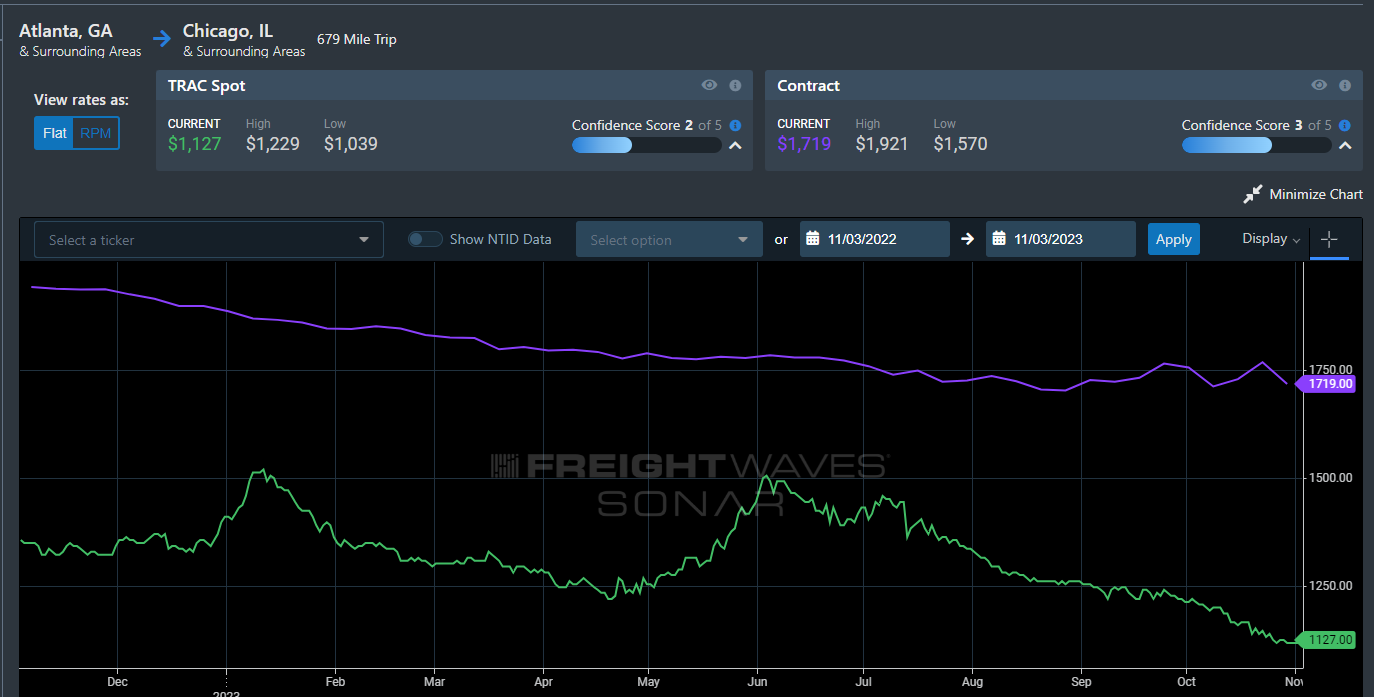
The reverse trip shows the inverse is also true, with spot rates falling off summer peak values moving from Atlanta to Chicago. These rates reflect a traditional headhaul and backhaul relationship emerging between these two markets. The headhaul, or outbound-heavy lane, is Chicago to Atlanta, while the backhaul, or inbound-heavy lane, is Atlanta to Chicago. 

The point of all this is that even in a market of abundant capacity, imbalances are still occurring under the surface that are difficult to see. Some of these imbalances are temporary or seasonal, while others represent longer-term shifts in domestic freight patterns. Identifying these patterns and relationships are key to navigating the volatile freight market and forecasting for the next year. 

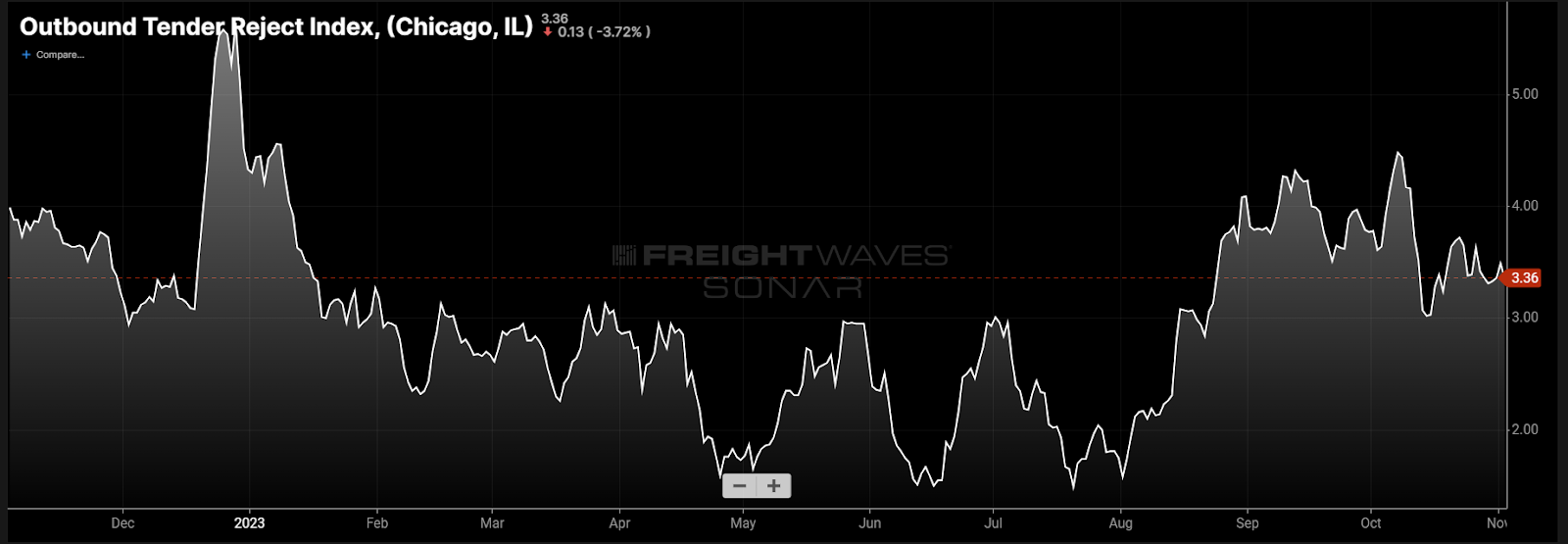
Chicago’s outbound tender rejection rates have also increased (from under 2% to 3.3%) but not to a level that would be alarming to anyone. While most shippers do not see or feel this slow shift to a tighter environment, most know it is coming. 

It does appear that both spot and rejection rates are starting to fall back in early November out of Chicago. With capacity still being abundant, imbalances like this tend to get ironed out. But this is definitely one more sign that the freight market’s loosest days may be in the past as capacity continues to exit at a record pace. And we can see it in action in this lane. 

About the Chart of the Week

The FreightWaves Chart of the Week is a chart selection from SONAR that provides an interesting data point to describe the state of the freight markets. A chart is chosen from thousands of potential charts on SONAR to help participants visualize the freight market in real time. Each week a Market Expert will post a chart, along with commentary, live on the front page. After that, the Chart of the Week will be archived on FreightWaves.com for future reference.

SONAR aggregates data from hundreds of sources, presenting the data in charts and maps and providing commentary on what freight market experts want to know about the industry in real time.

The FreightWaves data science and product teams are releasing new datasets each week and enhancing the client experience.

To request a SONAR demo, click here.

Pennsylvania brokerage lays off nearly 65 employees, sources say

Approximately 65 employees for Pittsburgh-based Elite Transit Solutions were laid off via Microsoft Teams on Friday. This is the second round of job cuts the freight brokerage has experienced over the past month; about 20 employees were let go on Oct. 20 because of the “current economic situation,” according to sources familiar with the layoffs. 

One former employee who was fired on Friday’s call told FreightWaves that Elite Transit Solutions’ CEO Michael D. Johnson didn’t allow workers to submit questions using the chat function and muted their microphones so they weren’t able to ask questions. After the call ended, their computer access was cut.

“We all had questions about when we would get paid for working these last two weeks and if we would get paid for our vacation time we had accrued,” the ex-employee, who asked to remain anonymous for fear of retaliation, told FreightWaves. “We were told to email human resources if we had any questions, but our [vice president] of HR left a day before we found out our jobs were being eliminated. Who is left to respond to our emails?”

Melissa Bucci, former vice president of people and culture at Elite Transit Solutions, confirmed the layoffs via LinkedIn on Friday, stating that she was sorry she didn’t “have an opportunity to say goodbye.” 

At its peak, the company had around 140 workers, another source familiar with the layoffs at Elite Transit Solutions told FreightWaves, but is down to around 10 people, including Johnson. 

Headquartered in Pittsburgh, Elite Transit also has offices in North Carolina, Chicago and Arizona. 

The company hasn’t announced it is ceasing operations and is in “talks with another freight brokerage about a possible merger,” according to multiple sources.

“At this point, we aren’t sure what is true and what is not, but the writing has been on the walls for months that Elite hasn’t been doing well and is struggling to secure financing and pay carriers,” the source said.

While Johnson, who founded the logistics company in 2013, initially agreed to speak with FreightWaves about the ongoing financial situation at Elite Transit Solutions, he later declined to comment.

Some carriers haven’t been paid since May

One former employee said he became aware of Elite Transit Solutions’ shaky financial situation soon after he was hired. He said nearly 80% of the inbound calls were from trucking companies that hadn’t been paid for loads they hauled for the brokerage since May or June. They were instructed to transfer the calls to the billing department, which went to voicemail, but claimed that no one answered the phones.

“We were cut off by almost every factoring company you can think of,” the ex-Elite Transit employee told FreightWaves. “It got so bad that the factoring companies were taking money back from the carriers because the contract was between the factoring company and the carrier, not with Elite.”

“We heard from carriers that were forced to close their trucking companies, including one that had to sell his business and his home, because we hadn’t paid him,” the source said. “We received an email from the wife of a carrier owner whose husband attempted suicide and blamed Elite for not paying him.”

Carriers have been posting warnings about payment issues with Elite Transit Solutions since May.

Elite Transit Solutions also urged independent trucking companies to use its “preferred factoring partner,” Connect Capital LLC, headquartered in Miami, writing on its website that “in most cases, Elite drivers get paid in less than 24 hours.”

The business address for Connect Capital is listed as a townhome which was purchased by Johnson for nearly $2.2 million in March 2022. Johnson, who is listed as the only authorized member for Connect Capital. The Florida secretary of state’s office filed to have Connect Capital administratively dissolved for failing to file an annual report in September. 

“Why did they continue to hire people knowing they were on shaky ground,” the source said. “These recent layoffs have put the livelihoods of several people and their families in jeopardy.”

Do you have a news tip or story to share? Send me an email or message me @cage_writer on X, formerly known as Twitter. Your name will not be used without your permission.

‘Fraud, theft and abuse’ force Texas freight brokerage to shut down
Family-owned California trucking company ceasing operations after 95 years
40-year-old Montana trucking company, freight brokerage shutters operations

Senate approves bill to help vets get CDLs

Army reservist fixing a truck

WASHINGTON — The U.S. Senate has approved legislation aimed at making it easier for military veterans to obtain a commercial driver’s license.

The Veteran Improvement Commercial Driver License Act of 2023 was discharged from the Committee on Veterans Affairs and considered and passed by the full Senate by unanimous consent on Thursday.

The legislation, backed by the American Trucking Associations and the Commercial Vehicle Training Association, removes a two-year waiting period currently required for certain CDL schools that veterans may want to attend and pay for using their GI Bill benefits.

Under current law, the U.S. Department of Veterans Affairs is barred from approving CDL courses offered at secondary branches of an educational institution if the branch has been operating for less than two years.

The legislation removes that barrier by allowing the VA to approve a CDL program for veterans at a new branch as long as it is appropriately licensed by the state and uses the same curriculum as the program at the primary institution that has previously been approved.

An identical bill introduced last year in the U.S. House of Representatives is getting more scrutiny.

During a House veterans affairs subcommittee hearing on Thursday, Joseph Westcott, legislative director for the National Association of State Approving Agencies, warned that the legislation in its current form — which is identical to the Senate version — “sweeps away veteran protections” provided by the two-year waiting period.

The waiting period, he said, is meant to prohibit veterans from enrolling in low-standard, fly-by-night truck driving schools by giving the branch school enough time to demonstrate it is stable and has a quality curriculum.

“This bill, as presently drafted, only requires that an institution offer the same curriculum as a previously state-approved institution anywhere in the nation,” Westcott said. “A truck driving school could request immediate approval of a ‘branch’ campus anywhere in the nation, and the [state approval agency] of jurisdiction would have no records (graduation rate, CDL pass rate, or job placement) to determine the approvability of the program.

“If we don’t safeguard that, then we would be in the situation where somebody could get approval in the state of Idaho, and now the two-year rule is effectively swept away in North Carolina. That’s concerning to me.”

But subcommittee Chairman Derrick Van Orden, R-Wisc., was concerned that pushback from state approval agencies over the bill’s language could undermine the bill’s passage, especially if it keeps CDL branch schools from being approved that happen to be in another state but are still located close to the primary school.

However, “we’re going to work with you on this,” he told Westcott. “Truck driving is a fantastic job, and if we can get our guys and gals behind the wheel and actively employed it would be fantastic.”

Click for more FreightWaves articles by John Gallagher.

Machine learning makes extended visibility options a reality

Basic visibility offerings have evolved from perks to table stakes over the past several years. More advanced and in-depth solutions, however, are not so commonplace. Visibility mainstay project44 recently rolled out a number of enhancements to its Movement platform, creating extended visibility options for its customers. 

These next-level offerings are powered by machine learning and they have the power to change the way logistics companies operate altogether. 

“While many providers offer basic modal visibility, shippers adopting these solutions find themselves still grappling with costly blind spots as shipments transition between modes and carriers. Poor data quality from carriers only exacerbates the issue, resulting in hundreds of billions of dollars in avoidable supply chain costs,” Jett McCandless, founder and CEO of project44, said in a recent news release. ​“project44’s cutting-edge, machine learning-powered solutions provide the sophisticated insights organizations need to transform their supply chain from a cost center into a competitive advantage.” 

By providing door-to-door visibility capabilities — and paving the way for stronger connections between industry players — project44 can help shippers and logistics service providers move from reactive to proactive. 

Extended Ocean Visibility

Shippers and service providers moving goods internationally have had limited visibility options for multimodal moves when landside moves aren’t booked by the ocean carrier. 

project44’s new Extended Ocean Visibility solution can merge data streams from customers’ carriers and freight forwarders to deliver a single source of truth for inventory in transit, eliminating costly blind spots and delivering visibility from door to door. Since Movement connects shipments to orders with SKU-level granularity and custom references, p44 customers can track their goods in transit by the references that matter most.  

Extended Air Visibility

When moving goods via airfreight, there isn’t much room for error, and these shipments tend to be high value and urgent. Shippers need visibility that enables them to proactively manage exceptions and rightsize inventory so they can reduce costs and provide a differentiated customer experience. Visibility has long been a challenge for these shipments, however, especially for pre- and on-carriage portions since they change hands so quickly and are operated by freight forwarders. 

Extended Air Visibility from project44 enables real-time tracking from door to door by unifying data from multiple sources — including freight forwarders — into a single platform, increasing confidence in air shipment arrival. This level of visibility delivers significant value to global shippers like Alcon, a multinational vision care products provider. ​

“Extended Air Visibility from project44 gives us the real-time tracking capabilities we need to provide a great customer experience every time,” said Alcon’s Curt Metzler.

Extended Truckload Visibility

As shippers and service providers increasingly seek to optimize supply chain costs, intermodal transportation has become a preferred choice due to its cost-effectiveness and eco-friendliness. However, the lack of direct collaboration with rail and short sea operators often leaves shippers in the dark about their shipments’ status. 

With Extended Truckload Visibility from project44, customers simply create a single shipment in project44’s Movement platform to gain access to crucial information such as real-time shipment status, estimated time of arrival at the destination and milestone events indicating mode transfers. This means companies can benefit from cost-efficient and eco-friendly shipping while staying connected every step of the way with domestic intermodal visibility. 

project44’s innovative machine learning technology offers shippers and logistics service providers a visibility experience that exceeds what most industry leaders thought was even possible. 

Click here to learn more about project44.

Shared truckload creates pathway to efficiency for enterprise shippers

A grey tractor pulling a white dry van trailer on a highway

As the trucking industry continues to slog through its toughest downturn since the 2008 financial crisis, analysts have pointed out a slow shift in market trends. Hard-hit carriers have been buoyed by these glimmers of hope in recent months, but the timing of a true market upswing remains difficult to pin down.

This much-anticipated market shift is likely inevitable, although its timing and shape is still unclear.

Some experts expected to see a significant rate jump by the fourth quarter of 2023, but high-frequency data housed in FreightWaves SONAR paints a different picture. In a recent article, FreightWaves CEO Craig Fuller pointed to SONAR’s Carrier Details Total Trucking Authorities index to shed some light on the ongoing freight recession.

In short, Fuller found that — if the current rate of trucking company closures continues — it will take another 78 weeks for capacity to be back in line with historical norms.

“While it is possible that freight rates could increase in anticipation of a capacity reset, FreightWaves and many other analysts don’t believe that freight rates will increase until at least the second quarter of 2024, and few predict large increases in rates even then,” Fuller said. 

This environment of uncertainty has made it difficult for shippers to navigate their RFP processes this bid season. Because it is difficult to forecast how rates will move throughout the next 12 months, running bids right now leaves shippers in a precarious position; if forecasts do not hold up, new RFPs could be rendered effectively useless in record time.

It is crucial for shippers to build flexibility into their transportation plans. This ongoing volatile environment has created an opportunity — and a necessity — for companies to take another look at how they move freight.

Fortunately, a slew of forward-looking industry partners have entered the market in recent years, offering shippers more ways to cut waste and boost efficiency than ever before. Flock Freight, for example, is laser-focused on revolutionizing the way shippers handle partial truckloads, creating an avenue for previously unimaginable savings.

Flock Freight offers shippers a shared truckload solution, powered by patented technology, that allows shippers to take advantage of the reliability of truckload while only paying for the space they actually use in any given trailer.

This model offers shippers a layer of nuance and flexibility that has been missing from the industry for decades. In order to take advantage of it, shippers — particularly large shippers — need to approach their operations with a sense of curiosity and collaboration.

Historically, enterprise shippers have not been in the habit of tracking pallet count. Their technologies — including TMS and ERP setups — are often not even equipped to capture pallets and dimensions.

“For large enterprise shippers, a lot of the roadblocks [to savings] come from the operations side of the business,” Todd LaFond, vice president of strategic partnerships at Flock Freight, said. “Most companies don’t know the number of pallets they need to move until an order is actually picked and loaded on their dock.”

At that point, freight that fits within the company’s less-than-truckload parameters is loaded onto a drop trailer. Orders that exceed those parameters are moved via truckload — no matter how much empty space is left in the trailer. 

This creates an environment of rampant inefficiencies evidenced by wasted money and unnecessary greenhouse gas emissions. For shippers that want to stop paying for empty space, Flock Freight is ready to step in and help them figure out how to visualize pallet counts and reduce waste.

“As a rule, our core value proposition to most companies that are shipping suboptimal truckloads is that we are able to provide up to 20% cost savings over full truckload rates,” LaFond said. “From a service perspective, our service will be closer to full truckload than to any LTL provider.”

Savings vary from customer to customer and load to load. Because shippers only pay for the space they use in a trailer, those that need less trailer space will naturally save more money. Flock’s machine learning technology plays a pivotal role here by working tirelessly behind the scenes to search the over 1.2 trillion ways to pool their shipments, evaluating over 5 million candidate pool routes, and ultimately finding 5,000 efficient pooling opportunities in near real-time.

Beyond the cost savings realized by switching from partial truckloads to shared truckloads, shippers that move their LTL freight over to a shared truckload model enjoy serious service gains — and decreased damage claims — at a reduced rate compared to full truckload.

“The more open customers are to alternative solutions, the greater their potential for savings,” LaFond said.

Click here to learn more about Flock Freight

How PSPs lead to better data-driven decisions – Taking the Hire Road

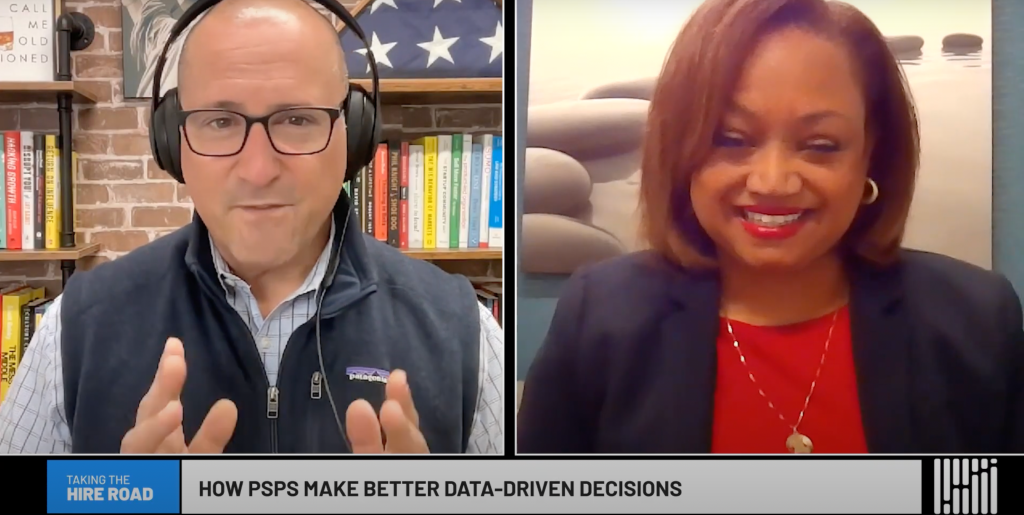
Jeremy Reymer, founder of DriverReach, is joined by a great industry friend and ally, Yvonne Glover. Glover serves as the director of operations at Tyler Technologies, an organization that builds solutions aimed at helping the public sector operate more efficiently.

About 97% of large government agencies use Tyler Technologies’ solutions, according to the company’s website. The Federal Motor Carrier Safety Administration is one of those agencies. The company was contracted to help FMCSA build and manage its preemployment screening program (PSP) from the very beginning.

“We are focusing on problem-solving — helping the government to help constituents,” Glover said. “We are looking at how to help the government access data.”

The FMCSA preemployment screening exists to help carriers decide whether driver candidates are a good fit for their organizations. While hiring managers must access each applicant’s motor vehicle record, the accuracy, timeliness and completeness of these records can vary widely by state.

The PSP is designed to complement motor vehicle records, giving managers a more comprehensive view of each applicant’s strengths and weaknesses. The screening report — which is updated about every 30 days — provides five years of crash data and three years of inspection data for each driver, regardless of state.

Glover noted that the PSP was not created to make decisions for hiring managers, but rather to support hiring managers in their decision making. That means a carrier can still decide to onboard drivers with negative marks on their PSPs. In this case, the data helps carriers customize training opportunities for each new driver.

Most folks talk about FMCSA preemployment screening in relation to its ability to benefit drivers. The PSP is also designed to help drivers, however. In fact, PSP Monitoring is a driver-specific program that alerts participants to any changes to their files — free of charge.

Drivers can request their own records at any time — whether they received a monitoring alert or not — to check for accuracy, keep an eye on their performance and see how they are coming across to hiring managers.

“As a driver, I would want to know what other folks are seeing,” Glover said. “I would want to ensure it is accurate.”

By signing up for PSP Monitoring and keeping tabs on their performance records, drivers can address any inaccuracies before they come up in a job interview.

Click here to learn more about Tyler Technologies.

More from Taking The Hire Road:

Who’s the happiest driver on the road?

For better retention, focus on what’s controllable

Fleetworthy’s mission for manageable compliance