Loaded and Rolling: Flexport acquires Convoy tech stack

Flexport acquires Convoy tech stack for undisclosed sum
(Photo: Jim Allen/FreightWaves)

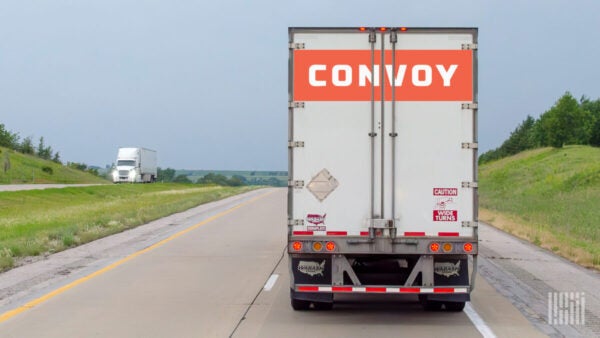
The Convoy saga has taken another turn as venture-backed freight forwarder Flexport announced Wednesday that it has acquired Convoy’s technology stack for an undisclosed sum. This comes after Convoy, which was valued at $3.8 billion from its final funding round 18 months ago, shuttered operations on Oct. 19.

Flexport CEO and founder Ryan Petersen wrote in an email to his team that in the coming weeks Flexport customers will be able to regain access to Convoy’s trucking network, which they had been able to access since 2021. The Convoy network is estimated to be around 400,000 truck drivers among 80,000 carriers, per the email. 

“Flexport’s strategy will be to offer a full range of trucking services to our customers who value us as a one-stop-shop for global logistics. We’ll offer expanded trucking services, including FTL, LTL, drayage (ocean) trucking, cartage (airport) trucking, and eventually intermodal (rail) trucking services to customers of our international freight forwarding services,” Peterson wrote.

Truckers solicit FMCSA on broker detention pay
(Photo: Jim Allen/FreightWaves)

A group representing small fleets and owner-operators is soliciting the Federal Motor Carrier Safety Administration regarding broker detention pay as the agency plans a study on the impacts of driver detention and road safety. The comments come in the form of an information collection request (ICR) that the FMCSA must then submit to the Office of Management and Budget for approval. Proponents of the rule change include the Owner-Operator Independent Drivers Association. A 2018 U.S. DOT OIG report concluded detention increases the likelihood of truck crashes that involve death and serious injury.

Opponents to possible changes include the Transportation Intermediaries Association (TIA) and the American Trucking Associations (ATA), which argue regulating detention time is an economic issue to be worked out between carriers and their customers. The ATA said in the ICR, “While there has been no end of speculation that excessive waiting times provide incentives for unsafe behaviors, numerous studies have failed to substantiate even a statistically rigorous correlation between detention time and crash risk, much less a causal link.”

Some comments to the ICR pointed out shippers and receivers as a culprit. FreightWaves’ John Gallagher cited one commenter who “asserted that although brokers know where and when a truck is heading for a pickup or delivery, ‘we get there and still have to sit for hours and hours while our clock’s ticking. As soon as we arrive, we should all start being paid on the clock.’” The commenter hopes this would speed up the loading and unloading process.

Market update: U.S. Bank reports fifth consecutive quarter of freight spend and volume declines
(Source: U.S. Bank)

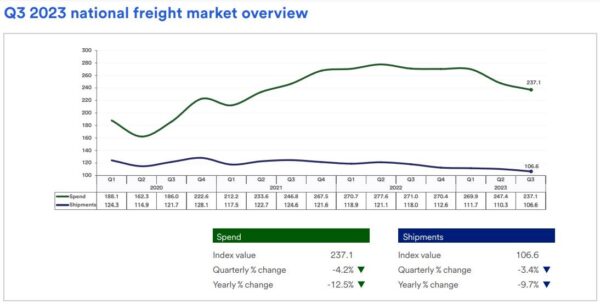
On Wednesday payments provider U.S. Bank released its Q3 Freight Payment Index, which saw freight spend and volume drop for the fifth consecutive quarter. Shipments fell 10% year over year (y/y) nationwide, with the Western region seeing the largest y/y decline at 23%. Freight spending fell 12.5% y/y, with the Midwest region seeing the largest decline at 17.9% y/y. 

One headwind impacting freight volumes is housing, with higher Fed rates slowing home construction. The report said, “When housing slows, it also reduces consumption of items needed to fill a home (e.g., furniture and appliances), all of which reduces truck freight. As shipment volumes contract, available capacity increases, which typically results in falling freight rates. The combination of declining rates and shipments leads to less shipper spend, which is what happened in the third quarter.”

Nearshoring appears to be having an impact on West Coast freight volumes, which fell 10% y/y. The report added, “Mexico has supplanted China as the United States’ largest trading partner, which is helping truck freight volumes on the Mexican border, meaning lower import volumes arriving at the West Coast seaports.”

FreightWaves SONAR spotlight: October outbound tender volumes no tricks or treats
(Chart: FreightWaves SONAR)

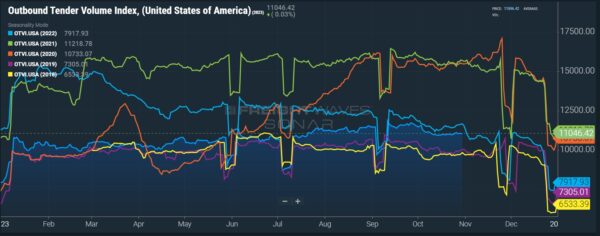
Summary: The rally in outbound tender volumes that began in mid-July appears to have run its course as tender volumes declined and remained muted at the end of October. Outbound tender volumes nationwide remained relatively flat, increasing 90.73 points or 0.83% from 10,955.69 on Oct. 23 to 11,046.42 points. Over the past 30 days, outbound tender volumes fell 410.87 points or 3.59% from 11,457.29 points to 11,046.42.

Overabundance of truckload capacity continues to create favorable conditions for shippers while threatening to further erode truckload carriers’ margins during the traditional peak season. In spite of falling volumes, the end of October brought a small bump to spot market rates, with the National Truckload Index 7-Day average (NTI) rising 2 cents per mile week over week from $2.22 per mile on Oct. 23 to $2.24 per mile all-in. For the month, spot rates fell 5 cents per mile from $2.29 to $2.24.

Looking at the seasonal view for historical outbound tender volumes, there is a risk of further volume declines in November before last-minute truckload replenishment orders arrive for Black Friday then another fall during Thanksgiving. It remains to be seen whether shippers will adjust and focus on more last-minute ad hoc loads to take advantage of lower spot rates and abundant capacity.

Increased consumer spending not enough to end jaw-dropping trucking bloodbath (FreightWaves)

What war? Diesel, crude give up most of their gains since attack on Israel (FreightWaves)

‘Fraud, theft and abuse’ force Texas freight brokerage to shut down (FreightWaves)

CRST, back in the acquisition game, buys Larkin’s BCB Transport (FreightWaves)

What the ‘Great Trucking Recession’ is warning us about the economy (Washington Examiner)


Werner’s Q3 light of expectations (FreightWaves)

Like the content? Subscribe to the newsletter here.

Zipline and Cleveland Clinic partner on prescription drone delivery

This story originally appeared on flyingmag.com

One of the most highly regarded health care providers in the U.S. will soon deliver prescriptions via drone.

Cleveland Clinic, considered one of the top hospital systems in the world based on rankings by outlets such as U.S. News & World Report and Newsweek, is partnering with drone delivery provider Zipline to fly certain medications directly to patients’ porches, patio tables or front steps starting in 2025.

Deliveries will be made using Zipline’s Platform 2 (P2) delivery system, which is designed to complete 10-mile trips to dense, urban areas in about 10 minutes.

The largest drone delivery provider on Earth in terms of sheer volume, Zipline has completed more than 800,000 deliveries of some 8.3 million items to date, per the company’s website. The bulk of these are on-demand health care deliveries of cargo such as blood, vaccines and prescription medications.

Already, Zipline is partnered with several U.S. retailers and health care providers, including Walmart, Cardinal Health and MultiCare Health System. It added agreements with Michigan Medicine, Intermountain Healthcare and OhioHealth earlier this year. The company currently flies in Arkansas, Utah and North Carolina, with plans to expand into other states in the months ahead.

Earlier this month, competitor Amazon Prime Air added prescription drone delivery to its service in College Station, Texas, as more firms begin exploring the use case.

“This technology will help us achieve our goal to expand our pharmacy home delivery program and provide easier, quicker access to prescribed medications in our communities,” said Geoff Gates, senior director of supply chain management at Cleveland Clinic.

Starting next year, Cleveland Clinic will coordinate with local government officials to check its compliance with safety and technical requirements for launching the drone delivery service. It will also begin to install Zipline docks and loading portals at locations in northeast Ohio, mostly facilities at its main campus in Cleveland and in nearby Beechwood.

Initially, the service will deliver specialty medications and other prescriptions — which typically would be shipped via ground delivery — from more than a dozen Cleveland Clinic locations. Eventually, it’s expected to offer emergency or “rush” prescriptions, lab samples, prescription meals, medical and surgical supplies, and items for “hospital-at-home” services.

Cleveland Clinic has been lauded for its supply chain (for which it earned the top spot on Gartner’s 2021 ranking) and innovative use of technology, in particular. That makes it somewhat unsurprising that the hospital system would add an emerging technology like drone delivery, which is already changing the health care landscape in regions such as Africa. Zipline’s drones, for example, have delivered blood, vaccines and other medical supplies in Rwanda since 2016.

“We are always looking for solutions that are cost effective, reliable and reduce the burden of getting medications to our patients,” said Bill Peacock, chief of operations at Cleveland Clinic. “Not only are deliveries via drone more accurate and efficient, the technology we are utilizing is environmentally friendly. The drones are small, electric and use very little energy for deliveries.”

Zipline’s P2 drones, or Zips, include a detachable delivery “droid.” The droid docks on loading portals that can be installed directly on buildings, sliding back and forth between the building’s interior and exterior through a small opening — like a fast-food restaurant employee handing off meals through a drive-thru window.

When a prescription is ready to be delivered, a Cleveland Clinic technician will load the droid, which can carry up to 8 pounds of cargo. The small capsule then slides out of the window, undocks from the loading portal and docks with the Zip, all on its own.

The drones will cruise at around 70 mph (61 knots) at an altitude near 300 feet, and customers will be able to track their orders in real time. Once it arrives at the delivery address, the Zip will deploy the droid, which uses a mix of onboard perception technology and electric fans to quietly and precisely steer itself to a drop-off point as small as a patio table. The Zip will then fly back to a Cleveland Clinic site and dock itself.

“Zipline has been focused on improving access to health care for eight years,” said Keller Rinaudo Cliffton, co-founder and CEO of Zipline. “We’re thrilled to soon bring fast, sustainable and convenient delivery to Cleveland Clinic patients.”

Zipline announced P2 in March, but the system is not yet in action. However, the company expects the new hardware and software will enable quicker, quieter deliveries. 

In addition to the upgraded Zips, easier integrations with retailers and other technology upgrades, a big benefit of P2 will be flexibility. The new drones will be able to fly up to 24 miles in a single direction and land on any dock in the network, allowing Zipline to send additional capacity to locations experiencing high volume (or divert it from sites that aren’t).

Already, the firm has several P2 customers lined up, including the government of Rwanda, Michigan Medicine, MultiCare and American restaurant chain Sweetgreen. It will continue to deploy its Platform 1 (P1) system — which airdrops packages using a parachute — for certain clients.

Zipline is one of five U.S. drone delivery companies — the others being Prime Air, UPS Flight Forward, Alphabet’s Wing and Causey Aviation Unmanned, a longtime partner of Israel’s Flytrex — to receive Part 135 air carrier certification from the FAA. The firm’s approval authorizes commercial operations spanning up to 26 miles, including beyond the visual line of sight (BVLOS) of the pilot.

In September, Zipline obtained an FAA BVLOS exemption for its services in Utah and Arkansas with P1. The waiver allows the company to remove visual observers from those routes, which it said it will begin doing later this year. Three other firms, including Flight Forward, received similar permissions.

It is time to maximize profitability with a more streamlined customer experience

a photo of container imports

Real-time shipping updates are one of the best ways that retailers can provide a transparent and high-quality customer experience. Today, it’s common for large online retailers to let customers track and manage their orders through a portal.

While freight forwarders and logistics service providers (LSPs) are in the business of providing a great customer experience, traditionally, their shipper customers haven’t received the same level of visibility as end consumers.

“There’s a really large knowledge gap that exists between freight forwarding companies or logistics service providers and their customers, and really it’s the transfer of information,” said Julian Alvarez, Logixboard founder and CEO.

That transfer of information is blocked because data is often siloed in freight forwarders’ and LSPs’ transportation management systems. Traditionally, freight forwarders and LSPs have primarily communicated via email, phone calls, and reports generated from their TMS, which quickly go stale. Due to the constant back-and-forth, important documents get lost in massive email threads, leading to customs holdups, scheduling mishaps and delayed payments.

Leveraging technology can help LSPs elevate customer service and maximize their revenue opportunities by delivering a customer-facing application in which clients can track shipments, pull customs and other important documents, see invoices and a breakdown of costs, and communicate with providers online.

Unfettered access to all the real-time data insights, analytics and documentation they need, in one place, allows customers to more easily manage their own supply chain, making for a best-in-class customer experience.

Logixboard, a user-friendly supply chain management platform, is an example of one innovator taking this approach to the customer experience. While LSPs may run their operations across 12 or more systems internally, they can give their customers access to just one. Logixboard connects and streamlines all of an LSP’s channels into a single customer-facing application.

In turn, their shippers can cut out the information middleman in favor of an easy-to-navigate interface where they can view their freight operations in real time. Not only does this enable streamlined communication, but it also eliminates single points of failure and builds trust between the LSP and its customer.

As freight forwarders and LSPs grow and expand their offerings into areas such as domestic and warehousing services, they can integrate management of these operations on their platforms. This can help them cross-sell to customers much more effectively.

“If they’re able to provide one unified, customer-facing application, they’re able to land larger accounts, provide visibility across the entire supply chain, which ultimately is what BCOs, shippers and importers want,” Alvarez explained.

Deploying technology requires work, and Logixboard consults with and works closely with clients as partners to successfully roll it out to customers. Logixboard also integrates into freight forwarders’ and LSPs’ existing systems, minimizing the burden of retraining their operations teams.

“Not only are we getting them up and running quickly, but we’re delivering a lot of value for them rapidly, whether that’s through new sales, through growing their share of wallets or just generating more efficiency as an operation,” Alvarez explained.

Providing a unified customer experience, combining both great service and great technology, allows companies to streamline their freight operations, in turn maximizing efficiency and accelerating new business.

“When we think of customer experience, we think of it as critical for these customers. We think the technology and the service that these companies offer ultimately helps them win,” Alvarez said.

Click here to learn more about Logixboard.

Lufthansa Cargo profits wiped out in Q3

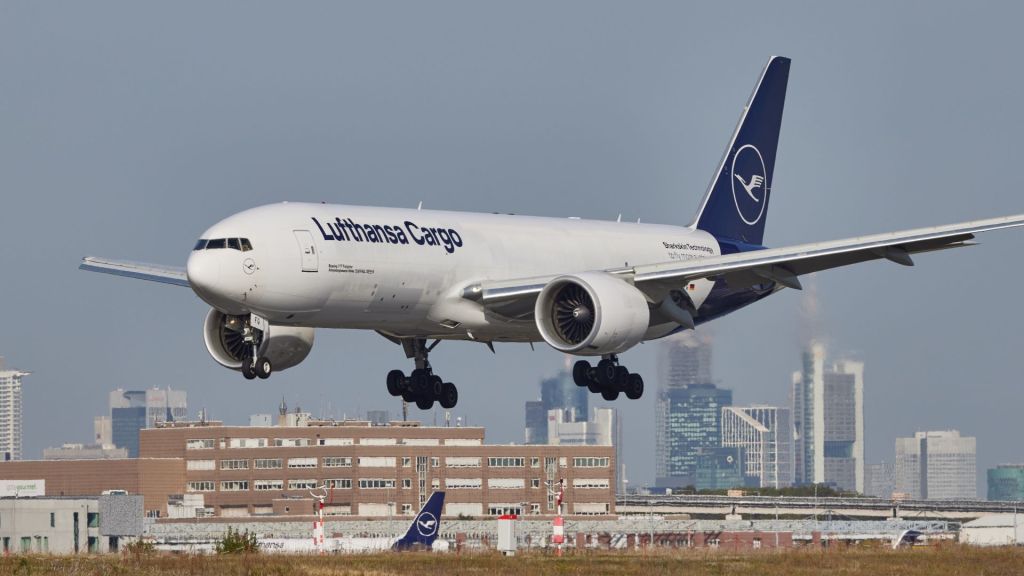
A blue-tailed Lufthansa Cargo jet approaches the runway with city buildings in the background.

Operating income for Deutsche Lufthansa AG’s cargo division collapsed to near zero during a seasonally weak third quarter, and the company indicated full-year segment earnings would be similarly sour despite expectations for a slight uptick in shipment volumes during the final months of the year.

Lufthansa Cargo’s pretax profit plunged 100%, from $352 million (331 million euros) to $1 million year over year (y/y) behind a 43% drop in core transportation revenue to $771 million due to the airfreight market’s ongoing correction from the pandemic peak when cargo operators raked in cash because grounded passenger planes eliminated a huge amount of supply. 

With economic uncertainty growing amid elevated inventories, freight demand is subdued while the recovery in passenger operations has created excess cargo capacity, resulting in summer rates that were 40%, or more, lower than in 2022. 

Lufthansa Cargo, the 16th-largest airfreight carrier by volume, operates 16 Boeing 777 freighters on long-haul routes and three Airbus A321 converted freighters for same-day e-commerce customers within Europe. Lufthansa Cargo also manages the belly cargo for Lufthansa Airlines, Austrian Airlines, Brussels Airlines, Eurowings, Discover and SunExpress. It is scheduled to receive another factory-built 777 freighter this quarter.

The airline’s cargo capacity across its freighters and passenger aircraft increased 7% and distance-based sales increased 5% y/y. The ratio of cargo space filled dipped nearly a point to 56.4%.

Average unit revenues were 41% lower during the quarter but were 45.6% better than before the COVID crisis.

Load factors and cargo sales for the Lufthansa Group (DXE: LHA) were slightly lower than for Lufthansa Cargo by itself, reflecting the decline at subsidiary Swiss International Air Lines. SWISS manages its own cargo operations.

“Given the marketwide normalization in the wake of the coronavirus pandemic, the Lufthansa Group expects to see a decrease in freight rates and thus a significant decline in revenue [and] … thus predicts an adjusted earnings before interest and taxes significantly below the previous year’s level,” the earnings report said.

Lufthansa Cargo’s finances have deteriorated since the start of the year. Operating income was 92% lower in the second quarter year over year and is down 85% year-to-date through September.

Management echoed recent volume signals from other sources that the market has bottomed out.

“Volumes are gradually ticking up as well, so we forecast tonnage to grow year-on-year in the fourth quarter. Lufthansa Cargo is expected to generate a solid profit in the mid-double-digit millions in the fourth quarter,” CFO Remco Steenbergen said on a call with analysts.

Air cargo volumes have edged up marginally during the past couple of months on a sequential basis, but the traditional late-year shipping surge for the holidays has underperformed recent history. Freight intelligence firm Xeneta reported Wednesday that even with a 2% upswing month over month, volumes are at a five-year low. Pricing has firmed up, with rates now about 30% lower than a year ago. 

Lufthansa Cargo’s operating expenses decreased 9% because of reduced need to charter extra flights, lower fuel expenses and cost initiatives. 

Lufthansa’s cargo business underperformed competitors such as Air Canada, American Airlines, Delta Air Lines, United Airlines, IAG Cargo (British Airways) and Air France-KLM, which experienced third-quarter revenue declines in the 30% to 36% range. Most of them, with the exception of Air Canada and AFKLM, don’t fly freighters.

Lufthansa said it fitted two more 777 freighters with AeroShark technology, a new surface film modeled on shark skin that reduces air resistance and fuel consumption. A total of four Lufthansa Cargo aircraft are now flying with the high-tech coating. AeroShark was developed by Lufthansa Technik and BASF. The film is applied when aircraft face regular maintenance layovers. 

Lufthansa in August promoted Frank Bauer to CFO of Lufthansa Cargo. He previously was controller and head of risk management for the Lufthansa Group.

Lufthansa Cargo operates 11 aircraft under its own brand. Five aircraft are chartered from AeroLogic, a joint venture with DH Express, and operated by AeroLogic on behalf of Lufthansa Cargo. 

Total Group revenues increased 8% to $10.9 billion, a record for the third quarter. The company had a profit of $1.6 billion, the second best in its history, due to strong travel demand and yields that were 25% above 2019 levels. 

Click here for more FreightWaves stories by Eric Kulisch.

Lufthansa Cargo profits fall nearly 100% on weak cargo demand

Lufthansa Cargo adds cities to new intra-European freighter network

Schneider posts cost-burdened Q3

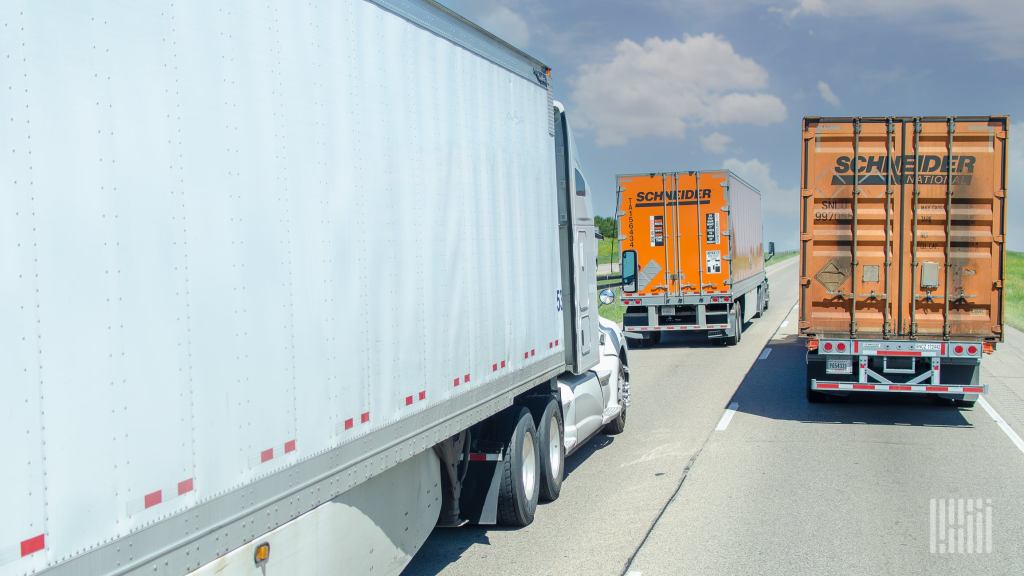
A Schneider tractor-trailer next to a Schneider intermodal container being pulled on a highway

Schneider National reported a big earnings miss Thursday and cut its outlook for the remainder of the year.

Earnings per share of 20 cents were below a consensus estimate of 37 cents, an adjusted second-quarter result of 45 cents and a year-ago result of 70 cents.

“Our results were driven by ongoing price pressures primarily in our network businesses, as well as other headwinds such as fuel, bad debt, and lower equipment gains,” President and CEO Mark Rourke said in a news release.

Retail diesel prices were off 15% year over year (y/y) in the quarter but increased more than 20% from the beginning to the end of the period, which didn’t allow fuel surcharge mechanisms to keep pace. Combined with an increase in bad debt expense due to customer bankruptcies and lower gains on equipment sales, the total impact was $18 million, or 8 cents per share.

Lower gains from equity investments were a 10 cent headwind y/y. A lower tax rate was a 1 cent tailwind, which was offset by a 1 cent headwind from higher interest expense due to an increase in debt from an acquisition.

Schneider (NYSE: SNDR) cut 2023 EPS guidance to a range of $1.40 to $1.45, a 22% reduction from the August forecast and well below a consensus estimate of $1.78. The company’s initial 2023 EPS guidance was $2.15 to $2.35 in early February.

The company doesn’t expect a lift in volumes in the fourth quarter as seasonal project opportunities failed to materialize. Lower gains on equipment disposals will again be a headwind. However, it expects fuel costs to moderate and noted further rate reduction is unlikely as all of its contracts from the recent bid season have been repriced.

Schneider is expecting 2024 to be a “transition year” with slow and steady improvement in fundamentals.

Table: Schneider’s key performance indicators

Truckload revenue fell 6% y/y (up slightly compared to the second quarter) to $535 million. Revenue per truck per week was down 16% y/y in the company’s one-way segment, partially offset by a 2% increase in the dedicated fleet. The metric was off 2% from the second quarter when combining both fleets.

The dedicated fleet’s contribution of total TL revenue increased to 61% from 54% a year ago. In August, Schneider acquired dedicated carrier M&M Transport Services, which was operating 500 trucks at the time.

The TL segment’s adjusted operating ratio deteriorated 1,000 basis points to 95.4% due to lower one-way rates, lagging fuel surcharges, costs to onboard new dedicated customers and an uptick in bad debt expense. The adjusted OR was 760 bps worse than the second quarter.

Management said customer conversations around contract renewals and pricing are getting more constructive. Schneider will continue to reduce its spot market exposure and noted that there is little room left to move lower on contract rates.

“The bites have been taken out of the apple and there’s no apple left,” said retiring CFO Steve Bruffett on a Thursday call with analysts.

Intermodal revenue was down 21% y/y (up 1% from the second quarter) to $263 million. Loads were off 9% y/y and revenue per load was down 16%. Intermodal volumes improved throughout the quarter and through October. Average container turns fell 5% y/y but improved 4% sequentially.

The segment recorded a 95.8% OR, which was 510 bps worse y/y and 490 bps worse sequentially.

Logistics revenue was off 30% y/y (down 5% from the second quarter) to $326 million. Brokerage loads were down 11% y/y with declines in revenue per load closing the gap on the overall revenue decline. The unit’s OR deteriorated 340 bps y/y to 97.4%.

Shares of SNDR were off 10.7% at 11:53 a.m. EDT Thursday compared to the S&P 500, which was up 1.4%.

More FreightWaves articles by Todd Maiden

Canadian Trucking Alliance wants drivers to report fraudulent carriers

The Canadian Trucking Alliance (CTA) is taking steps to crack down on a business model known as Driver Inc., a tax avoidance scheme that abuses workers and hurts the transportation industry, according to CTA President Stephen Laskowski. 

“Federal and provincial entities have said they stand with CTA in eliminating the abuse by the organizers of the Driver Inc. scheme, which is plaguing our workforce,” Laskowski said in a news release. “This scheme is extensive and undermines several government systems and, as such, we need all relevant agencies to simultaneously focus their enforcement branches on these violators.”

In Canada, misclassifying truck drivers as independent contractors is known throughout the trucking industry as Driver Inc. — a business model involving a carrier telling a driver who does not own a truck to register as a corporation and sell its driving services to the company.

Using the Driver Inc. model, carriers can avoid paying taxes and benefits to workers, while also often disregarding labor laws by withholding wages and payments to drivers. The CTA and other trucking association partners want their members and all compliant carriers to report cases of suspected Driver Inc. carriers to federal agencies.

Reports of noncompliance can be directed to the Canada Labour Code, the Tax Code, Workers Compensation Boards, Provincial Revenue Authorities, the Temporary Foreign Worker Program and other government programs, the CTA said.

A tip sheet created by CTA includes what types of information should be included if drivers or carriers suspect a company of using Driver Inc. and how to send or report the information.

Information that should be included when contacting authorities includes why a business or person is believed to be cheating, dates or length of time the suspected cheating occurred, how it was achieved and whether anyone else was involved.

Tips could provide the basis for formal investigations and audits on companies suspected of gross violations using the Driver Inc. model, CTA said.

“Many employers and workers have respect for Canada’s laws. … But not all companies want to follow the rules — they circumvent the system by avoiding taxes and denying employees basic labor rights and, consequently, our industry and society are paying the price for this noncompliance,” Laskowski said. 

The Manitoba Trucking Association (MTA) said it’s estimated that Driver Inc. is costing the Canadian government as much as $1 billion annually

“While it may seem like this scheme is merely a convenient loophole for carriers to take advantage of, there are serious consequences associated with Driver Inc.,” MTA said on its website. “Very often, workers’ compensation board remittances are not made, either by the carrier or driver using this scheme. … If these drivers are injured, they very often do not have their own coverage.”

In July, a group called Justice for Truck Drivers held a rally outside Toronto’s federal labor program office to bring attention to wage theft in the trucking industry. Justice for Truck Drivers includes 42 people who said collectively they are owed more than $300,000 in unpaid wages from several different carriers.

The money members of Justice for Truck Drivers said they are owed is part of approximately $9 million in unpaid wages that companies in the Canadian province of Ontario failed to pay out to employees in the 2021-22 fiscal year, according to data from Canada’s Ministry of Labour.

Worker advocates told FreightWaves that wage theft is an exploitative practice that is often part of misclassifying truckers under the Driver Inc. model. 

“The majority of cases that come to us regarding wage theft or anything else, the driver has been misclassified by their employer,” Navi Aujla, executive director of Brampton, Canada-based Labour Community Services of Peel, told FreightWaves. “When there’s misclassification, employees aren’t getting their full rights, employers are taking part in practices that would never be acceptable when someone is an employee.”

Click for more FreightWaves articles by Noi Mahoney.

More articles by Noi Mahoney

Trimble’s transportation revenue jumps 35% in Q3

US mulls terminating tomato trade agreement with Mexico

Universal Logistics’ Q3 earnings decline in ‘sluggish freight market’

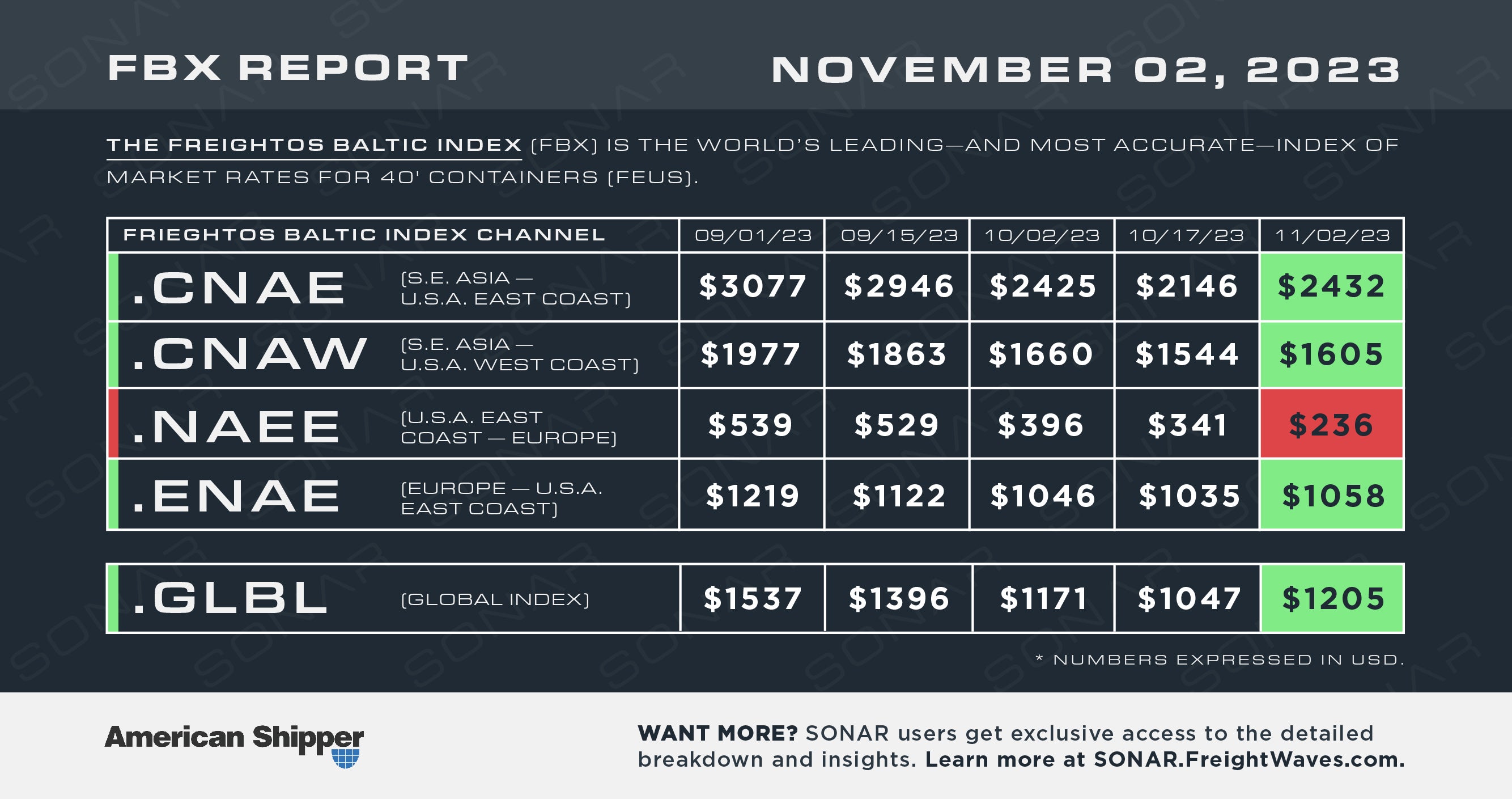
FBX Report: November 02, 2023


To learn more about FreightWaves SONAR, click here.

Nikola electric truck recall price tag $61.8M

Nikola fire screengrab from ABC 15

Nikola Corp. has set aside $61.8 million to replace the batteries in its recalled electric trucks. The company expects to begin returning repaired trucks to customers in the first quarter.

The accrued liability in third-quarter earnings includes the estimated cost to reengineer, validate and retrofit the 209 recalled battery-electric trucks with an alternative battery pack. Nikola did not identify the supplier.

“Upon further investigation, it was determined that the compromise of the battery packs was not limited to only the coolant manifold,” Nikola said in a news release. “As a result, our team has decided to replace the Romeo packs on existing customer battery-electric trucks with an alternative solution.”

Unlike most safety recalls where the supplier of the defective component contributes to the recall cost, Nikola owned Romeo Power. Therefore, it bears the recall costs alone. 

Recall cash spend should be less than accrual

Nikola expects to spend less than the accrual. Selling off the remaining battery-electric trucks in inventory should bring in $13 million. Nikola expects another $10.7 million coming from accounts receivable. That means spending $38.1 million over the next nine to 12 months. The company has said it will assemble battery-electric trucks as orders are received.

Nikola in June liquidated Romeo. Its assets were sold to Mullen Automotive. Nikola reported a $101 million loss from discontinued operations during the quarter.

Despite the recall, Nikola said it received an order for 47 battery-electric trucks from one dealer in Q3.

Nikola shipped three trucks, bought back seven and built no new units during the quarter. It reported negative revenue of $1.7 million. The startup lost $425.8 million, or 50 cents a share. That compared to a loss of $236.2 million, or 54 cents, a year ago. However, following the recent doubling of authorized shares, Nikola had 857.2 million outstanding shares compared to 438.4 million a year ago.

The company improved its cash and equivalents to $362.8 million, mostly through the sales of new equity. The money is sufficient to cover the recall expense and run the business into 2024, CFO Stacy Pasterick said on a call with analysts.

Nikola focusing on selling fuel cell trucks in California

Nikola began producing fuel cell electric vehicles (FCEVs) on Sept. 28. It has 277 nonbinding orders from 35 customers.

“We think the competition is well behind us and believe there is white space for us to capture market share with the introduction of the Advanced Clean Fleets Rule,” CEO Steve Girsky said.

The company is mining business based on California voucher programs that cut up to $288,000 from the price of a fuel cell truck for a large fleet and up to $408,000 for a small fleet of 20 or fewer trucks.

“We are driving forward, capitalizing on our first-mover advantage with our hydrogen fuel cell electric truck and laying the foundation for the ‘hydrogen highway’ starting in California,” Girsky said.

Nikola has mobile fueling and availability of hydrogen fuel to last into the first quarter of 2024. It has slowed plans for mobile fuelers to conserve costs and because early customers are using less fuel than expected. Startup infrastructure developer Voltera is Nikola’s partner in planning eight hydrogen fueling stations at sites it is developing in California.

Nikola sees tailwinds from the adoption of zero-emissions vehicles, specifically in California, where all new drayage trucks registered with the California Air Resources Board beginning Jan. 1, 2024, must emit zero tailpipe emissions. 

So far, so good

Nikola said its Tre FCEV Class 8 truck accounts for 96% of the California’s Hybrid and Zero-Emission Truck and Bus Voucher Incentives Project (HVIP) for fuel cell trucks through last Friday. Its battery-electric trucks are listed in 50% of Class 8 vouchers issued.

More than 30,000 trucks operating in California ports will eventually need to be replaced.

“We believe this represents a significant opportunity for Nikola in the near term and are well on our way to capturing market share,” the company said.

Nikola will replace batteries in fire-prone electric trucks

Nikola will recall 209 battery-electric trucks following 2 fires 

Stock slides into reverse after Nikola doubles authorized share count

Click for more FreightWaves articles by Alan Adler.

The role of integration software in last-mile logistics

By Frank Kenney

The views expressed here are solely those of the author and do not necessarily represent the views of FreightWaves or its affiliates.

E-commerce spending is growing rapidly, with total spending in 2022 exceeding $1.03 trillion, an increase of 7.7% from the previous year. With more orders being shipped directly to their destinations, last-mile delivery has become an integral part of efficient supply chains.

Technology plays an increasingly important role in making it even more efficient. When considering the challenges of last-mile delivery, leveraging ecosystem integration software and strategies provides significant benefits to — and a smoother enablement of — efficient last-mile delivery.

Challenges of last-mile delivery

The expenses associated with increased labor and additional vehicle mileage when transporting products to customers’ homes in final-mile delivery operations can be significant. Paying for last-mile delivery makes up 41% of all supply chain spending. This is why logistics companies are looking for ways to streamline the process and optimize supply chain spending. Associated costs include packaging materials and fuel expenses, as well as storage and warehousing for items that require refrigerated transport. Navigating these budget-breaking challenges requires well-thought-out strategies that optimize operations across the entire supply chain ecosystem to improve efficiency.

Despite these challenges and the costs associated with final-mile delivery, companies must recognize that customers and consumers absolutely love rapid delivery. In fact, nearly half (44%) of consumers are only willing to wait two days for an order to be delivered, and 72% of Amazon Prime users cite unlimited free delivery as the most important benefit of the service. This shows that rapid delivery, without significantly extra cost, is a driver of consumer loyalty that will bring customers back to a company again and again — so long as that company can fulfill rapid delivery promises.

Innovation in last-mile delivery

With Amazon Prime, Target, Walgreens and others offering same-day delivery, there is a greater need for faster and more reliable last-mile delivery solutions that are competitive with similar services. Customers have come to expect almost instantaneous delivery, while logistics and transportation companies continue to struggle with the challenges of same- or next-day delivery — largely due to workforce recruitment and retention, increasing fuel costs and the complexity of coordinating rapid deliveries. This is forcing logistics experts to innovate approaches to moving goods through the final mile. Some of the cutting-edge technology being utilized includes using autonomous drones, automated warehouses, self-driving vehicles and robots to increase speed and efficiency in the last mile.

An ecosystem-enablement approach to last-mile delivery

Last-mile delivery, whether automated or traditional, often involves utilizing various distribution channels and partners across a business’ supply chain ecosystem. It is also likely that the companies operating those various distribution channels have different delivery tracking and planning systems, capabilities and requirements.

To have clear communication between partners and logistic companies, data must be connected across various silos throughout the entire ecosystem by deploying integration technology. To have full visibility and control of final-mile deliveries, businesses must invest in an ecosystem integration platform that enables real-time sharing of data and updates across partner systems and workflows. This enables enhanced tracking and communication across all distribution channels and stakeholders involved in the last mile.

Integration software is necessary to navigate hectic supply chains, especially at the last mile. By connecting business systems between suppliers and partners that enable final-mile delivery, organizations can gain full visibility into what is happening in outsourced or partner-provided logistics operations. In fact, 99% of companies acknowledge they are losing money and missing out on business opportunities due to supply chain integration problems. This impact has motivated most companies (80%) to allocate 10% or more of their budget toward advancing their supply chain technology and integrating their business systems to enable greater visibility and efficiency in the last mile.

This is especially important as portions of last-mile delivery become autonomous. For example, if a fleet of unmanned drones is delivering along the last mile, it is imperative that it has direct communication with human-in-the-loop controllers as well as access to real-time updates from business systems that manage customer orders and preferences.

These human-in-the-loop controllers are not responsible for flying the individual drones. Rather, the human controller resolves flight path issues and scheduling conflicts stemming from multiple drones on delivery missions — one human can manage multiple drones, enabling a single human worker to execute multiple final-mile deliveries at once.

Possessing real-time access to customer and order management systems enables drones to incorporate last-minute requests and preference updates from the customer into active delivery missions.

Benefits of integration for last-mile delivery

Integration across the supply chain — all the way down to the final mile — is a crucial step that can offer tremendous benefits, especially as the last mile becomes more automated. The automation of final-mile delivery significantly reduces the level of human involvement required to ensure orders are delivered rapidly and in full. This not only reduces the cost of successful final-mile logistics operations but increases customer loyalty. However, enabling efficient automation requires connections between business systems that can facilitate real-time information exchanges and ensure last-mile delivery operations are executed in an optimal fashion.

Organizations that embrace ecosystem integration will not only find that they are able to automate last-mile delivery sooner but that the automated functions are more robust, controllable and predictable.

About the author

Currently a market evangelist and the strategy director at Cleo, Frank Kenney is widely credited as the creator of the term managed file transfer (MFT). He previously served more than 10 years as a research director at Gartner, where he defined the MFT, B2B gateway, SOA governance and cloud service brokerage markets.

CRST, back in the acquisition game, buys Larkin’s BCB Transport

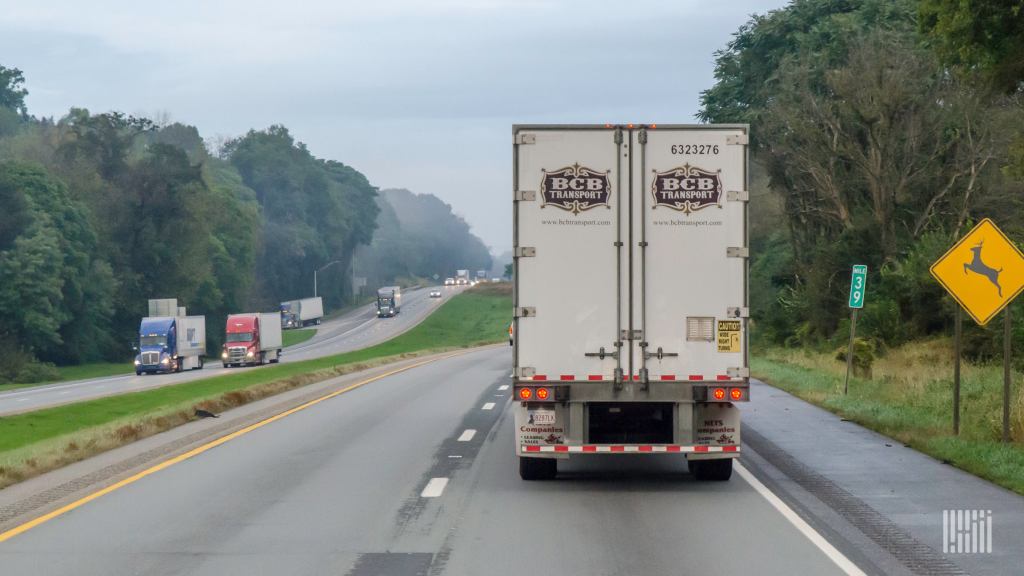
CRST has acquired BCB Transport, the Texas-based truckload carrier whose chief information officer and former president — and one of the co-founders in 2011 — is Rick Larkin, well known for his online channel BCB Live and his attire that always features a safety vest.

It’s the first acquisition for CRST since it bought final-mile provider NAL Group in 2020. That acquisition capped off a run of five purchases in six years: Specialized Transportation, BESL, Pegasus Transportation, Gardner Transportation and then NAL.

Larkin told FreightWaves he was limited in discussing the terms of the sale. But he did say he would continue to produce and host BCB Live.  Larkin co-founded BCB with Brian Brzozowski.

In response to written questions submitted to CRST, Hugh Ekberg, president and CEO, said Larkin “and all other leaders involved in the day-to-day business are staying with CRST to contribute to maximizing the potential of bringing the two businesses together.”

On its website, BCB said it has more than 300 trucks and was pursuing a plan to double its warehouse space. Ekberg, in his email, said the BCB acquisition will grow the CRST fleet by 10%.

“BCB brings an attractive productive mix of capacity options between company, independent contractor and brokerage,” he said. “BCB complements our business and brings some operating capabilities that will enhance and accelerate some of CRST’s current business initiatives. CRST’s business offers significant growth to the BCB operating model as well.”

In an article earlier this year in the Corridor Business Journal, which serves the Cedar Rapids-Iowa City area of Iowa where CRST is based, Jenny Abernathy, the company’s chief people officer, was quoted as saying CRST has 6,200 employees and another 2,000 independent contractors.

It also listed the company’s revenue as $2 billion. To put that number in perspective and in comparison to another Midwest-based truckload carrier, Werner Enterprises (NASDAQ: WERN) last year had revenue of about $3.3 billion. 

BCB recently made news when it said it had partnered with an AI provider, Optimal Dynamics, to use AI to automate some back-office operations, including load acceptance and dispatching. 

It said its first gains from the collaboration resulted in an almost 20% revenue gain per truck.

The BCB operations will be merged into CRST’s Capacity Solutions segment. According to Ekberg, that group provides dry van, refrigerated and flatbed one-way over-the-road trucking capacity.

The other solutions within CRST are Dedicated Solutions, which Ekberg described as dedicated contract carriage; Specialized Solutions, which he said handles “high-value products, specialty warehouse and project services”; and Home Solutions, which is home delivery of large products such as appliances and exercise equipment.

More articles by John Kingston

State of Freight takeaways: From the floor of a very weak trucking market

Tough freight market hits Echo’s debt ratings, down a notch at S&P

Cyberattack response plans need to be in place to avoid chaos