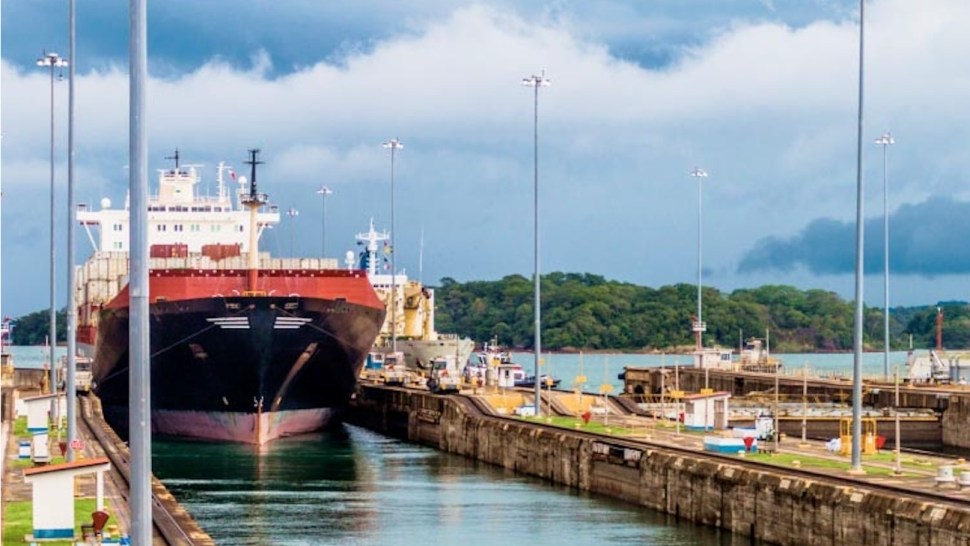
One of ocean shipping’s critical chokepoints just got a little tighter.
The Panama Canal Authority in an advisory to shipping reduced daily vessel transits beginning in September and postponed previously announced draft increases for Neopanamax vessels.
The measures reflect a deteriorating outlook linked to below-average rainfall and the prospect of a severe 2026–2027 El Niño weather event.
The early warning indicates that the water supply in Lake Gatun supplying the canal’s lock system is again becoming a direct constraint on the reliability, cost and routing of cargo moving through U.S. East Coast and Gulf Coast ports.
The authority said rainfall across the Canal watershed during the May–August period was 34% below historical average, while watershed inflows were 44% below average. Although Panama’s rainy season had begun, the ACP said the watershed was not producing the expected hydrologic response. Forecasts also pointed to additional precipitation and runoff risks during the remainder of the wet season.
The authority’s concern is not limited to current lake levels. It is trying to conserve enough water to support reliable operations during the 2027 dry season, which runs from January through April, while also safeguarding water supplies for human consumption.
The Sept. 4 reduction is from 36 to 34 daily transits, within an allocation of nine Neopanamax transits and 25 Panamax transits.
The subsequent Sept. 15 reduction takes capacity from 34 to 32 daily transits, as Panamax slots fall from 25 to 23 while super-sized Neopanamax capacity remains limited at nine.
The authority also postponed two planned draft changes. The maximum authorized draft of 48 feet in the Neopanamax locks will not take effect until Sept. 2, rather than Aug. 26. A subsequent adjustment to 47.5 feet, originally scheduled for Sept. 3, has been postponed until Oct. 1.
Draft restrictions not only affect the number of ships that can pass, but also the amount of cargo each ship can carry.
Why the United States is exposed
The Panama Canal Authority says the waterway handles approximately 5% of world trade and that more than 70% of the cargo moving through it originates in or is destined for the United States. About 72% of transiting ships are either bound for or coming from U.S. ports.
For U.S. logistics networks, the Canal is especially valuable because it connects Asian production centers with ports on the Atlantic and Gulf coasts without requiring vessels to sail on longer voyages around Africa’s Cape Horn or other alternative routes. Traffic includes containerized imports, agricultural exports, energy products, vehicle shipments, refrigerated cargo and other commodities.
The changes will be felt in ports from New York and New Jersey on the East Coast to Houston and New Orleans on the Gulf. A reduction in Canal capacity can affect vessel schedules, equipment positioning and terminal workload thousands of miles away.
A capacity problem, not simply a delay problem
The new limits also introduce greater competition for reservations. The ACP states that a confirmed reservation is the only mechanism that guarantees a transit date and requires customers to use the Canal’s Transit Reservation system to reduce the risk of extended delays. That’s a planning problem for carriers with several moving parts:
- Securing a slot becomes more important and potentially more expensive
- A vessel without a guaranteed transit date may arrive before it can enter the Canal
- Lower draft limits may reduce the ship’s effective cargo capacity
- Customers may face less certainty over arrival dates and container availability
- Cargo owners may need to decide earlier whether to accept a longer alternative route
Some Asia-U.S. East Coast services could be rerouted through the Suez Canal or around the Cape of Good Hope. Those options add sailing distance and fuel consumption and expose cargo to other operational, security and weather risks. Other cargo could move through U.S. West Coast ports and then travel east by rail, but that would increase demand for intermodal trains, inland terminals, chassis and transload capacity.
Those volumes are already happening. The Ports of Los Angeles and Long Beach saw near-record throughput in July of close to 1.9 million TEUs, with continued elevated volumes expected in August.
Rates on the trans-Pacific for Asia-U.S. East Coast containers have risen by 42% since the start of the Iran war, according to analyst Xeneta, and now stand more than $3,300 higher than West Coast prices, at $10,527 compared to $7,193.
Those higher rates combined with Canal issues could spur a switch by importers to West Coast gateways. East and Gulf Coast terminals could receive fewer Canal-routed vessels but face more volatile arrival bunching.
Railroads could see additional demand for transcontinental intermodal moves; western lines suffered network slowdowns earlier this summer during an unexpected import surge through Southern California.
Implications for U.S. commerce
Beyond containerized consumer goods, U.S. agricultural exporters, particularly those shipping grain and other commodities from the U.S. Gulf, the Canal can provide an efficient route to Asian buyers. Restrictions can increase voyage times, complicate vessel scheduling and raise the delivered cost of U.S. exports already under pressure from the Trump administration’s chaotic trade and tariff policies.
For importers, the immediate concern is service reliability. Longer or less predictable transits can affect factory production schedules, retail replenishment, construction materials and inventories of industrial inputs. Freight costs may rise if carriers face higher fuel consumption, additional canal-related charges or the cost of repositioning vessels and containers.
Read more articles by Stuart Chirls here.
Read more:
Trans-Pacific shippers ‘leaving money on the table,’ says analyst
China growth straining global auto shipping capacity: Liner CEO
Zim profit rises on Q2 revenue of $1.78 billion
Green light for new U.S. port that will handle 2 million containers a year
F3: Future of Freight Festival
Industry-defining keynotes, rapid-fire technology demos, and industry leaders networking in experiences across Chattanooga - plus the inaugural F3 Awards Dinner featuring the FreightTech and Shipper of Choice reveals.
Industry-defining keynotes, rapid-fire technology demos, and industry leaders networking in experiences across Chattanooga - plus the inaugural F3 Awards Dinner featuring the FreightTech and Shipper of Choice reveals.
The Signal at Chattanooga Choo Choo • Chattanooga, TN Register Now