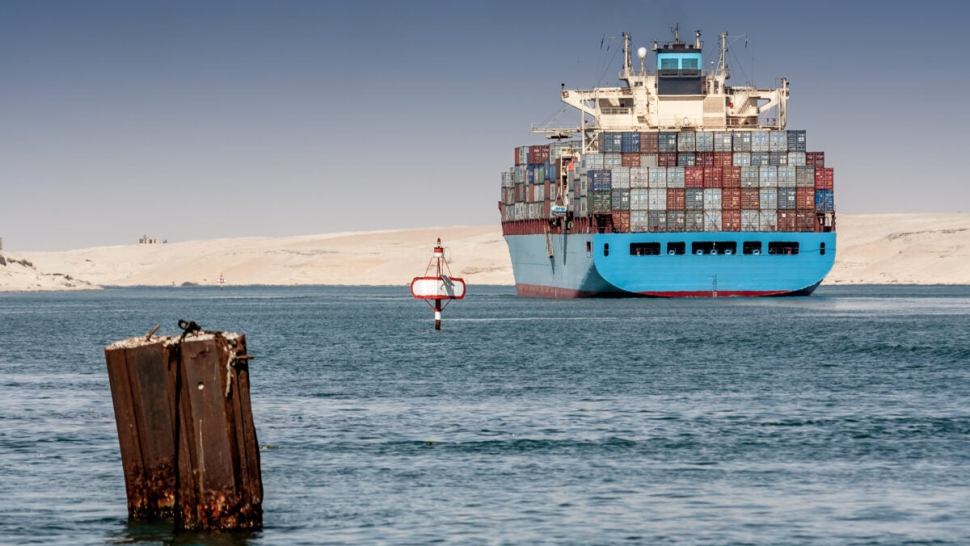
Ongoing attacks on vessels in the Red Sea by Yemen’s Houthis continue to disrupt shipping lanes in the chemical industry’s supply chain, according to Al Greenwood, chemicals expert and deputy editor at ICIS.
“It’s having an impact mainly in Europe and Asia. It’s rearranging routes because the rates for containers have really gone through the roof,” Greenwood told FreightWaves in an interview.
ICIS is a London-based provider of chemical and energy intelligence with 15 offices worldwide.
Greenwood said the Houthis are creating significant supply chain disruptions for chemical companies and governments.
“The chemical industry uses containers to ship plastics such as polyethylene and polypropylene which are in pellets, put it in bags and ship it out. Some of the liquids are shipped in ISO tanks,” said Greenwood, who is based in ICIS’ Houston office. “We’ve seen for container ships and tankers a combination of higher rates, port congestion, vessels having to take longer routes — it’s causing all kinds of delays.”
Polyethylene is a plastic used in everything from garbage and grocery bags to insulation for wires and cables to agricultural mulch, as well as bottles, toys, housewares and even knee joints. Polypropylene is a polymer used in pallets, bottles, jars, containers, cups and food packaging.
About 15% of the world’s ocean carrier traffic normally goes through the Red Sea, according to the International Monetary Fund. But now ships between Europe and Asia are instead going around the Cape of Good Hope on the southern tip of Africa, which can add anywhere from 10 days to a month of travel time compared to the Red Sea/Suez Canal route.
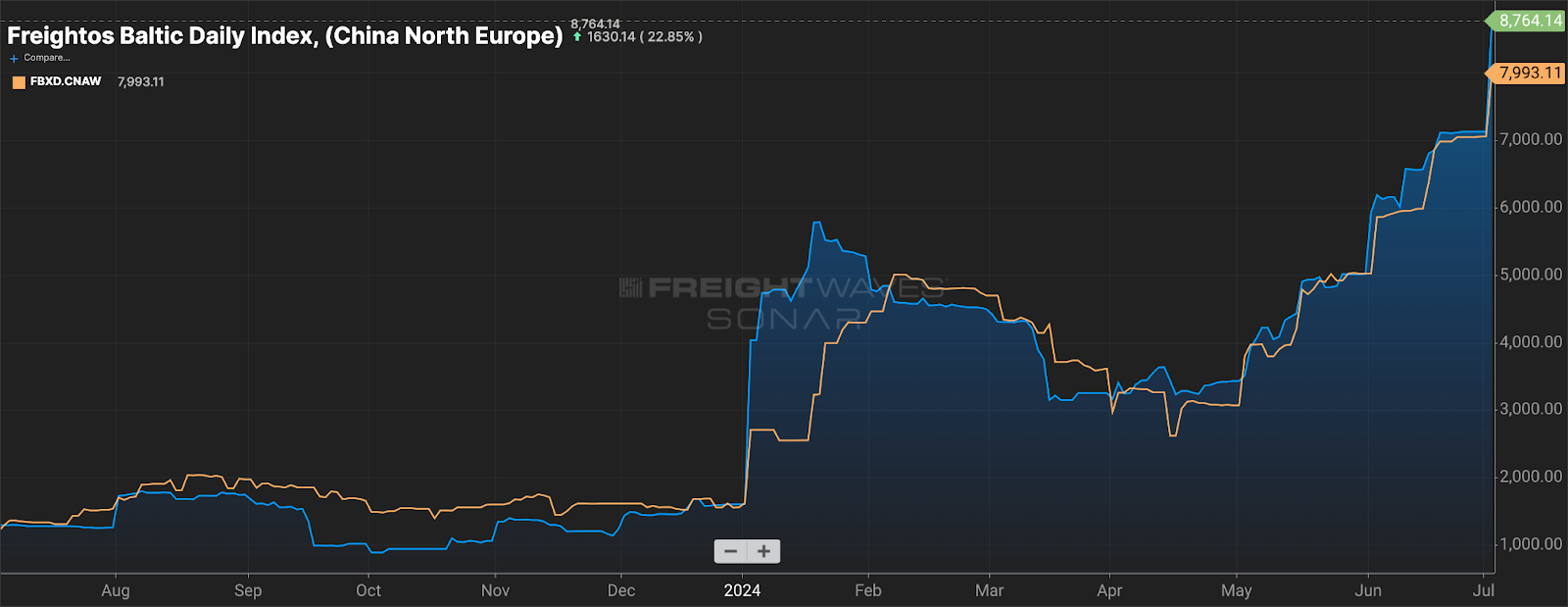
Rates for 40-foot containers from Asia to North Europe are at $8,764.14, according to the Freightos Baltic Daily Index, which measures the price movements of 40-foot containers in 12 major maritime lanes.
Related: Red Sea attacks reveal supply chain fragility
While the United States chemical supply chain is somewhat insulated from the disruptions in the Red Sea, Greenwood said the U.S. is still being impacted by the Houthi attacks.
Rates for 40-foot containers from Asia to North America West are currently at $7,993.11.
“Here in the United States, our main waterway conduit is the Panama Canal. We’re not as exposed to the Red Sea disruptions as Europe,” Greenwood said. “But shipping is a global market. The United States does export a lot of polyethylene, a lot of polyvinyl chloride. Those are bagged and pelletized, shipped in container ships. Well, those shippers are having to pay those higher rates as well, and they’re not happy about it.”
China is the world’s largest chemical producer
China is the world’s leading exporter of chemicals, accounting for $141.3 billion (18%) of global chemical exports in 2023, according to Tendata, an international trade data consulting agency.
The United States was the No. 2 global exporter of chemicals last year, accounting for $67.9 billion (8.8%) of global exports. The U.S. was the largest importer of chemicals in 2023, importing $324 billion, or 13.6%, of the total, according to TradeImeX.
Greenwood said rising freight rates, shipping delays and cancellations of shipments are causing containers full of chemicals to pile up in some Asian countries and ports.
“In India chemical buys for biphenyl are at a 20-month high because of tight vessel space and rising shipping costs. Melamine companies in China are on a wait-and-see mode because of higher freight rates. Polypropylene from South Korea, there’s been recent cancellations on some of the shipments to Europe. For Asian polyester exports, the sentiment is just awful because of the high costs and poor margins,” Greenwood said.
The extended and more expensive shipping routes around Africa to avoid the Red Sea will likely continue through the rest of the year, Greenwood said. The results will continue to ripple through the global supply chain and be increasingly felt by regular consumers in the form of higher prices and less availability of certain products.
“We’re seeing chemical buyers take some measures to try to remediate or make the best of this situation. There’s been an increase in demand for breakbulk vessels from Turkish, European and Indian buyers,” Greenwood said. “The buyers are getting the brunt of this. That’s why in Europe, they’re turning to domestic suppliers for chemical production. That’s why they’re exploring breakbulk vessels because of the shortage of container ships.”
Brokerage Compliance Symposium
The day before F3. Every compliance issue you face - fraud exposure, carrier liability, FMCSA rules, cargo theft, insurance gaps - navigated by attorneys and operators defining best practices in a changing industry.
F3 Awards Dinner
The night before F3. FreightTech100 companies honored. FreightTech 25 and Shipper of Choice winners revealed live. Cocktail reception into dinner and live music - 300 industry leaders in one purpose-built room.
F3: Future of Freight Festival
Industry-defining keynotes, rapid-fire technology demos, and industry leaders networking in experiences across Chattanooga - plus the inaugural F3 Awards Dinner featuring the FreightTech and Shipper of Choice reveals.
The day before F3. Every compliance issue you face - fraud exposure, carrier liability, FMCSA rules, cargo theft, insurance gaps - navigated by attorneys and operators defining best practices in a changing industry.
The Signal at Chattanooga Choo Choo • Chattanooga, TN Register NowThe night before F3. FreightTech100 companies honored. FreightTech 25 and Shipper of Choice winners revealed live. Cocktail reception into dinner and live music - 300 industry leaders in one purpose-built room.
The Signal at Chattanooga Choo Choo • Chattanooga, TN Register NowIndustry-defining keynotes, rapid-fire technology demos, and industry leaders networking in experiences across Chattanooga - plus the inaugural F3 Awards Dinner featuring the FreightTech and Shipper of Choice reveals.
The Signal at Chattanooga Choo Choo • Chattanooga, TN Register Now