




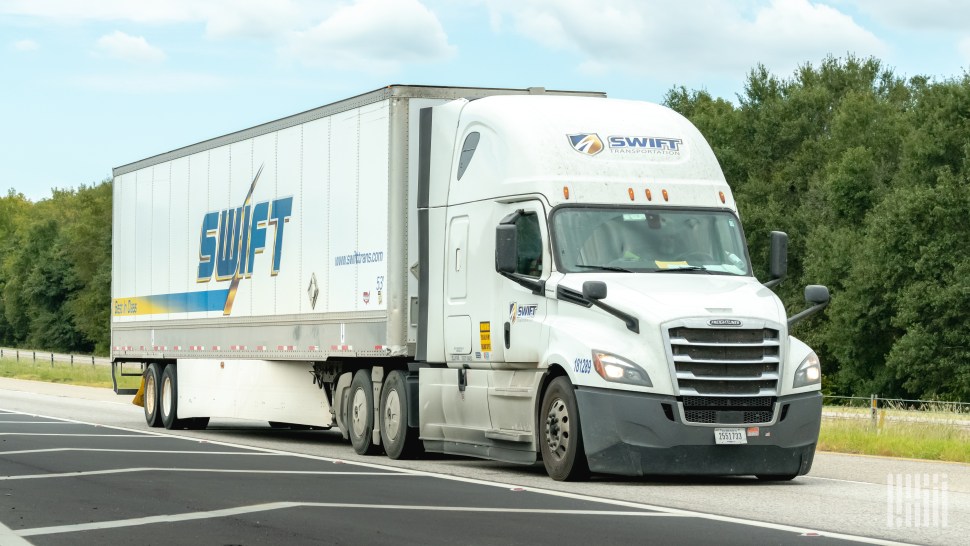
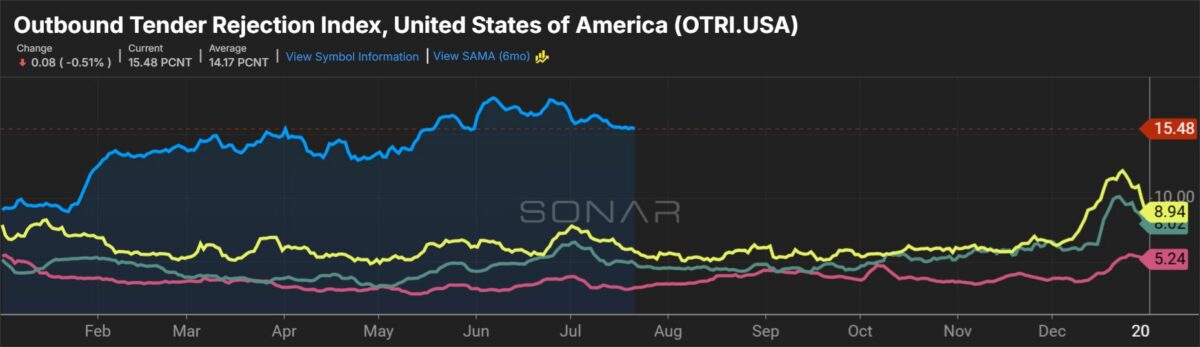
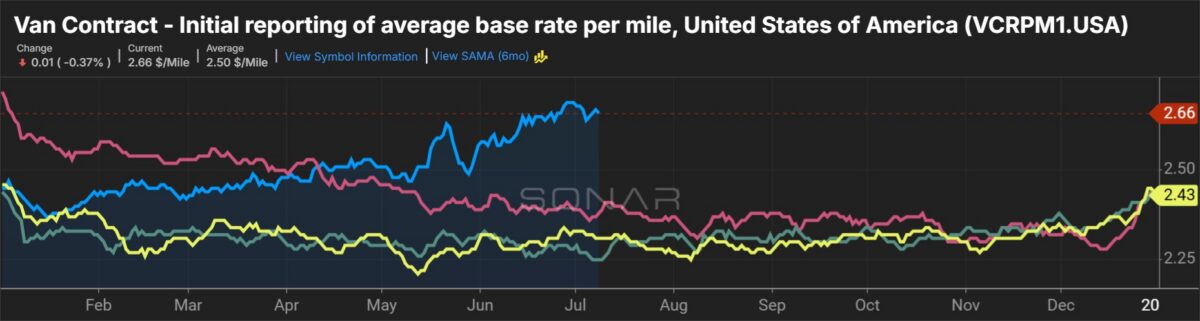
Regulatory authorities continued to force out non-compliant capacity in the second quarter, creating a “rapid progression in truckload market conditions,” according to Knight-Swift Transportation. The carrier reported better-than-expected results on Wednesday, highlighted by contract rates that climbed throughout the period and a tender rejection rate that was twice the industry average. It expects the positive momentum to intensify starting in September and to carry through the rest of the year.
“We’ve just never seen the FMCSA, the DOT with the push that they’re making on cleaning up our industry and taking the non-compliant, the bad actors out of it,” said CEO Adam Miller on a Wednesday evening call with analysts.
He believes the change the industry is experiencing is “durable” and “raises the floor” for rates in the next downturn.
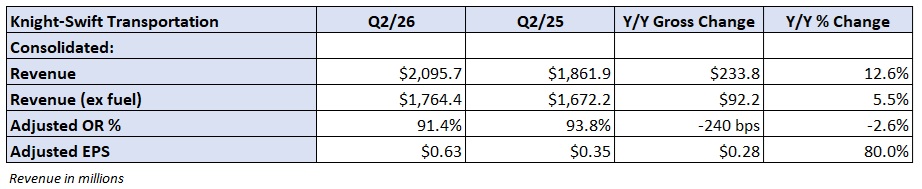
Knight-Swift (NYSE: KNX) reported second-quarter adjusted earnings per share of 63 cents, 28 cents higher year over year and 12 cents better than the consensus estimate. (Management’s EPS guidance range was 45 to 49 cents.)
Revenue of $2.1 billion was 13% higher y/y and ahead of the $2.04 billion consensus estimate. Revenue was up 6% y/y excluding fuel surcharges.
Inflationary TL rate cycle just beginning
Truckload revenue increased 3% y/y to $1.1 billion as a 6% increase in revenue per tractor was only partially offset by a 3% decline in average trucks in service.
The carrier has improved asset utilization through enhanced load planning tools. Deadhead was down 140 bps y/y and 70 bps sequentially. Loaded miles per tractor (up 0.2% y/y) improved y/y for a seventh straight quarter. Before adding any new tractors, management noted that there is significant opportunity to enhance utilization, particularly since some trucks remain unseated.
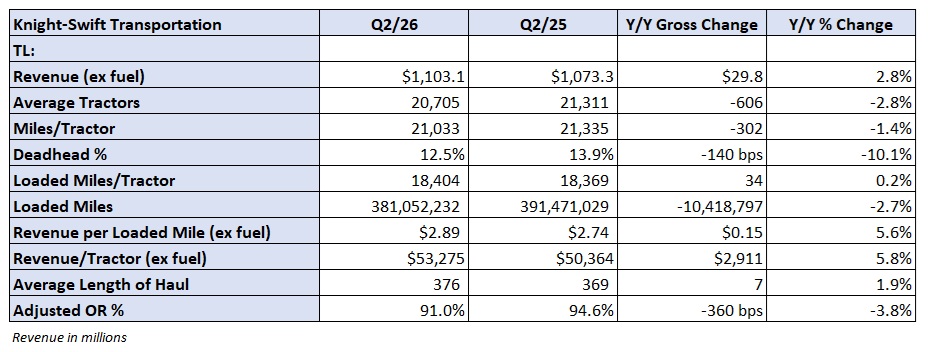
Revenue per loaded mile increased 5.6% y/y (excluding fuel) to $2.89. The metric is “just beginning to recover” as contract rates roll over. Most of the rate implementations in the quarter came from bids negotiated earlier this year and didn’t reflect a tighter supply backdrop.
Rate per loaded mile accelerated from low-single digits in April to 8% in June. (The over-the-road fleet saw double-digit increases in June.) The June number had the benefit of some project freight, but it also included a headwind from dedicated (28% of the TL fleet) where rate changes are less volatile and indexed to inflation.
The rate picture continues to improve. The carrier is getting double-digit rate increases on recent bids, and its spot market exposure is up to 15% from 10% at the start of the year.
The TL unit posted a 91% adjusted operating ratio (a 9% adjusted operating margin), which was 360 basis points better y/y. US Xpress’ over-the-road fleet was profitable for the first time since the 2023 acquisition.
Knight-Swift’s TL guidance calls for a mid-single-digit y/y revenue increase in the third quarter, with the adjusted OR improving 650 to 750 bps y/y (implying an 89.2% adjusted OR). Truck count is expected to be stable sequentially (lower y/y), with utilization also remaining level. Higher rates are the catalyst for the y/y revenue increase.
Driver pay to creep, not rip higher near-term
Management flagged driver pay as a creeping headwind but noted several ways to augment total driver compensation. It said it didn’t claw back any of the prior wage increases from the last upturn even as rates fell 20%-plus through the downturn. The company still has a long way to go to restore margins. It reported sub-80% ORs during the last peak.
Knight-Swift is only planning true wage hikes in select markets as there isn’t a current need to implement broad-based increases. Improved asset utilization (more paid miles for drivers) will raise existing driver pay packages. It noted that the labor market is looser than it was during the prior upturn and that it’s not competing against government stimulus like it did in 2021.
Other Q2 segment results, Q3 outlook
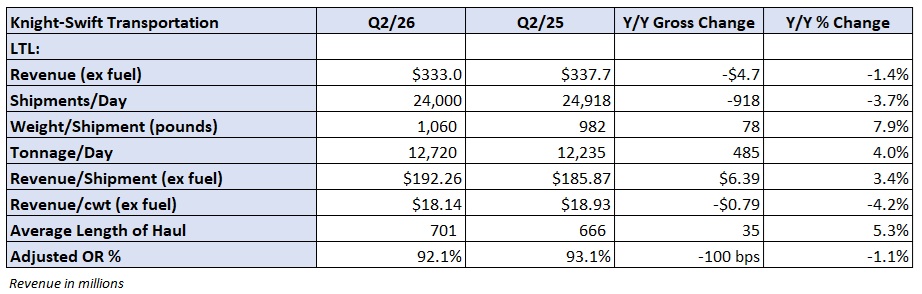
Less-than-truckload revenue declined 1% y/y to $333 million as a 4% tonnage increase was offset by a 4% decline in yield (ex-fuel). Shipments per day were down 4% y/y, but the declines lessened as the quarter progressed (down 6.5% y/y in April, down 3.2% in May and down 1.3% in June). Temporary embargoes to achieve desired service levels and a changing freight mix drove the declines.
Weight per shipment was up 8% y/y, which dragged down the yield metric. However, the yield headwind was partially offset by a 5% increase in length of haul. The company said contractual rate increases were up again by a mid-single-digit percentage in the quarter.
The unit recorded a 92.1% adjusted OR, 100 bps better y/y.
Revenue is expected to increase y/y by a low-single-digit percentage in the third quarter, with an adjusted OR in the low-90% range.
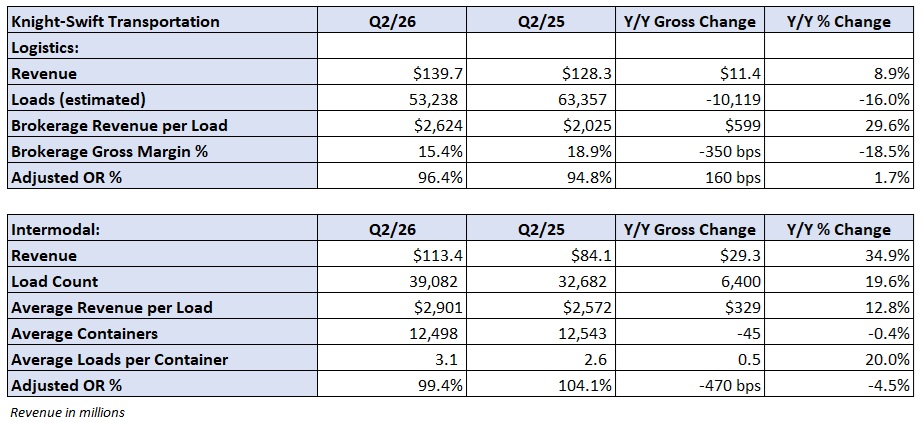
Logistics revenue increased 9% y/y as a 30% increase in brokerage revenue per load was partially offset by a 16% decline in volumes. The company said the volume weakness was driven by “further enhancements to our rigorous carrier screening practices.” Elevated purchased transportation costs (gross margin eroded 350 bps y/y) resulted in a 96.4% adjusted OR, 160 bps worse y/y. The unit is expected to see steady revenue and margin trends (sequentially) in the third quarter.
Intermodal returned to profitability at a 99.4% adjusted OR. Revenue was up 35% y/y as volumes grew 20% and revenue per load increased 13%. In the third quarter, intermodal revenue is expected to increase by a low-single-digit percentage sequentially (roughly 25% higher y/y), with the OR coming in slightly better than the second quarter.
Knight-Swift issued third-quarter adjusted EPS guidance of 71 to 77 cents, which was better than the 71-cent consensus estimate at the time of the print.
The second-quarter adjusted EPS result excluded several acquisition-related, restructuring, severance and non-cash impairment costs. The period benefitted from lower interest expense and higher gains on equipment sales (a 5-cent y/y tailwind).
Shares of KNX were off 0.5% in after-hours trading on Wednesday.
Why it matters? Serving as a bellwether for TL market trends, Knight-Swift is the nation’s largest asset-based carrier. The company’s second-quarter results highlight that the market has transitioned from a cyclical downturn to a structural recovery.
Brokerage Compliance Symposium
The day before F3. Every compliance issue you face - fraud exposure, carrier liability, FMCSA rules, cargo theft, insurance gaps - navigated by attorneys and operators defining best practices in a changing industry.
F3 Awards Dinner
The night before F3. FreightTech100 companies honored. FreightTech 25 and Shipper of Choice winners revealed live. Cocktail reception into dinner and live music - 300 industry leaders in one purpose-built room.
F3: Future of Freight Festival
Industry-defining keynotes, rapid-fire technology demos, and industry leaders networking in experiences across Chattanooga - plus the inaugural F3 Awards Dinner featuring the FreightTech and Shipper of Choice reveals.
The day before F3. Every compliance issue you face - fraud exposure, carrier liability, FMCSA rules, cargo theft, insurance gaps - navigated by attorneys and operators defining best practices in a changing industry.
The Signal at Chattanooga Choo Choo • Chattanooga, TN Register NowThe night before F3. FreightTech100 companies honored. FreightTech 25 and Shipper of Choice winners revealed live. Cocktail reception into dinner and live music - 300 industry leaders in one purpose-built room.
The Signal at Chattanooga Choo Choo • Chattanooga, TN Register NowIndustry-defining keynotes, rapid-fire technology demos, and industry leaders networking in experiences across Chattanooga - plus the inaugural F3 Awards Dinner featuring the FreightTech and Shipper of Choice reveals.
The Signal at Chattanooga Choo Choo • Chattanooga, TN Register Now