Retail diesel prices are continuing their steep fall against a background of analysts who are mostly trying to tell everybody the decline should not be assumed as the end of a war-driven era of higher prices.
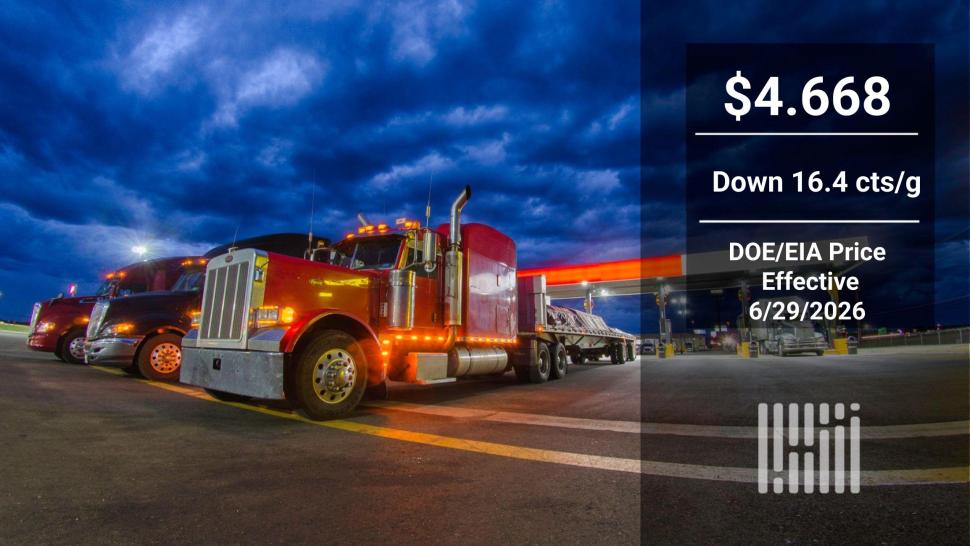
The Department of Energy/Energy Information Administration average retail diesel price fell for the eighth consecutive week, declining 16.4 cents/gallon to $4.668/g, published Tuesday, effective Monday.
With that lower number, the price used for most fuel surcharges is now down 97.2 cts/g from the $5.64/g price of May 4. Since then, the eight declines have ranged in size from 0.1 cts/g to 22.7 cts/g, posted a week ago.
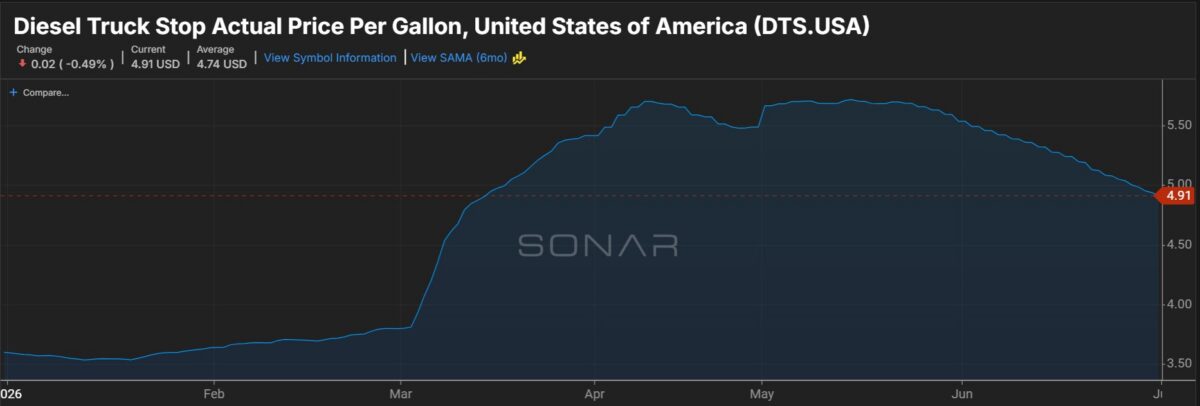
While the DOE/EIA number is the basis for most fuel surcharges, the volatile fuel market means that other indicators of the retail price of diesel are flashing widely divergent numbers. For example, the daily AAA national average detail price was $4.853/ Tuesday, while the DTS.USA average retail diesel price for Tuesday was $4.91/g.
Retail prices generally lag changes in futures and wholesale prices by several days (though wholesale and futures prices tend to move in a relatively tighter correlation.)
The FUELS.USA data series in SONAR is showing that the spread is relatively elevated, coming in Tuesday at $1.59/g in SONAR. When the Iran war began, it was about 75 cts/g. The latest number is down from more than $1.85/g early last week.
In the ultra low sulfur diesel market on CME, prices have been on a slight upward trend. After settling at a recent low of $3.0931/g on June 22, ULSD settled Tuesday, the final day for the July contract, at $3.3168/g, down about 1.5 cts/g for the day.
The number that is grabbing the attention of many in the market, and which oil bulls now are pointing to as strengthening their case that the recent broad market declines might not be sustainable, is the crack spread reflecting the strength of product prices relative to crude.
The 3:2:1 crack spread, which measures the spread between three barrels of crude on one side of the equation and two barrels of gasoline plus one barrel of diesel on the other side, is near record territory.
Just based on front month settlements Monday on the CME commodity exchange, the 3:2:1 for global crude benchmark Brent was almost $60/b. (There are other ways to measure it as well, but they all come up with enormous numbers compared to historical norms).
Just before the Iran war began, that number was about $22/b.
Currie the market bull
The most prominent voice pointing to those product prices and the crack spread as signaling a tighter market than crude might otherwise suggest has been Jeffrey Currie. He is the former head of commodity research at Goldman Sachs, now co-chair of Abaxx Markets and a frequent commenter on business news programs.
Currie, in an interview Friday on CNBC, said the crude market currently is in surplus because of the sudden rush of oil that has gotten out of the Strait of Hormuz, including Iranian oil that had been sanctioned by the U.S. but which now can move freely as a result of the peace deal with the U.S.
“We have surplus crude that’s hitting the market, but we have a shortage in products, so that shortage of the products is ultimately going to have refineries kick up their runs, chasing the good margins,” Currie said. “So I would view this as being temporary.”
Will they go back?
Also in an interview on CNBC, Helima Croft, Managing Director and the Head of Global Commodity Strategy and Middle East and North Africa Research at RBC Capital Markets, noted that focusing solely on how much oil is getting out of the Strait of Hormuz is only half the equation.
The other part, he said, is “whether companies feel comfortable going back the other way through the Strait.”
If they are not, then the sugar high of all that backed-up oil coming out of the region will be short-lived.
Until that happens, Croft said, “I don’t think we’re anywhere close to normalization of shipping flows.”
More articles by John Kingston
After a five-year wait, C.H. Robinson makes a broker acquisition
DeSantis KOs bill to allow CDL training of some Florida inmates
Brokerage Compliance Symposium
The day before F3. Every compliance issue you face - fraud exposure, carrier liability, FMCSA rules, cargo theft, insurance gaps - navigated by attorneys and operators defining best practices in a changing industry.
F3 Awards Dinner
The night before F3. FreightTech100 companies honored. FreightTech 25 and Shipper of Choice winners revealed live. Cocktail reception into dinner and live music - 300 industry leaders in one purpose-built room.
F3: Future of Freight Festival
Industry-defining keynotes, rapid-fire technology demos, and industry leaders networking in experiences across Chattanooga - plus the inaugural F3 Awards Dinner featuring the FreightTech and Shipper of Choice reveals.
The day before F3. Every compliance issue you face - fraud exposure, carrier liability, FMCSA rules, cargo theft, insurance gaps - navigated by attorneys and operators defining best practices in a changing industry.
The Signal at Chattanooga Choo Choo • Chattanooga, TN Register NowThe night before F3. FreightTech100 companies honored. FreightTech 25 and Shipper of Choice winners revealed live. Cocktail reception into dinner and live music - 300 industry leaders in one purpose-built room.
The Signal at Chattanooga Choo Choo • Chattanooga, TN Register NowIndustry-defining keynotes, rapid-fire technology demos, and industry leaders networking in experiences across Chattanooga - plus the inaugural F3 Awards Dinner featuring the FreightTech and Shipper of Choice reveals.
The Signal at Chattanooga Choo Choo • Chattanooga, TN Register Now