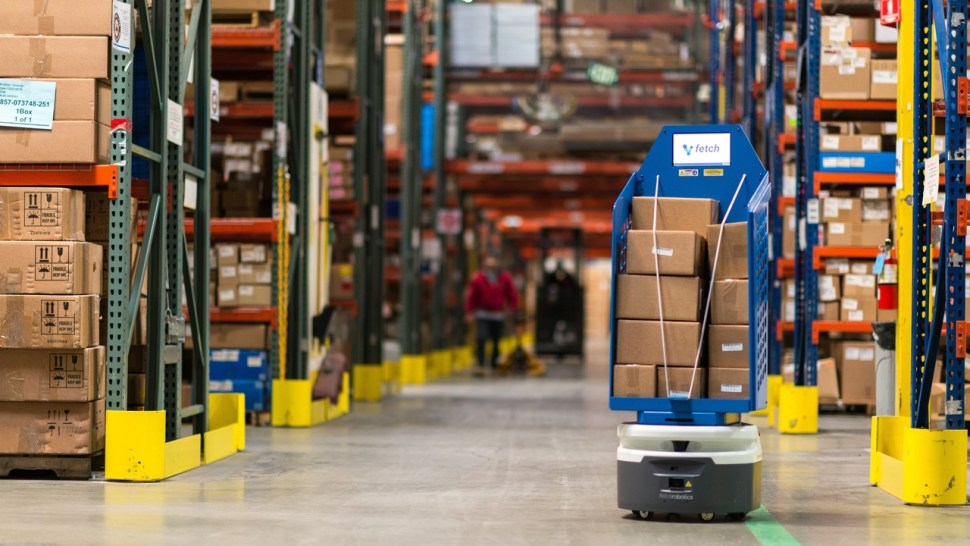
Artificial intelligence was the talk of the town at Manifest, but for venture capital investments, the machines themselves took center stage. FreightWaves spoke with Mike Plasencia, group director of new product strategy and RyderVentures at Ryder System, Inc. about technology trends and what they have been working on. He leads RyderVentures’ investment strategy across more than 20 portfolio companies.
For RyderVentures, there’s a convergence happening in the warehouse space that most in the industry are missing. The corporate venture arm of Ryder System has spent five years betting on disruptive technologies across advanced vehicle technology, e-commerce, digitization and warehouse automation.
“AI was definitely the belle of the ball last year for VC investment,” Plasencia said. “We’re also seeing a lot of energy in warehouse automation. That just continues to be a big area of growth and opportunity.”
The distinction is key. While autonomous trucks and robotaxis grab headlines, warehouse automation remains largely underpenetrated. There’s a clear utility, but Plasencia points to a specific reason: fear.
It’s a brave new world for AI that can operate in the physical world. Especially when many FreightTech companies are focused more on software solutions.
Physical AI Breaks the Single-Use Problem
The emerging trend Plasencia calls “physical AI” represents a blend of artificial intelligence models with warehouse hardware. It enables equipment to handle multiple use cases rather than being locked into a single application.
“In the past, you had some really good warehouse automation that handled specific use cases,” Plasencia said. “But I think now we’re seeing a lot of companies come to market where you can sort of bring these physical AI models to hardware that can now allow this hardware to handle multiple use cases and get up to speed a lot quicker.”
The flexibility argument cuts directly at the biggest barrier to adoption. Traditional warehouse automation requires significant capital investment for equipment that may become obsolete if business needs change. It used to be very expensive before the age of low-code to do software in a warehouse setting.
“Like, I buy it for a use case and what if my business changes? How do I redeploy that or how do I use that for something else?” Plasencia said. “That physical AI is gonna allow you to, one, increase the likelihood that that piece of automation is gonna fit for your use case — so greater chance of success — but also you have the flexibility to redeploy it to something else if your use case changes.”
The Capital Commitment Challenge
High upfront costs remain the primary hurdle preventing widespread automation adoption. Unlike software-as-a-service solutions, where the cost of switching vendors is relatively low, fixed capital investments in warehouse hardware are major commitments.
“You’re not buying one autonomous forklift. You might be buying dozens for a warehouse,” Plasencia said. “And now, what if you’re wrong? It’s a pretty big mistake.”
That risk calculus explains why penetration rates remain low despite the technology’s proven utility. Plasencia sees two areas accelerating in 2026: trailer unloading automation and new form factors that fundamentally reimagine warehouse design.
RyderVentures recently invested in Mytra, a company building what Plasencia describes as “almost like a big ASRS for pallets” where each pallet position operates as its own autonomous device within a matrix.
“Instead of an elevator getting and then getting moved up and then put away, each shelf, if you will, is its own autonomous device that can move along the racking to where it needs to be,” Plasencia said. “It’s constantly optimizing where it needs to be. It’s almost like slotting in real time.”
A “Brave New World” for Warehousing
The software-defined automation model eliminates traditional warehouse constraints. Rather than autonomous forklifts and mobile robots navigating aisles, goods move within a self-optimizing system.
Another challenge impacting warehousing is a lack of imagination. One example that can be compared to the current AI boom is to look back at the early adopters of electricity. For some, electricity, obviously a game changer, created challenges on how to use it. Some factories only used it to replace a single pump, others used bulbs for illumination. The most enterprising and successful users redesigned the factory itself to accommodate the new technology. Warehouses are on the cusp of a similar change, echoing other physical AI applications like autonomous vehicles.
“If you really had a pure-play autonomous vehicle, does it look like a truck anymore?” Plasencia said. “Well, it’s no different in the warehouse. In a future world, does racking look different?”
Consumer packaged goods companies are emerging as logical early adopters, though Plasencia declined to name specific customers.
For founders looking to attract investment in 2026, Plasencia offers direct advice: Table stakes AI isn’t enough.
“You’ve gotta really be able to show why the dataset or user base you’re serving or specialized knowledge is gonna make this a differentiated solution that gives you the time to build that beachhead to expand off of,” he said.
Now that technology is rapidly decreasing in costs, the moat in physical AI comes down to execution and expansion. Once inside an organization — navigating cybersecurity, IT compliance and trust-building — the winner keeps winning.
For warehouses and customers who don’t have the ability to go it alone, partnerships are proving a valuable substitute.
“If you’ve got a trusted partner that is delivering and continues to expand, you’re gonna stay with the horse you’ve got,” Plasencia said.
Brokerage Compliance Symposium
The day before F3. Every compliance issue you face - fraud exposure, carrier liability, FMCSA rules, cargo theft, insurance gaps - navigated by attorneys and operators defining best practices in a changing industry.
F3 Awards Dinner
The night before F3. FreightTech100 companies honored. FreightTech 25 and Shipper of Choice winners revealed live. Cocktail reception into dinner and live music - 300 industry leaders in one purpose-built room.
F3: Future of Freight Festival
Industry-defining keynotes, rapid-fire technology demos, and industry leaders networking in experiences across Chattanooga - plus the inaugural F3 Awards Dinner featuring the FreightTech and Shipper of Choice reveals.
The day before F3. Every compliance issue you face - fraud exposure, carrier liability, FMCSA rules, cargo theft, insurance gaps - navigated by attorneys and operators defining best practices in a changing industry.
The Signal at Chattanooga Choo Choo • Chattanooga, TN Register NowThe night before F3. FreightTech100 companies honored. FreightTech 25 and Shipper of Choice winners revealed live. Cocktail reception into dinner and live music - 300 industry leaders in one purpose-built room.
The Signal at Chattanooga Choo Choo • Chattanooga, TN Register NowIndustry-defining keynotes, rapid-fire technology demos, and industry leaders networking in experiences across Chattanooga - plus the inaugural F3 Awards Dinner featuring the FreightTech and Shipper of Choice reveals.
The Signal at Chattanooga Choo Choo • Chattanooga, TN Register Now