The Lesson Most Carriers Learn Too Late
When most fleet owners think about maintenance, they think repairs. They think of downtime, tow bills, and chasing mechanics. But if you’re planning to grow—and not just survive—the only way to keep your trucks moving is to build a proactive maintenance program, not a reactive one.
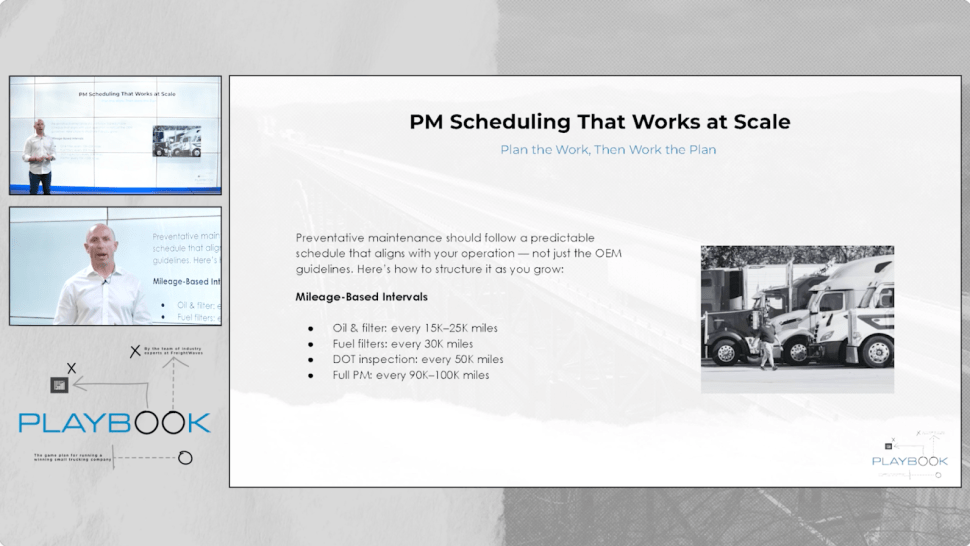
In this Masterclass, we brought in Tyler Harden from TTN Fleet Solutions, one of the most trusted names in fleet maintenance coordination, to drop a game on how 3-5 truck fleets (and beyond) can finally get their arms around preventable downtime.
And let’s be clear—downtime is what kills small fleets. Not rates. Not diesel. Not brokers. It’s the stuff that blindsides you when your truck is sidelined for something you could’ve caught weeks ago.
What the Data Says About Small Fleet Downtime
Tyler opened with a truth bomb: preventable maintenance issues are still the #1 reason for roadside failures across small and mid-sized fleets.
Think about that. Not blowouts. Not wrecks. Preventable mechanical failures.
Why? Because most small fleets:
- Have no formal maintenance planning
- Don’t track repair patterns or part lifecycles
- Rely too heavily on drivers for reporting issues
- Only schedule service after something breaks
If that’s you, this class was your wake-up call.
Proactive Maintenance: What It Actually Looks Like
Here’s where Tyler got surgical.
He broke down the three pillars of proactive fleet maintenance:
1. Preventive Maintenance Scheduling
This isn’t just about following the OEM’s PM intervals. It’s about adapting those intervals based on your operating conditions.
- Are you running heavy freight?
- Are your routes full of stop-start city driving?
- Are your drivers idling a lot?
- Are you doing more than 10,000 miles/month?
You need a calendar-based AND mileage-based system. Use oil sample data to fine-tune it. If you’re not sampling your oil yet, you’re flying blind.
2. Driver Inspection Accountability
Too many pre-trips are done with a quick walkaround and a signature.
Tyler emphasized building a driver inspection culture where every driver knows:
- What they’re looking for
- How to report it
- How it ties into their performance reviews
Small fleets can win here by doing periodic “ride-along inspections” or surprise under-the-hood checks during dispatch shifts.
3. Downtime Tracking & Root Cause Analysis
Every time a truck is out of service, log it. Note the why. Review it monthly.
Is one truck breaking down more than others? Is a certain component failing early?
Without tracking these patterns, you’re doomed to repeat the same repairs.
The 80/20 Rule of Fleet Maintenance
Tyler gave a powerful breakdown of how 20% of your trucks will cause 80% of your problems if you don’t track lifecycle costs.
Here’s how to apply that:
- Track repair cost per mile by VIN
- Compare trucks monthly
- Identify early which units are money pits
- Start prepping replacements or sales before they break you
It’s not emotional. It’s math.
Tools Small Fleets Can Use (Even Without a Shop)
You don’t need to be a mega-fleet with a full shop and staff to get this right. Tyler gave small fleet owners several options:
- Use platforms like TTN to schedule and coordinate vendor maintenance anywhere in the U.S.
- Create a maintenance calendar in Google Sheets—share it with your dispatcher or driver manager.
- Use your ELD data (Motive, Samsara, etc.) to schedule alerts based on mileage, engine hours, or fault codes.
- Use AI-powered tools (like TTN’s Smart Maintenance Suite) to predict failures and plan parts sourcing.
The Downtime That Really Hurts
Here’s the part that hit home: It’s not just about the truck being down.
Every hour of downtime is:
- Lost revenue (easy math)
- Driver frustration (they start looking)
- Broker or shipper disappointment (lost relationships)
- Missed future opportunities (because your truck isn’t ready)
Small fleets don’t have backup trucks. When one goes down, the whole business feels it. Tyler reminded us: The trucks you can’t use are your most expensive trucks.
The Top Mistakes Small Fleets Make
Tyler ran through a list of mistakes he sees every day:
- Relying solely on ELD fault codes
These are late-stage indicators. They tell you something is already wrong. - Skipping PMs to “save” cash
Those savings become tow bills and downtime. - Letting drivers choose their own shops
Standardize vendors or use a service partner like TTN to ensure quality and consistent billing. - Not keeping digital maintenance records
Good records = faster roadside repairs, better resale value, and audit protection. - Running worn-out equipment past the point of profitability
Learn when to cut ties before the repair bills outweigh the truck’s value.
How to Start If You’re Behind
If you’ve been reactive until now, here’s how to reset:
- Audit all current units
Start with year, mileage, recent repairs, and known issues. - Build a PM calendar per unit
Use manufacturer guidelines + operating adjustments. - Get your drivers on board
Teach them to inspect, report, and understand their role. - Create a downtime tracker
A simple sheet with date, issue, truck, and cost. - Pick your vendors
Whether it’s a local shop or a national provider like TTN—standardize it.
Final Thought – This Isn’t About Wrenches, It’s About Profit
What this Masterclass taught wasn’t just about mechanics. It was about running a smarter business.
Your maintenance plan is a profit protection system. Done right, it keeps drivers, protects relationships, and extends truck life.
Tyler said it best: “The fleets that stay in business the longest aren’t the ones that get lucky—they’re the ones that plan ahead.”
Call to Action – Join the Masterclass Series
If this class hits home, imagine what happens when you start stacking this level of insight across your whole operation. Maintenance, financials, dispatch strategy, compliance—all covered in our Masterclass series built for small carriers and owner-operators trying to do things the right way.
Sign up now and get access to upcoming classes, replays, worksheets, and resources designed specifically for the small fleet owner.
Your next breakdown doesn’t have to break the business.
Brokerage Compliance Symposium
The day before F3. Every compliance issue you face - fraud exposure, carrier liability, FMCSA rules, cargo theft, insurance gaps - navigated by attorneys and operators defining best practices in a changing industry.
F3 Awards Dinner
The night before F3. FreightTech100 companies honored. FreightTech 25 and Shipper of Choice winners revealed live. Cocktail reception into dinner and live music - 300 industry leaders in one purpose-built room.
F3: Future of Freight Festival
Industry-defining keynotes, rapid-fire technology demos, and industry leaders networking in experiences across Chattanooga - plus the inaugural F3 Awards Dinner featuring the FreightTech and Shipper of Choice reveals.
The day before F3. Every compliance issue you face - fraud exposure, carrier liability, FMCSA rules, cargo theft, insurance gaps - navigated by attorneys and operators defining best practices in a changing industry.
The Signal at Chattanooga Choo Choo • Chattanooga, TN Register NowThe night before F3. FreightTech100 companies honored. FreightTech 25 and Shipper of Choice winners revealed live. Cocktail reception into dinner and live music - 300 industry leaders in one purpose-built room.
The Signal at Chattanooga Choo Choo • Chattanooga, TN Register NowIndustry-defining keynotes, rapid-fire technology demos, and industry leaders networking in experiences across Chattanooga - plus the inaugural F3 Awards Dinner featuring the FreightTech and Shipper of Choice reveals.
The Signal at Chattanooga Choo Choo • Chattanooga, TN Register Now