




Fuel prices

Craig Fuller, CEO at FreightWaves
Monday, January 20, 2020
Top 10 ways to lower diesel fuel expenses for trucking companies
FreightWaves CEO Craig Fuller writes about methods to lower diesel fuel expenses for large and small trucking companies.

FreightWaves Staff
Friday, September 27, 2019
Port Report: truckers beware – IMO 2020 will cause fuel prices to “go through the roof”
U.S. trucking operators, heed this warning from Asia. Maritime experts say that after the IMO 2020 deadline, fuel availability will be uncertain, scrubbers won’t work, stockpiles will “evaporate” and fuel prices will “go through the roof”.

Brian Straight
Tuesday, September 24, 2019
Today’s Pickup: Dart celebrates history, truckers during Driver Appreciation Week
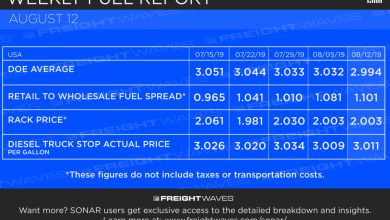
Dart Transit celebrated its 85 years in business and Truck Driver Appreciation Week earlier this month, awarding drivers raffle prizes that included a new pickup, boat and Polaris ATV. Also, fuel prices jump, France tests no-Brexit and trucking group pushes port improvements.

John Gallagher
Tuesday, July 9, 2019
Brown’s Amusements keeps the show safe on the road
Traveling carnival’s most important rides are reserved for the drivers in its trucks.

Brian Straight
Tuesday, June 11, 2019
Today’s Pickup: Continental, Leia work to bring 3D driver instrument panel to life
Continental and Leia are working on a 3D instrument display that brings to life the vehicle and its surroundings.

FreightWaves Staff
Wednesday, May 1, 2019
U.S. Venture acquires Breakthrough Fuel
Automotive parts, tires, fuels and lubricant specialist U.S. Venture has bought energy information and supply chain management company Breakthrough Fuel for an undisclosed sum.

FreightWaves Staff
Tuesday, March 19, 2019
FreightWaves NOW – March 19, 2019
Today on FreightWaves NOW, Nick Austin sees more flooding in MO; Ibrahiim Bayaan evaluates the meaning of manufacturing; and John Paul Hampstead connects the dots between a large carrier’s earning report, the spread between wholesale and retail fuel, and air cargo.

John Kingston
Friday, February 1, 2019
A trade gets done in Singapore and gives a hint what will happen to fuel prices under IMO2020
It was only one trade and the comparisons to diesel prices are less than perfect. But there now is an actual transaction that reflects a value for now of what fuel might do under IMO2020.

FreightWaves Staff
Saturday, November 24, 2018
Sky-high fuel prices and its aftermath – riots breakout in Paris
Protests over rise in fuel taxes have turned violent in Paris, leaving two dead and 600 injured.

FreightWaves Staff
Monday, October 29, 2018
Driving economies of scale in a chaotic Indian transportation industry
The Indian freight industry struggles with issues that most of the developing countries suffer with – like high fuel prices, inadequate infrastructure, lethargic governance, stifled technology adoption, and a general inefficiency in hauling equipment.
Trevor Willingham
Monday, October 22, 2018
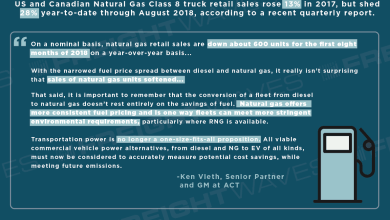
Class 8 Natural Gas Truck Retail Sales
We take a look at August’s Class 8 natural gas truck retail sale numbers.

FreightWaves Staff
Tuesday, October 2, 2018
India’s growing frustration with exploding fuel prices
The depreciating Indian rupee coupled with rising fuel prices have hit the Indian transportation corridor quite hard. The Indian government is now coming up with new regulations and innovative transportation practices to ease pressure.