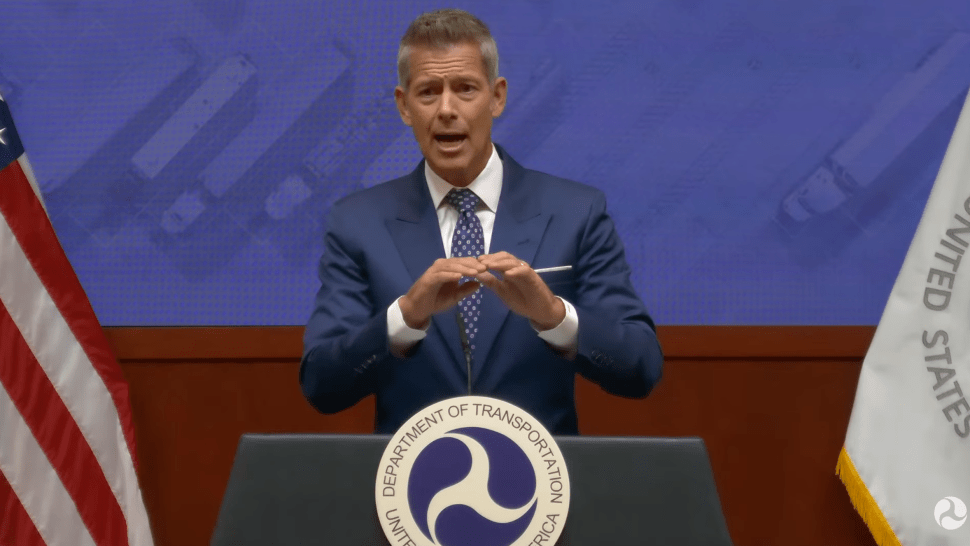
Transportation Secretary Sean Duffy took to social media on December 10, 2025, to announce what sounded like a seismic shift in the trucking industry: “We’ve now knocked 9,500 truck drivers out of service for failing to speak our national language, ENGLISH!” The headlines followed predictably, with many suggesting these drivers had been permanently removed from the industry. That’s not quite how this works.
If you’re a parent, think of an out-of-service order like a timeout for your kids. It’s not expulsion from the family; it’s a mandatory pause until the problem gets fixed. And just like a timeout, the duration varies dramatically based on what landed you there in the first place.
The Commercial Vehicle Safety Alliance maintains the North American Standard Out-of-Service Criteria, which serves as the pass-fail standard for roadside inspections across the United States, Canada, and Mexico. These criteria identify critical violations that present an imminent hazard, conditions severe enough that the driver, vehicle, or cargo cannot continue until the issue is resolved.
Vehicle vs. Driver Out-of-Service are Two Very Different Animals
Vehicle out-of-service violations are often the easier fix. You roll into a scale, the officer spots a mechanical defect that falls under the CVSA out-of-service guidelines, maybe a brake issue, a steering component problem, or a tire violation and your truck is benched until it’s repaired. The path back is straightforward: fix the defect, complete a Driver Vehicle Inspection Report for that day, get a work order showing who completed the repair and when, and mail in the signed violation showing completion. Your truck is back in service, potentially within hours.
Driver out-of-service violations can be more complicated. If your CDL is expired, suspended, or you don’t have the proper class or endorsements for what you’re hauling, you’re stuck until you get to a DMV to rectify the situation. Your truck doesn’t move without another qualified driver taking the wheel. Depending on where you are and what’s wrong, this could take days.
An 88-Year-Old Rule With A Complicated History
The requirement that commercial drivers read and speak English isn’t new, it dates back to 1937. Under 49 CFR 391.11(b)(2), commercial motor vehicle drivers must “read and speak the English language sufficiently to converse with the general public, to understand highway traffic signs and signals in the English language, to respond to official inquiries, and to make entries on reports and records.”
What changed over the decades was enforcement. In 2015, CVSA members voted to remove English proficiency from out-of-service criteria because, according to the organization, they “could not substantiate the safety impacts.” Then in 2016, the Obama administration’s FMCSA issued a guidance memo directing inspectors not to place drivers out-of-service for English language proficiency violations. Instead, they’d issue a citation and a fine, but the driver could continue rolling.
That changed dramatically in 2025. President Trump signed an executive order in April requiring strict enforcement of the English proficiency requirement. CVSA followed with an emergency measure in May, and by June 25, 2025, lack of English proficiency was officially back as an out-of-service condition.
The Assessment Process and Its Subjective Nature
According to FMCSA’s enforcement policy, all roadside inspections must now be conducted in English. If an inspector suspects during initial contact that a driver doesn’t understand, they must begin an English Language Proficiency assessment. This includes a driver interview evaluating their ability to respond to official inquiries and directions in English, followed by a highway traffic sign recognition assessment if they pass the first portion.
Under the current guidance, drivers cannot use tools like I-Speak cards, cue cards, smartphone translation apps, or on-call telephone interpretation services during the driver interview. The reasoning? Those tools might “mask a driver’s inability to communicate in English.”
The subjective nature of this assessment creates inconsistencies. We’ve seen drivers placed out-of-service at a scale at 7 PM for English proficiency, sit overnight, and then have a different officer come on shift the next morning, determine they actually communicate sufficiently in English, and put them back on the road. The same driver, the same English ability, two completely different outcomes based on who’s making the call.
What ‘Out of Service’ Actually Means for These Drivers
So what happens to the 9,500 drivers Duffy referenced? They haven’t lost their CDLs. They haven’t been deported. They haven’t been “removed from trucking” in any permanent sense. They’ve been told they can’t drive a commercial vehicle again until they can demonstrate English proficiency to an inspector’s satisfaction.
For some, that might mean sitting at a truck stop until the next shift change brings a different assessment. For others, it means enrolling in English language courses and notably, language learning companies like Babbel are already marketing services specifically to commercial drivers facing this situation.
You don’t learn English overnight. So yes, for drivers who genuinely struggle with the language, this is a significant career disruption. But it’s a timeout, not a termination. They still hold valid CDLs. They can still return to driving once they meet the proficiency standard, however subjectively, that standard might be applied.
The Bigger Picture and Non-Domiciled CDLs and the Ongoing Audit
English proficiency is just one piece of a larger enforcement push. Secretary Duffy has also launched a nationwide audit of states’ practices regarding non-domiciled commercial driver’s licenses, with a particular focus on “the potential for unqualified individuals obtaining licenses and posing a hazard on our roads.”
The Department of Transportation has threatened to withhold tens of millions of dollars in federal highway safety funds from states like California, Washington, and New Mexico unless they enforce English-language rules and revoke improperly issued licenses. California alone risks losing over $40 million, though state officials maintain they already require English testing during commercial road exams.
Emergency rules regarding non-domiciled CDL issuance have been subject to court stays due to a lack of statistical data demonstrating that non-domiciled CDL holders are causing more crashes. The administration is now pursuing the regular rulemaking process to address those concerns.
When you see headlines about 9,500 drivers being “taken off the road” or “removed from trucking,” understand what’s actually happening. These drivers received out-of-service orders and mandatory pauses that end when they can demonstrate English proficiency. Some may be back on the road within hours. Others might need weeks or months of language training.
Whether you think the renewed enforcement is necessary for highway safety or an overreach that ignores the realities of a driver shortage, get the terminology right. Out-of-service is not the same as out of the industry. A timeout is not an expulsion.
If you’re a driver who’s been put out of service for English proficiency? The path back exists. It requires more study than you expected when you got your CDL.
Brokerage Compliance Symposium
The day before F3. Every compliance issue you face - fraud exposure, carrier liability, FMCSA rules, cargo theft, insurance gaps - navigated by attorneys and operators defining best practices in a changing industry.
F3 Awards Dinner
The night before F3. FreightTech100 companies honored. FreightTech 25 and Shipper of Choice winners revealed live. Cocktail reception into dinner and live music - 300 industry leaders in one purpose-built room.
F3: Future of Freight Festival
Industry-defining keynotes, rapid-fire technology demos, and industry leaders networking in experiences across Chattanooga - plus the inaugural F3 Awards Dinner featuring the FreightTech and Shipper of Choice reveals.
The day before F3. Every compliance issue you face - fraud exposure, carrier liability, FMCSA rules, cargo theft, insurance gaps - navigated by attorneys and operators defining best practices in a changing industry.
The Signal at Chattanooga Choo Choo • Chattanooga, TN Register NowThe night before F3. FreightTech100 companies honored. FreightTech 25 and Shipper of Choice winners revealed live. Cocktail reception into dinner and live music - 300 industry leaders in one purpose-built room.
The Signal at Chattanooga Choo Choo • Chattanooga, TN Register NowIndustry-defining keynotes, rapid-fire technology demos, and industry leaders networking in experiences across Chattanooga - plus the inaugural F3 Awards Dinner featuring the FreightTech and Shipper of Choice reveals.
The Signal at Chattanooga Choo Choo • Chattanooga, TN Register Now