




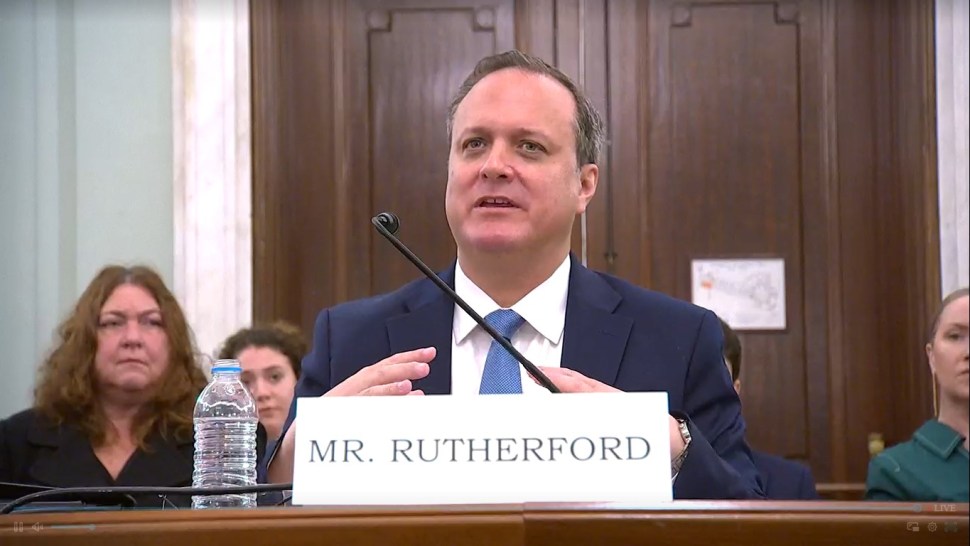
WASHINGTON — Senate lawmakers grilled the Trump administration’s likely point person for the nation’s freight markets on his strategy for keeping ahead of the next supply chain disruption.
Michael Rutherford, the administration’s pick to head the Office of Multimodal Freight Infrastructure & Policy at the U.S. Department of Transportation, testified at his nomination hearing that Freight Logistics Optimization Works (FLOW), DOT’s freight data exchange portal, will him and his staff do that.
“Supply chain visibility is everything,” Rutherford told the Senate Commerce Committee on Wednesday. “I like to describe transportation as being an outdoor sport – you have to be able to change as the operating environment changes. That forward-looking visibility that FLOW provides I think is incredibly helpful, and we have a great base from which to build.”
FLOW was created by the Biden administration in March 2022 in response to pandemic-related backups radiating out from U.S. ports clogged with container ships as importers struggled to keep up with a surge in freight demand in the second half of 2021.
The portal compiles purchase order and billing data shared voluntarily by importers, railroads, trucking companies, ports, warehouses and logistics companies to build an advance freight-flow forecast to flag congestion buildups in the supply chain that can be mitigated before they get out of hand.
Starting with an initial 18 companies providing freight data when it was launched three years ago, FLOW now has 86 members participating in the public-private partnership, including big-box importers Walmart (NYSE: WMT), Target (NYSE: TGT), and The Home Depot (NYSE: HD).
“Despite early successes, there is still so much more the freight office can do to build upon earlier efforts and I look forward to exploring the opportunities,” Rutherford told the committee.
CSX experience
A former railroad executive, Rutherford joined CSX in 2008, “ultimately managing everything moving on the railroad except intermodal and coal,” he told the committee, helping customers during the roll out of the railroad’s Precision Scheduled Railroading [PSR] initiative.
He said that experience will come into play in helping his office develop the National Multimodal Freight Network (NMFN), a federally designated network of highways, railways, seaports, and airports. DOT, under the Biden administration, published a draft NMFN interactive map in January.
“One of the objectives of the freight office is to address issues of congestion, which is the enemy of asset utilization,” Rutherford said. “When we fix problems of congestion, you’re not just driving down cost but you’re actually generating additional capacity, so that you can also be more efficient. We saw that at CSX with the rollout of [PSR]. It becomes a virtuous cycle.
“By working with the multimodal freight network and identifying key strategic infrastructure, we’ll be able to make certain that we’re focusing our emphasis on improving our overall infrastructure, where it matters most for both shippers and transportation providers.”
Rutherford promised that, if confirmed, finalizing the NMFN, which will be used to help states direct and prioritize infrastructure project funding, will be “a priority on Day One,” and he will use it to develop a broader National Freight Strategic Plan.
DOT recently opened a docket for public comments to help update the plan, which was issued in 2020 during the first Trump administration. Comments are due Aug. 14.
Related articles:
Brokerage Compliance Symposium
The day before F3. Every compliance issue you face - fraud exposure, carrier liability, FMCSA rules, cargo theft, insurance gaps - navigated by attorneys and operators defining best practices in a changing industry.
F3 Awards Dinner
The night before F3. FreightTech100 companies honored. FreightTech 25 and Shipper of Choice winners revealed live. Cocktail reception into dinner and live music - 300 industry leaders in one purpose-built room.
F3: Future of Freight Festival
Industry-defining keynotes, rapid-fire technology demos, and industry leaders networking in experiences across Chattanooga - plus the inaugural F3 Awards Dinner featuring the FreightTech and Shipper of Choice reveals.
The day before F3. Every compliance issue you face - fraud exposure, carrier liability, FMCSA rules, cargo theft, insurance gaps - navigated by attorneys and operators defining best practices in a changing industry.
The Signal at Chattanooga Choo Choo • Chattanooga, TN Register NowThe night before F3. FreightTech100 companies honored. FreightTech 25 and Shipper of Choice winners revealed live. Cocktail reception into dinner and live music - 300 industry leaders in one purpose-built room.
The Signal at Chattanooga Choo Choo • Chattanooga, TN Register NowIndustry-defining keynotes, rapid-fire technology demos, and industry leaders networking in experiences across Chattanooga - plus the inaugural F3 Awards Dinner featuring the FreightTech and Shipper of Choice reveals.
The Signal at Chattanooga Choo Choo • Chattanooga, TN Register Now