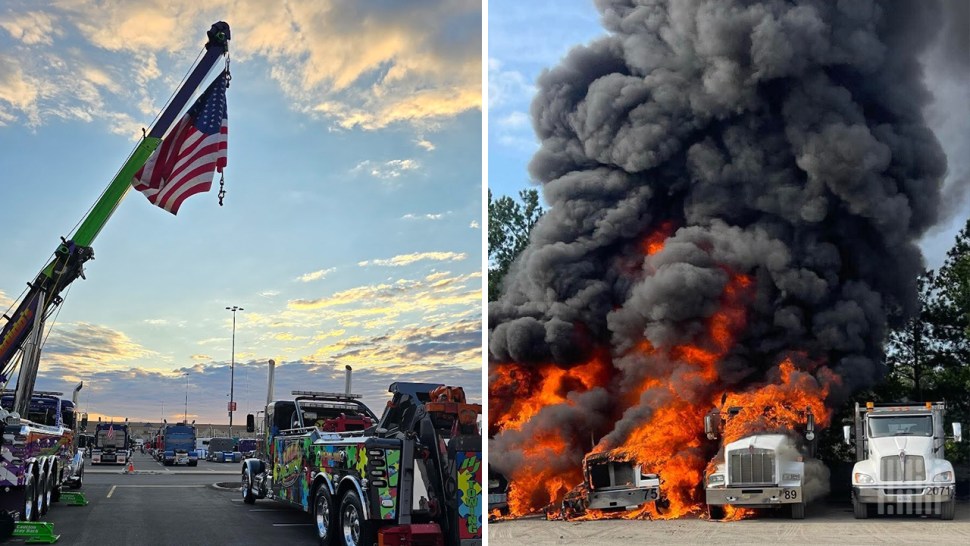
On June 6, a pickup truck pulling a trailer full of fireworks caught fire on Interstate 75 just north of the Ooltewah exit outside Chattanooga, Tennessee. Passersby flagged the driver, who pulled to the shoulder. Then the load went up. For roughly 25 minutes, mortars and shells fired in every direction across a closed interstate while Tri-Community firefighters and Hamilton County deputies worked the scene. Both directions of I-75 are shut down. The video has been viewed more than three million times. By some miracle, nobody was hurt.
Then the Tennessee Highway Patrol took a closer look, and the picture got worse. THP’s Commercial Vehicle Enforcement Division, the unit it brands as Motor Carrier Plus, conducted a post-incident inspection and found that the load had been in open violation of federal hazardous materials law. The driver, Dalton Beeler of Tennessee, was transporting fireworks from South Pittsburg to Knox County without a hazardous materials endorsement on his license, without placards on the trailer, without shipping papers, without emergency response information, without current hazmat registration, and without a USDOT number where one was required. He was cited for operating without the endorsement, and THP forwarded the findings to federal regulators for possible penalties. The explosives that shut down an interstate were never supposed to be on that trailer the way they were.
Investigators believe the fire started in the trailer’s rear brakes. Read that again. A brake fire on a trailer loaded with Class 1 explosives. That is not a freak event. That is the most predictable failure mode in trucking, meeting the most dangerous cargo on the road, and the only thing that made it remarkable is that it happened on camera.
I pulled every roadside inspection from FMCSA’s database in which the shipper on the bill of lading was a fireworks company. Then I pulled the carriers hauling those loads, their out-of-service rates, their brake records, the weight class of their equipment, and the corridors where they get stopped. The data show that the truck that burned near Ooltewah was not an outlier. It was a representative sample.
A brake fire is not rare
Across the worst-performing carriers in the fireworks freight pool, the brake numbers are damning. There are more than 1,400 brake violations on record, and 334 of them resulted in the vehicle being put out of service. Two carriers own most of that total, and both of them are intermodal drayage operators, the companies that pull containers off the rail and out of the ports.
Evans Delivery Company carries 783 brake violations and 183 brake out-of-service orders. ContainerPort Group carries 233 brake violations and 51 out-of-service orders. These are the trucks that move freight on the first leg inland after it comes off a ship.
That matters because the overwhelming majority of consumer fireworks sold in this country are manufactured in China. They arrive by ocean container, they land at a port, and the first move inland is on a drayage chassis. So the supply chain for your backyard show on the Fourth begins with a container handoff to a class of carrier with a documented, repeating brake problem. The fire on I-75 was a brake fire. The data says the brakes are exactly where this freight is weakest.
One in three rides light
Of the fireworks loads in the data where the combined vehicle weight was recorded, almost a third moved on what the industry calls hotshot equipment, meaning a pickup and a trailer rated at 26,000 pounds or less. Not a tractor-trailer. A truck you could buy at a dealership, and a trailer you could rent.
A whole cluster of those combos sit at or below 26,000 pounds. Black Diamond Fireworks, Stateline Fireworks, the Phantom Fireworks western operation, a couple of towing companies, and rental units from Ryder and Idealease all show up parked right at that line.
Twenty-six thousand and one pounds is the federal threshold where a commercial driver’s license becomes mandatory. Sitting at twenty-six thousand even is not a coincidence of physics. It is a choice. It is how an operator stays one pound under the line that would force a CDL, a medical card, and the full weight of the federal inspection regime. The hotshot model exists largely to live in that gap.
The placard doesn’t care about weight
The weight consideration or gap closes the moment the placard goes up, and almost nobody seems to understand that.
Under 49 CFR 383.5, a commercial driver’s license is required to operate any size vehicle that hauls a hazardous material that must be placarded. Any size. The weight does not matter. A half-ton pickup hauling placarded explosives needs the same Class C CDL as a fuel tanker.
Fireworks fall into two buckets. Display fireworks, the 1.3G shells that go up at the big municipal shows, are Table 1 materials, and Table 1 must be placarded at any quantity. One shell triggers it. Consumer fireworks, the 1.4G product sold at roadside stands, are listed in Table 2 and must be placarded once the load reaches 1,001 pounds. Either way, the instant that the diamond goes on the side of the trailer, the driver is legally required to hold a CDL with a hazardous materials endorsement, and that endorsement requires a fingerprint-based background check through the Transportation Security Administration. The man hauling the explosives must be able to tell a firefighter what is in the trailer.
So the under 26,000-pound rental rig is not actually dodging the hazmat rules. It is just betting that nobody checks. The endorsement exists for a reason that the Ooltewah video made obvious. The man hauling the explosives must be able to read the shipping papers, display the placards, and tell a firefighter exactly what is in the trailer when it is on fire on the shoulder of an interstate.
Dalton Beeler is that argument in the flesh. According to THP, he had none of it. No endorsement, no placards, no papers, no emergency response sheet, no registration. Every safeguard that federal law builds around explosive cargo was missing at once, and the only reason we know is that the trailer caught fire on a busy interstate in front of dozens of cameras. The compliant version of this load looks identical from the outside right up until the moment it matters.
“This incident looked like a fireworks show, but it could have been much worse,” THP Col. Matt Perry said in announcing the findings. He is right, and the reason it could have been worse is that it is sitting on the violation list. When first responders reach a hazmat fire, the placards, shipping papers, and emergency response information determine whether to fight it, flood it, or run. Beeler’s trailer offered them nothing to read.
Think about the wildfires that burn millions of acres and millions of homes a year. All it takes is a spark.
The worst of the bunch
The national average for vehicles ordered out of service at roadside hovers around 18 percent. Several of the carriers moving fireworks freight run multiples of that.
Jake’s Fireworks, which hauls its own product, posts a vehicle out-of-service rate of roughly 67 percent across its inspections. POD Logistics runs 47 percent across 149 inspections. USA Logistics runs 23 percent across 647 inspections. Bukhara Trans, Excalibur Trucking, Bright Texas, 5 Star Delivery, and an outfit named, with no irony at all, Firework Trucking LLC, all post vehicle-out-of-service rates north of 35 percent. These are not whisper-thin samples. These are the rates at which enforcement looked at the truck and ordered it off the road.
The crash and fatality totals attached to these carriers reflect their entire operation, every load they have ever run, not their fireworks freight specifically. The data establishes which equipment fails inspection, and these are the carriers that fireworks companies hand their freight to.
Where the freedom freight runs
The geography tells its own story. South Carolina is the single most-inspected state for fireworks freight, which surprises no one who has driven Interstate 85 through the upstate and watched the billboards. The state is the retail fireworks belt of the Southeast, pulling buyers across the line from stricter North Carolina and Georgia, and the I-85, I-77, and I-95 corridors are where the trucks get caught.
Fireworks loads turn up at the Cajon Scales and on the Dunsmuir grade in California, two of the longest, hottest mountain descents in the western highway system. A long downgrade causes brakes to overheat, and overheated brakes are how the Chattanooga trailer caught fire in the first place. Put a heavy load of explosives on a mountain grade, and you are running the Ooltewah experiment again, just without the camera.
Every Memorial Day, every Fourth of July, every small-town fireworks night, the explosives that light up the sky arrive on a truck. The data show a meaningful share of those trucks is the lightest-regulated, least-inspected equipment on the road, operated in many cases by people who treat the 26,000-pound line as a finish line rather than a warning.
The Ooltewah fire ended with a viral video and no injuries. The next one might end on a downgrade, in traffic, with a driver who cannot tell the first responder what is burning.
Brokerage Compliance Symposium
The day before F3. Every compliance issue you face - fraud exposure, carrier liability, FMCSA rules, cargo theft, insurance gaps - navigated by attorneys and operators defining best practices in a changing industry.
F3 Awards Dinner
The night before F3. FreightTech100 companies honored. FreightTech 25 and Shipper of Choice winners revealed live. Cocktail reception into dinner and live music - 300 industry leaders in one purpose-built room.
F3: Future of Freight Festival
Industry-defining keynotes, rapid-fire technology demos, and industry leaders networking in experiences across Chattanooga - plus the inaugural F3 Awards Dinner featuring the FreightTech and Shipper of Choice reveals.
The day before F3. Every compliance issue you face - fraud exposure, carrier liability, FMCSA rules, cargo theft, insurance gaps - navigated by attorneys and operators defining best practices in a changing industry.
The Signal at Chattanooga Choo Choo • Chattanooga, TN Register NowThe night before F3. FreightTech100 companies honored. FreightTech 25 and Shipper of Choice winners revealed live. Cocktail reception into dinner and live music - 300 industry leaders in one purpose-built room.
The Signal at Chattanooga Choo Choo • Chattanooga, TN Register NowIndustry-defining keynotes, rapid-fire technology demos, and industry leaders networking in experiences across Chattanooga - plus the inaugural F3 Awards Dinner featuring the FreightTech and Shipper of Choice reveals.
The Signal at Chattanooga Choo Choo • Chattanooga, TN Register Now