




2020 presidential candidate Bernie Sanders released details on his proposed $16.3 trillion Green New Deal on August 22. This deal would cover a range of industries with the common goal of reaching zero carbon emissions.
In his proposal, Sanders includes $216 billion to replace diesel-powered semi-trucks with electric trucks, $85.6 billion for electric vehicle charging, and $100 billion to place an $18,000 price cap on electric vehicles (EVs).
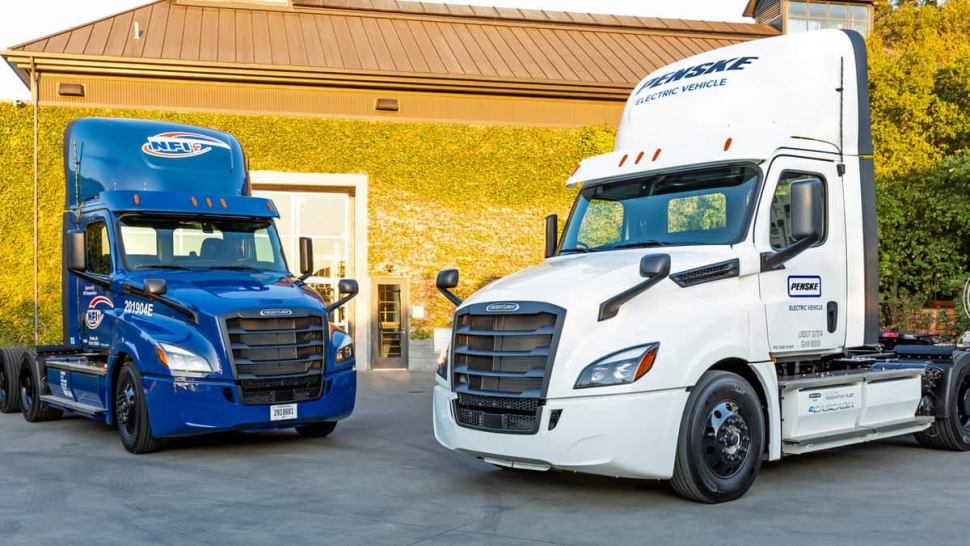
As envisioned, $216 billion would not be enough to replace all semi-trucks. Currently, Tesla advertises its electric semi for $200,000 – once the company is able to perfect and produce its trucks. Daimler has yet to release prices for its new electric vehicles, but the company did state that the trucks would be competitively priced with the non-electric versions of the models. One of those trucks would be the Freightliner eCascadia, which would be priced against the Freightliner Cascadia. Even at a competitive price, the eCascadia will likely cost over $160,000.
Sanders’ plan was also vague on his plan to place price caps on EVs. He allocated $100 billion in order to place a price cap of $18,000 per vehicle. If this includes all EVs, then he did not allocate nearly enough to cover the difference.
The FreightWaves SONAR chart below gives a total count of tractors reported to the Federal Motor Carrier Safety Administration (TCTC.USA). Even at a substantially discounted rate, electric trucks cost significantly more to make than traditional diesel trucks because of their batteries. If all the reported tractors were replaced with electric trucks, about $86,100 could go to each truck, if split equally.

SONAR: Total Count of Tractors
An electric charging infrastructure would receive $85.6 billion, shared between cars and trucks. Due to the short range of EVs, charging stations would need to be at most 200 miles apart. Furthermore, each of these stations would need the different plug-ins for each of the different manufacturers. Or conversely, standardization of chargers would need to be mandated to make these stations more accessible for the different types of EVs.
The development of charging stations would also require an electric grid that could handle the added load. Sanders’ plan sets aside $526 billion to develop a smart grid, which would move energy more efficiently and help move more power to places with a higher demand. His Green Deal proposal just hits early estimations of the cost to develop a smart electric grid, and does not account for the possibility of anything going wrong. Additionally, he plans to put $852 billion towards energy storage, to help fill capacity in high demand times.
The final pieces that went unaccounted for, in terms of the transportation sector, are population growth and density. Sanders’ plan does not account for increasing populations for the 2020-2050 period. More people means more infrastructure, and more infrastructure costs more money. Additionally, population density in smaller, growing cities makes building out infrastructure difficult to predict in the long-term.
As the population grows, more infrastructure is needed, and faster charging capabilities need to be developed. Currently, it can take almost two hours to fully charge an eCascadia, and 90 minutes to reach 80 percent. The time it takes to charge, in densely populated areas would cause longer waits at the stations, especially in areas with a booming tourism market.
Bernie Sanders’ Green Deal does not account for growth and leaves little room for unexpected changes made to the plans. It is also oriented towards switching to EVs and does not account for the growing interest in other – possibly more efficient options – like hydrogen.
Brokerage Compliance Symposium
The day before F3. Every compliance issue you face - fraud exposure, carrier liability, FMCSA rules, cargo theft, insurance gaps - navigated by attorneys and operators defining best practices in a changing industry.
F3 Awards Dinner
The night before F3. FreightTech100 companies honored. FreightTech 25 and Shipper of Choice winners revealed live. Cocktail reception into dinner and live music - 300 industry leaders in one purpose-built room.
F3: Future of Freight Festival
Industry-defining keynotes, rapid-fire technology demos, and industry leaders networking in experiences across Chattanooga - plus the inaugural F3 Awards Dinner featuring the FreightTech and Shipper of Choice reveals.
The day before F3. Every compliance issue you face - fraud exposure, carrier liability, FMCSA rules, cargo theft, insurance gaps - navigated by attorneys and operators defining best practices in a changing industry.
The Signal at Chattanooga Choo Choo • Chattanooga, TN Register NowThe night before F3. FreightTech100 companies honored. FreightTech 25 and Shipper of Choice winners revealed live. Cocktail reception into dinner and live music - 300 industry leaders in one purpose-built room.
The Signal at Chattanooga Choo Choo • Chattanooga, TN Register NowIndustry-defining keynotes, rapid-fire technology demos, and industry leaders networking in experiences across Chattanooga - plus the inaugural F3 Awards Dinner featuring the FreightTech and Shipper of Choice reveals.
The Signal at Chattanooga Choo Choo • Chattanooga, TN Register Now