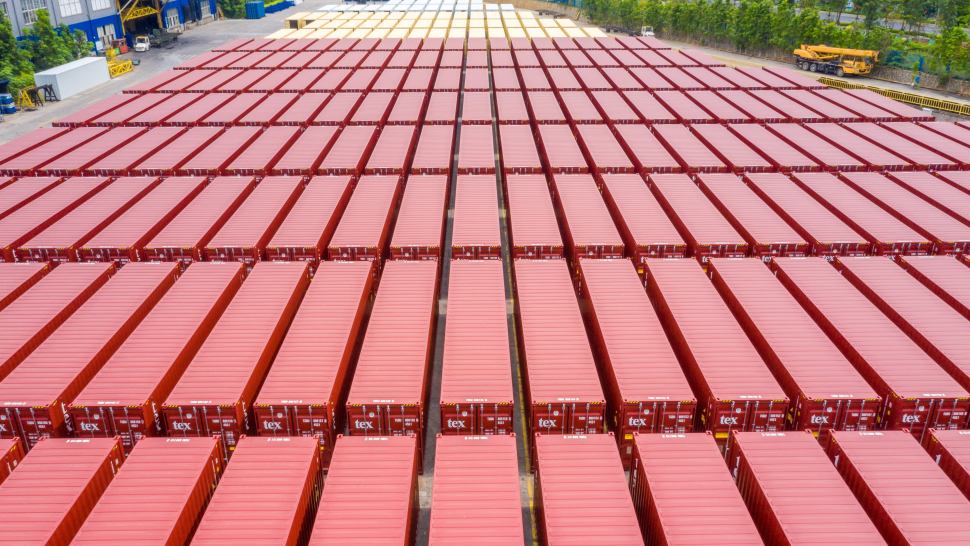
For a telling window on the global supply chain crisis, watch the market for the containers themselves: the commoditized, corrugated steel boxes that move the world’s cargo.
The extremely consolidated container manufacturing industry in China built more containers than ever before in 2021: 7.18 million twenty-foot equivalent units, according to consultancy Drewry, up 130% from 2020 and 62% from the previous record year in 2018.
Record container production coincided with a record surge in prices, underscoring the sheer intensity of demand as supply chains buckled. Factories were getting close to $4,000 per TEU for newly built containers at the peak, double the historical norm.
But now, both the factory output and the price of new containers are pulling back.
New boxes: Signs of easing
According to Triton International (NYSE: TRTN) and Textainer (NYSE: TGH) — the largest and second-largest box equipment lessors in the world — new container prices have fallen to $3,400 per TEU.
“New container prices have come down … in part due to the high volume produced through 2021, easing some of the shortage,” said John O’Callaghan, Triton’s head of operations, during a conference call with analysts on Wednesday.

On the manufacturing front, data from Drewry shows that container production started pulling back in Q4 2021, at 1.76 million TEUs, down 14% from 2.05 million TEUs in Q3 2021. Drewry estimates that production will total 4.5 million-4.8 million TEUs this year, down 33%-37% from 2021.
Inventory levels of equipment at container factories have also rebounded.
According to O’Callaghan, “The high container production in 2021 has alleviated some supply constraints. Container factory inventory is up to normal levels.”

Asked by an analyst about signs of market easing, Triton CEO Brian Sondey responded, “In terms of market dynamics, from July 2020 to around July-August-September-ish 2021 was one of the few periods I’ve seen in my 23 years when container supply was the overall limiter of global trade, when there was just an absolute shortage of container capacity.
“We are in a situation now where the market is still tight, and we are still effectively at almost 100% utilization, but it is no longer a fact that every container a shipping line gets means one more cargo load they can take. The lines have enough containers in their system to move the cargo.
“We don’t see that absolute shortage where containers are the limiter for global trade. That probably cleared up back in the late summer and early fall,” Sondey said, although he pointed out that new container pricing is still above the pre-COVID high of $3,000 per TEU reached back in 2010-2011.
Old boxes: No signs of easing
While the pricing of new boxes is down from its peak, pricing of older, used containers in the resale market is not, according to Triton and Textainer.
When congestion starts clearing in earnest, more boxes will be released into service as ship queues ebb, making more of the older containers available for resale, which, in turn, will lower resale prices. That hasn’t happened yet.
“The sale price of used containers remained high throughout the fourth quarter due to the continued strong demand and decreasing availability of resale containers,” said O’Callaghan.
During a conference call Thursday, Textainer CEO Olivier Ghesquiere commented, “Customers are holding on to those [older] containers for as long as they can. They want to delay returning them until the contract forces them to.
“With the continuation of high utilization rates and congestion around the world, we’re going to continue to face difficulties in getting those containers back in substantial volumes. That also means that the resale market remains undersupplied, and prices remain very high.”
Although the queue of ships waiting for berths in Los Angeles and Long Beach has recently eased, Ghesquiere doesn’t see an end to port congestion anytime soon. “My view is very much that congestion will remain present for most of this coming year. It’s not really a problem that can be solved by adding capacity, because we really are in an environment where ships are fully utilized and containers are fully utilized. The problem is with inland logistics.”
Earnings recap: Triton and Textainer
Container-equipment leasing companies perform particularly well in times when cargo shippers suffer from extremely high freight rates. The market tightness that’s bad for cargo shippers is good for leasing companies.
Triton reported net income of $177.4 million for Q4 2021 versus $115.2 million in Q4 2020. Adjusted earnings per share of $2.67 beat the consensus estimate of $2.52.
The company bought $3.6 billion of containers that were delivered last year and currently has $415 million of new containers on order for delivery so far this year.

Textainer reported net income of $72.9 million for Q4 2021 compared to $44.3 million in Q4 2020. Adjusted earnings per share came in at $1.46, just above the consensus estimate of $1.43.

Click for more articles by Greg Miller
Related articles:
- Glimmer of hope: Has the ship gridlock off ports finally peaked?
- Cartel? Liner competition increased as trans-Pacific rates spiked
- Supply chain chaos and port gridlock could drag on into 2023
- Los Angeles imports slump further as congestion throttles volume
- Imports take ‘dramatically longer’ to reach US as bottlenecks bite
- How three Chinese companies cornered global container production
- Shipping’s extreme consolidation could prolong supply chain pain
- How long does it take to build a shipping container?
Brokerage Compliance Symposium
The day before F3. Every compliance issue you face - fraud exposure, carrier liability, FMCSA rules, cargo theft, insurance gaps - navigated by attorneys and operators defining best practices in a changing industry.
F3 Awards Dinner
The night before F3. FreightTech100 companies honored. FreightTech 25 and Shipper of Choice winners revealed live. Cocktail reception into dinner and live music - 300 industry leaders in one purpose-built room.
F3: Future of Freight Festival
Industry-defining keynotes, rapid-fire technology demos, and industry leaders networking in experiences across Chattanooga - plus the inaugural F3 Awards Dinner featuring the FreightTech and Shipper of Choice reveals.
The day before F3. Every compliance issue you face - fraud exposure, carrier liability, FMCSA rules, cargo theft, insurance gaps - navigated by attorneys and operators defining best practices in a changing industry.
The Signal at Chattanooga Choo Choo • Chattanooga, TN Register NowThe night before F3. FreightTech100 companies honored. FreightTech 25 and Shipper of Choice winners revealed live. Cocktail reception into dinner and live music - 300 industry leaders in one purpose-built room.
The Signal at Chattanooga Choo Choo • Chattanooga, TN Register NowIndustry-defining keynotes, rapid-fire technology demos, and industry leaders networking in experiences across Chattanooga - plus the inaugural F3 Awards Dinner featuring the FreightTech and Shipper of Choice reveals.
The Signal at Chattanooga Choo Choo • Chattanooga, TN Register Now