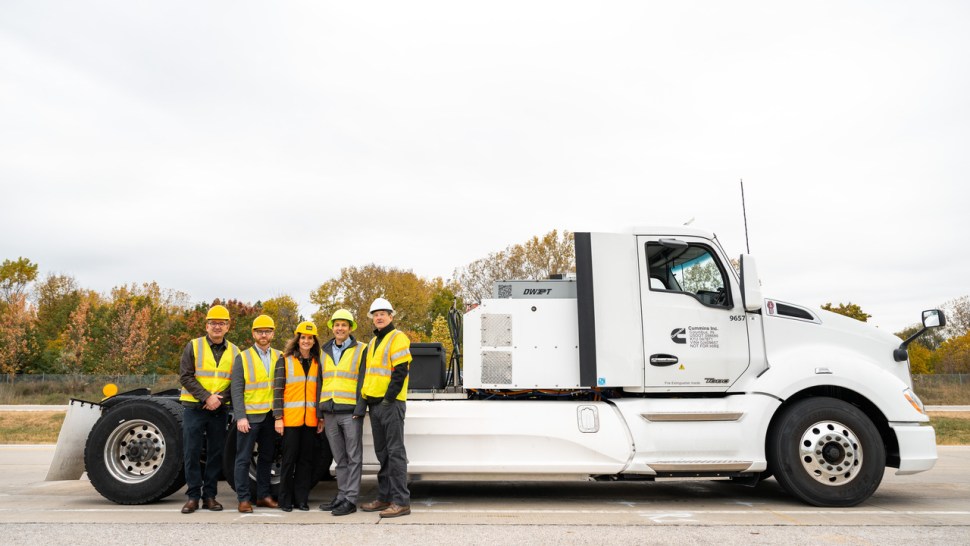
Charging an electric truck may soon be easier than plugging it in. Researchers at Purdue University have announced that, for the first time in the U.S., a roadway has wirelessly charged a heavy-duty electric truck while it was driving at highway speeds. Tests on the experimental highway segment used patent-pending systems designed by Purdue engineers.
The segment was built by the Indiana Department of Transportation along a quarter-mile stretch of U.S. 52/U.S. 231 in West Lafayette.
Purdue designed a wireless charging system that operates at power levels much higher than previously demonstrated in the U.S. The test segment in West Lafayette, Indiana, delivered 190 kilowatts to a truck traveling at 65 mph.
It takes a lot of juice to charge a commercial truck. “To put that in perspective, 200 kilowatts are on the scale of about a hundred homes,” said Steve Pekarek, Purdue’s Edmund O. Schweitzer III Professor of Electrical and Computer Engineering, in the announcement.
The system is not limited to commercial heavy-duty trucks, which require more wattage than lighter vehicles. It can work with various vehicle classes, including passenger vehicles. One benefit of testing with heavy-duty trucks is that trucking contributes the most to U.S. gross domestic product compared with other modes of freight transportation, according to data from the Bureau of Transportation Statistics.
Another benefit of on-highway charging would be smaller batteries, allowing for reduced vehicle weight that could then be used to haul more goods. Batteries are expensive, and current technology requires larger battery packs to achieve greater range.
The technology works similarly to wireless charging for a smartphone, using magnetic fields to transfer power when the device is placed on a pad. In this case, the team installed transmitter coils in a specially designed lane within the concrete pavement. The coils then send power to a receiver coil attached to the underside of the truck.
It does get more complicated than simply charging a phone. “Transferring power through a magnetic field at these relatively large distances is challenging. And what makes it more challenging is doing it for a heavy-duty vehicle moving at power levels thousands of times higher than what smartphones receive,” said Dionysios Aliprantis, a Purdue professor of electrical and computer engineering.
Cummins provided a prototype Class 8 battery-electric truck for integration with the high-power dynamic wireless power transfer system. The collaboration was cited as a key factor in the successful validation.
Transmitter coils and wireless charging are not new, but applying the technology to a heavy-duty truck at this scale is. “The Purdue-designed coils accommodate a wider power range — larger vehicles wouldn’t need multiple low-power receiver coils on the trailer to charge from the road, which has been proposed to meet the high-power demands. Instead, in the Purdue design, a single receiver coil assembly is placed under the tractor, greatly simplifying the overall system,” the release noted.
In addition to demonstrating the technology, the team is working to develop an industry standard for building these electrified highways.
Electric highways also offer potential cost savings. An economic analysis by the Purdue team found the technology could be financially viable at a breakeven energy cost of 32 cents per kWh compared with diesel trucks.
Brokerage Compliance Symposium
The day before F3. Every compliance issue you face - fraud exposure, carrier liability, FMCSA rules, cargo theft, insurance gaps - navigated by attorneys and operators defining best practices in a changing industry.
F3 Awards Dinner
The night before F3. FreightTech100 companies honored. FreightTech 25 and Shipper of Choice winners revealed live. Cocktail reception into dinner and live music - 300 industry leaders in one purpose-built room.
F3: Future of Freight Festival
Industry-defining keynotes, rapid-fire technology demos, and industry leaders networking in experiences across Chattanooga - plus the inaugural F3 Awards Dinner featuring the FreightTech and Shipper of Choice reveals.
The day before F3. Every compliance issue you face - fraud exposure, carrier liability, FMCSA rules, cargo theft, insurance gaps - navigated by attorneys and operators defining best practices in a changing industry.
The Signal at Chattanooga Choo Choo • Chattanooga, TN Register NowThe night before F3. FreightTech100 companies honored. FreightTech 25 and Shipper of Choice winners revealed live. Cocktail reception into dinner and live music - 300 industry leaders in one purpose-built room.
The Signal at Chattanooga Choo Choo • Chattanooga, TN Register NowIndustry-defining keynotes, rapid-fire technology demos, and industry leaders networking in experiences across Chattanooga - plus the inaugural F3 Awards Dinner featuring the FreightTech and Shipper of Choice reveals.
The Signal at Chattanooga Choo Choo • Chattanooga, TN Register Now