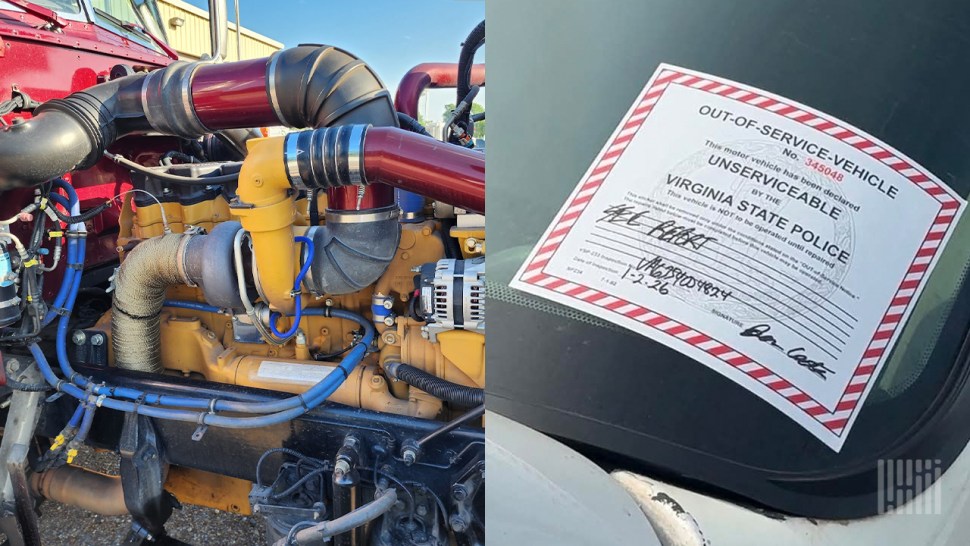
Every year, FMCSA and its state partners conduct roughly 3.3 million roadside inspections. In 2024, about 21.6 percent of vehicles and 6.7 percent of drivers were placed out of service. That’s over 700,000 vehicles and 220,000 drivers ordered off the road annually.
How do we know they actually stayed out of service? We don’t. Because nobody’s checking.
The Numbers
I’ve been tracking English Language Proficiency enforcement since Secretary Duffy’s executive order restarted it in June. You can sign up for our monthly analysis of the data at Trucksafe.
Through October 2025, federal inspectors issued 6,455 ELP violations while placing only 1,816 drivers out of service. That gap, violations issued versus drivers removed from the road, reflects legitimate exemptions such as border zones and ADA protections. I covered that in my December 3 piece for FreightWaves.
Texas racked up 7,090 ELP violations through October. Leads the nation. Yet Texas Transportation Code § 522.043(b) explicitly prohibits requiring English proficiency for intrastate CDL holders. I wrote about that conflict back in June. While the Texas Governor says one thing, the State Law has not been repealed, so they have a law that counters some of what Governor Abbott is demanding or saying.
Texas issues licenses to drivers who can’t read English; those drivers go interstate, and other states write the violations. FMCSA data show that Texas-domiciled carriers account for 3,357 ELP violations nationwide, but Texas itself issued only 1,381.
The violations are getting written. They’re just getting written somewhere else.
The Enforcement Gap
There are roughly 800,000 active motor carriers registered with FMCSA. In 2024, the agency and its state partners conducted approximately 12,300 compliance reviews.
That’s 1.5 percent.
At that rate, a carrier could operate for 65 years before facing a comprehensive audit. Most small carriers will never see an investigator unless they kill someone or their CSA scores light up like a Christmas tree.
The only systematic way to verify OOS compliance is during a compliance review, when investigators examine a carrier’s 12-month inspection history. But if only 1.5 percent of carriers are audited, the other 98.5 percent operate on the honor system.
Why We Don’t Enforce Enforcement
The answer isn’t malice. It’s math and incentives.
FMCSA distributes over $463 million annually to states through the Motor Carrier Safety Assistance Program. The formula is based on road miles, vehicle miles traveled, population, and fuel consumption. States qualify for incentive funds by reducing fatal crash rates and uploading inspection data.
Notice what’s not in the formula: enforcement outcomes.
A federal evaluation of Kentucky’s weigh stations made the conflict explicit. The state inspection process emphasized the quantity of inspections completed. The safety technology was designed to increase out-of-service rates. The evaluators noted these goals were “different procedures and priorities” that didn’t align.
States are measured on how many trucks they process, not how many bad actors they remove from the road.
Every OOS order creates friction. Paperwork. The 15-day disposition form. Potential DataQs challenges that tie up staff time. A truck is sitting in a parking lot instead of rolling through the scale. Meanwhile, the next 50 trucks are stacking up on the ramp.
Until Secretary Duffy threatened to pull $50 million in MCSAP funds from California, New Mexico, and Washington for failing to enforce ELP, there was no penalty for non-enforcement. Most enforcement decisions still carry no consequence for the state that looks the other way.
Fifty States, Fifty Enforcement Philosophies
The state-by-state disparities are pretty wild.
California issued 8 ELP violations from May through September 2025 out of 176,074 inspections. Federal inspectors working the same corridors found violations at rates astronomically higher.
Wyoming placed 99 percent of its ELP violations on out-of-state carriers. They’re catching trucks passing through, not policing their own.
And Texas, as I noted in June, has a state law that directly conflicts with federal requirements. Texas Transportation Code § 522.043(b) prohibits requiring ELP for intrastate CDLs. Those drivers get licensed, go interstate, and are placed out of service in Oklahoma, New Mexico, or Arizona.
Some states enforce. Others export the problem. MCSAP funding doesn’t distinguish between them.
The Paper Trail That Goes Nowhere
When an inspector places a vehicle or driver out of service, the carrier has 15 days to sign the inspection report certifying all violations have been corrected and return it to the issuing agency. They must keep a copy for 12 months.
Sounds reasonable, except CVSA recently petitioned FMCSA to eliminate the return requirement entirely, calling it “antiquated and redundant.” The inspectors’ own alliance is asking the agency to stop requiring carriers to confirm they fixed the problems.
FMCSA doesn’t have data on how many agencies actually request these forms. The agency admitted it can’t quantify the impact of eliminating the requirement. They’re proposing to make it optional based on whether individual states want to bother.
The proposed rule landed in May 2025. If it passes, we’ll have an out-of-service system with no verification mechanism whatsoever.
The Penalties Only Exist on Paper
Operating while under an out-of-service order isn’t just a violation. It’s a disqualifying offense.
First offense: 90 days to one year CDL disqualification. Second offense within ten years: one to five years. Third offense: three to five years. Hazmat doubles it.
Civil penalties run up to $29,980 per day for the driver. Employers who knowingly allow it face fines up to $38,612.
The teeth are there. The question is whether anyone’s biting.
Get placed out of service in Kansas today. Get caught in Texas tomorrow violating the same order. That’s a textbook case of jumping OOS. Your CDL should be suspended.
How does Texas know about Kansas? MCMIS uploads inspection data, but the systems don’t communicate in real time. Different states, different databases, different enforcement priorities. Unless a compliance review pulls your full inspection history, and remember, only 1.5 percent of carriers get audited, nobody’s connecting the dots.
What Would Real Enforcement Look Like?
Tie MCSAP funding to enforcement outcomes, not just inspection volume. States that identify and remove dangerous operators should be rewarded. States that process trucks without addressing violations should face consequences.
Build real-time OOS tracking across all jurisdictions. When a driver is placed out of service in Kansas, every scale in Texas should be notified immediately. The technology exists. The integration doesn’t.
Require mandatory verification of remediation. Not a paper form that may or may not get returned. Actual confirmation that the condition was corrected before the vehicle or driver returns to service.
Create automated flagging for repeat offenders. A carrier racking up dozens of OOS violations while reporting a two-truck fleet should trigger immediate intervention. Not eventually. Immediately.
Standardize enforcement protocols. Your chances of getting placed out of service shouldn’t depend on which state you’re in.
See No Evil, Hear No Evil, Speak No Evil
We don’t have the resources to police out-of-service compliance. Even if we did, the incentive structure doesn’t reward it.
The system was designed around the assumption that carriers would follow the rules. That a violation and a penalty would create enough deterrent to change behavior. That a 15-day paper return requirement would ensure vehicles got fixed before returning to service.
The math says otherwise.
We’re conducting 3.3 million inspections a year. We’re placing nearly a million vehicles and drivers out of service. We’re writing violations across every category in the book.
What we’re not doing is verifying anyone actually complied with the orders we issued.
FMCSA counts inspections. Nobody counts compliance.
Until that changes, we’re not enforcing enforcement. We’re just documenting the problem.
Brokerage Compliance Symposium
The day before F3. Every compliance issue you face - fraud exposure, carrier liability, FMCSA rules, cargo theft, insurance gaps - navigated by attorneys and operators defining best practices in a changing industry.
F3 Awards Dinner
The night before F3. FreightTech100 companies honored. FreightTech 25 and Shipper of Choice winners revealed live. Cocktail reception into dinner and live music - 300 industry leaders in one purpose-built room.
F3: Future of Freight Festival
Industry-defining keynotes, rapid-fire technology demos, and industry leaders networking in experiences across Chattanooga - plus the inaugural F3 Awards Dinner featuring the FreightTech and Shipper of Choice reveals.
The day before F3. Every compliance issue you face - fraud exposure, carrier liability, FMCSA rules, cargo theft, insurance gaps - navigated by attorneys and operators defining best practices in a changing industry.
The Signal at Chattanooga Choo Choo • Chattanooga, TN Register NowThe night before F3. FreightTech100 companies honored. FreightTech 25 and Shipper of Choice winners revealed live. Cocktail reception into dinner and live music - 300 industry leaders in one purpose-built room.
The Signal at Chattanooga Choo Choo • Chattanooga, TN Register NowIndustry-defining keynotes, rapid-fire technology demos, and industry leaders networking in experiences across Chattanooga - plus the inaugural F3 Awards Dinner featuring the FreightTech and Shipper of Choice reveals.
The Signal at Chattanooga Choo Choo • Chattanooga, TN Register Now