




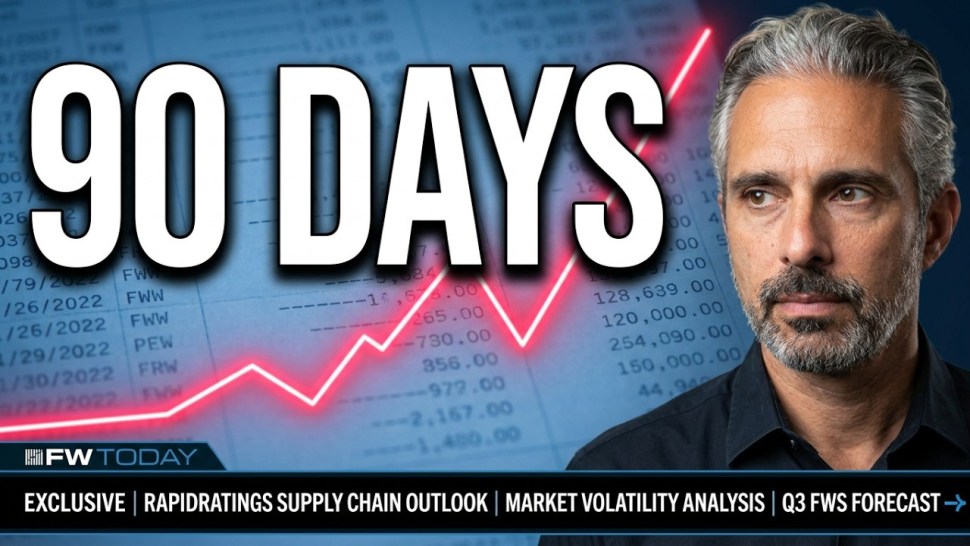
RapidRatings Executive Chairman James Gellert reveals the silent strain on middle-market companies. Discover how extended cash conversion cycles, driven by slower payments from larger customers and rising costs, are impacting financial health across supply chains. Gellert also explains RapidRatings’ algorithmic approach to financial analytics for both public and private companies, offering critical insights into default and credit risk.
Middle-market companies with up to $750 million in revenue have seen their cash conversion cycles stretch by roughly 30 days over the past few years, according to James, Executive Chairman of Rapid Ratings, a financial analytics firm that rates public and private companies across 27 industries in roughly 170 countries. The widening gap reflects a one-sided dynamic: larger buyers are slowing payments to preserve their own cash, while smaller suppliers remain obligated to pay their own vendors on accelerated timelines.
The squeeze matters acutely for carriers, brokers, and shippers because private companies make up approximately 75% of most large companies’ supply chains, Rapid Ratings’ Executive Chairman said. As working-capital pressure mounts on those private firms, the resilience of the broader supply chain ecosystem deteriorates with it.
“Those middle market companies have had cash conversion cycles, depending on the industry, gap out over the last few years almost a month,” he said, adding that the dynamic reflects larger customers “basically been able to extend payments, generally speaking, because they’re stronger.”
“So many companies have had to be the shock absorbers in the market keeping those or having the erosion in their operating margins.”
The deterioration has been compounded by a post-2022 macro environment marked by persistent inflation, elevated interest rates, higher labor costs, and tariff volatility. Most private companies borrow at floating rates rather than issuing long-dated bonds, leaving them directly exposed to rate moves that public peers can partially hedge. The result has been rising leverage, shrinking interest coverage ratios, and erosion in both operating and net margins across the middle market.
Private equity exit timelines have also lengthened under these pressures. The Rapid Ratings Executive Chairman said average hold periods, historically around 4.5 years over the past decade, have extended to six or seven years depending on sector, as multiple compression — worsened for SaaS businesses by AI-driven valuation shifts — makes exits less attractive. That elongated hold period is pushing more PE-owned companies toward M&A, restructurings, creditor negotiations for extensions or waivers, and in some cases bankruptcy, he said.
For supply chain managers, the firm’s advice is to intensify financial health monitoring of private suppliers and treat transparency as a commercial lever. Rapid Ratings reaches out to private companies on behalf of clients to obtain financials directly, and the Executive Chairman noted that many private firms now proactively seek inclusion in that network. “The stronger private companies are the ones who are going to capitalize on that the best,” he said, arguing that proactive financial disclosure by suppliers creates tangible commercial value with large buyers that are already conducting supply chain risk programs.
The firm rates companies across all size tiers with no minimum revenue cutoff, using an algorithmic model designed to assess financial health, default risk, and future performance on a comparable basis regardless of whether a company is public or private or where it is domiciled globally.
- Middle-market supplier cash conversion cycles have stretched nearly 30 days over the past few years as larger buyers slow payments while smaller vendors continue paying upstream suppliers quickly.
- Private companies represent about 75% of most large companies’ supply chains, making their financial deterioration — rising leverage, margin erosion, and floating-rate debt exposure — a systemic supply chain risk.
- Private equity hold periods have expanded from a historical average of 4.5 years to roughly 6–7 years due to multiple compression and operational pressures, increasing the likelihood of restructurings and bankruptcies among PE-backed suppliers.
Speaker 1 [0:00] So James, tell us all about Rapid Ratings.
Speaker 2 [0:01] Sure. So first of all, it’s great to be with you and looking forward to talking today. Rapid Ratings is a financial analytics company. We specialize in providing financial health ratings of public and private companies through an algorithmic process that gets used across many different use cases. But the largest are companies using us to understand their suppliers and their supply chain. as deeply as possible. And of course, financial risk is one of the underpinning elements of how companies are performing. So all business outcomes, positive and negative, almost always stem back to whether someone is financially capable of living up to their agreements, their expectations, delivering things on time and in quality, with high quality and so forth. So we represent companies across about 27 different industries. globally. We rate public and private companies with private companies from about 170 countries. And so through this data, we get to see an awful lot of what’s happening across industries and upstream into lots of categories of supply chain.
Speaker 1 [1:14] So James, what is it that you guys do that is special? I mean, at least public data, you know, anyone could sort of get that data from the public filings, but what is it What’s special about your dataset that someone would be using to really understand a business?
Speaker 2 [1:29] So I guess there are a couple of different ways of looking at it. The analytics themselves are probably the most sophisticated commercially available modeling system for understanding what we call financial health, default risk, credit risk, future financial performance are all different ways of looking at basically the same kind of thing, which is how strong is a company. Our system is very sophisticated, looks very deeply at companies, allows you to look at public and private companies on the same basis across any industry, large or small, and from anywhere in the world. One of the applications for the sophistication of the modeling is being able to put in private company data, and that of course is where many companies fall down and have a very difficult time when looking at their counterparties. It can be their customers, but predominantly their suppliers and other, and other third parties. So we have a process to reach out to private companies to obtain their financials on behalf of our clients. And we’ve now become the trusted player in this space. So many private companies come to us and want to be a part of this network. So as we have more and more industry concentration in industries like autos, like you were just just referring to a few moments ago, we have a considerable amount of data in the auto supply chain across lots and lots of different components of it or sub-industries of it. So the special sauce, if you will, is a combination of the ability to get private company financials and being trusted to do that. And then also the analytics that come out of that are different and highly predictive. And we’ve been extremely successful in identifying risks and problems that have emerged with companies for many years now.
Speaker 1 [3:22] So James, in terms of size, is there really, you know, small companies are notoriously, that’s where a pretty significant black box is. Maybe the risk is higher if you’re bigger because you’re just a bigger, you know, bigger customer to somebody, perhaps a bigger vendor to someone, but is there a size cutoff in terms of where you guys really focus?
Speaker 2 [3:43] There isn’t a size cutoff, but you are right, there are certainly idiosyncrasies to smaller companies and larger companies. I would say the easiest way to think about it is the larger companies have, generally speaking, more diversity of clients. They may have larger supply chain bases and therefore take on more risks in their supply chain. But also they have a very different access to capital. Than smaller companies do, not just being in the public markets, but there are a lot of different ways that public companies can raise capital that private companies can’t. So the illiquidity in the private market, the fewer sources of capital mean smaller companies and private companies will be buffeted around more by changes in macroeconomic conditions, geopolitical conditions, and then of course their own financial strength. So when people are looking at suppliers and trying to understand the resiliency of the supply chain, private companies are a particularly nuanced element of that. And generally speaking, represent about 75% of most larger companies’ supply chains. So as go the trends and the factors that are affecting private companies, ultimately goes the overall strength and resiliency of a broad supply chain ecosystem.
Speaker 1 [5:06] Yeah, I know that companies, we see it in our own customer base, have really stretched payables in this sort of higher interest market, interest rate market, sort of the slip maybe in sectors, a slowdown in the economy. But one of the, you know, ways to sort of generate or hold on to cash longer is to just slow pay your vendors. Are you guys looking at that as a sort of a sign of overall health, or how do you think of it?
Speaker 2 [5:32] Yeah, certainly we look at how quickly companies are paid, how quickly or slowly they pay, and that cash conversion cycle is a very interesting window into how companies are doing from a variety of perspectives. And what we’ve seen right now over the last few years is continued pressure on the middle market. So companies that are sort of $750 million in revenue and lower, and the pressure that they’ve been under from a top-line perspective as well as from a cost perspective has been compounded by the fact that larger customers of theirs have been paying slower. And the private companies, those middle market companies, are generally speaking still having to pay their suppliers upstream at an accelerated pace. So those middle market companies have had cash conversion cycles, depending on the industry, gap out over the last few years almost a month. So 30 days longer that they’ve had to manage their own working capital while getting paid later by larger companies that have basically been able to extend payments, generally speaking, because they’re stronger. So we’re seeing this as a factor and as a concern and certainly something people should be looking at. We’re also seeing more of the more sophisticated larger companies looking at ways to help manage the working capital of their own. but also the working capital of their primary suppliers.
Speaker 3 [7:06] Yeah, I mean, I think of bringing that specifically to our audience and thinking about that, we have a full sitrep on pay terms from shippers and what that means for carriers kind of by size and how that creates pressure for them. So certainly something that’s important. But you’ve said that financial health really across that middle market and private companies has been deteriorating since Can you talk about the factors that are leading to that?
Speaker 2 [7:32] Certainly. So the COVID period was an interesting one because obviously affected all companies, different, different industries, different ways, but it basically affected all companies. And a lot of the period coming out of COVID for many was relatively stable, particularly given if they had to borrow, capital, the cost of that capital was quite low. So interest rates were low, inflation hadn’t fully kicked in. And the period post-’22, we’ve seen more inflation and consistent inflation. We’ve seen higher interest rates, higher labor costs, and so higher costs of goods through broad inflation. And then when you throw tariffs in on top of it, you’ve not only had higher cost of many goods and services, you’ve had the volatility and the unknown that companies have had to navigate through. So that has put a tremendous amount of pressure on the companies that are borrowing at floating rate, which most private companies will be, as opposed to long-dated bond issuers in the public market. And so they’re paying more, you know, sort of across the board. They aren’t necessarily able to charge more or pass those costs through. So many companies have had to be the shock absorbers in the market keeping those or having the erosion in their operating margins. Then on top of that, they’ve been borrowing more. So you’ve seen a significant increase in leverage, a reduction in interest coverage, and erosion in both operating and net margins. So it’s really put a lot of strain on the middle market over the last few years.
Speaker 3 [9:17] And are those sort of the same reasons that are causing private equity firms to hold on to these companies longer than necessary, than maybe planned, or dragging out that exit?
Speaker 2 [9:32] That’s certainly a part of it. A lot of private equity firms have been able to rely on the improvement in companies, but also the improvement in multiples on pick a measure— revenue, EBITDA, whatever it may be. There’s been a compression over the last few years in those multiples. And then with more AI concerns coming in and the advent of AI in our day-to-day use, we’ve now seen multiples on particularly SaaS companies get really crushed quite hard. So the combination of the overall market for companies that a lot of private equity firms bought, let’s say in 2001 and 2002 with higher multiples, now being in a tighter multiple environment when these companies are struggling more in a lot of operational respects. So that has elongated the hold period. So a 4.5-year average, which going back over the last 10 years is probably a good benchmark for private equity holds, is now more like 6 or 7 years depending on the sector. So the companies are holding these companies longer, looking for exits, and needing to find more ways of creating operational improvement. in those businesses while they’re holding them.
Speaker 1 [10:52] So James, SaaS multiples have been compressed due to this AI, you know, AI-ification investment cycles, some fear that the SaaS apocalypse is upon us. What are you seeing right now? I mean, it’s going to make it more difficult talking to venture capitalists. They don’t really want anything that isn’t AI-centric. I think every startup has repositioned themselves as an AI-first company. which most of them probably aren’t truly AI. But what does that do for overall sort of state of SaaS businesses out there? And how are you thinking about sort of the risk profile of these companies?
Speaker 2 [11:30] Well, let’s face it, AI is neither categorically wonderful or categorically bad. It is about how it’s applied, where it’s applied, and the efficiencies that can be brought to running a business because of that AI. So what’s incumbent upon every business is trying to understand how they can create more efficiencies through using newer technologies. And that’s going back to any technology and technological revolution, revolutionary period, the internet itself, for instance. But the opportunities with AI are going to be capitalized on in management of businesses’ need to properly express to their clients, to their suppliers, to their stakeholders how they’re using that AI and how they’re going to be creating a roadmap of value for all of those stakeholders going forward because of the AI. So again, it’s neither good nor bad. It’s another technology that creates a lot of interesting opportunities, and businesses are going to adapt, and certainly some businesses will change. The fundamental objective of a business to be profitable and to generate returns for fill-in-the-blank shareholders, it doesn’t change. It continues, and it is one of the most fundamental parts of running a business and evaluating a business.
Speaker 1 [13:01] But James, a lot of the venture-backed companies they got the benefit of very high valuations in 2021, and even just around that, bookended in that period of time. With the idea, I think VCs largely believed that private equity, they could sell it. Again, all these institutional capital investors are selling it to themselves and trading up. But that window is closed. Unless the business, as you mentioned, has significant cash flows, a lot of private equity firms won’t touch it. What happens to all of these venture-backed companies with high multiples? Are we going to see a rerating of multiples for these VC-backed companies? Are we going to see investors hold on there for continuation funds? What is the prognosis for overinflated venture-backed technology businesses?
Speaker 2 [13:56] It’s multilayered, and it’s a real challenge, particularly for supply chain managers to understand the businesses that they’re working with. And many of the companies that are in people’s supply chains fall into this category, whether it’s venture or growth stage private equity. A lot of these companies are going to— they’re going to evolve. They’re going to evolve perhaps in ways that they wouldn’t have if the environment was different, but they are going to evolve. Many of them will become more efficient, they’ll become smaller, they may be focused on fewer things. Some expansion plans that they may have had may get pared back. We’re likely to see more M&A. This is a very interesting opportunity, this period, for strategic investors to buy middle market companies that may be in that private equity hold period towards the end and getting a little stale from that perspective, but sort of too soon operationally or improvement-wise to be flipped to yet another private equity firm, or as, as you brought up, a continuation fund. So we’re going to see more of these events, but we’re also going to see more challenges for these companies, those that are indebted, that have borrowed, are in a tricky time because it’s very difficult for the weaker companies to refinance. Many of the companies are having to negotiate with their creditors to get extensions or waivers or other negotiations for relief. So we’re going to see more bankruptcies. We’re going to see more restructurings, or maybe even better yet, you won’t actually see the restructurings, but they’re happening. But one of the big keys here is that we’re going to have— we’re going to be in a period for an extended time where strong, mature risk management of supply chains is going to be absolutely essential for people to understand the risks to their own business.
Speaker 1 [15:57] So what is your advice to founders that perhaps raised at high multiples during the sort of heyday? Is it get to profitability? Like, what should they do in terms of positioning themselves? themselves best. Is this going to be a situation where these businesses, the founders hold on to them forever, and institutional capital just has to sort of ride along? I mean, we’ve seen Bending Spoons as an example buy— it seems like they’ve gotten some great deal of buying some subscription-based businesses, technology businesses that have perhaps sort of peaked and are now on the decline. What’s the prognosis for these businesses?
Speaker 2 [16:33] Well, look, I think some of these businesses are going to have to focus on better defining what their value proposition is, better defining what their objectives are, and then marching towards achieving them in a milestone format, as opposed to saying everything’s gonna be a moonshot for the next couple of years and come back and look at us then. So there’s more scrutiny on these businesses. The opportunity, I think, from a communication standpoint is really fantastic because these businesses we’re talking about are trying to sell to or do sell to larger companies that know or are already doing more risk management of their suppliers. So this is an opportunity for communication, for transparency, for collaboration, because the large supply chain organizations really do want this from the private companies. And the private companies have an opportunity to not only comply when asked, but to be forward-looking in communicating how well they’re doing or how they are meeting goals and creating objectives and marching towards them. That kind of collaboration and transparency creates commercial value. I think the stronger private companies are the ones who are going to capitalize on that the best, and the strongest customers of theirs are the ones who are going to require it and really appreciate it when it’s done proactively.
Speaker 1 [18:05] Yeah, I think there’s so much to watch here. James, really appreciate your time.
Brokerage Compliance Symposium
The day before F3. Every compliance issue you face - fraud exposure, carrier liability, FMCSA rules, cargo theft, insurance gaps - navigated by attorneys and operators defining best practices in a changing industry.
F3 Awards Dinner
The night before F3. FreightTech100 companies honored. FreightTech 25 and Shipper of Choice winners revealed live. Cocktail reception into dinner and live music - 300 industry leaders in one purpose-built room.
F3: Future of Freight Festival
Industry-defining keynotes, rapid-fire technology demos, and industry leaders networking in experiences across Chattanooga - plus the inaugural F3 Awards Dinner featuring the FreightTech and Shipper of Choice reveals.
The day before F3. Every compliance issue you face - fraud exposure, carrier liability, FMCSA rules, cargo theft, insurance gaps - navigated by attorneys and operators defining best practices in a changing industry.
The Signal at Chattanooga Choo Choo • Chattanooga, TN Register NowThe night before F3. FreightTech100 companies honored. FreightTech 25 and Shipper of Choice winners revealed live. Cocktail reception into dinner and live music - 300 industry leaders in one purpose-built room.
The Signal at Chattanooga Choo Choo • Chattanooga, TN Register NowIndustry-defining keynotes, rapid-fire technology demos, and industry leaders networking in experiences across Chattanooga - plus the inaugural F3 Awards Dinner featuring the FreightTech and Shipper of Choice reveals.
The Signal at Chattanooga Choo Choo • Chattanooga, TN Register Now