




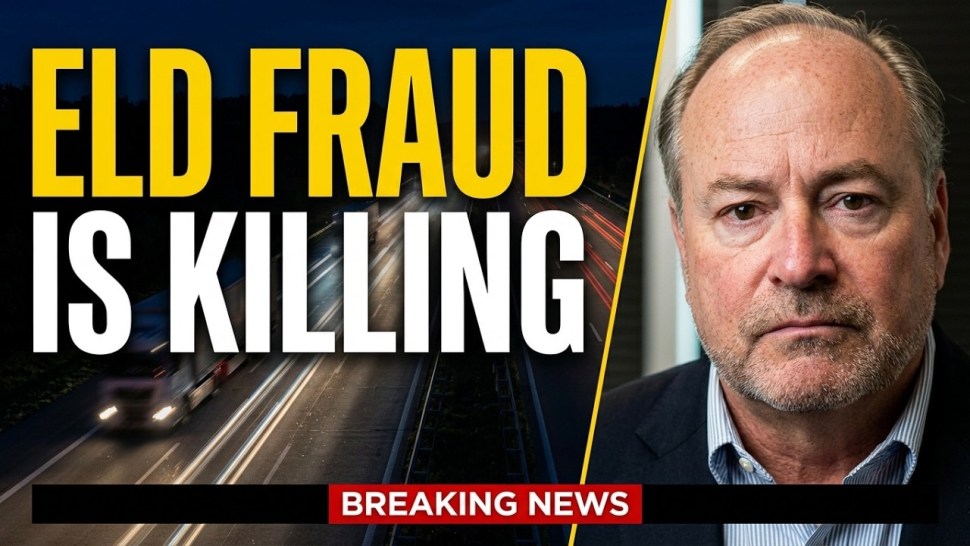
Mark Hazelwood breaks down the dangers of unchecked ELD self-certification and the surge of non-domiciled drivers, arguing these factors are not only distorting freight markets but also contributing to highway fatalities. He explains why US enforcement needs to catch up to Canada’s third-party certification model and the huge economic ripple effects for carriers and drivers. This is a must-watch for anyone concerned about the future of trucking safety and fair competition.
The United States has 1,020 electronic logging device providers operating under a self-certification model, compared with just 42 providers in Canada, which has required third-party certification since 2019. That gap, according to Mark Hazelwood — chairman of Conversion Interactive, Echo Flaps, and Assured Telematics — has allowed bad actors to flood the market with manipulable ELDs that let drivers far exceed legal hours-of-service limits, with deadly consequences. The current administration, he said, is moving toward mandating third-party ELD certification, though the timeline remains unclear.
The scale of the disparity underscores why the issue matters to carriers, brokers, and shippers: non-domiciled drivers exploiting manipulated ELDs are logging an estimated 145,000 to 150,000 miles per year, versus the roughly 92,000 to 96,000 miles a compliant driver can legally run. Hazelwood argues that each non-domiciled driver removed from service effectively eliminates the equivalent of 1.5 legal drivers worth of capacity, amplifying the market impact of enforcement actions.
The non-domiciled CDL holder population exploded during the previous administration, Hazelwood said, rising from approximately 170,000 when President Trump left office in January 2020 to 780,000 when he returned in January 2025. He attributed the surge in part to CDL mills that fast-tracked licenses within two to three days without adequate training. FMCSA and DOT have since taken more than 20,000 drivers out of service and revoked 28,000 illegal CDLs, though Hazelwood acknowledged that number alone is not sufficient to meaningfully shift capacity.
“There are about 1,020 ELD providers, and it’s all because we have self-certification on the ELD. In self-certification, it’s like grading your own papers. Guess what? You’re self-certified. You’re now an ELD provider.”
Hazelwood said the administration is expected to announce a move to third-party ELD certification, though he cautioned that full implementation would be difficult to accomplish within 12 months. He noted that Assured Telematics spent millions of dollars obtaining certification in Canada — where it was the first provider certified — and expects comparable costs domestically. He predicted many of the 1,020 current providers would exit the market rather than pursue certification once an announcement is made.
On the driver recruiting side, Hazelwood said Conversion Interactive — which he describes as the largest driver recruiting agency in the country — is seeing rising demand. Rates have been climbing for roughly five to six months, he said, but unlike prior upcycles, carriers are not rushing to add capacity due to the limited pool of qualified drivers, which he believes will help prevent the market from overcorrecting.
Separately, Hazelwood offered a bearish outlook on diesel crack spreads, noting that refiner margins on diesel currently sit at $87 per barrel against a historical norm of $15 to $20. He attributed elevated diesel prices largely to U.S. exports of roughly 2 million barrels per day flowing to Northern Europe to offset refinery disruptions tied to the Russia-Ukraine conflict. He projected crack spreads could fall below $40 within six months and said crude oil prices could return to the low-$60 range once the conflict concludes, potentially with a roughly 20% immediate drop in crude prices when a resolution appears imminent.
- The U.S. has 1,020 self-certified ELD providers versus just 42 in Canada, enabling hours-of-service manipulation that Hazelwood says is causing fatal crashes.
- Non-domiciled CDL holders grew from 170,000 in January 2020 to 780,000 in January 2025; each driver removed effectively eliminates 1.5 drivers’ worth of capacity.
- Diesel crack spreads stand at $87 per barrel — far above the $15–$20 norm — driven by U.S. exports of ~2 million barrels per day to Northern Europe.
Speaker 1 [0:00] Speaking of double brokering and the fraud that continues to propagate this industry, there’s no better person to talk about than Mark Hazelwood, who is on an absolute tear right now. Mark, let’s start with, uh, really what you’re up to. Uh, last time we talked, there’s a lot going on in your life. Uh, what, what is the latest, uh, with you, sir?
Speaker 2 [0:20] Well, first of all, uh, Julie and Craig, thank you for having me. I really appreciate the opportunity and, uh, several things. One of the things that we’ve really been focused on over the last year is really working on the non-domiciled driver and what the non-domiciled driver is doing and has done to the industry really over the last, you know, 7, 8 years since the ELD has come into play. But it’s really expanded itself in the previous administration. And really changed the dynamics of the trucking industry because of the amount of miles that these non-domiciled drivers are driving. And when you look at it, you know, they’re driving 145,000-150,000 miles a year to where a driver doing it legally and doing it by the hours of service can maybe get 92,000, 94,000, really good, maybe 96,000 miles a year. So that’s kind of what we’ve been focused on with the administration. And the administration, I think, is doing a stellar job of looking at all of the different aspects that these non-domicileds, you know, have come in and just manipulated the industry.
Speaker 1 [1:45] So, Mark, you’ve got 3 titles. You’ve got your chairman of Conversion Interactive, Echo Flaps, and Assured Telematics. Can we work through each of those, exactly what each of these do, for those— for our audience who maybe isn’t familiar with them? So let’s start with Conversion Interactive.
Speaker 2 [2:00] Yeah, first, Conversion Interactive, uh, uh, is a company. We are the largest, uh, driver recruiting agency. And not just an agency, we’re more technology than we are agency, uh, in today’s world. And, uh, uh, Joanne, my wife, and I own that with Kelly Walkup. And we have worked diligently to develop Agentic, which is an AI development, and really had some great success with recruiting drivers. And it’s a tough market, and it has turned on a dime. It went from, you know, companies not needing drivers to where today, as As you were talking about earlier, Julie, rates are definitely on the upswing and are going to continue that way as capacity leaves the market. And good capacity is there, but drivers are in high demand. So that’s what we do in conversion.
Speaker 1 [2:59] And Mark, are we seeing the driver market, you know, something we were talking about, the labor situation, concern about the market overcorrecting? You’ve been around this industry for your whole life. Do we think this industry is going to be able to hold off of its temptation to overcorrect?
Speaker 2 [3:18] I believe so. And I think for the first time you’re seeing real capacity leave the market to where, as Julie was talking earlier, you don’t see capacity entering the market. Typically, when you have rate increases like what we’ve seen over the last, let’s call it 5, 6 months, You typically have, and John was talking about this too, carriers adding trucks, adding equipment. I think from a capacity standpoint and from just a driver standpoint, I think it’s a little tough for the carriers to add capacity due to the limitation of drivers. I do think this though, as you get back to where carriers will find that the return is there, they will invest in equipment and invest in drivers and invest in making sure that the supply chain is not disrupted.
Speaker 3 [4:12] So I do want to talk about your other 2 jobs, but while we’re on this topic, I want to keep talking about capacity exiting the market. And you play a personal role and devote your time to enforcement and to, I guess, championing these causes towards pulling pulling unsafe capacity off of our roads. Can you talk a little bit more about that and what you are doing with FMCSA and DOT and how that all plays together?
Speaker 2 [4:37] Sure, we’ve had a meeting with carriers and with the ATA with Secretary Duffy and Administrator Barrs back in December. It was really an important meeting, but it was very constructive, and you can tell that they understand the issues and they’re having tremendous success looking at the industry. And I say this, that they had to have success because the previous administration had been so bad. And actually, I think it was by design to bring so much capacity into the market. And they did so by, you know, Having the CDL mills, you know, fast-track CDLs in the schools, you know, not, not actually training drivers. And it just added so much capacity. If you look, when President Trump left office in January of ’20, there were about 170,000 non-domiciled CDL holders. Don’t know how many of those were driving, but they were holders. When President Trump came back in, in January of 2025, there’s 780,000 non-domiciled CDL holders. So you can see the amount of CDLs that have been issued during the previous administration. And most of those came into the marketplace, and it wasn’t because the marketplace was, as you, as both of you know, uh, that you saw rate increases during that point in time. But how, why were they coming into the market? They were coming into the market because they were manipulating, uh, the ability to, the miles they run, the insurance they carry, everything that they did, uh, they were, they were manipulating I’m not going to— I’m not going to use another word. I’ll use manipulation. But they were manipulating the market to benefit themselves.
Speaker 3 [6:49] So speaking of the number of illegal CDLs, I mean, I think the numbers reported are that Duffy’s team’s taken out more than 20,000 drivers out of service and 28,000 illegal CDLs. That’s not enough to move the market and actually take capacity out of the market. But is it the threat of the enforcement?
Speaker 1 [7:07] No, it’s John Kingston who— and Mark knows this. Probably painfully, he’s bought enough fuel and oil in his life. It’s the incremental barrel that sets the price of the oil.
Speaker 2 [7:19] Like, at the end of the day, is it enough to change the market?
Speaker 3 [7:22] And what do you think it will look like the rest of the year?
Speaker 1 [7:24] Look, we have reported on the fact that capacity has come out. That’s the reason that this recovery is underway. It doesn’t take a lot. It’s the incremental. I mean, Mark, John Kingston, our oil reporter, has been reporting on commodities his whole life. He likes to say it’s not the percentage, it’s the incremental that sets the price of oil. I would argue that truck driver capacity is the same thing. Truck is a commodity. You disagree with that?
Speaker 2 [7:51] No, 1,000%. Every driver that comes out, and really when you take one driver out, Julie, to your point, you’re taking 1.5 out because that driver that you’re taking out, that non-domiciled, has probably run 140,000 to 150,000 miles. Versus versus running 92,000 miles—that’s a major difference. And as the this administration continues to focus on how do these drivers, how do these carriers, how do they manipulate the market? Well, they manipulate it by manipulating their ELD. And you look in this country. There are about 1,020 ELD providers, and it’s all because we have self-certification on the ELD. This administration is going to change that, and they’re going to get a third-party certification. To put that into perspective, Canada has third-party certification, and they have been in the ELD and the certification since 2019. They have 42 providers in Canada. 1,020 versus 42. Why are there 1,020 here? Because in self-certification, it’s like grading your own papers. Guess what? You’re self-certified. You’re now an ELD provider. And so there was a lot of demand for these ELDs, and especially for those that would allow the drivers and/or the companies to manipulate those ELDs so the driver can drive more. But the problem with that is this: they’re killing people. They’re killing people. And you had— you have innocent Americans on the highway, and they’re driving in Florida, California, wherever, Indiana, Pennsylvania, where a state trooper was killed, and they’re being killed by these illegals driving trucks that have not been trained to drive trucks. They haven’t been put through certified schools and they’ve been given a CDL within 2 to 3 days. And in the schooling, self-certification again. We’ve got to get the third-party certification in schools and on ELDs.
Speaker 1 [10:09] Well, I mean, it’s— I mean, as you point out, a lot of these ELD companies are actually based overseas. They’re editing the software. We’ve reported numerous cases where these Chameleon carrier networks happen to own the ELD devices that these chameleon operators are using. And as soon as they get shut down, they just recertify under a different name, software copy paste, real simple. It’s a massive hole. Derek Barr has been totally on this, top cop in the industry, trying to crack down on this, Mark. What are your— in terms of timeline, what are you hearing?
Speaker 2 [10:45] You know, it’s going to take a while, and I don’t know when they will announce that they’re going to third-party certification. I would hope it’s going to be sooner versus later because I think that will wake up those that are manipulating the ELDs. So I do think that they will announce it sooner versus later. But then getting to the point where you actually go through the certification, It— you have to find those that are going to certify. And so the FMCSA will have to find certification process, get through the process, and then have those that are going to be hired to do the certification. And then you have to allow the ELD providers to go through that certification. And, you know, that’s going to take a while. My guess is if we could get that done over the next 12 months, I think it would be a heroic act to get it done in 12 months. I do think this, as you announce and as you start going to certification, I think there’ll be a lot of the ELD providers that have been out there allowing these drivers and companies to manipulate. I think they will leave the market because they know it is coming and they won’t spend the money. And it’s going to be expensive. It’s going to be expensive for me, for our company. to go through this certification. We spent millions of dollars getting certified in Canada. We were the first to be certified in Canada with our ELD, and we know we’re going to spend a whole lot of money to get there, but it has to happen. It has to happen in this industry. It’s got to happen. We can’t have, you know, self-certification on something as important as an ELD.
Speaker 1 [12:35] Yeah, I mean, Derek Barrs and Duffy have so much work to do to clean up the travesty, the economic security and safety crisis that this trucking industry has become, which is quite— it’s quite fortunate that we have an administration and a cabinet secretary that cares about the state of trucking. It’s interesting, when Sean Duffy was first appointed DOT secretary, we had that major air crash up in Washington, DC. It was the first sort of commercial crash that we’d had in over a decade.
Speaker 3 [13:04] And that was like immediately.
Speaker 1 [13:05] It was immediately. It was right at the end of January. I believe. And all the attention was on that. There was a period of time on X where the FreightX folks, the trucking folks were saying, hey, it’s more of the same. Duffy doesn’t really care about trucking. But then there was a lot of fast and furious come May. I mean, it has been almost daily, or certainly every couple of days when we hear Duffy talk about trucking. We’ve never seen a DOT secretary do that. It made it into the State of Union address, probably the first time. Mark, do you ever remember a president talking about trucking during the State of the Union? I certainly don’t.
Speaker 2 [13:40] Never. And when we had our meeting in December, uh, early December, uh, and we met with, uh, Secretary Duffy and Administrator Barr, and, um, uh, Chris Spear went with us, and we left the meeting and he was like, that’s a first. You know, he said, I have never been In a meeting with the DOT FMCSA to where when we left, we said, okay, these guys got it and they’re going to do something about it.
Speaker 1 [14:11] And they’re doing it.
Speaker 2 [14:13] I mean, they’re doing a lot. Yeah, they have this administration. We are so blessed and honored to, you know, to have them. And they really care about trucking and they care about citizens. They care about everyday citizens traveling the interstates, traveling the roads. that they can feel safe. And we’ve got to get the industry back to where it is a safe industry.
Speaker 1 [14:35] I agree with you, Mark Hoare. We’re running out of time. Real quick question. Oil. We’ve got to ask you about energy. You have delivered a lot of gallons to this industry. First of all, do you miss it? Do you miss being in the energy part of the industry? And what’s the state of oil?
Speaker 2 [14:56] First of all, yes, I do miss it. I would be lying to tell you that I didn’t. But yes, I do miss it. Here’s what I see in oil is that it’s especially diesel. And John hit on this very eloquently. But our crack spreads on diesel are $87 today. $87, a typical crack spread and a refiner margin. That’s what crack spread is, refiner’s margin. And you look at it and say, What is typical? What is typical? Typical is $15 to $20, $20 being really, really, really good. Okay, really good. And so $87 is a little bit more than just out the top. And so when you hear President Trump talk about the oil companies, that’s what he’s really talking about and should talk more about the amount of profitability. Now, why is diesel so much more than gas? Gas is $40. On the crack spread, which is still huge. But diesel is being exported. And John talked about this, you know, the amount of refineries that are being affected in Russia and Ukraine. And you got to realize, we’re at 20% consumption on diesel fuel in the United States, 80% gasoline. When you look at Europe, Europe is about 50% to 55% diesel versus gasoline. So it’s a heavy diesel distillate consumer. And so that’s where the diesel is going. We’re exporting now about 2 million barrels a day, and it’s pretty much all going to Northern Europe. And so that’s what’s kind of keeping the price high. I do think, and I’m a little bit bigger proponent of this, that as this conflict ends— and don’t ask me when it’s going to end because I have no idea, but at some point in time it will— now we’re producing about 14 million barrels a day. Probably by next spring we’ll be in the 16 million barrel range. And I think you’re going to see crude in a range somewhere between low side of $62 and maybe Maybe even in the high 50s as it was before it got there. But the demand is really strong, as we know, both gas and diesel. The demand is strong. So when you look at this crack spread, it has got to come down. Do I think it’s going to be $20 in the next 6 months? No, but I think it will be under, under $40. So I think you’re going to have some, some retraction of diesel pricing. Especially with the conflict. And as John mentioned, you’ve never seen anything— the traders react when there’s good news, or you think that this conflict is going to end, you see an immediate reaction and a discount of maybe 20% in the price of crude oil. And I think you’re going to see that really happen when the conflict ends. You’ll get back to where pricing was before the conflict, which is in that, uh, you know, low 60 range to mid 60 range.
Speaker 1 [18:11] So Mark, we’re gonna have to go. Love having you on, man. It’s good to see you. You look great. We’re gonna have you in Chattanooga. Come to Chattanooga for F3. We’ll be friendly here, I promise.
Speaker 2 [18:21] I’m going to you. I just told Asa, I said we need to go.
Speaker 1 [18:25] You got to come down to Chattanooga. Now you’re in Nashville, right? Nashville, yes sir. Yeah, so you left Knoxville. So we’re good to see you
Brokerage Compliance Symposium
The day before F3. Every compliance issue you face - fraud exposure, carrier liability, FMCSA rules, cargo theft, insurance gaps - navigated by attorneys and operators defining best practices in a changing industry.
F3 Awards Dinner
The night before F3. FreightTech100 companies honored. FreightTech 25 and Shipper of Choice winners revealed live. Cocktail reception into dinner and live music - 300 industry leaders in one purpose-built room.
F3: Future of Freight Festival
Industry-defining keynotes, rapid-fire technology demos, and industry leaders networking in experiences across Chattanooga - plus the inaugural F3 Awards Dinner featuring the FreightTech and Shipper of Choice reveals.
The day before F3. Every compliance issue you face - fraud exposure, carrier liability, FMCSA rules, cargo theft, insurance gaps - navigated by attorneys and operators defining best practices in a changing industry.
The Signal at Chattanooga Choo Choo • Chattanooga, TN Register NowThe night before F3. FreightTech100 companies honored. FreightTech 25 and Shipper of Choice winners revealed live. Cocktail reception into dinner and live music - 300 industry leaders in one purpose-built room.
The Signal at Chattanooga Choo Choo • Chattanooga, TN Register NowIndustry-defining keynotes, rapid-fire technology demos, and industry leaders networking in experiences across Chattanooga - plus the inaugural F3 Awards Dinner featuring the FreightTech and Shipper of Choice reveals.
The Signal at Chattanooga Choo Choo • Chattanooga, TN Register Now