




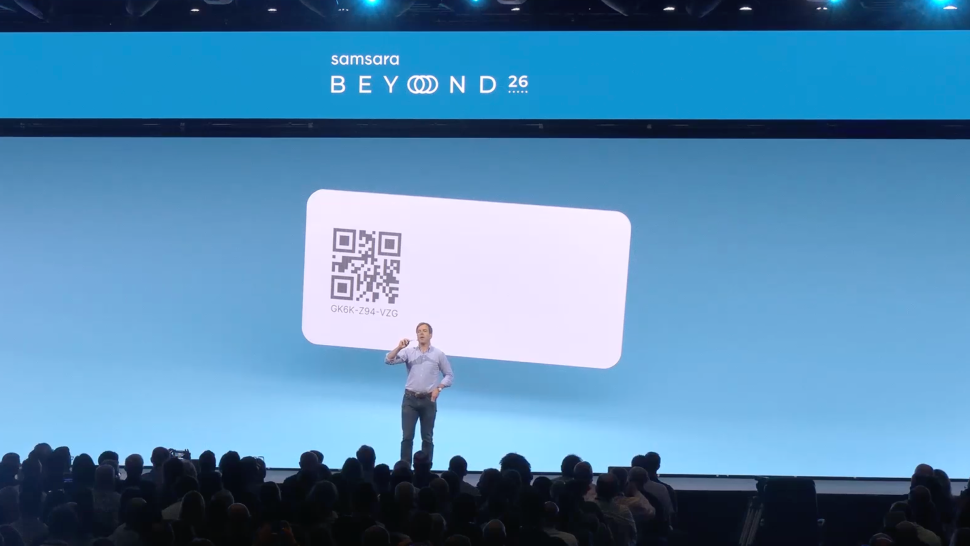
Samsara introduces a groundbreaking paper-thin sticker designed for real-time cargo tracking, offering up to 45 days of shipment visibility. This disposable Bluetooth-enabled tag leverages Samsara’s extensive network of connected equipment, providing an affordable and ubiquitous solution for managing diverse shipments from pallets to biological samples. Learn how this innovative technology shifts reactive exception management to proactive service delivery.
Samsara has introduced a paper-thin, disposable Bluetooth sticker designed to give shippers real-time visibility on any shipment for up to 45 days — roughly six weeks — after activation. The product targets one-way freight movements where operators do not want to manage reverse logistics of more durable tracking hardware, according to David Gal, Samsara’s Vice President of Product and Engineering for Connected Equipment.
The tracker’s commercial significance lies in its pricing and network reach. Gal said customers should expect “roughly single-digit dollar pricing per shipment” at volume, with no capital infrastructure required for deployment. That positions the sticker between costly LTE/GPS cellular trackers and RFID tags — which lose visibility the moment a labeled item leaves first-party reader infrastructure — by instead piggybacking on Samsara’s existing fleet of millions of trucks, trailers, buses, and other connected equipment already on the road.
“The way the sticker works is it chirps out a little hello world signal, and all those millions of pieces of moving equipment and phones and warehouse scanners are listening for that hello,” Gal said.
The label does not need to be on a Samsara customer’s vehicle to be detected. Any truck or device on the Samsara network within range will pick up the Bluetooth ping and report the location — a critical distinction for shippers whose freight moves on carriers outside their own network. Gal said the open-air range is a couple hundred feet, and the density of the Samsara network allows the signal to pass through cargo and metal trailer walls to be picked up by passing vehicles on the opposite side of a highway.
Use cases have extended well beyond standard palletized freight. Gal cited biological samples, GPUs, copper wire destined for building infrastructure projects, and chemicals headed to construction sites as examples already tracked with the device. The discreet form factor also supports anti-theft applications: customers have placed the sticker inside cargo, beneath shipping labels, or have printed shipping labels directly on top of the tracker to conceal it from potential thieves.
Gal contrasted the product with consumer-grade options such as Apple AirTags, noting the key differentiator is disposability. Samsara’s existing durable asset trackers are built to last six years in the field for equipment like construction machinery, but customers asked for a lower-cost, single-use alternative for outbound shipments they never expect returned. “Once you ship that out, you’re not getting that AirTag back, or if you try to get it back, it’s really expensive to do so,” he said.
On long-term trajectory, Gal said Samsara expects costs to continue falling as the technology scales. “We think long-term, in the future, 5, 10 years out, this should be really ubiquitous,” he said, adding the company aims to reach a “pretty exciting place” on cost. The product is currently available through Samsara’s enterprise pricing structure, which includes volume discounting.
- Samsara’s disposable Bluetooth sticker tracker offers 45 days of shipment visibility at roughly single-digit dollar pricing per shipment at volume.
- The label uses Samsara’s network of millions of connected vehicles to relay location without requiring any dedicated reader infrastructure.
- Use cases span standard pallets to biological samples, GPUs, chemicals, and copper wire, with anti-theft concealment options built into the design.
Speaker 1 [0:00] cover it nonstop here, is fraud and risk management. And the person to tell us all about how to mitigate fraud, they’ve rolled out a brand new paper-thin sticker, Julie and I got the chance to see it, is Samsara’s own David Gal. He’s a Vice President of Product and Engineering for Connected Equipment at Samsara. Welcome, David. How are you?
Speaker 2 [0:23] I’m doing okay. Thanks for having me. I appreciate it.
Speaker 1 [0:26] Well, tell us about this sticker. What exactly is it? What does it do? And why is it so cool? Because it’s so small.
Speaker 2 [0:32] Yeah. Yeah. Thanks again for having me. So the sticker is exactly as described. It’s a sticker. It’s right here. It’s paper thin, flexible. And what this is is a single-use cargo tracker for shipments. So it provides real-time shipment visibility through the Samsara network on any piece of freight or cargo so that customers can see exactly where their freight is at any given time and shift the game from being reactive on exceptions to being proactive and delivering better service.
Speaker 1 [0:59] So what is the— I mean, I was shocked that you could get a battery. I believe it’s 45 days is what Julie and I saw. What is— what exactly enables you to do that? It just feels like— I mean, like, I don’t know. I know battery technology has come a long way, but 45 days in this tiny little thing, how is that able to hold such a charge?
Speaker 2 [1:18] Yeah, it’s pretty cool. So we describe it as a sticker. Inside of the sticker is something very special. So there is exactly that. There’s a battery. There’s a Bluetooth chip, so it’s a little radio. There’s an antenna, and there’s a bunch of code that talks to what we call the Samsara network. So that’s millions of trucks and trailers and buses and bulldozers that are out in the world of physical operations. So the way the sticker works is it chirps out a little hello world signal, and all those millions of pieces of moving equipment and phones and warehouse scanners are listening for that hello. So you asked kind of about the battery. There is some pretty cool battery technology in this. This will last 45 days, so it gives shipment visibility for roughly 6 weeks once activated. And it’s been a pretty game-changing product for our customers so far, so we’re happy with it.
Speaker 3 [2:01] Can you talk to us about some of the use cases, maybe some unexpected use cases? I imagine I can think of a ton, but obviously shipping and packaging as well as actually tracking freight. But can you talk us through some of those examples?
Speaker 2 [2:14] Yeah, certainly. So in the world of physical operations, we think about shipments, tan boxes. That’s kind of, I think, what pops into most people’s heads, pallets and whatnot. We’ve actually seen a lot of other interesting use cases, other forms of shipments. So think about maybe chemicals going to a construction site or even copper wire going to a building infrastructure project. So there’s all sorts of shipments out there. We’ve seen biological samples. We’ve seen, of course, GPUs and cabling going to infrastructure buildout. I think what’s really interesting is the whole world of physical operations. in some sense really exists for shipments. And so we’re just seeing all kinds of those out there.
Speaker 1 [2:54] So David, if the— so on the Semstar network that you guys have across all these devices, if the label— so let’s say that the package is stolen and this label exists, even if it’s off your proprietary network, not Semstar’s network, but let’s say that I’m a company that’s got a small fleet of 100 trucks. Even if that box moves out of that truck network and sees another device out there that’s owned by Samsara, will it ping? Will it use those transmissions to tell us where it’s at?
Speaker 2 [3:28] Yeah, you got it exactly right. So the way this works is that label chirps out a hello world and all those millions of vehicles and trucks and trailers, they’re all actively listening for all labels. So it doesn’t matter if it’s your truck that’s listening for it or somebody else’s. If that Samsara network picks up the signal from this label, then we’ll hear about it, know about it, know exactly where it is. I think the interesting thing is the way this all works is Bluetooth, which is maybe surprising for a lot of folks. Shipping labels and tracking shipments is not necessarily a new concept in the industry, but if you think about the underlying technology, most folks have either taken a look at RFID or on the other end of the spectrum, cellular and GPS-based solutions. Both are viable, but both have some key challenges, which the Bluetooth network that Samsara has really addresses. So in the case of RFID, you know, people are attracted to it because of the low tag price, which is great, but there’s a significant capital invest— investment required for the readers. And then kind of to your point, as soon as that RFID label leaves the infrastructure, the first-party infrastructure, even by a few meters, there’s no more visibility. So that’s really challenging for a lot of our customers. On the other end of the spectrum, you have LTE and GPS, which is pretty ubiquitous. Cell service is kind of everywhere at this point, but it’s really expensive. And so what the Bluetooth technology enables us to do is find a really interesting sweet spot in the middle where we can have a low-cost tag, no capital infrastructure required to deploy because of that Samsara network, because anybody’s truck will pick it up. And it means that you get visibility everywhere. So that’s really the secret ingredient to making all this work.
Speaker 1 [5:04] So the, you know, I’m familiar with the Apple tags. I think most consumers are. That’s sort of the, probably the most classic example of tag technology. This is, you know, very small is the first thing. Is there any, if I were to describe this to a layperson and they obviously knew the tags, what is the big difference between that and a typical Apple tag in terms of what this actually does versus a tag?
Speaker 2 [5:30] Yeah, so I mean, I think there’s a few things. The first is that this is disposable. So this is really purpose-built for one-way visibility or one-way shipments. We have a series of asset tracking products that are sort of durable ones. They’re kind of hard goods that customers are tracking pieces of construction equipment, let’s say, with, or tools. But these last 6 years in the field. And what happened was we deployed these to our customers and they said, this is great. What about one-way use cases where we don’t want to deal with the reverse logistics? So, you know, we have heard, of course, of consumers putting AirTags in shipments and whatnot, but that’s gone. Once you ship that out, you’re not getting that AirTag back, or if you try to get it back, you know, it’s really expensive to do so. So the key difference here is that this is disposable, and the network that’s listening for it is exactly in the right place at the right time. In other words, it’s on the roads and highways, it’s at the job site, it’s in the residential area. So the coverage is really remarkable.
Speaker 1 [6:21] Yeah, that’s awesome. And then just show the size of it. And one of the things, David, I’d like to talk about is So if you’re in a container ship and you’ve got— or even in a truck and you’ve got this stuff buried inside of a box inside of a trailer, what is the range that it needs to be near a sensor?
Speaker 2 [6:36] Yeah, so that’s a great question. And this is the surprising part of it. And that’s— and this is sort of why I said the secret sauce is the Samsara network, is that we are actually putting this on shipments of our own, oftentimes carried by carriers that are not necessarily Samsara customers. And it’s exactly the setup you said. It’s on a pallet in the back of a truck. That Bluetooth is chirping through all the cargo that’s in that truck, through the metal walls of that box truck, let’s say, and getting picked up by another vehicle on the other side of the highway. So, you know, in open air, the range is a couple hundred feet, but the thing that really makes this possible is the density of the Samsara network. It’s the fact that that Samsara footprint is really everywhere in this ecosystem.
Speaker 1 [7:13] That’s very cool. You know what would be cool?
Speaker 3 [7:15] If I could put one on my kids?
Speaker 1 [7:17] I was thinking, you know, it was 45 days. David, has anyone put these on their children?
Speaker 2 [7:22] Funny enough, we had a family day a few weeks ago at our office. And one of the staff engineers that helped build this, I saw a photo of him putting it on his child. So it’s happening.
Speaker 3 [7:30] I would put it inside their shoe or in their backpack.
Speaker 1 [7:34] We took the Apple tags because that was like, you don’t know. But those things are big. So put them in their socks or something. You know what we should do, David? We should have you come to F3. And we should give tags to our attendees, and we create a scavenger hunt of stuff, and maybe turn this into a game with the tags. Are you in? Let’s do it.
Speaker 2 [7:58] I’m in. Let’s do it.
Speaker 1 [7:59] I think it would be a really cool demo of the tech. And you could have like— maybe it’s like, we’ll come up with a game. We need to come up with our event team to design this really cool experience. But I just think it’s so remarkable that we’ve reached the point where this sort of nanotechnology has a transmitter as well as a battery that lasts that long.
Speaker 3 [8:17] I think the disposable nature of it is what’s incredible.
Speaker 1 [8:20] How much do one of these cost, David?
Speaker 2 [8:21] So this is all enterprise-based pricing with Samsara, so volume discounting and everything. But basically in volumes, people should be expecting to look at roughly single-digit dollar pricing for shipment. And the cool thing is that this product’s brand new. So we expect that with time, the technology’s gonna scale and we can get these down to be even cheaper. We think long-term, in the future, 5, 10 years out, this should be really ubiquitous. We should be able to get cost to really scale and be in a pretty exciting place.
Speaker 1 [8:47] And the thieves are unlikely to know, or at least recognize. I mean, it looks just like a normal tag, right?
Speaker 3 [8:53] Like a normal tag.
Speaker 2 [8:54] That’s right. It looks like just a normal sticker. And we’ve seen some pretty interesting use cases with our customers, whether maybe putting the sticker on the inside of cargo, for example, to make it even more discreet, or underneath a shipping label, or even printing the shipping label on top of it. So It’s been pretty cool.
Speaker 1 [9:08] Forge pirates, beware. You’re on notice. Yeah.
Speaker 3 [9:12] Yeah. And I just love—
Speaker 1 [9:13] Sansara and Sam, the owl is coming towards you. We got to get Sam to sit right here. I think he would be an awesome co-host.
Speaker 3 [9:20] Sam wants an actual— Craig wants an actual owl.
Speaker 1 [9:24] I do.
Speaker 3 [9:25] Like a physical owl that he can—
Speaker 1 [9:26] It’s on its way. So it’s being tracked. I need a tracking device to figure out where it’s at.
Speaker 2 [9:31] Yeah.
Speaker 3 [9:31] Put the label on it.
Speaker 1 [9:32] Well, David, thank you so much.
Brokerage Compliance Symposium
The day before F3. Every compliance issue you face - fraud exposure, carrier liability, FMCSA rules, cargo theft, insurance gaps - navigated by attorneys and operators defining best practices in a changing industry.
F3 Awards Dinner
The night before F3. FreightTech100 companies honored. FreightTech 25 and Shipper of Choice winners revealed live. Cocktail reception into dinner and live music - 300 industry leaders in one purpose-built room.
F3: Future of Freight Festival
Industry-defining keynotes, rapid-fire technology demos, and industry leaders networking in experiences across Chattanooga - plus the inaugural F3 Awards Dinner featuring the FreightTech and Shipper of Choice reveals.
The day before F3. Every compliance issue you face - fraud exposure, carrier liability, FMCSA rules, cargo theft, insurance gaps - navigated by attorneys and operators defining best practices in a changing industry.
The Signal at Chattanooga Choo Choo • Chattanooga, TN Register NowThe night before F3. FreightTech100 companies honored. FreightTech 25 and Shipper of Choice winners revealed live. Cocktail reception into dinner and live music - 300 industry leaders in one purpose-built room.
The Signal at Chattanooga Choo Choo • Chattanooga, TN Register NowIndustry-defining keynotes, rapid-fire technology demos, and industry leaders networking in experiences across Chattanooga - plus the inaugural F3 Awards Dinner featuring the FreightTech and Shipper of Choice reveals.
The Signal at Chattanooga Choo Choo • Chattanooga, TN Register Now